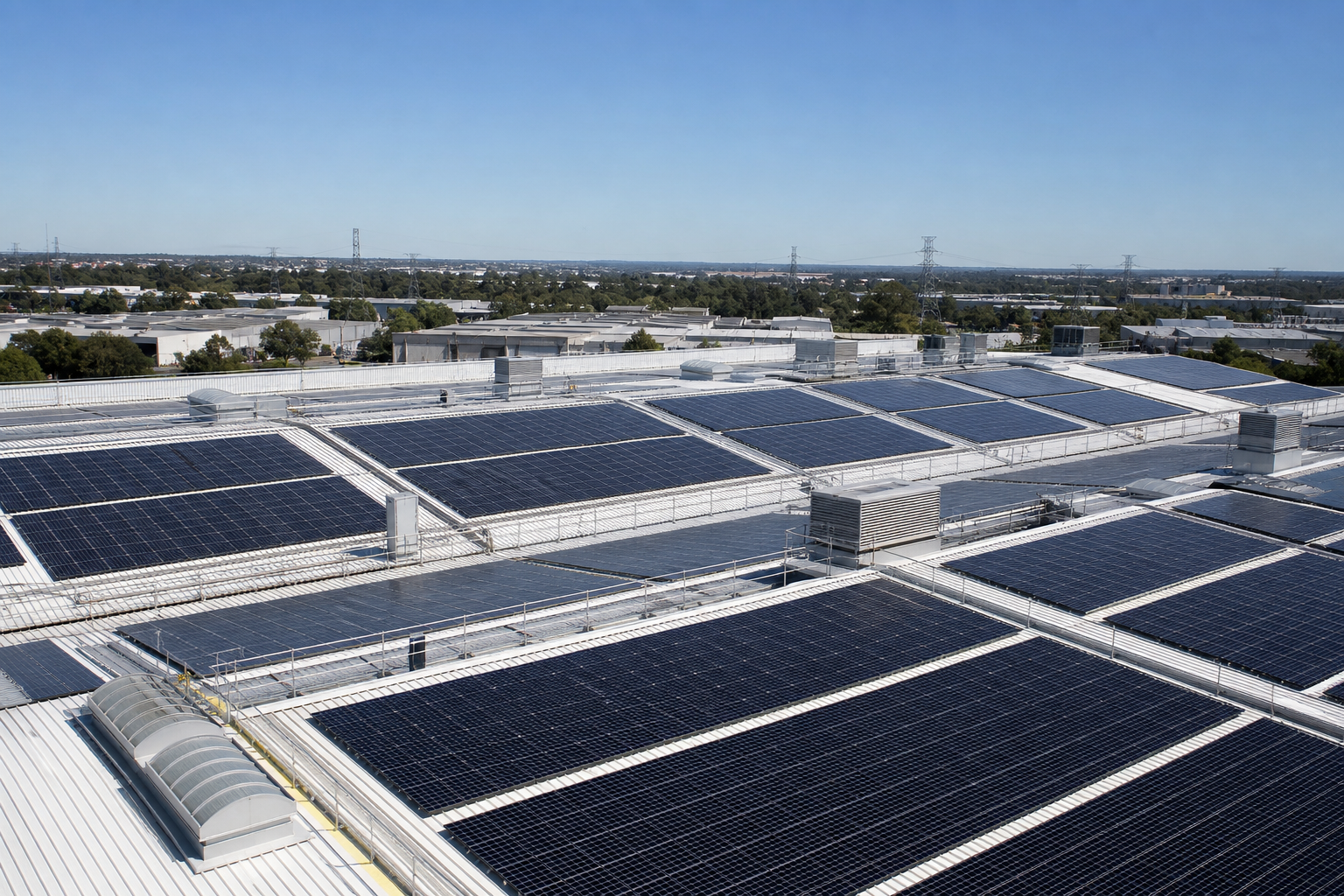
Industrial Solar Installation Sydney: 2026 Project Guide
Last updated:
Industrial solar installation Sydney projects commonly range from about 100 kW to 1 MW or more, and the right system is sized against the facility’s half-hourly load, roof condition, network connection and future electrification plan. For factories, logistics centres and cold stores with strong daytime demand, a properly engineered array can materially reduce imported electricity and often reach simple payback in roughly three to six years. Interactive Solar manages the Sydney project from site assessment and business-case modelling through grid approval, installation, commissioning and ongoing care.
This industrial solar installation Sydney project guide is for facility managers, operations teams and business owners considering solar as industrial infrastructure, not a retail panel purchase. It focuses on the decisions that determine value: load matching, demand charges, roof and switchboard readiness, federal certificate rules, the incoming 1 MW incentive expansion, network controls, installation safety and lifecycle service.
Key Takeaways
- Industrial solar systems in Sydney typically range from 100 kW to over 1 MW, with payback often taking three to six years.
- The Small-scale Renewable Energy Scheme cap now covers systems up to 1 MW installed from 1 October 2026 (previously 100 kW); applications open from mid to late November 2026.
- Connection must be approved by Ausgrid or Endeavour Energy, and designs must meet standards including AS/NZS 3000, 5033:2021, 4777.1:2024 and 4777.2:2020.
- A worked 500 kW example with 720 MWh annual output and 85 per cent self-consumption shows a first-year saving of about $134,640.
- Project timelines commonly run from about eight weeks to six months or more, depending on network assessment and equipment lead times.
Industrial Solar Installation Sydney: Quick Project Facts
- Typical capacity: 100 kW to several megawatts, subject to usable roof area, electricity demand and network approval.
- Best-fit sites: manufacturing plants, refrigerated facilities, warehouses, distribution centres, workshops and owner-occupied industrial estates with substantial daytime consumption.
- Indicative payback: often three to six years for a well-matched Sydney project, but tariffs, self-consumption, finance, site works and curtailment can move the result materially.
- Key approvals: the relevant distribution network service provider, usually Ausgrid or Endeavour Energy, must approve the connection before the system is connected.
- Core standards: AS/NZS 3000, AS/NZS 5033:2021, AS/NZS 4777.1:2024 and AS/NZS 4777.2:2020, plus site-specific structural, fire, access and network requirements.
- 2026 incentive change: the Small-scale Renewable Energy Scheme cap has been legislated to expand from 100 kW to 1 MW for systems installed on or after 1 October 2026. Applications open from mid to late November 2026 while the Clean Energy Regulator finalises its processes.
The correct proposal should show how each assumption was derived. Interactive Solar’s commercial solar team can assess interval data, roof constraints and the connection pathway before recommending a capacity.
What Makes Industrial Solar Different From Commercial Solar?
Industrial solar uses familiar photovoltaic technology, but the engineering and project controls are usually more complex. Large sites may have high-voltage supply, multiple switchboards, embedded networks, generators, power-factor equipment, demand tariffs, around-the-clock processes and strict shutdown windows. Those interfaces must be mapped before design is finalised.
For industrial solar installation Sydney, a standard commercial proposal may focus on annual kilowatt-hours. An industrial proposal must also consider when power is used, the facility’s maximum demand, whether generation will reduce the billed demand peak, and how much output may be exported or curtailed. It should include single-line diagrams, protection requirements, safe access, monitoring architecture and a commissioning plan.
Operational continuity matters too. A food processor cannot casually switch off refrigeration, and a production line cannot lose power because cable routes or board works were poorly staged. The installation method needs to fit production schedules, permit systems and site safety rules.
How Much Does Industrial Solar Cost in Sydney?
There is no responsible flat price for an industrial system because roof access, structural remediation, electrical infrastructure, network studies and operating constraints differ widely. As a public market reference, Solar Choice’s May 2026 index listed an average Sydney price of about $74,650 including GST and the then-available STC discount for a 100 kW commercial system. Larger industrial projects require project-specific pricing and should not be extrapolated from that figure alone.
For industrial solar installation Sydney, use the following ranges as capacity-planning examples, not quotes:
| System size | Indicative Sydney generation | Approximate roof area | Common application |
|---|---|---|---|
| 100 kW | About 135 to 150 MWh a year | About 500 to 650 m² | Workshop, small factory, trade facility |
| 250 kW | About 340 to 375 MWh a year | About 1,250 to 1,600 m² | Manufacturing site or medium distribution centre |
| 500 kW | About 680 to 750 MWh a year | About 2,500 to 3,200 m² | Large warehouse, cold store or processing plant |
| 1 MW | About 1.35 to 1.5 GWh a year | About 5,000 to 6,500 m² | Major factory, logistics campus or multi-building site |
Actual yield depends on orientation, tilt, shading, losses, curtailment and local weather. Roof area depends on module wattage, setbacks, access lanes, skylights and plant. A bankable business case should be based on a site-specific energy simulation rather than a generic yield factor.
Costs an industrial proposal should include
- PV modules, inverters, mounting, cabling and protection equipment
- Structural engineering and any roof strengthening or remediation
- Switchboard, transformer, protection relay and metering works
- Network application, studies, testing and witness-test requirements
- Scaffolding, edge protection, walkways and safe roof access
- Crane lifts, traffic management and restricted-hours labour
- Monitoring, communications and export-control equipment
- Planned maintenance, warranty administration and performance reporting
Industrial Solar Installation Sydney: Sizing From Load Data
For industrial solar installation Sydney, the right capacity is determined by interval data first and roof space second. Twelve months of half-hourly or five-minute meter data reveals weekday and weekend baseloads, seasonal peaks, shutdown periods and the proportion of generation likely to be used on site.
Self-consumed solar normally has greater value than exported energy because it avoids the facility’s retail energy charge and associated losses or fees. However, a larger array can still be sensible when future loads are expected from electrified process heat, vehicle charging, an expanded production line or battery charging.
Use an annual load duration curve
An annual bill total hides the detail needed for design. A load duration curve sorts every interval from highest to lowest demand and shows how often the facility operates above a given level. Combined with a solar production profile, it helps estimate self-consumption and periods of export.
For example, a factory with a stable 350 kW daytime baseload may absorb most generation from a 250 kW array. A warehouse with a brief 350 kW morning peak but only 80 kW through midday may export much more from the same system. Their annual consumption can look similar while the solar economics differ sharply.
Do not assume solar will eliminate demand charges
Demand charges are often set by the highest measured kW or kVA interval during a billing period. Solar can reduce them only when the demand peak coincides reliably with solar production. If the peak occurs before sunrise, after sunset or during a cloudy process surge, rooftop PV alone may not change that charge.
A battery or load-control strategy may help where demand charges are material. Interactive Solar can model a battery-ready design and explain whether commercial battery storage is likely to add value now or should be staged later.
The 2026 Federal Solar Incentive Change
For industrial solar installation Sydney incentives, the key change is that the Small-scale Renewable Energy Scheme (SRES) eligibility for rooftop solar PV has been legislated to expand from 100 kW to 1 MW for systems installed on or after 1 October 2026, through amendments to the Renewable Energy (Electricity) Regulations 2011. Before that date, rooftop PV above 100 kW could only seek Large-scale Generation Certificates (LGCs) after accreditation as a power station.
1 MW is the new SRES eligibility ceiling for rooftop solar installed on or after 1 October 2026, up from 100 kW. Certificate applications are expected to open in mid to late November 2026.
Source: Clean Energy Regulator, September 2026
That creates a practical sequencing decision for industrial buyers. The expanded threshold applies by installation date, but STC applications will not open until the Regulator completes its processes in late November, so confirm in the contract how and when the upfront discount is applied and who carries any timing risk. Roof investigations, interval-data analysis, network enquiries and concept design should proceed in parallel.
For current rules, see the Clean Energy Regulator’s Renewable Energy Target eligibility guidance. The deeming period for 2026 is five years, and the scheme steps down annually to its 2030 end.
STCs versus LGCs in plain English
- STCs: a deemed certificate benefit generally assigned upfront to reduce the purchase price of an eligible small-scale system.
- LGCs: certificates created from metered eligible renewable generation after an accredited power station operates. Revenue depends on certificate creation and market value.
- From 1 October 2026: eligible systems up to 1 MW can use the simpler upfront SRES pathway for installations on or after that date.
Avoid selecting 99.9 kW purely to stay under the old threshold if the site can economically use much more solar. Compare the whole-of-project value of each capacity, including incentive eligibility, generation, network costs, curtailment, finance and expansion plans.
Grid Connection and Export Approval in Sydney
For industrial solar installation Sydney, network approval is a design input, not paperwork to leave until installation week. Sydney industrial properties commonly fall within Ausgrid or Endeavour Energy territory, and larger embedded generators require assessment because they can affect voltage, protection and other customers.
The connection package can include inverter details, single-line diagrams, protection settings, export-control design, transformer information and power-quality studies. Complex applications may also require network augmentation, additional relays or witness testing. The final system must reflect the approved connection offer.
Export limits do not necessarily cap generation
A site may be permitted to install more generation than it can export if reliable export control is approved. When daytime loads are high, a zero-export or limited-export system can still offset substantial imported electricity. The controller must respond correctly when loads change and must fail safely under the network’s requirements.
Dynamic connections can suit flexible industrial sites
Ausgrid describes dynamic connection agreements for qualifying large high-voltage customers that can receive real-time signals and adjust load or generation. This can provide a firm capacity plus variable capacity when the network allows it, potentially avoiding some traditional upgrade costs. Suitability depends on the site’s automation, monitoring and operational flexibility.
For Endeavour Energy sites, the installer should use the current connection portal and apply the required inverter settings, including the applicable AS/NZS 4777.2 regional configuration. Multi-tenanted industrial complexes and embedded networks need extra care because generation behind a shared connection point can affect upstream private and network assets.
Roof, Structure and Safety Checks Before Design
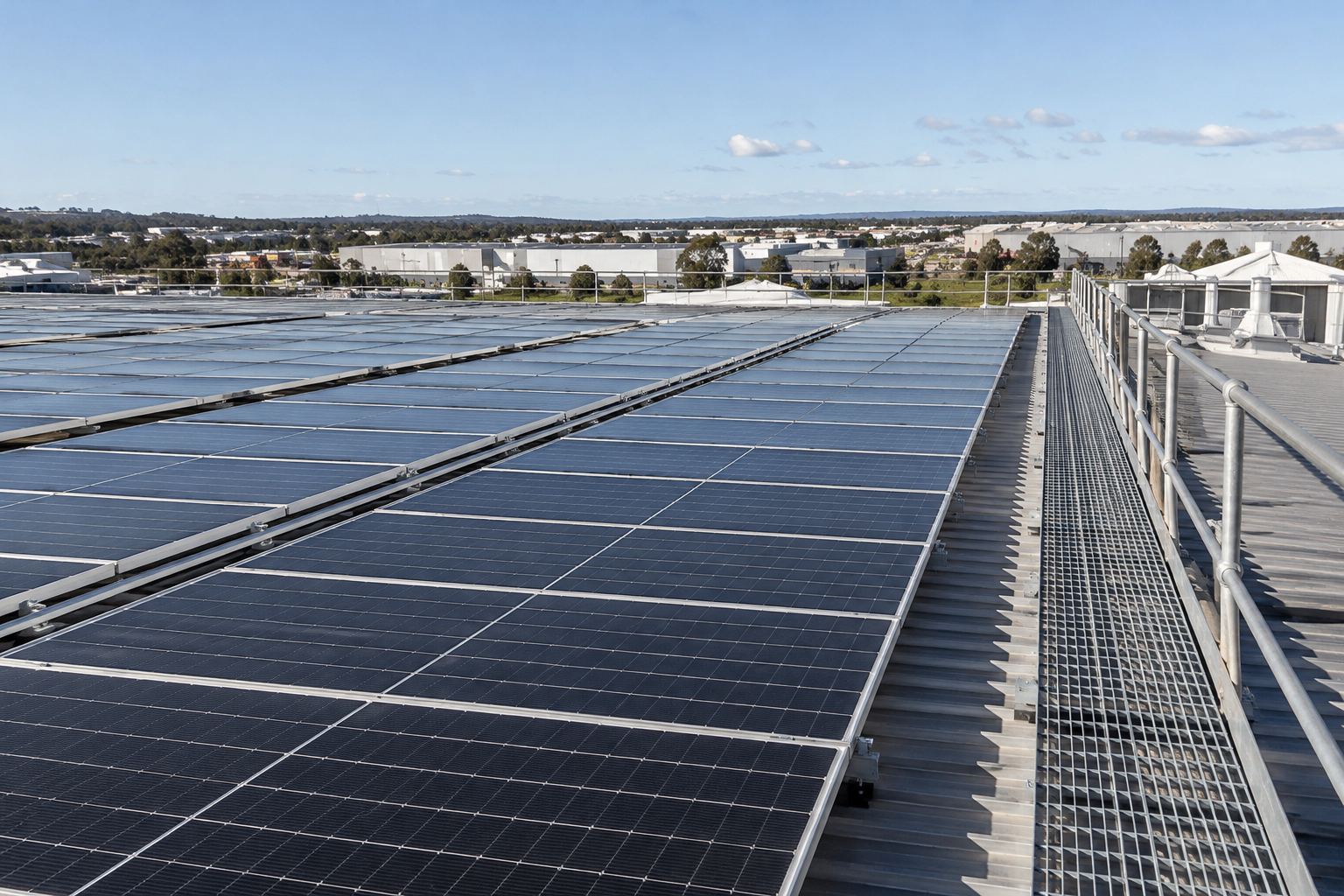
For industrial solar installation Sydney, an industrial roof is not automatically solar-ready because it is large and unshaded. A structural engineer may need to verify purlins, fixings and load paths against dead load and wind actions. Roof-sheet age, corrosion, leaks, warranties, drainage, skylights and planned replacement dates should be reviewed before mounting is specified.
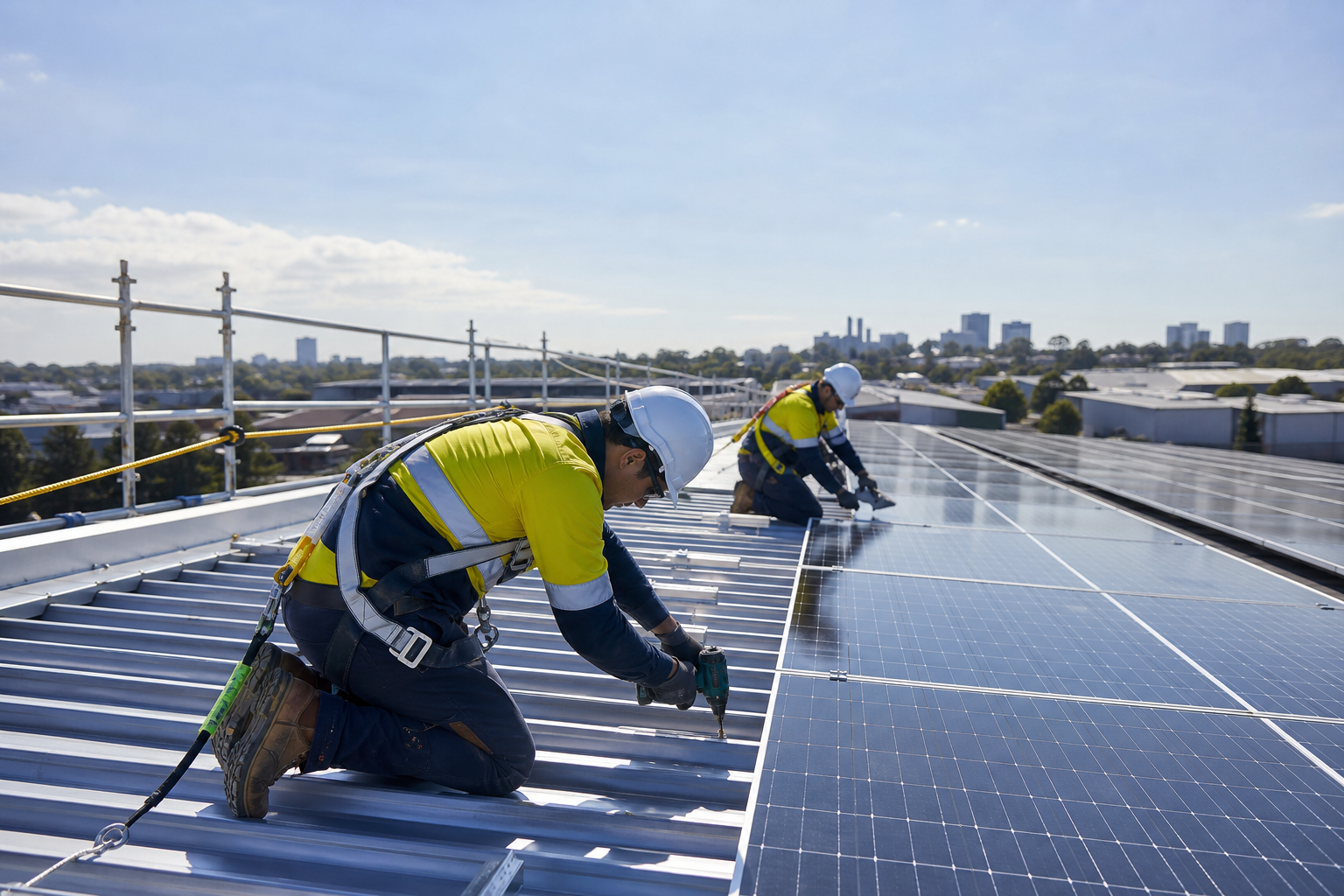
Fragile roofing and asbestos-containing materials require specialist controls. SafeWork NSW’s commercial and industrial roof guidance covers fall risks, fragile surfaces, electrical hazards and asbestos. A project plan should also preserve safe maintenance access after commissioning, not merely achieve safe access during construction.
Coordinate solar with the roof lifecycle
If the roof will need replacement within several years, doing that work before solar can avoid the cost and risk of removing and reinstalling the array. If staged replacement is unavoidable, divide the array and cable routes so future works are practical.
Keep emergency and service access clear
Layouts must maintain appropriate clearances around edges, skylights, smoke vents, HVAC equipment and service routes. Inverters and switchgear need ventilation, working space and access for safe isolation. The cheapest dense layout can become expensive if every maintenance visit requires temporary access controls.
Electrical Design and Australian Standards
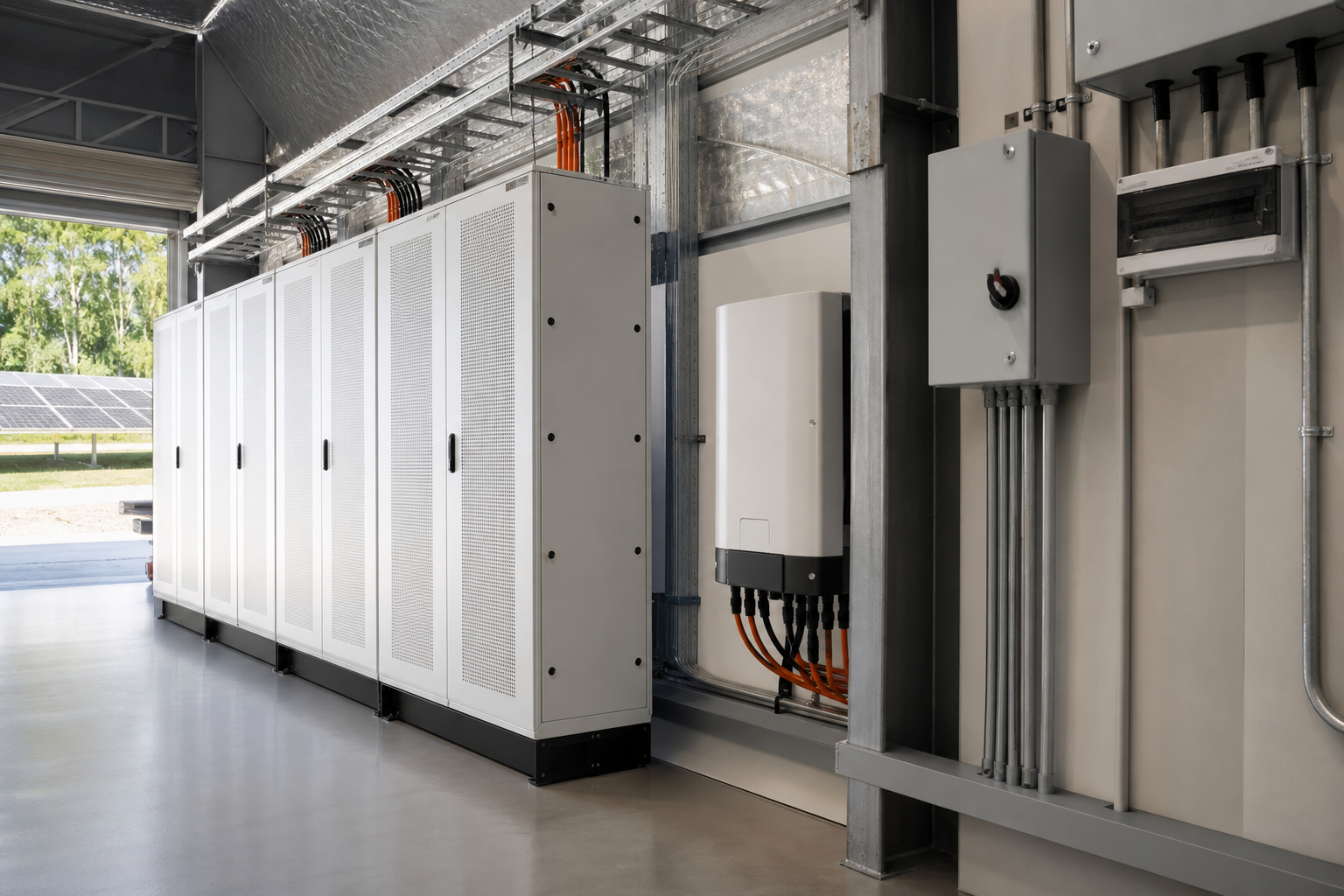
Industrial solar installation Sydney connects a generation plant to an operating electrical installation. The design must coordinate earthing, cable ratings, fault levels, isolation, protection, labelling and the site main switchboard. Existing generators, automatic transfer switches, uninterruptible power supplies and power-factor correction equipment must be included in the review.
Relevant requirements include:
- AS/NZS 3000: the Wiring Rules for electrical installations.
- AS/NZS 5033:2021: installation and safety requirements for PV arrays.
- AS/NZS 4777.1:2024: installation requirements for grid-connected inverter energy systems.
- AS/NZS 4777.2:2020: inverter requirements and regional settings.
- AS/NZS 5139:2019: safety requirements where battery energy storage is included.
NSW also requires electrical wiring to be completed by appropriately licensed people, and permission from the distribution network is required before connection. A compliant handover should include test results, shutdown procedures, system documentation, warranties and monitoring access.
Batteries, Peak Demand and Future Electrification
In an industrial solar installation Sydney project, a battery is not automatically essential, but industrial sites have stronger battery use cases than simple export arbitrage. Storage can shift solar into late operations, reduce selected demand peaks, support controlled loads and improve the value of a network-constrained array. Backup capability requires careful design because many standard grid-connected batteries do not support an entire industrial site during an outage.
In NSW, Peak Demand Reduction Scheme incentives can support eligible activities that reduce summer peak demand. Further commercial and industrial battery activities were announced to commence on 1 September 2026, with final incentive value depending on project eligibility, certificates and Accredited Certificate Provider arrangements. Confirm the live rules before including any amount in the investment case.
The solar design should also reserve capacity for planned electrification. EV fleet charging, electric forklifts, heat pumps, induction equipment and process changes can all alter load. Interactive Solar also designs EV charging solutions, allowing charger controls, PV production and site demand to be considered together.
Industrial Solar Installation Sydney: Project Timeline
A straightforward 100 kW project can move faster than a multi-megawatt or high-voltage installation, but industrial work should be planned in stages. A realistic program may range from roughly eight weeks to six months or more, depending on network assessment, engineering, equipment lead times, site access and shutdown windows.
- Discovery and data collection: gather bills, interval data, tariffs, site plans, roof information and future load plans.
- Site assessment: inspect roof condition, access, shading, switchboards, transformers, cable pathways and operational constraints.
- Concept design and business case: compare capacities using generation, self-consumption, demand effects, incentives and sensitivity scenarios.
- Engineering and network application: prepare structural and electrical designs, protection details and connection documents.
- Procurement and construction planning: confirm approved equipment, safety controls, crane lifts, deliveries and shutdown sequencing.
- Installation: deliver roof and electrical works while coordinating with the facility’s permit and production systems.
- Testing and commissioning: verify protection, inverter settings, export controls, monitoring and network requirements.
- Handover and care: provide documentation, training, maintenance schedules and performance support.
Review examples of completed work in the Interactive Solar project gallery, and ask how the team would stage your site around operating hours.
How to Evaluate the Financial Case
A credible industrial solar installation Sydney model separates engineering assumptions from financial assumptions. It should state annual generation, degradation, self-consumption, export price, retail tariff, demand treatment, operating costs, incentive value and finance terms. It should also show downside cases.
Ask for three scenarios
- Base case: current operations and tariff with realistic system losses.
- Downside case: lower electricity escalation, more curtailment, higher operating costs or reduced self-consumption.
- Growth case: planned electrification, extended shifts or additional production loads.
Simple payback is easy to understand, but net present value, internal rate of return and cumulative cash flow provide a more complete view. If the property is leased, model the lease term, landlord consent, make-good obligations and how energy savings are shared.
Worked 500 kW example
Consider a Sydney manufacturer assessing 500 kW of rooftop PV. At an illustrative 720 MWh annual output and 85 per cent self-consumption, 612 MWh would directly offset imported energy. If avoided variable energy cost averaged $0.22 per kWh, the first-year energy saving would be about $134,640 before exports, demand effects, operating costs, finance, tax and degradation.
This is not a quote or universal forecast. A real model must use the facility’s actual intervals and contract. It does show why self-consumption is load-specific: moving from 85 per cent to 60 per cent self-consumption would shift 180 MWh from higher-value avoided imports to lower-value exports or curtailment.
Choosing an Industrial Solar Installer in Sydney
For industrial solar installation Sydney, choose a team that can explain the entire system, including the parts that are not panels. The installer should show relevant NSW electrical licensing, current accreditation, approved equipment, appropriate insurance, commercial roof-safety processes and experience with network applications at the proposed capacity.
Ask these questions before signing:
- Will you design from interval data, and can I see the self-consumption calculation?
- Who is responsible for structural engineering, network approval and protection studies?
- What costs are excluded for switchboard, transformer, access or network works?
- How will installation be staged around production and shutdown restrictions?
- What happens if export approval is lower than assumed?
- How are performance, alarms and warranty claims managed after handover?
- Does the design reserve a practical pathway for batteries, EV charging or roof works?
Interactive Solar combines commercial design with local Sydney installation and aftercare. Its Interactive Care service supports ongoing system performance, while customer feedback is available on the reviews page.
Common Industrial Solar Mistakes
- Choosing capacity from roof area alone: this can create low-value export or curtailment.
- Ignoring roof age: later roof replacement can require costly array removal.
- Treating network approval as guaranteed: the approved export and protection conditions may change the design.
- Assuming all demand charges disappear: the peak may not coincide with solar output.
- Comparing only price per watt: exclusions for engineering, access and board works can distort quotes.
- Overstating incentives: the 1 MW SRES expansion applies to systems installed from 1 October 2026, but certificate applications open later in November 2026, so contracts must state how the timing is handled.
- Skipping lifecycle access: inverters, modules and roof assets must remain serviceable for decades.
Tax Treatment and Installer Accreditation for Industrial Solar
Eligible small businesses can claim the $20,000 instant asset write-off, which became permanent from 1 July 2026. It applies per asset to businesses under the turnover threshold, so most industrial arrays will be depreciated through standard capital allowance rules instead. The 20 per cent Small Business Energy Incentive bonus deduction ended on 30 June 2024 and is not available for 2026 projects. Confirm treatment with your accountant.
Installer accreditation is now issued by Solar Accreditation Australia, which took over from the Clean Energy Council in May 2024. The Clean Energy Council still maintains the approved product lists and the Solar Retailer Code of Conduct. For connection rules, check the Ausgrid or Endeavour Energy requirements for your site early, because network limits often decide the final array size.
Frequently Asked Questions
What size industrial solar system does a Sydney factory need?
It depends on interval demand, usable roof area, network capacity and future loads. Many industrial projects fall between 100 kW and 1 MW, but the optimum can be smaller or much larger. Start with at least twelve months of interval data and a site assessment.
How long is the payback for industrial solar in Sydney?
A well-matched industrial solar installation Sydney project often models at roughly three to six years. High daytime self-consumption and expensive imported energy usually shorten payback, while difficult roof works, network upgrades, low utilisation or expensive finance can extend it.
Can industrial solar reduce demand charges?
Yes, but only where the billing demand peak overlaps solar generation consistently. Review actual demand intervals. A battery or load-control strategy may be required if peaks occur outside solar hours or during short process surges.
Do industrial solar systems receive STCs in 2026?
Yes, for eligible rooftop systems installed on or after 1 October 2026 the SRES cap has risen from 100 kW to 1 MW, so industrial systems up to that size can receive upfront STCs. Applications open from mid to late November 2026. Systems above 1 MW still use the LGC pathway.
Can a factory install solar with a zero-export limit?
Potentially, yes. A correctly designed export-control system can limit grid export while solar supplies site loads. It still requires network approval, compatible control equipment and commissioning against the approved connection conditions.
How long does industrial solar installation take?
Allow roughly eight weeks to six months or more from data collection to commissioning. Network studies, high-voltage interfaces, roof remediation, procurement and restricted shutdown windows are common schedule drivers.
Can industrial solar be installed on an asbestos roof?
For industrial solar installation Sydney, an asbestos roof requires specialist assessment and strict asbestos and work-at-height controls. In many cases, roof remediation or replacement before solar is the safer and more economical lifecycle decision. Do not allow penetrations or disturbance without an appropriate asbestos management plan.
Plan Your Sydney Industrial Solar Project
The best industrial solar installation Sydney project starts with the facility’s operating data, not a panel count. Interactive Solar can review your interval usage, roof and electrical infrastructure, compare practical system sizes, manage the grid pathway and develop a staged plan for solar, batteries and EV charging.
Contact Interactive Solar to arrange an industrial site and energy assessment in Sydney. Bring twelve months of bills or interval data, any roof drawings and your expected load changes so the first design conversation is grounded in the way the facility actually operates.
Make Interactive Solar a preferred source in Google
One click tells Google to surface our articles more often in Top Stories, AI Overviews and AI Mode.