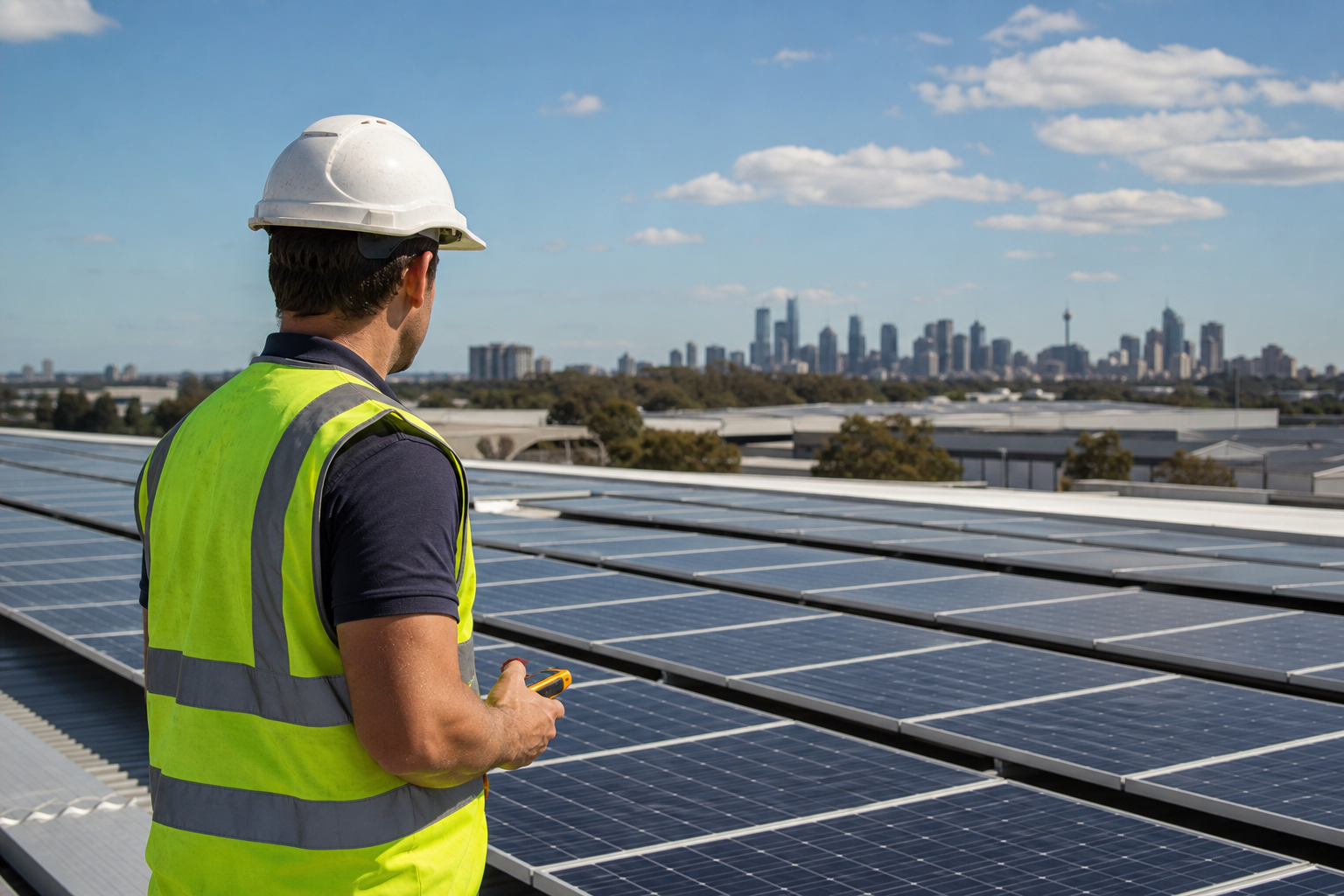
Business Solar Installation Sydney: 2026 Tax, Rebates & ROI Guide
Last updated:
Business solar installation sydney has never offered a stronger financial return than it does right now. In 2026, Sydney businesses that install a quality solar system are cutting electricity bills by 50-80%, accessing federal STCs worth thousands of dollars in upfront rebates, and unlocking tax deductions that accelerate payback to as little as 2.5 years. If your business is paying more than $3,000 per year in electricity, the numbers almost certainly stack up. This guide covers what that looks like in practice for Sydney SMEs, hospitality venues, retailers, and warehouse operators, with real 2026 figures you can use.

Business Solar Installation Sydney: How Much Will It Actually Cost in 2026?
Business solar installation sydney quotes vary by system size, roof type, and inverter choice. In 2026, indicative installed prices (after STCs) for common commercial system sizes in Sydney are:
| System Size | Gross Price (installed) | STC Rebate (est.) | Net Cost | Best For |
|---|---|---|---|---|
| 10 kW | $12,000-$16,000 | $2,800-$3,200 | $9,000-$13,000 | Small office, cafe, small retail |
| 20 kW | $20,000-$26,000 | $5,600-$6,400 | $14,500-$20,000 | Restaurant, mid-size office, gym |
| 30 kW | $28,000-$36,000 | $8,400-$9,600 | $19,500-$27,000 | Larger retail, showroom, small factory |
| 50 kW | $44,000-$56,000 | $14,000-$16,000 | $30,000-$41,000 | Warehouse, manufacturing, large office |
| 100 kW | $80,000-$100,000 | $22,000-$26,000 | $58,000-$78,000 | Large warehouse, industrial site |
Systems above 100 kW fall under Large-scale Generation Certificates (LGCs) rather than STCs, which changes the rebate structure but not the fundamental economics. For most Sydney SMEs, a system in the 10-50 kW range hits the sweet spot between generation capacity and upfront investment.
2026 STC Rebates Explained for Sydney Businesses
The Small-scale Technology Certificate (STC) scheme is the primary federal rebate for business solar installation sydney sites under 100 kW. In 2026, the STC deeming period is 5 years (down from 6 in 2025), but the STC spot price has remained strong at approximately $36-40 per certificate through mid-2026 according to the Clean Energy Regulator.
How STCs are calculated for a commercial system in Sydney (Zone 3):
- System capacity (kW) multiplied by zone rating (1.382 for Sydney Zone 3) multiplied by deeming years (5) equals STC quantity
- A 30 kW system in Sydney generates approximately: 30 x 1.382 x 5 = 207 STCs
- At $38 per STC, that is approximately $7,870 in rebate value
- STCs are assigned directly to your installer at point of sale, reducing your upfront invoice
The Clean Energy Regulator maintains the official STC calculator and approved product lists. Your installer must use CEC-approved panels and inverters for STC eligibility. See the Clean Energy Regulator’s STC information page for current zone multipliers and certificate prices.
Business Solar Installation Sydney: The New 1 MW SRES Rebate from October 2026
From 1 October 2026, the federal government is expanding the Small-scale Renewable Energy Scheme (SRES) eligibility cap from 100 kW to 1 MW for mid-scale commercial solar. This is a tenfold increase, confirmed by the Clean Energy Regulator following the Renewable Energy (Electricity) Regulations amendment, and it is the single biggest change to commercial solar economics in years.
What this means in practice for a Sydney business solar installation sydney project above 100 kW:
- Systems between 100 kW and 1 MW installed on or after 1 October 2026 can access upfront Small-scale Technology Certificates instead of the lower-value Large-scale Generation Certificate (LGC) pathway that previously applied. The Clean Energy Regulator estimates this can meaningfully reduce the upfront cost of a medium-sized commercial system.
- Applications will not open until mid-to-late November 2026 while the Clean Energy Regulator finalises assessment processes, so businesses planning a system above 100 kW should get their site audit and design underway now to be ready when the scheme opens.
- The change is aimed squarely at warehouses, distribution centres, large retail sites, and manufacturing facilities with big roof areas that were previously stuck in the less favourable LGC market for anything above 100 kW.
If your business has a roof large enough for a system above 100 kW, this is worth discussing with an accredited installer before committing to a smaller system just to stay under the old cap. Read the Clean Energy Regulator’s transitional guidance for mid-scale solar for the latest detail on eligibility and timing.
Tax Deductions and the Instant Asset Write-Off in 2026
Business solar installation sydney projects qualify for significant tax benefits that commercial owners often underestimate. The combination of the STC rebate plus tax deductions can reduce your effective net cost by an additional 25-30% compared to the pre-tax price.
Key tax treatments applicable from the 2026-27 financial year:
- $20,000 instant asset write-off (now permanent): As part of the 2026-27 Federal Budget, the ATO confirmed the $20,000 instant asset write-off is a permanent feature from 1 July 2026. Small businesses using simplified depreciation can immediately deduct the full cost of an eligible solar asset costing under $20,000, rather than depreciating it over several years.
- Small business depreciation pooling: For solar systems costing more than $20,000, businesses with aggregated turnover under $10 million can pool the eligible depreciating asset at a rate of 30% per year (declining balance) from the first year. A $25,000 net-cost solar system added to the pool in FY2026-27 generates approximately $7,500 in deductions in Year 1 alone.
- GST input tax credit: GST-registered businesses can claim the GST component of the installation cost as an input tax credit, effectively reducing the net cost by ~9%.
- Small Business Energy Incentive has ended: The temporary 20% bonus deduction for electrification and energy-efficiency assets only applied to expenditure incurred between 1 July 2023 and 30 June 2024. It does not apply to 2026 solar installations, so do not rely on outdated advice referencing it.
A worked example: a Sydney cafe owner installs a 20 kW system at a gross cost of $23,000. After STCs ($6,000), net cost is $17,000. After GST credit ($1,545), the after-tax base is $15,455. With small business depreciation pooling at 30% ($4,637 deduction at 25% marginal rate = $1,159 in Year 1 tax saving), effective Year 1 cost drops further. Over the life of the asset, the full $15,455 net cost is deductible.
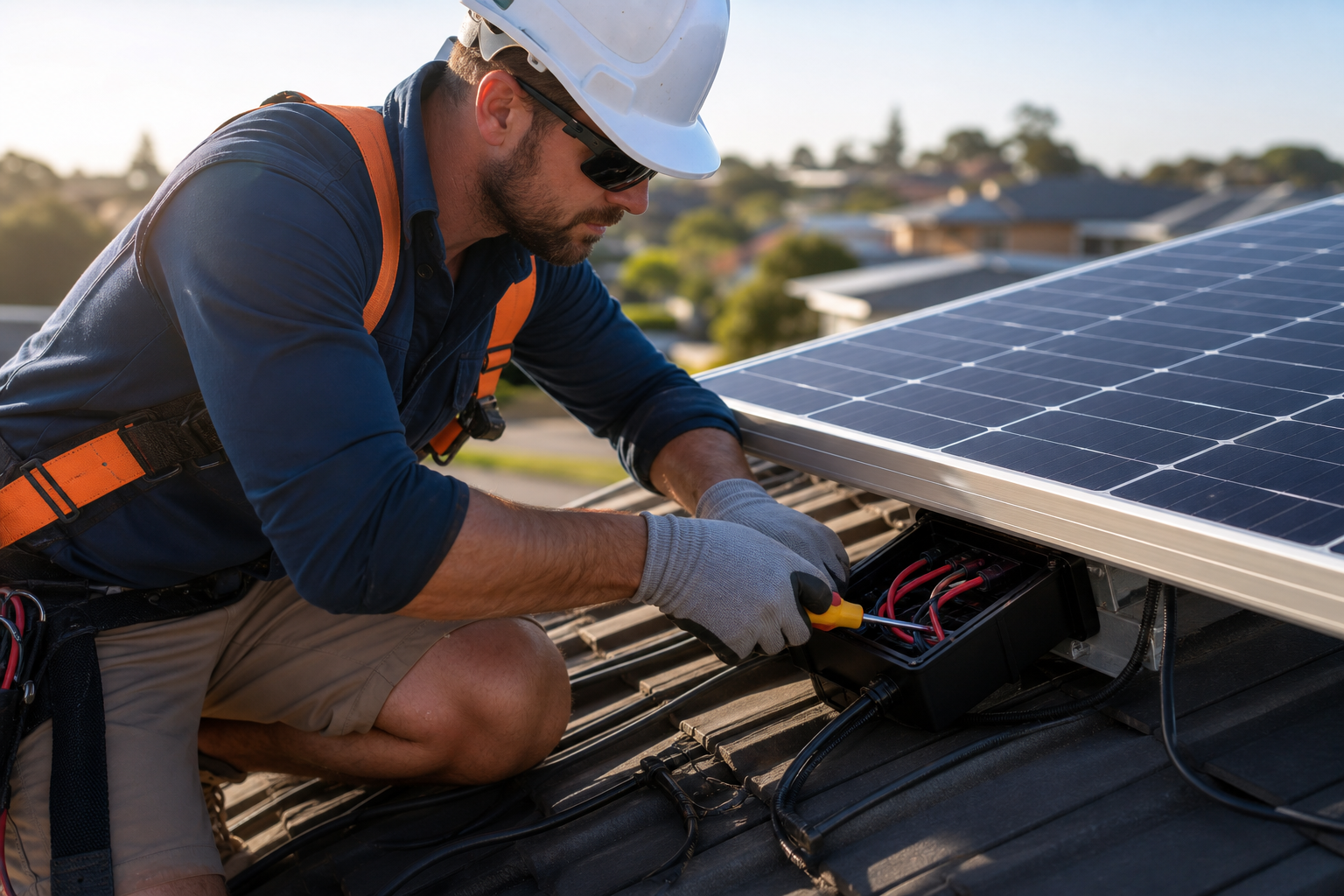
ROI and Payback by Business Type
Business solar installation sydney payback periods vary significantly by how much electricity a business consumes during daylight hours. The more closely your load profile matches solar generation (roughly 7 am to 5 pm), the faster you recover your investment.
| Business Type | System Size | Daily Self-Consumption | Annual Savings (est.) | Payback Period |
|---|---|---|---|---|
| Cafe / Restaurant | 15-20 kW | High (commercial appliances run all day) | $8,000-$14,000 | 2-3 years |
| Retail Store | 10-20 kW | Good (lighting, HVAC, refrigeration) | $5,000-$10,000 | 2.5-3.5 years |
| Gym / Fitness Centre | 20-30 kW | Very high (HVAC, lighting, showers) | $10,000-$18,000 | 2-3 years |
| Office Building | 20-50 kW | Moderate (primarily weekday hours) | $8,000-$20,000 | 3-4 years |
| Warehouse / Factory | 30-100 kW | High if daytime operations | $15,000-$45,000 | 2.5-4 years |
| Medical Practice | 10-20 kW | High (equipment, lighting, HVAC) | $6,000-$12,000 | 2.5-3.5 years |
These estimates assume an electricity price of $0.28-0.32/kWh (Ausgrid/Endeavour tariff range for small commercial customers in 2026) and a feed-in tariff of $0.06-0.08/kWh for exported excess generation. The ratio of self-consumption to export matters: every unit you consume yourself is worth 4-5 times more than a unit you export.
Interactive Solar’s commercial team helps Sydney businesses model their actual load profile before system sizing, so you know your real payback before you sign anything. Explore our commercial solar services to learn about the site audit process.
Grid Export Limits and Network Rules in Sydney
Every business solar installation sydney project must comply with the Distribution Network Service Provider (DNSP) rules that govern how much power can be exported to the grid. Getting this wrong delays your connection approval by weeks.
In 2026, export limits in Sydney are:
- Ausgrid network (Eastern Sydney, Inner West, Northern Beaches, North Shore, Central Coast): 10 kW export per single-phase connection, 30 kW per three-phase connection. Systems larger than these limits require an approved inverter with export limiting capability or a separate grid connection upgrade.
- Endeavour Energy network (Western Sydney, Parramatta, Blacktown, Liverpool, Penrith, Wollongong): Similar single/three-phase limits, with some zones allowing higher exports subject to network capacity assessment.
- Essential Energy (regional NSW): Not relevant to most Sydney metropolitan businesses.
For a 50 kW commercial system on a three-phase connection (common for warehouses and factories), export is typically capped at 30 kW. The system generates up to 50 kW but any excess beyond what the export limit allows is curtailed at the inverter. This makes maximising on-site consumption even more important: the less you export, the less curtailment you experience.
Adding a solar battery solves this elegantly: excess generation charges the battery first, and the battery discharges in the evening when solar generation stops. For businesses that operate across multiple shifts, this dramatically improves the economics.
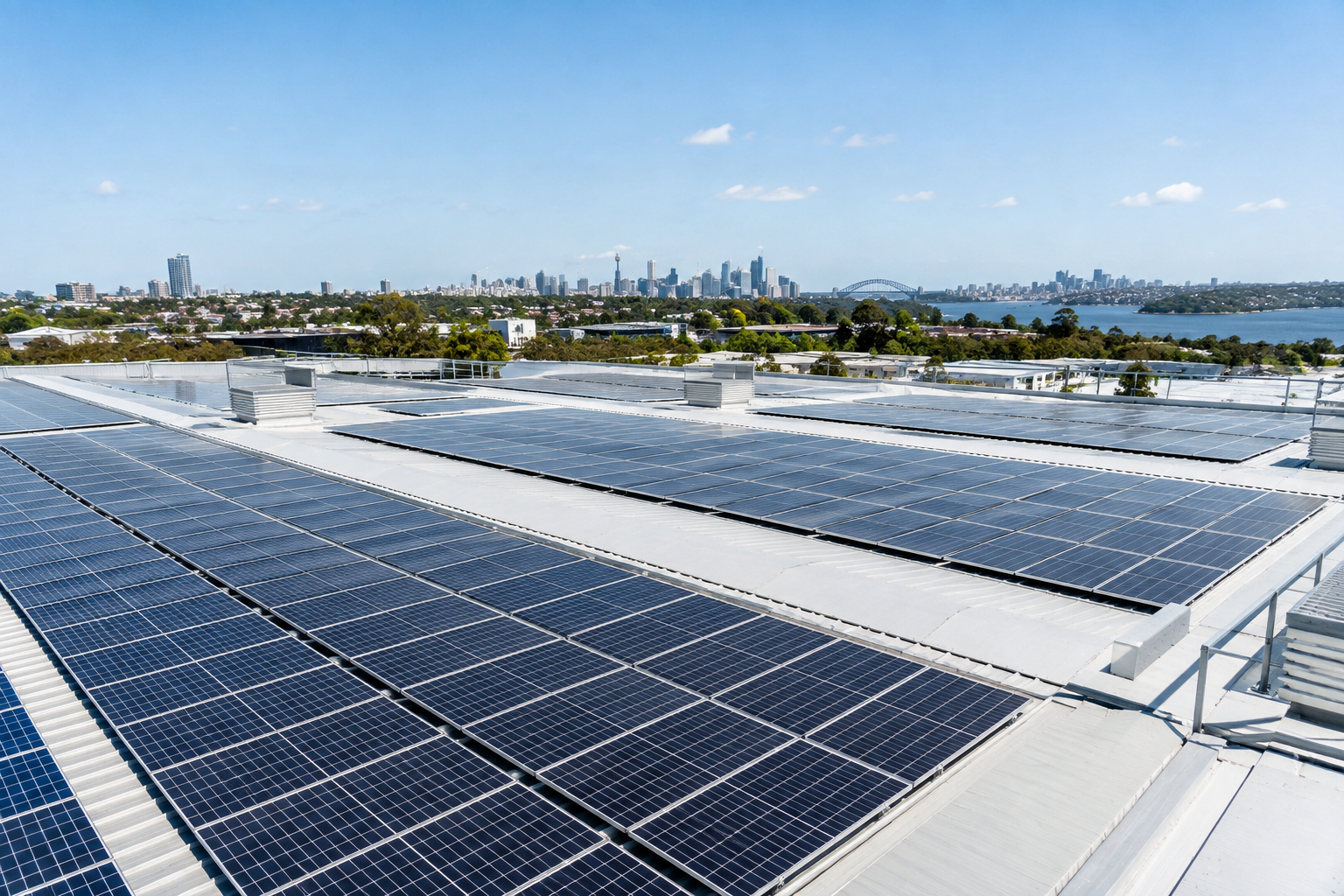
Commercial Battery Add-Ons in 2026
The federal Cheaper Home Batteries Program, which launched on 1 May 2026, applies to eligible battery systems connected to an existing or new solar installation. While named “home batteries,” the program also covers eligible small commercial battery installations below certain size thresholds. The tiered STC rebate structure for batteries is:
- 0-14 kWh capacity: 100% of deeming-equivalent STCs (maximum rebate, approximately $2,800-$3,500 for a 10-13 kWh unit at 2026 STC prices)
- 14-28 kWh capacity: 60% of deeming-equivalent STCs
- 28-50 kWh capacity: 15% of deeming-equivalent STCs
For a Sydney business adding a 10 kWh battery to their commercial solar installation, this can mean $2,500-$3,500 in rebate value, bringing the net cost of a quality LFP battery from around $10,000-$13,000 installed to $7,000-$10,000. The battery typically adds 1.5-2.5 years to payback but significantly increases overall lifetime savings by capturing previously-curtailed or exported generation.
NSW also expanded its Virtual Power Plant (VPP) incentive in July 2026 to cover batteries up to 50 kWh connected to VPP networks, offering participating business owners additional payments for providing grid support services during peak demand events. Details are on the NSW Government energy website.
Installer Accreditation and What to Check Before Signing
Not every solar installer offering business solar installation sydney quotes is eligible to deliver STC-eligible systems. Since 29 May 2024, installer and designer accreditation has been run by Solar Accreditation Australia (SAA), not the Clean Energy Council. The Clean Energy Council still maintains the Approved Products List used for STC eligibility, but the installer accreditation scheme itself moved to SAA.
What to verify before signing a business solar contract:
- SAA Accredited Installer: The individual tradesperson who signs off on your installation must hold current Solar Accreditation Australia (SAA) accreditation. Verify at the SAA public installer register.
- CEC Approved Products: Panels and inverters must appear on the Clean Energy Council Approved Products List for STC eligibility. Ask for the specific panel and inverter model and cross-check before signing.
- Electrical contractor licence: A separate electrical contractor licence is required under NSW fair trading rules. The CEC accreditation alone is not sufficient to legally energise the system.
- Design and engineering sign-off: For systems above 10 kW, structural engineering sign-off on the roof mounting is typically required by the DNSP as part of the network application.
- Public liability and worker’s compensation insurance: The installer must hold current insurance. Ask for a certificate of currency before work begins.
- Workmanship warranty: Minimum 5 years is standard in the industry. Be cautious of contractors offering only 1-2 years on workmanship.
Interactive Solar’s installers are Solar Accreditation Australia (SAA) accredited and the business has been installing commercial solar across Sydney since the early days of the industry. Learn about our accreditations and experience. Interactive Solar’s team holds current Solar Accreditation Australia credentials across all installers. You can also read what Sydney business owners say about us on our customer reviews page.
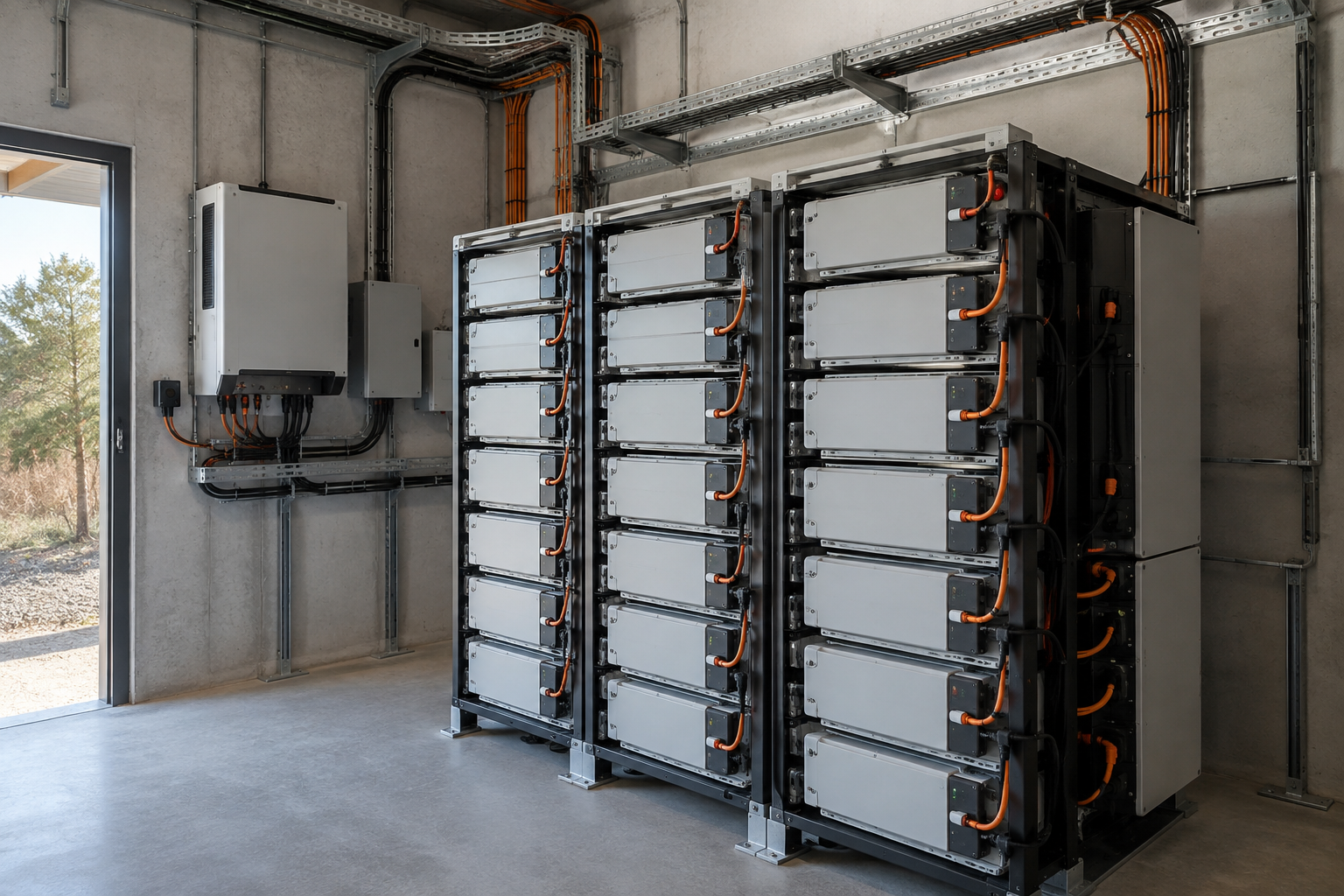
Which Panel, Inverter and Battery Brands Do Installers Use in 2026?
The panel and inverter brands used in your business solar installation sydney project have a direct impact on long-term yield, warranty reliability, and resale value. In 2026, the commercial solar market in Australia has consolidated around a handful of proven Tier 1 manufacturers.
Panels: Aiko (TOPCon and ABC cell technology, SolarQuotes 2026 Installer’s Choice Award winner), Jinko Solar (Tiger Neo series, strong Australian distributor support), REC Group (Alpha Pure-R, premium performance in tight commercial roof spaces), and Trina Solar (Vertex N series) dominate commercial installs. Premium TOPCon and N-type panels degrade at 0.3-0.4% per year versus 0.5-0.7% for older PERC panels, a meaningful difference compounded over 25 years.
Inverters: Fronius (Primo/Symo range, European engineering, excellent monitoring), SMA (Sunny Tripower, field-proven reliability), and Sungrow (cost-competitive, strong commercial warranty support in Australia) are the dominant commercial inverter choices. For hybrid systems that will include a battery, Sungrow’s commercial hybrid inverter range integrates natively with Sungrow batteries, simplifying the installation.
Batteries: Tesla Powerwall 3 (built-in inverter, 13.5 kWh, best for smaller commercial installs), Sungrow SBR series (modular 9.6-25.6 kWh, excellent for mid-size commercial), and BYD Battery-Box HVM (premium LFP, 11.5-22.1 kWh). All three use lithium iron phosphate (LFP) chemistry, which offers a better safety profile and longer cycle life than older NMC chemistry batteries.
Timeline from Quote to Switch-On
A realistic timeline for a business solar installation sydney project in 2026 looks like this:
- Site audit and design (1-2 weeks): A detailed site audit assesses your roof, structural integrity, switchboard capacity, metering configuration, and load profile. This produces the design drawings used for the network application.
- Quote and contract (1 week): Review the quote, panel/inverter specs, warranty terms, and payment schedule before signing.
- Network application (2-6 weeks): Your installer lodges the connection application with Ausgrid or Endeavour Energy. This is often the longest part of the process. Systems under 10 kW with standard grid connections can be approved in days; larger systems requiring export limiting or switchboard upgrades take longer.
- Building/development approval (if required, 2-6 weeks): Most commercial solar installations on existing buildings are exempt from council DA under NSW Exempt Development provisions, but some heritage-listed properties and strata buildings have additional requirements. Your installer will advise.
- Installation (1-3 days): The physical installation typically takes 1 day for small systems, 2-3 days for larger commercial installs.
- Meter reconfiguration and energisation (1-2 weeks after installation): Your retailer must reconfigure your meter for bi-directional metering (to record exports). The system cannot be switched on until this is complete.
Total timeline from signed contract to live system: 6-14 weeks is typical for Sydney commercial projects in 2026. Planning well ahead of summer (November-January) is wise, as installer capacity tightens significantly during high-demand periods.
Watch: The Solar Retailer Code of Conduct Explained
The Clean Energy Council’s Solar Retailer Code of Conduct sets minimum standards for how solar retailers and installers must deal with customers, from quoting through to warranty support. Signing with a retailer that follows the Code is a useful extra check alongside SAA installer accreditation.
Common Mistakes Sydney Businesses Make
After installing commercial solar across hundreds of Sydney business sites, Interactive Solar’s team sees the same mistakes repeatedly. Avoiding these can save you significant money and frustration.
- Undersizing because the quote looked cheaper: A system sized for current load often cannot accommodate business growth. If you plan to add a second shift, EV charging, or additional equipment within 3 years, size the system for that future load today. Adding panels later often requires a second network application and switchboard modification.
- Ignoring the inverter clipping ratio: Installing a 30 kW inverter under 40 kW of panels (1.33 DC:AC ratio) is industry-standard and improves morning/afternoon generation. Some cheap quotes achieve a lower price by under-specifying the inverter, reducing annual yield.
- Not considering a battery because payback seems long: A battery added at the time of the solar installation is cheaper than retrofitting one later. If you plan to add battery storage within 5 years, factor it into the initial design and switchboard configuration even if you don’t purchase the battery immediately.
- Choosing the lowest quote without checking CEC accreditation: The STC rebate can be clawed back if the installation is not completed by an SAA-accredited installer using Clean Energy Council approved products. Always verify before signing.
- Forgetting about EV chargers in the design: If your business will electrify its vehicle fleet, the switchboard and solar system design should account for EV charger load from day one. Retrofitting is possible but adds cost.
FAQ: Business Solar Installation Sydney
How much does business solar installation sydney cost in 2026?
After the federal STC rebate, most Sydney businesses pay $9,000-$13,000 for a 10 kW system, $14,500-$20,000 for 20 kW, and $30,000-$41,000 for 50 kW. The STC rebate is applied automatically at point of sale by your Solar Accreditation Australia (SAA) accredited installer, so the price you pay is already the post-rebate price.
What size solar system does my Sydney business need?
As a rule of thumb, size your system to match your daytime consumption. Review your electricity bills for peak usage hours: if your business uses 60 kWh per day between 8 am and 4 pm, a 20-25 kW solar system will typically cover 80-90% of that consumption on a good day. Your installer should perform a proper load profile analysis using interval meter data rather than relying on total daily consumption alone.
Are businesses eligible for the 2026 STC rebate?
Yes. Commercial solar systems installed by Solar Accreditation Australia (SAA) accredited installers using Clean Energy Council approved products are eligible for STCs under the federal Small-scale Renewable Energy Scheme, and from 1 October 2026 that eligibility extends up to 1 MW, not just 100 kW. The rebate is applied at point of sale and reduces your invoice directly. You do not need to apply for it separately.
Can my business claim solar as a tax deduction?
Yes. A commercial solar system is a depreciating asset for tax purposes. Depending on your business turnover and the current rules, you may be able to claim the cost under immediate deduction, small business depreciation pooling, or standard depreciation schedules. Consult your accountant to confirm which treatment applies to your specific situation in FY2026.
How long does business solar installation take in Sydney?
The physical installation takes 1-3 days depending on system size. The end-to-end process from signed contract to a live, grid-connected system typically takes 6-14 weeks in Sydney, with the network application to Ausgrid or Endeavour Energy being the main variable. Plan ahead to avoid installer capacity constraints during the summer peak (November to January).
Does business solar installation work for leased premises?
It can, but it requires your landlord’s written consent for roof access and the installation. Some landlords offer a rent reduction or split the cost in exchange for ownership of the system. Others prefer a lease-back arrangement where the business owns the system and the landlord benefits from lower building operating costs if the tenancy includes outgoings. Commercial solar finance products are also available that allow you to spread the cost and take ownership at the end of the term, improving the landlord-tenant negotiation position.
What happens to my solar system if I move premises?
Solar panels are permanently fixed to the roof structure and generally cannot be economically relocated. If you move, the system typically remains with the building and either transfers to the landlord’s ownership (check your installation agreement) or is included in the business sale as a value-add asset. The ongoing savings for the next occupant make a solar-equipped property more attractive to buyers and tenants alike.
Ready to get accurate numbers for your Sydney business? Contact Interactive Solar for a no-obligation commercial site audit and quote. Our SAA-accredited team covers all of metropolitan Sydney including Eastern Suburbs, Inner West, Northern Beaches, and all of Western Sydney. You can also browse our commercial project gallery to see the work we have completed for Sydney businesses across every industry.
Make Interactive Solar a preferred source in Google
One click tells Google to surface our articles more often in Top Stories, AI Overviews and AI Mode.