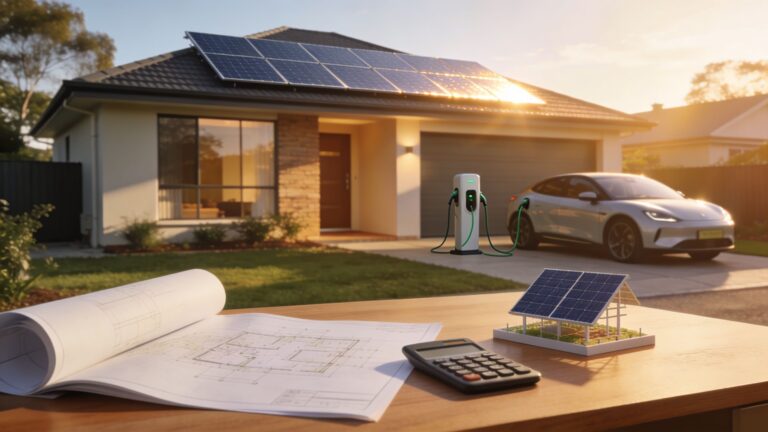
Sydney Solar System Price: Rebates & Tailored Quotes
Last updated:
You're probably here because you want a straight answer to a simple question. What's the solar system price for a home or business in Sydney?
The honest answer is that there isn't one fixed number that means much on its own. A useful solar quote isn't like pricing a fridge, hot water system, or television. It's closer to pricing a renovation. The final figure depends on your roof, your switchboard, your energy habits, your future plans, and how well the system is designed to perform over the long term.
That can be frustrating when you're trying to compare options. It's also the reason so many online price lists send people in the wrong direction. A cheap-looking quote can end up costing more if the layout is poor, the inverter is undersized, the installation is rushed, or the system doesn't match how the property uses power.
Beyond the Price Tag What Determines Solar Value
A Sydney homeowner gets two solar quotes for systems that look similar on paper. One is several thousand dollars cheaper. Six months later, the cheaper system is clipping in the afternoon, the monitoring is basic, and adding a battery will mean replacing key equipment. The higher quote included better design work, cleaner cable runs, stronger after-sales support, and room to expand. That is the difference between price and value.

Solar has matured into a mainstream purchase in Australia. The harder part now is not deciding whether solar works. It is working out which system will keep performing, suit the way the property uses power, and still make sense years from now.
Why one quote never fits every roof
Key variables show up in the site inspection and system design.
- Roof orientation and pitch change how production is spread across the day, which affects how much of that solar power you can use on-site.
- Shade from trees, chimneys, neighbouring buildings, and antennas can reduce output and may justify optimisers or microinverters in some cases, but not every case.
- Your load profile matters just as much as roof space. A home with daytime occupancy uses solar differently from a household that is empty until evening.
- Available roof area affects panel choice. On a tight roof, higher-efficiency panels can solve a problem that a cheaper module cannot.
- Future electrification plans such as EV charging, pool equipment, induction cooking, or electric hot water can change what a sensible system size looks like.
I have seen plenty of properties where the cheapest quote was based on what could be sold quickly, not what would perform well over time. A system can look fine on a proposal and still be poorly matched to the building.
What experienced buyers compare
Good buyers look past the headline number and ask what they are getting for it.
| What to check | Why it matters |
|---|---|
| System design | Panel layout, string design, and inverter sizing affect real output more than a big wattage number on the first page |
| Component quality | Better panels and inverters usually bring stronger warranty backing, better long-term performance, and fewer service headaches |
| Installation standard | Roof penetrations, isolator placement, cable management, and commissioning all affect safety and reliability |
| Monitoring and support | Clear monitoring helps you catch faults early and confirm the system is doing its job |
| Expandability | Battery readiness and switchboard capacity can save a costly retrofit later |
Installation quality deserves close attention. Installation quality matters as much as system hardware. Premium gear cannot make up for poor workmanship.
Battery discussions also confuse price comparisons. Some quotes include battery-ready hardware, some include storage, and some leave out the switchboard or backup requirements that affect the final figure. For a grounded reference point, this guide to Australian solar battery system costs shows why storage pricing varies so much from one project to the next.
The right question is not, "What is the cheapest solar system price?" The right question is, "What system will deliver the best return, the fewest problems, and the most flexibility for this property?"
Deconstructing Your Complete Solar System Investment
Solar isn't one product. It's a package of decisions. The easiest way to understand the total investment is to treat it like a custom build where every part affects the final result.
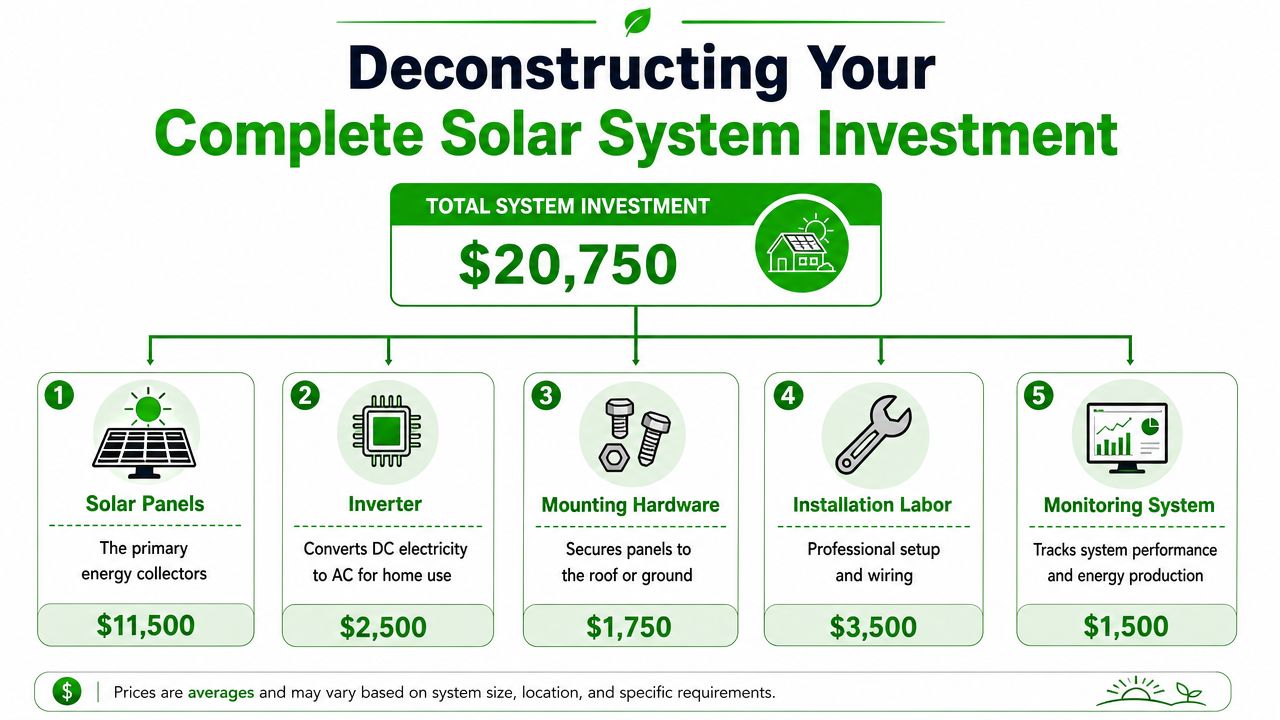
The visible parts get most of the attention, but the hidden parts often determine how the system behaves in year five, year ten, and beyond.
The five parts that shape the outcome
Solar panels are the energy collectors. The difference between entry-level and premium modules usually comes down to efficiency, degradation behaviour, manufacturing consistency, and how much output you can fit into a limited roof area. On a spacious roof, a broader range of panel options may work. On a tight roof, higher-efficiency panels can solve a layout problem that cheaper modules can't.
The inverter is the operating brain. It converts the DC electricity from the panels into AC power your home or business can use. It also handles monitoring, fault detection, and often the path to future battery integration. If the inverter is poorly matched to the array or lacks flexibility, the system may work on paper but disappoint in daily operation.
A close look at the battery side of the equation helps here. This guide to Australian solar battery system costs is useful because it shows why battery decisions can't be treated as an afterthought when you're comparing overall system value.
The pieces buyers often overlook
Mounting gear and electrical hardware rarely make the brochure headline, yet they matter every day the system is on the roof. Rails, brackets, isolators, cabling, protection devices, and switchboard integration all need to suit the site conditions and comply with the relevant standards.
Then there's labour. Good installation work isn't just “putting panels up”. It includes site assessment, cable routing, weatherproofing, switchboard planning, commissioning, testing, and making sure the monitoring is correctly configured. That's why experienced buyers don't compare quotes line by line as if every installer is delivering the same thing.
A neat panel layout means very little if the electrical work behind it is untidy, rushed, or hard to service later.
Here's the practical breakdown many property owners find helpful:
- Panels collect the solar energy.
- The inverter manages how usable that energy becomes.
- Mounting and electrical hardware support safety and durability.
- Monitoring reveals whether the system is performing as designed.
- Labour determines how well all of those parts work together.
For a quick visual explanation of how these elements fit together, this short video is worth watching.
Why batteries change the conversation
Panels-only thinking is often too narrow now. A frequently overlooked question is what the full all-in price looks like after batteries, grid connection changes, and financing. Many solar system price articles focus on sticker price per watt, but that misses the cost of storage and backup, which can materially change the budget. For Australian homeowners, that gap matters because buyer decisions are increasingly shifting from panels-only to solar-plus-storage to manage evening usage and rising retail tariffs, as noted in this discussion of all-in solar and battery budgeting.
Battery planning doesn't mean every home should add storage immediately. It means every quote should consider whether the property is a good candidate now, later, or not at all. If you're weighing those options, a detailed battery comparison guide for different household needs is more useful than a generic package list.
How Government Incentives Reduce Your Final Cost
Two Sydney homes can install similar-sized systems and still see different bottom-line prices. One of the biggest reasons is how government incentives apply to that specific job, and whether the quote shows them clearly.
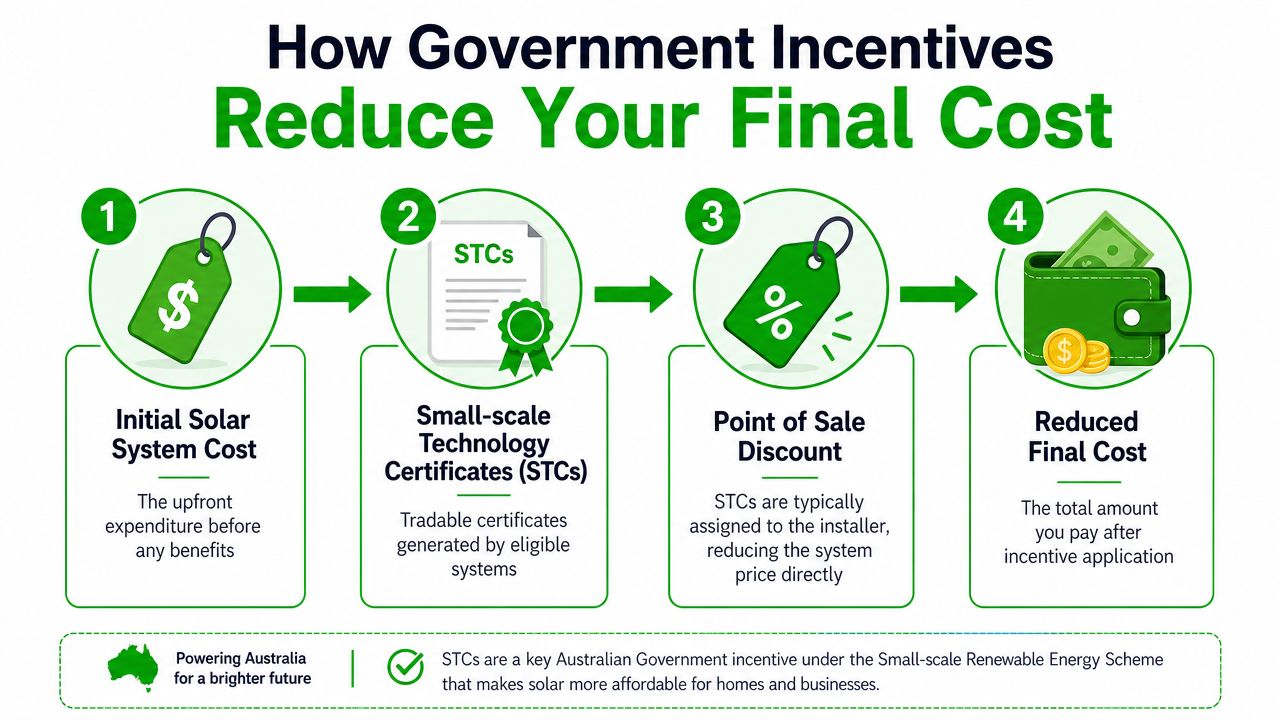
For NSW buyers, the main federal support is the Small-scale Renewable Energy Scheme, or SRES. Under that scheme, eligible solar installations create Small-scale Technology Certificates, usually called STCs. In day-to-day quoting, that means the certificate value is commonly applied upfront to reduce the amount you pay, rather than left for you to sort out later.
That is one reason fixed online price lists can be misleading. A system price only starts to mean something once the available incentives have been applied to your property, system size, and installation details.
How the process works in plain English
The usual flow looks like this:
- Your proposed system is checked for eligibility under the federal rules.
- STCs are calculated based on the system and installation details.
- The installer manages the assignment paperwork in a standard sale.
- The STC value is deducted from the quoted price so your out-of-pocket cost is lower.
Simple on paper. Important in practice.
The catch is that incentives do not make every quote equal. I have seen proposals where the rebate is shown clearly, and others where it is buried inside the total with no explanation of how the final figure was reached. If you are comparing solar system prices, check whether the STC deduction has been included, how it has been calculated, and whether the installer has explained the assumptions behind it.
Why the installer matters here
A good installer treats incentives as part of the system design and quoting process, not as a sales line. They confirm eligibility, show the reduction transparently, and make it clear what you are paying before and after the STC adjustment.
That matters because the cheapest-looking quote is not always the best value. A low number can come from aggressive assumptions, weaker components, or an undersized system that saves less over time. Incentives reduce your entry cost, but they do not fix poor design or poor workmanship.
If you want a local breakdown of what support may apply, this guide to NSW solar rebates and government rebate pathways is a practical starting point.
Solar Scenarios for Sydney Homes and Businesses
Real value becomes clearer when you look at how different properties use electricity. The same roof area can lead to very different recommendations depending on who lives or works there.
The growing family in the Hills District
This home uses a lot of power before school, after work, and across the weekend. Air conditioning, laundry, kitchen appliances, and a busy household rhythm create steady demand. They don't want the smallest system that fits. They want one that follows the way the house runs.
The right design here is often a larger residential array with careful panel placement across the best roof aspects, plus an inverter that leaves room for future storage. If roof space is constrained, higher-efficiency modules may be the better call. If the family expects higher evening demand later, battery-readiness matters from day one.
What doesn't work is undersizing the system just to keep the quote looking attractive. That usually leaves the household buying too much power from the grid in the hours that matter most.
The Inner West couple planning for an EV
This property may have moderate current electricity use but a clear future shift coming. One or both owners work away from home now. They're planning to add an EV charger and possibly switch more appliances from gas to electricity over time.
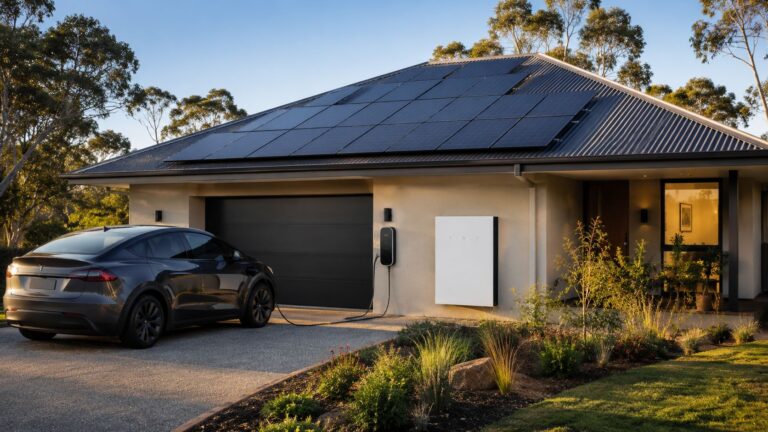
That changes the design brief. The best system isn't the one that matches last year's bill perfectly. It's the one that reflects where the home is heading. A battery-ready inverter, smart monitoring, and allowance for daytime EV charging can make far more sense than a bare-minimum panel-only system.
A quick decision filter helps in this type of home:
- Driving habits matter if charging will mostly happen during daylight hours.
- Roof space matters if future electrification is likely.
- Monitoring matters because load shifting only works when the household can see usage patterns.
- Battery timing matters because some homes should prepare now and add storage later.
The local café or light commercial site
Commercial solar has its own pattern. A café, office, workshop, or retail business often uses most of its power while the sun is out. That's ideal from a solar value perspective because direct self-consumption is usually the strongest financial outcome.
A well-designed commercial system focuses on daytime load offset, switchboard suitability, safe access, and reliable monitoring. The owner typically wants fewer bill shocks, clearer operating costs, and equipment that won't become a maintenance headache.
The best commercial systems are built around the business day, not around a brochure package.
What doesn't work for a business is copying a residential template and scaling it up. Commercial sites need a proper review of load profile, roof condition, access, safety, and how operations might change during the life of the system.
The common thread across every scenario
There's no universal answer because no two sites are identical.
Some properties need more generation. Some need smarter timing. Some need battery readiness. Some need export limits considered before the design is finalised. A useful quote is one that responds to those realities instead of pretending every Sydney roof belongs in the same package tier.
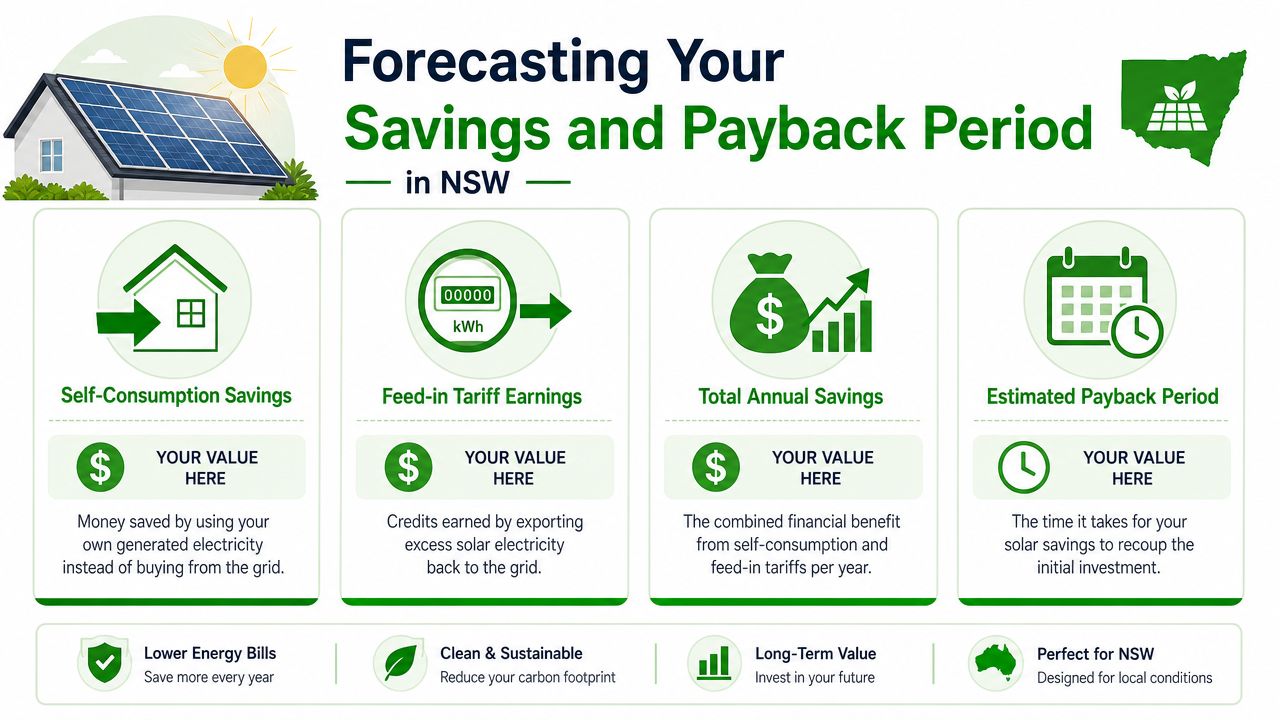
Forecasting Your Savings and Payback Period in NSW
Once the design is right, the conversation shifts from price to return. That's the part many buyers should focus on first.
In NSW, that return is getting harder to ignore. Default market offer electricity prices in NSW rose by roughly 19% to 23% for 2024–25 depending on network area, and Sydney households saw annual bill increases measured in the hundreds of dollars, according to this discussion of NSW electricity price rises and solar relevance. The same source notes that the ACCC has reported solar households can substantially reduce grid imports.
Where the savings actually come from
Most solar savings come from two channels, but they aren't equal.
Self-consumption is the big one. This means using the electricity your system generates at the moment it's being produced, instead of buying that power from the grid. If you run appliances, cooling, business equipment, or EV charging during solar hours, the value tends to improve.
Feed-in tariff credits are the second piece. When your system exports excess electricity, your retailer may credit you for that exported energy. It still helps, but for most households the stronger value usually comes from using more of your own generation on-site.
A simple comparison makes the point:
| Savings driver | What it means in practice |
|---|---|
| Self-consumption | You avoid buying retail electricity for that portion of use |
| Export credits | You receive bill credits for surplus generation sent out |
| Better sizing | The system matches your habits rather than chasing headline capacity |
| Load shifting | You move suitable usage into solar-producing hours |
What affects payback
Payback period isn't a mystery number. It's the time the system takes to recover its cost through energy savings and credits. The exact timeline varies by property, but the inputs are straightforward.
- Your retail electricity rate affects how valuable each avoided grid unit is.
- Your self-consumption level often has the biggest effect on annual savings.
- System design quality determines how much useful generation you get.
- Future usage changes can improve or weaken the outcome depending on whether the design anticipated them.
For Australian households, broader market context matters too. CSIRO's latest GenCost analysis reports that utility-scale solar PV remains one of the lowest-cost new-build generation options in the National Electricity Market, with estimated long-run costs of roughly A$40 to A$65/MWh depending on financing assumptions and site quality, according to this summary of GenCost solar economics. That doesn't tell you your rooftop payback directly, but it supports the wider case that solar generation remains competitive.
How to judge a quote properly
The best quote isn't the one with the smallest upfront figure. It's the one that gives the clearest line between installation quality, expected production, self-consumption strategy, and long-term reliability.
A solar system pays back through behaviour as much as hardware. The design has to suit how the property uses energy.
If you're trying to assess timing, this guide on rising electricity prices and how to prepare gives useful context for why more NSW property owners are revisiting their grid dependence.
The practical takeaway is simple. If your quote doesn't explain how savings are created, it hasn't answered the core question.
Your Next Step to an Accurate Solar System Price
A real solar system price can't come from a generic webpage, a copied package list, or a rough guess over the phone. It comes from assessing the property properly.
That means checking the roof layout, switchboard, shading, expected usage, future plans, and whether battery or EV readiness should be built into the design. It also means understanding how the system will create value over time, not just what the equipment costs on installation day.
For most Sydney homes and businesses, the smartest move is to get a customized quote that explains the design logic, the component choices, the incentive treatment, and the likely savings pathway in plain language. That's the difference between buying solar and investing in it.
If you want an accurate next step rather than another vague estimate, book a proper consultation through Interactive Solar's contact page.
If you want straight advice, a custom design, and a transparent quote suited to your property, speak with Interactive Solar. As a family-owned NSW team with in-house installation capability, they can assess your site properly and help you choose a solar solution built for long-term value, not just a cheap headline number.
Make Interactive Solar a preferred source in Google
One click tells Google to surface our articles more often in Top Stories, AI Overviews and AI Mode.