Skydome Skylights Sydney: Your 2026 Guide
Last updated:
A lot of Sydney homeowners ask the wrong first question.
They ask, “Should I get a skylight?” when the better question is, “If I'm cutting into my roof, what upgrade gives me the best mix of light, comfort, and lower running costs?”
That shift matters. A skylight can make a dark hallway feel liveable again. It can also become a heat entry point, a condensation problem, or a poor trade if your real goal was lower bills. Roof work is never just cosmetic. It affects temperature, moisture control, and what else you can do with that roof later, including solar, battery storage, EV charging support, and ventilation.
If you're researching Skydome skylights in Sydney, that's a sensible place to start. Skydome is a known Australian name. But don't stop at brand recognition. Judge the decision as a whole-of-roof choice.
Considering Skydome Skylights for Your Sydney Home?
Natural light is attractive for a reason. Dark internal bathrooms, corridors, laundries, and stairwells are unpleasant to use. A skylight can fix that fast.
Skydome is also not some unknown import. The brand's own materials state it was established in 1976, with a major base in Seven Hills, Sydney, and products designed for Australian roof profiles and conditions, which is why it has long been treated as a benchmark in local daylighting (Skydome background and Sydney footprint).
That history matters, but it doesn't answer the key homeowner question. Is a skylight the smartest roof upgrade for your house, or just the most visually obvious one?
Start with the room, not the product
Before choosing any skylight, identify what you want to fix:
- Darkness during the day means you need better daylight delivery.
- A hot, stuffy room points more toward ventilation.
- High electricity bills usually point first to solar.
- All three at once usually require a combined strategy, not a single product.
Jumping straight to product brochures is a common misstep. That's backwards. The room's function, roof layout, ceiling cavity, orientation, and your existing summer comfort problems should drive the decision.
Practical rule: If your main complaint is power bills, don't start with skylights. Start with the roof upgrades that directly cut electricity use or offset grid reliance.
Think of the roof as limited real estate
Every roof penetration and every roof-mounted product competes for the same space. Skylights, solar panels, vents, flues, and service runs all affect each other. That's why a skylight decision should be checked against your broader roof plan.
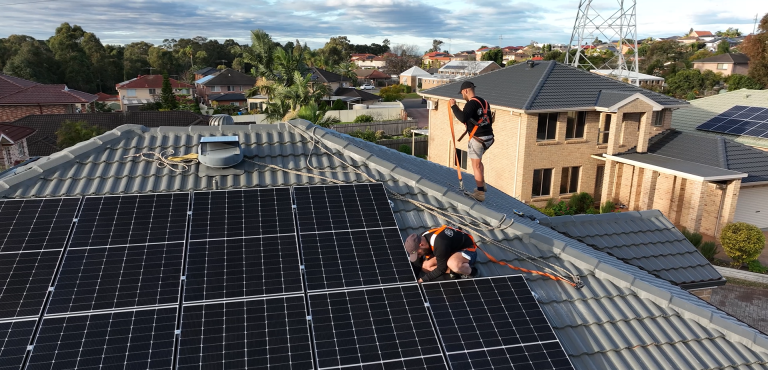
If you're looking at examples of how different roof upgrades sit together in real homes, a visual gallery helps more than generic advice. Browse completed roof energy projects and pay attention to panel layout, ventilation placement, and how uncluttered roofs perform better over time.
My advice for Sydney homes
If you love the idea of natural light, fine. Keep it on the table.
But don't let “I want more daylight” override the bigger issues of heat gain, waterproofing risk, and lost solar panel space. In Sydney, where summer comfort and electricity costs are already front-of-mind, a roof opening should earn its place.
An Overview of Skydome Skylight Options
Skydome skylights in Sydney generally fall into three practical categories. Each solves a different problem, and each comes with different thermal consequences.
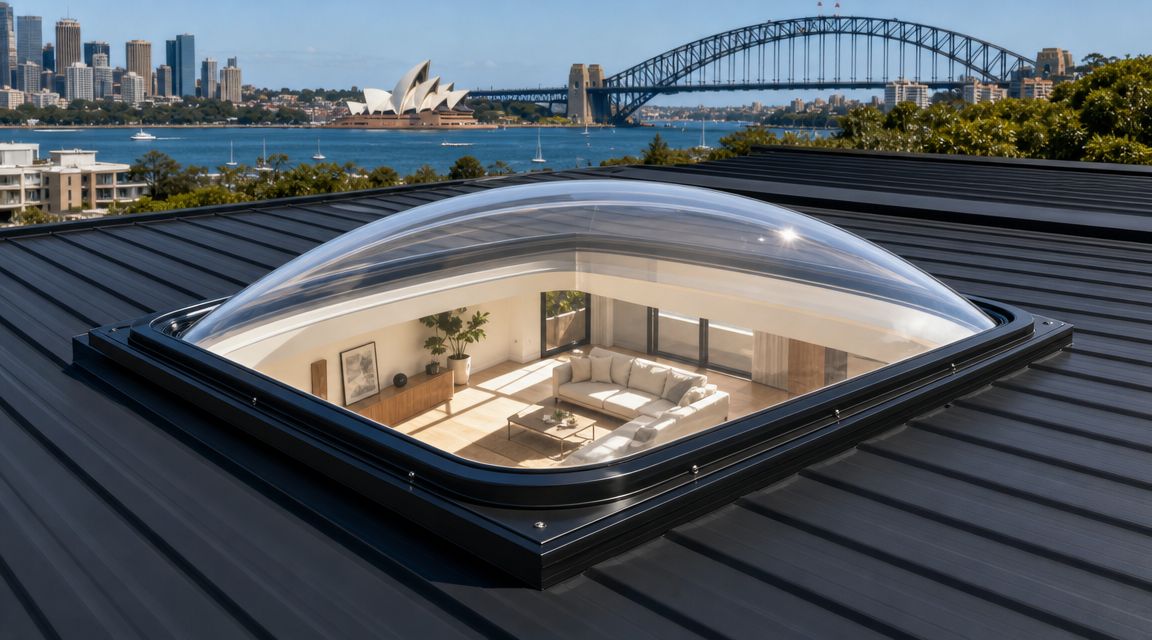
Traditional dome skylights
These are the classic raised units many Australians recognise immediately. They're common on older homes and practical where the goal is straightforward daylighting rather than a flush architectural look.
The main attraction is light spread. Dome-style units can throw daylight broadly into a space, especially when paired with a ceiling diffuser. The trade-off is that dome systems are often part of a simpler roof penetration approach, so the final result depends heavily on shaft length, sealing, and the quality of installation.
Flat glass skylights
If you want a cleaner appearance and stronger energy credentials, this is the category to take seriously. Skydome's glass skylight range is the one with the clearest measurable performance claims.
Skydome glass skylights carry a Five Star Energy Rating, use Low-E double glazing, and distributor material says they're tested to Australian standards and offer 99% UV blockout (Skydome glass skylight performance details).
That combination matters in Sydney because it addresses three common homeowner concerns:
| Feature | Why it matters in Sydney |
|---|---|
| Low-E double glazing | Helps control heat transfer better than simpler glazing approaches |
| Five Star Energy Rating | Gives you a concrete benchmark instead of vague “efficient” marketing |
| 99% UV blockout | Helps protect interiors from fading and reduces solar exposure concerns |
Tubular daylighting devices
These aren't the same as a large feature skylight. They're designed to bring daylight into enclosed or awkward spaces through a reflective tube. For many hallways, walk-ins, and internal bathrooms, they're often the more practical answer because they need less visual and structural commitment.
They also tend to suit homes where the roof cavity doesn't allow a broad shaft, or where you want daylight without making the ceiling opening the centrepiece of the room.
The best skylight isn't the one that lets in the most light. It's the one that solves the room problem with the least penalty elsewhere.
What to prioritise when comparing options
Don't get distracted by appearance alone. Compare the following first:
- Glazing quality. Glass with better thermal control generally beats basic glazing when comfort matters.
- UV control. Strong UV reduction is worth having in bright Sydney conditions.
- Roof compatibility. A product that suits Australian roof profiles matters more than showroom styling.
- Ceiling shaft requirements. A product can perform well on paper and still disappoint if the shaft design is poor.
- Your purpose. Large feature light, modest daylight boost, or low-risk retrofit are not the same brief.
My opinion is simple. If you want a premium daylight opening in a frequently used room, focus on the glass range and its thermal specs. If you're brightening a small dark zone, tubular daylighting often makes more sense than a bigger skylight.
Installing Skylights on Common Sydney Roof Types
A good skylight can still become a bad roof job.
That's because skylight performance isn't only about the product. It's about how the installer handles the roof covering, water path, pitch, and ceiling cavity. In Australia, skylight installation must satisfy the National Construction Code performance framework, and for Sydney conditions the major technical issue is proper management of rain, solar heat, and condensation. The key point from Skydome technical material is blunt. Correct flashing geometry is the main defence against water ingress, more than the skylight unit itself (NCC and flashing guidance for skylight assemblies).
Tiled roofs need precise water paths
Terracotta and concrete tile roofs are common across Sydney suburbs. They can take skylights well, but only when the installer respects how water moves across the roof.
Tiles aren't a flat waterproof plane. Water tracks through overlaps, around profiles, and under pressure during storms. A skylight on tile needs flashing that sends water away cleanly, deals with wind-driven rain, and matches the tile profile instead of fighting it.
Colorbond roofs are cleaner, but not foolproof
Metal roofing often gives installers a more predictable surface, but mistakes still happen. Bad penetrations on Colorbond usually come from rushed detailing, poor upstand treatment, or failure to account for runoff concentration.
If the roof pitch is low, the installer has even less margin for error. Water will linger longer, and any weakness in flashing or sealing gets exposed quickly.
Sydney storms don't test the glazing first. They test the flashing, lap detail, and workmanship.
What I'd insist on before approving the job
For any skylight install, ask these questions:
- Who is detailing the flashing? Product quality doesn't rescue poor flashing.
- What roof material is being penetrated? Tile and metal roofs need different approaches.
- How is condensation being managed? This is often ignored until stains appear.
- How long is the shaft? Long shafts complicate thermal performance and finishing.
- Who takes responsibility if another roof-mounted system is installed later? Solar work, antenna changes, and repairs can interact badly with poor skylight placement.
If you want a useful reference on workmanship standards and roof integration, this guide to professional skylights installation is worth reading for its installation-first perspective.
My advice is blunt. Don't buy a skylight until you're satisfied with the installer's roof detailing plan. In Sydney, the roof opening is the risk. Not the showroom display.
The Real Cost of Natural Light Heat Gain and Loss
A skylight is a window in your roof. Treat it that way.
That means it does two things at once. It brings in daylight, which can reduce the need for electric lighting during the day. It also changes how heat moves through the building envelope. In Sydney, that second part is where many homeowners make a poor call.
The Australian Your Home technical guidance points to the core trade-off. Skylights can reduce lighting demand, but long or poorly insulated shafts can increase heat loss or heat gain. If the shaft is badly detailed, the thermal penalty can wipe out the lighting benefit (Australian skylight energy efficiency guidance).
Here's a useful explainer before going further:
Why the shaft matters as much as the skylight
Homeowners tend to focus on the roof unit. I pay close attention to the light shaft because that's where many real-world losses show up.
A long shaft through a hot roof cavity can behave like an unwanted transfer path. If it isn't properly sealed and insulated, you can end up with:
- Extra summer heat entering the room
- Greater winter heat loss
- Condensation risk around cooler surfaces
- Reduced comfort even when the room looks brighter
That's the trap. The room feels improved visually, but performs worse thermally.
Daylight savings are real, but limited
Yes, a skylight can reduce the need to flick on lights during the day. That's useful, especially in enclosed circulation spaces.
But lighting is only one part of household energy use. If the skylight also adds cooling load in summer, the net benefit may be weaker than people expect. This is why I tell clients to compare “saved lighting” against “added thermal burden”, not just admire the daylight effect.
A bright room that needs more air conditioning isn't automatically an efficiency upgrade.
Ask the right question
Don't ask, “Will this make the room lighter?”
Ask, “Will this room be cheaper and more comfortable to use after the roof is opened?”
If you're trying to lower running costs, read practical ways to reduce electricity bills before locking in any roof penetration. It helps frame skylights properly, as one possible tool among several, not the automatic answer.
Skylights vs Solar Panels vs Roof Ventilation
These three upgrades get bundled together because they all involve the roof. But they do very different jobs.
For Sydney households dealing with rising electricity prices, the actual choice isn't “Do I like skylights?” It's whether a skylight gives a better outcome than a solar or ventilation upgrade when your goals are lower bills and better summer comfort. That's why this decision should be treated as an energy-performance calculation, not a style decision dressed up as efficiency (discussion of skylights versus broader energy outcomes).
If your goal is lower electricity bills
Solar panels are the obvious winner.
A skylight may cut daytime lighting use in one part of the house. Solar changes the supply side of the equation by generating power on your roof. If the reason you started looking upward was bill pressure, solar addresses the problem more directly than daylighting does.
A skylight can still be worth doing, but not as your first move if cost reduction is the brief.
If your goal is a cooler house in summer
Roof ventilation is usually the better first tool.
Skylights can introduce or amplify solar heat gain depending on design and placement. Ventilation is meant to do the opposite. It helps move trapped heat and moisture out of the roof space so the home doesn't fight such a large heat load from above.
If summer discomfort is your biggest complaint, start with roof ventilation options for Sydney homes, then decide whether daylighting still needs to be added.
If your goal is a dark internal area
Here, skylights or tubular daylighting earn their keep.
A dark hallway, windowless ensuite, or internal laundry often can't be solved by solar panels or ventilation alone. You need daylight delivery. The mistake is assuming every daylight problem needs a large traditional skylight. Sometimes a smaller, lower-risk daylighting solution does the job better.
Side-by-side comparison
| Priority | Skylights | Solar panels | Roof ventilation |
|---|---|---|---|
| Natural light | Best fit | Doesn't address it | Doesn't address it directly |
| Bill reduction | Indirect and limited | Strongest fit | Indirect |
| Summer comfort | Can help visually, may hurt thermally | Helps if powering cooling loads | Strong direct fit |
| Roof penetration risk | Yes | Yes | Yes |
| Best use case | Dark internal spaces | High power bills | Hot roof cavities and stuffy homes |
My recommendation by homeowner type
- Bills are your pain point. Prioritise solar.
- Bedrooms stay hot into the evening. Prioritise ventilation.
- A hallway or bathroom is gloomy all day. Consider a skylight or tube.
- You want all of the above. Plan the roof as one integrated system, not three separate purchases.
If you want a simple conceptual primer on sunlight use in buildings, this article on your guide to active and passive solar is a useful background read.
My view is firm. Most Sydney homeowners who start by shopping for skylights are trying to solve either an energy problem or a heat problem. In those cases, solar or ventilation often delivers the stronger return. Skylights make sense when daylight itself is the essential outcome.
How to Combine Skylights with Solar and Ventilation
The smartest roof upgrades rarely come from choosing one product in isolation. They come from deciding what each part of the roof should do.
A skylight handles daylight. Solar handles electricity generation. Ventilation handles trapped heat and moisture. Once you separate those functions, planning gets easier and the compromises become obvious.
A sensible whole-of-roof approach
If a skylight is important to you, keep it. Just don't let it dominate the entire roof plan.
A practical sequence looks like this:
Map roof space first
Work out where solar panels need the cleanest, least-shaded areas. Don't drop a skylight into premium panel space if bill reduction matters.Place ventilation where heat builds
Ventilation should respond to roof cavity conditions, not just whatever space is left over after other products are chosen.Choose the smallest skylight solution that achieves the daylight outcome
If a tubular unit solves the darkness issue, that may preserve more roof area and reduce thermal disruption.Treat the shaft as part of the energy system
Sealing and insulating the shaft matters. A pretty ceiling diffuser doesn't fix poor thermal detailing above it.
When combinations work well
Some of the best results come from pairings, not stand-alone products:
- Skylight plus ventilation works well where daylight is needed but summer heat is already a problem.
- Skylight plus solar suits households that want design improvement without losing sight of energy performance.
- Solar plus battery plus selective skylighting can make sense where self-consumption and comfort matter more than a purely aesthetic roof plan.
Good roof design gives each opening a job. Bad roof design lets products compete with each other.
Don't design one upgrade that undermines the others
This happens all the time. A homeowner installs a large skylight for visual impact, then later discovers panel placement is compromised. Or they add daylighting to a hot upper-storey zone without addressing roof heat buildup, so the brighter room becomes less comfortable.
If your roof is likely to carry more than one technology, review integrated options such as solar panels and solar batteries in Sydney before committing to skylight positions. The exact product mix varies, but the planning principle is the same. Roof space should be allocated deliberately.
My recommendation is simple. If daylight is essential, choose the least disruptive skylight solution that still does the job, then protect comfort with ventilation and protect running costs with solar.
Planning Your Sydney Roof Upgrade
A skylight can be a good decision. It's just not automatically the best one.
Skydome has genuine local credibility, and that matters. But the brand is only one part of the decision. The bigger issue is whether a skylight helps your home more than the alternatives once you account for summer comfort, roof risk, future solar potential, and running costs.
Use this filter before you approve any roof modification:
- If you need daylight in a dark internal room, a skylight or tubular daylighting system may be justified.
- If you need lower bills, solar should usually come first.
- If you need a cooler, less stuffy house, ventilation often deserves priority.
- If you want the best long-term outcome, combine the right technologies instead of forcing one product to solve every problem.
There's also a timing issue. Roof work is easier to coordinate when you think ahead. If you expect to add solar later, or want to take advantage of available support, review NSW solar rebate information and related government incentives before finalising roof layout decisions.
The blunt version is this. Don't shop for a skylight the way you'd shop for a tap or light fitting. Your roof is your weather shield and your energy platform. Any cut into it needs to improve the house, not just brighten a corner.
If you want a practical assessment of whether skylights, solar, batteries, EV charging, roof ventilation, or a combination makes the most sense for your Sydney property, speak with Interactive Solar. Their team can help you plan the roof as a complete system so you improve natural light, comfort, and bill control without creating conflicts between upgrades later.
Make Interactive Solar a preferred source in Google
One click tells Google to surface our articles more often in Top Stories, AI Overviews and AI Mode.