Residential Solar Installation Sydney: 2026 Cost & Sizing Guide
Last updated:
A residential solar installation sydney homeowner budgets for typically costs between $5,000 and $8,500 after the federal STC rebate for a common 6.6kW to 10kW system, with most households paying it back in 3.5 to 5 years through lower electricity bills. The exact price depends on system size, panel quality, roof complexity and whether you add battery storage. This guide breaks down real 2026 pricing, rebate calculations, sizing advice and the installation process so you can budget accurately and choose the right system for your home.
Key Takeaways
- A 6.6kW to 10kW residential solar installation in Sydney typically costs $5,000 to $11,000 after the federal STC rebate is applied.
- Most Sydney households pay back their system within 3.5 to 5 years through electricity bill savings of $1,800 to $2,800 a year.
- A 6.6kW system generates around 45 STCs worth roughly $1,700 to $1,800, while a 10kW system generates around 69 STCs worth roughly $2,600 to $2,800.
- Sizing depends on household usage, with 6.6kW to 8.8kW suiting most 3-4 person families and 10kW to 13.2kW suiting larger homes or EV owners.
- Most installations are completed in a single day, with the full process from quote to switch-on taking 2 to 4 weeks.
Residential Solar Installation Sydney: What Drives the Price?
Pricing for a residential solar installation in Sydney in 2026 generally falls into these ranges, after the federal Small-scale Technology Certificate (STC) rebate is applied at point of sale:
- 6.6kW system: $5,000 to $8,000 installed, suited to a 3-4 person household with average daytime usage
- 10kW system: $7,500 to $11,000 installed, suited to larger homes, pool pumps or families planning an EV
- 13.2kW system: $9,500 to $13,500 installed, suited to homes with high daytime consumption or plans to add a large battery
Where you land in each range depends on panel brand (premium Tier 1 modules such as Aiko or REC cost more than budget imports), roof pitch and access, switchboard upgrades, and whether you choose a single-phase or three-phase inverter. Annual bill savings on a well-sized 6.6kW system typically run $1,800 to $2,800, which is what drives the 3.5 to 5-year payback windows most Sydney households see today.
How Many Solar Panels Do You Need for Your Sydney Home?
Sizing comes down to your daily electricity consumption, roof space and export limits set by your network. As a rough guide for Sydney households:
- Small household (1-2 people, low daytime use): 5kW to 6.6kW, roughly 13-17 panels
- Average family (3-4 people, some daytime use): 6.6kW to 8.8kW, roughly 17-22 panels
- Larger household or high daytime load (pool, aircon, EV): 10kW to 13.2kW, roughly 25-33 panels
Ausgrid and Endeavour Energy, the two main distribution networks across metropolitan and Western Sydney, cap standard single-phase inverter export at 5kW without special approval, which is why most homes with a 6.6kW to 10kW array still run a 5kW single-phase inverter or step up to three-phase for larger systems. A proper site assessment, including a roof inspection and a look at 12 months of your actual usage data, is the only reliable way to confirm the right size. Interactive Solar includes this assessment as part of every residential solar quote.
Sydney Suburbs and Network Areas We Service
A properly scoped residential solar installation Sydney wide needs to account for which network operator covers your street, because export limits and connection paperwork differ between them. Ausgrid covers most of the Sydney metro area including the Eastern Suburbs, Inner West, North Shore and Northern Beaches. Endeavour Energy covers Western Sydney, Parramatta, Blacktown, Liverpool and the Blue Mountains corridor. Both networks allow standard residential exports up to 5kW on a single-phase connection without special approval, and both require a connection application to be lodged before your system is switched on. Interactive Solar handles this paperwork directly with the network on your behalf, so you are not left chasing approvals yourself.
STC Rebates: How Much Do You Actually Save?
The federal government’s Small-scale Renewable Energy Scheme (SRES) is the main upfront discount on any residential solar installation in Sydney, applied directly at the point of sale rather than claimed later. It works by creating Small-scale Technology Certificates (STCs), calculated as: system size (kW) × zone rating × deeming period, rounded down to a whole number.
Sydney sits in Zone 3, with a rating of 1.382. For 2026, the deeming period has stepped down to 5 years (from 6 in 2025), which reduces the certificate count each year as the scheme winds toward its scheduled 2030 close. A worked example for a common system:
- 6.6kW system: 6.6 × 1.382 × 5 = approximately 45 STCs, worth roughly $1,700 to $1,800 at current certificate prices
- 10kW system: approximately 69 STCs, worth roughly $2,600 to $2,800
Because the deeming period drops every year and certificate prices fluctuate with market supply, the rebate value on any given system size gets smaller over time. Installing sooner rather than later locks in a larger discount. Only systems using Clean Energy Council approved products, installed by a Solar Accreditation Australia-accredited installer, are eligible to generate STCs, which is why choosing a properly accredited installer like Interactive Solar protects both your rebate and your system’s compliance.
Payback Period and Long-Term Savings
Most Sydney households recover the cost of a residential solar installation within 3.5 to 5 years, driven by three factors: how much of your solar generation you use directly in the home (self-consumption), your retail electricity rate, and your feed-in tariff for exported power.
A household that shifts high-draw appliances like dishwashers, pool pumps and EV charging into daylight hours can lift self-consumption from a typical 30-40% up toward 60-70%, which meaningfully shortens payback. Over a panel’s 25-year performance warranty, a well-installed 6.6kW system in Sydney can be expected to generate lifetime savings well in excess of $35,000 to $45,000, even accounting for gradual panel degradation of around 0.3-0.5% per year for premium Tier 1 modules.
Time-of-use electricity plans are becoming more common across Sydney retailers, and they change the payback maths further. Households on a time-of-use tariff who run pool pumps, dishwashers and washing machines during solar-generation hours rather than in the evening peak see a noticeably faster return, because they avoid buying back expensive peak-rate power in the evening. A residential solar installation Sydney households pair with simple load-shifting habits, even without a battery, routinely outperforms the basic payback estimates quoted by comparison sites.
Residential Solar Installation Sydney: Export Limits, Feed-in Tariffs and Rebates in 2026
Three rules shape the return on a residential solar installation Sydney homeowners should check before signing. First, network limits: Ausgrid allows single-phase sites up to a 30kVA inverter if exports stay within 10kW, while Endeavour Energy applies a standard 5kW per phase export limit, with Flexible Exports lifting eligible customers to 10kW.
Second, feed-in tariffs are low. The IPART benchmark for 2026-27 is 3.4 to 6.5 c/kWh, against grid import prices of roughly 30 to 40 c/kWh. Every kWh you use at home is worth several times a kWh you export, so size the system around daytime usage and consider a battery.
Third, installer accreditation moved from the Clean Energy Council to Solar Accreditation Australia in May 2024. The CEC still maintains the approved product lists and the Solar Retailer Code of Conduct. You can verify STC rules on the Clean Energy Regulator site.
3.4 to 6.5 c/kWh is the 2026-27 IPART benchmark feed-in tariff in NSW, versus roughly 30 to 40 c/kWh to buy power from the grid. Source: IPART.
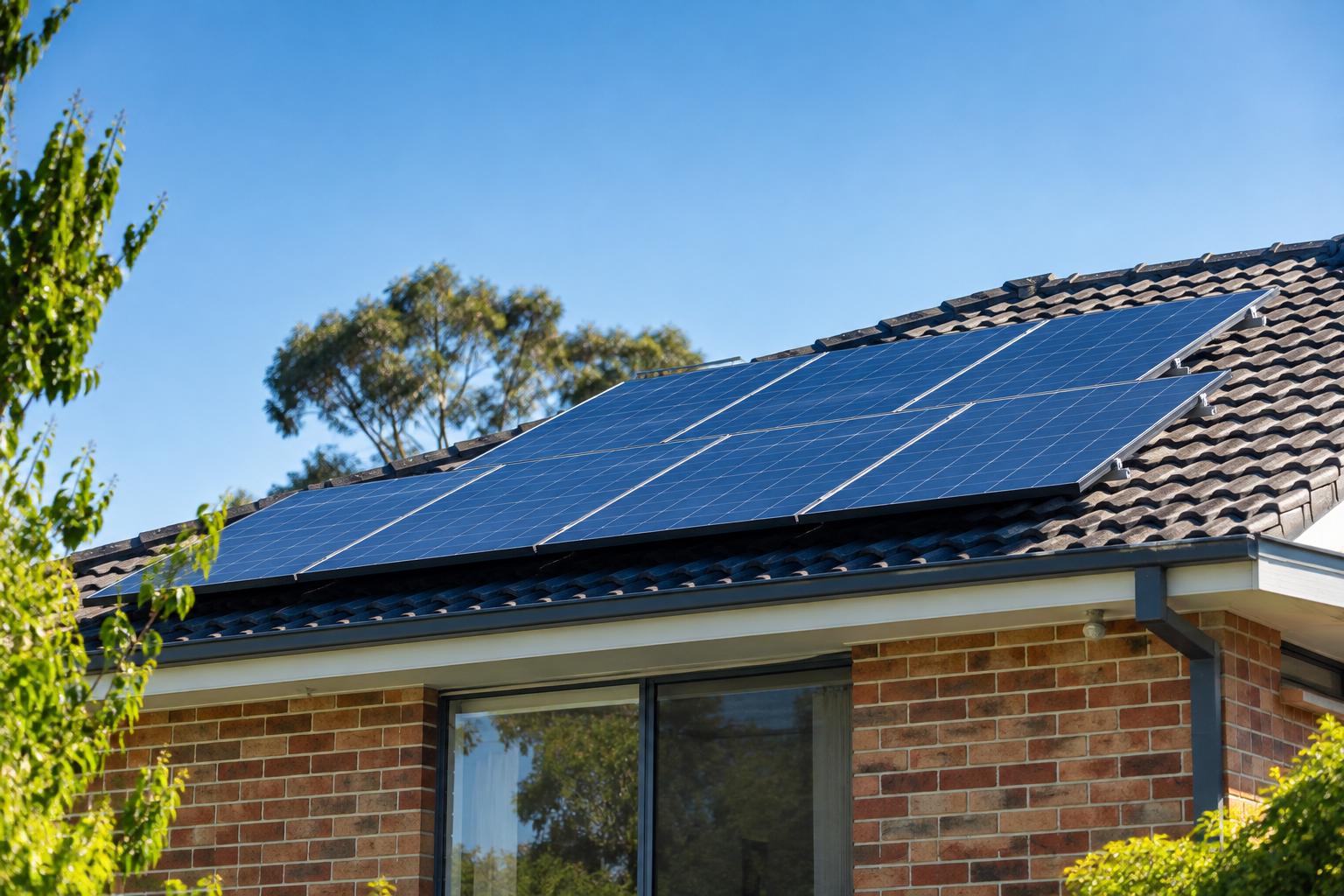
Choosing Panels, Inverter and Installer for Your Residential Solar Installation
Panel quality affects both output and longevity. Choose brands with strong local support and a clear Australian warranty process, which matters if you ever need a claim in 10 or 15 years.
Tier 1 status, as tracked by Bloomberg NEF, reflects a manufacturer’s financial strength and manufacturing scale rather than panel efficiency alone, but in practice it correlates closely with the brands that still exist to honour a 25-year warranty. Budget panels from smaller, non-Tier 1 manufacturers can look identical on a spec sheet, yet carry real risk if the manufacturer exits the market before your warranty period ends.
Beyond the panel brand, three things separate a good installation from a mediocre one:
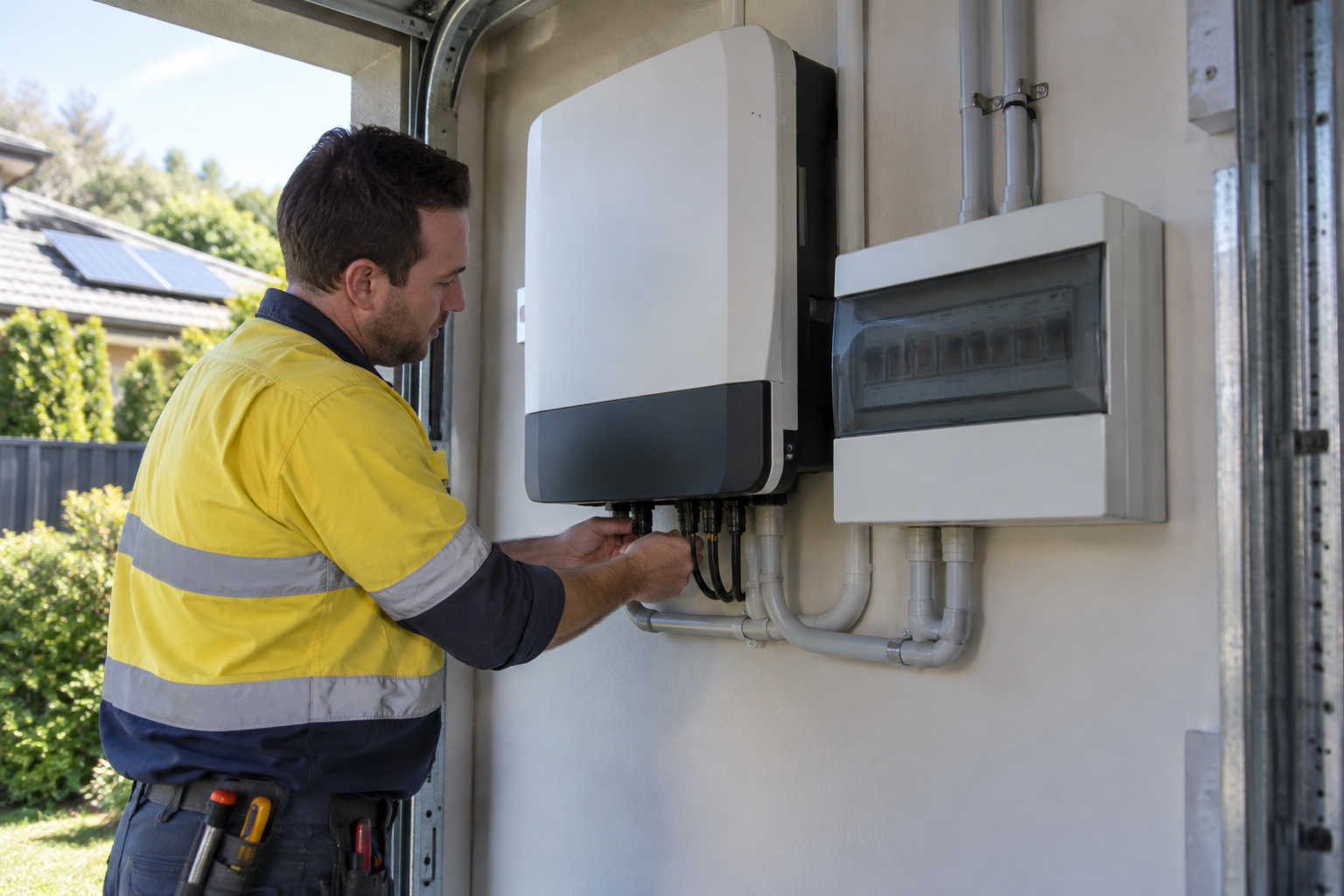
- Inverter sizing and type: a hybrid inverter (battery-ready) future-proofs the system even if you are not adding storage on day one
- Racking and roof penetration quality: correctly flashed penetrations and quality rail systems prevent leaks and hold up in Sydney’s storm season
- Installer accreditation: only a Solar Accreditation Australia (SAA) accredited installer using Clean Energy Council (CEC) approved products keeps your system eligible for STCs and manufacturer warranties
Interactive Solar only installs Tier 1 panels and CEC-approved inverters, and our team designs each system around your actual usage pattern rather than a generic template. You can compare specific product options through our commercial solar and residential solar pages, or view completed projects in our gallery.
The Residential Solar Installation Sydney Process, Step by Step
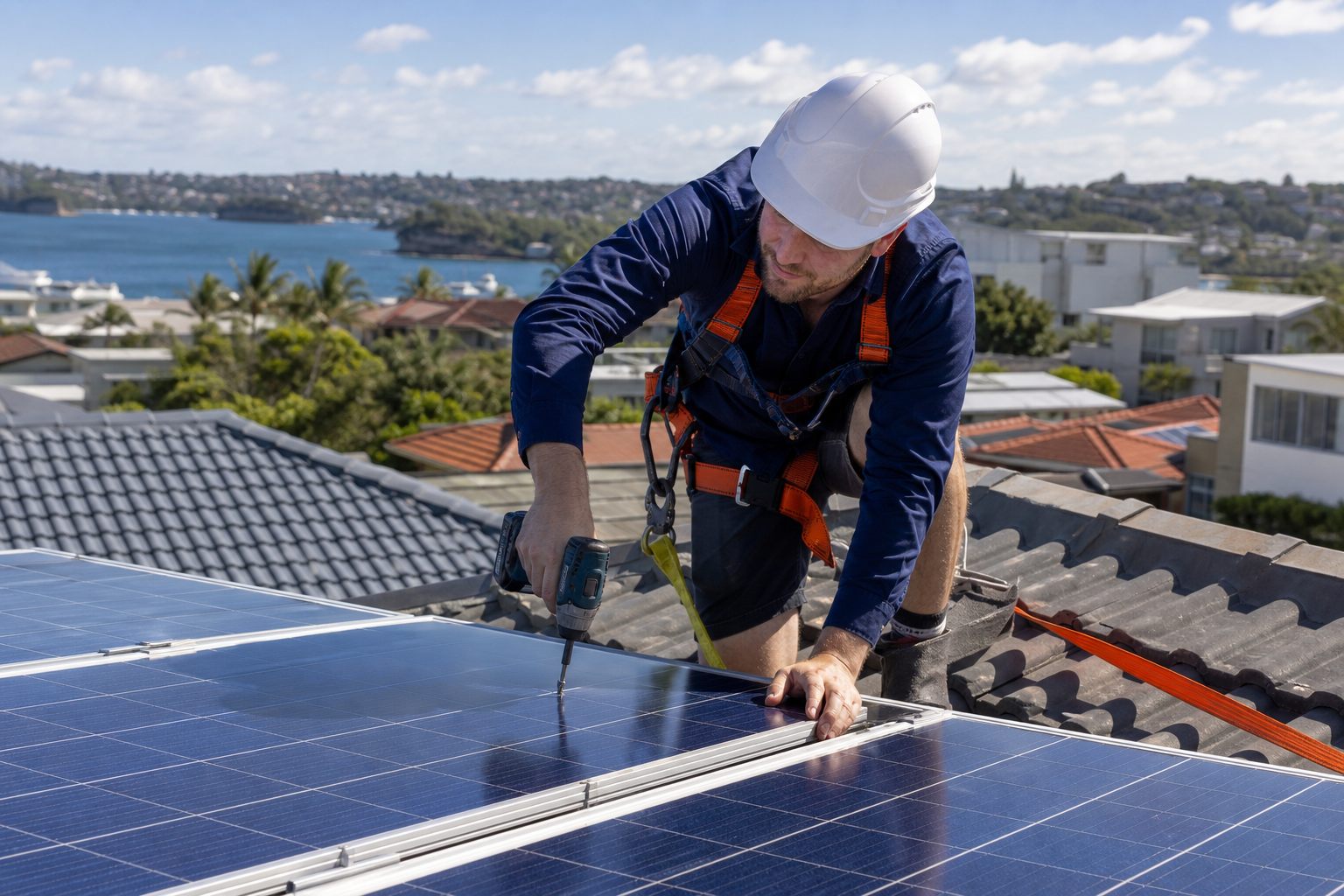
A typical residential solar installation Sydney project runs through five stages:
- Site assessment and quote: roof inspection, shading check, usage analysis and a fixed-price proposal, usually completed within a few days
- Design and paperwork: system design, network connection application to Ausgrid or Endeavour Energy, and STC assignment paperwork
- Installation day: most 6.6kW to 10kW residential jobs are completed in a single day by a licensed, SAA-accredited crew
- Grid connection and inspection: your network operator approves the connection, and an independent inspection confirms compliance with AS/NZS 5033 and AS/NZS 4777
- Monitoring handover: you’re set up with a monitoring app so you can track generation, self-consumption and export in real time
Most projects go from signed quote to switched-on system within 2 to 4 weeks, depending on network approval timeframes.
Adding a Battery Later
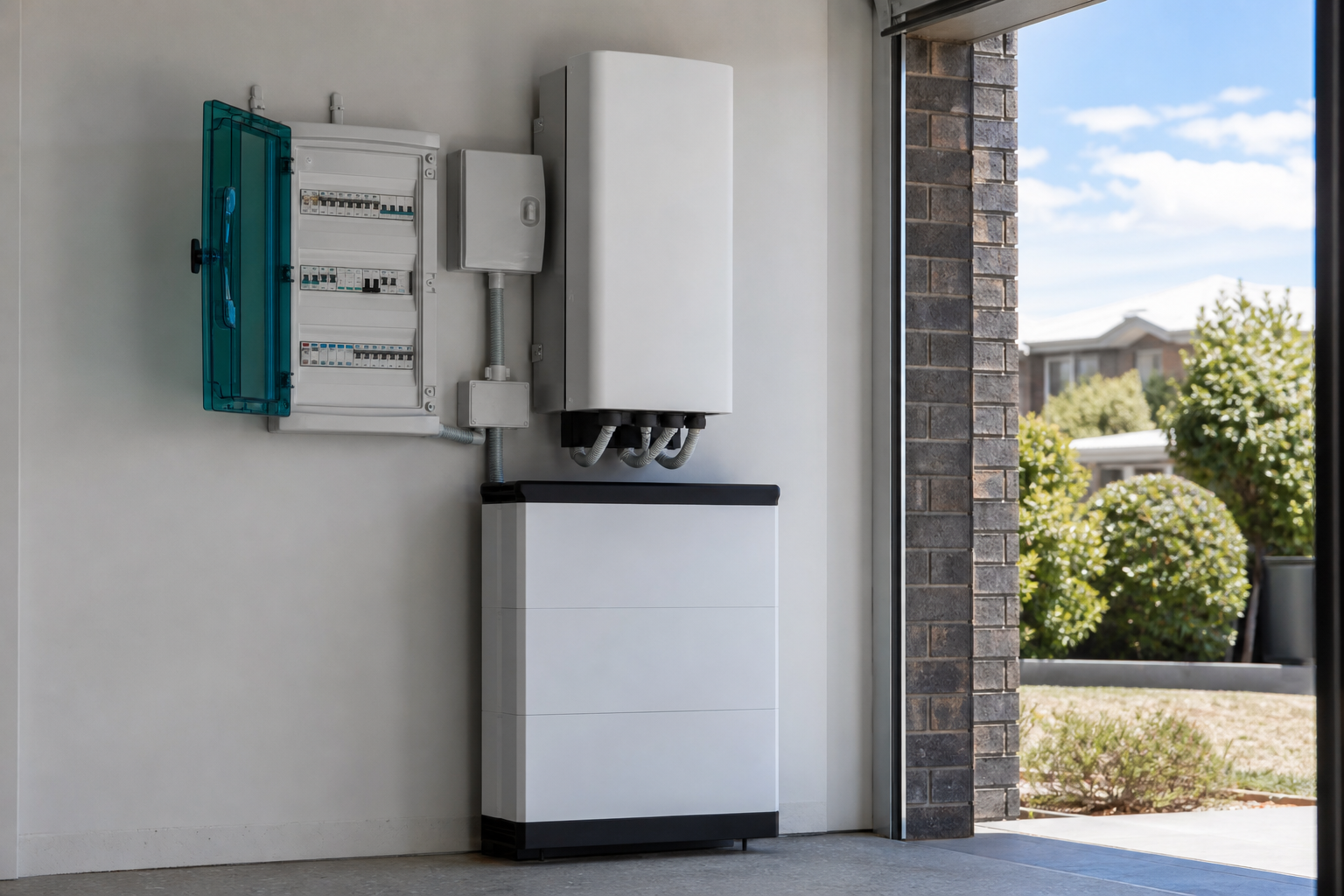
You do not need to install a battery on day one. If a hybrid inverter is fitted during your initial installation, adding a battery later is a straightforward retrofit. The federal Cheaper Home Batteries Program, which began in mid-2025 and continues through 2026, applies a tiered rebate on eligible battery capacity, meaningfully cutting the upfront cost of storage. Pairing solar with a battery through our solar batteries service lets you use more of your own generation after sunset instead of exporting it for a low feed-in tariff. Many Sydney households are now also considering an EV charger as part of the same long-term energy plan.
Battery incentives that stack with solar in NSW
The federal Cheaper Home Batteries Program gives a tiered, STC-style discount on 5 to 100kWh batteries paired with solar, using CEC-approved equipment installed to AS/NZS 5139 by a battery-endorsed installer. NSW adds a virtual power plant incentive that can stack from 1 July 2026, with terms that vary by provider. The NSW Home Energy Saver scheme offers interest-free loans up to $15,000 for eligible owners, and a discount of up to $4,000 for low-income households (apply for the discount before the loan to use both).
Financing a Residential Solar Installation Sydney Wide
Most homeowners do not pay the full cost of a system in cash upfront. NSW’s Home Energy Saver program offers interest-free loans of up to $2,400 for eligible households to help cover solar and battery upgrades, and several major banks now offer dedicated green home loans with lower interest rates for verified solar and battery purchases. Retailers including Interactive Solar can also arrange third-party finance with terms typically spanning 3 to 7 years, structured so that monthly repayments sit close to, or below, the electricity bill savings the system generates from day one.
Before committing to any finance offer, compare the total cost of the loan against a straight cash purchase, and check whether the provider requires the finance company to hold a caveat over your Certificate of Compliance. A reputable installer will walk you through these figures during your quote, not after your deposit is paid. You can view current offers on our solar specials page.
Why Homeowners Choose Interactive Solar
Interactive Solar has built its reputation across Sydney, Western Sydney, Parramatta, Blacktown and Liverpool on transparent, fixed-price quoting and in-house installation crews rather than subcontracted labour hire. Every residential solar installation Sydney homeowner receives a written system design showing expected annual generation, a full itemised STC rebate breakdown, and manufacturer warranty documentation before any deposit changes hands.
Our company background spans thousands of completed residential and commercial installations, and our Interactive Care program covers post-installation monitoring, cleaning reminders and warranty claim support long after the crew has left your roof.
Common Mistakes to Avoid
- Undersizing to save money upfront: a system too small for your usage stretches out payback and wastes valuable roof space
- Choosing panels on price alone: budget Tier 2/3 panels often carry weaker warranties and degrade faster, eroding savings over 25 years
- Skipping the hybrid inverter: a standard inverter is cheaper today but means a full inverter replacement if you add a battery later
- Using an unaccredited installer: work by an installer without SAA accreditation can void your STC eligibility and manufacturer warranty entirely
- Ignoring your export limit: oversizing beyond what your network allows without approval can lead to curtailment and lost generation
Sydney residential solar system sizes at a glance
| System Size | Installed Cost (after STC rebate) | STCs Generated | Best Suited For |
|---|---|---|---|
| 6.6kW | $5,000 to $8,000 | ~45 STCs ($1,700 to $1,800) | 3-4 person household, average daytime usage |
| 10kW | $7,500 to $11,000 | ~69 STCs ($2,600 to $2,800) | Larger homes, pool pumps, EV owners |
| 13.2kW | $9,500 to $13,500 | Not stated | High daytime consumption or large battery plans |
Frequently Asked Questions
How much does a residential solar installation cost in Sydney in 2026?
Most households pay $5,000 to $8,000 for a 6.6kW system and $7,500 to $11,000 for a 10kW system, after the federal STC rebate is applied at the time of installation.
How long does a residential solar installation take?
The physical installation is usually completed in a single day for most homes. Including design, network approval and inspection, the full process typically takes 2 to 4 weeks from signed quote to switched-on system.
What size solar system do I need for my Sydney home?
Most 3-4 person households do well with 6.6kW to 8.8kW. Larger homes, or those planning an EV or battery, often size up to 10kW to 13.2kW, but a proper usage-based assessment is the only way to be certain.
Do I need council approval to install solar panels in Sydney?
Most standard rooftop residential systems do not require council development approval, only network connection approval from Ausgrid or Endeavour Energy. Heritage-listed properties or unusual roof structures may need additional checks.
Can I add a battery to my system later?
Yes, provided a compatible hybrid inverter was installed originally. If your current inverter is not battery-ready, an inverter upgrade may be needed before storage can be added.
What happens to the STC rebate value over time?
The rebate reduces each year as the scheme’s deeming period steps down, with the program scheduled to close in 2030. Installing sooner locks in a larger discount than waiting.
Why choose Interactive Solar for a residential solar installation in Sydney?
Interactive Solar is an SAA-accredited installer using Tier 1 panels and CEC-approved inverters, with in-house design, installation and aftercare through our Interactive Care program. We size every system to your actual household usage, not a generic template, and our reviews reflect that approach.
Ready to get a fixed-price quote for your home? Contact Interactive Solar today for a free site assessment, or browse our current solar specials. You can also check the government’s official STC entitlement calculator from the Clean Energy Regulator to estimate your own rebate.
Make Interactive Solar a preferred source in Google
One click tells Google to surface our articles more often in Top Stories, AI Overviews and AI Mode.