AC Coupled Battery: Your Guide to Adding Storage in 2026
Last updated:
You’ve already done the first part right. You put solar on the roof, you’re generating through the middle of the day, and the system itself may still be working fine. But your bills haven’t stayed where you expected them to.
That usually happens for a simple reason. Most households use a lot of power before the sun is fully up and again after it drops. Cooking, heating or cooling, hot water boosting, pool pumps, entertainment, and EV charging often land outside the best solar window. So even with a healthy solar array, the grid still supplies the expensive part of your day.
For many NSW homeowners, the next logical step isn’t replacing the solar system. It’s adding storage in a way that works with what’s already on the wall. That’s where an ac coupled battery becomes a practical option.
Your Solar is Working But Your Bills Are Still High
A common retrofit job starts with a homeowner who says some version of this: “Our solar app looks good, but the bill still hurts.”
They’re often exporting plenty of power at lunchtime, then buying it back in the evening when the house is busiest. The original solar install may have made perfect sense at the time. What changed is the household. Kids got older, someone started working from home, an EV arrived, or tariff pressure made night-time imports more painful.

Before jumping to batteries, it’s worth checking whether the existing system is performing properly. Dirty panels, shading changes, and unnoticed faults can subtly reduce output. A practical reference like this Solar Panel Maintenance Checklist helps homeowners rule out the basics first.
Why the bill keeps landing at the wrong time
Solar panels do their best work when the sun is strong. Your retailer bills you hardest when your house needs power outside that window.
That mismatch is exactly why batteries matter. Storage shifts surplus solar into the parts of the day when you need it. For households trying to cut imported power, an ac coupled battery is often the cleanest retrofit path because it usually works with an existing solar setup instead of forcing a full rebuild.
Most bill shock in solar homes doesn’t come from poor generation. It comes from poor timing.
A battery won’t fix every problem. It won’t rescue undersized solar, severe shading, or wasteful loads that run all night. But when the core issue is “we make solar at the wrong time”, storage is the right conversation to have.
If your goal is reducing dependence on rising tariffs, this guide on how to reduce electricity bills is a useful companion to battery planning.
What Exactly Is an AC Coupled Battery
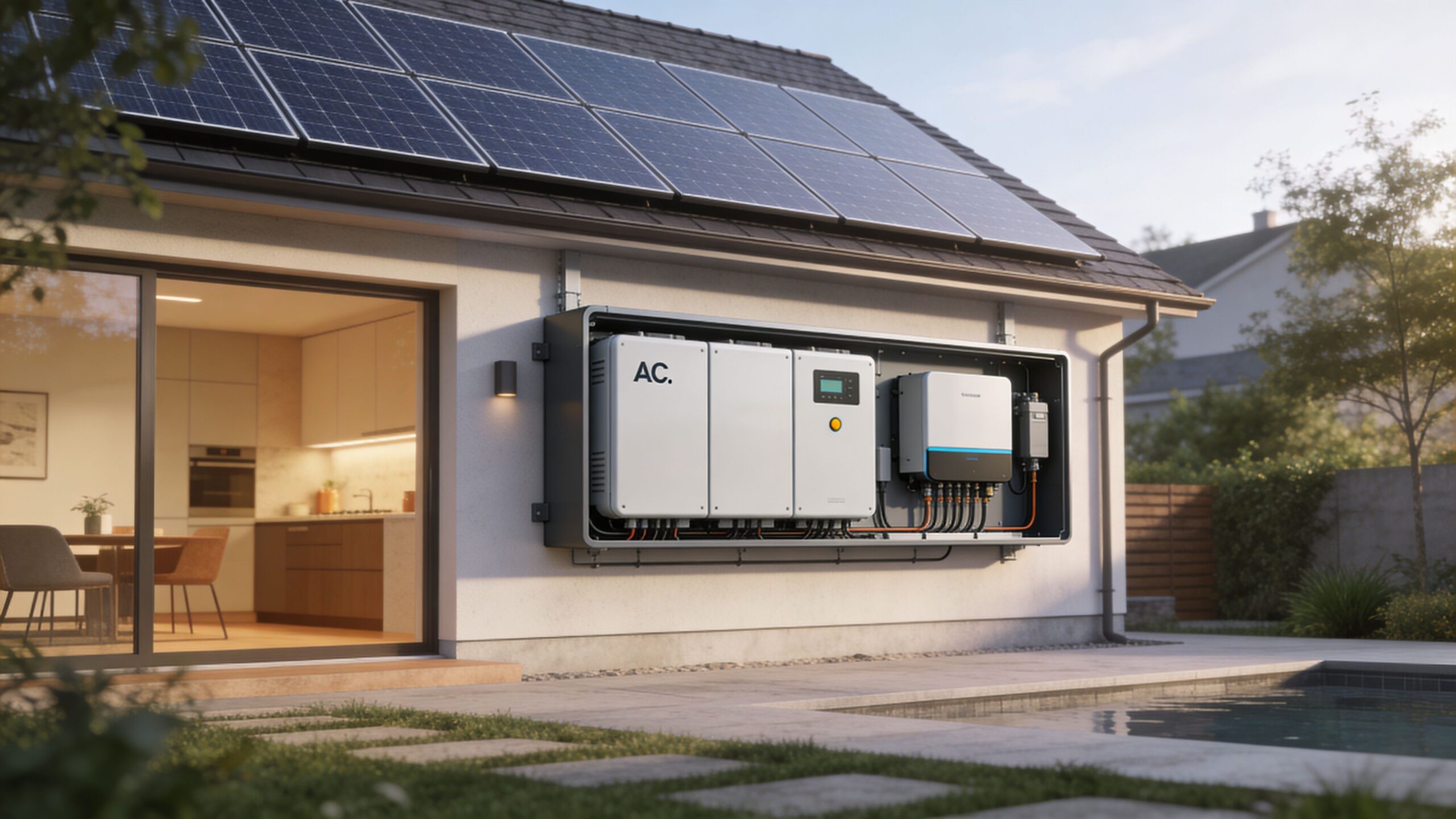
An ac coupled battery is a battery system added on the AC side of your home’s electrical system. In plain English, that means it sits alongside your existing solar inverter and switchboard rather than replacing how the panels are already wired.
The easiest way to think about it is a water system. Your solar panels are like rain collected on the roof. Your existing inverter is the plumbing that makes that water usable in the house. An ac coupled battery is like adding a smart storage tank to the property after the plumbing is already in place. It doesn’t ask you to rebuild the roof. It stores what would otherwise be wasted and sends it back when the house needs it.
The simple version
Your solar panels produce DC electricity. Your existing solar inverter converts that to AC electricity for the house.
An ac coupled battery adds a separate battery inverter. That battery inverter takes spare AC power, converts it for battery storage, then converts it back again when the battery supplies the home later.
That independent inverter is the key to why AC coupling is so popular in retrofits. The battery system can operate as its own controlled part of the installation, instead of trying to merge into the original solar hardware.
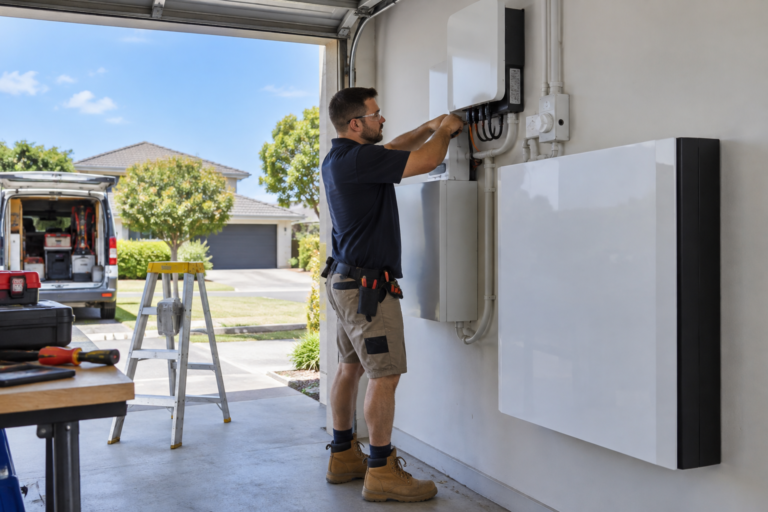
What’s actually on the wall
A typical retrofit usually involves a few core components:
- Your existing solar panels and inverter stay in place if they’re suitable.
- A battery unit stores the energy.
- A battery inverter manages charging and discharging.
- Monitoring and control hardware tracks home load, solar production, battery status, and grid flow.
- Switchboard work and protection equipment make the system compliant and safe.
This is why AC coupling suits homes with older but still serviceable solar systems. If the current inverter is doing its job, there’s often no technical reason to throw it out just to add storage.
Why homeowners like the concept
The appeal isn’t just technical. It’s practical.
You keep more of the original solar investment. The installation can be less disruptive than redesigning the whole array around a different architecture. And when the house changes later, such as adding an EV charger or shifting appliance schedules, the battery system can often adapt more easily on the AC side.
Practical rule: If the existing solar inverter is healthy and the main goal is storage, AC coupling is often the first option worth assessing.
That doesn’t make it automatically better in every situation. It means it solves a very specific problem very well. “I already have solar. I want to store more of what I generate. I don’t want unnecessary replacement work.”
That’s the retrofit sweet spot.
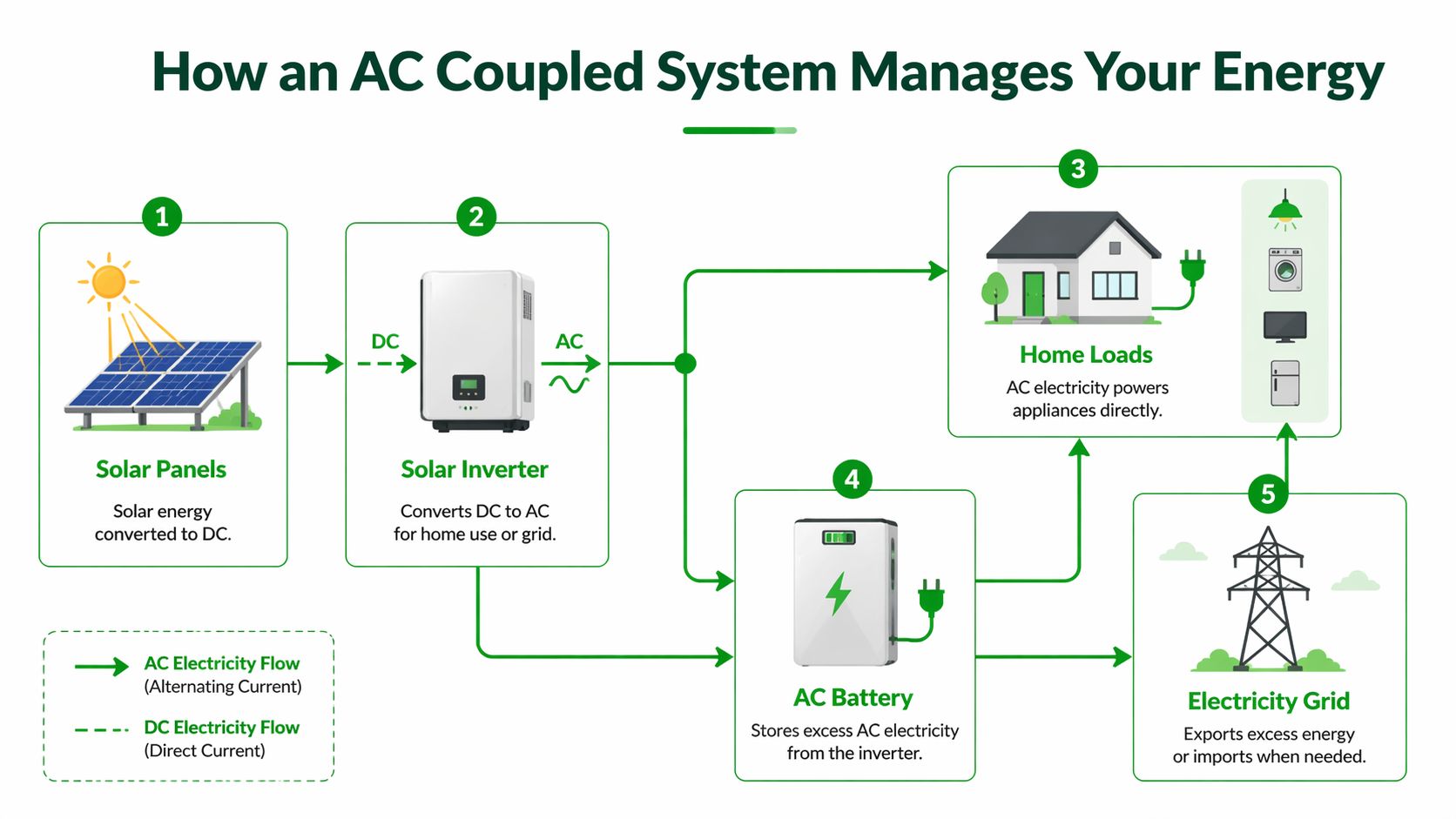
How an AC Coupled System Manages Your Energy
The best way to understand an ac coupled battery is to follow the power through a normal day. Once you see the path energy takes, the trade-offs make sense.
Morning and midday
Your solar panels start by generating DC power. That goes to the existing solar inverter, which converts it to AC power for immediate use in the home.
If the house is using that energy right away, appliances run directly from solar. Fridges, lights, daytime air conditioning, pool equipment, and similar loads can be covered first.
When production rises above what the house is consuming, the system has a choice to make. Instead of exporting all the excess to the grid, the battery inverter can direct surplus AC into the battery for storage.
What happens during charging
This is the part people often miss. The battery doesn’t store AC. It stores energy in battery form, so the battery inverter converts the excess AC back into a storable form for the battery.
Later, when the sun drops and the home still needs power, the battery inverter reverses the process and supplies usable AC back to the house.
That means an AC-coupled system involves multiple conversion steps:
- Solar panels generate DC
- Solar inverter converts DC to AC
- Battery inverter converts surplus AC for storage
- Battery inverter converts stored energy back to AC for home use
Those extra steps explain why efficiency matters in battery design.
Why round-trip efficiency matters
Verified Australian guidance puts round-trip efficiency for AC-coupled batteries at 90-94%, lower than 98% for DC-coupled setups because of the extra AC to DC and DC to AC conversions. Those conversions create 6-10% energy losses per cycle, which becomes relevant when households are trying to avoid peak tariffs that can reach 40-50¢/kWh in NSW according to this AC-coupled lithium battery guide.
That doesn’t mean AC coupling is inefficient in a practical sense. It means the design priority is different. You accept some conversion loss in exchange for retrofit flexibility and easier integration with an existing solar system.
Evening and overnight behaviour
When the sun fades, the battery supplies the home first until it reaches its discharge limit or reserve setting. If demand rises above what the battery can provide, the grid tops up the difference.
In a well-configured home, this shifts more of your own solar into the expensive parts of the day. It’s one of the most direct ways to improve self-consumption without rebuilding the solar array from scratch.
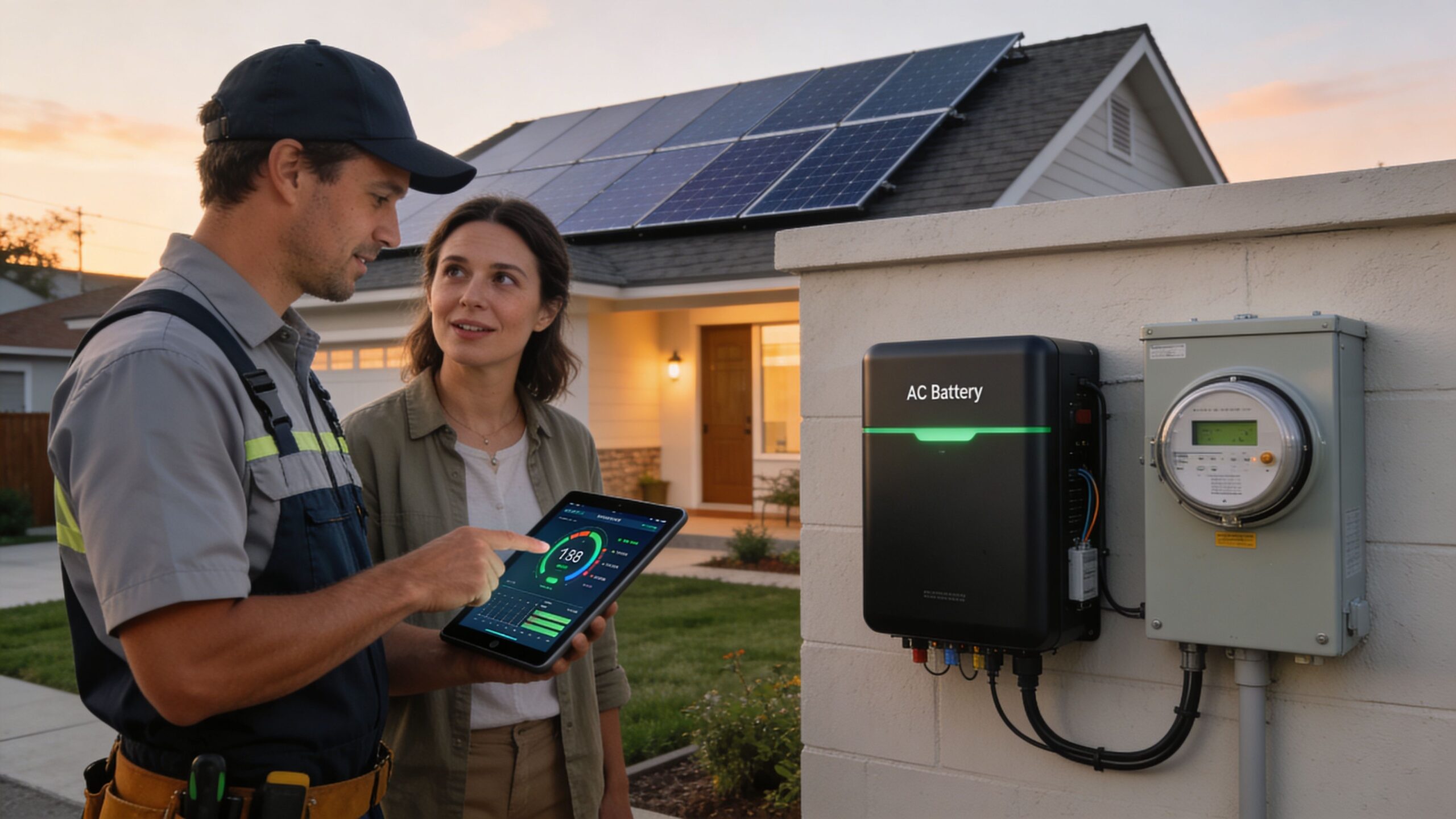
A good monitoring setup also changes the experience. Homeowners can see whether the battery is charging too late, discharging too early, or getting stranded because of poor scheduling. Detailed monitoring often reveals easy wins in appliance timing and EV charging behaviour. For anyone interested in the monitoring side of system performance, this overview of inverter remote monitoring and solar efficiency is worth reading.
The battery doesn’t save money just by existing. It saves money when control settings, load timing, and system sizing line up with how the household actually lives.
AC Coupled vs DC Coupled Batteries A Clear Comparison
Homeowners often ask which system is better. The honest answer is that better depends on the job.
For a brand-new solar and battery installation, a DC-coupled design may make sense because it can be built as one integrated system from the start. For an existing home with a working solar inverter, AC coupling is often the more practical choice because it avoids replacing equipment that still has value.
The comparison that matters at home
| Feature | AC Coupled System | DC Coupled System |
|---|---|---|
| Best use case | Retrofitting battery storage to existing solar | New solar and battery systems designed together |
| How it connects | Battery sits on the AC side with its own inverter | Battery integrates on the DC side before or within the main conversion path |
| Existing inverter compatibility | Usually works well with an existing solar inverter | Often depends on replacing or reworking the original inverter setup |
| Installation impact | Typically less disruptive for a home that already has solar | More suitable when the whole system is being designed from scratch |
| Round-trip efficiency | 90-94% in NSW home use, based on verified guidance | 98% in the verified comparison data |
| Energy conversion losses | 6-10% per cycle from extra conversions | Lower losses because there are fewer conversion steps |
| Retrofit appeal | Strong | Weaker |
| System flexibility | High for homes adding storage later | High when planned early, less convenient as a retrofit |
| What usually drives the decision | Keep the current solar system and add storage sensibly | Build the most integrated architecture from day one |
Where AC coupling wins
AC coupling wins when the solar system already exists and still performs well. That’s the most common NSW conversation. The homeowner doesn’t want to pull out a functioning inverter just to install a battery.
It also suits households that want staged upgrades. Solar first. Battery later. EV charger after that. The AC-side architecture gives designers more room to work around what’s already installed.
Where DC coupling wins
DC coupling has a cleaner conversion path. If you’re building from zero and efficiency is your absolute top priority, it deserves serious consideration.
That can matter in homes where roof layout, battery location, and inverter choice are all being planned together. In that case, the installer isn’t trying to respect old equipment. They’re optimising a fresh design.
The trade-off most people actually make
Most homeowners are not choosing between two blank-sheet designs. They’re choosing between:
- Keeping a working solar system and adding storage
- Replacing major parts of a working solar system to chase a more integrated design
That’s why retrofit jobs so often lean toward AC coupling.
If the house already has solar, the battery decision is usually less about theory and more about how much existing infrastructure still makes sense to keep.
There’s another practical issue. A battery is only as useful as its control logic, backup behaviour, and day-to-day settings. A technically elegant design that’s awkward to live with won’t feel like a win.
For a broader side-by-side review of battery options and setup styles, the battery comparison guide is a helpful next step.
Why AC Coupling Is The Top Choice For Solar Retrofits
If a household already has solar, AC coupling is usually the first architecture worth examining. That isn’t marketing language. It’s how the retrofit market has developed.
In Australia, AC-coupled battery systems account for approximately 60-70% of all battery additions to existing solar PV installations as of 2024, largely because they work with older inverters without forcing a major overhaul. The same verified data notes that properly sized systems can help NSW homeowners achieve a 70-100% offset in grid reliance. That retrofit trend is outlined in this AC vs DC coupling overview.
It works with what you already own
This is the big reason. Many homes in Sydney and greater NSW installed solar years ago. The panels may still be productive. The inverter may still be serviceable. The owners don’t want to bin good hardware just to add storage.
AC coupling respects that reality. It lets the original solar system continue doing what it already does, while the battery system handles storage as a separate layer.
That lowers disruption during the upgrade and can simplify the design conversation. Instead of asking, “What must we replace?”, the better question becomes, “What still works well enough to keep?”
It suits real retrofit constraints
Retrofit work is rarely tidy on paper. Switchboards vary. Cable paths vary. Battery locations vary. Shade patterns and household loads vary.
AC-coupled designs handle these constraints well because they don’t depend on rebuilding the PV side from scratch. That flexibility matters in established homes where aesthetics, wall space, and access all affect the installation.
A good retrofit also leaves room for future changes. Plenty of households add a battery first, then later decide they want backup circuits, better monitoring, or EV charger integration.
Installation quality matters more than product brochures
A strong battery product can still perform badly if the design is lazy. Poor load assessment, poor inverter matching, weak switchboard work, and sloppy commissioning all show up later as frustration.
That’s why retrofit quality is inseparable from installer quality. This resource on why installation quality matters in advanced solar systems makes that point well.
A short visual explanation can help if you’re comparing architectures and trying to understand why retrofits so often go down the AC path.
What doesn’t work well
AC coupling is not the best answer when the existing solar system is already the weak link. If the inverter is near end-of-life, undersized for current needs, or tied to a layout that no longer makes sense, a more substantial redesign may be smarter.
It also won’t hide poor consumption habits. If a home runs heavy loads overnight with minimal daytime generation to store, the battery won’t create energy that isn’t there.
A good retrofit keeps the parts that still earn their place and upgrades the parts that don’t.
That's why AC coupling keeps leading the retrofit market. It solves the actual problem most solar homeowners have. Add storage without turning the whole house into a rebuild.
Sizing Performance and Safety in NSW
Battery retrofits go wrong most often at the design stage, not on installation day. The battery may be perfectly good, but the sizing, inverter matching, or control setup isn’t right for the house.
The result is familiar. A battery fills too early, empties too early, or can’t capture the solar surplus the homeowner expected. In some cases, the system starts curtailing solar output when it should be storing or serving loads.
Start with household behaviour, not battery marketing
The right battery size depends on how the household uses energy across the day, not just how much electricity it uses in total.
A home that’s empty during the day and active at night behaves differently from a home office setup with daytime cooling, server gear, or regular appliance cycling. EV charging changes the picture again. So does electric cooking. So does pool equipment that can be shifted into solar hours.
A practical assessment usually looks at:
- Daytime solar surplus. Is there enough spare generation to charge a battery consistently?
- Evening demand. How much grid use happens after solar production falls away?
- Seasonal behaviour. Summer and winter can produce very different charging patterns.
- Future changes. Planned EV chargers, renovations, or all-electric upgrades should shape the design now.
The Factor 1.0 rule
One of the most important technical checks in an AC-coupled system is the Factor 1.0 rule.
Verified Australian guidance states that the solar inverter’s AC output should not exceed the battery inverter’s AC rating. A straightforward example is a 5kW battery inverter paired with no more than 5kW of solar inverter capacity. The purpose is to avoid grid instability and forced solar curtailment when the battery is full. That rule is outlined in Victron’s AC coupling guidance.
This isn’t a minor technical footnote. It affects how much of your solar can be used cleanly and how stable the system remains during high production periods.
On-site check: If an installer can’t explain inverter matching clearly, they’re not ready to design your battery retrofit.
Why poor sizing creates hidden losses
When an AC-coupled system is mismatched, the homeowner may not notice a dramatic fault straight away. Instead, they notice weaker battery performance than promised.
Common symptoms include:
- Battery fills but surplus solar still gets clipped
- The home imports from the grid earlier than expected
- Monitoring shows awkward charge and discharge patterns
- Backup performance doesn’t align with the loads the household assumed would run
This is why battery sizing can’t be based on battery capacity alone. Charge rate, inverter power, circuit priorities, and monitoring logic matter just as much.
Safety and compliance in NSW
Battery installations must be treated as serious electrical work, not as add-ons. Product approval, installation method, switchboard suitability, and compliance with Australian standards all matter.
Verified data also notes that CEC-approved AC-coupled setups can qualify for federal and NSW incentives, including STCs and battery rebate pathways where eligible. Those details can change over time, so the key point for homeowners is simple. Ask whether the exact battery and inverter combination is approved and whether the proposed design supports the incentive pathway you’re relying on.
For NSW households trying to understand the local rebate options, this summary of the NSW battery rebate and what to know is useful background reading.
Questions worth asking before approval
Ask the installer to answer these in plain language:
- How was the battery size selected for my load profile?
- What inverter pairing is being used, and does it satisfy the Factor 1.0 rule?
- Will the system provide backup, and if so, which circuits are included?
- How will the battery behave in summer versus winter?
- Which products are approved for the incentive path being discussed?
A battery system should feel predictable after installation. If the explanation before installation is vague, the system after installation usually is too.
Your AC Battery Installation Checklist
Choosing an ac coupled battery is only half the job. The other half is choosing the installer and system design that fit your house properly.
The market is getting busier. Verified market data says the Australian AC-coupled solar battery segment is projected to grow at a CAGR of over 10.5% from 2025-2033, with over 500 MW installed in 2024 alone, and AC-coupled systems making up 90% of retrofits. That same outlook notes that product choice and incentive navigation are becoming more important, which is why installer knowledge matters so much. Those figures come from this AC-coupled market report.
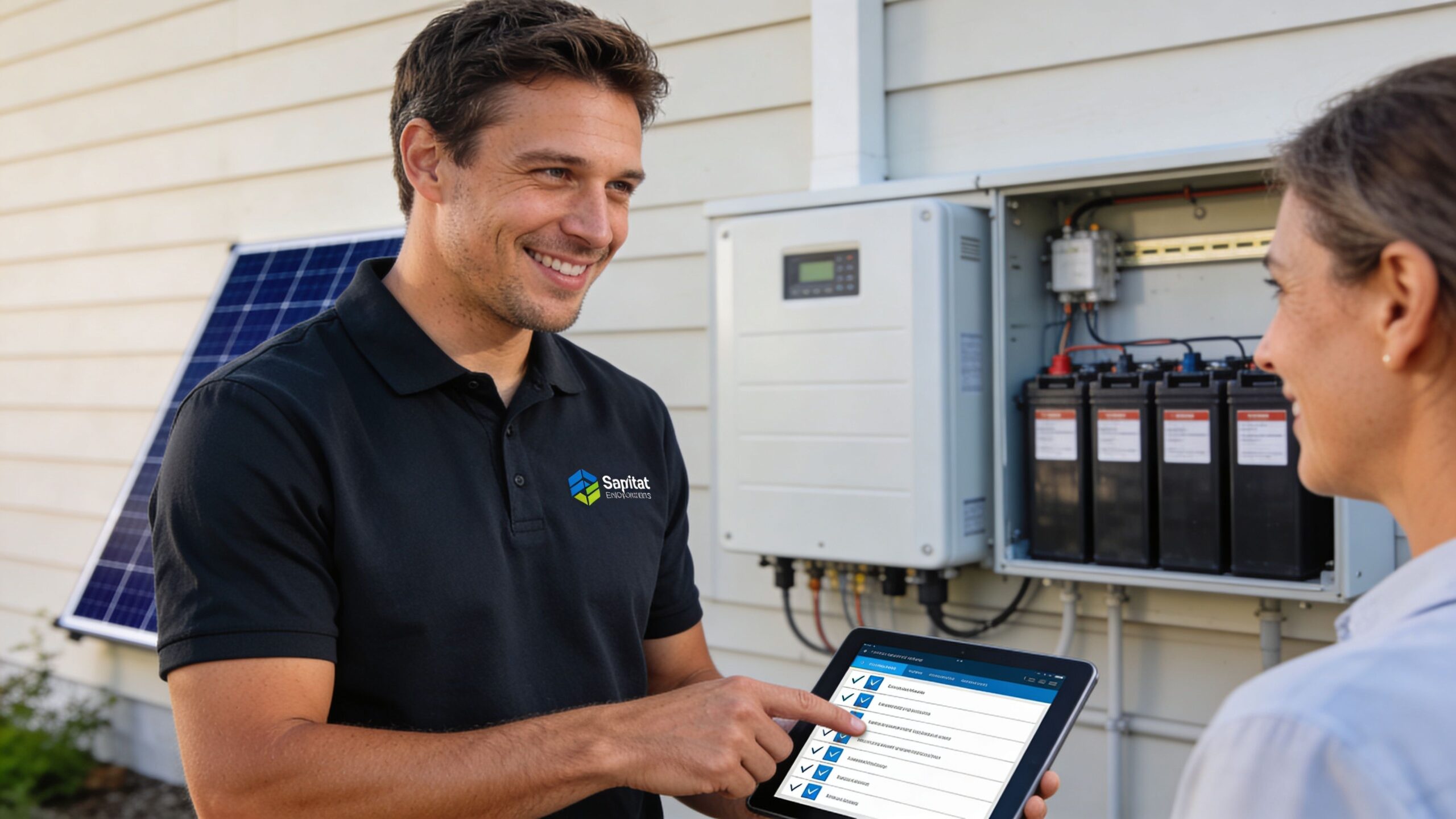
Questions to ask before you sign
Don’t settle for broad promises. Ask direct questions and listen for direct answers.
- Who is designing the system? You want to know whether the design is being done by someone who has reviewed your existing inverter, switchboard, load profile, and site constraints.
- What happens to my current solar inverter? A good installer should tell you whether it stays, whether it needs limitations, or whether it creates a constraint that changes the recommendation.
- Is backup included or optional? Some homeowners assume every battery provides whole-home backup. That’s not always how the system is configured.
- How will monitoring work day to day? You should be able to see solar generation, battery charge, home consumption, and grid import or export in a useful way.
- What after-care is included? Battery installs need support after commissioning, especially when settings need refinement around tariffs, EV charging, or changing household routines.
What a strong proposal should include
A professional quote should do more than list hardware. It should explain the design logic.
Look for these items:
- Existing system review with notes about inverter compatibility and any switchboard issues
- Battery and inverter sizing rationale tied to your usage pattern
- Backup scope that identifies which loads stay on during an outage, if backup is part of the design
- Monitoring details including the app or platform you’ll use
- Compliance pathway showing approved equipment and installation standards
If the proposal feels generic, it probably is.
Red flags homeowners often miss
Some warning signs show up before any tools come out:
- The installer never asks for interval usage data
- They talk only about battery capacity, not inverter rating or load behaviour
- They promise performance without discussing your evening demand
- They avoid questions about approvals, warranties, or support after handover
Those issues usually point to sales-first design rather than engineering-first design.
The best battery quote often isn’t the flashiest one. It’s the one that explains the constraints honestly.
What to bring to the consultation
You’ll get a better result if you prepare a few basics:
- Recent electricity bills so the installer can understand tariff structure and usage timing.
- Any solar app screenshots or inverter details from the current system.
- A list of major loads such as ducted air, pool equipment, EV charger, electric hot water, and cooking appliances.
- Your priorities, whether that’s bill reduction, backup, self-consumption, EV integration, or future expansion.
What a good installation process feels like
A good process is calm and methodical. The installer inspects the existing system properly, checks wall locations, reviews switchboard space, explains any limitations, then gives you a recommendation that matches the house instead of forcing a product.
That kind of process matters because batteries are long-term infrastructure. You’re not buying a gadget. You’re changing how the home uses energy every day.
If you want help reviewing your current solar system and working out whether an ac coupled battery is the right retrofit path, Interactive Solar can assess the existing setup, explain the trade-offs clearly, and design a battery solution that fits your home, usage pattern, and future plans.
Make Interactive Solar a preferred source in Google
One click tells Google to surface our articles more often in Top Stories, AI Overviews and AI Mode.