Commercial Solar Installation Liverpool: 2026 Cost, Rebates & ROI Guide
Last updated:
Commercial solar installation Liverpool businesses are choosing in 2026 delivers average payback periods of 1.5 to 4 years, bill savings of $4,000 to $60,000+ annually depending on system size, and access to federal STC rebates worth thousands of dollars, plus a new pathway for systems up to 1MW from October 2026. Liverpool sits in Endeavour Energy’s network zone and qualifies for Zone 3 STC deeming, making it one of the most financially rewarding locations in New South Wales for commercial solar. This guide covers every key decision point: choosing the right system size and inverter configuration, navigating Endeavour Energy’s export limits, qualifying for 2026 and 2027 rebates, and getting installation right the first time.
Key Takeaways
- Commercial solar in Liverpool delivers payback periods of 1.5 to 4 years, with annual savings of $4,000 to $60,000+ depending on system size.
- Liverpool sits in Endeavour Energy's Zone 3 STC deeming area, with a 30kW system generating around $21,870 in rebate value.
- Endeavour Energy caps exports at 10kW per phase for single-phase and 30kW total for three-phase connections, so systems must be sized to match daytime load.
- From 1 October 2026, the SRES rebate cap expands from 100kW to 1MW, letting large Liverpool warehouses access simpler upfront STC discounts.
- A 100kW Moorebank warehouse system costs $80,000 to $110,000 before rebates and can achieve payback in around 1.65 years.
Commercial Solar Installation Liverpool: 2026 Cost by System Size
System size is the single biggest variable in your project cost and savings potential. In Liverpool, commercial systems typically range from 10kW (small retail or office) up to 250kW or more (large warehouse or distribution centre). The table below uses current 2026 pricing and Endeavour Energy zone data.
| System Size | Indicative Supply & Install Cost | Approx STC Rebate | Net Cost After Rebate | Annual Savings (est.) | Payback Period |
|---|---|---|---|---|---|
| 10kW | $12,000 – $16,000 | $2,700 | $9,300 – $13,300 | $3,500 – $5,000 | 2.5 – 3.5 yrs |
| 30kW | $28,000 – $38,000 | $8,100 | $19,900 – $29,900 | $10,000 – $14,000 | 2.5 – 3.5 yrs |
| 50kW | $42,000 – $58,000 | $13,500 | $28,500 – $44,500 | $16,000 – $22,000 | 2.5 – 4 yrs |
| 100kW | $80,000 – $110,000 | $27,000 | $53,000 – $83,000 | $30,000 – $42,000 | 2.5 – 4 yrs |
| 200kW | $150,000 – $200,000 | LGCs apply | Varies | $60,000+ | 3 – 5 yrs |
Note: STC rebates apply to systems under 100kW. Systems at or above 100kW generate Large-scale Generation Certificates (LGCs) instead, traded on a separate market. Your installer calculates the exact rebate at the time of contract based on the current STC spot price.
STC Rebates and 2026 Incentives for Liverpool Businesses
The federal STC (Small-scale Technology Certificate) scheme is the primary rebate mechanism for commercial solar systems under 100kW in Liverpool. In 2026, Liverpool falls under Zone 3 for STC deeming purposes, which means installations receive a strong multiplier compared to cooler southern states. The deeming period stepped down to 5 years on 1 January 2026 (from 6 years in 2025), so the number of STCs your system earns has decreased slightly year on year. It is still substantial: a 30kW system generates approximately 810 STCs worth roughly $27 each at 2026 spot prices, delivering around $21,870 in rebate value. A 10kW system generates approximately 270 STCs worth around $7,290.
Beyond federal STCs, Liverpool businesses can access additional 2026 incentives:
- NSW Small Business Energy Rebate: Eligible SMEs can claim up to $1,650 to offset energy bills, often stackable with solar installation timing.
- Cheaper Home Batteries Program (commercial extension): From July 2026, NSW extended battery incentives to SME premises using battery systems in the 20kWh to 200kWh range, stacking with the federal Cheaper Home Batteries Program.
- Instant Asset Write-Off: The $20,000 instant asset write-off is now a permanent feature of the tax system from 1 July 2026 (2026-27 Federal Budget, Act No. 71 of 2026), not a year-by-year extension. Eligible small businesses can claim an immediate deduction for solar panels, inverters, and battery equipment costing under $20,000 per asset, rather than depreciating it over several years. Confirm eligibility and asset thresholds with your accountant via the ATO instant asset write-off guide.
- Interest-Free Finance: Some federally backed green loan programs offer 0% or low-interest finance for energy-efficient capital equipment including solar. Interactive Solar can connect you with accredited finance partners.
The Clean Energy Regulator’s STC calculator is the authoritative source for verifying exact deeming figures before signing a contract.
Key stat: The Small-scale Renewable Energy Scheme (SRES) eligibility cap for solar PV expands from 100kW to 1MW for systems installed on or after 1 October 2026, under amended Renewable Energy (Electricity) Regulations 2011. Applications are expected to open mid-to-late November 2026 while the Clean Energy Regulator finalises processes. Source: Clean Energy Regulator, September 2026.
SRES Cap Expansion: What 100kW to 1MW Means for Liverpool Warehouses
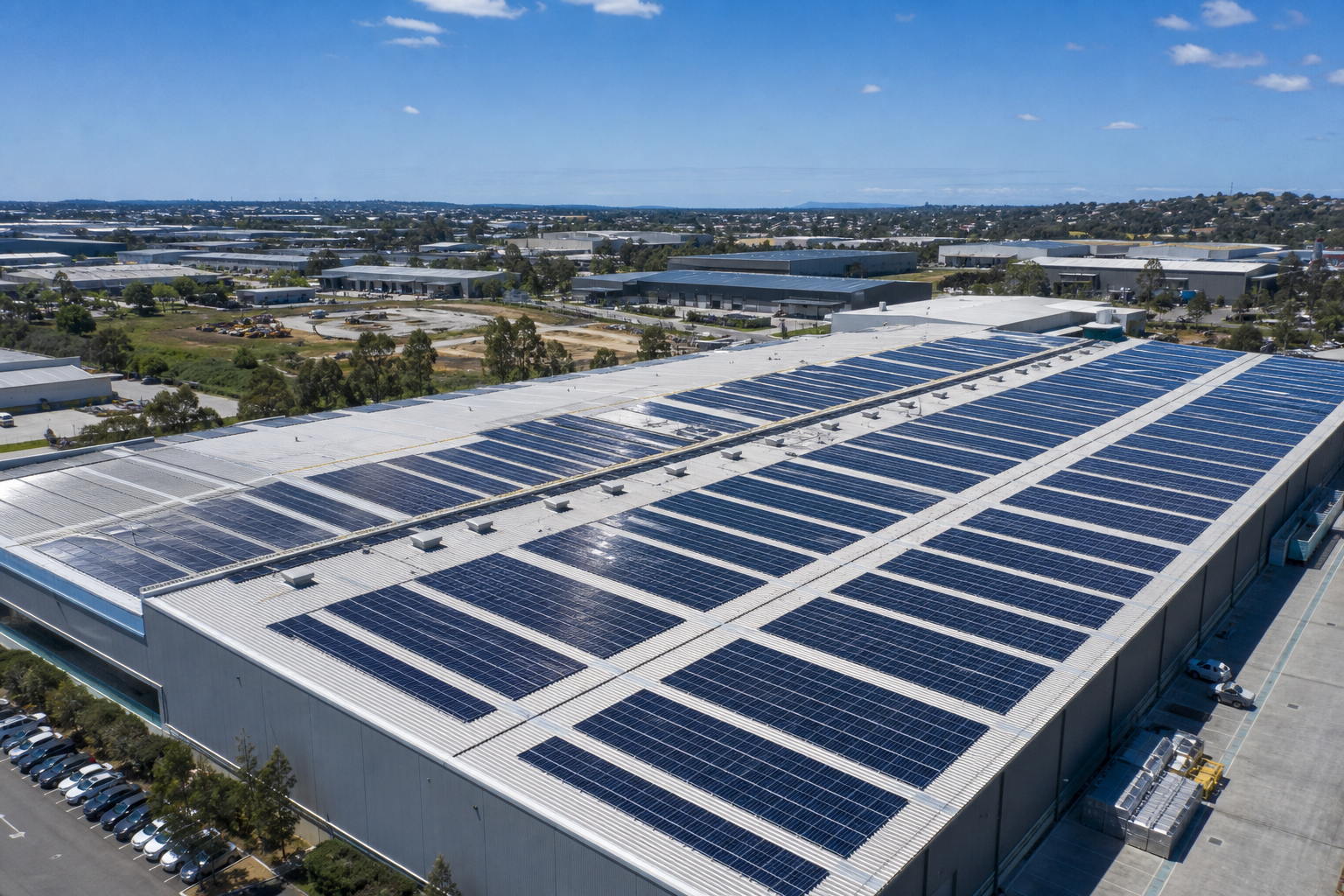
From 1 October 2026, commercial solar systems up to 1MW become eligible for the STC-based SRES rebate instead of being pushed into the more complex Large-scale Generation Certificate (LGC) market once they cross the old 100kW threshold. This is a major shift for Liverpool, where large-format warehouses and logistics facilities in Moorebank, Prestons, and along the M7 corridor commonly need systems well above 100kW to cover their roof area and daytime load.
Practically, this means a 250kW or 500kW warehouse system installed after 1 October 2026 can access the simpler, more predictable upfront STC discount that smaller systems already enjoy, rather than needing to register as an accredited person and trade LGCs on the wholesale market. Applications for the expanded scheme are not expected to open until mid-to-late November 2026, so Liverpool businesses planning a large system should factor this timing into contract and installation scheduling. Interactive Solar is tracking the Clean Energy Regulator’s rollout and can advise whether waiting for the expanded cap makes financial sense for your specific project size.
Endeavour Energy Network: What Liverpool Businesses Need to Know
Liverpool LGA sits entirely within Endeavour Energy’s distribution network, not Ausgrid’s. This distinction matters for export limits and grid connection approvals. Endeavour Energy’s standard export limit in 2026 is 10kW per phase for single-phase connections and 30kW total for three-phase connections. Most Liverpool commercial premises have three-phase power, giving a combined export allowance of up to 30kW to the grid.
What this means in practice: a 100kW system on a three-phase connection can only export 30kW of surplus power at any given time. The remaining generation either powers your loads directly or is curtailed. This is why load-matching during design is so critical: the more of your solar output you can consume on-site, the more valuable each kilowatt-hour becomes (avoiding paying grid tariff rates of 30 to 45 cents/kWh, vs. feed-in tariffs of just 4 to 8 cents/kWh).
Endeavour Energy’s Distributed Energy Resource (DER) register manages connection approvals for systems above certain thresholds. For systems above 30kW, your installer must submit a formal connection application and await Endeavour Energy’s technical assessment, which can add 4 to 8 weeks to the project timeline. Interactive Solar manages this process end to end, including preparing the connection application and liaising with Endeavour Energy’s engineering team on your behalf.
Matching System Size to Your Load Profile
Oversizing a commercial solar system relative to on-site consumption wastes potential savings because excess generation feeds in at low feed-in tariff rates. Undersizing means you are still buying expensive grid power during peak hours. The right approach is to size the system to match your daytime load profile as closely as possible.
Key data points your installer needs to size correctly:
- 12 months of electricity bills showing kWh consumption by month and ideally time-of-use breakdown.
- Operating hours: Do you operate Monday to Friday, seven days, or shift work? Daytime-only businesses (offices, retail) benefit most because solar generation aligns with peak operation. Businesses with large evening loads (cold storage, late-shift manufacturing) benefit more from battery storage pairing.
- Roof area and orientation: A north-facing roof in Liverpool captures the most solar energy. East/west splits can be used to extend the generation window earlier in the morning or later in the afternoon. Your installer should provide a shade analysis.
- Future load growth: Air conditioning upgrades, EV fleet charging, refrigeration expansion. Sizing for anticipated future loads avoids the cost of a second installation later.
As a worked example: a Liverpool logistics company in Prestons running 8am to 6pm with a 42kW average daytime load would benefit from a 50kW to 60kW system sized to cover roughly 85% to 100% of peak daytime consumption, staying within Endeavour Energy’s three-phase 30kW export limit while maximising self-consumption.

Equipment Selection for Commercial Solar in 2026
Panel and inverter quality directly determines system longevity, real-world yield, and warranty protection. Interactive Solar specifies Tier 1 panels and CEC-approved inverters on all commercial installations. Here is what the leading options look like in the Liverpool market in 2026.
Solar Panels
TOPCon (Tunnel Oxide Passivated Contact) and HJT (Heterojunction) cell technologies dominate the 2026 commercial market, replacing older PERC panels in new installations. Key panel metrics to compare:
- Efficiency: Premium TOPCon panels (Aiko, Jinko N-Type, REC Alpha) deliver 22% to 24% module efficiency, maximising output per square metre of roof space.
- Degradation rate: Premium panels degrade at 0.25% to 0.4% per year. Budget panels at 0.5% to 0.7% per year. Over 25 years, the premium panel retains 91% of original output vs. 83% for a budget panel: a 10% difference in lifetime energy production.
- Product warranty: Tier 1 manufacturers offer 25-year product warranties. Insist on this for a commercial installation.
- Performance warranty: 25 years at 80%+ output minimum; premium brands now offer 90% at 25 years.
Inverters
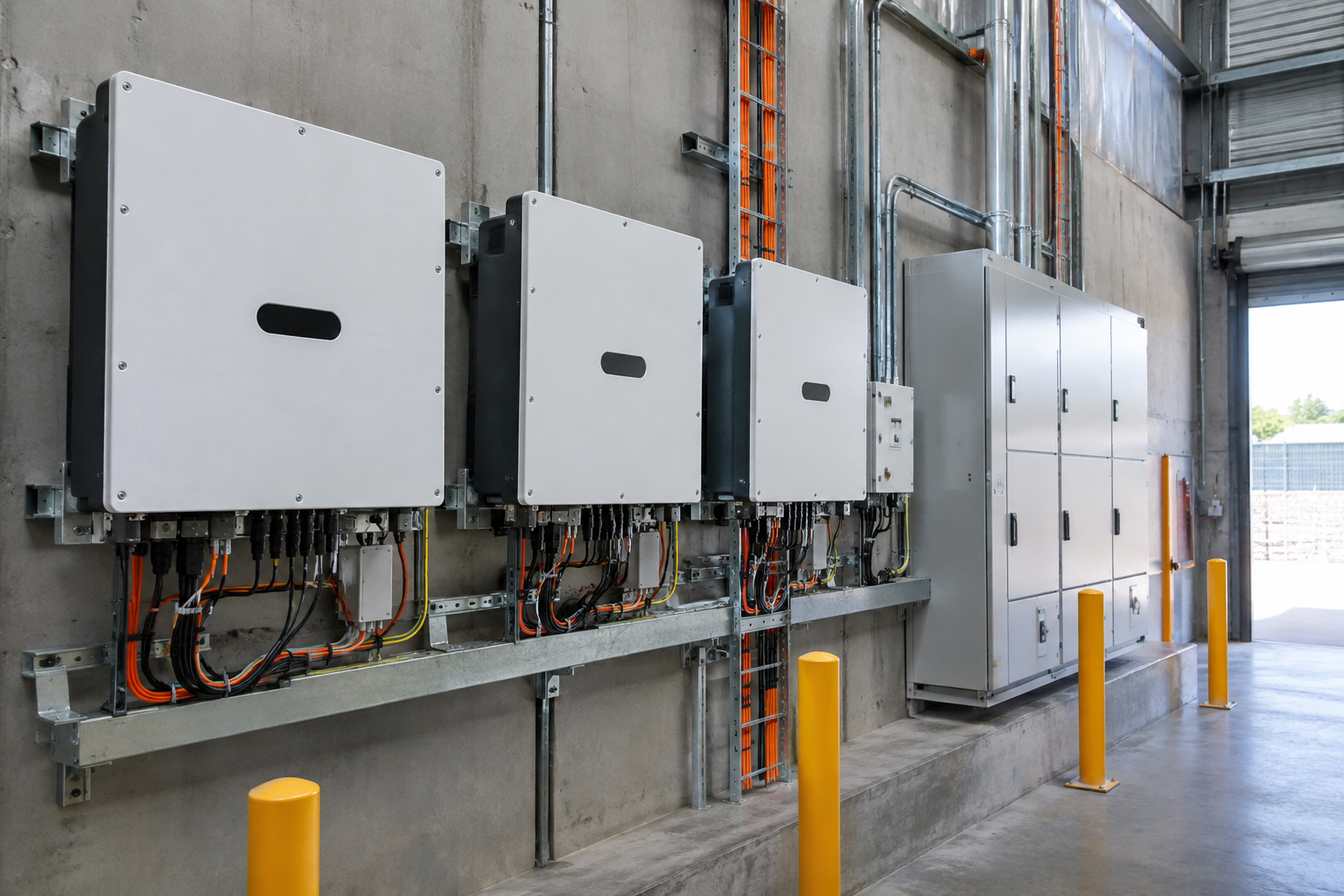
String inverters from Fronius, SMA, and Sungrow are the standard for commercial systems in the 10kW to 100kW range. For larger systems or roofs with shading, microinverters or DC optimisers (SolarEdge, Tigo) can recover significant yield. Three-phase inverters are required for commercial premises with three-phase power supply. Interactive Solar specifies inverters with a minimum 10-year warranty and recommends models with embedded monitoring so you can track your system’s performance in real time.
Battery Storage Pairing
Adding battery storage to a Liverpool commercial solar system makes strong financial sense if you have high evening loads or time-of-use tariffs with peak rates above 45 cents/kWh. The 2026 Cheaper Home Batteries Program provides tiered STC-equivalent rebates on battery capacity: 100% rebate on the first 14kWh, 60% on 14kWh to 28kWh, and 15% on 28kWh to 50kWh. For commercial systems, pairing a 13.5kWh to 27kWh battery unit captures the highest rebate tiers. Visit our solar batteries page for brand comparisons and sizing guidance.
The Step-by-Step Installation Process in Liverpool
Understanding the commercial solar installation Liverpool timeline helps you plan around your business operations. Here is the typical process with Interactive Solar.
- Site Assessment and Proposal (Week 1): We visit your premises, analyse your bills, measure the roof, and produce a detailed proposal including system specifications, shading analysis, rebate calculations, and projected savings. No cost, no obligation.
- Contract Signing and Rebate Assignment (Week 1 to 2): You sign the installation agreement and assign your STCs to Interactive Solar (we deduct the rebate from your invoice price, so you do not need to manage the STC market yourself).
- Endeavour Energy Connection Application (Week 2 to 4): For systems above 30kW, we submit the Distributed Energy Resource connection application. Smaller systems are approved faster under Endeavour Energy’s deemed-to-comply pathway.
- Council and Structural Sign-Off (if required): Most commercial roof-mounted systems under 100kW in Liverpool do not require council DA approval under the State Environmental Planning Policy (SEPP) provisions, but larger or heritage-listed sites may. We advise you upfront.
- Installation (1 to 3 Days): Our Solar Accreditation Australia (SAA) accredited installation team mounts the racking, installs panels, runs DC cabling, mounts the inverter, and connects to your switchboard. We minimise disruption to your business operations.
- Grid Connection and Commissioning: We submit the completed work to Endeavour Energy and issue your Certificate of Electrical Safety. Once the system is commissioned, we walk you through the monitoring app and confirm system performance matches design specifications.
- Ongoing Care: Interactive Solar’s Interactive Care aftercare program covers monitoring, maintenance, and warranty support for the life of the system.
Liverpool LGA Suburbs We Service
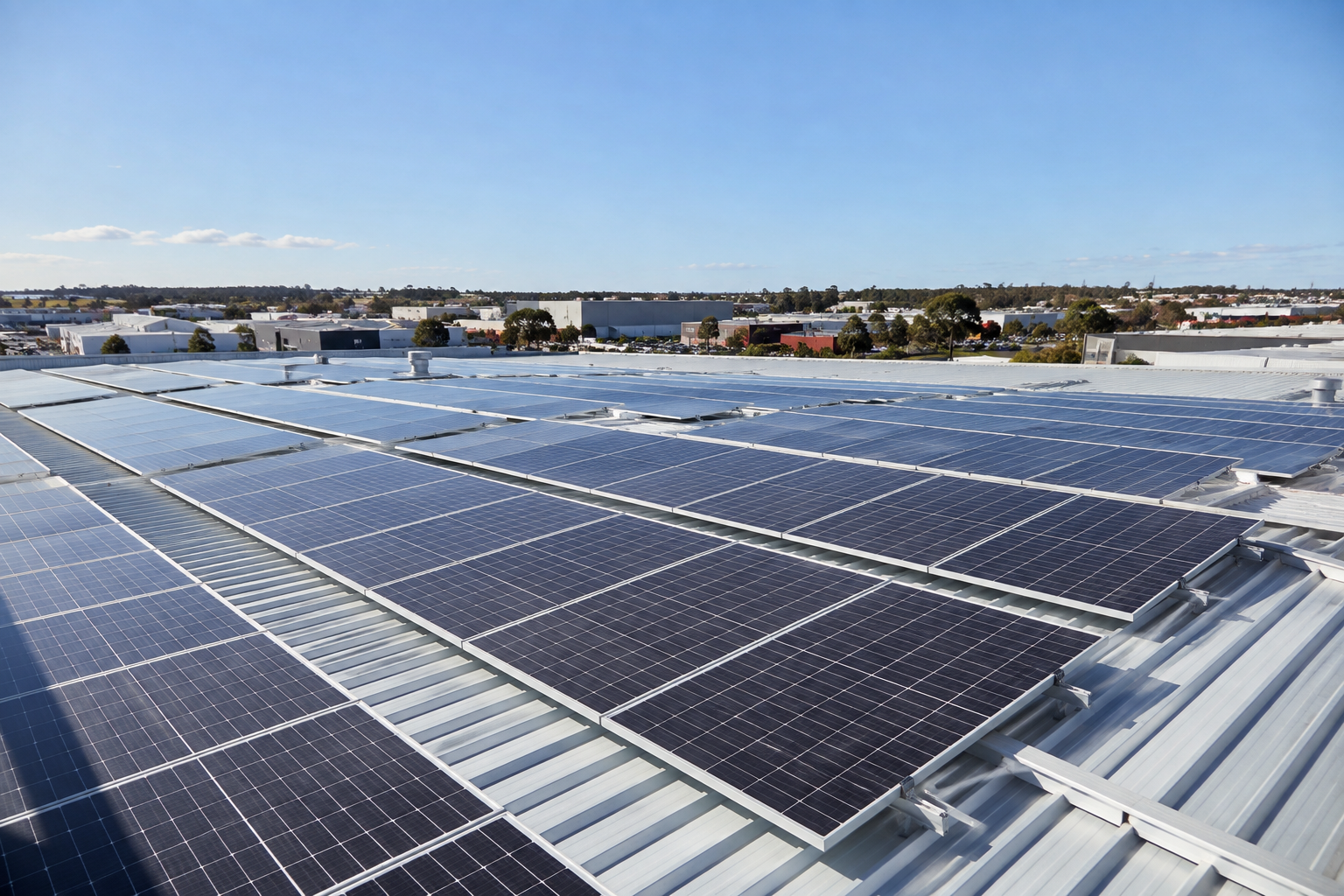
Interactive Solar services all commercial and industrial premises across the Liverpool LGA. The Liverpool council area covers a large and fast-growing industrial and commercial corridor in south-western Sydney. Key suburbs we service include:
- Moorebank: Major logistics and distribution precinct. Moorebank Intermodal Precinct is one of the largest freight hubs in Australia, with warehouses well suited to large-scale commercial solar (100kW to 300kW+).
- Prestons and Prestons Industrial: Mixed industrial and commercial. Strong demand for 30kW to 100kW systems from manufacturers and cold-storage operators.
- Casula and Casula Mall precinct: Retail and mixed-use. Systems in the 10kW to 30kW range common for retail tenancies and showrooms.
- Warwick Farm: Commercial offices and light industrial. Training and racecourse precinct with growing commercial solar adoption.
- Ingleburn: Industrial south of Liverpool. Manufacturing and engineering businesses typically benefit from three-phase 50kW to 100kW systems.
- Wetherill Park, Chipping Norton, Miller: Light industrial and commercial areas with strong solar suitability due to large roof footprints.
If your business is located in an adjacent LGA such as Fairfield, Camden, or Campbelltown, we service those areas too. Contact us at our contact page to confirm availability for your postcode.
How to Choose a Commercial Solar Installer in Liverpool
Not all solar installers in the Liverpool market have the same credentials, experience, or accountability. Here is what separates a reliable commercial installer from a risk:
- Installer Accreditation: Installer and designer accreditation transferred from the Clean Energy Council to Solar Accreditation Australia (SAA) on 29 May 2024. An SAA-accredited installer has completed rigorous training and is held to a code of conduct, and this accreditation is mandatory for your STC rebate to be valid. The Clean Energy Council still maintains the approved product lists and the Solar Retailer Code of Conduct, which reputable installers sign up to voluntarily.
- Licensed Electricians: Solar installation is electrical work. All wiring must be performed by a licenced electrician. Ask to see your installer’s NSW electrical contractor licence number.
- Commercial Track Record: Ask for references from commercial installations of similar size. A company experienced in 100kW warehouse systems has very different capability from one that primarily does 6.6kW residential systems.
- Structural Engineering Sign-Off: For larger rooftop arrays, the racking and roof attachment should be reviewed by a structural engineer. Reputable commercial installers include this as standard.
- Warranty Backed by a Stable Business: A 25-year panel warranty is only valuable if the installer is still in business. Interactive Solar has operated across Sydney for many years and provides ongoing aftercare via our Interactive Care programme.
- Transparent Proposal: Your proposal should specify panel brand, model, and wattage; inverter brand and model; racking system; total system kW; estimated annual generation in kWh; projected annual savings; and rebate calculations. If any of these are missing, ask for them before signing.
Interactive Solar is a Solar Accreditation Australia (SAA) accredited commercial solar installer covering Liverpool and all of Western Sydney. View our completed projects in the gallery and read real customer feedback on our reviews page.
Commercial Solar ROI Calculator: Liverpool Business Scenarios
Return on investment is the number most Liverpool business owners want to see first. The following three scenarios use 2026 electricity rates (assumed 32 cents/kWh daytime grid tariff) and current STC spot pricing. Savings assume 70% to 80% self-consumption ratio, typical for businesses operating during daytime hours.
Scenario 1: Liverpool Cafe (10kW System)
- Annual generation: approximately 14,600 kWh
- Self-consumed: approximately 11,680 kWh (80% ratio)
- Annual savings: approximately $3,737 (grid tariff avoided) + $283 (feed-in tariff income)
- Total annual benefit: approximately $4,020
- Net cost after STC rebate: approximately $10,500
- Payback: approximately 2.6 years
Scenario 2: Prestons Manufacturer (50kW System)
- Annual generation: approximately 73,000 kWh
- Self-consumed: approximately 56,210 kWh (77% ratio)
- Annual savings: approximately $17,987 (grid tariff avoided) + $682 (feed-in tariff income)
- Total annual benefit: approximately $18,669
- Net cost after STC rebate: approximately $34,500
- Payback: approximately 1.85 years (exceptional, high daytime load match)
Scenario 3: Moorebank Logistics Warehouse (100kW System)
- Annual generation: approximately 146,000 kWh
- Self-consumed: approximately 102,200 kWh (70% ratio)
- Annual savings: approximately $32,704 (grid tariff avoided) + $1,755 (feed-in tariff income)
- Total annual benefit: approximately $34,459
- Net cost after STC rebate: approximately $57,000
- Payback: approximately 1.65 years (large load, very strong payback)
These scenarios are indicative. Your actual payback depends on your specific tariff structure, load profile, roof orientation, shading, and any battery storage pairing. Interactive Solar provides a full financial modelling report as part of every commercial proposal. Explore our full range of commercial solar solutions or visit our solar specials page for current promotions.
Common Mistakes Liverpool Businesses Make When Going Solar
After installing commercial systems across Liverpool and Western Sydney, we see the same costly mistakes repeated. Knowing them upfront protects your investment.
- Choosing on price alone: The cheapest quote almost always uses budget panels with higher degradation rates, uncertified racking, or thin-margin installers unlikely to honour long-term warranty claims. A $5,000 saving upfront can cost $30,000 in lost production over 25 years.
- Ignoring export limits before sizing: Installing a 100kW system on a single-phase connection generates massive curtailment losses. Always confirm your supply configuration and Endeavour Energy’s export limits before agreeing to a system size.
- Skipping shade analysis: A single shaded string can reduce your whole system’s output by 15% to 30% depending on inverter topology. Insist on a shading analysis that models your roof across multiple seasons.
- Not locking in STC prices at contract signing: STC spot prices fluctuate. The best installers lock in the STC value at contract date so you are not exposed to price movements before installation.
- Forgetting roof condition: A solar system installed on a deteriorating roof requires expensive removal and reinstallation for roof repairs. Assess your roof’s remaining life before committing to solar.
- Overlooking battery storage synergy: If you have significant evening loads or plan to add EV charging, adding a battery at the time of solar installation is significantly cheaper than adding one separately later (labour and cabling costs are shared).
Frequently Asked Questions: Commercial Solar Installation Liverpool
How much does commercial solar installation liverpool cost in 2026?
A 30kW commercial system in Liverpool costs approximately $28,000 to $38,000 before the STC rebate of around $8,100, bringing the net cost to $19,900 to $29,900. A 100kW system costs $80,000 to $110,000 before rebates. Prices vary with panel brand, roof type, inverter specification, and network connection costs.
How long does commercial solar installation in Liverpool take?
From site assessment to commissioning, the typical timeline is 6 to 10 weeks. This includes 2 to 4 weeks for Endeavour Energy connection approval (for systems above 30kW), plus 1 to 3 days of physical installation. Smaller systems under 30kW can often be commissioned in 4 to 6 weeks total.
What rebates are available for commercial solar in Liverpool in 2026?
The federal STC scheme is the primary rebate, worth $7,000 to $27,000+ for systems under 100kW depending on size. Liverpool sits in Zone 3 with a 5-year deeming period in 2026. Additional incentives include NSW Small Business Energy Rebates, interest-free green finance, and depreciation benefits. Systems above 100kW generate LGCs instead of STCs.
Does commercial solar installation liverpool require council approval?
Most rooftop commercial solar systems in Liverpool are exempt from Development Approval under NSW State Environmental Planning Policy provisions. Exceptions apply to heritage-listed properties, systems on the ground (not rooftop), or unusual structural situations. Your installer should advise you upfront on whether a DA is required.
What is the best system size for my Liverpool business?
The ideal size depends on your daytime electricity consumption, roof area, supply configuration (single-phase vs three-phase), and Endeavour Energy’s export limits (10kW single-phase, 30kW three-phase). A professional site assessment and load analysis produces an optimised recommendation. Most Liverpool commercial systems fall in the 20kW to 100kW range.
Can I add battery storage to a commercial solar system in Liverpool?
Yes. Battery storage pairs well with commercial solar, particularly if you have high evening loads or time-of-use tariffs with expensive peak rates. The 2026 Cheaper Home Batteries Program provides rebates on battery capacity up to 50kWh. Adding batteries at the time of solar installation is the most cost-effective approach. See our solar batteries page for options including Tesla Powerwall and Sungrow.
Is commercial solar installation liverpool worth it for small businesses?
Yes, for businesses with meaningful daytime electricity consumption. Even a 10kW system can deliver a payback period of 2.5 to 3 years and 20+ years of essentially free daytime electricity afterward. The 2026 STC rebate reduces upfront cost significantly, and finance options can make it cash-flow positive from month one. Request a no-obligation proposal from Interactive Solar to see the numbers for your specific premises.
Ready to explore commercial solar installation Liverpool for your business? Contact Interactive Solar today for a free site assessment, detailed financial modelling, and a transparent proposal with no hidden costs. Our SAA-accredited team has completed commercial solar installation Liverpool projects across Moorebank, Prestons, Casula, Ingleburn, Warwick Farm, and all surrounding suburbs in the Liverpool LGA.
Make Interactive Solar a preferred source in Google
One click tells Google to surface our articles more often in Top Stories, AI Overviews and AI Mode.