Commercial Solar Panels Sydney: The 2026 Buyers Guide to Tier 1 Panels
Last updated:
Commercial solar panels sydney businesses are installing in 2026 are better, cheaper, and faster-paying than ever. If your business is weighing up a solar upgrade, the short answer is this: a well-specified Tier 1 panel system from a Solar Accreditation Australia (SAA) accredited installer will cut your daytime electricity bill by 60–80 percent, pay back in 3–5 years on most Sydney commercial sites, and continue producing clean power for 25 or more years. This guide covers exactly which panels to buy, how to compare brands, what warranties to demand, and how to size the right system for your operation.
Key Takeaways
- A Tier 1 commercial system typically cuts daytime electricity bills by 60 to 80 percent and pays back in 3 to 5 years.
- Tier 1 status means a manufacturer has been financed in six or more non-recourse projects by six or more banks, not a quality rating.
- Top-rated brands include Aiko Solar (28 percent of installer votes), Jinko Solar (14 percent) and SunPower/Maxeon (11 percent) in the 2026 Installer's Choice Awards.
- Premium panels degrade at just 0.25 to 0.35 percent per year versus 0.5 to 0.7 percent for budget panels, adding tens of thousands in extra savings over 25 years.
- Systems under 100 kW qualify for STCs with a 5-year deeming period in 2026, while systems over 100 kW use LGCs instead.
Commercial Solar Panels Sydney: What “Tier 1” Actually Means in 2026
Commercial solar panels sydney buyers encounter the term “Tier 1” constantly, but the definition is frequently misused by installers. Tier 1 is not a quality rating. It is a bankability classification maintained by Bloomberg NEF (formerly BNEF) and updated quarterly. A manufacturer reaches Tier 1 status by being financed in six or more non-recourse commercial solar projects by six or more unique banks over the preceding two years. It signals that global project finance lenders trust the company to still exist and honour warranties two decades from now.
Why does bankability matter to a Sydney business owner? Because a 25-year performance warranty is worth nothing if the manufacturer has vanished by year eight. Every panel on the Clean Energy Council’s Approved Products List satisfies Australian Standards, but the Tier 1 shortlist tells you which manufacturers have the financial depth to back their guarantees across your system’s lifetime.
In 2026, the confirmed Tier 1 manufacturers most commonly specified by Sydney commercial installers include: Aiko Solar, Jinko Solar, REC Group, Trina Solar, Canadian Solar, LONGi Solar, and SunPower (now Maxeon Solar Technologies in commercial contexts). Each has different strengths in wattage density, degradation rate, and warranty structure.
Commercial Solar Panels Sydney: 2026 Brand Comparison by Specification
Commercial solar panels sydney projects are dominated by a handful of panel families in 2026. The SolarQuotes Installer’s Choice Awards 2026 polled accredited installers nationally: Aiko Solar took first place at 28 percent of votes, Jinko Solar second at 14 percent, and SunPower (Maxeon) third at 11 percent. Here is how the leading options compare on the specs that matter most for a commercial Sydney site.
Aiko Solar Neostar Series (2026)
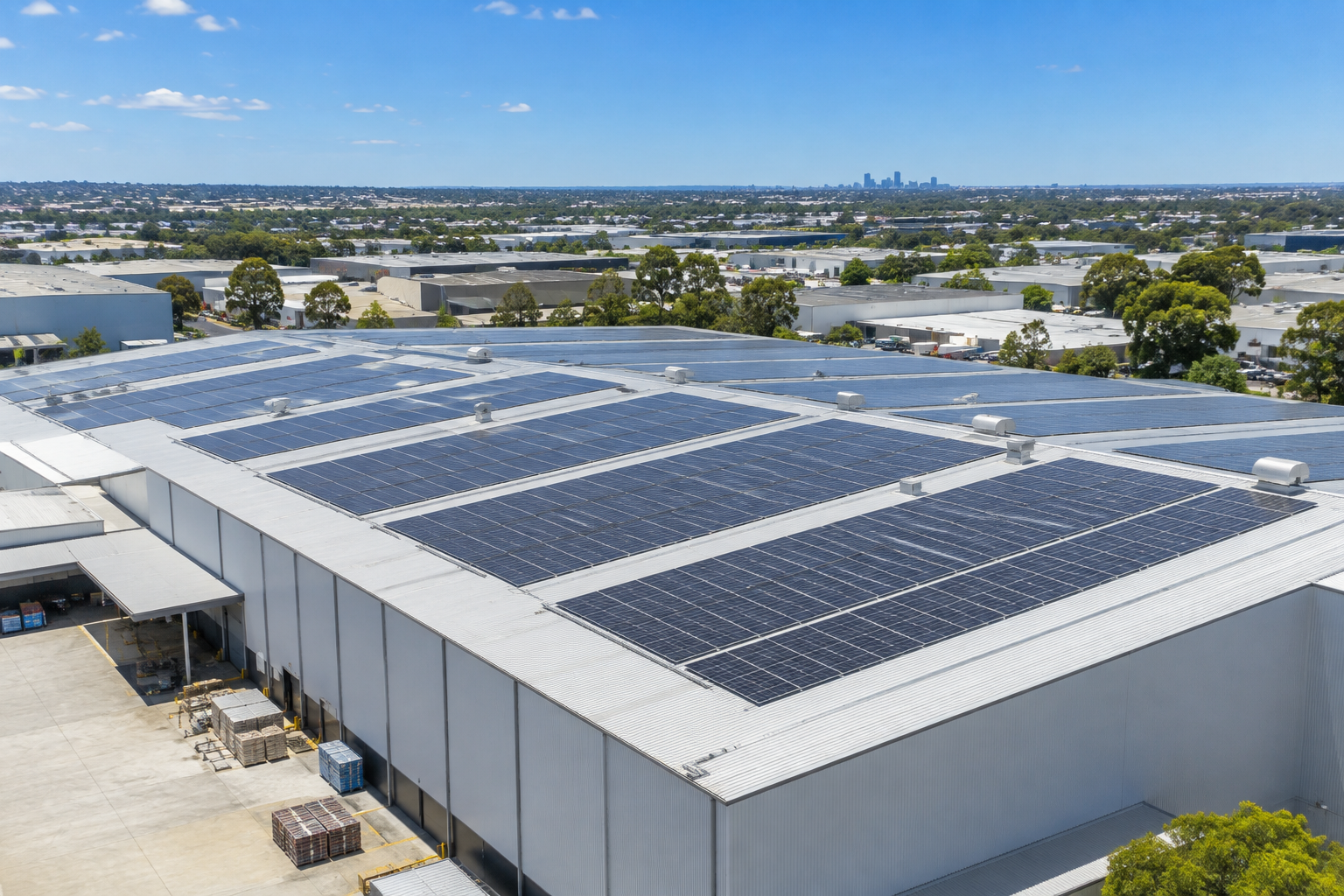
Aiko produces all-back-contact (ABC) monocrystalline panels with module efficiencies reaching 24.1 percent on their commercial-grade Neostar line. Wattage per panel sits at 580–610 W in 2026 commercial configurations. The cell architecture eliminates front-side shading losses from busbars, making Aiko particularly strong on east-west dual-pitch roofs common across Western Sydney warehouses. Performance warranty: 30 years at 87.4 percent output. Product warranty: 15 years. Degradation rate: approximately 0.35 percent per year.
Jinko Solar Tiger Neo Series
Jinko’s N-type TOPCon panels in the Tiger Neo range deliver 580–605 W per panel at 22.6–23.2 percent efficiency. TOPCon (Tunnel Oxide Passivated Contact) cell technology reduces surface recombination losses compared to PERC, translating to better low-light and high-temperature performance. For a Sydney commercial site running HVAC-heavy operations through summer, this high-temperature coefficient matters. Performance warranty: 30 years at 87.4 percent. Degradation: 0.4 percent per year. Jinko is the world’s largest panel manufacturer by volume, which supports long-term warranty confidence.
REC Alpha Pure-R Series
REC’s Pure-R panels use HJT (Heterojunction Technology) cells, combining crystalline silicon with thin amorphous silicon layers. This delivers industry-leading temperature coefficients (around -0.24 percent per degree Celsius) and strong bifacial gains on reflective flat roofs. Wattage: 430–460 W for their commercial HJT modules. Performance warranty: 25 years at 92 percent. REC is manufactured in Singapore with strong Australian distributor networks, making warranty claims more accessible for Sydney businesses than some Chinese-only manufacturers.
Trina Solar Vertex S+ Series
Trina remains a cost-leader at commercial scale. Their Vertex S+ N-type TOPCon modules hit 560–580 W and carry a 30-year performance warranty at 87.4 percent. Degradation rate: 0.4 percent per year. For price-sensitive commercial buyers who still want Tier 1 quality, Trina offers a competitive cost-per-watt at scale (typically 5–10 percent cheaper per watt than premium Aiko or REC). Trina’s global manufacturing base and strong CEC approval list presence make them a reliable commercial choice.
SunPower (Maxeon) Series 6 Commercial
SunPower’s Maxeon technology leads the industry on long-term performance retention. Their Series 6 commercial panels carry a 40-year performance warranty (industry first) at 88.25 percent output, with a degradation rate of just 0.25 percent per year. This makes SunPower the clear winner in a lifecycle cost analysis over 25 years, even if the upfront cost per watt is 20–30 percent higher than Tier 1 alternatives. For premium Sydney commercial projects where roof access is difficult and long-term reliability is paramount, Maxeon commands a strong premium.
Commercial Solar Panels Sydney: Sizing Your System for Maximum Payback
Commercial solar panels sydney sizing starts with your daytime electricity consumption, not your roof area. The goal is to match generation to self-consumption as closely as possible, because excess exports to the grid attract low feed-in tariffs (typically 3–8 cents per kWh in 2026, compared to retail rates of 25–38 cents).
Use this framework to size a commercial Sydney system:
- Step 1: Get 12 months of interval data from your retailer (NMI data at 15-minute intervals). This shows exactly when your site consumes electricity and how much.
- Step 2: Calculate your daytime load (typically 9am–4pm for solar). For most Sydney businesses this is 60–80 percent of total daily consumption.
- Step 3: Size the array to match daytime load, not total daily consumption. Oversizing exports at low rates and delivers poor returns.
- Step 4: Apply your network’s export limit. On the Ausgrid network (eastern Sydney), single-phase connections are limited to 10 kW export; three-phase to 30 kW. On the Endeavour Energy network (western Sydney including Parramatta, Blacktown, Liverpool), limits are the same: 10 kW single-phase, 30 kW three-phase. Systems over these thresholds need a battery or export-limiting inverter to avoid curtailment.
Typical commercial system sizes in 2026:
| Business Type | Typical Load (kWh/day) | Recommended System Size | Panel Count (600W) | Est. Annual Savings |
|---|---|---|---|---|
| Small office / retail | 50–100 kWh | 15–30 kW | 25–50 panels | $4,500–$9,000 |
| Medium warehouse | 200–400 kWh | 50–80 kW | 84–134 panels | $15,000–$24,000 |
| Large factory / school | 500–1,000 kWh | 100–200 kW | 167–334 panels | $30,000–$60,000 |
| Industrial complex | 1,000+ kWh | 200+ kW | 334+ | $60,000+ |
Commercial Solar Panels Sydney: Understanding Degradation and 25-Year Yield
Commercial solar panels sydney buyers often focus on upfront price per watt without modelling long-term yield. Degradation rate is the percentage of output lost each year. Over 25 years, even a small difference in degradation compounds significantly.
A worked example: two 100 kW systems, same site, different panels:
- Budget panel at 0.7% degradation/year: By year 25, the system produces at 84.2 percent of original capacity. Cumulative generation over 25 years (at 130,000 kWh/year year-1 output): approximately 2,896,000 kWh.
- Premium panel at 0.35% degradation/year: By year 25, the system produces at 91.6 percent of original capacity. Cumulative generation over 25 years: approximately 3,092,000 kWh.
That 196,000 kWh difference over 25 years, valued at 30 cents per kWh self-consumed, equals approximately $58,800 in additional savings from the premium panel. If the premium panels cost $10,000 more upfront, the net advantage is nearly $49,000. This is why degradation rate, not sticker price, drives lifecycle ROI on commercial projects.
Commercial Solar Panels Sydney: Warranty Types You Must Understand
Commercial solar panels sydney quotes typically include three separate warranties. Confusing them is one of the most common mistakes Sydney buyers make when comparing proposals:
1. Product Warranty (Materials and Workmanship)
This covers defects in the panel itself: delamination, hot spots, microcracks, frame corrosion, junction box failures. It does NOT cover performance degradation. Standard product warranties run 10–15 years; premium manufacturers (Aiko, REC, SunPower) offer 12–15 years. This is the warranty that fails first if a manufacturer disappears, so Tier 1 status is directly relevant here.
2. Performance (Linear Degradation) Warranty
This guarantees minimum output at specific years. Industry standard is 80 percent of rated output at year 25. Premium brands warrant 87.4–92 percent at year 25. The performance warranty is typically backed by the manufacturer’s balance sheet alone, making financial stability critical.
3. Workmanship / Installation Warranty
This comes from your installer, not the panel manufacturer. Under Australian Consumer Law, installers must also stand behind their work. Look for a minimum 5-year installation workmanship warranty from any SAA-accredited installer. Interactive Solar provides full installation workmanship warranty on every commercial project.
Commercial Solar Panels Sydney: Inverter and Racking Considerations
Commercial solar panels sydney performance depends as much on the inverter and racking system as on the panels themselves. Panel quality is wasted on a poor inverter or inadequate mounting.
Inverter Selection for Commercial Systems
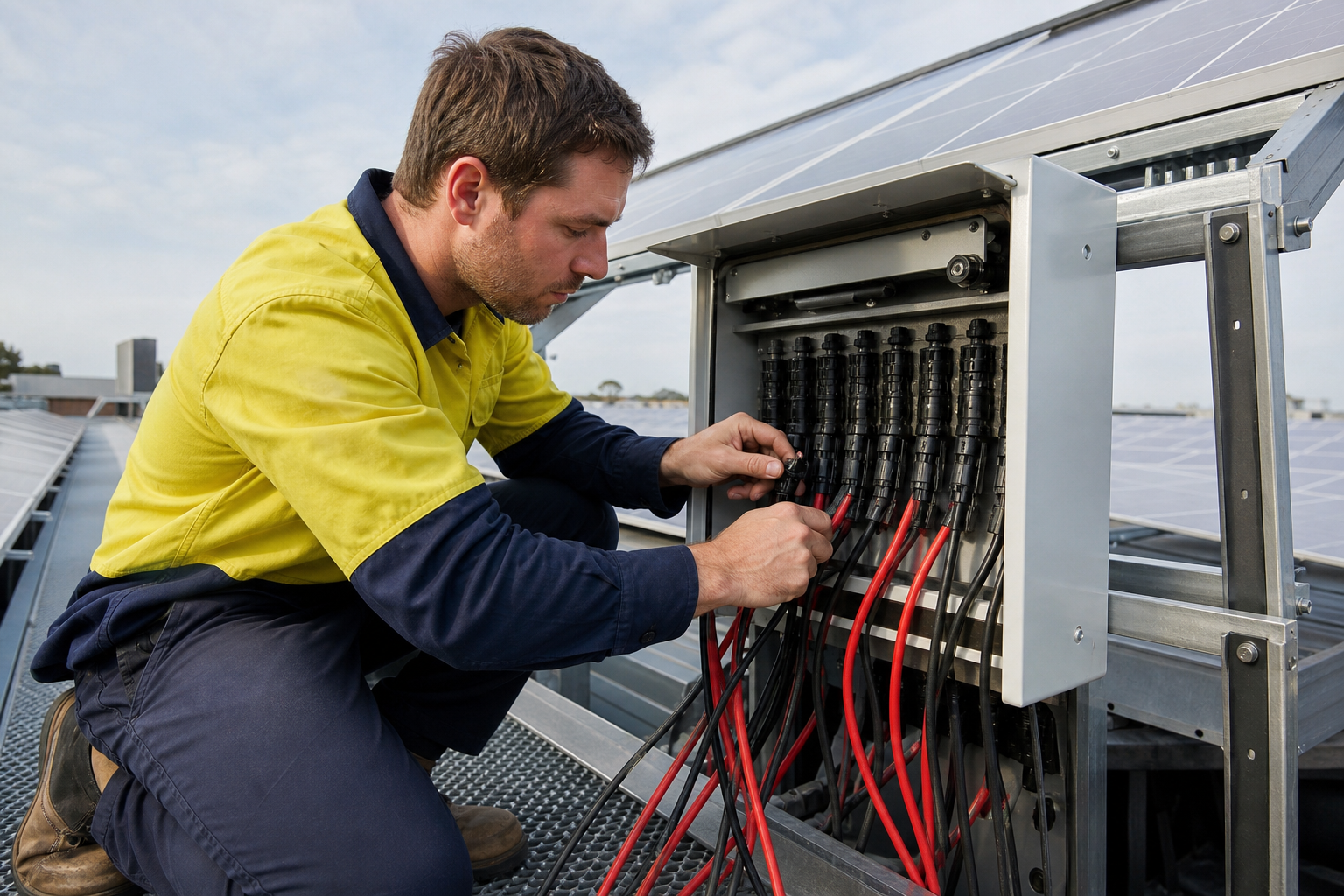
For systems up to 100 kW, string inverters from Fronius, SMA, SolarEdge, or Sungrow offer the best balance of cost and performance. SolarEdge DC-optimised systems add per-panel monitoring and power optimisers, which suits partially-shaded roofs. For systems over 100 kW, central inverters or multiple commercial-grade string inverters in a combiner configuration are standard practice on Sydney industrial sites. All inverters must be listed on the CEC Approved Products List to qualify for STC rebates.
Racking and Mounting Systems
Sydney’s coastal and semi-coastal environment requires marine-grade aluminium or stainless-steel fasteners on all racking within 2 km of salt water (Sydney CBD, eastern suburbs, northern beaches). For inland Western Sydney sites, standard anodised aluminium is adequate. Flat commercial roofs typically use ballasted racking (weighted, not penetrating) to preserve roof integrity and warranty. Pitched metal roofs use roof-penetrating clamp systems designed to interface with the specific profile (Klip-Lok, Trimdek, SuperDek). Always confirm your racking supplier has Structural Engineering sign-off for your roof type and wind loading zone.
Commercial Solar Panels Sydney: 2026 Rebates and Financial Incentives
Commercial solar panels sydney projects under 100 kW qualify for Small-scale Technology Certificates (STCs) under the federal Renewable Energy Target. STCs are calculated based on your location (Zone 3 for Sydney), system output, and the remaining deeming period. In 2026, the STC deeming period is 5 years, reduced from 6 in 2025. For a 30 kW system in Sydney Zone 3, you can expect approximately 207 STCs (30 kW x 1.382 zone rating x 5 years), worth around $7,900 at an indicative $38 per STC. STC prices move, so treat this as an estimate and ask for a quote.
For systems over 100 kW, STCs are replaced by Large-scale Generation Certificates (LGCs), which require registration with the Clean Energy Regulator and are sold on the LGC market rather than upfront. This is typically handled by your installer through a power purchase arrangement or direct market sale.
Additional 2026 incentives for Sydney businesses:
- Cheaper Home Batteries Program: While primarily residential, commercial operations under 100 kW with storage can access the tiered STC uplift (full support on the first 14 kWh of usable storage, tapering to 60 percent for 14 to 28 kWh).
- $20,000 Instant Asset Write-Off: This is now permanent from 1 July 2026 for small businesses (turnover under $10M), so a qualifying commercial solar asset costing under $20,000 can be deducted in full in the year it is first used. Larger systems enter the depreciation pool. The old 20 percent Small Business Energy Incentive bonus deduction expired on 30 June 2024. See the ATO for eligibility.
- NSW Electricity Infrastructure Roadmap: Businesses in declared Renewable Energy Zones may access additional grants. Check NSW Government’s Net Zero website for current eligibility.
To understand current rebate calculations for your specific system size and location, visit the solar batteries and incentives page or contact Interactive Solar for a tailored quote that includes current STC values.
SRES Cap Expansion: What Moving From 100 kW to 1 MW Means for Panel Choice
From 1 October 2026, solar PV systems up to 1 MW can access the Small-scale Renewable Energy Scheme instead of being limited to 100 kW, so mid-sized commercial arrays that previously sold LGCs may now qualify for upfront STC-style support. Applications are not expected to open until mid-to-late November 2026 while the regulator finalises its processes, so ask your installer how they will handle systems installed on or after 1 October.
For panel selection this matters because bigger roofs favour higher-wattage, lower-degradation modules: more kilowatts per square metre means more STC value from the same roof. Network limits still apply, and Endeavour Energy standard connections are capped at 5 kW per phase unless flexible exports are approved, as set out by Endeavour Energy.
Commercial Solar Panels Sydney: How Interactive Solar Selects Panels for Each Project
Commercial solar panels sydney projects handled by Interactive Solar begin with a site assessment that determines which panel technology suits your roof type, orientation, shading profile, and consumption pattern. Not every site needs the most expensive panel. For north-facing unshaded warehouse roofs with high daytime loads, a mid-tier Jinko or Trina TOPCon panel delivers excellent ROI. For east-west split roofs or partially-shaded commercial buildings, the higher bifacial gain and lower temperature coefficient of Aiko or REC panels justifies the premium.
Every commercial system Interactive Solar installs uses panels from the CEC Approved Products List, paired with CEC-approved inverters, and is installed exclusively by Solar Accreditation Australia (SAA) accredited electricians (installer accreditation moved from the Clean Energy Council to SAA in May 2024; the CEC still maintains the Approved Products List). This is not optional: it is a prerequisite for STC rebate eligibility and for compliance with Australian Standards AS/NZS 5033 and AS 4777. View our company background and accreditations or browse the commercial project gallery for examples of completed Sydney installations.
Interactive Solar services all of greater Sydney including the Ausgrid network (eastern suburbs, inner west, northern beaches, North Shore) and the Endeavour Energy network (Parramatta, Blacktown, Liverpool, Campbelltown, Penrith, the Hills district). For large systems over 100 kW, we coordinate directly with the network operator for export limit approvals and protection relay settings.
Watch: Choosing a Solar Retailer You Can Trust
Check retailer credentials against Solar Accreditation Australia and the NSW Government energy site before signing.
FAQ: Commercial Solar Panels Sydney
What is the difference between Tier 1 solar panels and standard panels?
Tier 1 is a bankability classification from Bloomberg NEF, not a quality rating. It means the manufacturer has been financed by multiple independent banks in six or more non-recourse projects. This signals financial stability and ability to honour 25-year warranties. Standard (non-Tier-1) panels may meet Australian Standards but carry higher risk of the manufacturer exiting the market before your warranty term ends.
How many commercial solar panels does my Sydney business need?
For most Sydney commercial sites, divide your average daytime electricity consumption (kWh) by approximately 5 (average peak sun hours per day in Sydney Zone 3). Then divide that system size (kW) by 0.6 kW (the wattage of a typical 2026 commercial panel) to get panel count. A 50 kW system needs roughly 84 x 600W panels. Your installer should always start with 12 months of interval data, not just a single bill.
What degradation rate should I expect from commercial solar panels in Sydney?
Budget Tier 1 panels (Trina, Canadian Solar) degrade at approximately 0.5–0.7 percent per year, leaving you at around 82–84 percent of rated output at year 25. Premium panels (Aiko ABC, REC HJT, SunPower Maxeon) degrade at 0.25–0.35 percent per year, retaining 91–94 percent by year 25. Over a full 25-year lifecycle on a large system, this difference can be worth tens of thousands of dollars in additional generation.
Are commercial solar panels in Sydney eligible for government rebates?
Yes. Systems under 100 kW qualify for Small-scale Technology Certificates (STCs), which are typically discounted off your upfront installation price. In 2026, the deeming period is 5 years. Systems over 100 kW qualify for Large-scale Generation Certificates (LGCs) instead. Both require CEC-approved products and a CEC-accredited installer for eligibility.
What warranties should I insist on for a commercial solar panel system?
You need three warranties: a product warranty (minimum 10 years, ideally 12–15 years from a Tier 1 manufacturer), a performance warranty (minimum 80 percent output at year 25, ideally 87–92 percent), and a workmanship warranty from your installer (minimum 5 years). Read the fine print on the performance warranty: it should be a linear guarantee, not a stepped warranty with large acceptable drop-offs in early years.
What inverter should I pair with commercial solar panels in Sydney?
For systems up to 100 kW, Fronius Symo, SMA Tripower, SolarEdge Commercial, or Sungrow SG commercial-grade string inverters are all strong choices. For partially-shaded roofs, SolarEdge with DC optimisers or Enphase microinverters eliminate string mismatch losses. All inverters must appear on the CEC Approved Products List to qualify for STCs. Your installer should provide a monitoring platform with at least 5 years of data access.
How long does a commercial solar installation take in Sydney?
For systems under 30 kW on a standard commercial roof, installation typically takes 1–3 days once permits are in order. For systems between 30–100 kW, allow 3–7 installation days plus 2–4 weeks for network connection approval from Ausgrid or Endeavour Energy. Systems over 100 kW require more complex engineering sign-offs and network protection relay settings, adding 4–8 weeks to the approval timeline. Your installer should manage the entire DA and network application process. See our Interactive Care aftercare and monitoring service for what happens after installation.
Ready to get a specification-matched proposal for your Sydney commercial site? Contact Interactive Solar for a no-obligation commercial solar assessment. Our SAA-accredited team works across all of greater Sydney, from the eastern suburbs to Western Sydney’s industrial and warehouse precincts.
Make Interactive Solar a preferred source in Google
One click tells Google to surface our articles more often in Top Stories, AI Overviews and AI Mode.