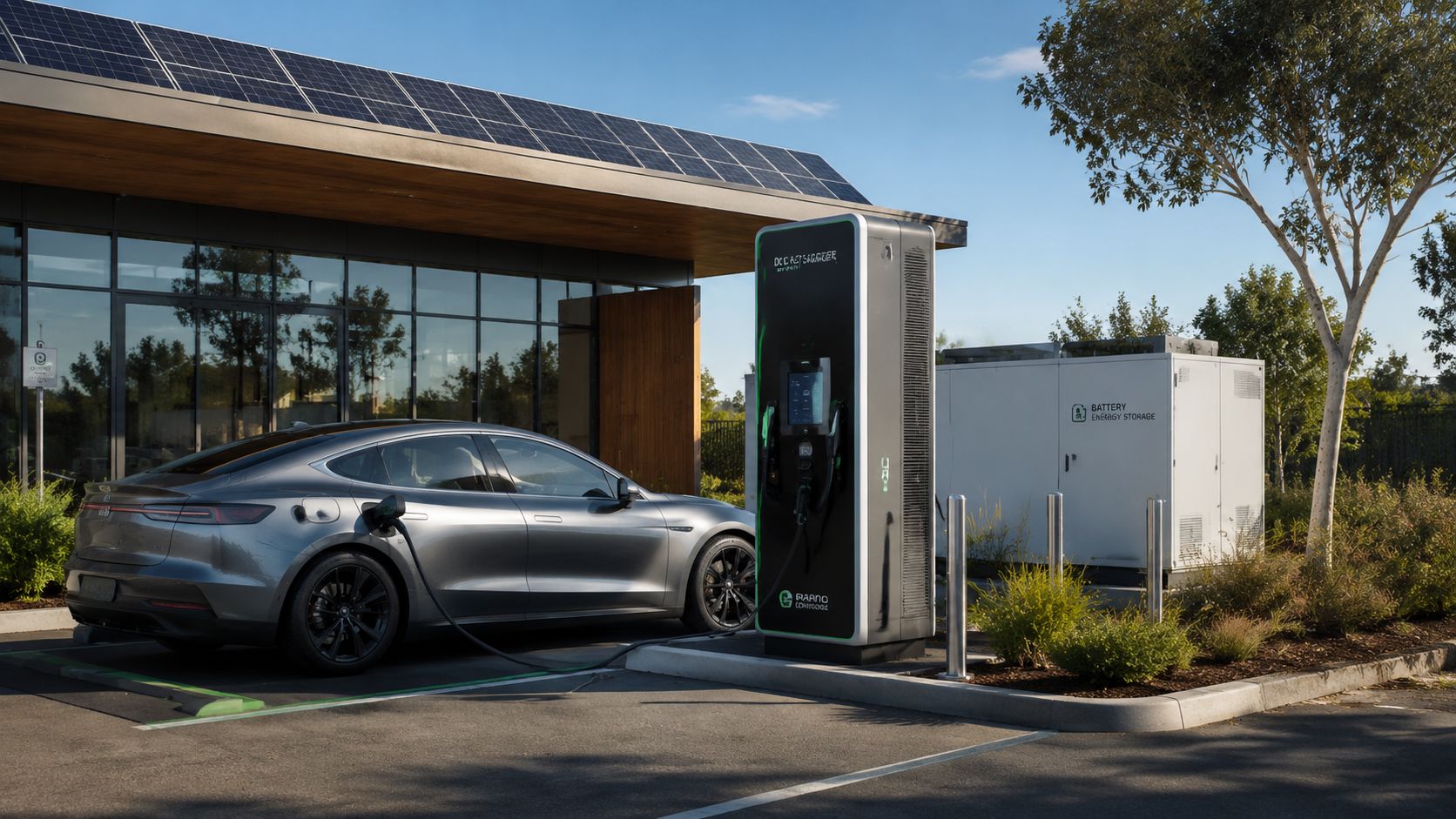
Level 3 EV Charger Guide for Australian Businesses
Last updated:
If you're looking at a Level 3 EV charger for a site in NSW, you're probably already past the basic question of whether EV charging matters. The key question is whether fast charging fits your site, your customers, your fleet, and your electricity profile.
That's where many projects go off track. People focus on the charger headline, usually the biggest kW number on the brochure, and skip the harder questions: Can the site support it? Will vehicles stay long enough to justify it? Should the charger sit behind solar and battery storage? Will the grid connection make the business case work, or break it?
For commercial sites, a Level 3 EV charger isn't just a charging product. It's an energy infrastructure decision. When it works, it can improve vehicle turnaround, support destination traffic, and strengthen a broader energy strategy. When it's poorly matched to the site, it becomes an expensive asset that spends too much time underused or too much money pulling power at the wrong times.
What Is a Level 3 EV Charger
A Level 3 EV charger is the common label for DC fast charging. Unlike home and workplace AC chargers, it delivers direct current to the vehicle battery through specialised equipment designed for rapid charging in public and commercial settings.
The simplest way to think about it is this. AC charging is a steady refill. DC fast charging is a short, high-output transfer built for drivers who need to get moving again soon.
Why it's different from Level 1 and Level 2
With Level 1 and Level 2 charging, the car handles part of the conversion process. With DC fast charging, the charging station does that heavy work and sends power directly in the form the battery uses. That's why the equipment is larger, the electrical requirements are much higher, and the installation is treated more like infrastructure than an appliance.
For a quick grounding in the broader charging environment, this overview of EV charging basics in Australia is useful before you compare site options.
EV Charger Levels at a Glance
| Feature | Level 1 Charger | Level 2 Charger | Level 3 (DC Fast) Charger |
|---|---|---|---|
| Power type | AC | AC | DC |
| Typical setting | Home emergency or very light use | Home, workplace, destination charging | Highway, fleet, retail, public fast charging |
| Typical power output | Low power | Moderate power | 50 kW to 350+ kW, with some systems operating at 400 to 500 kW or higher according to industry guidance on Level 2 versus Level 3 charging |
| Charging style | Long dwell | Overnight or extended parking | Short-stop top-up |
| Best use case | Minimal daily need | Routine daily charging | En-route charging and rapid turnaround |
| Fit for homes | Yes | Yes | Generally no |
The commercial mistake is treating Level 3 as just a faster version of Level 2. It isn't. It serves a different job.
Practical rule: If the vehicle can sit for hours, AC charging is usually the starting point. If the vehicle needs meaningful energy in a short stop, DC fast charging enters the conversation.
What Level 3 is really for
In Australia, public fast-charging investment has been directed toward corridor gaps and long-distance travel rather than ordinary residential charging, which reinforces the point that Level 3 chargers are transport infrastructure, not household appliances. The Australian Government's Ultra Fast Charging for Highway Trips Program committed A$39.3 million to support 117 fast and ultra-fast charging sites, with many locations targeting about 20-minute top-ups for practical long-distance travel, as noted in this summary of Level 3 charging and the highway program.
That policy direction matches what works in practice. These chargers belong where turnover matters, where vehicles need a fast top-up, and where the site owner has a clear operational or commercial reason to provide it.
Understanding DC Fast Charger Technical Specs
A DC fast charger spec sheet can look straightforward until it meets a real site. A charger may be rated at 150 kW or 350 kW, but that number alone does not tell you what drivers will experience, what the grid connection must support, or whether the asset will earn its keep.
For commercial sites in NSW, the useful question is not "what is the fastest unit available?" It is "what charging outcome does this site need, and what will it cost to deliver repeatedly?"
What the kW rating actually tells you
The kW rating is the charger's maximum instantaneous power output. It shows how fast the unit can deliver energy under the right conditions. It does not show how much energy a vehicle will receive over a full session, and it does not guarantee that every EV can take that power.
That distinction matters on commercial projects. A 50 kW charger can be a good fit where vehicles stop long enough for a meaningful top-up. A 150 kW unit usually suits sites that need better turnover. Higher power hardware can make sense, but only where the vehicle mix, utility capacity, and revenue model support it.
If your team needs a quick refresher on the difference between power and stored energy, this guide on kW versus kWh for commercial energy planning clears up a lot of confusion early.
Why nameplate power and real charging speed are different
Real charging speed is shaped by three things at once. The charger has to be able to supply the power, the vehicle has to be able to accept it, and the site has to be able to feed the charger without creating a bigger electrical problem.
Battery state of charge changes the result immediately. A vehicle arriving low can often accept power much faster than one arriving half full. Battery temperature matters too. So does the vehicle's own charging curve. Chargefox explains this clearly in its overview of what affects EV charging speed, including the way charging power usually falls as the battery fills.
This is why two cars can plug into the same unit and have very different session times.
I see buyers get caught here regularly. They compare charger ratings, then assume customer experience will match the biggest number on the brochure. In practice, session performance is constrained by the slowest part of the chain, and that may be the car, the site supply, or the charger's power sharing setup.
Connectors and power sharing matter more than many buyers expect
Connector choice affects utilisation. For Australian commercial sites, CCS2 is still the main connector to prioritise for current mainstream EV compatibility. CHAdeMO may still be relevant if the site serves older vehicles, but for many new projects it is becoming harder to justify dedicating capacity to a declining standard.
The other spec to read carefully is how the charger handles dynamic power sharing. A dual-port unit rated at 150 kW does not always mean each vehicle can receive 150 kW at the same time. In many cases, the charger splits available output between vehicles based on demand and configuration. That can be a smart use of capital, but only if it matches actual traffic patterns.
A site serving delivery vans in staggered windows has different needs from a public charging bay where two vehicles may arrive together and both expect a short stop.
Read the spec sheet as an operating model
The technical sheet is more useful when you read it in this order:
- maximum output per connector
- simultaneous charging behaviour
- required supply voltage and current
- connector standards
- cooling method and operating temperature range
- backend communications, load management, and payment options
Those details affect more than charging speed. They shape switchboard upgrades, cable routes, demand charges, maintenance access, and whether solar or battery storage can reduce peak import at the right time.
For NSW businesses, that last point is often where the project either works financially or becomes an expensive marketing feature. A charger that pulls hard for short periods can create a very different network demand profile from a bank of AC chargers. If the site already has solar, or is considering battery storage, the DC charger should be assessed as part of the broader energy system, not as a standalone appliance.
A practical way to choose the right spec
Start with the vehicles, then the dwell time, then the site capacity.
A retail site with 30 to 60 minute stays may get better utilisation from moderate-power DC charging that aligns with existing grid limits. A fleet depot with fixed dispatch times may need higher power, but may also benefit from battery buffering to avoid oversized network upgrades. A highway or regional stop may justify higher power hardware if turnover and traffic support it.
The right spec is the one that fits the site's operating pattern, electrical constraints, and long-term energy plan. That is the business case commercial buyers should test first.
Where Level 3 EV Chargers Make Sense
A site manager usually asks the Level 3 question after the first operational problem appears. Vehicles are queueing between jobs, drivers are leaving with less charge than planned, or a retail site wants to turn charging bays over faster without adding more parking. That is the point where DC fast charging starts to make commercial sense. It solves a time and throughput problem, but only at sites where that time has clear business value.
Highway and corridor sites
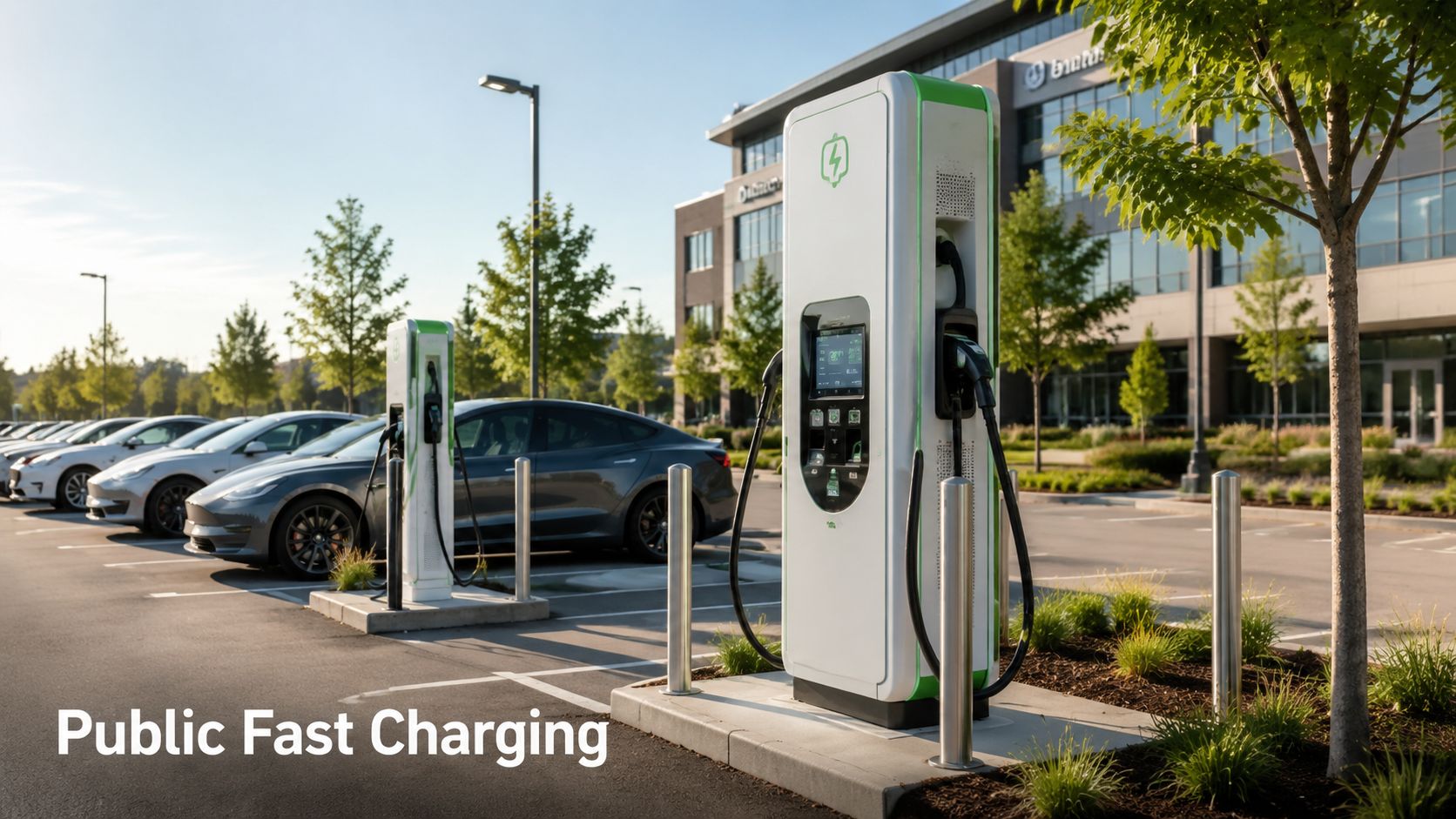
Highway sites are the clearest fit because the driver is buying range, not parking. A roadhouse, service centre, or regional stop needs to add useful energy during a short break, then get the vehicle back on the road.
In Australia, public fast charging has expanded through federal and state programs tied to long-distance travel corridors, as outlined in the Australian Government's National Electric Vehicle Strategy. For site owners, the commercial question is simple. Is the location on a route where drivers already stop, and will charging increase spend, dwell, or repeat visits enough to justify the capital cost and network impact?
Traffic volume matters, but site function matters more. A well-placed regional stop with amenities, good access, and room for future charging bays often performs better than a harder-to-access site that only looks attractive on a map.
Fleet depots and operational sites
Fleet depots justify DC fast charging when vehicle readiness affects revenue. That includes courier fleets, trade vehicles, community transport, service fleets, and any operation with fixed dispatch windows and limited time between shifts.
At these sites, the charger is an operational asset. It reduces idle time, supports shift changeovers, and can avoid the need for extra vehicles to cover charging downtime. The stronger business case often comes from labour efficiency and fleet availability, not from charging fees.
For NSW businesses planning fleet electrification, a broader commercial EV charging strategy for Australian businesses helps frame the charger as part of the site's energy plan rather than a standalone piece of hardware. That matters when solar output, battery storage, and peak demand charges will shape the project economics as much as vehicle use.
Retail, hospitality, and destination sites
Retail and hospitality sites are more selective. DC fast charging works best where customers stay long enough to buy meaningful energy, but not so long that lower-cost AC charging would do the same job.
Roadside retail, larger shopping centres, quick-service precincts, and some hotels fit that pattern. Standard office parking, long-stay venues, and sites with all-day dwell usually do not. In those cases, spending more on DC hardware can tie up budget and grid capacity without adding much practical value.
This short video gives a useful visual sense of how fast-charging sites are positioned in real-world use:
Where it usually does not make sense
Level 3 charging is often the wrong tool for homes, small offices, and low-utilisation car parks.
If vehicles are parked overnight, through a full workday, or during long customer visits, AC charging usually covers the load at far lower cost and with less pressure on the site's electrical infrastructure. I see this mistake often in early planning. Teams focus on charger speed before they test utilisation, tariff exposure, and whether the site could get better long-term value from a mix of AC charging, solar, and battery storage.
For commercial sites in NSW, the best Level 3 projects start with operations and energy strategy together. If the charger improves turnover, protects fleet uptime, or supports a corridor location with proven demand, it can be a strong asset. If not, it becomes an expensive way to buy speed the site does not really need.
Installation Grid and Site Requirements
A Level 3 charger installation is an electrical project, a civil project, and often a network project. That's why early feasibility work matters so much.
Industry guidance commonly describes Level 3 or DC fast charging as a high-capex asset that requires 480V three-phase power and often utility upgrades, making it unsuitable for residential use. It also highlights that the key business questions are site economics, network constraints, and demand-charge exposure, as noted in this comparison of Level 2 and Level 3 charging for business use.
Electrical capacity comes first
The first screening question is simple. Can the site support the charger without major upstream work?
In NSW, that usually means checking existing switchboard capacity, three-phase supply, transformer headroom, and the likely response from the local network. If the available capacity is tight, the project may require staging, load management, or broader site upgrades before the charger itself is even considered.
A useful starting point is understanding the wider set of cost drivers involved in commercial EV charging station installation planning, because the charger hardware is only one part of the project.
Civil works often decide the easy sites from the hard ones
The charger cabinet and dispenser are the visible parts. The hidden work often drives programme complexity.
Typical site works can include:
- Trenching and cabling: High-capacity cabling routes can be straightforward on open ground and painful in established car parks.
- Concrete foundations: DC equipment needs stable mounting surfaces and clear equipment zones.
- Protection infrastructure: Bollards, wheel stops, signage, and traffic management matter because these assets live in active vehicle areas.
- Cable path design: Long cable runs can complicate both cost and installation sequencing.
A charger that looks simple on a site map can become difficult once you account for drainage, traffic flow, existing services, and the nearest practical connection point.
NSW network engagement is part of the job
For many sites, the project team has to engage with the relevant electricity distributor early. In NSW that may involve distributors such as Ausgrid or Endeavour Energy, depending on the location.
That process isn't just administrative. The network view can shape whether the charger is approved as proposed, whether export and import settings need attention, and whether the site should consider staged deployment rather than a single large jump in load.
Site reality: The best charger layout on paper can fail if the nearest viable electrical connection is in the wrong place or the site can't support the peak demand.
Good design starts with usage, not hardware
A lot of poor DC fast charging projects start from the charger and work backwards. The better approach is to start with the site's operating pattern.
Ask these questions first:
- How long do vehicles stay?
- How many charging events are expected at the same time?
- Will charging align with solar production hours or evening peaks?
- Is the site already carrying heavy electrical loads from HVAC, refrigeration, or manufacturing equipment?
Those answers shape charger size, placement, energy controls, and whether battery support should be built in from day one.
Compliance and execution matter
A commercial DC charging site also needs disciplined project management. Electrical safety separation, cable management, user access, pedestrian movement, and maintenance access all affect how the finished asset performs.
That's why experienced buyers treat the Level 3 charger as one part of a site-wide energy and infrastructure plan. Not as a standalone box to be bolted to the wall at the end of the car park.
Integrating DC Fast Charging with Solar and Battery Storage
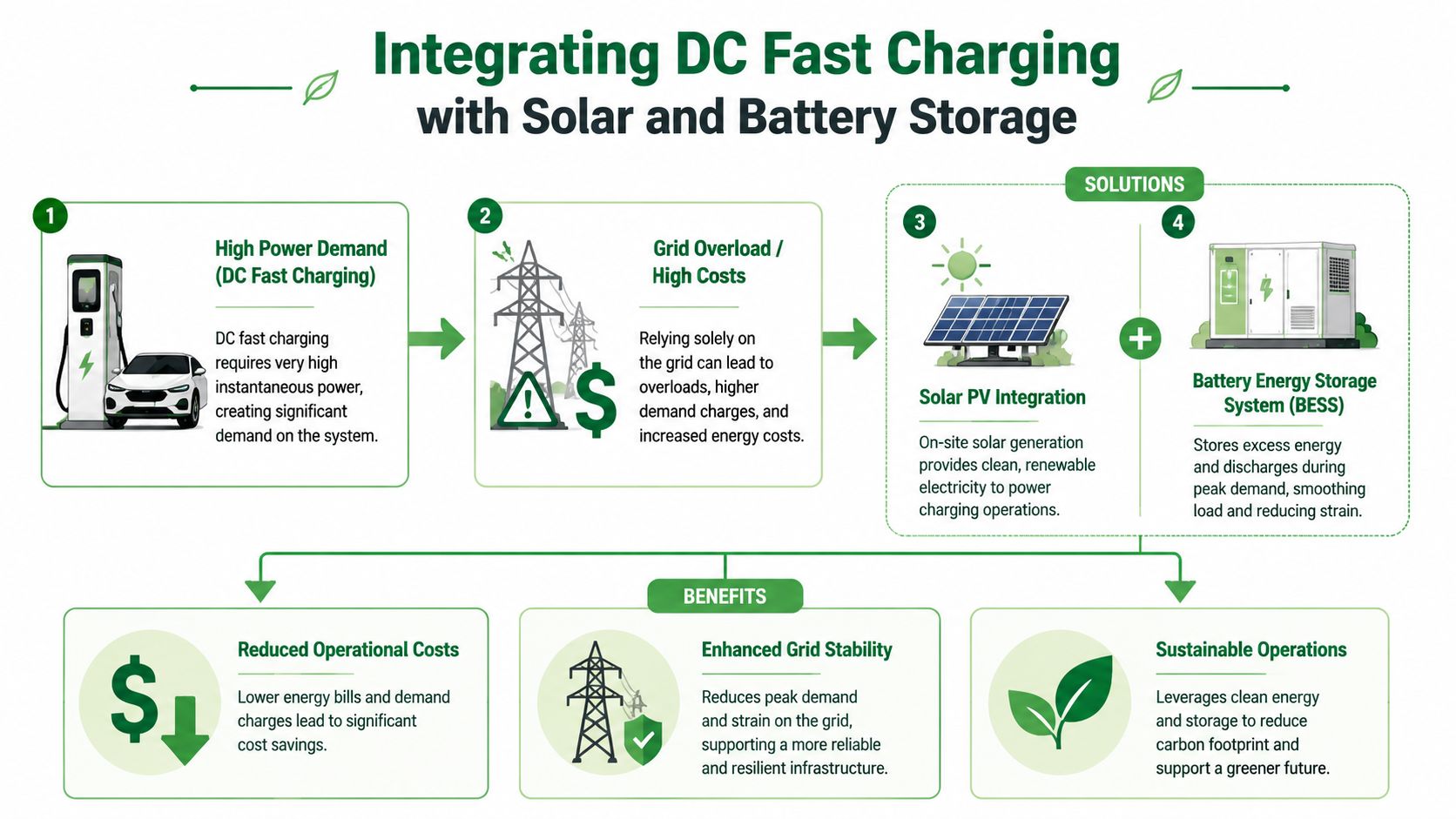
Once a site commits to DC fast charging, the next question shouldn't be “How fast can the charger go?” It should be “How will the site supply that load intelligently?”
That's where solar and battery storage change the economics and the operational profile. Instead of treating the charger as a pure grid burden, the site can support it with on-site generation, stored energy, and better control over when electricity is imported.
Why solar belongs in the conversation
Many commercial charging sessions happen during business hours. That timing matters because daytime charging can align with on-site solar production.
For sites with usable roof area, solar can offset part of the energy drawn by the charger and reduce reliance on imported grid electricity during the day. That won't remove every infrastructure issue, but it improves how the asset performs financially and environmentally.
Businesses looking at a wider energy plan usually benefit from reviewing how renewable energy solutions for commercial sites fit together before they commit to charging hardware in isolation.
What battery storage adds
Battery storage does two practical jobs in a DC fast charging environment.
First, it can store excess solar generation for use later in the day when charging demand continues after solar output falls.
Second, it can help smooth short, sharp charging loads. That matters because DC fast charging can create high instantaneous demand, especially when combined with other major site loads. A battery energy storage system can reduce the strain of those peaks by supplying part of the load locally rather than pulling the full amount from the grid at once.
The strongest commercial use cases
Solar and battery integration tends to make the most sense when the site has one or more of these traits:
- Daytime charging demand: Vehicles arrive while solar production is available.
- Existing high electricity costs: The business already has a reason to improve load management.
- Capacity constraints: The site needs help managing grid draw rather than adding more load.
- A broader decarbonisation objective: The charger is part of a larger shift in energy strategy.
Not every site needs all three technologies on day one. But when a business knows charging demand will grow, it's often smarter to plan the charger, solar, and battery pathway together than retrofit the energy strategy later.
Charging without an energy plan often turns a useful asset into an expensive peak-load event.
What doesn't work
The weak version of this strategy is installing a DC fast charger first, then discovering the site's peak demand profile has worsened, daytime generation is underutilised, and the charger sits outside the building's energy controls.
The better version is integrated design. That means modelling how the charger will operate alongside solar PV, battery dispatch, existing load patterns, and likely future growth. It also means deciding early whether the site needs simple offsetting, stronger peak management, or room to add more chargers later.
A long-term view beats a hardware-first decision
Commercial charging infrastructure lasts longer than a single procurement cycle. Vehicle mix changes. Occupancy changes. Electricity tariffs change. Operational demand changes.
A site that plans for those shifts can expand charging in a controlled way. A site that chases speed alone often ends up revisiting switchboards, network applications, and load management sooner than expected.
For NSW businesses, that's the bigger opportunity. Use DC fast charging as part of a coordinated site energy strategy, not as a standalone convenience feature.
Buyer Considerations for NSW Businesses
A common NSW scenario looks like this. A business wants a fast charger because EV uptake is rising, drivers are asking for quicker turnaround, and management wants a visible signal that the site is ready for electrification. The risk is buying charger capacity before checking whether the site, tariff structure, and future load profile can carry it profitably.
The better buying decision starts with the job the charger needs to do. For a depot, that usually means protecting vehicle availability and controlling energy costs. For a retail or mixed-use site, it may mean balancing customer dwell time, network constraints, and whether charging will become a revenue line or merely a tenant amenity.
Match the charger to dwell time and business model
Charging speed only matters in context.
If vehicles sit on site long enough for lower-power DC charging to meet operational needs, oversized hardware can increase capital cost, connection complexity, and demand charges without improving outcomes. If vehicles need to turn quickly between jobs, a slower unit can create a daily operational bottleneck that costs more than the savings from cheaper equipment.
The right question is not "What is the fastest charger we can buy?" It is "What charging window does the site need to support, and what does that do to infrastructure cost?"
Check the vehicle mix before you lock in hardware
I always want to see the expected vehicle list before discussing final charger selection. Charger brochures rarely tell the whole commercial story.
Review these points early:
- Current connector requirements: Make sure the charger suits the vehicles in service today.
- Vehicle charging limits: Some EVs will not use the charger's full rated output.
- Fleet replacement plans: Future vehicle procurement can justify spare capacity, but only if there is a credible rollout plan.
- User type: Staff, fleet, visitors, and public users place very different demands on utilisation and uptime.
A charger can look impressive on paper and still be the wrong asset if the vehicles on site cannot use it effectively.
Treat the grid connection as part of the purchase decision
For NSW businesses, the charger is only one part of the project cost. The harder questions usually sit behind the switchboard.
Before approval, get clear answers on:
- Available site capacity: What headroom exists today, and under what operating conditions?
- Network and approval pathway: Is the project straightforward, or will it trigger a more involved application process?
- Demand impact: How will charging affect maximum demand and tariff exposure?
- Staging options: Can conduits, switchboard space, and controls be sized now for later expansion?
- Operational controls: Can the charger respond to site load limits, solar output, or battery dispatch?
Those questions separate a workable site plan from a hardware sale.
Assess the charger as an energy asset, not just a transport asset
This matters most for sites with solar, battery storage, or both. A DC fast charger can either increase peak costs or become a controllable load that supports a broader energy strategy.
For example, some NSW commercial sites can use daytime solar generation to offset charging load, then use battery storage or charging controls to reduce late-afternoon demand spikes. Other sites have limited solar contribution because charging happens outside solar production hours. The business case changes by site. That is why charger procurement should be tied to load analysis, tariff review, and an expansion plan, not handled as a standalone equipment purchase.
If solar or battery storage is not part of stage one, leave room for it. Spare switchboard capacity, communications integration, and control-ready hardware are often cheaper to plan now than retrofit later.
Include tax and policy in the internal business case
Charging infrastructure decisions often sit alongside fleet policy, salary packaging, and broader electrification planning. For businesses reviewing that side of the decision, Australia Wide Tax Solutions' EV tax update is a useful reference on the changing treatment of EV-related tax settings.
It will not choose the charger for you. It does affect how the project is assessed by finance and management.
A short NSW buyer checklist
Use this as a decision filter before committing capital:
- Define the use case. Fleet turnover, customer charging, tenant amenity, or public access.
- Measure actual parking duration. Real dwell time should drive charger sizing.
- Review site capacity early. Electrical constraints can reshape the whole project.
- Model operating cost, not just purchase cost. Tariffs and demand charges matter.
- Plan staged growth. Civil and electrical allowances today can save major rework later.
- Check vehicle compatibility. Buy for the vehicles that will use the site.
- Prepare for solar and battery integration. Even a staged approach needs design allowance from day one.
The right Level 3 EV charger suits the site's operating pattern, works with the electrical supply available, and fits a long-term energy plan.
In NSW, that is usually the difference between a charger that supports the business and one that keeps creating avoidable cost.
Make Interactive Solar a preferred source in Google
One click tells Google to surface our articles more often in Top Stories, AI Overviews and AI Mode.