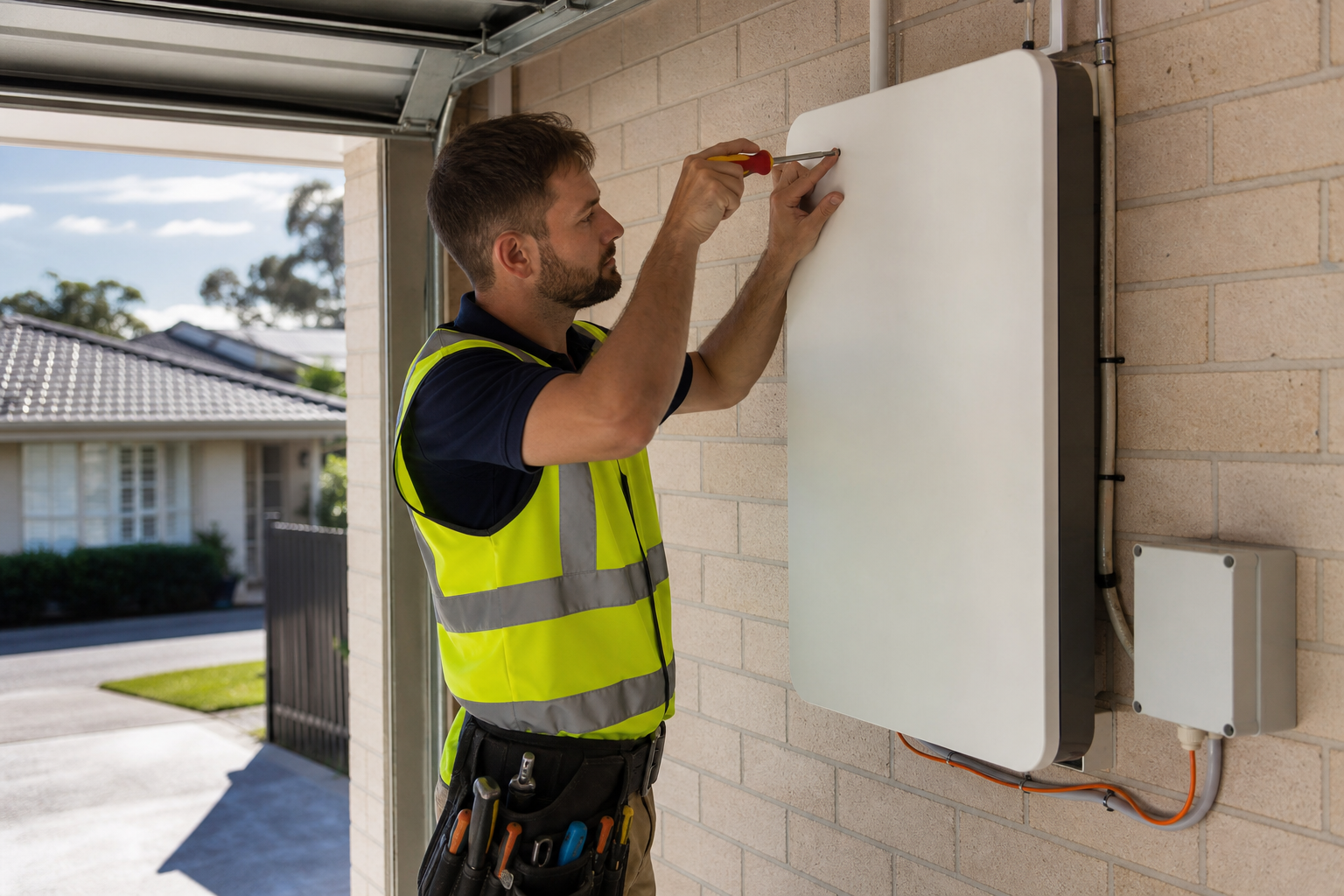
Home Battery Installation Sydney: 2026 Rebate, Sizing & Grid Guide
Last updated:
Home battery installation Sydney homeowners are pursuing in record numbers is now more rewarding than at any point in the past decade. A typical 10 kWh battery, installed by a CEC-accredited electrician, cuts grid power bills by 60 to 80 percent, earns feed-in credits overnight, and qualifies for a combined federal and NSW rebate worth $3,000 to $6,000 in 2026. The short answer: if your household uses more than 20 kWh per day and you already have solar, a battery pays for itself in four to six years and saves you money every day after that.

Key Takeaways
- A typical 10 kWh battery cuts grid power bills by 60 to 80 percent and pays for itself in 3.5 to 6 years when paired with existing solar.
- In 2026 Sydney households can stack a federal STC rebate, an NSW Battery Discount of around 30%, and an NSW VPP incentive of up to $1,500 on one installation.
- A 13.5 kWh Tesla Powerwall 3 earns roughly $3,672 in federal STC rebate, bringing its installed price down to $9,300 to $12,800.
- Full installation takes 4 to 8 hours on the day, but the whole process from quote to commissioning spans 2 to 4 weeks due to network approvals.
- Households without solar buying a battery for grid charging typically see payback periods of 7 to 12 years, far longer than the 3.5 to 5 years achieved with existing solar.
Home Battery Installation Sydney: How the 2026 Rebate Stack Works
The biggest question most Sydney families ask is: what does the government actually pay? In 2026, there are two rebate streams you can stack on the same installation.
Federal Cheaper Home Batteries Program (STC tiers, effective 1 May 2026):
- 0 to 14 kWh of usable capacity: 100% of the STC factor applied (approximately $272 per kWh at mid-2026 STC prices)
- 14 to 28 kWh: 60% of the STC factor applied
- 28 to 50 kWh: 15% of the STC factor applied
- Above 50 kWh: no STCs issued
In practice, a 13.5 kWh Tesla Powerwall 3 installed after 1 May 2026 earns approximately 13.5 kWh x 6.8 STCs/kWh x $40/STC = roughly $3,672 in federal rebate, which your installer passes through as a point-of-sale discount. A 10 kWh Sungrow SBR earns around $2,720 in STCs. The STC multiplier steps down each year, so 2026 installations receive a higher rebate than 2027.
NSW Battery Discount (Cheaper Home Batteries Program state component):
NSW households receive an upfront discount of approximately 30% on batteries between 5 kWh and 50 kWh in size, applied through the installer at the point of sale. You do not need to apply separately. The NSW Government expanded battery eligibility from 1 July 2026 to cover all capacity up to 50 kWh (previously capped at 28 kWh for the VPP incentive component).
NSW VPP Incentive (additional, up to $1,500):
Once your battery is commissioned, you can enrol it in a Virtual Power Plant through an approved VPP operator. NSW Government pays up to $1,500 as a sign-up incentive for batteries between 2 kWh and 50 kWh. As of 1 July 2026, the cap was raised to 50 kWh, meaning larger home batteries now qualify for the full VPP payment. Leading VPP operators active in Sydney include Amber Electric, Reposit, and AGL Virtual Power Plant.
| Battery | Usable Capacity | Pre-rebate Price (installed) | Federal STC Rebate (est.) | After-rebate Price (est.) |
|---|---|---|---|---|
| Sungrow SBR 9.6 kWh | 9.6 kWh | $7,500 to $9,500 | ~$2,611 | $4,900 to $6,900 |
| Sungrow SBR 12.8 kWh | 12.8 kWh | $9,500 to $11,500 | ~$3,482 | $6,000 to $8,000 |
| BYD Battery-Box HVM 10.2 kWh | 10.2 kWh | $8,500 to $11,000 | ~$2,774 | $5,700 to $8,200 |
| Tesla Powerwall 3 (13.5 kWh) | 13.5 kWh | $13,000 to $16,500 | ~$3,672 | $9,300 to $12,800 |
| Enphase IQ Battery 10T | 10.1 kWh | $9,500 to $12,000 | ~$2,747 | $6,700 to $9,200 |
STC rebate estimates based on 6.8 STCs/kWh at $40/STC (mid-2026 STC market price). Your actual installer discount will vary. Prices are indicative of Sydney metro market as at August 2026.
Home Battery Installation Sydney: Sizing for Real Sydney Households
The right battery size depends on three variables: how much solar you export during the day, how much grid power you consume at night, and whether you want backup power during outages. Getting this wrong is the most expensive mistake Sydney homeowners make.
Step 1: Check your daily export first
Pull three months of smart meter data from your retailer’s app or from the Ausgrid/Endeavour Energy customer portal. Look at how many kWh you export between 9am and 3pm on average weekdays. That is approximately the solar surplus a battery can capture. If you export 8 kWh/day on average, a 10 kWh battery will absorb almost all of it. If you export 3 kWh/day, a 10 kWh battery is significantly oversized and you will be charging most of it from the grid.
Step 2: Match battery to night consumption
The average Sydney household uses 8 to 12 kWh between 5pm and 11pm: cooking, air conditioning, hot water, TV, and appliances. A 10 to 13.5 kWh battery covers most or all of this evening peak. Households with larger air conditioning loads or EV charging at home may need 15 to 20 kWh to fully cover evening demand.
Step 3: Factor in backup if that matters to you
Not all batteries provide whole-home backup during a blackout. The Tesla Powerwall 3 includes a built-in backup gateway as standard, switching to island mode automatically in a blackout. Sungrow SBR and BYD systems typically need a compatible Sungrow or Fronius hybrid inverter for backup functionality, and only circuits wired to the backup panel will be powered. Ask your installer to confirm what is included in their quoted price.
Sydney-specific climate note: Sydney’s 6 to 6.5 peak sun hours on a north-facing roof means most 6.6 kW solar systems generate 26 to 30 kWh on a clear summer day. A 10 kWh battery fills by midday, leaving hours of additional export. A second battery (or a modular expansion like a Sungrow SBR second module) may be worth modelling for larger households.
Home Battery Installation Sydney: Grid Connection and Flexible Exports in 2026
How your battery interacts with the grid depends on which network distributor serves your address, and this changed significantly in 2026. Sydney is split between two distributors: Ausgrid (eastern suburbs, inner west, north shore, parts of the Hills district) and Endeavour Energy (western Sydney, Blacktown, Penrith, Liverpool, Campbelltown, Wollongong fringe).
Ausgrid customers: Ausgrid introduced a two-way solar pricing tariff in July 2024 (mandatory for applicable customers from July 2025). Under this model, exports above a set threshold during high-congestion periods can attract a negative export price (you are charged for exporting). A battery with smart export management helps avoid these charges by storing surplus rather than exporting during low-value windows. Your installer or retailer can configure your inverter to limit exports during these periods.
Endeavour Energy customers: Endeavour launched its Flexible Exports program in 2026, which raises the fixed export limit from 5 kW to 10 kW for customers who opt in. Flexible Exports allow the network to remotely curtail exports only when local grid stability requires it. For most days, you export at the full 10 kW rate. Battery owners benefit doubly: the stored energy avoids the curtailment windows entirely, and the higher baseline export limit means any surplus beyond your battery’s state of charge earns credits at a higher rate.
If you are in Endeavour territory, ask your battery installer whether your inverter model is already Flexible Exports certified or needs a firmware update. Most 2024 and newer Sungrow and Fronius hybrid inverters are compatible.
Home Battery Installation Sydney: The Installation Process Step by Step
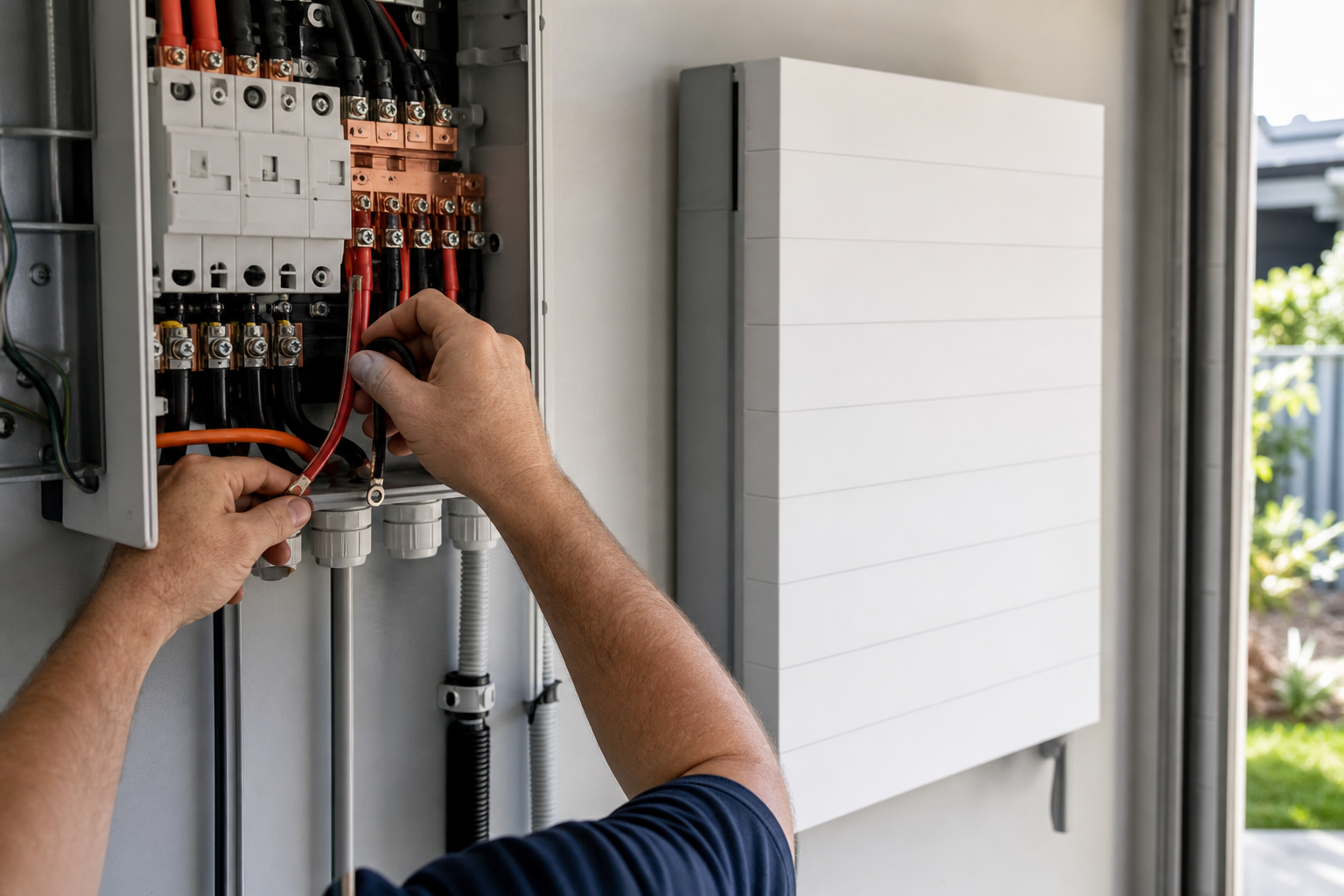
Home battery installation Sydney properties typically complete in one to two business days from the physical installation perspective, but the full process from quote acceptance to final commissioning spans two to four weeks. Here is what to expect.
- Quote and site assessment (1 to 3 days): A CEC-accredited designer visits your home, reviews your meter data, inspects your switchboard, and measures available wall space (most batteries need a 600 mm x 1,200 mm minimum area). They confirm which battery model suits your roof orientation and usage profile and provide a written quote including the STC rebate applied as a point-of-sale deduction.
- Approval and paperwork (1 to 2 weeks): Your installer lodges a Notification of Proposal to Connect (NPC) with your distributor (Ausgrid or Endeavour) and applies for any required metering upgrades. If your meter is not yet smart, the distributor arranges a free upgrade. This is the most variable part of the timeline.
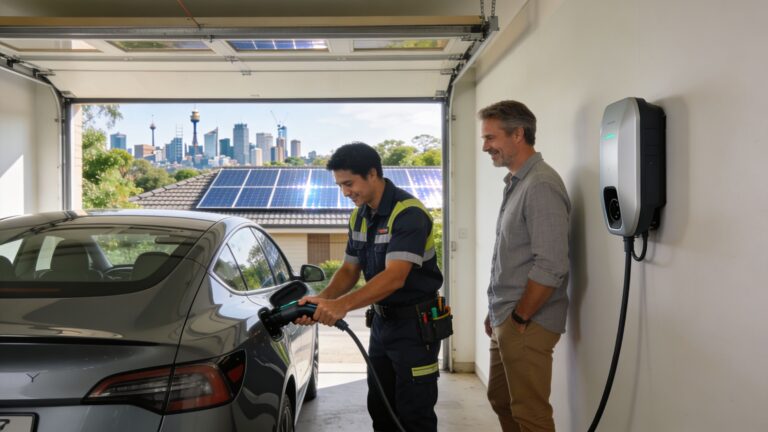
- Installation day (4 to 8 hours): The licensed electrician mounts the battery (typically in a garage, laundry, or utility room on a brick or timber-stud wall), connects DC cables from the solar array, wires the battery inverter to the switchboard, and installs the communication gateway. The switchboard may need an upgrade if it is pre-2005 and does not have modern circuit breakers.
- Commissioning and monitoring setup (1 to 2 hours): The installer commissions the battery management system, connects it to your home Wi-Fi, and configures your preferred charging schedule. For Tesla Powerwall, the Tesla app is set up on your phone. For Sungrow, the iSolarCloud app is configured. You can see real-time charge level, solar generation, grid imports, and exports from your phone.
- CEC paperwork and STC lodgement: After installation, your installer lodges the STC claim with the Clean Energy Regulator on your behalf and submits the compliance certificate to your state electrical safety regulator. You receive copies for your records and for home insurance purposes.
Interactive Solar’s team of CEC-accredited installers handles all network paperwork, metering coordination, and STC lodgement as part of the quoted price. There are no hidden fees for switchboard assessments or standard metering upgrades.
Home Battery Installation Sydney: Payback Modelling with 2026 Electricity Prices
Does a battery actually pay back in Sydney in 2026? The answer depends heavily on your electricity tariff and feed-in rates. Here is a realistic worked example for a Sydney household on a time-of-use tariff.
Household profile: 4-person home in Parramatta (Endeavour Energy zone), 6.6 kW north-facing solar, 25 kWh/day total consumption, exports 10 kWh/day without battery.
| Metric | Without Battery | With 10 kWh Battery |
|---|---|---|
| Grid import (kWh/day) | 15 | 5 |
| Grid import cost (@$0.35/kWh avg) | $5.25/day | $1.75/day |
| Solar export credits (@$0.06/kWh) | $0.60/day | $0.12/day |
| Net daily energy cost | $4.65/day | $1.63/day |
| Annual saving | – | approx. $1,100/year |
With a post-rebate battery cost of around $6,000 (Sungrow SBR 9.6 kWh after federal STC) and VPP sign-up payment of $1,500, the net cost is approximately $4,500. At $1,100/year in grid bill savings plus VPP revenue of $200 to $400 per year from demand response events, payback is approximately 3.5 to 4 years.
The Powerwall 3 at $9,300 to $12,800 after rebate takes longer: 6 to 8 years at the same rates. However, it covers the full 13.5 kWh and provides whole-home backup, which carries its own value for households with medical equipment, home offices, or young children.
Adding a battery to an existing residential solar installation consistently outperforms a battery-only purchase, because the existing solar export is the primary charging source. Households without solar who buy a battery to charge from the grid overnight at off-peak rates generally see payback periods of 7 to 12 years, which is marginal.
Home Battery Installation Sydney: VPP Enrolment Step by Step
Virtual Power Plant enrolment is one of the least understood but highest-value steps in home battery ownership in Sydney. Once enrolled, your battery contributes to grid stability during peak demand events, and you earn payments for making your stored energy available.
Here is how to enrol after installation:
- Check VPP-ready inverter certification: Your battery must be on the Clean Energy Council’s approved list and your inverter must support remote dispatch signals. Tesla Powerwall 3, Sungrow SBR with SH inverter, and BYD with Fronius Gen24 all qualify.
- Choose a VPP operator: Compare Amber Electric (real-time spot price pass-through), Reposit (demand response payments), and AGL Virtual Power Plant (flat monthly payment). NSW Government incentive is paid regardless of which operator you choose.
- Lodge the NSW VPP incentive claim: Your VPP operator lodges the $1,500 claim on your behalf after you have been enrolled for 12 months and participated in the required number of demand response events.
- Configure battery reserve: Set a minimum battery reserve (usually 20 to 30%) so the VPP operator cannot discharge your battery below your backup threshold during a demand event. This is configurable in all major battery apps.
Interactive Solar can advise on VPP-compatible battery and inverter combinations and explain how the incentive applies to your specific situation. See our solar batteries page for current stock and approved VPP-compatible models.
Home Battery Installation Sydney: Choosing a Licensed Installer
Not all battery installation quotes are equal. The most common way Sydney homeowners overpay or end up with a substandard installation is by accepting a quote that excludes switchboard upgrades, metering coordination, or STC rebate processing.
Here is a checklist of what to confirm before signing:
- CEC accreditation: Your installer must be accredited by the Clean Energy Council as a battery designer and installer. Check the CEC Approved Retailer register at cleanenergycouncil.org.au. Only CEC-accredited installations are eligible for STCs and the NSW Battery Discount.
- Licensed electrician on site: Battery installation must be carried out by a licensed electrician (not just a solar panel installer). Ask specifically who will be doing the switchboard connection and signing the certificate of electrical compliance.
- All permits and paperwork included: The quote should include NPC lodgement with Ausgrid or Endeavour, metering coordination, and STC lodgement. Some cheaper quotes add these as extras.
- Product warranty clarity: Tesla Powerwall 3 carries a 10-year product and performance warranty. Sungrow SBR carries a 10-year product warranty. BYD Battery-Box HVM carries 10 years. Confirm the warranty is the manufacturer’s own warranty, not just an installer’s labour warranty.
- Written quote with rebate applied: The STC rebate should be shown as a deduction on your quote (not as a separate future credit). This is the correct point-of-sale model under the Cheaper Home Batteries Program.
Contact Interactive Solar for an obligation-free site assessment. Our team includes CEC-accredited battery designers, licensed electricians, and dedicated project managers who handle all network paperwork from first contact to commissioning.
Home Battery Installation Sydney: Where to Put Your Battery
Battery placement is a practical decision that affects safety, performance, and aesthetics. Most residential batteries are designed for indoor or covered-outdoor installation, with specific temperature operating ranges.
Garage (most common): Excellent choice. Temperature stable year-round, minimal UV exposure, easy access for monitoring and servicing. Ensure at least 50 mm clearance on all sides per the manufacturer spec. A concrete or brick wall mount is preferred; timber stud walls need a backing board rated for the battery’s weight (Tesla Powerwall 3 is 130 kg).
Laundry or utility room: Works well for smaller batteries (under 20 kg). Check ventilation is adequate. Some batteries produce minor heat during charging; rooms without windows or airflow should be assessed by the installer.
Outdoor wall (covered): Sungrow SBR and BYD HVM are IP55-rated for covered outdoor installation. Direct western or northern sun exposure raises ambient temperature and shortens cycle life; a shade structure or the eave of the house is preferable. Avoid locations below a downpipe or in a flood-prone side passage.
What to avoid: Uncovered outdoor installation in direct sun (IP rating allows it but thermal cycling degrades cells faster), inside a living area without proper fire-rated enclosure, within 600 mm of a gas meter, and inside an unventilated roof space.
Your installer will complete a site inspection before quoting to confirm the optimal location. For multi-storey homes or units with shared walls, there may be body corporate or landlord approvals to consider.
Browse the Interactive Solar gallery to see real Sydney battery installations across different property types and placements.
Home Battery Installation Sydney: Common Mistakes to Avoid
A few mistakes come up repeatedly when Sydney homeowners look back on their battery purchase. Avoiding these saves thousands of dollars.
- Buying on price alone: The cheapest quote often excludes switchboard upgrades, metering work, or uses a battery model not on the CEC approved list (making it ineligible for STC rebate). Always compare fully itemised quotes that include all compliance costs.
- Oversizing relative to solar generation: A 20 kWh battery for a household that exports 5 kWh/day will spend most of its time at low state of charge. Lithium iron phosphate (LFP) batteries perform best when cycled regularly. An oversized battery sees fewer full cycles and earns a lower return on investment.
- Installing before a solar upgrade: If your existing solar system is undersized (3 kW or less), your battery will spend significant time grid-charging rather than solar-charging. Pairing a battery with a solar upgrade is almost always better value than a standalone battery retrofit.
- Forgetting the VPP incentive: An estimated 40 percent of NSW battery owners who are eligible for the $1,500 VPP incentive fail to enrol within the eligibility window. Ask your installer at commissioning which VPP operators are compatible with your equipment and how to register.
- Choosing a battery without backup for high-risk reasons: If your household has medical equipment on life support or is in a bushfire-prone area, the $2,000 to $3,000 premium for whole-home backup capability is worth every cent. A battery without backup functionality is invisible during a blackout.
Interactive Solar’s Interactive Care program includes a 12-month post-installation review, monitoring support, and assistance with VPP enrolment, so you get the full value of your battery from day one.
Frequently Asked Questions: Home Battery Installation Sydney
How much does home battery installation Sydney cost in 2026 after rebates?
After federal STC rebates (applied at point of sale), home battery installation Sydney costs range from approximately $4,900 for a Sungrow SBR 9.6 kWh to $12,800 for a Tesla Powerwall 3. The NSW Battery Discount (around 30% off) and the $1,500 VPP incentive can further reduce the effective cost. Most Sydney households investing in a 10 to 13.5 kWh battery pay between $5,500 and $10,000 all in.
Do I need solar panels before getting a home battery in Sydney?
No, but it is strongly recommended. A battery charges most cost-effectively from rooftop solar during daylight hours. Charging from the grid overnight at off-peak rates (typically $0.18 to $0.25/kWh) and discharging during peak periods ($0.40 to $0.55/kWh) can still be profitable, but payback periods are 7 to 12 years versus 3.5 to 5 years when solar provides free charging.
How long does home battery installation take in Sydney?
Physical installation typically takes 4 to 8 hours for a standard single-battery retrofit onto an existing solar system. The full process from quote acceptance to commissioning spans 2 to 4 weeks, with most of this time spent on network approval (NPC lodgement with Ausgrid or Endeavour Energy) and metering coordination. Homes requiring a switchboard upgrade add 1 to 2 days of electrical work.
What rebates are available for home battery installation in Sydney in 2026?
Sydney homeowners can access: (1) Federal STC rebate under the Cheaper Home Batteries Program at 100% factor for 0 to 14 kWh capacity, 60% for 14 to 28 kWh, and 15% for 28 to 50 kWh; (2) NSW Battery Discount of approximately 30% off installed cost for 5 to 50 kWh batteries; (3) NSW VPP Incentive of up to $1,500 for enrolling your battery in a Virtual Power Plant. All three can be stacked on a single installation.
Which battery is best for a Sydney home in 2026: Tesla, Sungrow, or BYD?
Tesla Powerwall 3 is best for homeowners who want whole-home backup, a single integrated unit with built-in inverter, and premium aesthetics. Sungrow SBR is best for those wanting modular expansion (you can add capacity later) and strong value at lower upfront cost. BYD Battery-Box HVM sits between the two in price and is particularly suited to homes with an existing compatible Fronius or SolarEdge inverter. Interactive Solar installs all three brands and can advise which suits your site and usage profile.
Is a battery worth it in Sydney if I am on a flat-rate electricity tariff?
Less so than for time-of-use tariff customers, because you are not arbitraging a peak/off-peak price difference. However, you still save the full flat rate on every kWh you self-consume from stored solar rather than buying from the grid. If your flat rate is $0.30 to $0.35/kWh and your feed-in rate is $0.06/kWh, the spread is still substantial. Switching to a time-of-use tariff at the same time as installing a battery typically increases the battery’s return by 15 to 25 percent.
Does my home need a switchboard upgrade for battery installation in Sydney?
Homes built before 2000 often have older switchboards with ceramic fuses rather than modern circuit breakers, or insufficient spare circuits for the battery connection. A switchboard upgrade adds $800 to $2,000 to the total cost and must be done by a licensed electrician. Your Interactive Solar site assessment will identify this at the quote stage so there are no surprises on installation day. Many mid-2000s and newer homes with modern switchboards do not require an upgrade.
For a tailored assessment of your home, solar system, and the best battery option for your Sydney suburb, reach out to the Interactive Solar team or browse the full FAQ page for more answers.
Make Interactive Solar a preferred source in Google
One click tells Google to surface our articles more often in Top Stories, AI Overviews and AI Mode.