
Solar Battery Storage Cost: 2026 Guide for NSW
Last updated:
You're probably in one of two situations right now. You already have solar and you're watching cheap daytime generation leave the house while you buy grid power every evening. Or you're pricing a full solar upgrade and trying to work out whether battery storage is worth adding now, later, or not at all.
That's where most NSW homeowners get stuck on the same question: what is the actual solar battery storage cost?
The frustrating answer is that there isn't a single honest number. There's a battery unit price, a system price, an installed price, and then the actual value of that system at your property. Those are not the same thing. A battery that looks affordable in an online ad can become a very different project once you add the inverter, switchboard work, compliance requirements, backup setup, labour, and site-specific electrical work.
That's why the right way to think about battery cost isn't “What's the cheapest battery?” It's “What am I really buying, what problem does it solve, and what will it do at my house in NSW?”
Why Your Solar Panels Are Only Half the Solution
A common NSW pattern looks like this. The home produces strong solar generation through the middle of the day, especially when no one's using much power. Then the household comes alive after work. Air conditioning starts, the oven goes on, lights come on, devices get charged, and the home begins importing electricity from the grid at the exact time power is often most expensive.
That mismatch is why solar on its own can feel incomplete.
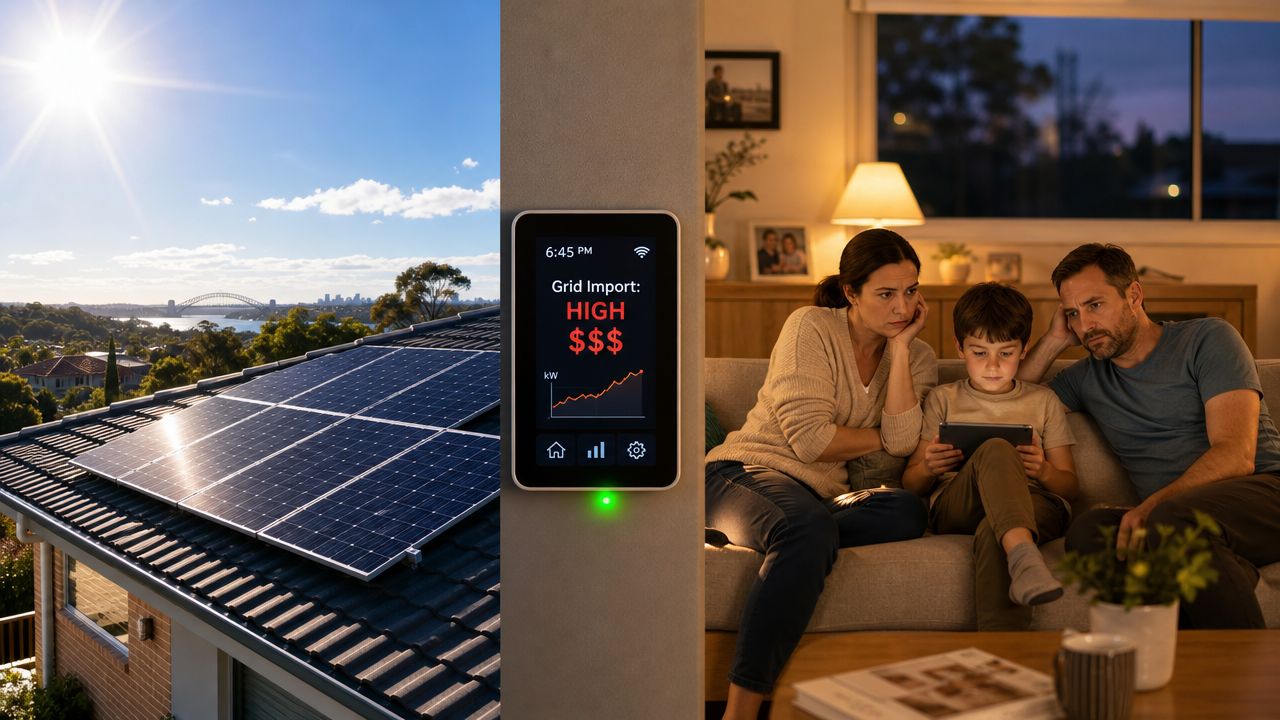
A battery changes the role of the solar system. Instead of only reducing daytime imports, it lets the household keep more of its own generation and use it later. That matters if your biggest bills land in the evening, if your retailer pushes time-of-use pricing, or if you want backup capability during outages.
The evening bill problem
Think about a family in Western Sydney with a healthy rooftop system. On a sunny weekday, the panels can generate well while the house is mostly empty. By sunset, though, solar production has dropped away and the family is buying electricity again for cooking, cooling, entertainment and hot water loads.
Without storage, they're often selling low-value daytime exports and buying back power later when they need it most.
With storage, the same house can keep more of that daytime solar on site. That doesn't automatically make every battery a great financial choice, but it does explain why so many households move from solar-only to solar-plus-storage.
Battery cost is really a value question
The mistake is treating battery storage like a simple appliance purchase. It isn't. It's part energy asset, part electrical upgrade, part resilience decision.
A battery can lower grid reliance, but the right question isn't “How cheap is the battery?” It's “How well does the system match the way this home uses electricity?”
If you're still deciding whether storage even fits your situation, it helps to start with a plain-English overview of how solar batteries work. Once you understand the flow of energy, the pricing starts to make more sense.
Whats Included in a Professional Battery Installation
People often compare battery prices the way they'd compare a fridge or television. That's the wrong model. A better comparison is buying an engine versus buying a complete roadworthy car. The engine matters, but it won't get you very far on its own.
A compliant home battery system includes far more than the cells inside the battery cabinet.
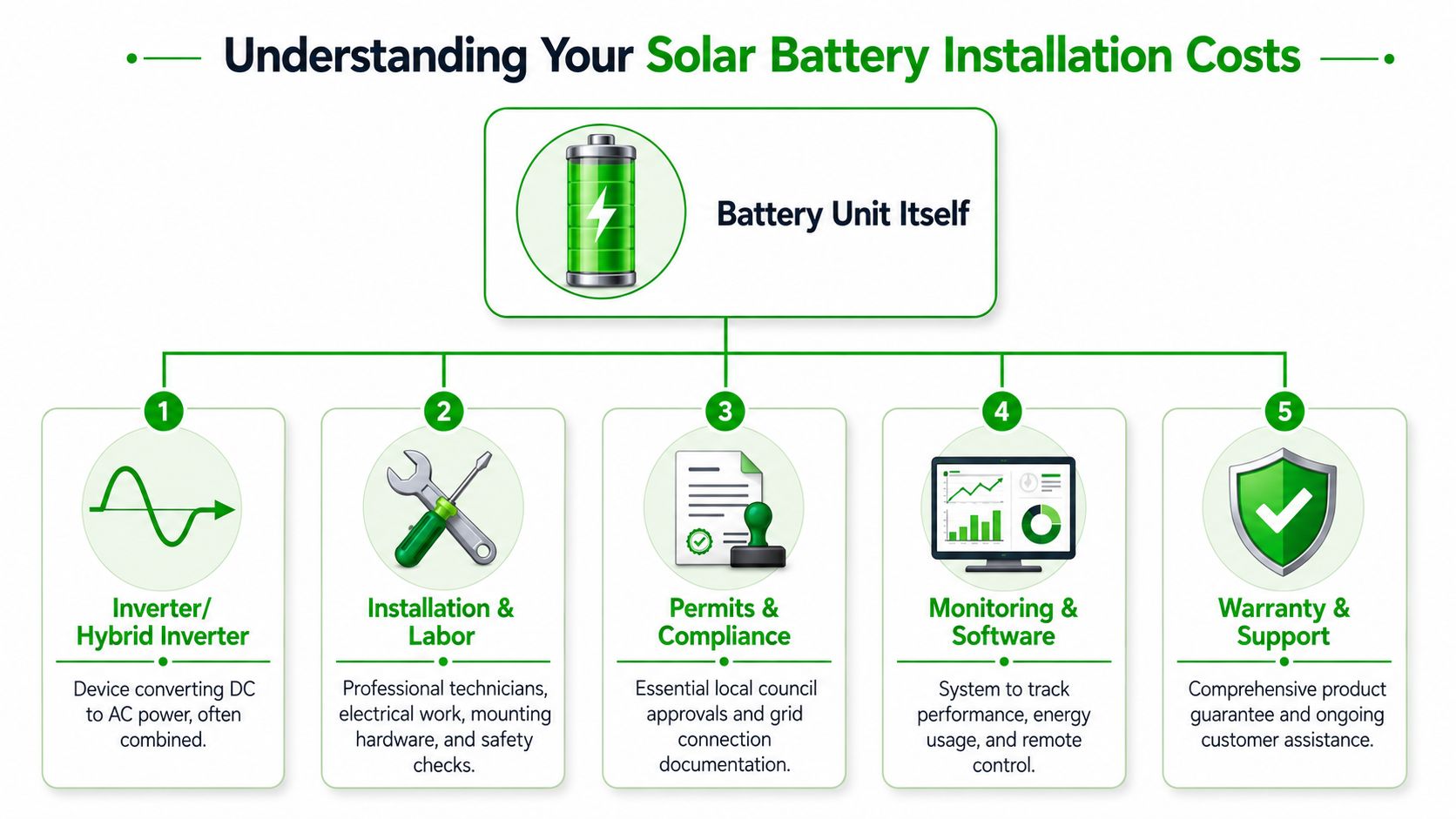
What you're actually paying for
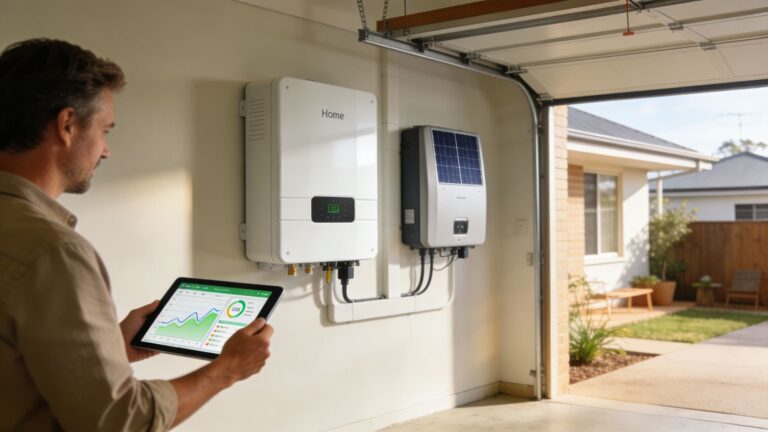
At the centre is the battery unit itself. That's the stored energy component people see advertised online. But that hardware still needs the rest of the system around it to work safely and properly.
A professional installation usually includes:
- Inverter or hybrid inverter. This is the conversion and control equipment that lets stored DC energy work with the home's AC supply.
- Battery management and protection hardware. This protects battery health and handles charging, discharging and safety logic.
- Balance of system components. Cabling, isolators, enclosures, mounting gear, labels, breakers and other electrical hardware all matter.
- Labour and commissioning. Qualified electricians have to install, configure, test and verify the system.
- Permitting, inspection and grid connection work. Many “cheap” estimates often fall apart at this stage.
Why soft costs matter so much
This is the part many buyers don't see until they ask for a formal proposal. Hardware pricing has fallen sharply at the pack level, but installed projects haven't fallen in the same neat line because real homes are not factory conditions.
Recent market coverage notes stationary battery pack prices fell to about US$70/kWh in 2025, yet real-world installed residential backup systems are still around a US$1,037/kWh median because the delivered project includes engineering, labour, permitting, inspection and interconnection rather than just battery hardware, as outlined in this industry discussion of battery and installation pricing.
That gap is exactly why NSW homeowners see one number in a headline and a very different number in a quote.
The site changes the system
Two homes can ask for the same battery brand and capacity and still receive very different proposals. One might have clean wall space beside a modern switchboard and straightforward cable runs. Another might need switchboard upgrades, longer cabling, difficult access, a more involved backup circuit arrangement, or additional compliance work.
Practical rule: if a battery quote looks simple before anyone has reviewed your switchboard, tariffs, usage profile and backup needs, it probably isn't complete.
If you want to see what a proper turnkey scope looks like, review a full solar battery supply and install process instead of comparing hardware-only listings.
Key Factors That Influence Your Final Investment
The final investment doesn't move up or down because of one thing. It changes because several design choices interact with each other. Some affect performance. Some affect longevity. Some affect installation effort. All of them shape the actual solar battery storage cost.
Capacity has to match usage
Battery size is usually the first thing people focus on, and for good reason. Too small, and the battery empties early in the evening. Too large, and you can end up paying for storage you rarely use well.
What matters is not just how much electricity your household uses in total, but when you use it. A home with heavy night-time air conditioning, pool equipment, cooking loads and EV charging behaves very differently from a home where most demand sits in the middle of the day.
That's why capacity should be based on interval data, daily load shape and your goals. Backup-only priorities lead to one design. Bill reduction and tariff optimisation can lead to another. If you need a quick refresher on the sizing difference between power and stored energy, this short guide on kW vs kWh is worth reading.
Chemistry affects more than marketing
Battery chemistry isn't just a spec-sheet footnote. It influences safety profile, thermal behaviour, warranty conditions, space requirements and long-term operating style.
Some homeowners only ask which chemistry is cheapest. A better question is which chemistry suits the application. For a typical household battery in NSW, reliability, proven local support and sensible operating characteristics matter more than chasing a headline feature.
The inverter is the brains of the system
A battery system's real-world performance depends heavily on the inverter and controls, which manage charge and discharge behaviour, solar integration, monitoring, backup response and system coordination.
Cutting corners here usually shows up later as awkward expansion limits, reduced flexibility, poor monitoring, or a system that doesn't behave the way the household expected during peak periods or outages.
A stronger inverter choice can cost more upfront, but it often avoids design compromises that are expensive to fix after installation.
Installation complexity changes everything
Online pricing stops being useful because the same battery can be a straightforward retrofit at one property and a complex electrical project at another.
A few examples make the point:
- Switchboard condition. An older board may need upgrades before a battery can be integrated cleanly and safely.
- Backup configuration. Whole-home backup and essential-load backup are not the same exercise.
- Cable route and access. Distance, wall type and mounting location affect labour and materials.
- Existing solar setup. A compatible modern solar inverter creates different options than an older system with limited integration pathways.
Homes don't buy battery systems off a shelf. Electricians and designers have to adapt a battery system to the home that already exists.
That's why one-size-fits-all battery pricing is mostly a marketing shortcut.
How to Compare Solar Battery Costs Like a Pro
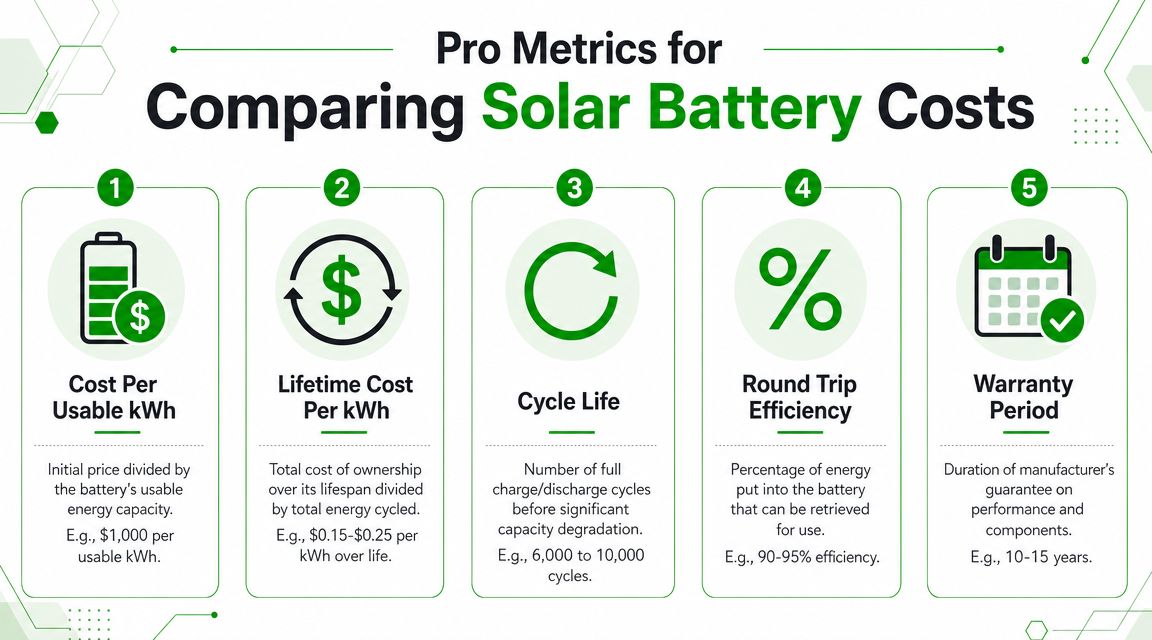
The most useful comparison tool isn't the total quote. It's the installed cost per usable kilowatt-hour.
That metric gives you a cleaner way to compare systems of different sizes and configurations. It also forces the conversation back to usable energy, which is what matters in day-to-day operation.
The visual below highlights the comparison mindset professionals use when looking past sticker price.
The benchmark that matters
The Clean Energy Council advises that a residential battery in Australia typically costs about A$1,000 to A$1,300 per usable kWh installed, which is why a common 10 kWh system is roughly A$10,000 to A$13,000 before rebates or finance effects, according to this installed battery cost discussion citing Clean Energy Council guidance. For larger commercial systems, the cost per kWh drops with scale, and the same source notes larger commercial storage often ranges from US$280 to US$580 per kWh.
Those figures are useful because they compare installed systems, not just hardware.
For a broader market perspective, it also helps to review current solar battery prices in Australia with a focus on what's included, not just what's advertised.
What to compare on each quote
When I review battery proposals, I'd rather see a homeowner compare these points than obsess over the cheapest headline number:
| Comparison point | Why it matters |
|---|---|
| Usable capacity | Nameplate capacity can look bigger than what you can actually use. |
| Inverter pathway | The inverter setup affects performance, backup options and future expansion. |
| Backup scope | Essential circuits and whole-home backup have different cost and design implications. |
| Monitoring platform | Good software improves visibility, support and load-shifting control. |
| Warranty support | A strong product is only part of the story. Local support matters when faults happen. |
This explainer is also worth a watch before you compare finance-backed quotes:
If you're financing part of the project, battery economics can change depending on repayment structure, not just equipment quality. Business owners in particular should spend a few minutes understanding equipment financing rates so the funding side doesn't distort an otherwise sensible technical decision.
Calculating Your Savings and Payback in NSW
The first thing to understand is that a battery doesn't save money in just one way. It can reduce grid purchases at night, shift self-generated solar into higher-value hours, and in some cases support tariff strategies that make stored energy more valuable than exported energy.
That means two NSW households with the same battery may get very different outcomes.
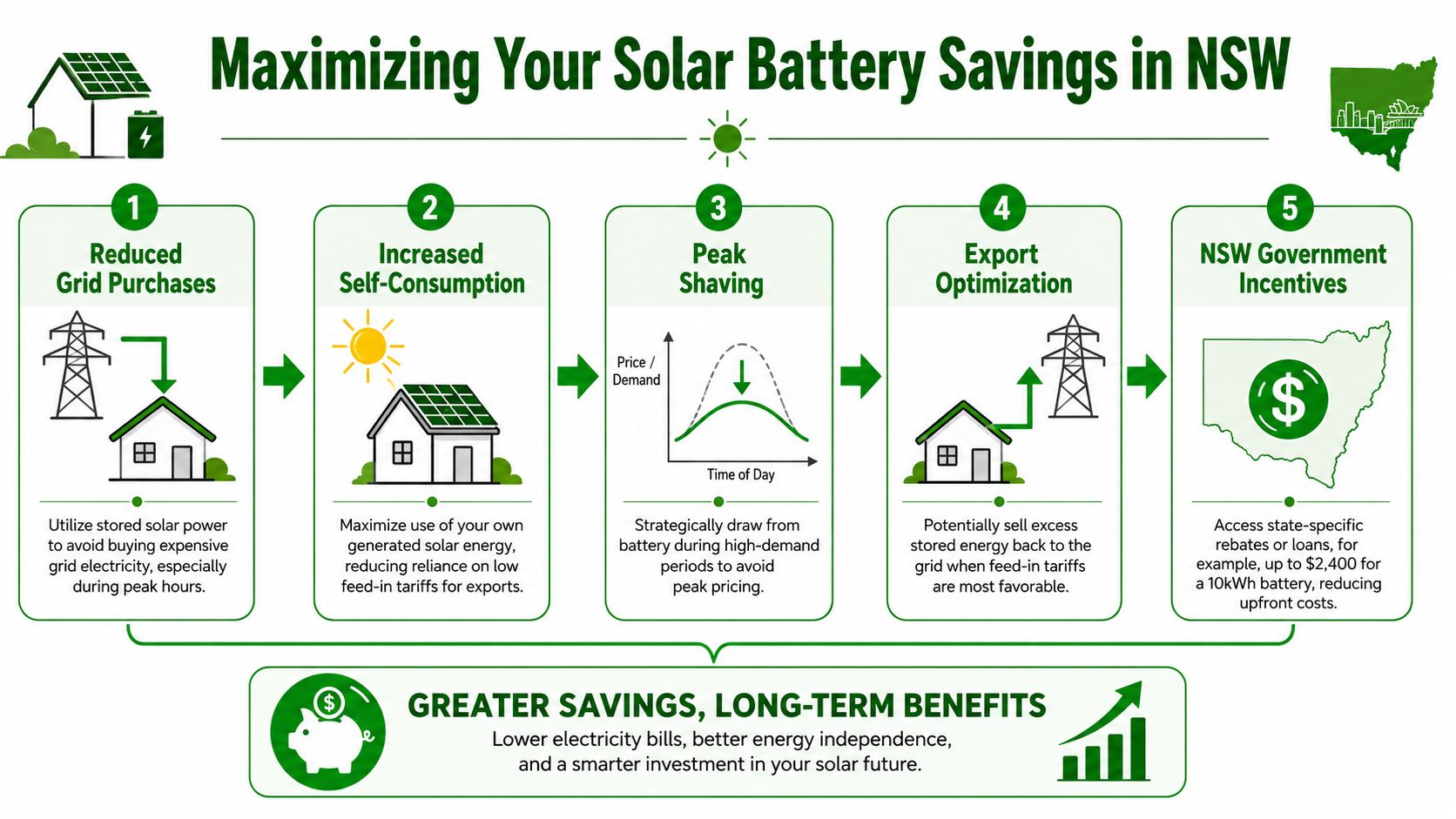
A practical NSW example
Take a family in Western Sydney on a time-of-use tariff. During the day, their rooftop solar covers a decent share of house loads and may export excess generation. In the evening, demand rises sharply. Cooling, cooking, lighting and entertainment all stack up at once.
With no battery, they import during the same window that grid energy can hurt the most.
With a battery, the household can hold onto daytime solar and use it later. That increases self-consumption and can reduce the need to buy electricity during the evening peak. If the battery and tariff strategy are well matched, the household gets more value from the solar system they already own.
What improves battery economics
Independent analysis shows a battery is most compelling where export compensation is poor or time-of-use tariffs are strong. It often doesn't dramatically shorten the payback period compared to solar-only, but it can significantly increase long-term savings and energy independence, as discussed in this independent video analysis of battery payback and tariff conditions.
That's an important distinction. A battery can be a sound household decision even when the payback story is more nuanced than sales material suggests.
Some households buy a battery for pure economics. Others buy for backup confidence, tariff control and lower reliance on the grid. Those are different goals, and they should be priced differently in your head.
Where people misread payback
The most common mistake is assuming every stored kilowatt-hour delivers the same value. It doesn't. A battery works best when the home has a clear mismatch between solar production and evening use, weak export value, or strong incentive to avoid higher-priced periods.
A battery tends to be less compelling when:
- Daytime occupancy is already high. If the household already uses most of its solar directly, the battery has less unused solar to capture.
- Export terms are relatively favourable. Better export value can reduce the extra advantage of storing energy.
- The battery is oversized for daily cycling. Storage that sits half-used too often won't earn its keep as well.
Homeowners outside NSW often ask the same questions for similar reasons. This guide for Brisbane homeowners on batteries is useful because it shows how tariff structure and usage patterns shape the answer more than broad sales claims do.
If you want to test your own usage pattern before asking for quotes, a proper solar savings calculator gives a much better starting point than guessing from monthly bills.
Lifespan Maintenance and Future-Proofing Your System
The cheapest battery on day one can be the wrong investment over the life of the system. Long-term value depends on how the battery performs, how it's supported, and whether it still fits the household a few years from now.
That's why I'd separate purchase price from ownership quality.
Think beyond the warranty card
A warranty is important, but it's not the whole story. You also want to know how the battery is expected to be used, how the system manages charging behaviour, and whether the manufacturer's support pathway is practical in Australia.
Battery technology is no longer a fringe product category. By 2025, the levelised cost of storage was estimated at about US$65/MWh, a milestone highlighted in Ember's analysis of battery storage economics. That matters because it reflects a market that has matured enough for storage to be economically viable in mainstream energy planning, not just niche backup use.
Maintenance is usually light, support is not
Modern residential battery systems generally don't need the kind of routine maintenance people associate with older backup technologies. But that doesn't mean after-care is irrelevant.
You still want:
- Clear monitoring access so faults or underperformance can be spotted quickly
- Responsive installer support if communications, inverter behaviour or warranty issues arise
- A sensible expansion path if your energy use changes later
Future-proofing matters more than people think
Households change. An EV arrives. Someone starts working from home. Air conditioning hours increase. A renovation adds more electrical load.
A battery system that can adapt is worth more than one that only just fits today's pattern.
Buy the battery system that suits the house you're likely to have over the next several years, not just the bill you saw last month.
That doesn't always mean installing the largest possible battery now. It means choosing a platform and configuration that won't box you in later.
How to Get an Accurate and Reliable Battery Quote
A proper battery quote is not a formality. It's the diagnostic stage that turns a rough idea into a safe, workable and correctly priced project.
If a provider can give you a firm number without understanding your switchboard, existing solar equipment, tariff structure, household load pattern and backup expectations, they're guessing.
What a serious quoting process should include
A reliable proposal usually starts with your electricity usage, but it shouldn't end there. Good battery design also needs a review of how the home behaves across the day and evening, whether backup is required, and what constraints the site creates.
Look for a process that includes:
- Bill and usage review so the battery is sized around real consumption patterns
- Equipment compatibility check for your current solar inverter and site layout
- Site inspection to assess switchboard condition, cable runs, mounting location and access
- Clear scope of works so you know what's included in the installed system
- Compliance and connection planning rather than vague assumptions
Why generic estimates often mislead
Online calculators and ad-based package pricing can be useful for orientation, but they don't price your property. They price an idea of a property.
That's a big difference in residential electrical work. If you want a good external reference on why electrical scope matters so much at home, this essential guide for homeowner electrical work gives a helpful overview of the kinds of details that change project cost and safety outcomes.
The same principle applies to batteries. A custom quote isn't a sales trick. It's the only way to price the actual job instead of a simplified version of it.
The best outcome is not the lowest battery number on a search results page. It's a system that fits the home, matches the tariff, performs as promised and doesn't surprise you later with omitted work.
If you want a battery quote based on your actual home, tariff and usage pattern, talk to Interactive Solar. Their team can assess your existing setup, explain the trade-offs clearly, and provide a customized proposal that reflects the actual installation scope rather than a generic advertised package.
Make Interactive Solar a preferred source in Google
One click tells Google to surface our articles more often in Top Stories, AI Overviews and AI Mode.