
Unlock Best Solar Battery Prices Australia 2026
Last updated:
Your electricity bill lands. You look at the total, then you likely search for solar battery prices australia and open half a dozen pages that all seem to say something different.
One page lists a battery size. Another lists a brand. A third gives a broad installed range with no mention of backup, inverter compatibility, export limits, or whether the battery will suit your home. The numbers look precise, but the advice often isn’t.
That’s where buyers get tripped up. A battery isn’t just a box on the wall with a price tag. It’s part of a larger energy system, and the long-term result depends on how well that system matches your solar production, your evening usage, your tariff, your switchboard, and your local grid rules.
Australia’s interest in battery storage has moved well beyond early adopters. In late 2025, residential battery uptake surged, with over 1.2 GWh installed in December 2025 alone, one of the strongest months on record according to Smart Energy Answers’ 2026 storage trends report. That doesn’t mean every battery purchase is a good one. It means more households are deciding the old approach of exporting cheap solar by day and buying expensive electricity back at night no longer makes sense.
A good buying decision starts by asking a better question. Not “what does a battery cost?” but “what am I getting, and how well will it perform over time?”
Thinking About a Solar Battery Your Guide Beyond the Price Tag
A lot of homeowners start in the same place. They already have solar, they’re still seeing painful evening bills, and they feel like they’re missing out on the value of the energy they generate during the day.
That frustration is reasonable. The online discussion around solar battery prices australia often reduces a complex system into a single number. That’s useful for advertising. It’s not useful for buying.
Why simple price lists mislead
A battery quote can look cheaper because it excludes key parts of the job. It might leave out switchboard upgrades, backup circuit work, the inverter pathway, monitoring setup, or the practical labour involved in fitting the system safely and neatly. Another quote can look more expensive because it includes everything required to make the battery work properly from day one.
The same problem happens with battery size. Bigger sounds better, but that’s only true when the rest of the system supports it. A battery that rarely fills is not a bargain. It’s just underused capacity.
A battery is only good value when it stores energy you would otherwise buy from the grid at a higher rate.
The better way to assess value
A practical battery assessment looks at a handful of things together:
- Your daytime solar surplus. This tells you how much energy is available to charge the battery.
- Your evening and early morning usage. That’s where most battery value shows up.
- Your tariff structure. Time-of-use homes often get a different result from flat-rate homes.
- Your existing solar setup. The age and type of inverter matters.
- Your backup expectations. Some people want bill reduction only. Others want selected circuits to stay on in a blackout.
If you focus only on sticker price, you miss the part that matters most. Total cost of ownership is shaped by lifespan, warranty strength, efficiency, compatibility, and whether the battery is properly sized for your actual load profile.
What a Solar Battery Investment Really Includes
People often talk about “the battery price” as if they’re buying one standalone item. In practice, they’re buying an integrated energy solution. It’s closer to buying a complete vehicle than buying an engine.
The battery cells matter, of course. But so do the control electronics, the inverter pathway, the monitoring platform, the safety hardware, the installation method, and the quality of the commissioning.

The hardware is only part of the job
A proper battery quote usually includes several layers of value, not just storage capacity.
- Battery unit. This is the storage component itself, usually rated in usable kilowatt-hours.
- Inverter or hybrid integration. Some systems need a compatible hybrid inverter, while others use AC-coupled architecture.
- Mounting, isolators, cabling, protection gear. These are safety-critical, not optional extras.
- Monitoring and software. Good software decides when the battery charges, discharges, and how backup behaves.
- Labour and compliance. Licensed electrical work, testing, commissioning, and paperwork all sit here.
The difference between a neat, reliable installation and a troublesome one is often hidden in these “boring” parts of the job.
Why larger batteries can look better per kWh
Battery pricing has a scale effect. According to AVE’s February 2026 battery cost analysis, fixed installation costs are around $2,000 to $3,000 for labour and setup, so the marginal cost per kWh drops as battery size increases. That’s why a larger system can look more cost-effective on a per-kWh basis even though the total installed spend is higher.
That sounds attractive, but it needs context. Lower cost per kWh doesn’t automatically mean better value for your home. If the battery is too large for your solar generation or your overnight load, part of that cheaper capacity may sit idle.
Here's a simple way to understand:
| Part of the quote | What it affects |
|---|---|
| Battery size | How much energy you can shift into the evening |
| Inverter pathway | Efficiency, compatibility, and upgrade complexity |
| Installation scope | Safety, reliability, neatness, and compliance |
| Backup setup | Which circuits stay powered during outages |
| Software and monitoring | Day-to-day optimisation and fault visibility |
Some homeowners comparing brands eventually realise they aren’t just comparing batteries. They’re comparing complete system design philosophies. That’s why reading a detailed model comparison can help before you even request a quote, especially if you’re weighing premium integrated options such as those covered in this Tesla Powerwall 3 guide.
Practical rule: If a quote can’t clearly explain what hardware, labour, backup scope, and integration pathway are included, it isn’t detailed enough to compare properly.
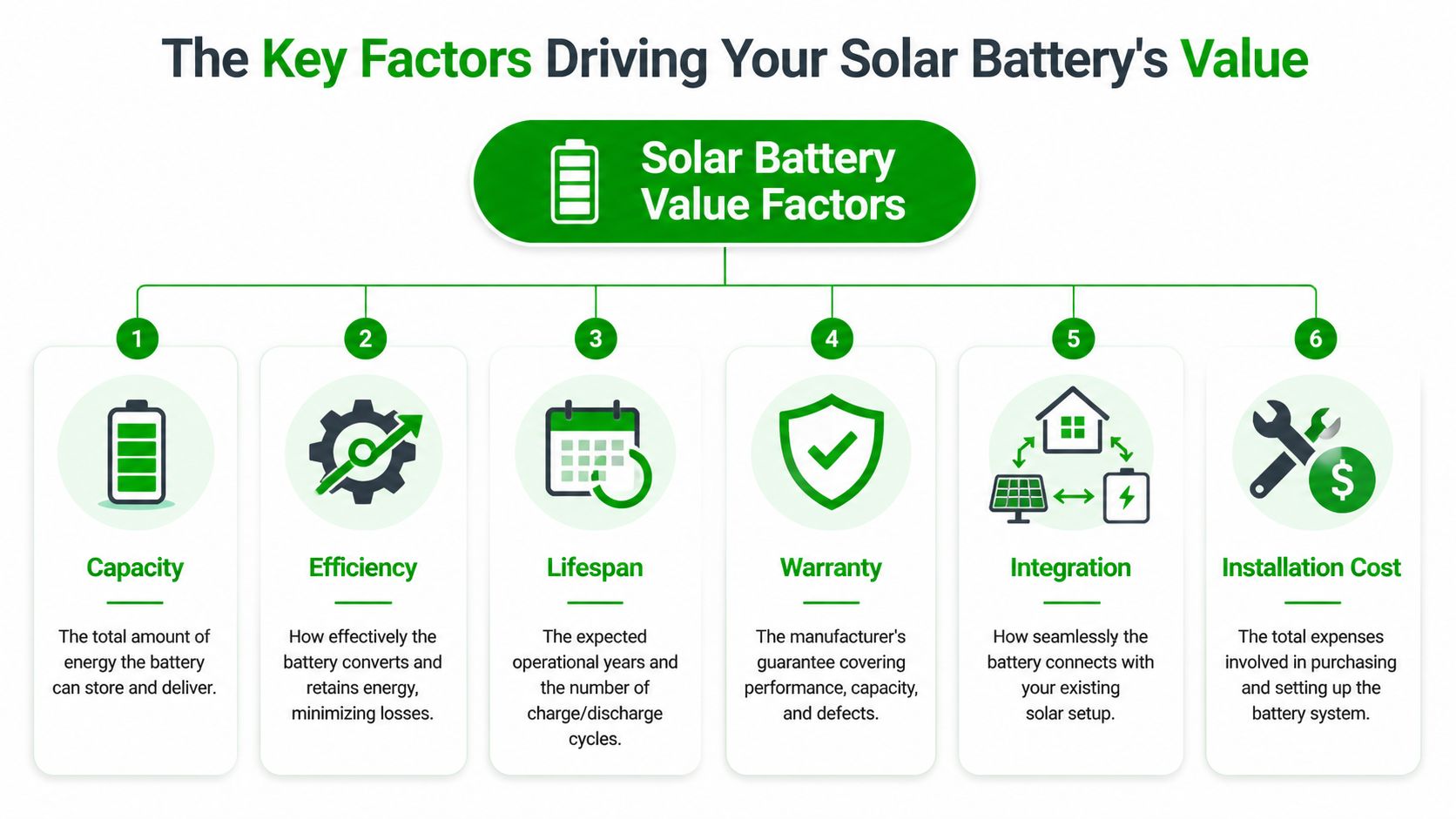
The Key Factors Driving Your Solar Battery's Value
A battery’s long-term value comes from how several technical choices work together. Capacity gets most of the attention, but it’s only one dial on the system.
The key question is whether the battery can cycle usefully, efficiently, and reliably over many years in Australian conditions.
Capacity should follow your load, not your impulse
The most common buying mistake is assuming bigger automatically means smarter. It doesn’t.
If your household only has a modest amount of surplus solar after daytime appliance use, and your overnight consumption is moderate, an oversized battery may not fill and discharge to a sufficient extent to justify itself. You’ll own more storage than you can regularly use.
The mismatch gets worse when export limits are ignored. Solar Calculator’s battery pricing analysis points out that many homes with 5 to 10 kW solar systems and 10 to 16 kWh batteries run into export constraints, and 30 to 40% of battery capacity can be underutilised when the battery can’t be effectively charged from surplus solar. That’s one of the biggest hidden reasons some battery payback calculations disappoint in real life.
Chemistry matters more than many buyers realise
Most homeowners don’t need to become battery chemists, but they do need to know the broad difference between common chemistries. For Australian residential systems, Lithium Iron Phosphate (LFP) has become a strong fit because it combines thermal stability with long cycle life.
LFP batteries commonly offer over 6,000 charge cycles while retaining at least 80% of original capacity, according to Why Solar’s battery price tracker. In practical terms, that means the battery isn’t just expected to work through its warranty. It’s engineered for sustained daily cycling over a long service life.
That matters because battery value isn’t created on installation day. It’s created through years of repeated charge and discharge.
AC coupled or DC coupled changes the design logic
Two systems with similar storage capacity can behave quite differently depending on how they integrate with solar.
DC-coupled systems are often a natural fit for new solar-and-battery installs or major upgrades where a hybrid inverter is part of the plan. They can be efficient and tidy because solar generation can charge the battery with fewer conversion steps.
AC-coupled systems can make sense when adding a battery to an existing solar setup that already has a functioning solar inverter. They can reduce disruption and preserve more of the original installation, but the right answer depends on the current equipment and the homeowner’s goals.
Here’s the practical comparison:
- New system or major redesign often suits a DC-coupled pathway.
- Existing solar with a healthy inverter may suit AC-coupling better.
- Backup requirements can favour one architecture over another depending on the product.
- Future expansion plans should be discussed before choosing either path.
A battery comparison is much easier when you can see these trade-offs brand by brand. This battery comparison guide is a useful starting point for that process.
Warranty quality is about more than the headline years
A warranty should answer three practical questions.
First, what capacity retention is guaranteed at the end of the warranty term? Second, what throughput or cycle conditions apply? Third, who handles support if something goes wrong?
A long warranty with narrow conditions can be less valuable than a well-structured warranty with clear local support. Ask how performance is measured, what the exclusions are, and whether the monitoring platform helps identify issues early.
Many battery buyers focus on how much storage they can buy. The better question is how much usable storage they’ll still have years from now.
The best battery is the one that gets used well
When installers size a battery properly, they’re trying to maximise useful cycling. That means the battery charges often enough, discharges often enough, and aligns with the household’s expensive grid periods.
That is a more valuable outcome than maximising installed capacity.
Why Local NSW Expertise Matters for Your Battery Installation
Battery design is never purely theoretical. Local rules and local conditions shape what works.
A Sydney or greater NSW home doesn’t operate inside a generic national template. Grid export limits differ by network area, council requirements can vary, and site conditions often change the installation pathway in ways online calculators can’t see.
NSW projects need local problem-solving
A practical installer looks at the whole site, not just the brochure specification. Roof layout, cable run length, meter position, switchboard condition, backup circuit needs, and wall location all influence the final system design.
Weather matters too. In NSW, summer storms can turn backup capability from a nice extra into a real purchasing factor. Some homeowners want the battery purely for bill reduction. Others want refrigeration, lighting, communications, garage access, and selected power points to stay available during an outage.
Those are different design briefs. They shouldn’t produce the same quote.
Incentives and approvals are only useful when applied correctly
Battery incentives can improve the value equation, but homeowners still need the system to be technically right. Chasing a rebate without checking compatibility, export limits, or usable solar surplus is how people end up with a battery that looks good on paper and performs poorly in practice.
For NSW households trying to understand what support may apply and how timing affects project planning, this overview of the NSW battery rebate launch helps clarify the moving parts.
A local specialist should also be able to explain, in plain English:
- What your network allows for export and battery connection
- Whether your switchboard needs upgrades
- How backup will be configured if that’s part of the brief
- What approval steps are required before installation
- Who is responsible for post-install support
Good battery design is local. The grid rules, the property layout, and the homeowner’s usage habits all matter as much as the product badge.
The distance between quote and result matters
A remote sales process can still produce a neat PDF. It can’t inspect site access, identify hidden switchboard issues, or confirm the best mounting location with the same confidence as an on-site assessment.
That gap matters because the cheapest quote often gets more expensive once practical site conditions catch up with it. A detailed local assessment reduces that risk.
How a Solar Battery Creates Financial Value
A battery earns its keep when it shifts cheap daytime solar into the hours when grid power costs more.
That matters because the sticker price only tells you what the hardware costs. The key question is how much expensive electricity the battery can replace over its life, and whether that aligns with the way your home or business uses power.

A common Sydney usage pattern
A typical Sydney household can produce plenty of solar from late morning to mid-afternoon, then hit its highest demand after 5 pm. Cooking starts, lights go on, air conditioning runs, and appliances that sat idle all day suddenly overlap.
Without a battery, a lot of that midday solar goes out to the grid for a modest feed-in tariff. Later, the same household buys power back at a much higher retail rate. A battery improves the value equation by storing that surplus solar and discharging it during the evening peak.
That is why payback varies so much from one site to the next. Homes with strong evening demand and time-of-use tariffs usually get more value than homes that use most of their power while the sun is already up. Tariff structure, usage timing, and available solar surplus do most of the heavy lifting.
Where businesses often see value differently
For a small business, bill savings are only part of the picture.
If the site relies on refrigeration, EFTPOS, internet, alarms, or other business-critical loads, backup power can protect trading hours and reduce disruption. That value does not always show up neatly in a generic calculator, but any owner who has lost stock or sales during an outage knows it is real.
A battery makes the most sense when it has a clear job. Shift solar into expensive periods, support selected backup loads, or both.
Three ways a battery can improve the economics
The strongest battery proposals are built around one or more of these outcomes:
- Higher solar self-consumption. More of your own generation is used on site instead of exported at a lower rate.
- Lower peak-period imports. Stored energy offsets grid purchases when tariffs are higher.
- Backup for selected circuits. The system can keep key loads running during an outage, which may protect comfort, food storage, or business continuity.
Some buyers also look at Virtual Power Plant programs where available. That can add value, but it should be treated as a bonus, not the main reason the numbers work.
A short explainer can help make the savings mechanics more concrete:
Why generic calculators miss the real answer
Online savings tools can give a rough starting point. They usually miss the details that change battery value in the field.
A proper assessment looks at how your load moves through the day, what tariff you are on, how much surplus solar is available after daytime consumption, and whether the battery will cycle often enough to justify its installed cost. It should also test whether backup is part of the brief, because backup changes both hardware choice and installation scope.
| Assessment area | Why it matters |
|---|---|
| Usage timing | Shows whether battery discharge will replace expensive evening imports |
| Tariff type | Changes the dollar value of each kWh the battery delivers |
| Solar generation pattern | Indicates how often the battery is likely to charge fully |
| Export limit | Can increase the benefit of storing surplus solar on site |
| Backup goals | Affects battery selection, wiring design, and installation cost |
If lower bills are the main goal, battery storage should be assessed alongside other ways of reducing electricity bills. The best outcome usually comes from the full system strategy, not from chasing a battery price in isolation.
How to Get a Transparent and Accurate Battery Quote
A strong quote should tell you what is being proposed, why it suits your property, and what’s included in the installation. If it doesn’t, you’re not comparing offers. You’re comparing sales shortcuts.
At this stage, educated buyers separate a real proposal from a broad estimate.

What a trustworthy quote should include
The best quotes are itemised and specific. They explain the battery model, the integration method, the backup scope, and any site works required.
Look for these basics:
- Exact product identification. Brand, model, chemistry, usable capacity, and warranty should all be named clearly.
- Inverter pathway. The quote should state whether the system is AC-coupled, DC-coupled, or requires a hybrid inverter change.
- Installation scope. It should spell out whether switchboard work, backup circuits, monitoring setup, and commissioning are included.
- Performance logic. The installer should explain why this size suits your load profile and solar generation.
- After-sales process. You should know who handles support, warranty claims, and fault response.
If the proposal skips those details, ask for a revised version before making a decision.
Questions worth asking before you sign
Some questions reveal more than the answers themselves. They tell you whether the installer has thought through your project.
Who will install the system?
Ask whether the work is done by in-house teams or passed to subcontractors.Why this battery and not another one?
A serious answer should reference your usage profile, solar system, and goals.What happens in a blackout?
Some batteries offer backup by default. Others need extra hardware or circuit planning.What does the warranty really cover?
Ask about end-of-warranty capacity, exclusions, and support pathway.What site assumptions are built into the quote?
This helps flush out surprise variations later.
Red flags that deserve caution
Some warning signs appear early.
- Vague bundled pricing. If everything is rolled into one line with no detail, it’s hard to know what you’re buying.
- Oversized recommendations without usage analysis. Bigger isn’t automatically better.
- No discussion of export limits. That’s a major gap in battery design.
- No mention of switchboard condition or backup circuits. Site reality matters.
- Pressure before detail. Good installers answer questions before asking for commitment.
A battery quote should read like a system design document, not a flyer.
Consumer protection matters here too. Before signing, it’s worth understanding the standards behind responsible sales and installation conduct, including the New Energy Tech Consumer Code.
A simple quote comparison table
When you compare quotes, use the same checklist for each one.
| Quote feature | Good sign | Warning sign |
|---|---|---|
| Battery details | Exact model and usable capacity listed | Brand only, no model detail |
| Integration method | AC or DC pathway explained | No explanation of compatibility |
| Backup scope | Circuits or backup method stated | “Backup ready” with no specifics |
| Site works | Switchboard and cabling scope clear | “Subject to site” with no context |
| Warranty | Performance and process explained | Warranty mentioned vaguely |
A clear quote saves trouble later. It also tells you a lot about the company behind it.
Frequently Asked Questions About Solar Batteries
A lot of battery decisions come down to the last few practical questions. They usually show whether a quote is built around your home, or built to hit a sales target.
Common Solar Battery Questions
| Question | Answer |
|---|---|
| Should I add a battery to existing solar or start with a full new system? | Check the age of the solar system, inverter compatibility, panel output, and how long you plan to stay in the home. In some cases, adding storage to an existing system is straightforward. In others, a new battery works better as part of a broader redesign, especially if the current inverter setup limits performance or backup options. |
| Is LFP a good choice for Australian homes? | Often, yes. As noted earlier, LFP batteries are generally well suited to daily cycling, thermal stability, and long service life. That does not make every LFP product equal. The battery management system, warranty terms, and local support still matter. |
| Will a battery run my whole home in a blackout? | Only if the system is designed for that outcome. Many battery systems back up selected circuits such as lights, fridge, internet, and a few power points. Whole-home backup is possible in some properties, but it depends on inverter capability, surge loads, switchboard design, and battery output, not just battery capacity. |
| Is a bigger battery always better value? | Value comes from how much of the battery you will actually use. An oversized battery can look attractive on paper but deliver poor payback if your solar surplus is limited or your overnight demand is modest. Good sizing starts with interval usage data, tariff structure, and export conditions. |
| How long should a good battery last? | A well-specified home battery should give years of consistent service. Real lifespan depends on chemistry, temperature, cycle depth, installation quality, and whether the system is charged and discharged in a sensible operating range. I always tell buyers to read the throughput and performance warranty, not just the years listed on the front page. |
| Can a battery help with EV charging? | Yes, but the battery has to be sized for that load and the charging habits need to make sense. EV charging can drain a home battery quickly, so the better question is whether the battery will cover evening household loads, meaningfully support the EV, or do both without compromising payback. |
| What’s the biggest mistake buyers make? | Comparing batteries by sticker price or capacity alone. A better comparison looks at usable storage, discharge rate, backup setup, warranty detail, installation scope, software quality, and after-sales support. That is where total cost of ownership becomes clear. |
The right battery is the one that fits the home, the tariff, and the way power is used.
A battery purchase usually works out best when the conversation is detailed from the start. Clear questions lead to better system design, fewer change orders, and a quote that reflects real value rather than a neat headline number.
If you want a battery proposal built around your actual usage, tariff, and property layout, talk to Interactive Solar. Their team designs and installs custom solar, battery, EV charging, and energy solutions across Sydney and greater NSW, with in-house expertise that helps turn a battery quote into a system that effectively works.
Make Interactive Solar a preferred source in Google
One click tells Google to surface our articles more often in Top Stories, AI Overviews and AI Mode.