
How Many Solar Panels Do I Need? A Sydney Sizing Guide
Last updated:
Your power bill lands, you look at the total, and the same question comes up again: how many solar panels do i need to make a real dent in it?
Most Sydney homeowners start by looking at roof space first. That’s understandable, but it’s not how good solar systems get designed. A usable roof matters, of course. So do shade, switchboard layout, panel wattage, and where the sun hits your roof across the day. But the starting point is your actual electricity use and how a system will perform in NSW conditions, not a generic calculator built for somewhere else.
That matters because the baseline here is already different. In Australia, the average household uses about 5,600 kWh a year, and for most NSW homes, a 6 to 7 kW solar PV system is typically what’s needed to offset full usage. That usually means 15 to 20 panels at 400W, depending on Sydney’s 4.5 to 5.5 daily peak sun hours. For a median Sydney home using 4,800 kWh per year, a 6.6 kW system can cover the home’s usage and still leave room for exports, according to this NSW-relevant sizing summary.
Sizing Your Solar System Beyond Generic Calculators
A family in Baulkham Hills with a broad north-facing roof can need a different system from a terrace in the Inner West, even if their annual usage looks similar on paper. In NSW, the right panel count comes from local production conditions, roof constraints, and what the household wants the system to do over the next few years.
Generic calculators miss the parts that change the result in Sydney suburbs. They often assume clean north orientation, no chimney or tree shade, and steady daytime consumption. That is not how many NSW homes behave. A split-level home in the Sutherland Shire, a Federation roof in the North Shore, and a duplex in Western Sydney can all have very different usable roof area once setbacks, tilt, and obstructions are factored in.
The starting benchmark still matters. As noted in this solar sizing reference, average household use is often put at about 5,600 kWh a year, and many NSW homes land in the 6 to 7 kW range to offset that level of consumption, which usually works out to roughly 15 to 20 panels at 400W. That gives a rough starting point only. It does not account for Sydney’s spread of roof angles, morning or afternoon shade, or whether the home is likely to add a battery or EV charger later.
That is the gap between a calculator and a proper design.
On site, I would want to know four things early. How much electricity the home uses across the year. When that electricity is used. Which roof faces are usable. What is likely to change, such as an EV, ducted air, or a battery after the STC window or budget lines up. Those factors decide whether it makes sense to keep the system close to current usage or size it a little larger for future daytime loads.
Maintenance matters too, especially near the coast or under heavy tree cover. Dirt, salt film, leaf litter, and bird droppings can drag output down over time, which is why a practical guide to Sparkle Tech solar panel cleaning is useful after installation, especially on low-pitch or hard-to-access roofs.
The better question is not just how many panels fit. It is how many panels will produce enough power, on your roof, in NSW conditions, for the way your household runs. Buyers also get led astray by bad assumptions about exports, shading, and oversizing, so this guide to common solar myths and misconceptions is worth reading if the quotes you have received seem inconsistent.
Start with Your Energy Bill Not Your Roof Space
The first document I’d want to see on a site visit isn’t a roof plan. It’s your electricity bill.
On an Ausgrid or Endeavour Energy bill, the most useful figure is usually your average daily consumption in kWh. If it isn’t shown clearly, you can still work it out from your usage over the billing period. That number is more useful than floor area, bedroom count, or what a neighbour installed, because it reflects how your household lives.
A home with one person who’s away most of the week behaves very differently from a home with teenagers, air conditioning, and someone charging tools or running a home office. Bills capture that. Generic calculators don’t.
What to look for on the bill
Start by pulling together recent bills and checking for patterns. You’re looking for consistency, but also for signs that your usage changes sharply in certain seasons.
A useful checklist is:
- Average daily usage in kWh. This is the key design input.
- Billing period dates. Usage during hotter or colder months can shift.
- Any unusual spikes. New pool pumps, renovated kitchens, ducted air, or added appliances matter.
- Tariff structure. Time-of-use habits can influence how valuable daytime solar will be.
If you want to lower your bills before sizing a system, this guide on how to reduce electricity bills is a practical companion because it helps identify waste that solar doesn’t need to cover.
Why roof size comes second
People often stand in the driveway, look up, and assume roof area sets the answer. It doesn’t. Roof space only tells you the upper limit of what may fit. Your bill tells you what you need.
That distinction matters. A huge roof doesn’t mean you should fill it. A small roof doesn’t mean solar won’t work. What matters is matching the array to the load profile, then checking whether the roof can support that design without ugly compromises around shading, odd string layouts, or crowding around vents and valleys.
Your bill already includes your habits. Late dinners, long showers, pool pumps, air con, gaming consoles, work-from-home days. That’s why it’s the foundation of a professional design.
Later in the process, a good installer will also ask whether your usage is about to change. Plenty of households are about to add an EV, battery, electric hot water, or induction cooking. If that’s likely, designing only for today can leave you undersized very quickly.
This video is a useful primer if you want to understand the bigger picture before comparing quotes.
The Sizing Formula Professionals Use in NSW
A Sydney quote should be built from Sydney conditions.
The core calculation is simple:
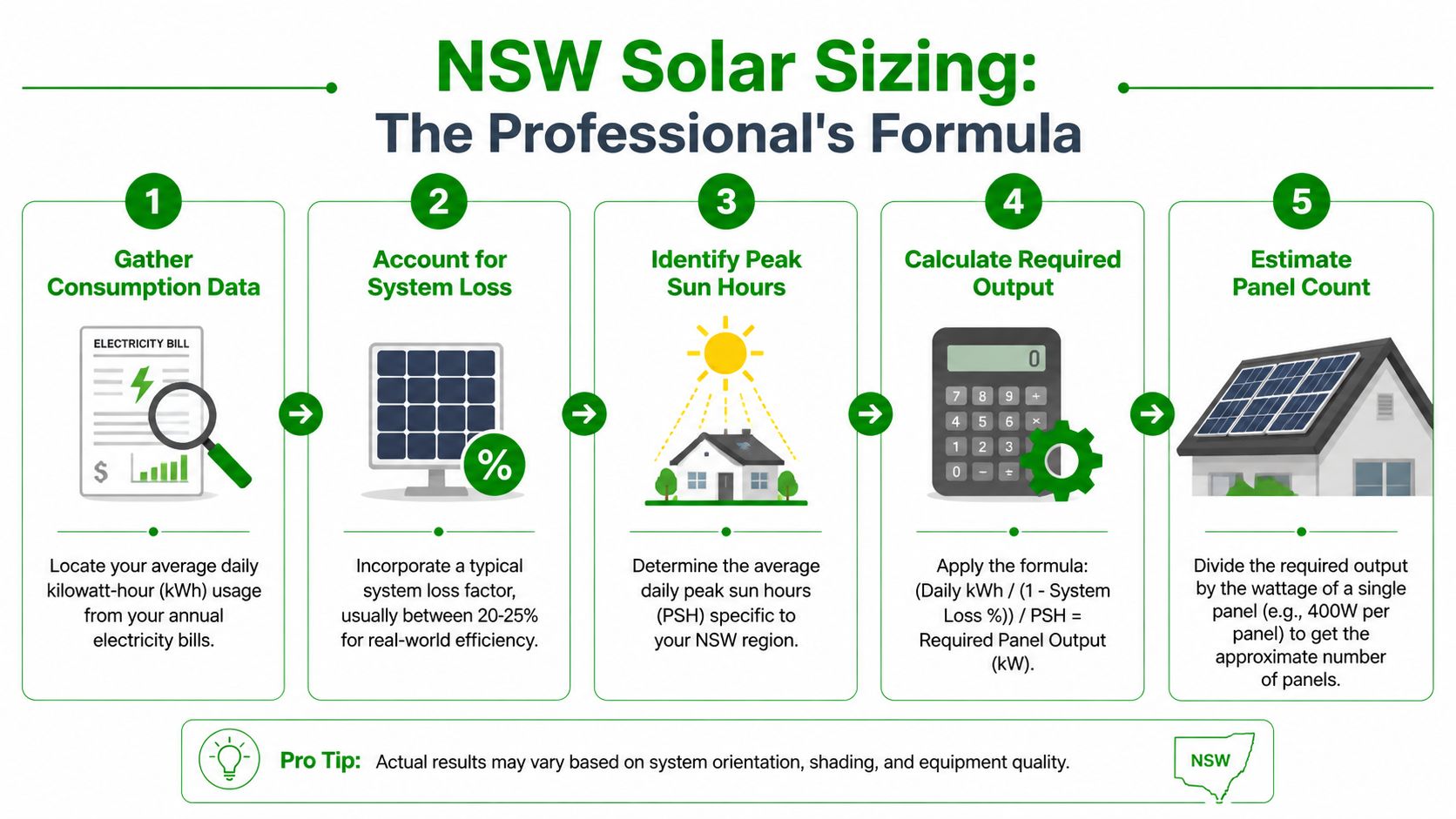
System size (kW) = Daily usage (kWh) ÷ Peak sun hours ÷ System efficiency
What changes from one job to the next is the input. In NSW, I use local peak sun hours, realistic system losses, and the customer’s actual usage pattern rather than a national average. For Sydney homes, a practical design range is usually 4.5 to 5.2 peak sun hours per day, with 0.8 as a sensible efficiency allowance for inverter losses, temperature, cable loss, dust, and panel mismatch, based on this solar system sizing method.
What each part of the formula means on a real NSW job
| Part of the formula | What it means in practice |
|---|---|
| Daily usage | Your average kWh per day from the electricity bill |
| Peak sun hours | The usable solar resource for your part of NSW, not total daylight hours |
| System efficiency | A built-in allowance for normal real-world losses |
| Panel wattage | The rated output of each panel, such as 415W |
Peak sun hours cause the most confusion. They measure usable solar energy, not the time between sunrise and sunset. A bright winter day in Sydney can still produce much less than a clear summer day, which is why online calculators often oversimplify the answer.
A worked example using Sydney assumptions
Take a home using 19.2 kWh per day.
19.2 ÷ 4.8 ÷ 0.8 ≈ 5 kW
Then convert that system size into panel count:
5,000W ÷ 415W ≈ 12 panels
That puts the home in the range of a 5 kW system with about 12 panels at 415W each. It is a good starting point, not a final layout.
That last part matters. On plenty of Sydney roofs, the arithmetic is the easy bit.
Where professional judgement changes the answer
Two homes can have the same bill and need different system layouts because the roof dictates how cleanly that capacity can be installed. A broad roof in the Hills District often gives more flexibility with string design and panel placement. A terrace in the Inner West can force tighter spacing around chimneys, parapets, and neighbouring shade.
Panel choice also changes the outcome. A higher-wattage panel can reduce panel count, which helps on constrained roofs, but it does not automatically make the system better. Physical dimensions, inverter pairing, and how the array is split across roof faces still need to be set up properly.
Future load matters too. If the household is likely to add an EV charger, battery, or switch from gas to electric hot water, I would rather allow for that early than size the system to today’s bill and leave no room to grow. Homes with good passive design also behave differently through the year, so understanding solar-responsive architecture can help explain why two similar homes in Sydney do not always consume power the same way.
A quick sense check before you compare quotes
Use this process:
- Find your average daily kWh on the bill.
- Choose a Sydney peak sun hour figure that reflects local conditions.
- Apply a system efficiency factor instead of assuming perfect output.
- Convert the result to watts.
- Divide by your proposed panel wattage to estimate panel count.
This check helps you spot quotes that are clearly too small, too optimistic, or based on unrealistic production assumptions. If you are weighing up proposals, this guide to the cost of solar panels in NSW helps put system size, hardware choice, and value into context.
Adjusting for Your Roof Shading and Orientation
The neat spreadsheet answer usually changes at this point.
In NSW, 65% of households need a 5 to 8 kW system, or about 13 to 20 panels, to cover median daily usage. A well-placed 6.5 kW system, roughly 17 panels at 385W, can produce 25 kWh a day in Sydney’s 4.9 average sun hours, according to this NSW household sizing summary.
That phrase matters: well-placed.
Two Sydney roofs with very different outcomes
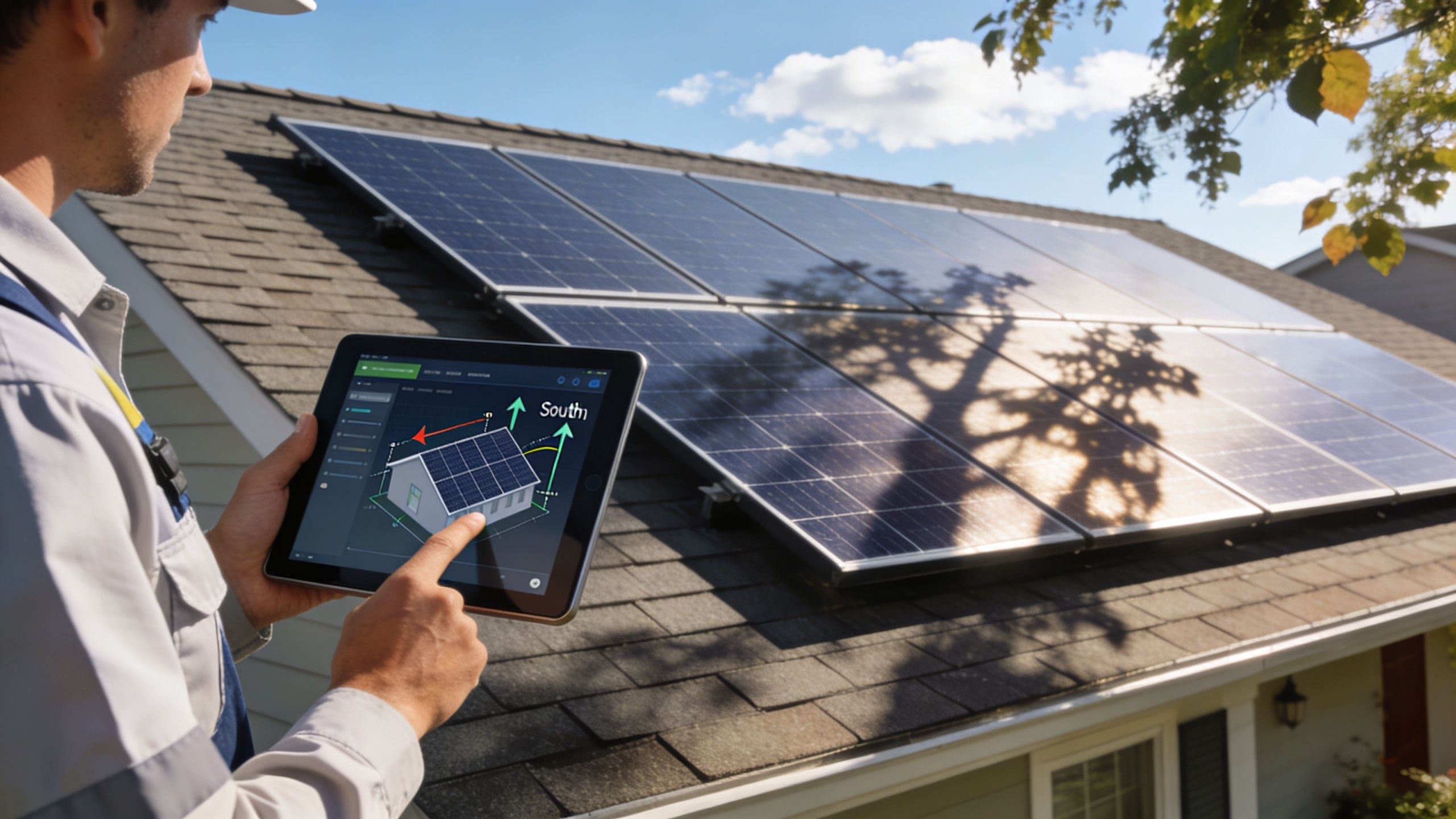
Take a newer family home in Kellyville. It often has broader roof planes, fewer awkward penetrations, and enough area to place a strong-sized system cleanly. Even if the ideal north-facing section isn’t large enough, an east-west split can still make practical sense when the goal is longer production across the day rather than chasing a perfect midday peak.
Now compare that with an Inner West terrace. The roof can be narrower, steeper, and interrupted by parapets, chimneys, neighbouring overshadowing, or heritage constraints. On those homes, the theoretical panel count from a calculator may not fit elegantly, or the best panel placement may not be the maximum panel placement.
What changes the final panel count
A site assessment usually changes the draft design for one or more of these reasons:
- Orientation. North-facing space is valuable, but it isn’t the only workable option. East and west roof faces can still perform well when designed properly for the household’s load profile.
- Shading. A gum tree that only clips the roof in late afternoon might not kill the project, but it can change where panels go and whether module-level optimisation makes sense.
- Roof geometry. Valleys, dormers, skylights, antennas, and tight setbacks all limit usable space.
- Aesthetics and service access. Cramming every last panel onto a roof can create a messy layout and make future maintenance harder.
The best design isn’t always the one with the most panels. It’s the one that places the right panels in the right positions for how the property actually performs.
That’s one reason building design matters more than people realise. If you’re renovating or building, understanding solar-responsive architecture helps you think about roof orientation, glazing, and passive design together rather than treating solar as an afterthought.
What works and what usually doesn’t
What works well is a design that respects the roof. Clean panel groupings. Consistent orientation where possible. Enough clearance around roof features. Room for serviceability.
What usually disappoints is forcing too many panels into compromised areas just to hit a sales target. Panels broken across tiny roof fragments, obvious shade lines across one section, or layouts that ignore access and installation detail tend to create headaches later. Build quality matters as much as sizing, which is why the standard of solar installation quality deserves close attention when you compare proposals.
Sizing for the Future Batteries EVs and Business
A family in Western Sydney installs solar for today’s bill, then adds ducted air conditioning, buys an EV two years later, and starts looking at batteries after the next blackout. The original system can still help, but if the array was sized too tightly, the upgrade path gets awkward and more expensive than it needed to be.
That is why I raise future plans early in NSW solar consultations.
A battery changes the job of the solar array. An EV changes it again. If the plan is to cover more evening use, charge a car at home, or reduce grid reliance over time, the panel count should reflect that from the start, not just this quarter’s usage.
The practical question is not whether to max out every roof. It is whether the system should support a staged energy plan. In Sydney suburbs, that often means reserving the best north and west roof faces for the highest-performing panels, checking whether the inverter can support expansion, and making sure the switchboard and cable routes will not become the weak point later.
For homeowners weighing that up, it helps to review home EV charger installation costs and setup requirements at the same time as solar sizing, because charger location, circuit capacity, and charging habits all affect the design.
If an EV or battery is even a realistic medium-term plan, say so before the layout is locked in.
Battery-ready design also depends on how the home uses power through the day. A household that is empty until 6 pm has a different solar-battery strategy from one with someone working from home, pool pumps running, or daytime air conditioning. In NSW, where summer cooling loads can be heavy and winter afternoons are shorter, that usage pattern matters more than generic calculators suggest.
For businesses, the same principle applies with bigger loads and tighter financial scrutiny. A workshop, office, medical practice, or light industrial site may have plenty of roof area, but the design still has to match operating hours, three-phase supply, plant loads, and any plan to electrify vehicles or equipment. Analysts at SolarReviews note that commercial and hybrid system sizing often shifts upward once battery storage or EV charging is part of the brief, especially where daytime consumption already aligns well with solar generation.
The takeaway is simple. A system sized only for the current bill can be fine for a household with stable usage and no electrification plans. A system meant to support batteries, EV charging, or business growth needs a wider brief, because the cheapest install today is not always the cheapest path over the next five to ten years.
Your Next Step A Personalised Solar Design
By this point, you can make a far better estimate than most online tools. Start with your bill. Use Sydney peak sun hours, not generic national averages. Apply a realistic system efficiency factor. Convert the required system size into panel count based on the wattage you’re considering. Then adjust for the roof you really have, not the perfect one in a calculator.
That process gives you a sound estimate. It does not give you a bankable design.
The final panel number depends on details that only a proper assessment can confirm. Roof orientation. Shade across different times of day. Panel layout around vents and ridges. Switchboard capacity. Whether you want a battery later. Whether an EV charger is likely. Whether your usage is about to change because the household is changing.
That’s why the best next step isn’t hunting for a magic panel number. It’s getting a design that reflects your property, your usage, and your plans over the next several years.
A good solar design should answer more than “how many solar panels do i need”. It should answer how those panels will be arranged, what they’re expected to offset, how the system can grow with your household, and where compromises are being made if the roof isn’t ideal.
If you want that worked through properly, Interactive Solar can turn your bill data, roof conditions, and future plans into a personalised NSW system design. Their team handles solar, batteries, EV chargers, and commercial projects with in-house installation and local experience, so you get a layout that’s designed for how your property performs, not a generic calculator result.
Make Interactive Solar a preferred source in Google
One click tells Google to surface our articles more often in Top Stories, AI Overviews and AI Mode.