Roof Ventilation Installation NSW: Cooler Home 2026
Last updated:
Summer in Sydney has a way of exposing weak points in a house. By mid-afternoon, the upstairs feels stuffy, the air conditioner keeps grinding away, and the power bill starts to reflect every hot day the roof has absorbed. Many homeowners focus on the AC unit, insulation, or window coverings first. Those all matter. But the roof cavity is often where the problem starts.
A poorly vented roof space traps heat and moisture, then pushes that stress back into the living areas below. That affects comfort, cooling demand, and how hard the rest of your energy system has to work. If you're planning solar panels, battery storage, or an EV charger, that matters even more. The lower your home's cooling load, the more value you can get from every kilowatt your solar system produces.
Your Guide to Roof Ventilation Installation
A common pattern in NSW homes goes like this. The house gets uncomfortably hot in summer, especially in bedrooms on the western side or on the second storey. The owner upgrades the air conditioning, maybe adds blinds, maybe starts looking at solar. Yet the house still feels like it stores heat long after sunset.
In many cases, the roof space is acting like a heat reservoir. Once the sun has baked the roof all day, that trapped heat doesn't just vanish. It radiates downward into ceilings and keeps the indoor temperature high well into the evening. That's why roof ventilation installation isn't just a roofing add-on. It's part of the thermal performance of the whole building.
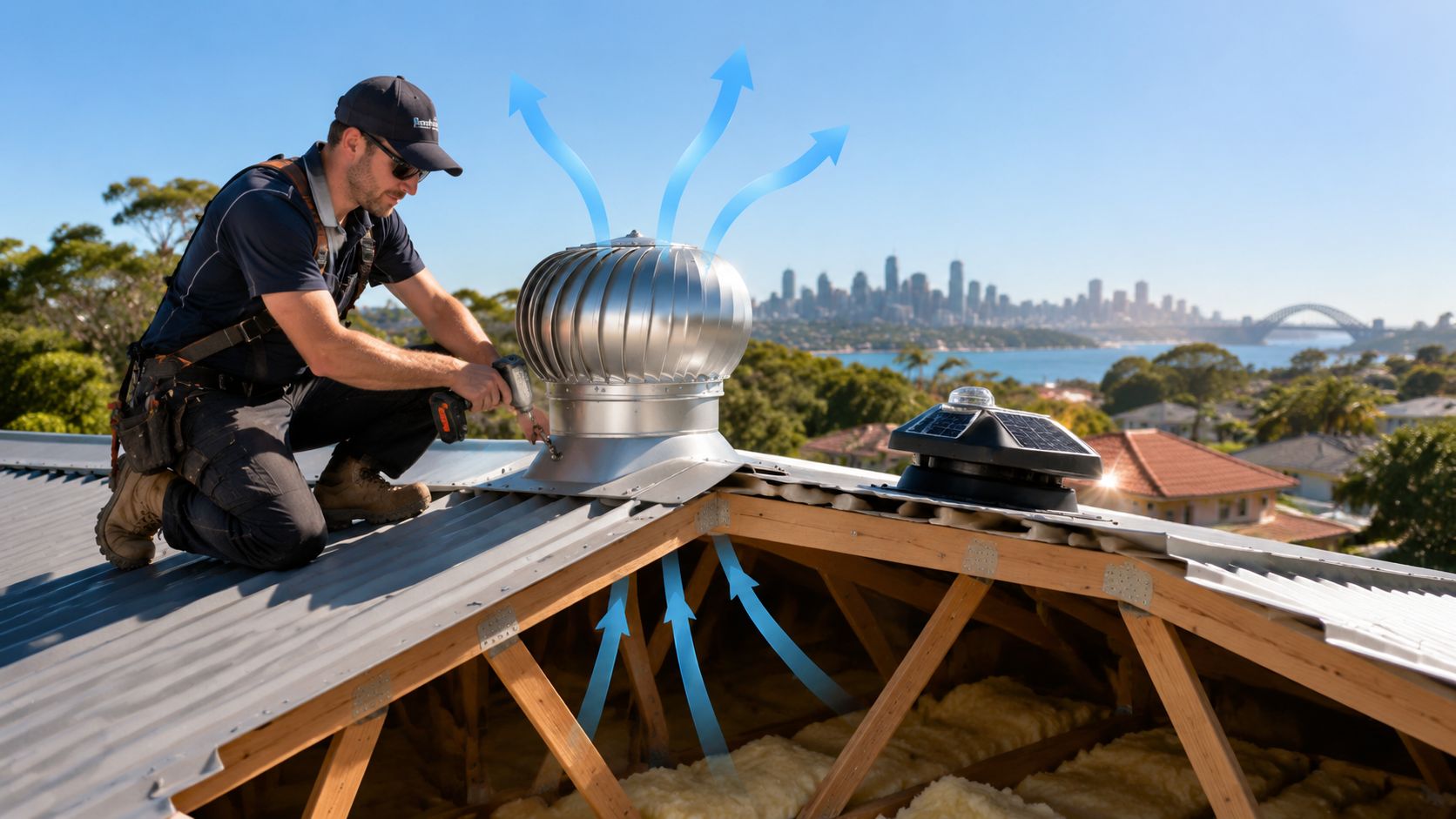
When the system is designed properly, ventilation helps the roof cavity release hot, stale air and draw in replacement air from lower intake points. That improves comfort, reduces strain on cooling equipment, and helps the roof space behave more like a managed part of the house rather than a sealed oven.
Why homeowners often miss it
People usually notice the symptoms before they identify the cause:
- Hot bedrooms late in the day that never seem to cool down properly
- An overworked air conditioner that runs longer than it should
- Uneven comfort between downstairs and upstairs zones
- A solar plan that looks good on paper but has to carry a larger cooling load than necessary
Roof work also tends to be out of sight, so it gets less attention than windows, appliances, or lighting. That's understandable. It's the same reason many people focus on skylights for brightness before looking at how the roof assembly manages heat. If you're already comparing roof upgrades, it's worth seeing how natural light solutions can affect home performance alongside ventilation choices.
Good roof ventilation isn't a gimmick. In NSW conditions, it's one of the practical upgrades that can make the rest of your energy decisions work better.
Why Your Roof Is a Hidden Energy Drain
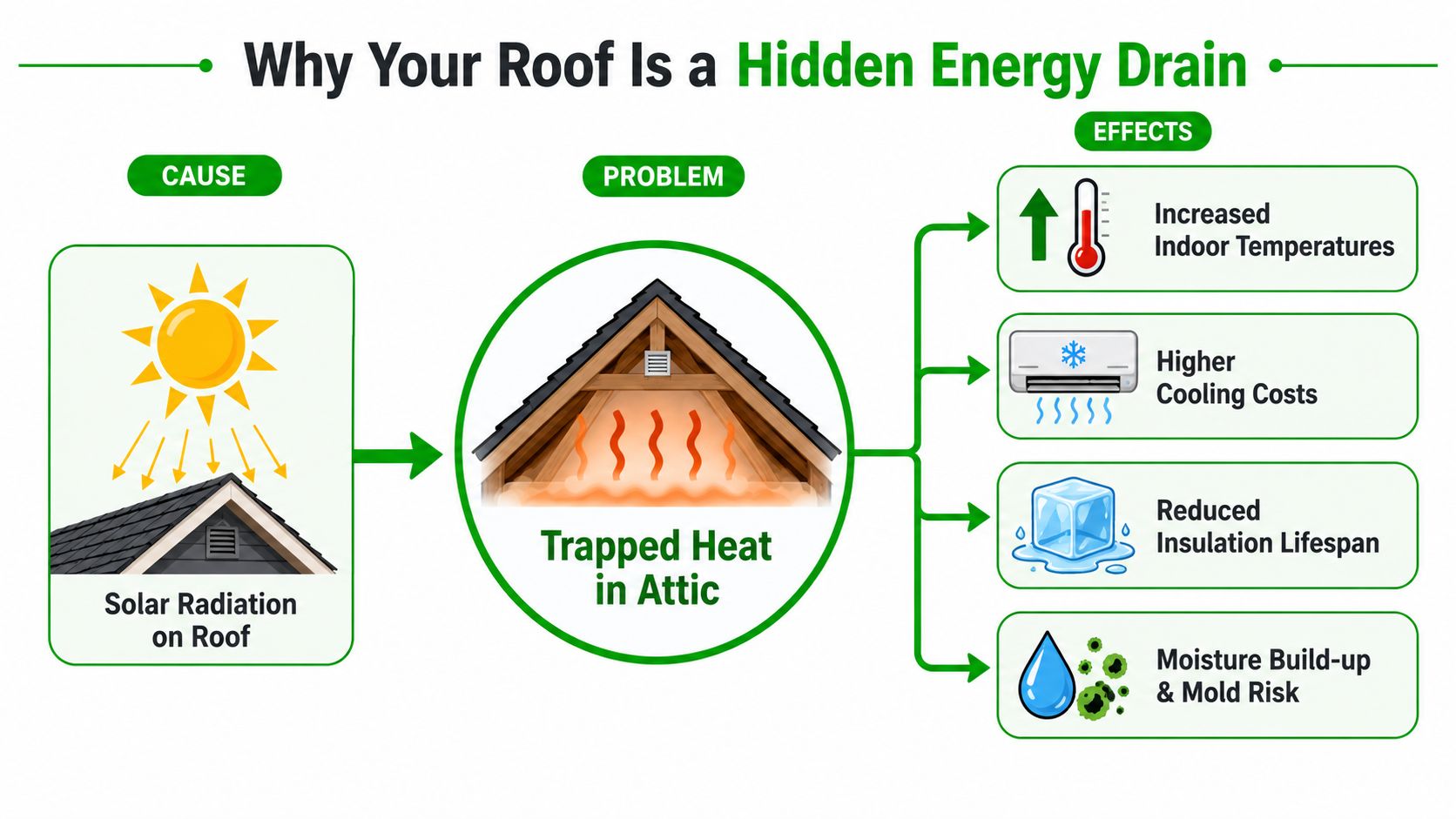
A roof space without enough airflow behaves a lot like a parked car in the sun. The roof absorbs solar radiation, the air underneath heats up, and that heat gets trapped. Once that happens, the ceiling below becomes the barrier between your living space and a very hot roof cavity.
How trapped heat affects the house
Heat rises naturally, but in a roof cavity it also accumulates because there's nowhere effective for it to go. That creates a constant transfer of heat into the rooms below. Ceiling plasterboard, insulation layers, ducting, recessed fittings, and framing all sit in that hot zone.
The result is practical, not theoretical. A study referenced for NSW homes found proper roof ventilation installation reduced summer cooling loads by 18% to 22%, with annual electricity savings of about $140 to $210 per household. That's why ventilation belongs in the same conversation as efficient air conditioning and solar generation.
The stack effect in plain language
The basic airflow principle is simple. Hot air wants to rise. A well-designed roof ventilation system uses that to its advantage by letting hot air escape through higher exhaust points while cooler replacement air enters through lower intake points.
If you only add an exhaust vent and ignore intake, the system struggles. Air has to come from somewhere. Without a clear intake path, the exhaust side can't do its job properly.
Practical rule: Ventilation works as a system, not as a single hole in the roof.
It's also a moisture issue
Roof ventilation isn't just about summer heat. Moisture from day-to-day living can move upward into the roof space. If that moisture lingers, materials stay damp longer than they should.
That can contribute to:
- Mould risk on roof timbers and surfaces
- Insulation performance loss when insulation becomes affected by moisture
- Premature wear in roofing components and surrounding materials
- A less stable indoor environment across changing seasons
A lot of generic guides stop at “hot air out, cool air in.” The underlying issue is broader. Heat, moisture, airflow balance, and roof durability are all tied together. If the roof cavity is unmanaged, the house pays for it every day the cooling system runs.
Common Signs You Need Better Roof Ventilation
Most homeowners don't inspect their roof cavity often. They notice patterns inside the home first. Once you know what to look for, poor ventilation becomes easier to spot.
What shows up inside the house
If the roof space is holding too much heat or moisture, you'll usually see some mix of these signs:
- Upstairs rooms stay hotter for longer. Bedrooms under the roofline are often the first clue.
- The air conditioner runs hard in late afternoon and early evening. The house keeps absorbing stored heat from above.
- Indoor comfort feels uneven. One side of the home may feel manageable while another feels persistently warm.
- Winter condensation appears on the inside of windows. Moisture issues don't always stay hidden in the roof space.
- A musty smell develops in ceiling-adjacent areas. That can point to stagnant air and lingering dampness.
What you might see in the roof space
If you can safely inspect the ceiling cavity or have a professional check it, look for practical evidence rather than guesses.
| Sign | What it can suggest |
|---|---|
| Dark spotting or mildew on timbers | Moisture isn't clearing properly |
| Damp-looking insulation | Humidity is lingering in the cavity |
| Strong heat build-up under the roof deck | Poor air exchange |
| Rusting or staining around penetrations | Moisture and temperature stress |
These signs don't automatically prove ventilation is the only problem. Roof leaks, insulation gaps, and ducting issues can create similar symptoms. But when several of them appear together, ventilation should be high on the checklist.
If a home is hard to cool and the upper rooms stay hot well into the evening, I'd inspect the roof space before assuming the air conditioner is undersized.
Why early action matters
Ventilation problems tend to look minor until they combine with seasonal stress. Heat loads rise in summer. Moisture sits longer in still air. Roofing materials expand and contract. Small weaknesses become bigger repairs.
That's one reason resources on preventing costly roof damage are useful even outside cold-climate examples. The broader lesson applies in NSW too. Roof systems last longer when water management, airflow, and detailing are treated as one package instead of separate jobs.
If you're seeing the symptoms above, don't reduce the problem to “the house just runs hot.” Houses run hot for reasons. Roof ventilation is often one of them.
Choosing the Right Vents for Your NSW Home
There isn't one vent that suits every roof. The right answer depends on roof shape, pitch, existing intake paths, roofing material, internal layout, and how the home behaves in Sydney or broader NSW conditions.
Start with balance, not hardware
Before comparing products, start with net free area, or NFA. A common rule used in roofing guidance is 1 square foot of vent area per 150 square feet of attic floor area, split evenly between intake and exhaust. In specific code-allowed cases, a reduced ratio may apply, but the design still has to be balanced.
That's the part many people miss. A strong exhaust vent with weak intake doesn't create efficient airflow. It often creates disappointment.
Four common options
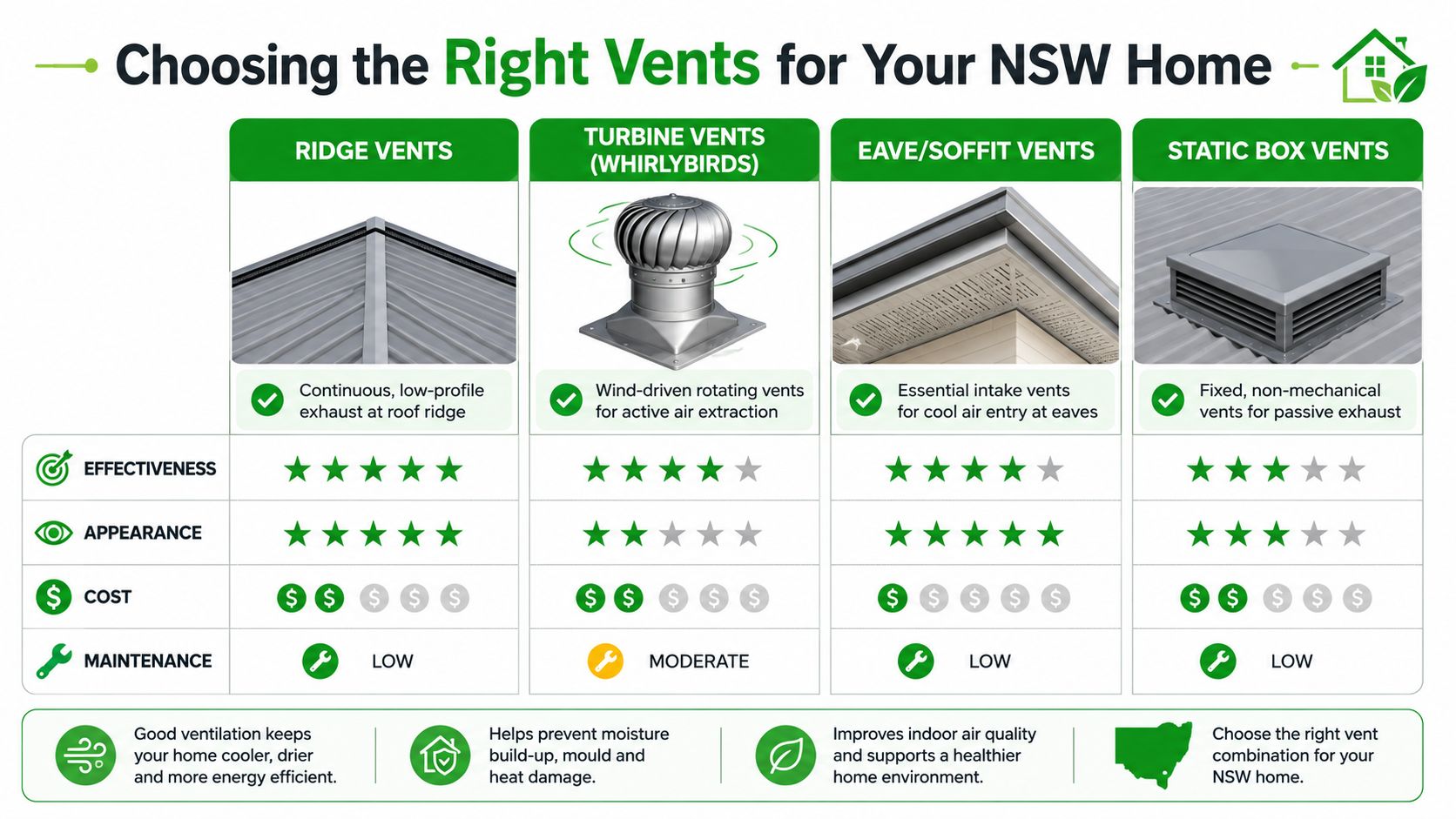
Ridge vents
Ridge vents sit along the roof peak and allow rising hot air to escape continuously across the highest point.
They usually suit homes where the roof design provides a clear ridge line and where intake ventilation at the eaves can support the exhaust path. Their strengths are even air release and a low-profile appearance. Their weakness is simple. If the intake side isn't there, performance drops.
Turbine vents or whirlybirds
Turbine vents use wind movement to help extract air from the roof space. They're familiar on many NSW homes and can work well when correctly sized and placed.
They can be a practical retrofit on roofs where ridge venting isn't ideal. But they shouldn't be treated as a magic fix. Too many turbines, or turbines installed without enough intake, can leave the system unbalanced.
Eave or soffit vents
These are the intake side of the system. They sit lower on the roof assembly and let replacement air enter as warmer air exits above.
In practice, eave vents are often the most important part of the whole design. Without them, many exhaust-only systems never reach their potential.
Static box vents
Static vents provide passive exhaust without moving parts. They can suit some roof forms where ridge venting isn't practical and where a simple fixed outlet makes more sense than a turbine.
Their performance depends heavily on placement and total system design. They're usually best judged as part of the full roof layout rather than as standalone products.
NSW-specific trade-offs
A Sydney roof isn't just a roof. Coastal exposure, humidity, older tile roofs, modern metal roofs, insulation upgrades, and solar panel placement all influence the best venting plan.
A few examples:
- Solar panels change roof dynamics. They can shade parts of the roof while also changing access and layout options for vents.
- Older homes often have inconsistent airflow paths. You may need to correct blocked or missing intake points before adding exhaust.
- Complex roof geometry can create dead zones. One vent type may work well on one section and poorly on another.
- Powered options need restraint. Some people look at solar powered attic vents as a direct upgrade, but the primary question is whether the roof has the intake path and layout to support them.
The best vent is the one that fits the roof and the airflow path. Not the one with the loudest marketing.
If you want a broader look at product layouts and system types, a guide to roof ventilation system options for Australian homes can help you compare approaches before speaking with an installer.
The Professional Installation Process Explained
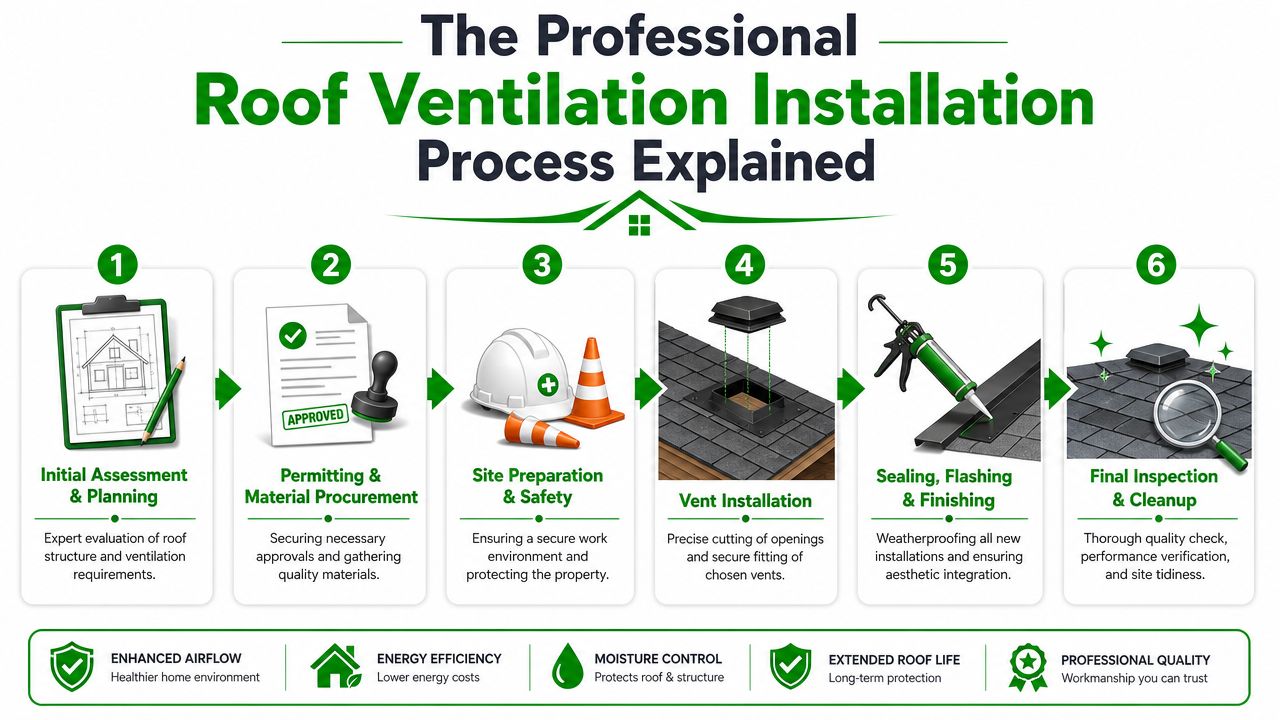
A proper roof ventilation job starts long before anyone cuts into the roof. Good installers spend time on assessment because placement, waterproofing, and airflow balance decide whether the system performs well or becomes a future leak point.
Assessment and system design
The first step is understanding the roof, not selling a vent. The installer checks roof type, pitch, available ridge length, eave condition, ceiling cavity access, insulation, ducting, and any existing penetrations.
Then the system gets designed around airflow requirements, not guesswork. That includes calculating how much vent area is needed and where intake and exhaust should sit to create a functional path through the roof space.
Safe cutting and weatherproof fitting
Once the layout is confirmed, the installation itself has to protect the roof envelope. At this stage, trade skill is most important.
According to professional installation guidance, the vent flange must be integrated under the uphill shingles and sealed with manufacturer-recommended roofing cement. The same guidance warns that if flashing, shingle overlap, or sealant continuity is wrong, the vent can become a major leak path.
That principle applies broadly across roof types. Whether the home has tiles, metal roofing, or shingle-style systems, the penetration has to shed water correctly.
What a careful installer pays attention to
A reliable installation team will usually focus on details like these:
- Cut location: Openings need to suit the roof framing and airflow path, not just the easiest spot to reach.
- Flashing sequence: Water must be directed over and away from the vent assembly.
- Sealant compatibility: The wrong sealant can fail early or interfere with the roofing material.
- Internal clearance: Ducts, insulation, and framing must not block the intended air path.
- Final checks: The roof should be left watertight, tidy, and mechanically sound.
A vent that moves air but creates a leak hasn't solved anything. It has only swapped one building problem for another.
Why roof type changes the method
Tile roofs and metal roofs aren't handled the same way. Penetration details, fastening methods, and flashing assemblies all differ. That's one reason homeowners with concrete or terracotta roofs should look at roof-specific guidance, especially when comparing solar and ventilation work on the same property. For example, tile roof installation considerations often overlap with access and waterproofing decisions for vent placement.
Professional roof ventilation installation should feel methodical, not rushed. If the conversation skips assessment and goes straight to “we'll just add a couple of vents,” that's a warning sign.
Compliance Licensing and Performance in NSW
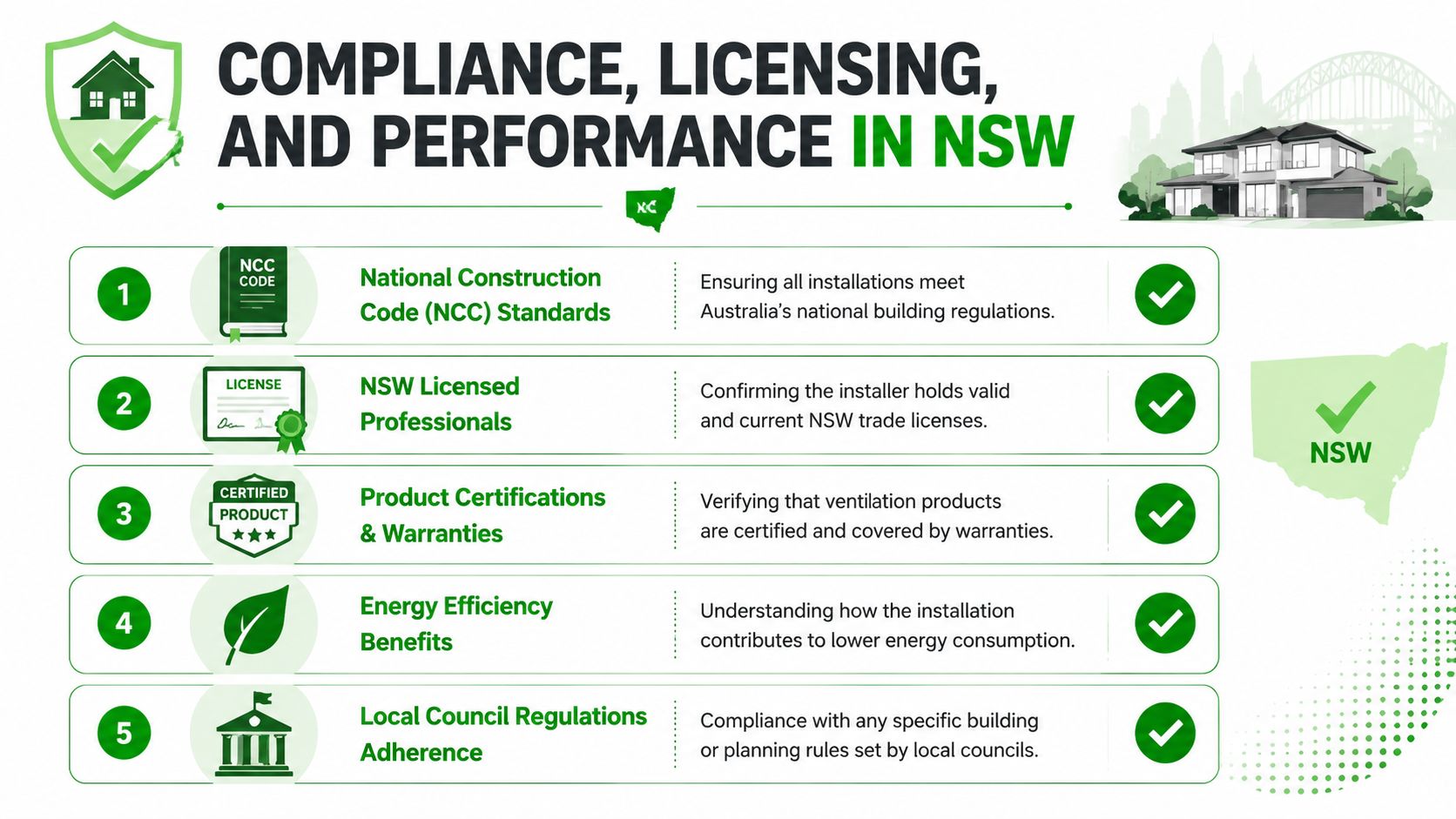
In NSW, roof ventilation isn't just a comfort upgrade. It sits inside a compliance framework that affects design, workmanship, and long-term performance. Homeowners don't need to memorise the code, but they do need to know when an installer is cutting corners.
What the code requires
For enclosed attics and rafter spaces, NSW building code guidance requires a minimum net free ventilating area of 1/150 of the attic floor, with 40% to 50% of that area in the upper portion of the roof to keep the system balanced. In specific situations, a 1/300 ratio may be allowed, but only when the code conditions are met.
That requirement matters for two reasons. First, it stops installers from undersizing the system. Second, it stops them from treating roof ventilation as “just add an exhaust vent and move on.”
Compliance is practical, not bureaucratic
People sometimes hear “code compliance” and think paperwork. On roofs, compliance is physical.
It affects:
- Whether the vent area is sufficient
- Whether the upper and lower split is balanced
- Whether penetrations are placed and sealed properly
- Whether the finished roof remains weather-tight
- Whether the installation can be defended if problems show up later
A compliant job usually performs better because the design discipline is stricter.
Why licensing matters
Roof penetrations and electrical work around energy upgrades carry real risk. A licensed, insured installer is accountable for the work, understands the relevant standards, and is less likely to improvise where they shouldn't.
That becomes even more important when ventilation sits alongside solar, battery, or roof lighting upgrades. Once several systems share the same roof space, poor coordination causes avoidable mistakes. Openings get crowded. Access gets compromised. Waterproofing details become messy.
Check this before approving work: Ask who is doing the installation, what licence coverage applies, and how the roof penetration method will be detailed for your specific roof type.
Performance isn't just about airflow
Homeowners often compare products and forget the building context. A well-chosen vent on a poorly prepared roof won't deliver good results. Nor will a code-sized system if insulation, intake paths, or roof condition are ignored.
That's why adjacent roof upgrades should be viewed together. For example, people weighing daylight improvements can benefit from understanding roof opening and skylight cost considerations in NSW homes, because every new penetration affects waterproofing, layout, and performance planning.
Good compliance work doesn't feel flashy. It feels deliberate, documented, and hard to fault after the installer leaves.
Ventilation as Part of a Whole Home Energy Strategy
Roof ventilation delivers the most value when it's treated as part of the home's energy system, not as an isolated fix. A cooler roof cavity lowers the background stress on the house. That means the air conditioner has less heat to fight, the indoor environment is easier to manage, and the rest of your upgrades can work under better conditions.
That's especially relevant in NSW, where a major gap in many guides is local decision-making. As one industry discussion highlights, homeowners want to know whether roof vents will lower indoor temperature and bills in their specific Sydney or NSW climate. That's the right question. Ventilation should be judged by how it fits your roof, your cooling pattern, and your broader energy plan.
Why it helps solar and battery performance indirectly
Ventilation doesn't generate electricity. What it does is reduce wasted cooling demand. If your home needs less energy to stay comfortable, more of your solar production can go where you want it to go. That may mean charging a battery earlier, running household loads more efficiently, or reducing how much power you need to draw from the grid in the evening.
The same logic applies if you're adding EV charging. Every improvement that trims avoidable house load gives your energy system more room to work.
For homeowners comparing efficiency upgrades more broadly, there are useful insights for energy conservation that reinforce the same principle. The best results usually come from stacking improvements that reduce demand first, then supplying that demand more intelligently.
If your roof space is trapping heat, that should be addressed before expecting solar alone to solve everything. And if you're considering a powered option, it helps to compare where a roof ventilator fan fits into a broader home energy setup.
If you want a practical plan that ties roof ventilation, solar panels, battery storage, and EV charging into one efficient system, speak with Interactive Solar. Their team can assess how your roof and energy use work together, then recommend the upgrades that will deliver the best long-term result for your NSW home or business.
Make Interactive Solar a preferred source in Google
One click tells Google to surface our articles more often in Top Stories, AI Overviews and AI Mode.