Best 3-Phase EV Charger Australia: 2026 Buyer’s Guide
Last updated:
Those looking for the best 3-phase EV charger in Australia are often really asking a different question. Will a 3-phase charger make enough difference to justify the extra complexity at my property?
That's the right place to start. The biggest mistake I see is buyers chasing the highest kilowatt rating on the box, then finding out their house supply, switchboard, or car won't use that charger the way they expected. A 3-phase charger can be the right call, but it isn't automatically the smart one.
Before getting into the detail, this quick comparison helps separate the marketing from the practical reality.
| Charger path | Best suited to | What usually works well | Where it often falls down |
|---|---|---|---|
| Single-phase home charger | Most households charging overnight | Simple setup, reliable overnight top-ups, less demanding on site capacity | Slower daytime turnaround |
| 3-phase home charger | Homes with 3-phase supply and a real need for faster AC charging | Faster destination charging, better fit for some future vehicle upgrades, useful with smart controls | Overkill if the EV only needs routine overnight charging |
| 3-phase smart solar charger | Homes or businesses with solar and variable site load | Better solar use, app scheduling, load-aware charging | Needs proper setup, not just a capable charger |
| 3-phase commercial charger | Workplaces, hotels, retail, mixed-use sites | Faster turnaround for staff and visitors, more practical for destination charging | Poor value if nobody stays parked long enough or site load hasn't been assessed |
Understanding 3-Phase vs Single-Phase EV Charging
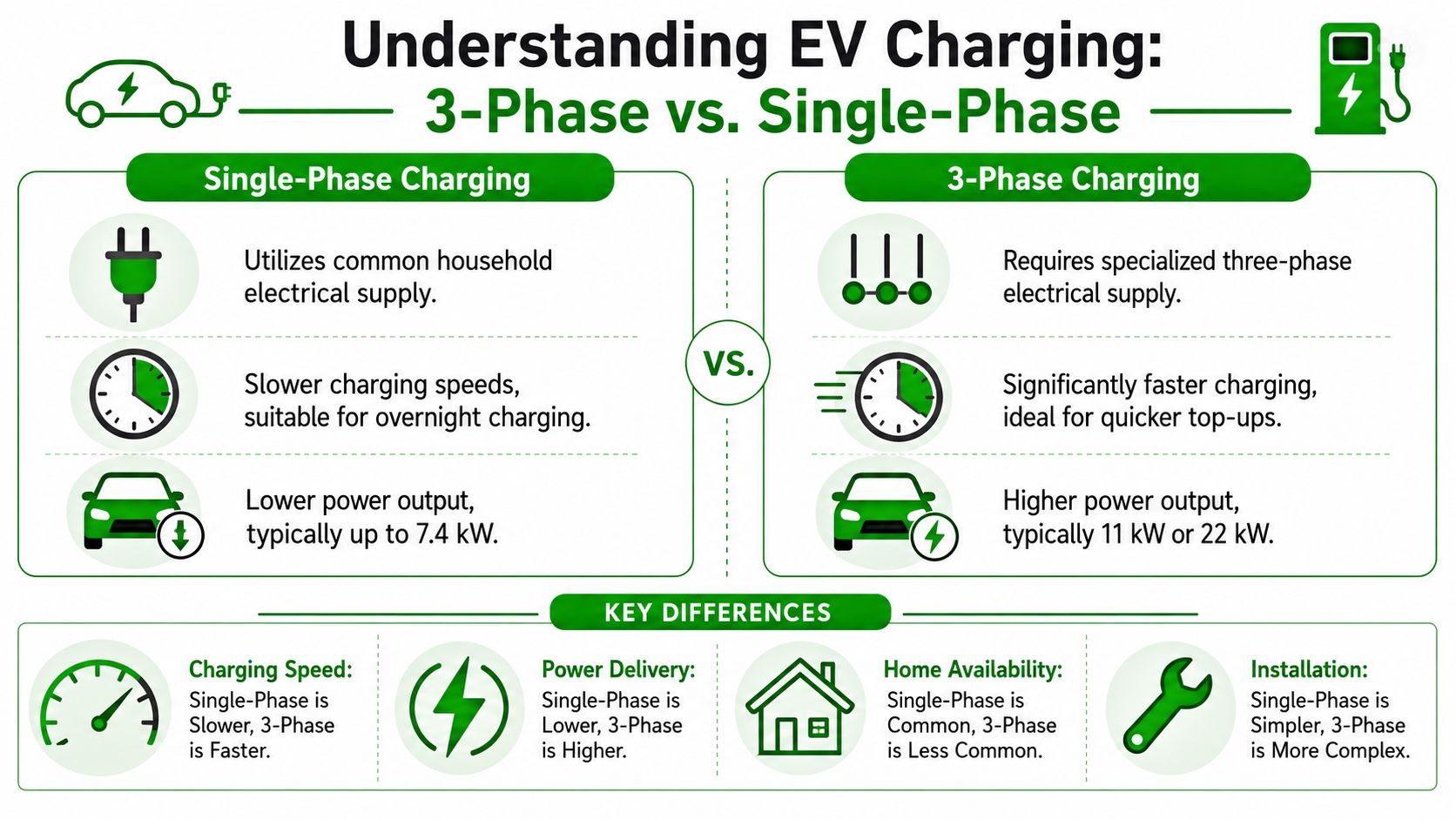
A single-phase EV charger uses the standard supply found in most Australian homes. A 3-phase EV charger uses three active phases instead of one, which allows much higher AC charging power where the property supply and vehicle both support it.
In simple terms, the difference is speed. In Australia, a 3-phase AC charger can deliver up to 22 kW, while a typical single-phase home charger is about 7 kW. SolarQuotes notes that this translates to about 40 km of range per hour from a 7 kW charger and roughly 125 km of range per hour from a 22 kW 3-phase charger (SolarQuotes EV charger guide).
What the power difference means in real life
That headline number matters most when you need a shorter charging window. If you get home late, head out again soon after, or want to top up during the day rather than leave the car plugged in all night, 3-phase starts to make sense.
For a lot of drivers, though, charging speed only matters up to the point where the car is ready each morning. If a single-phase charger already covers your normal driving overnight, adding more charging power doesn't automatically add more value.
Practical rule: Buy for your actual charging window, not for the biggest number on a brochure.
Why 3-phase chargers are more common at workplaces
Three-phase supply is more common where electrical capacity is higher, such as workplaces, shopping centres, hotels, and larger homes. That's why 3-phase chargers often make more sense as destination chargers than as standard suburban home chargers.
At those sites, cars may only be parked for part of the day. In that situation, stronger AC charging gives drivers a more meaningful top-up before they leave again. That's also why many businesses looking at EV chargers for homes and workplaces should think beyond charger brand and start with site use.
The important catch
A 22 kW charger doesn't guarantee 22 kW charging. The charger can only offer what the site and vehicle allow. That's the practical limit many buyers miss, and it's the reason a 3-phase charger can be brilliant on one property and pointless on another.
Who Actually Needs a 3-Phase Charger in Australia
Do you need a 3-phase EV charger at home, or are you paying for capacity you will rarely use?
For many Australian households, the answer is simpler than the brochures make it sound. The right charger is the one that fits your supply, your car's onboard AC charging limit, and the hours the car is parked. A higher kW rating only matters if those three line up.
Typical households
Most home charging is boring in the best way. The car gets parked in the evening, sits there all night, and needs to recover a normal day of driving before morning. For that pattern, single-phase is often enough.
That lines up with how Australians use their cars. The Bureau of Infrastructure and Transport Research Economics has reported that average passenger vehicle travel is well below the sort of daily distance that forces fast home AC charging for every driver (BITRE travel data). If your EV is parked for 10 to 12 hours most nights, the practical question is not “What is the biggest charger I can buy?” It is “Will this setup reliably replace what I used today by tomorrow morning?”
If the answer is yes on single-phase, 3-phase may not improve much day to day.
I see this often. A homeowner asks for 22 kW because it sounds future-proof, but their car only accepts 7 kW or 11 kW AC, they drive moderate distances, and the vehicle is parked all night. In that case, the extra spend does not get them much outside of a better number on paper.
Home 3-phase charging starts to make sense in a narrower set of situations:
- Two EVs sharing limited charging time, especially if both need a decent refill between trips
- High daily kilometres, where overnight on single-phase is tight or unreliable
- Short home dwell times, such as shift workers, sales reps, or drivers who head back out after dinner
- Existing 3-phase supply with enough spare capacity, where installation is straightforward
- Daytime charging strategy tied to solar and storage, where charging behaviour is part of a broader solar battery storage setup
The supply side matters more than many buyers expect. If the property only has single-phase, upgrading just to chase a bigger charger can become expensive quickly. Switchboard capacity, cable run, protection, metering, and network requirements all come into it. At that point, “best 3-phase EV charger” is the wrong question. The better question is whether the property benefits enough to justify the electrical work.
Businesses and commercial sites
Commercial sites have a different job to do. They are not just filling one car overnight. They are serving staff, visitors, fleet vehicles, or tenants during a limited parking window.
That makes 3-phase more useful in workplaces, accommodation, retail, and mixed-use buildings. A driver parked for part of a shift or a short stay can leave with a meaningful top-up, and the site can serve more vehicles across the day. That is where higher AC charging rates often earn their keep.
Even then, the charger still needs to match the site. I would rather install a well-managed 11 kW or 22 kW unit with proper load control on a suitable board than oversize the hardware and fight supply limits from day one.
When 3-phase is overkill
3-phase is often too much for a home if:
- The EV charges overnight without difficulty on single-phase
- The house does not already have 3-phase supply
- The vehicle cannot use the charger's full AC output
- The buying decision is driven by headline kW rather than use case
That last point is the one that catches people. The best 3-phase EV charger in Australia is not the one with the highest rating. It is the one that suits the property, the vehicle, and the way charging happens in real life.
Key Features to Compare in 3-Phase EV Chargers
Once you've decided 3-phase is justified, stop comparing units by peak output alone. In practice, the strongest features to assess are solar-aware charging, dynamic load management, and app-based control, because those are the features that determine whether a 22 kW-capable charger can operate properly at the site without creating supply issues (Australian EV charger comparison data).
That's the difference between a charger that looks good on paper and one that behaves properly in an Australian home or business.
| Feature | Why It Matters for Australian Homes & Businesses |
|---|---|
| Solar-aware charging | Helps the charger follow available solar surplus instead of pulling unnecessary grid energy |
| Dynamic load management | Reduces the chance of overloading the main supply when other large appliances are running |
| App-based control | Lets users schedule charging, monitor sessions, and adapt charging to real use patterns |
| Vehicle AC compatibility | Prevents overbuying a charger the car can't fully use |
| Tethered vs untethered format | Changes day-to-day convenience and flexibility across different vehicles |
| Access control for shared sites | Useful where staff, tenants, or visitors need managed charging access |
| Build suitability for location | Outdoor installs need a charger suited to local conditions and mounting position |
Solar-aware charging
For homes with solar, this is one of the few features that can materially improve the value of the charger. A charger that can respond to surplus generation is far more useful than one that just charges at full rate the moment it's plugged in.
Without solar awareness, the charger may still work perfectly well. It just won't make the best use of the energy system already on site. That's why solar integration matters more than headline power for many owner-occupiers.
Dynamic load management
This is the feature I'd call essential on many 3-phase installs.
A charger can be rated for high output, but if the house or business is already carrying air conditioning, cooking load, hot water, machinery, or other big electrical demand, the charger needs to respond intelligently. Dynamic load management helps the charger back off when the site is under pressure instead of forcing nuisance trips or pushing the installation beyond what's practical.
A high-capacity charger without load management can create more problems than it solves.
App control that's actually useful
App control gets oversold, but it does have real value when it's done well. The useful parts are straightforward:
- Scheduling: Charge when the car is parked and the site is best able to supply it.
- Monitoring: See whether the charger is doing what you expect.
- User control: Adjust behaviour without standing at the switchboard or charger.
- Operational visibility for businesses: Useful when multiple people depend on the charger.
For solar-backed sites, app visibility also helps confirm whether the charger is behaving the way the broader energy system needs it to.
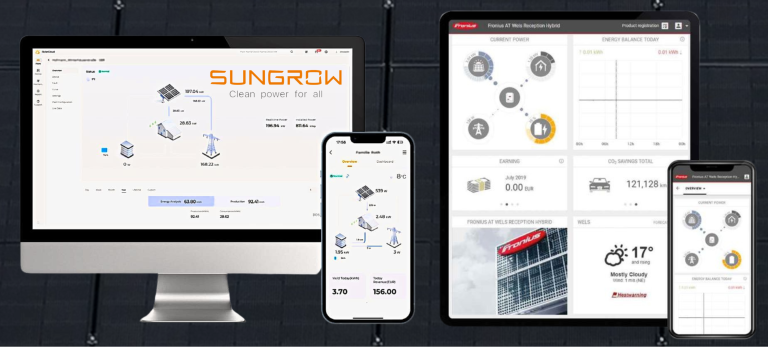
If remote visibility across the energy system matters, charger planning often ties into inverter remote monitoring and solar performance oversight, especially on sites trying to coordinate charging with generation and building load.
Don't ignore the car's AC limit
This is one of the biggest buying mistakes. A 3-phase charger may be able to supply more than the EV can accept on AC. So the charger isn't always the bottleneck.
That means two buyers can install the same model and get very different real-world outcomes. One may use the charger's upper capability well. The other may get little advantage over a lower-capacity setup.
Small details that matter daily
The best units also get the practical details right:
- Cable handling: Especially important if the charger is used every day.
- Mounting position: Side wall, garage, driveway post, or commercial bay all change cable reach.
- Shared access: Important for workplaces, apartment settings, and mixed-use parking.
- Software stability: Fancy features don't help if users avoid the app because it's unreliable.
Good charger selection is mostly boring. That's a compliment. The right unit should fit the site cleanly, operate predictably, and not need constant workarounds.
Comparing the Main Types of 3-Phase Chargers
Are you paying for charging capacity you will never use, or buying a unit that suits the way the site runs?
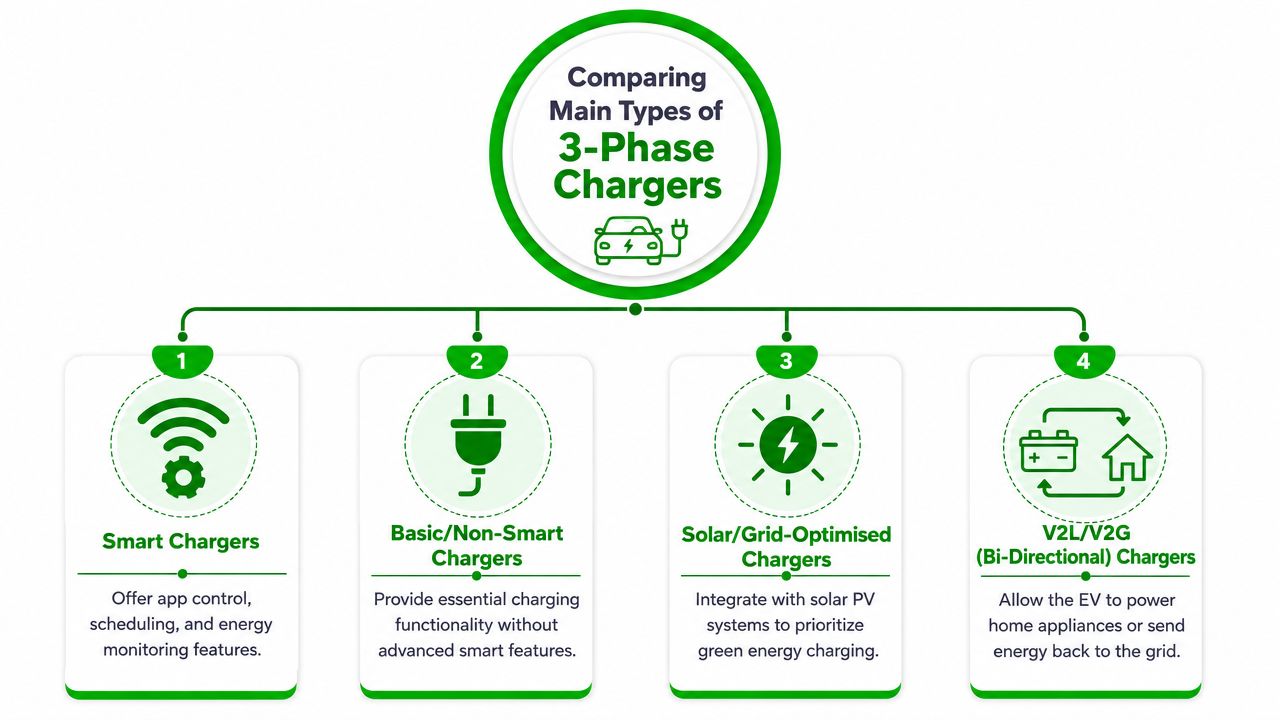
The practical comparison is not brand versus brand. It is charger type versus site type. A typical Australian home with one EV, overnight parking, and modest daily kilometres often does not need the most advanced 3-phase unit on the shelf. A business with multiple drivers, rotating users, or daytime charging demand often does.
Basic high-power chargers
These are the plain workhorses. They deliver 3-phase AC charging without much software, tariff control, or solar coordination.
That can be the right choice for:
- small commercial sites with one regular vehicle
- private depots or staff parking
- homes that already know they want fast AC charging and do not care about app features
The upside is simplicity. Fewer moving parts usually means fewer support headaches.
The downside shows up once the site load varies through the day or the owner wants the charger to respond to solar output. At that point, a basic unit can feel too rigid. It still charges the car, but it does not do much else.
Smart solar-aware chargers
For many owner-occupied homes with solar, this is the category that makes the most sense. The value is not the headline kW figure. The value is controlling when the car charges and how hard it pulls.
Common Australian options in this group include models such as the Tesla Wall Connector Gen 3, Fronius Wattpilot, and Zappi v2.1. Their actual difference is not the brochure claim. It is how well they handle solar diversion, current adjustment, scheduling, and day-to-day usability. The Open Charge Map charger database is also useful for seeing which products and charging formats appear most often across real sites, especially if you are comparing practical ecosystem fit rather than marketing language.
This category suits properties where:
- the EV sits parked for long enough to wait for cheaper or solar-backed charging
- the owner wants lower grid use, not just the fastest possible refill
- the vehicle can benefit from 3-phase AC input
That last point matters. Some cars will not make full use of a higher-capacity 3-phase charger, so the extra spend buys convenience features, not faster charging. For plenty of houses, that can still be worth it. For others, it is money better kept in the switchboard upgrade budget or not spent at all.
Commercial networked chargers
Shared-use sites need a different type of charger again. Once multiple users are involved, charger management becomes as important as charging performance.
Commercial networked units are built for things like:
- staff access control
- usage tracking
- billing or cost allocation
- load sharing across multiple chargers
- remote fault visibility
For a workplace or apartment car park, those functions matter more than whether one unit has a slightly stronger app interface. If nobody can control access or see who used what power, the installation becomes difficult to manage very quickly.
Some projects also sit outside the usual suburban or office setup. Operators working with mobile plant, remote assets, or rougher environments may find Solana EV's off-road vehicle charging useful as a reference point for how charging requirements change once vehicle duty and site conditions get less conventional.
Bidirectional and niche chargers
Bidirectional products get plenty of attention, and rightly so, but they are still a niche decision for most Australian properties.
If the current goal is reliable daily charging, focus on that first. A charger with future-facing features is not automatically the better buy if the car cannot use them, the site is not ready for them, or the owner will never turn them on. I would rather see a property install a charger that fits its actual daily use than overspend on capability that stays idle.
If you want a broader sense of how different units behave once they are installed, these charger and solar product reviews are a useful starting point.
Installation and Australian Electrical Requirements
A 3-phase charger only makes sense if the electrical side supports it. That starts with the obvious point. The premises must have 3-phase supply available, and the site still needs enough switchboard capacity and the right circuit design for the charger to operate properly.
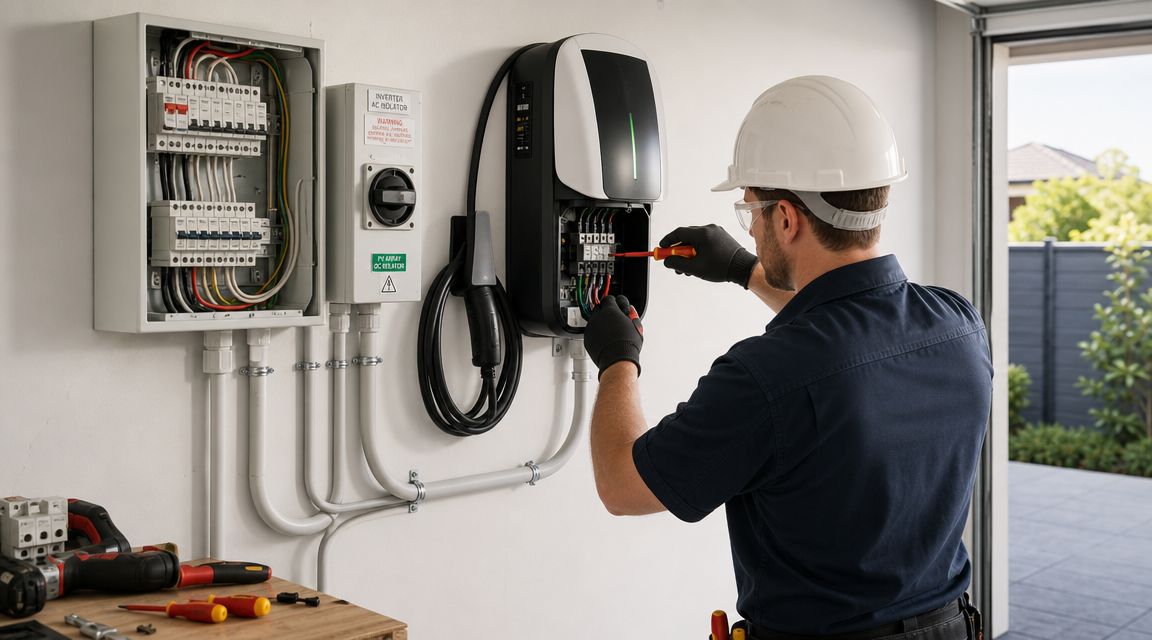
The Electric Vehicle Council describes a dedicated AC charger at up to 22 kW (32 Amp, 3-phase) as a standard high-capacity option, but notes that performance depends on the premises having 3-phase supply and on the vehicle being able to accept the higher AC rate. Many EVs in Australia are limited to 11 kW AC, which is why a proper site assessment matters before any hardware choice is finalised (Electric Vehicle Council charging guide).
What an electrician checks first
The charger is only one part of the installation. Before a unit is selected, a licensed electrician should check:
- Supply type: Whether the property has usable 3-phase available.
- Switchboard capacity: Whether the board can accommodate the additional circuit and protection.
- Main load profile: Whether the site can support charging alongside the existing electrical demand.
- Cable route: How the charger will be supplied from the board to the parking location.
- Vehicle compatibility: Whether the EV can use the charger output being proposed.
That last point gets skipped too often. A 22 kW-capable charger on a site with 3-phase supply still won't deliver that result if the car won't take it.
Why panel and switchboard condition matters
On older homes, the switchboard can be a significant issue. Not always, but often enough that it shouldn't be treated as an afterthought. If you want background on the broader upgrade factors that can affect this kind of work, this homeowners' electrical panel cost guide is a useful general reference for understanding why board upgrades sometimes become part of the conversation.
A proper installation also has to comply with the relevant Australian electrical requirements, including the practical application of safe circuit protection, correct cable sizing, and suitable equipment location.
Good EV charger installations are planned at the switchboard first and at the wall second.
Here's a useful visual overview of what a compliant install process should account for:
What doesn't work
Three things tend to cause trouble:
- Buying the charger before the site is assessed
- Assuming 3-phase supply means unlimited charging capacity
- Treating installation quality as secondary to charger brand
That's why charger work should be handled as proper electrical infrastructure, not just accessory installation. For households and businesses comparing providers, the quality of system installation workmanship and electrical execution matters as much as the charger itself.
Your Decision Checklist for the Right 3-Phase Charger
Is a 3-phase EV charger worth paying for at your place, or are you buying speed you will rarely use?
Start there. The right charger is the one that suits your supply, your vehicle, and how the car is driven day to day. In plenty of Australian homes, a well-chosen single-phase unit does the job perfectly well. In a business, or in a home with high daily mileage and limited charging windows, 3-phase can make clear sense.
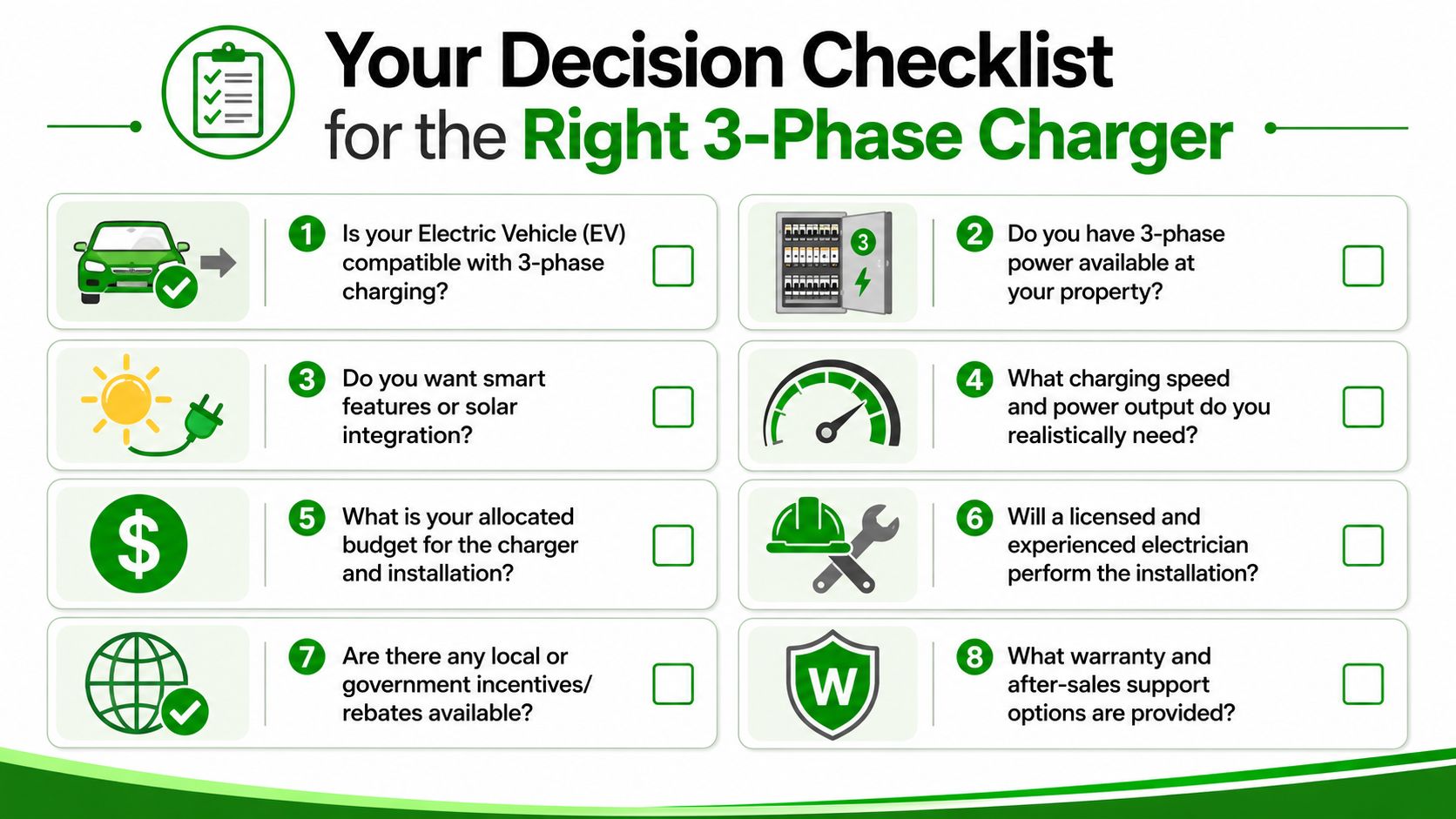
Ask these before you compare models
How fast do I really need the car charged?
If the car is parked overnight and comfortably refilled by morning, extra charging power may deliver no practical benefit.Does the property already have 3-phase supply?
If not, the charger conversation can quickly turn into a much larger electrical job.What AC charging limit does my EV have?
A charger cannot force the car to accept more AC power than its onboard charger allows.Do I want to use excess solar instead of grid power?
If yes, solar response and load control matter more than headline kW.What else is running on site at the same time?
Ducted air, pool equipment, workshop loads, commercial refrigeration, and other fixed loads all affect charger sizing.Will the charger be used by one driver or several?
Shared access often means RFID control, app management, billing, or usage reporting become worthwhile.
Match the charger to the use case
The simplest way to cut through the marketing is to match the charger to the site.
| If this sounds like you | The better direction is usually |
|---|---|
| One EV, overnight charging, standard household driving | Single-phase charger or entry-level smart charger |
| Home with 3-phase supply, solar, and short turnaround times between trips | Smart 3-phase charger with load management |
| Workplace, depot, or business with staff and visitor charging | Managed 3-phase destination charging |
| Shared parking or multiple authorised users | Networked commercial charger with access control |
A higher kW rating does not automatically make a charger the better buy. If the property cannot spare the capacity, or the car cannot use the available AC output, the extra capability stays on paper.
Questions to put to your installer
A good installer should be able to answer these clearly, without falling back on brand talk:
- Can this site support the charger without causing nuisance tripping or load issues?
- Will my EV use the charger's available AC capacity, or will part of it be wasted?
- Do I need dynamic load management based on the rest of the property demand?
- Will the charger integrate properly with my solar and tariff setup?
- Is a tethered or untethered unit better for the way the car is parked?
- Who handles faults, warranty support, and software issues after installation?
The better answer is often a charger that is sized properly, configured properly, and easy to live with.
My practical view
For businesses, 3-phase charging is often easier to justify. Time on site is tighter, usage is less predictable, and the charger may support staff, customers, or fleet vehicles during business hours.
For homes, the case is narrower. It makes sense where the property already has 3-phase available, the EV can take advantage of it, and the household has a real need for faster AC charging between trips. If that is not your situation, a simpler charger usually gives better value and fewer complications over time.
If you want a charger recommendation based on your switchboard, your EV, and the way you drive, Interactive Solar can assess the site and specify a charger setup that fits the property instead of just selling the highest-rated unit.
Make Interactive Solar a preferred source in Google
One click tells Google to surface our articles more often in Top Stories, AI Overviews and AI Mode.