Solar Panel Efficiency Comparison: 2026 Guide for NSW
Last updated:
You're probably looking at two panel spec sheets that both sound impressive, both use the word “premium”, and both claim high efficiency. On paper, the choice can look simple. Pick the panel with the bigger number and move on.
In Sydney, it's rarely that simple.
A good solar panel efficiency comparison has to answer a more practical question. Which panel will produce the most useful energy on your roof, in your conditions, over the long term? For many NSW homes and businesses, the limiting factor isn't whether solar works. It's how much generation you can squeeze from a roof with mixed orientation, some shade, limited area, and very hot summer conditions.
That's why panel selection has changed. The old approach was often about getting the most watts at the lowest upfront hardware cost. The better approach today is to compare watts per square metre, heat behaviour, and whole-system fit.
| Comparison factor | What to check | Why it matters in Sydney and NSW |
|---|---|---|
| Module efficiency | Mainstream panels are commonly 19%–22%, while premium models reach about 23% in one independent comparison set, and leading residential modules are listed in the 23.8%–25.0% range in another Australian-focused review, depending on product class and source (SolarInsure, Clean Energy Reviews) | Higher efficiency helps fit more generation on constrained roofs |
| Temperature behaviour | Look beyond STC figures and check the temperature coefficient | Hot roofs can change which panel performs best across summer |
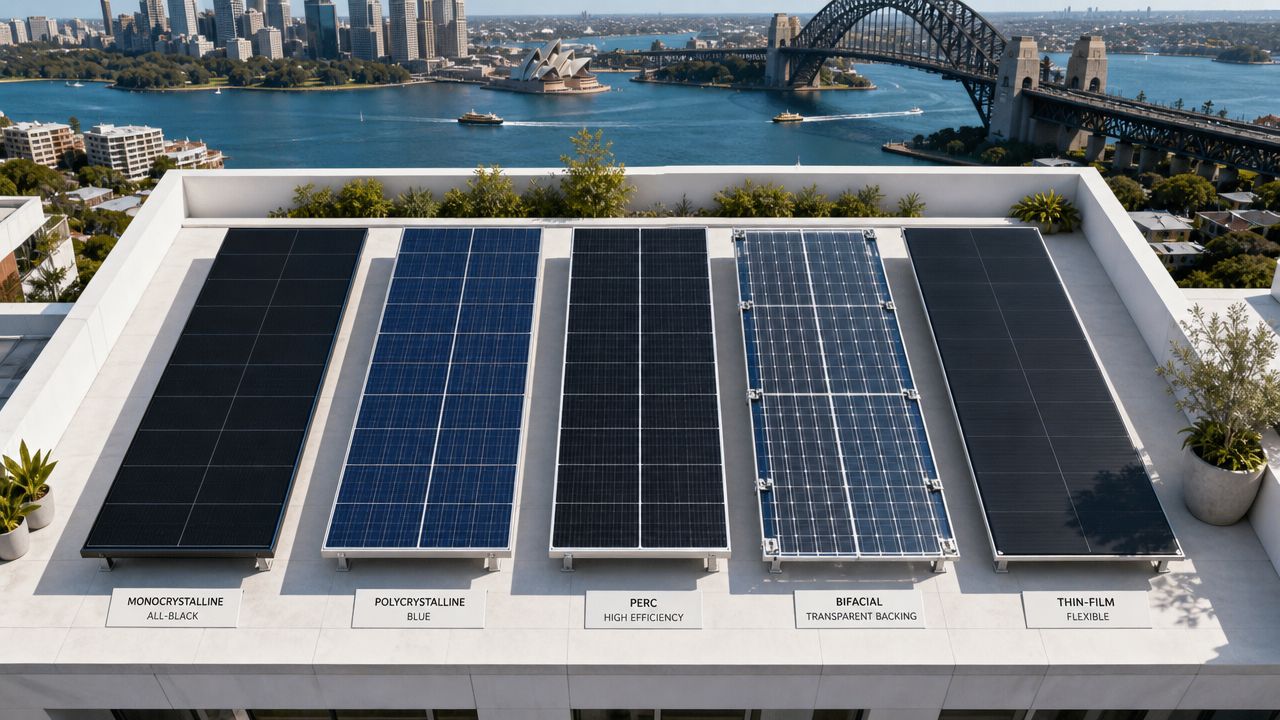
| Panel technology | Mono-PERC, TOPCon, HJT, bifacial, thin-film | Different technologies handle heat, roof space, and site design differently |
| Roof-space impact | A 1 percentage-point efficiency gain can reduce roof area needed by roughly 4%–5% (SolarInsure) | Important for terraces, duplexes, and busy suburban rooftops |
| Installed output, not brochure output | Ask what the system is likely to produce on your site | Real energy yield matters more than laboratory marketing |
Choosing Panels Beyond the Brochure
Ten years ago, many households were deciding whether to install solar at all. Today, most buyers are making a more refined decision. They want to know which module will make the best use of their roof, support future battery charging, and keep delivering strong output through NSW summers.
That shift matters because panel efficiency has moved a long way. Solar technology improved from roughly 15% efficiency in 2010 to 19%–22% for today's mainstream panels, according to SolarReviews' look at how panel efficiency has changed over time. That's not just a spec-sheet story. It means a modern array can generate substantially more electricity from the same roof area than an older system.
Why the buying decision is more nuanced now
On a large, simple roof, you've got room to be flexible. On a typical Sydney roof, you often don't.
Skylights, vent pipes, split-system units, setbacks, neighbouring structures, and awkward roof geometry all compete for space. In those cases, panel efficiency becomes a design constraint, not a vanity metric. The better the panel uses each square metre, the more generation you can fit without forcing a compromised layout.
There's another layer to this. Buyers often compare brands first. Installers usually compare module class, heat behaviour, dimensions, warranty support, and electrical fit before brand becomes decisive. A strong brand with the wrong panel for the site can still be the wrong choice.
Practical rule: Start your solar panel efficiency comparison with your roof, not the logo on the front of the module.
What works and what doesn't
What works is matching the panel to the site and system goals. That means checking orientation, daytime usage, likely summer roof temperature, and whether battery readiness matters.
What doesn't work is assuming that every high-watt panel is automatically a high-value panel. It also doesn't work to spend heavily on premium hardware and then ignore workmanship. Array layout, cable routing, inverter pairing, and installation standards all affect the result. That's why the quality of the solar installation itself matters just as much as advanced hardware.
Why Nameplate Efficiency Is Not the Whole Story
The biggest mistake I see in a solar panel efficiency comparison is treating the brochure figure as the final answer. It isn't. It's only the starting point.
Panel efficiency is usually quoted under Standard Test Conditions, which rate modules at 25°C. That sounds tidy and scientific. A Sydney roof in summer is neither tidy nor cool.
The lab number versus the roof number
On a hot Sydney summer roof, panel temperature can reach 60°C or more, and a typical crystalline silicon panel can lose 0.3%–0.5% of its efficiency for every 1°C above 25°C, according to 8MSolar's explanation of solar panel efficiency versus temperature. In that scenario, real-world output can drop by around 10%–15% when you need it most.
That changes how panels should be compared. If two modules sit close together on headline efficiency, the one with better heat behaviour may be the better annual performer on an exposed NSW roof.
Why this matters in daily use
Most households don't feel panel performance as an abstract percentage. They feel it in practical ways:
- Summer air conditioning demand: Hot days are often the days when the home needs the most electricity.
- Battery charging window: If you plan to add storage, stronger daytime production helps the battery charge more consistently.
- Business daytime loads: Offices, workshops, and retail sites often use power hardest during the very conditions that heat panels up.
A panel that looks outstanding at 25°C can be less impressive once it spends summer mounted above dark roof tiles in full western sun.
Other real-world losses buyers overlook
Heat isn't the only reason a brochure can mislead. Actual output also depends on:
- Roof orientation: North-facing roof sections usually behave differently from east or west strings.
- Partial shade: Even small amounts of recurring shade can change annual yield.
- Soiling: Dust, bird droppings, leaf matter, and traffic grime all chip away at performance.
- Array design: String lengths, inverter compatibility, and panel placement matter.
A lot of homeowners clean their gutters more often than they think about panel surface condition. That's understandable, but it does affect production over time. If your roof is exposed to dust, leaf litter, or heavy bird activity, proper solar panel cleaning and maintenance habits are worth factoring into expected output.
A Practical Comparison of Solar Panel Technologies
A common Sydney scenario looks like this. The owner wants enough solar to cover daytime air conditioning, the roof has a few awkward planes, and there is no room to waste on low-output panels. In that situation, panel technology changes the result in a very practical way. It affects how many kilowatt-hours the system will produce from the roof area you have, especially once summer heat is part of the equation.
Early in a quote comparison, I sort panels by technology before brand. That usually clears out a lot of brochure noise and makes it easier to see which products are suited to limited roof space, hot roof surfaces, or a commercial building with better mounting height and airflow.
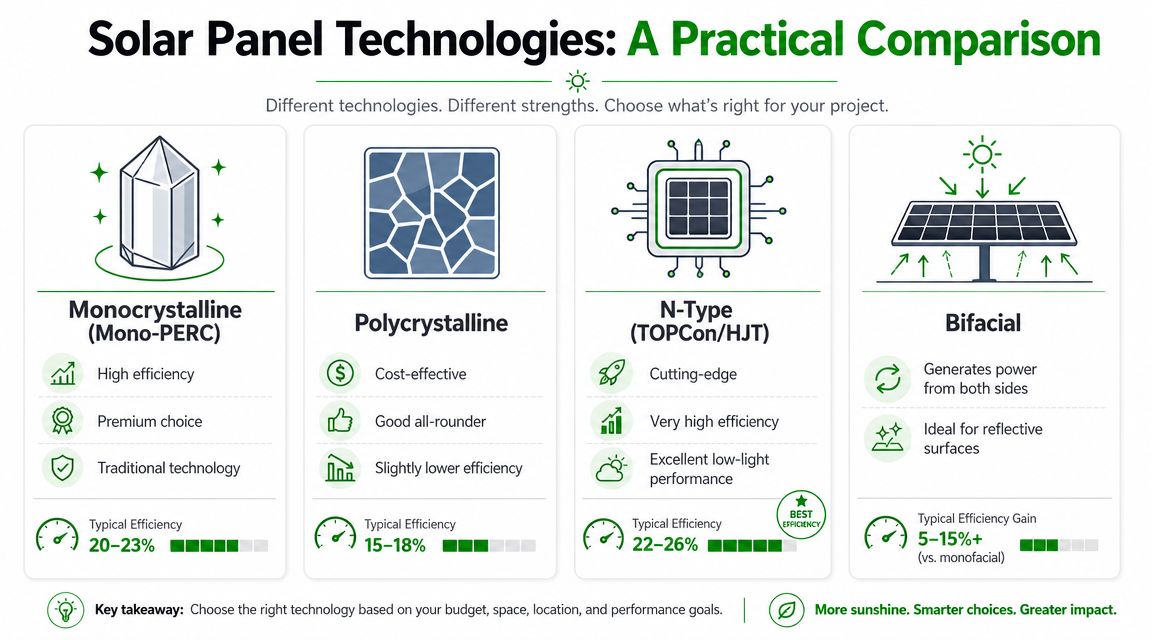
Technology comparison table
| Panel technology | Practical efficiency position | Heat performance | Best fit | Watch-outs |
|---|---|---|---|---|
| Monocrystalline Mono-PERC | Mainstream choice for residential installs | Good baseline performance, but older designs usually give away more output as roof temperature rises | Standard homes with decent roof area | Often loses ground to newer cell types on tight roofs |
| Polycrystalline | Older, lower-density option | Modest performer in modern comparisons | Large roofs where panel count is less constrained | Hard to justify where every square metre matters |
| N-type TOPCon | Higher-output category in the current market. The U.S. Department of Energy notes that TOPCon is now one of the main high-efficiency crystalline cell architectures in commercial production, alongside HJT and other advanced designs (DOE solar cell technology overview) | Commonly stronger than older PERC modules in hot conditions | Sydney homes and businesses trying to maximise annual kWh from limited roof space | Quality still depends on the manufacturer, frame, glass, and warranty support |
| HJT | Premium high-performance category | Strong thermal behaviour and good low-light response in the right product | Premium residential jobs and performance-focused commercial sites | Usually priced above mainstream options |
| Bifacial | Site-dependent rather than universally better | Can perform well where rear-side gain is available | Elevated commercial roofs, some ground-mounts, light-coloured or reflective surfaces | Often offers limited extra value on close-flush suburban roofs |
| Thin-film | Niche rooftop choice | Different performance profile and installation use case | Specific commercial or industrial applications | Rarely the first pick for maximising output on a Sydney house |
What usually works best in NSW
For a typical home in Sydney, the practical shortlist is usually Mono-PERC versus N-type TOPCon, with HJT entering the conversation on premium projects. Polycrystalline has largely fallen away because roof area in metropolitan installs is too valuable. Bifacial can be excellent, but only when the mounting setup lets the back of the panel do useful work.
The core trade-off is simple. If roof space is generous and the budget is tight, a standard monocrystalline panel can still make sense. If the roof is chopped up by hips, skylights, vents, or setbacks, higher-output N-type panels often earn their keep because they produce more usable capacity from the same footprint and tend to hold onto production better in hot weather.
That is why I pay attention to products such as high-performance JA Solar when a client needs stronger output density without jumping straight to the highest-priced module on the market.
Bifacial panels need a more careful conversation. On a commercial roof with spacing under the panels, pale membrane roofing, or raised framing, they can add worthwhile generation. On a standard suburban tile roof with panels mounted close to the surface, the rear-side gain is often too limited to drive the decision. This guide to bifacial solar panels in real installations is useful if that option is on the table.
Later in the decision, it helps to hear the terminology explained visually before comparing quotes.
Evaluating Panels with Real-World Performance Metrics
A proper solar panel efficiency comparison doesn't end at technology type. Once you've narrowed the field, the next step is reading the metrics that directly affect yearly production.
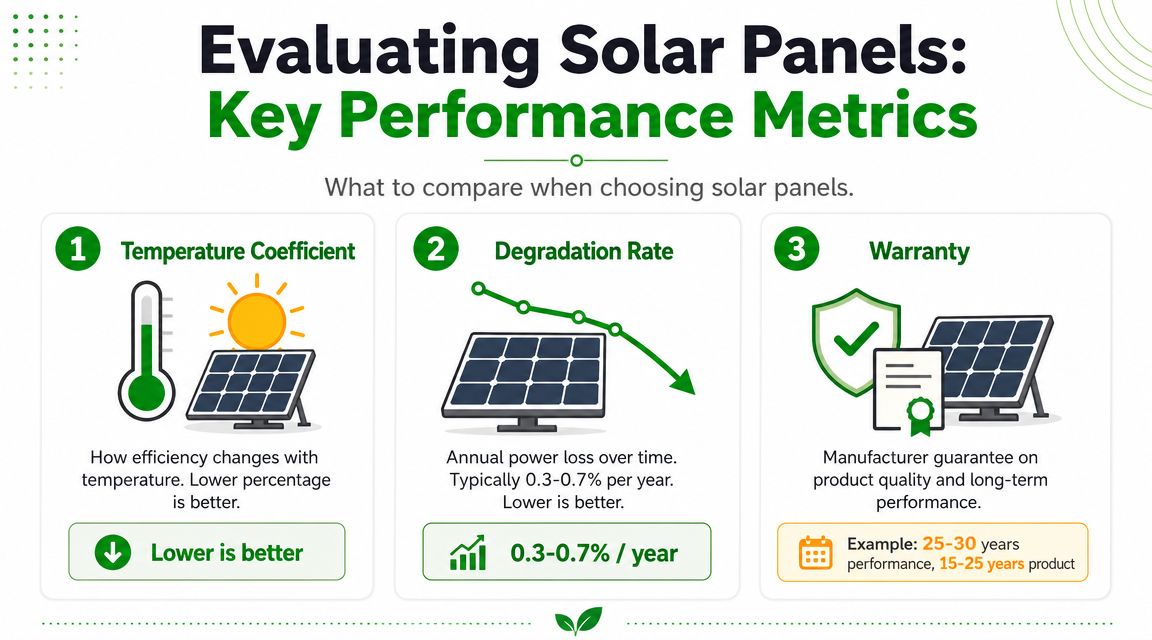
The three that matter most in real projects are temperature coefficient, degradation behaviour, and warranty support. Not because they sound technical, but because they tell you how the panel is likely to behave after installation rather than in a sales brochure.
Temperature coefficient
This is the first figure I'd check for a Sydney or Western Sydney roof. Real-world crystalline silicon systems often operate at around 15%–20% efficiency after site conditions are factored in, and temperature losses of roughly 0.3%–0.5% per degree Celsius above 25°C make this spec critical during NSW summer conditions, as outlined in these IEA-based panel efficiency benchmarks.
A lower temperature-related loss generally means the panel gives away less output when the roof heats up. That can matter more over a year than a tiny edge in brochure efficiency.
Degradation and warranty
Degradation tells you how well the panel is expected to hold performance as the years pass. Warranty tells you how much confidence the manufacturer is willing to put behind that claim.
I wouldn't read warranty length in isolation. A long warranty attached to weak local support, poor documentation, or uncertain importer backup isn't as reassuring as many buyers assume. What matters is whether the brand has a credible support path in Australia and whether the installer can still help if there's a problem later.
Installer view: The best panel on paper is the one that still performs well in heat, is backed properly, and suits the inverter and roof layout from day one.
Performance ratio and system monitoring
The panel is only one contributor to system output. Inverter clipping, shading patterns, string design, and operational faults all affect what the household sees. That's why ongoing monitoring matters. If you want to track whether the array is behaving as designed, it helps to understand how inverter remote monitoring supports solar efficiency over time.
If you're comparing brands in the premium mainstream category, a practical reference point is to look at detailed product reviews rather than just headline brochure claims. This overview of high-performance JA Solar is a good example of the kind of comparison material worth reading.
Modelling Solar Output for a Sydney Home
Consider a common scenario. A household in Western Sydney has a decent north-facing roof section, but not a huge one. There's enough area for a well-sized system, though not enough to waste space on underperforming modules. The family wants strong daytime coverage now and the option to add battery storage later.
In that situation, the panel decision shouldn't be framed as “standard versus premium” in a vague sense. It should be framed as which panel gives the best usable annual production from the available roof area.
A practical way to model it
Start with system size, roof geometry, orientation, and daytime consumption. Then compare two panel paths:
- A mainstream panel option that uses roof area adequately.
- A higher-efficiency option that fits more capacity or better heat resilience into the same footprint.
What often happens in Sydney is that the premium panel doesn't just improve the spec sheet. It improves the design flexibility. You may fit the target system size without spilling onto a less favourable roof face. You may also preserve cleaner string design and leave room for future additions.
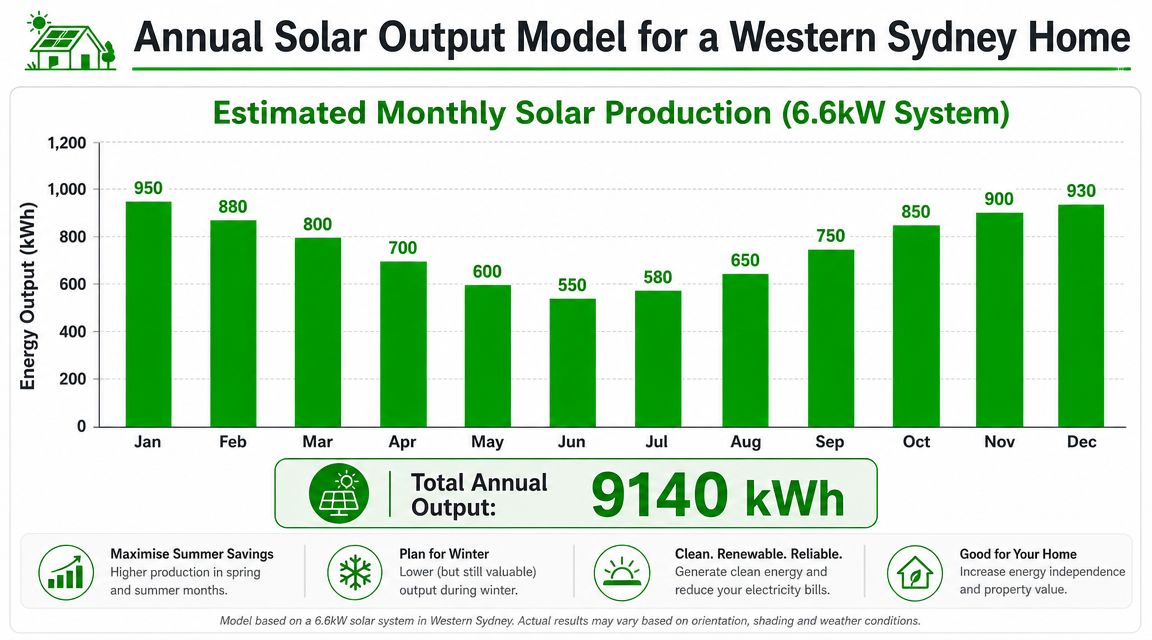
The seasonal production pattern below helps illustrate how output shifts over the year for a typical 6.6kW system in Western Sydney.
What the model shows in practice
The biggest lesson from a site model isn't usually the annual total by itself. It's where the production sits during the parts of the year when the property needs it.
For a Sydney home, a stronger panel choice can improve outcomes in several ways:
- Better use of limited north-facing roof area: More of the available roof contributes meaningful generation.
- Stronger summer resilience: If the module handles heat better, the system can hold more output during high-demand periods.
- Simpler upgrade path: Future battery integration is easier when the array is already extracting good production from the best roof space.
- Less compromise in layout: You're less likely to spread onto awkward roof sections just to hit a target capacity.
A good output model doesn't ask, “Which panel is best in general?” It asks, “Which panel works best on this roof, with this consumption pattern?”
For businesses, the same logic applies. If the building has broad roof space, the most efficient module may not be essential. If the roof is cluttered with services, plant, or access constraints, higher output density becomes much more valuable.
Matching Panels to Your Property and Goals
Two Sydney properties can have the same system size on paper and deliver different value over time. The gap usually comes from roof shape, summer heat, daytime usage, and how much good roof area is available.
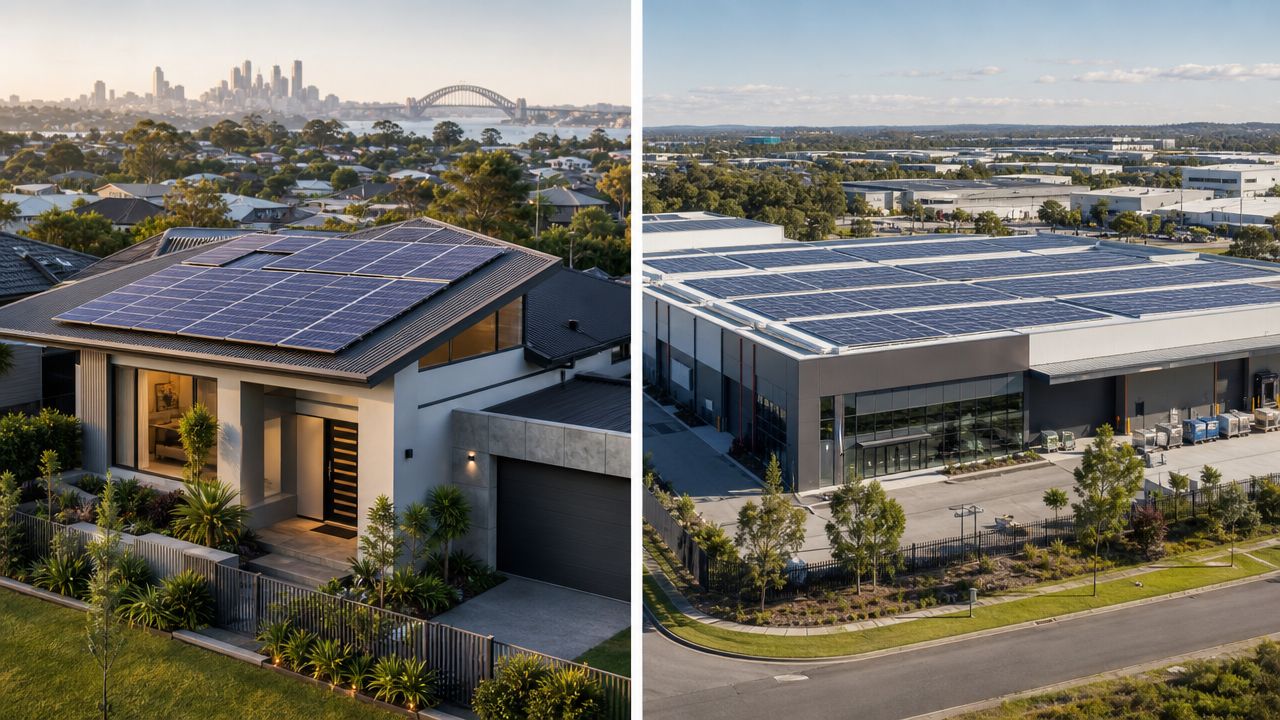
Small urban roof with tight usable space
On a compact roof in Sydney, panel choice has a direct effect on annual kWh because every square metre has to work hard. If chimneys, skylights, parapets, and setback rules cut down the usable area, higher-efficiency modules usually justify their extra cost.
I do not judge that choice by the brochure rating alone. I look at how the panel holds output on hot afternoons, because that is when NSW roofs often lose performance. The Clean Energy Council's approved products list is a good starting point for narrowing the field to panels that are certified for the Australian market. From there, the real comparison is build quality, warranty support, temperature coefficient, and how much generation the module can deliver from the best roof faces over a Sydney year.
On a constrained roof, a premium panel often wins because it gets more useful production from the limited north, north-west, or west-facing space you have.
Large roof with minimal shading
A broad roof changes the economics.
If there is plenty of clear space and a simple layout, the best value panel is often a proven mid-to-premium option rather than the most efficient module available. The reason is straightforward. Once roof area stops being the bottleneck, the return from paying extra for each percentage point of efficiency can shrink.
That said, lower price should not be the deciding factor by itself. A cheaper panel with weaker heat performance can give back some of that upfront saving through lower summer output. For homes in western Sydney or commercial sheds that run hot, I would still favour a panel with solid temperature behaviour and a manufacturer with a track record of local support.
Commercial site with daytime loads
Commercial systems are usually judged on daytime energy offset, not just annual production. That shifts the panel decision toward predictable output in hot operating conditions and reliable long-term support.
For warehouses, schools, offices, and workshops, I would prioritise:
- Stable performance in heat: Rooftop temperatures on commercial buildings can get punishing, and weaker modules lose more output when the roof is hottest.
- Output per usable section: Plant equipment, access paths, and fire compliance zones can cut the available area faster than many owners expect.
- Service and warranty responsiveness: Downtime matters more on a business site with a larger power bill and more stakeholders.
- Compatibility with staged upgrades: Many sites add storage, load controls, or EV charging later, so panel choice should support that plan cleanly.
Homes planning for batteries or EV charging
If a household expects to add a battery or an EV charger later, I usually recommend building a stronger solar base from day one, especially if the prime roof space is limited. That does not always mean buying the top panel on the market. It means choosing modules that make good use of the best roof area and keep producing well through Sydney heat, so there is more solar available for future self-consumption.
That matters even more if afternoon charging is part of the plan. A panel that holds output better in high temperatures can contribute more usable energy during the hours when cars come home and cooling loads are still running. Households comparing future storage options should also look at how solar production and battery sizing work together in this battery comparison guide for Australian homes.
The right panel is the one that fits the roof, the load, and the upgrade path. For some properties, that points to maximum output density. For others, it points to lower cost per installed watt with dependable real-world performance.
How Panel Choice Impacts Your Entire Solar System
Panels don't operate alone. They set the tone for the rest of the system.
Choose a lower-performing panel on a constrained roof, and you may need more modules than the roof comfortably allows. Choose a better panel for the same roof, and you can preserve layout quality, improve daytime production, and give the inverter and any future battery more useful energy to work with.
Inverter pairing and string design
High-efficiency panels can simplify design. If the array produces more from the best roof sections, the installer may avoid pushing extra panels onto poorer orientations just to reach a target capacity. That often helps with cleaner stringing, better inverter matching, and a tidier installation overall.
The inverter also needs to be chosen with the array behaviour in mind. A panel's operating characteristics, roof orientation mix, and expected daytime load all affect what “good pairing” looks like.
Battery performance and self-consumption
If you plan to add storage, panel choice has flow-on effects. A stronger array can help the battery fill more consistently through shorter winter days and support heavier daytime self-consumption through summer.
That's one reason battery planning shouldn't be treated as a separate conversation that happens years later. Even if the battery isn't going in on day one, it helps to understand how battery sizing and comparison decisions interact with solar system design.
Long-term value versus short-term simplification
The cheapest panel can still be the right panel on some properties. But on many Sydney roofs, panel choice affects too many other parts of the system to reduce the decision to one line on a quote.
The better question is this: does the panel help the whole system perform well in the conditions your property sees?
That's the standard I'd use for any solar panel efficiency comparison. Not the most impressive brochure. Not the loudest brand marketing. The panel that delivers the most useful energy, from the roof space you have, in the heat and operating conditions NSW properties deal with every year.
If you want a system designed around real roof constraints, future battery readiness, and dependable long-term output, talk to Interactive Solar. Their team can assess your roof layout, energy usage, and expansion plans, then recommend a solar solution that's engineered for practical performance rather than brochure hype.
Make Interactive Solar a preferred source in Google
One click tells Google to surface our articles more often in Top Stories, AI Overviews and AI Mode.