Best EV Car Chargers: A 2026 Buyer’s Guide for NSW
Last updated:
Your EV arrives. The keys are exciting. The charger decision usually isn't.
Most NSW buyers start the same way. They search for the best EV car chargers, open a few comparison lists, and get hit with a wall of terms: 7 kW, 22 kW, single-phase, three-phase, tethered, OCPP, dynamic load management. The result is predictable. People either overbuy a charger their home can't properly use, or they buy the cheapest wallbox and only later realise it doesn't work well with solar, tariffs, or a future second EV.
The practical answer is simpler than most roundups make it sound. The best charger isn't the one with the biggest number on the box. It's the one that matches your switchboard, your vehicle, your parking habits, and your solar setup so the installation performs well after the electrician leaves.
A lot of broad product reviews miss that installation reality. If you want another perspective on home Level 2 options, Jolt Electric's expert EV charger guide is a useful companion read. For common homeowner questions around solar, batteries and charging, the Interactive Solar FAQ library is also worth bookmarking before you commit to hardware.
| Use case | Usually the best fit | Why it works |
|---|---|---|
| Standard NSW home with one EV | 7 kW smart AC charger | Suits common single-phase homes, works well for overnight charging |
| Home with solar | 7 kW to 11 kW charger with solar integration | Better at soaking up daytime surplus and reducing grid imports |
| Home with constrained switchboard | Load-managed smart charger | Helps avoid overloading the home and may reduce upgrade pressure |
| Business car park or workplace | Multiple AC chargers with scheduling/load balancing | Better matched to longer parking times |
| Highway or rapid turnover site | DC fast charger | Better for short dwell times and quick top-ups |
Choosing Your First EV Charger Can Be Confusing
A typical buyer starts by assuming faster must be better. They see a 22 kW charger online and compare it to a 7 kW wallbox, then conclude the bigger unit is the obvious choice. In many NSW homes, that's where the confusion starts.
Most houses don't charge cars in a laboratory setting. They charge overnight, they share power with ovens, air conditioning and hot water, and many now have rooftop solar in the mix. That means the charger's brochure figure often matters less than the installation outcome. A higher-kW charger doesn't automatically mean shorter charging times if the property has single-phase supply or limited switchboard capacity, and many Australian guides still fail to answer that properly, as discussed in this analysis of charger selection and installation outcomes.
The part most roundups skip
The shortlist shouldn't begin with brand. It should begin with the site.
Ask these questions first:
- What electrical supply do you have: Single-phase and three-phase homes have very different charger options.
- When is the car parked: Overnight at home, all day at work, or only for short stops?
- Do you already have solar: If yes, the right charger can help use more of your own generation.
- Will you add another EV later: Expansion matters more than many first-time buyers expect.
The best EV car chargers in real homes are chosen around electrical limits, not marketing claims.
That's why the right charger often looks less glamorous on paper than the wrong one. A smart 7 kW unit with load management and solar control can deliver a better ownership experience than a larger unmanaged charger that forces unnecessary compromises.
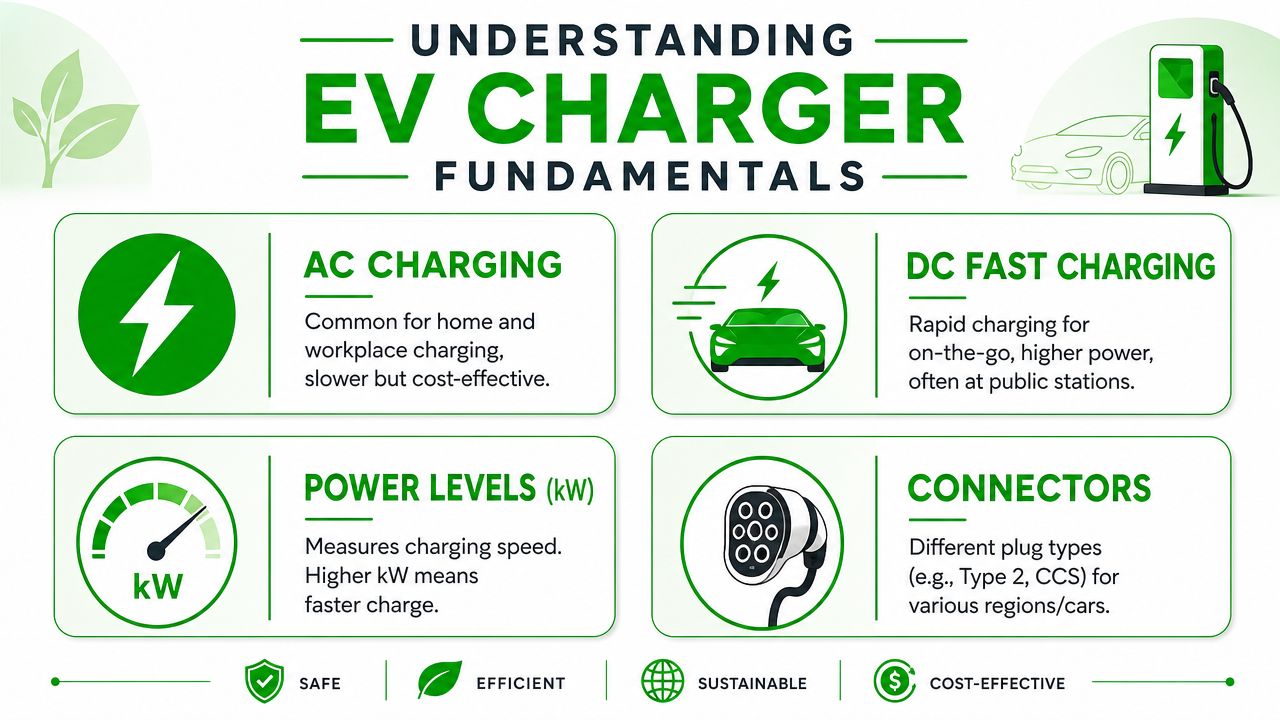
Understanding EV Charger Fundamentals
Before comparing specific models, get the basics right. Once you understand a few core terms, charger shopping becomes much easier and a lot less sales-driven.
AC and DC charging
For most homes and workplaces, AC charging is the standard. The charger on the wall supplies AC power, and the vehicle converts it for battery charging. In Australia, home charging remains the dominant use case, and the best options usually sit in the 7 kW to 11 kW range with load management and solar integration because that matches typical household electrical capacity and rooftop solar adoption, as noted in IRENA's EV charging landscape overview.
DC fast charging is different. It's built for public rapid charging and fleet-style use where dwell time is short and site power is much heavier.
Single-phase and three-phase
This is often the primary decision-maker in NSW homes.
A lot of houses are single-phase, which makes a 7 kW charger a practical fit. Some properties have three-phase supply, which opens the door to higher AC charging rates if the vehicle can accept them and the switchboard has capacity. But having a three-phase-capable charger doesn't guarantee three-phase performance. The property and the car both have to support it.
Tethered and untethered
This one is about convenience and appearance.
- Tethered charger: The cable is attached to the unit. It's quick to use and great for daily charging.
- Untethered charger: The charger has a socket, and you bring your own cable. It can look neater and may suit mixed vehicle use or some strata settings.
Neither is universally better. Households usually prefer tethered for convenience. Shared sites often lean untethered for flexibility.
Connectors and compatibility
In practical terms, buyers in Australia mainly care about Type 2 for AC charging and CCS2 for DC fast charging. For modern EVs, charger and vehicle compatibility is usually straightforward as long as you're buying from a reputable supplier and installer.
Practical rule: Choose the charger around your electrical supply first, your car second, and the product brand third.
If you're still comparing options, the Interactive Solar EV charger page gives a useful overview of home and business charging setups without turning the decision into a spec-sheet contest.
The Critical Features Most Buyers Overlook
A charger's headline kW rating gets all the attention. The features that save money usually sit further down the spec sheet.
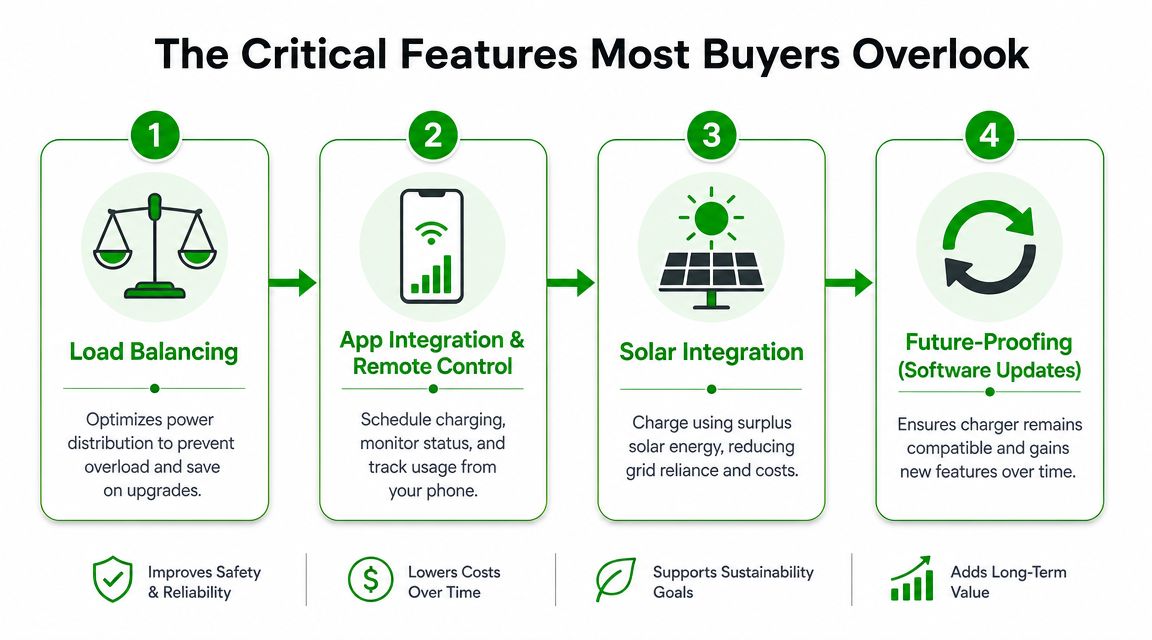
That's why many of the best EV car chargers aren't only the fastest ones. They're the models that control when the car charges, how much power it draws, and whether it can respond to what the rest of the house is doing in real time.
Dynamic load management
For Australian homes, a 7 kW single-phase AC wallbox is the practical benchmark. Over an 8-hour overnight window, it can add about 56 kWh of energy, according to ChargePoint's guide to choosing a home EV charger. That's more than enough for many daily driving patterns.
The catch is that charging performance in a real house depends on what else is running. Dynamic load management solves that by adjusting charging output to stay within the site's available capacity. If the oven, ducted air or pool equipment kicks in, the charger can back off rather than pushing the switchboard beyond a comfortable operating point.
That's not a luxury feature. In many homes, it's what makes the installation sensible.
Solar integration
If you already have rooftop solar, this feature deserves more attention than charger power.
A solar-aware charger can do things a basic wallbox can't:
- Use surplus generation: Charge when the roof is producing more than the home is consuming.
- Reduce peak imports: Shift charging away from expensive evening periods where possible.
- Support better self-consumption: Turn excess solar into kilometres instead of sending it away.
For NSW households, that's often where the primary value lies. A charger that aligns with solar production will usually outperform a higher-powered unit that just starts pulling from the grid whenever it's plugged in.
App control and scheduling
Smart app control sounds cosmetic until you use it.
Being able to schedule charging around tariffs, monitor sessions, and change current limits matters in everyday life. It also makes troubleshooting easier. If charging doesn't behave as expected, you can usually tell whether the issue is timing, vehicle settings, or site capacity without guesswork.
If you want a broader look at how monitoring improves system performance, the same logic applies across energy assets. The guide to inverter remote monitoring is a good example of why visibility matters just as much as hardware.
Software support matters more than most buyers think
A charger is no longer just electrical hardware. It's also software.
That means updates, integrations, app stability and support quality all affect the long-term value of the unit. A basic charger may still work fine, but if your goal is lower bills, solar coordination, and easier expansion later, software support isn't optional.
Buy the charger that manages power well. Don't just buy the one that advertises the highest power.
Matching a Charger to Your Australian Use Case
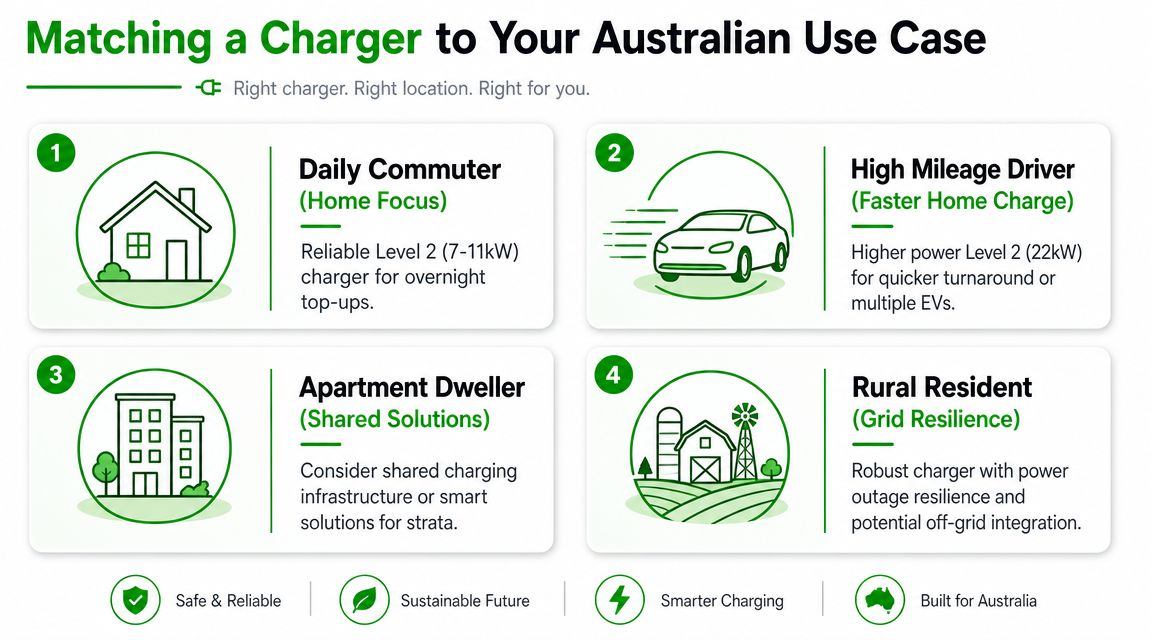
There isn't one best EV charger. There's the best fit for the way the site is used.
Homeowner with one EV
For a typical NSW commuter, a 7 kW smart AC charger is often the sweet spot. It suits common residential electrical setups, supports overnight top-ups, and can work well with tariff scheduling or solar charging if the unit is chosen properly.
If the home has solar, the decision shifts even more strongly toward a charger with good control software and surplus-solar modes. The best installation isn't always the one that delivers the highest charging speed. It's the one that automatically does most of the charging at the right times.
Household with high driving demand or more than one EV
People often begin looking at 11 kW or 22 kW options. Sometimes that's justified. Sometimes it isn't.
A larger charger can make sense when:
- The property has suitable supply: Three-phase availability changes what's possible.
- Vehicles turn around quickly: One car arrives home and another leaves again soon after.
- Two EVs are likely: Planning ahead can avoid rework later.
But the bigger unit only earns its keep when the home and vehicles can make real use of it. Otherwise, a smart, expandable setup with proper load sharing is usually the better long-term decision.
Workplace, retail and destination charging
For offices, retail sites and similar locations, charger choice should follow parking duration. According to the US Department of Transportation EV charging speed guide, AC chargers typically deliver 10 to 20 miles of range per hour, while DC fast charging can bring a battery electric vehicle to 80% in about 20 minutes to 1 hour depending on vehicle and charger capability.
That's why workplaces usually get better value from AC installations. Cars sit for hours, so lower-power charging still matches user behaviour. Highway-adjacent or quick-turnover sites are different. They're where high-power DC equipment makes operational sense.
The right charger follows dwell time. Long parking suits AC. Short parking favours DC.
Apartment and strata properties
Strata jobs rarely succeed with a simple off-the-shelf mindset. Shared infrastructure, metering, permissions, cable pathways and future expansion all need to be considered from the start.
The strongest approach is usually a scalable system that supports central management, staged rollout and fair allocation of available site power. If the property also wants broader energy resilience, reviewing storage options alongside charging can help. A battery comparison guide for Australian properties is useful context when EV charging and on-site energy strategy start overlapping.
Navigating Installation and Compliance in NSW
Buying the charger is the easy part. Installing it properly is where the job is won or lost.
With Australia expanding charging access under the National EV Strategy, public infrastructure is improving, but it remains concentrated in metropolitan areas. For most households, that keeps professionally installed home charging at the centre of day-to-day EV ownership.
What a proper installation actually involves
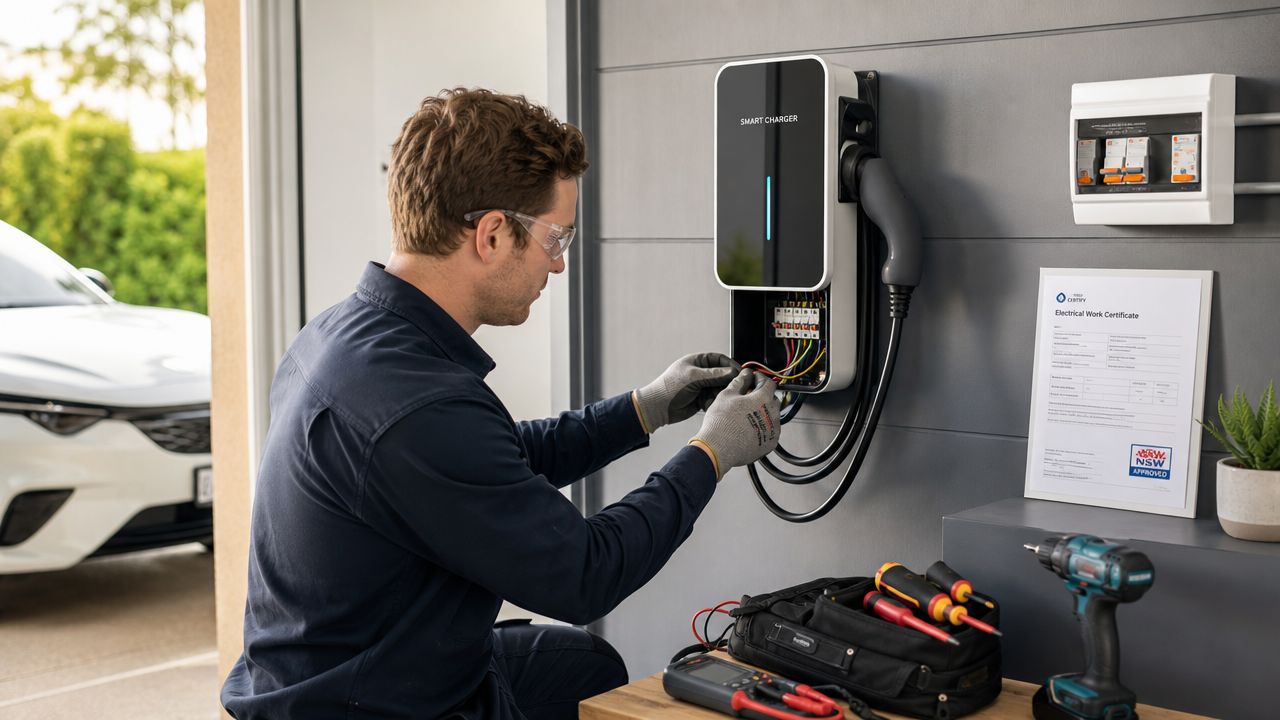
A sound installation starts with site assessment, not with drilling the charger onto the nearest wall.
An experienced electrician will usually look at:
- Switchboard capacity: Whether the home can support the charger as proposed
- Cable route: The safest and cleanest path from switchboard to charger location
- Protection hardware: Correct isolation and safety devices for the circuit
- Future use: Whether the setup should allow for a second EV or smarter controls later
This is also where load management can save a lot of pain. In homes with limited headroom, it may allow safe charging without forcing immediate electrical upgrades.
Safety and circuit protection
EV chargers are continuous electrical loads. That means circuit protection matters.
If you want a plain-English refresher on the role of protective devices, E & I Sales' circuit protection solutions provide a useful overview of how RCDs and circuit breakers fit into safe electrical design. The exact protection method should always be specified by a licensed electrician for the charger and site involved.
The broader consumer protection side matters too. If you're comparing installers, the New Energy Tech Consumer Code overview is worth reading so you know what good sales, system design and after-sales conduct should look like.
Here's a practical walkthrough of what a charger installation can involve on site:
When upgrades become necessary
Some homes need switchboard work. Some don't.
A good installer won't default to an upgrade just because the charger is high-powered. They'll first look at whether a lower charging current, smarter scheduling, or load management can achieve the same day-to-day result safely. That's often the difference between a charger that looks impressive on paper and one that suits the house.
Future-Proofing Your EV Charging Investment
The charger you install now should still make sense when your household changes.
That could mean a second EV, a battery, more solar, changing tariffs, or future energy features that rely on smarter communication between the charger, the home and the vehicle. Choosing from the best EV car chargers today means looking beyond immediate charging speed and asking how adaptable the system will be.
Think in stages, not snapshots
A charger is part of a broader energy system. If you expect another EV later, it helps to choose a unit or platform that supports expansion, load sharing and software-driven control rather than a dead-simple charger with no pathway forward.
This matters for resale and ownership value too. Vehicle values move for many reasons, and buyers increasingly look at the total running-cost picture around an EV, not just the badge on the bonnet. For context on the wider ownership discussion, Freedom Cars' article on electric car depreciation rates is a useful read. The charger won't determine resale on its own, but a well-set-up home charging environment can make EV ownership more practical and attractive over time.
What to prioritise for the long term
Focus on qualities that age well:
- Reliable software support: Updates and app stability matter more as systems become more connected.
- Scalability: One charger today might need to coordinate with another later.
- Solar and battery compatibility: Flexible integration keeps options open.
- Installer workmanship and warranty clarity: Long-term confidence starts with the original installation.
A future-proof charger isn't the most powerful unit available. It's the one that can still adapt when your household energy needs change.
Vehicle-to-home and vehicle-to-grid capability will shape more buying conversations over time. Even if you're not choosing around those functions today, installing a smart, properly designed charging system is the right first step.
Your Next Steps to Smarter EV Charging
The shortlist for the best EV car chargers gets much clearer once you stop chasing maximum kW and start assessing the property properly.
For most NSW buyers, the strongest result comes from matching the charger to the home's electrical reality, the vehicle's actual charging capability, and the way the household uses solar and grid energy through the day. That usually leads to a smart AC charger with the right controls, not the biggest possible wallbox.
If you're a homeowner, that means checking supply type, switchboard headroom, cable route, parking habits and whether solar integration will reduce imports. If you're a business or strata manager, it means thinking about dwell time, load balancing, user access and how the system expands later.
The main mistake is treating the charger like an appliance purchase. It's not. It's an electrical infrastructure decision, and the quality of the design matters just as much as the brand on the casing.
A customized recommendation will nearly always outperform a generic top-10 list because it's based on what your site can deliver safely and efficiently. That's where better charging experience and lower running costs usually come from.
If you want a charger recommendation based on your switchboard, solar setup, tariff structure and future plans, speak with Interactive Solar. A personalized assessment can help you choose a system that charges reliably now, works with your home, and stays useful as your energy needs evolve.
Make Interactive Solar a preferred source in Google
One click tells Google to surface our articles more often in Top Stories, AI Overviews and AI Mode.