Warehouse Solar Installation Sydney: Cost & Rebate Guide
Last updated:
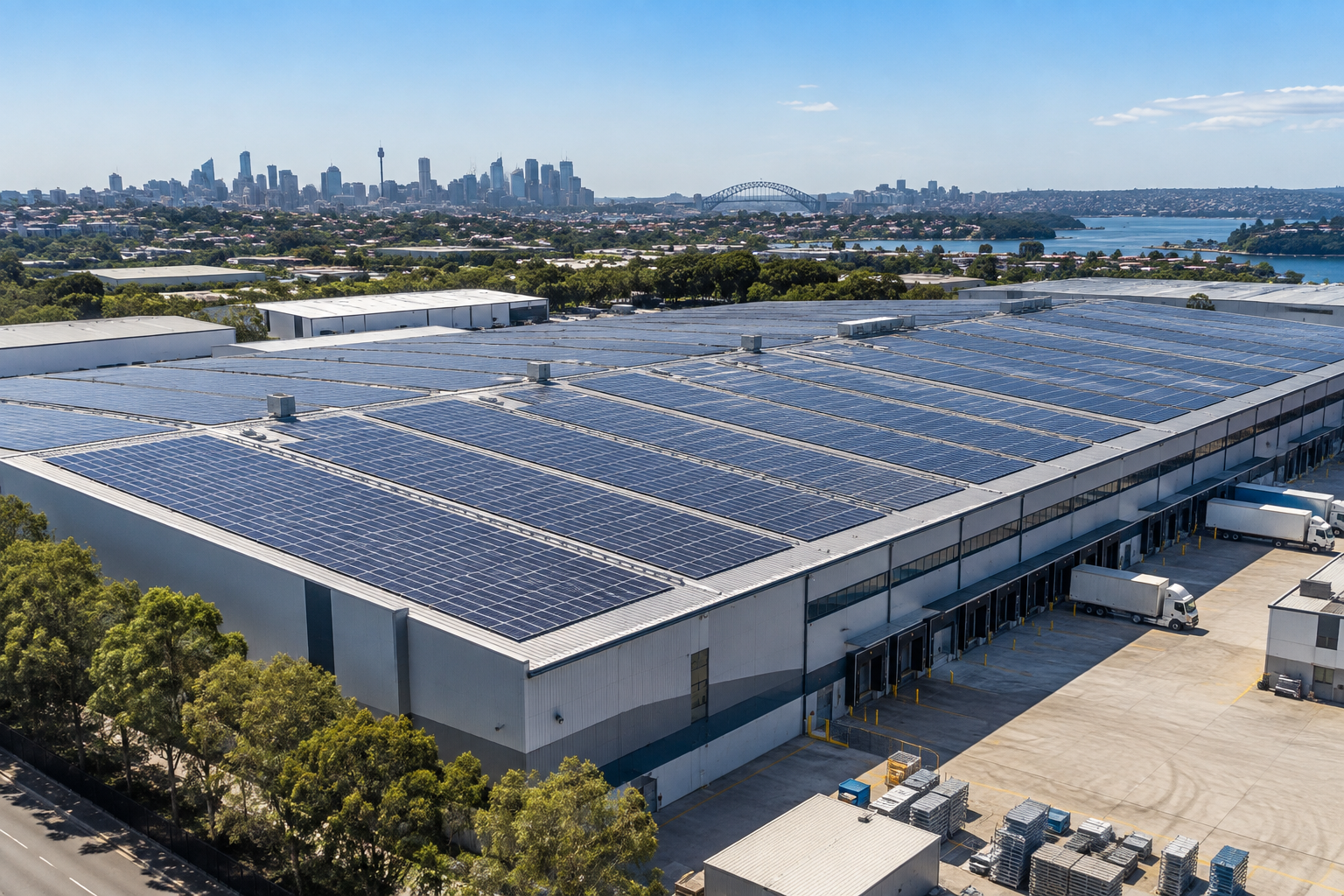
Warehouse solar installation sydney businesses choose as their first major energy infrastructure upgrade typically delivers a payback period of 3 to 5 years for a correctly sized system in 2026. A 30 kW to 100 kW rooftop array on a Sydney warehouse can cut annual electricity costs by $15,000 to $65,000, depending on load profile, tariff structure, and orientation. The key is precise system sizing matched to your actual consumption data, not a generic square-metre estimate.
This guide covers the 2026 technical specifications, rebate figures, financial modelling, compliance requirements, and step-by-step process for warehouse solar in Sydney, with worked examples across different warehouse sizes and usage patterns.
System Sizing by Warehouse Type
Warehouse solar installation sydney projects differ from residential or small commercial installs because the load profile and roof characteristics vary enormously between warehouse categories. Getting the size right is the single most important decision you will make.
The starting point is always 12 months of interval data from your electricity retailer. This shows your actual half-hourly consumption, which reveals when you use power, how much you use, and whether your peak demand exceeds what solar can realistically offset. Here is how sizing typically breaks down by warehouse category in 2026:
Distribution and Logistics Warehouses (5,000 to 20,000 sqm)
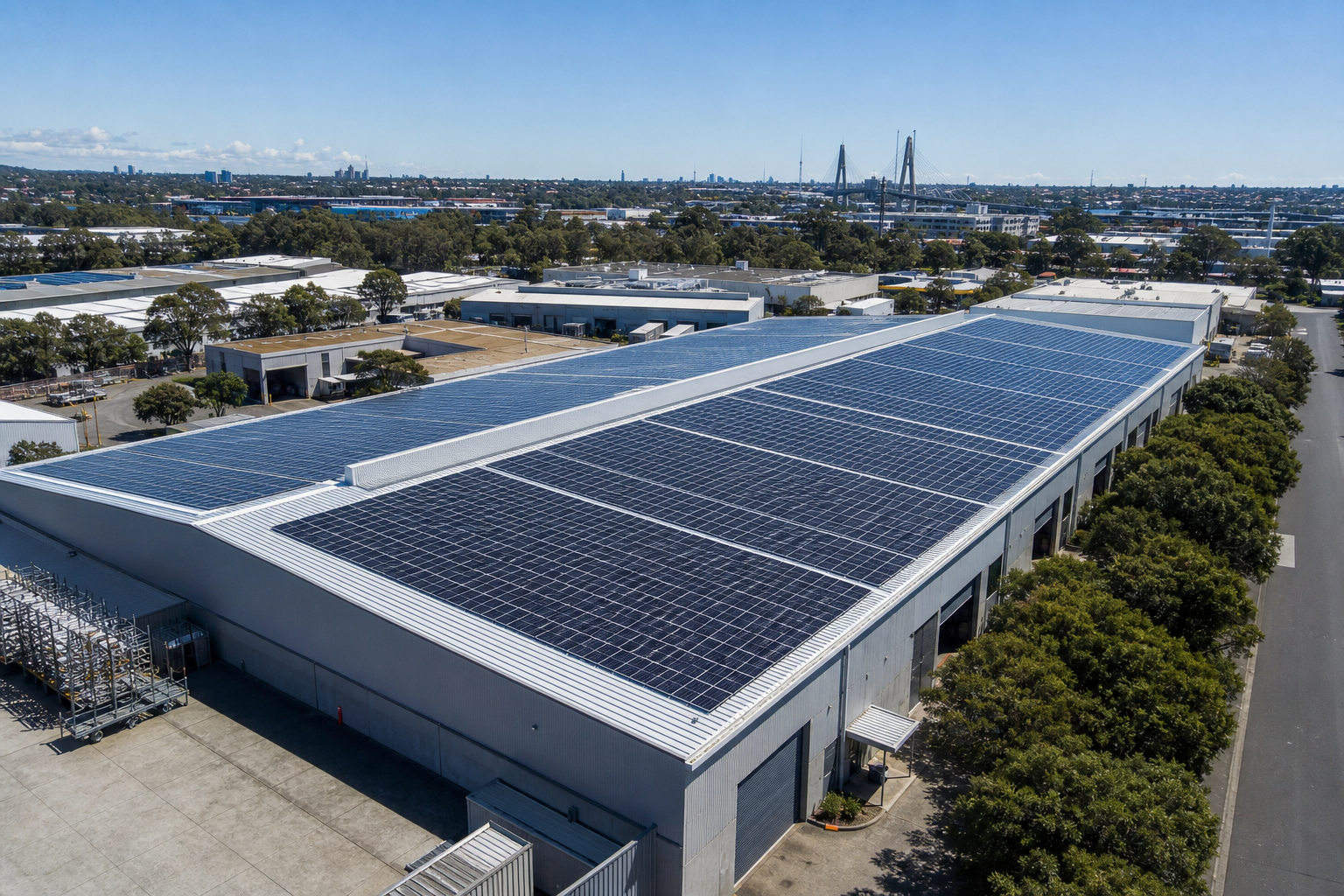
These sites run conveyor systems, dock levellers, extensive LED lighting, and fork trucks charging in shifts. Typical system size: 50 kW to 150 kW. A 75 kW system on a 10,000 sqm distribution warehouse in Western Sydney generates approximately 97,500 kWh per year (1,300 peak sun hours, Performance Ratio 0.80), offsetting around 35 to 45 per cent of total site consumption when demand is spread across operating hours.
Cold-Storage and Refrigerated Warehouses (1,000 to 8,000 sqm)
Refrigeration compressors run 24 hours. Solar can only offset daytime consumption, so the self-consumption rate is lower, typically 50 to 65 per cent of solar generation. System size: 30 kW to 100 kW. Battery storage is strongly recommended to capture excess midday generation and shift it to evening compressor loads. A 50 kW system paired with a 100 kWh battery in a refrigerated facility can push self-consumption above 80 per cent.
Manufacturing and Workshop Warehouses (500 to 5,000 sqm)
Heavy machinery, compressors, CNC equipment, and shift-based operations create variable but often high daytime demand. These warehouses typically achieve the highest self-consumption rates: 70 to 90 per cent when production runs align with solar hours. Recommended system size: 20 kW to 80 kW. Ausgrid and Endeavour Energy single-phase export limits (10 kW) mean three-phase connections are essential above 30 kW on the grid side.
Trade and Wholesale Showrooms with Storage (200 to 2,000 sqm)
Daytime-only operations, strong lighting loads, and HVAC make these ideal solar candidates with self-consumption rates of 75 to 95 per cent. System size: 10 kW to 40 kW. These smaller systems often achieve the fastest payback: 2.5 to 4 years is achievable in 2026 with current STC values and NSW tariff levels.
Warehouse Solar Installation Sydney: 2026 STC Rebate Breakdown
Warehouse solar installation sydney proposals must include an accurate 2026 Small-scale Technology Certificate (STC) calculation because it directly affects your upfront cost. The federal STC scheme runs until 2030 with annual deeming period reductions, and 2026 values differ from 2025 figures that many online calculators still display.
Here is how the 2026 STC calculation works for a Sydney warehouse, which sits in Zone 3 for solar irradiance purposes:
- Deeming period in 2026: 5 years (reduced from 6 in 2025, stepping down by 1 year annually toward 2030)
- Zone 3 STC multiplier for Sydney: 1.382 (per the Clean Energy Regulator’s postcode zone table)
- STC spot price (mid-2026): approximately $36 to $38 per certificate on the open market
- Formula: System kW x Zone multiplier x Deeming years = STCs generated
Worked STC Examples for Common Warehouse System Sizes
| System Size | STCs Generated | Approx. Rebate Value | Net Installed Cost* |
|---|---|---|---|
| 30 kW | 30 x 1.382 x 5 = 207 | ~$7,450 | ~$22,000 to $28,000 |
| 50 kW | 50 x 1.382 x 5 = 346 | ~$12,450 | ~$34,000 to $42,000 |
| 75 kW | 75 x 1.382 x 5 = 518 | ~$18,650 | ~$49,000 to $61,000 |
| 100 kW | 100 x 1.382 x 5 = 691 | ~$24,850 | ~$64,000 to $80,000 |
*Net installed cost after STC rebate, pre-tax. Systems above 100 kW switch from STCs to Large-scale Generation Certificates (LGCs), a different mechanism with quarterly settlement rather than instant point-of-sale rebate. Talk to Interactive Solar’s commercial team about LGC arrangements if your system is above the threshold.
The STC rebate is typically deducted from your invoice by the installer, who then on-sells the certificates. Reputable installers pass through the full market value. Always request an itemised quote showing gross system cost, STC deduction, and net cost to you.
SRES Eligibility Expansion: 100 kW to 1 MW
The federal government has announced an expansion of Small-scale Renewable Energy Scheme (SRES) eligibility from the current 100 kW cap up to 1 MW, intended to take effect from 1 October 2026, subject to the making of regulations. Under current rules, warehouse systems above 100 kW switch to Large-scale Generation Certificates (LGCs), a quarterly-settled mechanism worth substantially less upfront than the instant point-of-sale STC rebate. If the expansion proceeds as announced, warehouses installing 100 kW to 1 MW systems would become eligible for the same instant STC discount currently reserved for smaller systems, worth roughly 20 per cent off the installed cost. Applications under the expanded threshold are expected to open in mid-to-late November 2026. Confirm the regulation has been finalised and check current guidance at the Clean Energy Regulator before committing a large-scale warehouse design to the STC pathway rather than LGCs.
Grid Export Limits and Network Rules for Sydney Warehouses
Warehouse solar installation sydney projects above 10 kW single-phase or 30 kW three-phase must navigate Ausgrid and Endeavour Energy network connection requirements, and these rules directly affect how you size and configure your system.
As of 2026, the two networks covering Greater Sydney have the following export limits for business connections:
- Ausgrid (Eastern suburbs, North Shore, CBD, parts of Northern Sydney): 10 kW per phase for single-phase, 30 kW three-phase for standard business connections. Larger export requires a formal Network Access Request (NAR) with protection relay requirements.
- Endeavour Energy (Western Sydney, Blacktown, Parramatta, Liverpool, Penrith, Campbelltown): Same 10 kW single-phase / 30 kW three-phase default limits. Systems 30 to 1,000 kW require a Connection Enquiry submission and can take 8 to 20 weeks for approval.
For most warehouses, the practical answer is to size the system so that self-consumption absorbs the majority of generation, minimising export reliance. Zero-export configurations (with export limiting using the inverter’s built-in export control) let you install larger systems without a formal NAR, as the grid sees no net export.
Zero-export is particularly effective for warehouses with flat, high daytime loads: HVAC, refrigeration, lighting, and production equipment. Work with a designer accredited by Solar Accreditation Australia to model your interval data and determine whether zero-export or a controlled-export configuration suits your site. Visit Interactive Solar’s accreditations page to see our accreditation and design process.
2026 Financial Model and Payback Calculator
Warehouse solar installation sydney returns depend on four variables: system cost after rebates, annual generation, self-consumption rate, and the retail electricity rate displaced. Here is a full worked example for a 50 kW system on a mid-size logistics warehouse in Blacktown under 2026 conditions:
Worked Financial Example: 50 kW Logistics Warehouse, Blacktown, 2026
| Parameter | Value |
|---|---|
| System size | 50 kW (133 x 380W panels) |
| Annual generation (Zone 3, PR 0.80) | ~65,000 kWh |
| Self-consumption rate | 75% (daytime operations) |
| Self-consumed kWh | 48,750 kWh |
| Exported kWh | 16,250 kWh |
| Retail tariff displaced | $0.32/kWh (Ausgrid/Endeavour business SME average 2026) |
| Feed-in tariff | $0.05/kWh |
| Annual savings (self-consumed) | $15,600 |
| Annual FiT revenue (exported) | $812 |
| Total annual benefit | $16,412 |
| Gross system cost | $56,000 |
| STC rebate (346 certificates x $36) | $12,456 |
| Net system cost | $43,544 |
| Simple payback | 2.65 years |
| 10-year net return | ~$120,576 |
| 25-year NPV (5% discount rate) | ~$185,000 |
This example uses conservative figures. A site with a higher retail tariff (demand tariff components can push effective per-kWh rates to $0.38 to $0.45), longer operating hours, or a larger roof could see payback under 2 years. For an accurate model specific to your warehouse, request a free site assessment from Interactive Solar’s commercial team.
NSW Small Business Incentives for Warehouse Solar in 2026
Beyond federal STCs, NSW businesses have access to additional incentives in 2026, listed on the NSW Government business energy programs page:
- NSW Electricity Infrastructure Roadmap: Long-term signals supporting commercial renewable investment, though direct small-business grants have been absorbed into broader programs.
- Small Business Energy Incentive (federal): Businesses with turnover under $50 million can claim an additional 20 per cent tax deduction on eligible energy-efficiency upgrades, including solar. Maximum additional deduction of $20,000 per year. Confirm current eligibility with your accountant.
- Instant Asset Write-Off (depreciation pooling): Solar systems are depreciable assets. The $20,000 instant asset write-off threshold for businesses under $10 million turnover was made permanent from 1 July 2026 under Act No. 71 of 2026, removing the previous year-to-year renewal uncertainty. See the ATO’s simplified depreciation guidance for eligibility. Larger businesses use the general depreciation pool at 30 per cent diminishing value. A $43,500 net-cost system claimed over 3 to 5 years meaningfully reduces after-tax cost.
- Cheaper Home Batteries Program (for warehouses with battery storage): Effective 1 May 2026, the federal STC rebate for battery storage scales at 100 per cent for the first 14 kWh, 60 per cent for 14 to 28 kWh, and 15 per cent for 28 to 50 kWh. This stacks with the solar STC rebate if you add storage at the same time.
Financing Options for Warehouse Solar in Sydney
Most Sydney businesses fund warehouse solar through one of four routes: cash purchase, a commercial equipment loan, an asset finance/lease arrangement, or a power purchase agreement (PPA) where a third party owns the system and the warehouse pays only for the power used.
- Cash purchase: Delivers the fastest payback because there is no interest cost, and the business can claim the full STC rebate and depreciation benefits immediately. Best suited to businesses with available capital and a stable tax position.
- Commercial equipment loan: Spreads the net cost over 3 to 7 years, typically at rates a few points above the business’s standard lending rate. Many Sydney warehouse operators structure repayments to roughly match the monthly electricity savings, making the system cash-flow neutral or positive from month one.
- Asset finance / chattel mortgage: Common for businesses that prefer to preserve working capital. The solar system secures the loan itself, and depreciation and interest may be deductible depending on the business structure. Speak with an accountant about which structure suits your 2026 tax position.
- Power Purchase Agreement (PPA): A financier or energy retailer owns and maintains the system on your roof; you pay an agreed rate per kWh, usually below your current grid rate, with no upfront cost. Less common for warehouses under 100 kW because the fixed administrative cost of a PPA structure is harder to justify at smaller scale, but increasingly available for larger sites.
Interactive Solar works with several commercial finance partners and can model the cash-flow difference between financing options as part of a free site assessment. Contact Interactive Solar to compare financing structures against your specific warehouse load profile.
Warehouse Solar Installation Sydney: Equipment Specification Guide 2026
Warehouse solar installation sydney projects require commercial-grade equipment, not residential panels and string inverters. Here is what to look for in a 2026 commercial specification:
Panels: Tier 1 TOPCon Modules for Commercial Use
In 2026, TOPCon (Tunnel Oxide Passivated Contact) cell technology dominates new commercial installations due to its superior low-light performance, lower temperature coefficient, and slower degradation rate compared to older PERC cells. Key specifications for warehouse applications:
- Minimum wattage for commercial: 550W to 650W bifacial modules (allows fewer panels to reach target kW, reducing roof penetrations)
- Temperature coefficient: Look for -0.30%/C or better (important for metal roof surfaces that can reach 60 to 70C in Sydney summers)
- Degradation rate: Tier 1 TOPCon panels degrade at 0.3 to 0.4 per cent per year vs 0.5 to 0.7 per cent for budget alternatives. Over 25 years this compounds to roughly 7 to 10 per cent more total energy from premium modules.
- Brands verified on Clean Energy Council approved product list (required for STC eligibility): Aiko, Jinko, REC, Trina, Canadian Solar
Inverters: Three-Phase Commercial String Inverters and Hybrids
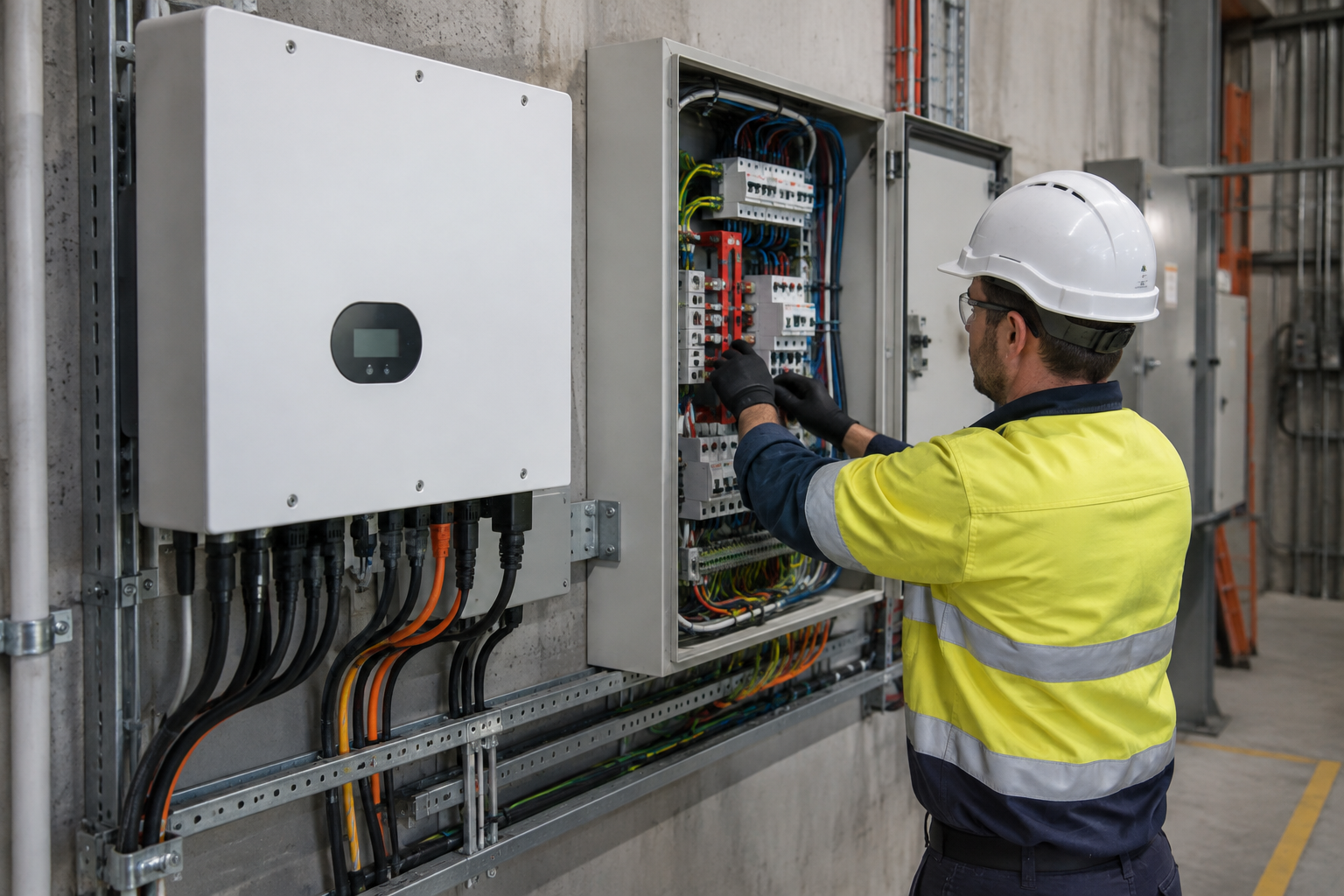
Warehouse systems above 30 kW use multiple three-phase string inverters or a central inverter configuration. In 2026, the leading commercial inverter brands for Australian networks are Fronius, SMA, and Sungrow commercial range. For warehouse battery integration, Sungrow’s commercial hybrid inverter range (SG50CX-P2 and above) allows direct DC-coupling, improving round-trip efficiency over AC-coupled retrofits. All inverters must carry CEC approval for Australian grid connection.
Mounting Systems for Warehouse Metal Roofs
The majority of Sydney warehouses have corrugated iron or Klip-Lok profile metal roofs. Purpose-built metal-roof mounting systems (Clenergy, Esdec, Racking Solutions Australia) use clamp-based attachment points, avoiding membrane penetrations that can void roof warranties. Confirm the racking system is compatible with your specific roof profile and that the structural engineer sign-off covers both panel wind loading (AS/NZS 1170.2) and roof sheet load-bearing capacity.
Compliance and Installation Checklist
Warehouse solar installation sydney requires a chain of compliance steps that differ from residential jobs. Missing any one of them can delay commissioning by weeks or invalidate your STC claim. Here is the full 2026 compliance checklist:
- Solar Accreditation Australia-accredited designer and installer: Mandatory for STC eligibility. Installer accreditation transferred from the Clean Energy Council to Solar Accreditation Australia on 29 May 2024; check the Find an Installer database before signing any contract. The Clean Energy Council still maintains the approved product list and the Solar Retailer Code of Conduct.
- Electrical contractor licence (NSW): The installing electrician must hold a current NSW electrical contractor licence. Verify on the NSW Fair Trading licence checker.
- Structural engineering report: For commercial roofs, a structural engineer must certify the roof can bear the added panel weight and wind loading. Required by most councils and network operators.
- Development Application or Complying Development Certificate: Warehouse solar in NSW is generally exempt development under the State Environmental Planning Policy, but check your local council and heritage overlays.
- Network connection application (NCA): Required before any system above the inverter rating threshold connects to the grid. Submit to your local DNSP (Ausgrid or Endeavour Energy) and allow 4 to 20 weeks for approval.
- Metering installation: A new bi-directional meter must be installed by a Level 2 ASP (Accredited Service Provider). This is separate from the solar install and often adds 2 to 4 weeks to the commissioning timeline.
- Certificate of Electrical Safety (CES): Issued by the installing licensed electrician on completion.
- STC assignment form: You assign your STCs to the installer, who redeems them via the REC Registry. Confirm the quantity in writing before signing.
Interactive Solar manages every step in this compliance chain for Sydney warehouse clients, from initial network enquiry through to meter installation and STC redemption. View our full process at our Commercial Solar page.
Watch: How the Solar Retailer Code of Conduct Protects Warehouse Buyers
Interactive Solar is a signatory to the Clean Energy Council’s Solar Retailer Code of Conduct, which sets standards for quoting, contracts, and after-sales support on commercial and residential solar projects.
Battery Storage Integration for 2026
Adding battery storage to a warehouse solar installation changes the financial case significantly. In 2026, the economics of commercial battery storage have improved with the federal Cheaper Home Batteries Program extending rebates to small commercial systems and the continuing decline in lithium iron phosphate (LFP) battery pack costs.
For warehouses, the primary use case for batteries is demand peak shaving. Many commercial electricity tariffs include a demand charge based on the highest 30-minute consumption interval recorded in the billing period. A single large compressor starting up or a piece of machinery ramping can spike your demand reading and add hundreds of dollars to your monthly bill.
A 100 kWh battery system with a 50 kW discharge rate can cap demand spikes by supplying that peak load from stored energy before the network meter records it. Depending on your demand tariff rate, peak shaving alone can save $3,000 to $12,000 per year, independent of the solar savings. Combine this with solar self-consumption and you have a compelling stack.
For warehouses participating in Virtual Power Plant (VPP) programs, the Solar Batteries page explains how NSW-based batteries can earn additional revenue through grid stabilisation services, with the NSW VPP incentive expanded to a 50 kWh cap from 1 July 2026.
Installation Timeline and Project Management
Warehouse solar installation sydney timelines in 2026 are longer than residential projects due to the compliance chain described above. Here is a realistic project schedule for a 50 to 100 kW warehouse system:
| Phase | Activity | Typical Duration |
|---|---|---|
| Site assessment | Roof inspection, interval data review, load analysis, switchboard audit | 1 to 2 weeks |
| System design | Solar Accreditation Australia-accredited designer produces system layout, single-line diagram, structural brief | 2 to 3 weeks |
| Network application | Submit NCA to Ausgrid or Endeavour Energy | 4 to 16 weeks |
| Structural sign-off | Engineer reviews roof and issues compliance report | 2 to 4 weeks (runs parallel to NCA) |
| Equipment ordering | Panels, inverters, racking, cabling (runs parallel) | 3 to 6 weeks |
| Installation | Mounting, panel fitting, inverter installation, wiring | 2 to 5 days on-site (varies by size) |
| Electrical inspection | NSW Fair Trading inspector sign-off, CES issued | 1 to 2 weeks |
| Metering | Level 2 ASP installs new bi-directional meter | 2 to 4 weeks |
| Commissioning and handover | System energised, monitoring activated, STC paperwork signed | 1 to 2 days |
Total realistic timeline: 14 to 28 weeks from first consultation to system energisation. Network approval time is the biggest variable. Submitting the NCA early in the process (before design is finalised, if possible) compresses the overall timeline. Interactive Solar front-loads network enquiries for this reason. Check our current project queue and availability at Contact Us.
Common Specification Mistakes to Avoid
The following errors appear regularly in warehouse solar proposals from less experienced installers. Knowing them helps you evaluate any quote you receive:
- Sizing from roof area, not interval data: A 10,000 sqm roof could theoretically hold 1 MW of panels, but the relevant question is how much you consume during solar hours. Over-sizing without load matching results in excessive export and wasted capital.
- Ignoring demand tariff structure: If your tariff includes a demand component (which most warehouse tariffs above 100 MWh per year do), the financial model must account for demand charge savings, not just energy offset. This typically improves ROI substantially.
- Underspecifying cable runs: Warehouse switchboards are often far from optimal inverter locations. Long DC cable runs increase voltage drop and may require upsizing to prevent energy losses and inverter protection trips.
- Skipping the switchboard audit: Many older warehouse switchboards do not have capacity for a commercial solar connection. Upgrading a switchboard can add $3,000 to $15,000 to the project cost and several weeks to the timeline. A thorough site audit catches this early.
- Not confirming export limit before design: Designing a 100 kW system for a single-phase connection and then discovering a 10 kW export limit requires a complete redesign. Always confirm network constraints before finalising system size.
- Accepting a quote with no structural engineer: If a quote does not include or reference a structural engineer, you are exposed to roof damage liability and may fail the building insurance terms for commercial properties.
Frequently Asked Questions: Warehouse Solar Installation Sydney
How much does warehouse solar installation sydney cost in 2026?
A fully installed 50 kW commercial system in Sydney costs approximately $43,000 to $55,000 net after the STC rebate in 2026. A 100 kW system ranges from $64,000 to $85,000 net. Costs vary by roof type, switchboard upgrades required, inverter brand, and distance to the point of connection. Always request three itemised quotes and verify each includes structural sign-off, network application fees, and metering costs.
What size solar system does a warehouse need?
Start with 12 months of interval data from your electricity retailer. The ideal system size offsets 80 to 100 per cent of your daytime consumption without excessive export. For a warehouse consuming 150,000 kWh per year with 60 per cent daytime use, a 75 kW system (generating ~97,500 kWh annually) typically delivers the best return. A Solar Accreditation Australia-accredited designer can run this analysis from your actual data.
What rebates are available for warehouse solar in Sydney in 2026?
The primary rebate is the federal Small-scale Technology Certificate (STC) scheme, worth approximately $12,000 to $25,000 for 50 to 100 kW systems in 2026 (Zone 3, 5-year deeming period). Additional incentives include the Small Business Energy Incentive (20 per cent bonus tax deduction for businesses under $50M turnover) and the Cheaper Home Batteries Program for storage add-ons. Confirm current eligibility with your installer and accountant.
How long does warehouse solar installation take in Sydney?
Allow 14 to 28 weeks for a 50 to 100 kW warehouse system in Greater Sydney. The network approval process (Ausgrid or Endeavour Energy) is the longest variable, taking 4 to 16 weeks. Metering changes add another 2 to 4 weeks after installation. Submitting your Network Connection Application early significantly compresses the overall schedule.
Is battery storage worth adding to a warehouse solar system?
For warehouses on demand tariffs, batteries often deliver strong returns independent of solar savings. Peak shaving alone can save $3,000 to $12,000 per year by flattening the 30-minute demand spikes that drive demand charges. In 2026, the federal Cheaper Home Batteries Program provides STC rebates on the first 50 kWh of commercial storage capacity, reducing battery costs by $4,000 to $18,000 depending on system size.
Do I need council approval for solar on a warehouse in NSW?
Most warehouse solar installations in NSW qualify as exempt development under the State Environmental Planning Policy (Exempt and Complying Development Codes) 2008, provided panels do not protrude above the ridgeline by more than 500 mm and are not on a heritage-listed building. Confirm with your local council and heritage register before proceeding. Your installer should conduct this check as part of the pre-design assessment.
What happens after the warranty period ends on commercial solar panels?
Leading commercial panels (Aiko, Jinko, REC, Trina) carry 25-year linear performance warranties guaranteeing minimum output of 80 to 85 per cent of nameplate capacity at year 25. Product warranties are typically 12 to 15 years. Inverter product warranties are 5 to 10 years (extendable). Interactive Solar’s aftercare program covers annual performance reviews and post-warranty maintenance planning: see Interactive Care for details.
For a tailored warehouse solar assessment including interval data analysis, network constraint review, and a detailed financial model, contact Interactive Solar. Visit our project gallery to see completed commercial installations across Sydney, or get in touch to start the conversation.
Make Interactive Solar a preferred source in Google
One click tells Google to surface our articles more often in Top Stories, AI Overviews and AI Mode.