Australian Made Solar Panels: A 2026 NSW Buyer’s Guide
Your power bill lands, you wince, and you start doing the same maths most NSW homeowners are doing right now. Solar makes sense. The hard part isn't whether to install it. The hard part is choosing gear you won't regret in ten years.
That's where Australian made solar panels enter the conversation. Plenty of people like the idea. Fewer understand what they're buying, what they're paying extra for, and whether it changes the result on the roof.
My view is simple. Don't buy a panel because it has a flag attached to the marketing. Buy it because the panel, the warranty path, and the installer all stack up for your home, your roof, and your long-term plans. If local manufacturing improves that outcome, it's worth serious attention. If it doesn't, sentiment alone isn't enough.
Why Choosing the Right Solar Panels Matters More Than Ever
NSW homeowners aren't looking at solar as a novelty anymore. They're looking at it as protection. Electricity costs are under constant pressure, and once you commit to a system, you're living with that decision for years. Good panels make that investment pay off. Average panels can still work, but they leave less room for error.
Australia has already shown what mass solar adoption looks like. The catch is that local manufacturing hasn't kept pace. The Australian Energy Council says Australia manufactures around 1% of the solar panels installed domestically, which means roughly 99% are imported, as outlined in its analysis of Australia's solar manufacturing challenge.
That creates a real buyer question. If almost every panel on the market comes from overseas, does it make sense to chase an Australian made option at all?
The panel decision affects more than generation
Initial focus often goes to panel wattage. That matters, but it's not the whole job. A panel choice also affects:
- Warranty confidence because support is only useful if someone stands behind it.
- Roof layout flexibility because panel dimensions and output shape how much usable generation you can fit.
- Long-term system planning because today's array often becomes tomorrow's battery and EV charging platform.
- Procurement risk because delayed or substituted panels can derail a carefully designed system.
Practical rule: Don't compare solar panels as if they're all interchangeable black rectangles. They're part of a system, and some systems age much better than others.
What matters for a NSW buyer
For a Sydney or greater NSW home, I'd narrow the decision to three things. First, is the panel approved for the Australian market and supported properly here? Second, is the manufacturer bankable enough that the warranty has substance? Third, does the installer know why they chose that panel for your site, instead of just offering whatever was easiest to source that month?
That's the standard I'd use before I worried about slogans.
What Really Qualifies as an Australian Made Solar Panel
“Australian made” gets used loosely in solar. That's a problem, because buyers often assume it means every part came from Australia, was built in Australia, and is backed by an Australian supply chain from start to finish. In practice, those are different things.
Consider cars: One car may be built in Germany from a global mix of parts. Another may be assembled in Australia from imported components. Both can be sold with strong local support, but they are not the same manufacturing story. Solar works the same way.
Three labels buyers confuse
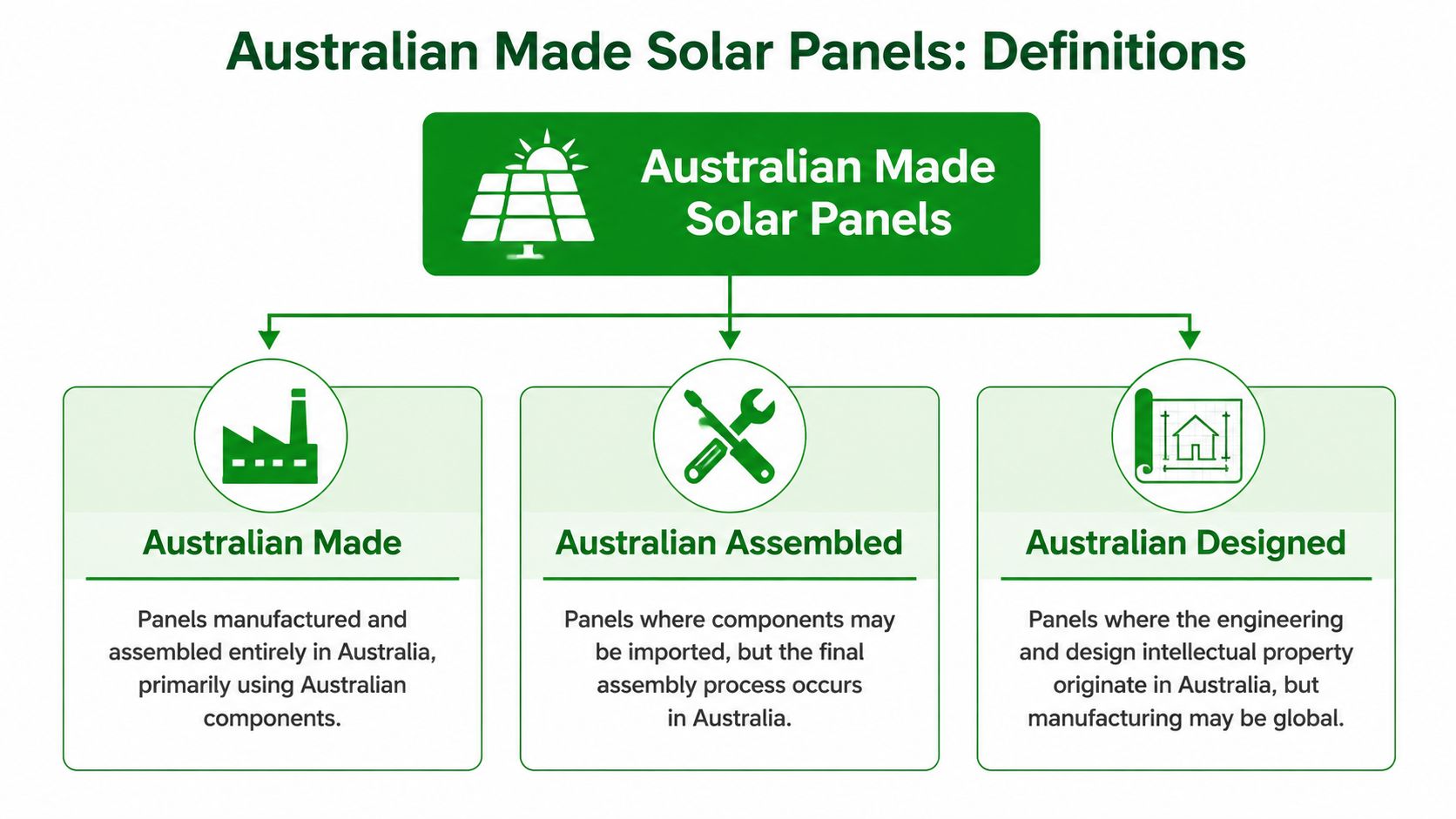
When you're reviewing quotes, separate these terms clearly:
- Australian made means the module itself is manufactured domestically in the strict sense used by the market discussion around local panel production.
- Australian assembled usually means imported components are brought together locally for final assembly.
- Australian designed means the engineering or brand ownership may be local, while manufacturing happens elsewhere.
Those distinctions matter because they affect what you're really valuing. Some buyers care most about domestic manufacturing. Others care more about quality control, local support, or alignment with Australian conditions.
The current reality in the market
Australia's only current domestic PV module manufacturer is Tindo Solar, based in Adelaide, according to this industry profile of Tindo Solar. If you're talking about Australian made solar panels in the strict manufacturing sense, that generally means Tindo.
That same source notes Tindo's listed product line includes the Walara Series in 440 W and 475 W configurations, and the company states its panels use ten-busbar architecture and M10 cells to reduce internal resistance losses. That isn't just brochure language. Lower resistive loss is relevant in hot operating conditions because excess heat can drag output down.
Buyers should ask a blunt question: “Was this panel manufactured here, assembled here, or simply sold here?” If the salesperson can't answer cleanly, keep digging.
What this means when you compare quotes
If one quote says “Australian brand” and another says “Australian made”, don't treat them as equal. They may both be legitimate products, but they represent different value propositions.
The right move is to ask for the exact panel model, where the module is manufactured, who handles warranty claims in Australia, and whether the installer chose it for technical reasons or just because it fit a price bracket. That simple conversation cuts through most of the noise.
The Practical Advantages of Locally Manufactured Panels
If you strip away the marketing, the practical case for locally manufactured panels comes down to control. Control over manufacturing. Control over testing. Control over support. That's why some NSW buyers are willing to pay more for them.
The strongest argument isn't patriotism. It's accountability.
Better alignment with Australian operating conditions
Recent industry coverage says Tindo's Adelaide facility uses advanced manufacturing methods described as combining robotics, AI, and human capabilities, with each panel engineered, manufactured, and tested in Adelaide using componentry and processes validated against Australian conditions, as noted in this Australian Made campaign feature on Tindo Solar.
For a homeowner, that matters if you care about consistency from one panel to the next and whether the product has been developed with local heat and exposure in mind. NSW roofs aren't lab benches. They deal with punishing summer conditions, grime, storms, and long service life expectations.
The warranty is only as good as the path to a claim
A solar warranty looks comforting on a quote. It means far less when there's a failure and nobody wants to own the problem.
With a locally manufactured panel, the appeal is straightforward. If there's an issue, you're dealing with an Australian company and an Australian market context. That doesn't guarantee perfection, but it usually gives the homeowner a clearer line of responsibility.
Here's the advice I give people. Don't ask only how long the warranty runs. Ask who approves the claim, who inspects the fault, who supplies the replacement, and who pays for the labour to swap it out. Those answers matter more than the headline warranty term.
Supply and project certainty also count
A lot of buyers underestimate supply chain friction until their installation date shifts or their panel model gets substituted. Locally made modules can help on that front, particularly when an installer is trying to lock in exact equipment for a project.
If you're comparing system proposals and want a better feel for where product choices sit in the market, it's worth reviewing broader solar pricing trends in Sydney so you can judge whether a premium reflects genuine product positioning or just padded margin.
Local manufacturing doesn't automatically make a panel better. It does make responsibility easier to trace, and that has real value when something goes wrong.
My recommendation is simple. If you're the sort of homeowner who plans to stay put, values a straightforward support path, and doesn't want your system built around whatever imported stock happened to be cheapest that week, local manufacturing deserves a hard look.
Balancing Performance Cost and Australian Standards
The wrong way to buy solar is to chase the cheapest panel on the quote. The right way is to judge value over the full life of the system.
That doesn't mean you must buy Australian made solar panels. It means you should understand what a premium is buying. Sometimes it buys better support, tighter quality control, and more confidence in the product batch you're getting. Sometimes it buys nothing more than a nicer sales pitch.
CEC approval is the baseline, not the bonus
For Australian installations, Clean Energy Council-approved PV modules are the benchmark for eligibility in the rooftop solar market, as set out by the Clean Energy Council approved modules program. That's the first filter for any panel, local or imported.
The same source base also supports another useful procurement point. Independent supplier material for Australian-made panels notes a minimum 98% output at delivery against the module data sheet. That matters because it gives installers and owners a measurable acceptance check before commissioning.
If a panel isn't properly approved for the market, I wouldn't consider it. No matter how attractive the sales angle sounds.
The useful comparison for homeowners
The actual comparison isn't “Australian good, imported bad”. That's simplistic and wrong. The practical comparison is Australian made versus premium imported panels that also have proper approvals, credible support, and a known track record.
| Factor | Australian Made Panels | Premium Imported Panels |
|---|---|---|
| Manufacturing origin | Manufactured domestically in Australia | Manufactured overseas |
| Main buyer appeal | Local manufacturing, local accountability, stronger connection to domestic support | Broad brand choice, mature global production scale, strong options at different performance tiers |
| Standards check | Must still meet CEC approval requirements | Must still meet CEC approval requirements |
| Quality control angle | Buyers often value local testing and clearer traceability | Buyers rely more on manufacturer reputation and importer or distributor support |
| Warranty comfort | Often attractive to buyers who want a local claim path | Can still be solid if the Australian support structure is real and established |
| Best fit | Homeowners prioritising local manufacturing and direct accountability | Homeowners prioritising model choice, established global brands, or specific roof design needs |
If you want a useful technical reference point while comparing modules, review this guide to solar panel efficiency comparisons. Efficiency isn't everything, but it helps explain why some panels suit constrained roofs better than others.
My recommendation on value
Paying more makes sense when the extra value is concrete. Better fit on your roof. Better support. Better confidence in quality control. Better alignment with how long you'll stay in the home.
Don't pay more for a label alone. And don't buy cheap panels just because the payback sounds quicker on paper. Weak support and poor installer judgement can make a “cheap” system expensive in all the ways that matter later.
Integrating Your Panels with Batteries and EV Charging
Panels aren't the end product. They're the generation engine for the rest of your home energy setup.
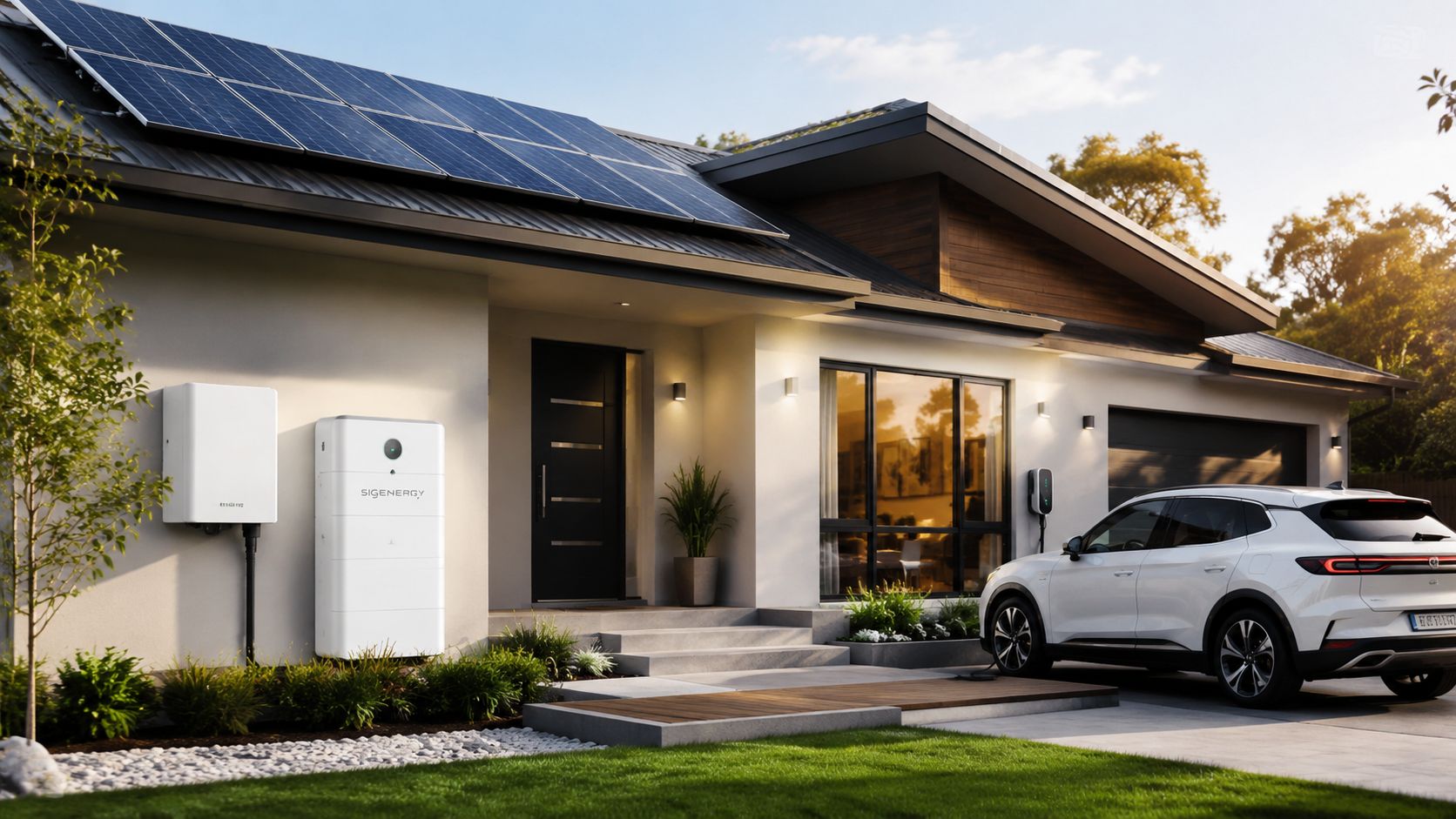
If you think there's any chance you'll add a battery or charge an EV at home, the panel decision you make now needs to support that future cleanly.
Good panels give you better options later
A well-designed array doesn't just lower daytime grid use. It creates flexibility. You can store excess generation in a battery, shift more of your usage into solar-powered hours, and make better use of the energy your roof already produces.
That matters even more if your household is changing. A future EV, a growing family, more time working from home, or a plan to add air conditioning all change your load profile. If your original panel layout was chosen with no thought for expansion, you can paint yourself into a corner.
Think in systems, not components
Many quotes falter. They treat panels, inverter, battery readiness, and EV charging as separate purchases. They're not. They affect each other.
A better approach is to ask whether the system has been designed with battery compatibility, switchboard capacity, monitoring, and future load growth in mind. Homeowners considering a broader energy setup should look at hybrid solar solutions rather than viewing panels as a stand-alone appliance.
The smartest solar systems are designed for the household you're becoming, not only the one you are today.
A battery won't fix a poor panel decision, and an EV charger won't magically create more solar energy to use. If the roof generation is undersized or badly configured, every later upgrade becomes more constrained.
A short explainer on how a broader home energy setup works is below.
What I'd tell a NSW homeowner planning ahead
Choose panels with a long view. Prioritise a system design that leaves room for battery integration, sensible inverter selection, and clean EV charging expansion. Even if you don't add those pieces on day one, your panel choice sets the foundation.
That's the difference between buying solar and building an energy strategy.
Key Questions to Ask Your Sydney Solar Installer
A good installer won't be rattled by detailed questions. In fact, the right company should welcome them. If someone gets slippery when you ask about warranty process, accreditation, or who's doing the install, take that as a warning sign.
Most bad solar experiences start before the panels hit the roof. They start with vague answers.
Ask these before you sign anything
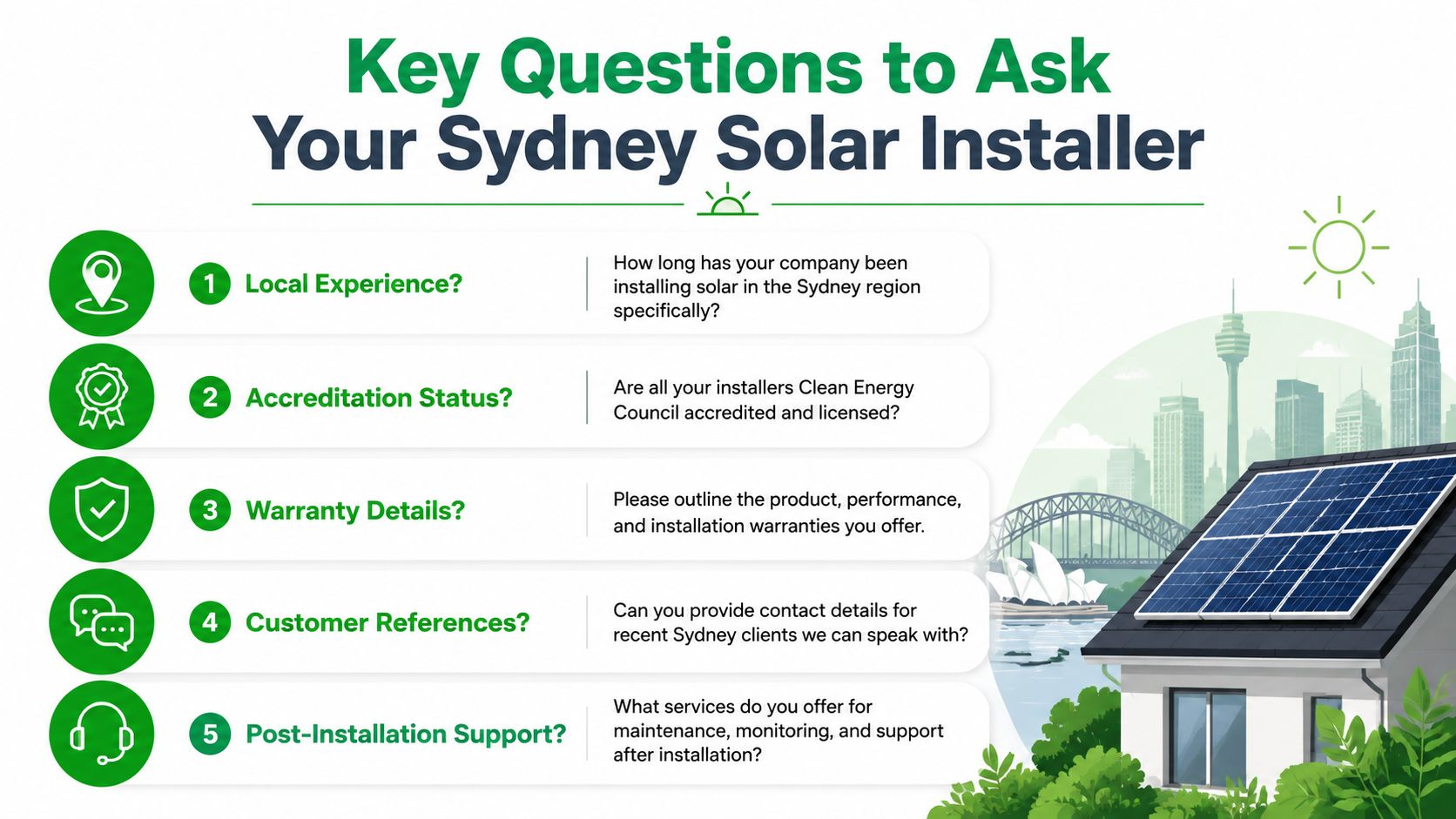
Use this checklist when you speak to any installer:
- Who exactly is installing the system. Ask whether the work is done by in-house teams or passed to subcontractors you'll never meet.
- What panel and inverter models are on the quote. Brand alone isn't enough. You want exact model names.
- Why this panel suits my roof. A proper answer should mention roof space, orientation, shading, future expansion, or support pathway.
- Who handles warranty claims in practice. Ask what happens if a panel fails years down the line.
- Is every major component approved for the Australian market. That should be an immediate yes, with no dancing around the point.
- Can this system accommodate a battery or EV charger later. If not, ask what would need to change now.
Check the company, not just the quote
A polished proposal doesn't prove competence. Before you commit, verify who you're dealing with. If you want an extra layer of due diligence beyond reviews and referrals, you can run a contractor background check to confirm you're not relying purely on sales material.
For local buyers comparing firms, it also helps to review established solar panel installers in Sydney and compare how clearly each business explains design, installation, and after-sales support.
If an installer can't explain their design choices in plain English, they probably don't understand them well enough.
The answer quality tells you a lot
The actual answers matter. But the way they answer matters too.
A serious installer will be specific. They'll explain trade-offs. They'll tell you where a local panel makes sense and where a premium imported panel might be the better fit. That kind of honesty is what you want on day one, because it's also what you'll want years later if service is needed.
Taking Control of Your Energy Bills Today
Solar isn't fringe anymore. By 30 June 2025, Australia had 4,154,426 solar panel installations nationwide, and rooftop PV supplied 12.4% of the country's total energy generation in 2024, producing 30,178 GWh, according to this summary of Australia's solar statistics. That tells you something important. Solar is now a normal part of how Australian homes power themselves.
For NSW homeowners, the main decision isn't whether solar is credible. It is. The main decision is what kind of system you want sitting on your roof for the long haul.
My advice is blunt. Start with standards and installer quality. Then weigh whether Australian made solar panels give you enough added value in local accountability, manufacturing confidence, and warranty comfort to justify the premium for your home. For some households, the answer will be yes. For others, a well-supported premium imported panel will be the smarter move.
Either way, don't buy on sticker price alone. Buy on fit, support, and long-term usefulness.
If you want to sanity-check the numbers for your property before talking to installers, use a proper solar savings calculator and then pressure-test any quote against the questions above. That's how you avoid buying blind.
If you want a clear recommendation on whether Australian made solar panels suit your roof, usage, and future battery or EV plans, speak with Interactive Solar. A proper consultation should leave you with a system design you understand, realistic expectations, and a straight answer on whether local manufacturing is worth paying for in your case.
Make Interactive Solar a preferred source in Google
One click tells Google to surface our articles more often in Top Stories, AI Overviews and AI Mode.