
Solar Prices Sydney: 2026 Guide to Cost & Value
Last updated:
Your latest electricity bill lands, and the first thing you do is search solar prices sydney. That reaction makes sense. You want a straight answer, a rough budget, and some confidence that solar will reduce what you’re paying every quarter.
The problem is that “price” on its own doesn’t tell you much.
Two Sydney homes can install the same nominal system size and get very different results. One owner ends up with a tidy-looking system that underperforms, exports too much cheap power, and becomes frustrating the first time a fault appears. The other gets a system designed around when the household uses energy, how the roof behaves in real sun, and what the family might add later, like a battery or EV charger. On paper, both quotes can look close. In practice, they’re not the same investment.
That’s why a good solar decision starts with value, not a headline number. You’re not buying panels as a commodity. You’re buying generation, reliability, electrical design, installation quality, warranty support, and a path to lower dependence on the grid over many years.
Your Guide to Understanding Solar Value in Sydney
A Sydney homeowner gets two solar quotes for what looks like the same size system. One is a few thousand dollars cheaper, both promise savings, and both look tidy on the page. Six months later, the cheaper system is exporting most of its generation for a low feed-in rate, the inverter app is frustrating to use, and the owner is asking why the savings never matched the sales pitch.
That happens because the number at the bottom of the quote is only one part of the decision.
Solar is part electrical infrastructure, part roof work, and part long-term planning for how the home will use energy over the next 10 to 15 years. A low upfront figure can still turn into a poor investment if the system size is wrong, the layout ignores shade or roof orientation, the inverter is chosen on price alone, or the installation quality is average.
Shifting the question from price to value
A better starting point is simple. Don’t ask only, “What does solar cost in Sydney?” Ask, “What will this system do for this home?”
That changes how you read a quote.
Average market pricing can give you a rough sense of whether a proposal is in the right range, but average pricing is not the same as good value. It does not show whether the array has been designed around your daytime usage, whether the switchboard needs work, whether panel placement has been compromised to hit a package price, or whether the system leaves room for a battery or EV charger later.
Roof shape matters. Shade matters. Access matters. Switchboard condition matters. Future plans matter too.
A straightforward single-storey roof with clean sun exposure will usually cost less to install than a split-level home with multiple roof faces, awkward cable runs, and compliance upgrades. That price difference is not a red flag. In many cases, it reflects a more honest scope of work.
Practical rule: If a quote is very cheap before anyone has properly checked your roof layout, switchboard, daytime consumption, and future electrification plans, treat it with caution.
What creates long-term solar value
The strongest quotes usually get three things right:
- System design fits household usage, so more solar is used on site instead of exported cheaply.
- Components suit the home and budget, rather than being selected only to win on headline price.
- Installation quality is high, because performance on paper means little if workmanship is poor.
That last point gets missed often. I’ve seen good hardware underperform because of poor panel placement, rushed cable work, weak weatherproofing, or sloppy commissioning. If you want a clearer view of what good workmanship looks like, read this guide on why installation quality matters in advanced solar systems.
Read your quote like an owner, not just a shopper. Check what the system is expected to produce, when your household is likely to use that energy, what products are being supplied, what warranties apply, and whether the design still makes sense if your energy use changes.
That is how solar prices sydney should be judged. Not by the cheapest number on the page, but by whether the system will still be the right fit years from now.
Why Average Solar System Prices Can Be Misleading
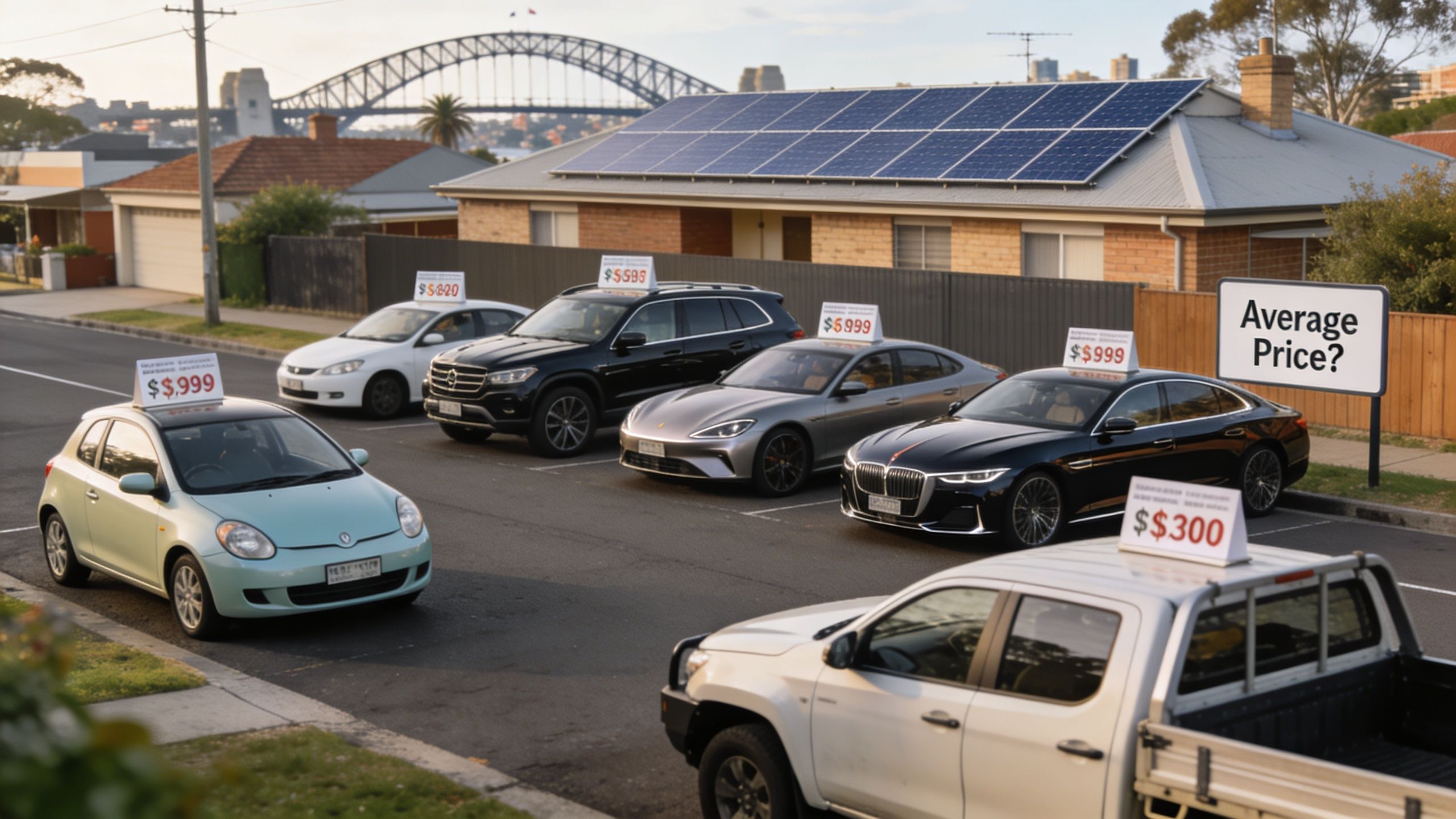
A Sydney homeowner gets two quotes for a 6.6kW system. One is thousands cheaper. On paper, both look similar. In practice, they can deliver very different outcomes over the next 10 to 15 years.
That is why average pricing causes trouble.
An average gives you a rough market reference. It does not tell you how well the system fits your roof, how the installer has handled shading and switchboard requirements, or whether the hardware will still make sense if you add a battery, air conditioning, or an EV later. If you want a broader reference point on current NSW system costs, our guide to the cost of solar panels in NSW gives useful context. It still should not be treated as a quote.
A benchmark is only a starting point
Average system prices get attention because they are easy to compare. The problem is that they flatten the details that drive long-term value.
I tell Sydney clients to treat an average price as a sanity check, nothing more. If a quote sits well below the pack, there is usually a reason. Sometimes it is a genuine promotion or a simpler install. Sometimes the design has been stripped back, the inverter is entry-level, the panel layout is weak, or extras have been left out until later.
Price matters. What that price includes matters more.
Three 6.6kW systems can behave very differently
System size on its own tells you very little. Two homes can both be quoted 6.6kW and end up with completely different production profiles, monitoring quality, upgrade paths, and maintenance risk.
| What changes the quote | Why it matters |
|---|---|
| Panel tier and model | Higher-quality panels can offer better efficiency, tighter degradation terms, and stronger manufacturer support. That may matter a lot on smaller or more complex roofs. |
| Inverter quality and features | The inverter affects monitoring, fault reporting, battery compatibility, export control options, and how easy the system is to service later. |
| Roof design and site conditions | Shade, orientation, roof pitch, access, tile type, split array layouts, and switchboard work all change labour time and design quality. |
Average price falls short. It cannot show whether one installer has allowed for isolator upgrades, pest protection, better panel placement, or a cleaner cable run that will hold up over time.
Cheap solar is not always cheap ownership
A low upfront price can still be good value if the design is sound and the installer has priced the job properly. I have also seen low quotes that looked excellent until the owner realised the savings would be weaker than expected, the monitoring was poor, or the system had no sensible path for battery storage later.
The hidden cost usually shows up in one of these areas:
- Lower self-consumption, because the system was sized or positioned badly
- Reduced reliability, because product quality or installation standards were cut back
- Extra variation costs, after site issues appear during installation
- Limited future flexibility, if the inverter or switchboard setup cannot support later upgrades
Those are ownership problems, not shopping problems.
Read the quote like someone who has to live with it
The better question is not, “What is the average solar price in Sydney?” It is, “What am I getting for this number, and how will that affect my savings over time?”
A strong quote should help you judge long-term return, not just upfront spend. Look for clear product models, expected production, assumptions around shading, warranty details, and whether the design suits how your household uses power. That is how you compare solar quotes like an expert, and it is why average pricing is only a starting point, not the decision.
Deconstructing the Key Cost Factors in a Solar Quote
Two Sydney homes can both be quoted for a 6.6kW system and end up with very different results over the next 10 years. One saves well, runs reliably, and is ready for a battery later. The other looked cheaper on day one, but delivers less energy, has poorer monitoring, and becomes awkward to upgrade.
That difference usually sits inside the quote details, not the headline number.
Most variation in solar prices sydney comes from three areas. Equipment, installation work, and system design. If you assess those properly, you stop comparing quotes like price tags and start comparing them like long-term investments.
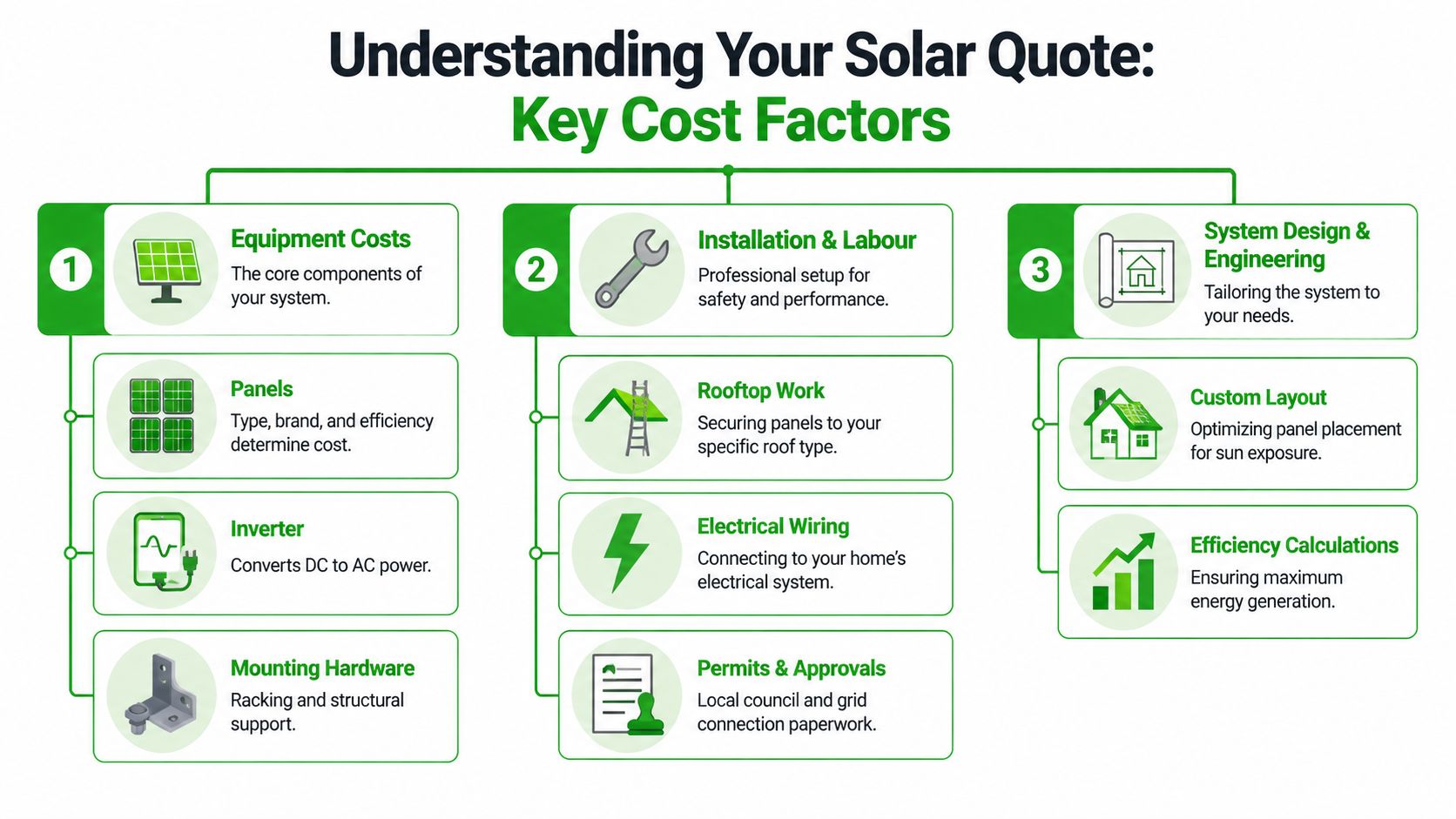
Panels decide more than output
Panels get the attention because you can see them. They still need to suit the roof, the budget, and the energy target.
A better panel is not always the most expensive one. On a tight roof with limited usable space, higher-efficiency modules can justify the extra spend because each panel position has to work harder. On a larger roof with good orientation and no major shading, a mid-to-upper range panel can be the smarter buy if it gives solid performance, a credible warranty, and a better overall system value.
Check more than the brand name. Look at the exact model, efficiency, degradation terms, product warranty, panel dimensions, and how the panel performs in heat. Sydney roofs get hot in summer, and temperature performance affects real-world production.
A quote should show:
- The exact panel brand and model
- How many panels fit the usable roof area
- What warranties apply and who stands behind them
- Why that panel was chosen for your roof, not just your budget
The inverter is where many cheap quotes cut corners
The inverter does more than convert DC to AC. It affects system efficiency, fault reporting, monitoring quality, and what you can add later.
I pay close attention to the inverter because this is often where a cheap quote makes up its price gap. The panel brand may look respectable on paper, but the inverter can be undersized, limited in monitoring, or poorly suited to the roof layout.
You will usually be choosing between three broad paths:
| Inverter path | Best suited to | Trade-off to consider |
|---|---|---|
| String inverter | Simpler roofs with consistent sun exposure | Usually lower cost, but less flexible if panels face different directions or deal with regular shade |
| Microinverters | Roofs with panel-level variation or shade concerns | Better panel-level visibility and flexibility, but a higher equipment cost |
| Hybrid inverter | Homes likely to add battery storage | Cleaner battery pathway later, but only if the rest of the system is planned around that goal |
The right choice depends on the roof and the homeowner’s plans. A straight north-facing roof with no shade does not need the same hardware as a split east-west roof with chimney shadow and future battery plans.
On-site reality: A good system starts with the roof conditions and the household’s energy use. It should not be built around whatever hardware happens to be on special.
Labour and installation scope change the real cost
Installation is not a generic line item. The work changes from house to house, and the quote should reflect that accurately.
A single-storey metal roof with clear access is simpler than a steep tiled roof with multiple levels, long cable runs, and an ageing switchboard. Add difficult panel access, extra safety setup, or electrical upgrades, and the labour component changes fast. That does not mean the quote is inflated. It often means the installer has looked at the site properly.
This is also where average pricing stops being useful. Two systems with the same size can have very different installation requirements, and one quote may include switchboard work, consumption monitoring, isolator replacement, or a better mounting setup that another quote has left out.
Cheap quotes often stay cheap by keeping the scope thin.
System design has the biggest effect on long-term value
This is the part many homeowners do not get shown clearly enough.
System size matters, but layout matters just as much. Panel orientation, string design, shading losses, inverter sizing, and expected daytime usage all shape the savings you will see. A quote that squeezes the maximum number of panels onto a roof is not automatically the best quote. If the layout creates avoidable shading losses or pushes generation into times when the home uses very little power, payback can suffer.
Good design should answer practical questions. Why are panels going on that roof face? Why this inverter size? How much of the production is likely to be used in the home versus exported? Is there a sensible path for a battery or EV charger later?
That is what separates a system that looks good on paper from one that performs well in real life.
Read the quote like a professional
Start with the specification, not the total price.
Check these points first:
Model-level detail
Brand-only quotes are not enough. The exact panel and inverter models should be listed.Roof layout and design assumptions
You should be able to see panel placement, orientation, and any shading considerations.Electrical scope
Switchboard work, isolators, monitoring, metering changes, and cable routes should be clear.Installation inclusions and exclusions
Ask what could trigger added cost on install day. A good quote spells this out early.Future options
If battery storage or EV charging is likely later, the quote should state whether the design supports that path.
For a state-based breakdown of what commonly affects pricing, this guide to the cost of solar panels in NSW gives useful context.
The best quote is rarely the cheapest and rarely the most expensive. It is the one that explains the design, uses suitable hardware, includes the installation scope, and gives you the strongest return over the life of the system.
How Government Incentives Impact Your Final Investment
A Sydney homeowner gets three quotes for what looks like the same 6.6kW system, and the prices are miles apart. One reason is the incentive is already baked in, but not every quote handles it the same way, and the rebate does not make the systems equivalent.
That is the part many people miss.
Government support lowers the upfront cost. It improves payback. It does not fix a weak design, cheap hardware, or an installer who has left out electrical work that appears later as a variation.

How the federal incentive usually appears on a quote
For most Sydney homes, the federal STC incentive shows up as an upfront discount on the proposal. Homeowners usually do not claim it themselves after installation. The installer applies it during quoting, which is why the headline price you see is often already net of the incentive.
That sounds simple, but it creates confusion. One quote may show the gross system price and the STC discount separately. Another may only show the final figure. If you are comparing quotes, ask to see both numbers. It is the fastest way to tell whether you are comparing the actual system value or just looking at different formatting.
I always tell homeowners to read rebates as a cost adjustment, not a reason to stop asking questions. The right question is not, “How much did the incentive save me?” The better question is, “What am I getting after the incentive is applied?”
For a clear local breakdown, see our guide to NSW solar rebates and government incentives.
Why feed-in tariffs change the maths
Export income still helps, but it is usually the smaller part of the financial result.
IPART’s NSW solar benchmark sets the 2025-26 feed-in tariff benchmark at 4.8 to 7.3 c/kWh. That matters because exported solar is typically worth much less than the electricity you avoid buying from the grid. The households that get the best long-term return usually use more of their solar directly, either through daytime loads or by planning for storage later.
Exporting power has value. Using your own solar power usually has more.
This is why average price is a poor shortcut. A cheaper system that produces plenty of excess power for low-value export can underperform a slightly dearer system designed around how the home uses energy.
A household that is empty through the day can still get strong value from solar. The design just needs more thought. Appliance timing, hot water control, pool filtration, EV charging habits, and battery-readiness all matter because they affect how much solar stays in the home instead of going out to the grid.
A practical way to assess this is:
- High daytime usage often means faster savings because more solar is used on site.
- Low daytime usage means system size and panel layout need tighter control so exports do not dominate the savings estimate.
- Battery or EV plans should be reflected in the inverter and switchboard approach from day one.
This short explainer gives a useful visual overview before you compare quotes:
Future-Proofing Your Home with Batteries and EV Charging
Solar on its own lowers bills. A well-planned solar system with battery storage and EV charging can change how a household buys energy altogether.
That’s the bigger opportunity.
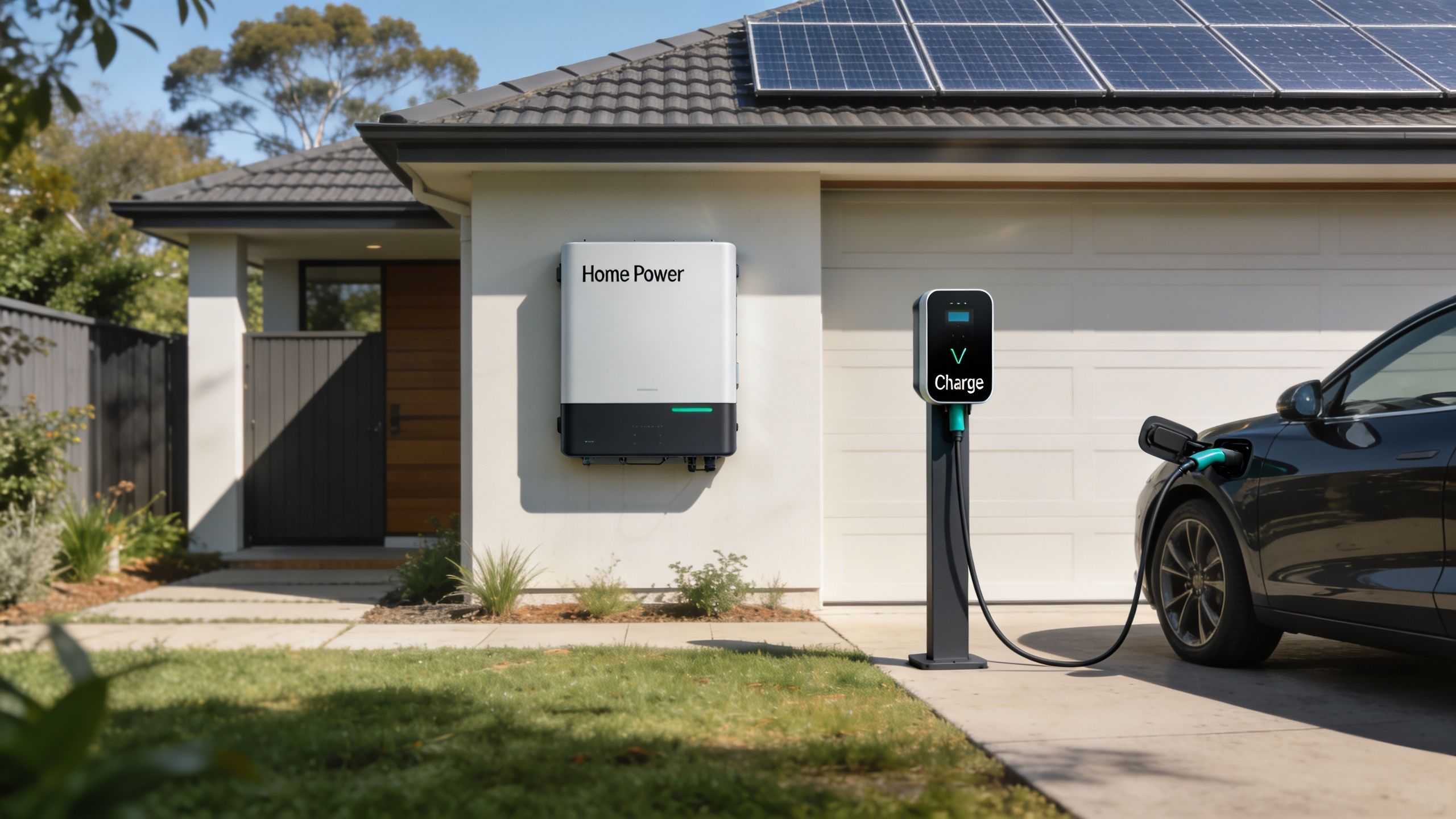
Australia’s household solar generation has grown dramatically. The ABS article on household solar generation in the national accounts reports that household solar generation has surged 20 times since 2010 and now accounts for about 8% of total economy-wide electricity generation. That scale matters because it changes the smartest use of rooftop solar. The focus shifts away from exporting excess power and toward maximising self-consumption.
Batteries solve a practical problem
Most homes use a lot of electricity in the late afternoon and evening. That’s often when rooftop solar output has already fallen away. A battery helps bridge that gap by storing solar produced earlier in the day for use when the home needs it.
This isn’t just about chasing lower bills. It’s about control.
If your household runs air conditioning after work, cooks on electric appliances, charges devices, and stays active into the evening, a battery can turn daytime generation into evening coverage. For some households, that’s the difference between “we have solar” and “we feel the benefit of solar every day”.
EV charging changes the maths again
Once an EV enters the picture, your roof can become part of your transport plan. Charging during solar production hours can make far more sense than buying all that energy from the grid.
That’s why EV readiness shouldn’t be an afterthought. It should be asked early, even if the car hasn’t been purchased yet.
A future-proof quote should answer questions like these:
- Will the inverter and switchboard setup support a battery later?
- Is there a sensible pathway for a dedicated EV charger?
- Has the system been sized with future electrification in mind?
- Will the monitoring platform help you manage charging and usage behaviour?
A good solar design doesn’t just fit your life today. It leaves room for the life you’re moving toward.
What works and what doesn’t
What works is a system designed as an energy ecosystem. Solar generation, storage, EV charging, and home usage all need to make sense together.
What doesn’t work is adding products one by one without checking whether the earlier decisions support them. That’s how people end up replacing inverters too soon, reworking switchboards, or discovering their “cheap solar deal” wasn’t built for expansion.
If you’re already thinking about an electric vehicle, reviewing home EV charger installation options and costs alongside your solar planning is the sensible move. It’s easier and cleaner to think through both at once than to retrofit the whole strategy later.
For Sydney households trying to reduce dependence on the grid over the long term, batteries and EV chargers aren’t side issues. They’re often the next logical step.
Real-World Savings Scenarios and Payback Timelines
A Sydney homeowner gets three quotes for solar and sees three very different prices, three different system sizes, and three different payback estimates. That usually causes more confusion than clarity. The useful question is not, "What does solar cost on average?" It is, "What will this system save on this home, with this usage pattern, over the next 10 to 15 years?"
That is where payback gets real. Two homes with the same quarterly bill can get very different results from the same system if one household uses power during the day and the other does most of its consumption after sunset.
Scenario one
A family in Western Sydney has school-age kids, ducted air conditioning, and heavier usage in the afternoon and early evening. On paper, they may look like a straightforward candidate for a larger system. In practice, the return depends on what happens between 10 am and 4 pm.
If they can shift some loads into solar hours, dishwasher, washing machine, pool pump, pre-cooling the house, the numbers usually improve fast. If they cannot, a quote with a big panel count can still look good upfront but deliver a slower payback than expected because too much generation is exported at low feed-in tariff rates.
This is why I tell homeowners to read the savings estimate with some scepticism. Ask how much of the generated power you are expected to use yourself, not just how many kilowatt-hours the system will produce.
Scenario two
A retired couple in the Sutherland Shire spends more time at home during the day. They are often a strong fit for solar because their self-consumption is higher.
They may not need the largest system in the suburb. They usually get better value from a sensible system size, good panel placement, reliable inverter performance, and monitoring that is simple enough to use. If the installer gets those details right, the payback can be strong without overspending on capacity they are unlikely to use well.
A careful design often beats a bigger, cheaper quote.
The best payback usually comes from using your own solar well, not just buying more panels.
Scenario three
For a homeowner installing solar now and expecting to buy an EV within a few years, quote analysis matters more than headline price.
A cheap system may still generate savings, but the long-term value drops if the inverter choice, switchboard setup, or overall design makes later upgrades expensive. A better quote will show what the home can support now, what can be added later, and what those future steps are likely to involve. That is a very different proposition from a quote that only focuses on the lowest install cost.
What payback really depends on
Payback is shaped by the structure of the quote, not just the total at the bottom of the page. The main factors are:
- How much solar generation the household will use directly
- Whether the proposed system size matches actual daytime and seasonal usage
- Panel, inverter, and installation quality
- Shading, roof layout, and orientation
- Whether the design leaves a practical path for future upgrades
A system with a lower upfront price can still be the more expensive option over time if it underperforms, exports too much cheap power to the grid, or needs corrective work later. A well-designed system often costs more at the start and pays that back through better production, fewer issues, and a cleaner upgrade path.
If you’re in an apartment or rental
Solar savings are harder to access if you do not control the roof, but the options are starting to broaden. Energy Matters’ coverage of solar access and emerging alternatives points to models such as solar gardens and options such as NSW’s Solar Sharer program, which is planned for a potential launch in July 2026.
That matters because the average system price is even less useful in these situations. Access, ownership structure, and billing arrangement matter more than a standard detached-home comparison.
If battery storage is part of the long-term plan, this battery comparison guide for Sydney homeowners will help you assess backup capability, chemistry, and expansion options without getting lost in sales language.
Frequently Asked Questions About Solar in Sydney
Can I install solar on a south-facing or flat roof
Sometimes, yes. A good installer looks at usable roof area, shading, layout options, and your consumption profile before ruling anything in or out. A north-facing roof is often ideal, but it’s not the only roof that can work. Flat roofs can also be viable with the right mounting approach.
The key question isn’t roof direction in isolation. It’s whether the proposed layout will generate useful power at the times your home needs it.
What happens to my solar system during a blackout
A standard grid-connected solar system usually shuts down during a blackout for safety reasons. That protects network workers and complies with grid requirements.
If you want power available during outages, that needs to be designed in. Usually, that means selecting compatible battery hardware and backup capability from the start rather than assuming any battery will provide whole-home backup automatically.
Do I need council approval for a normal residential solar installation
In many standard residential cases, separate council approval isn’t the main issue. The bigger practical steps are usually network connection requirements, electrical compliance, and making sure the site and system design meet the relevant standards.
That said, unusual properties can trigger extra considerations. Heritage restrictions, strata conditions, difficult roof structures, or major electrical upgrades can all change the process. A proper site assessment should pick that up early.
What maintenance should I expect after installation
Solar systems are generally low maintenance, but low maintenance doesn’t mean no maintenance. Monitoring matters. If generation drops unexpectedly, you want to know quickly rather than months later when a bill arrives.
It’s also sensible to ask your installer about support response times, inverter monitoring access, workmanship warranty, and whether they’ll still be the point of contact if a fault appears later.
How do I compare two quotes that look similar
Start with the specification, not the total.
Check the exact panel model, inverter model, layout, monitoring platform, installation scope, warranty support, and whether the system is ready for battery or EV integration later. If one quote is cheaper, ask what has been removed or simplified to make it cheaper. Sometimes the answer is reasonable. Sometimes it’s the whole story.
Is bigger always better with solar
No. Oversizing can be smart in some homes, especially where future electricity use is likely to grow. But bigger isn’t automatically better if the household exports too much low-value energy, has limited useful roof space, or is unlikely to add battery storage or flexible daytime loads.
A right-sized system usually beats a max-sized system that wasn’t thought through.
If you want a clear, no-pressure assessment of what suits your roof, usage, and future plans, talk to Interactive Solar. Their team handles solar, batteries, and EV charging with in-house installation and practical advice, so you can compare options based on long-term value instead of guessing from headline prices.
Make Interactive Solar a preferred source in Google
One click tells Google to surface our articles more often in Top Stories, AI Overviews and AI Mode.