2026 Guide to the cost of skylight in NSW
Last updated:
A lot of homeowners start in the same place. There's a dark hallway, a gloomy bathroom, or a living area that never feels quite bright enough, and the first search is simple: what's the cost of skylight installation in NSW?
Then the confusion starts. One website talks about the skylight itself. Another talks about installation. A third mixes repairs, replacements, and new installs together as if they're the same job. They're not.
That's why skylight pricing often feels inconsistent. You're not buying a single product off a shelf. You're paying for a roof opening, weatherproofing, interior finishing, labour, and the installer's ability to make all of that work on your particular home. If your broader goal is lower running costs, it also helps to look beyond daylight alone and think about the bigger energy picture, especially with rising energy costs and home energy options.
Why a Simple Question Has a Complex Answer
A homeowner in Sydney can ring three roofing companies about one dark room and hear three very different prices by lunchtime. In practice, that usually points to scope, not dishonesty. One contractor may be pricing a straightforward replacement. Another may be allowing for a new opening, internal shaft work, and a higher finish standard. A third may be assuming difficult access or extra safety setup.
That is why “what does a skylight cost?” rarely has a clean one-line answer. The final figure depends on the exact work involved, the roof type, the ceiling below, and how much remedial or finishing work sits around the skylight itself.
A skylight quote is really a building quote
Homeowners tend to focus on the glass and frame because that is the visible product. On site, the bigger cost drivers are often the parts you never see once the job is finished.
A new skylight can involve roof alterations, flashing integration, waterproofing, insulation treatment, plaster repairs, trim work, and paint touch-ups. If the home has a cathedral ceiling, limited roof access, brittle tiles, or a steep pitch, labour and risk change again. That is why two similar-looking jobs can price very differently.
A useful rule on real quotes is simple. The cheaper the unit looks online, the more closely you need to check the installed scope.
- Unit cost is the skylight itself.
- Roof work covers cutting, framing, and fitting it into the existing roof.
- Weatherproofing covers flashing and sealing details designed to keep water out over time.
- Internal finish covers the shaft, plastering, trim, and making the ceiling line look right in the room.
That last part catches many people out. A skylight can be installed watertight at roof level and still need substantial work inside the home before it looks finished.
Price confusion often starts with mixed job types
Online price guides often roll repairs, replacements, and fresh installations into one range. That makes the numbers look inconsistent when they are describing different categories of work.
A flashing repair sits in a different cost bracket to replacing damaged glazing. Both are very different from cutting a new opening into an existing roof and building the shaft below. Renovation pricing works the same way across the trade, which is why a broad reference like the Smarter Home Renovations cost breakdown is useful for understanding how quickly labour, access, and finish levels shift the total.
In NSW, those variables matter even more because homes vary so widely. A single-storey house with clear access is one thing. A multi-level home with a complex roofline, tight side access, older materials, or a ceiling cavity full of services is another.
There is also a bigger question worth asking before cutting the roof. If the main goal is lower power bills and a more comfortable home, daylight is only one option. In many homes, the better starting point is to review broader home energy options as electricity costs rise, including roof ventilation, which can improve heat build-up and comfort for less than a full skylight project.
A skylight can be the right solution. It just should be priced and assessed as part of the whole home, not as a simple off-the-shelf product.
Deconstructing the Final Skylight Price Tag
A skylight quote works a bit like a car purchase. The sticker price gets your attention, but it's not the whole story. With skylights, the visible unit is only one part of the final bill.
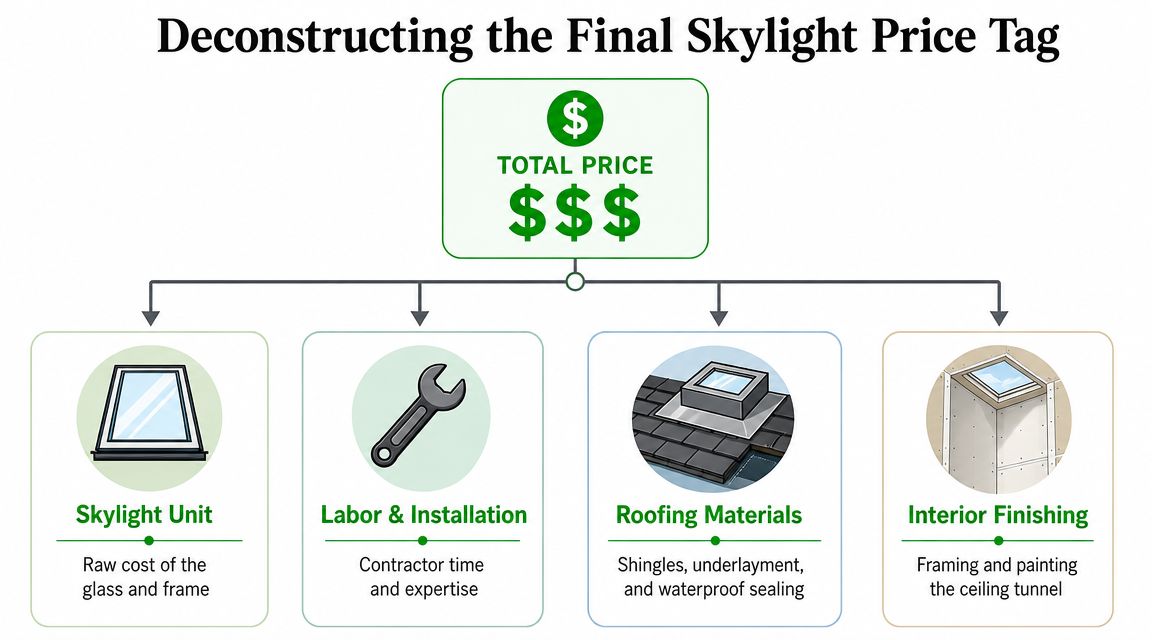
Australian guidance shows the split clearly. A basic fixed skylight can start around AUD $230 to $802 for the unit itself, while full new-install scenarios can land around AUD $3,200 to $6,800+ per unit once installation complexity is included (VELUX project calculator guidance).
The unit is only the first line item
The skylight unit is the obvious component. Fixed units are usually the simplest starting point. Once you move into venting, electric, or solar-operated models, the product side becomes more specialised.
But a low product price doesn't mean a low project price. A basic unit can still require substantial labour if the roof opening is new, the shaft is deep, or the interior finish needs to match an existing ceiling neatly.
Labour is where homes become different
Two homes can use the same skylight model and still produce very different quotes. Labour changes based on roof height, roof material, access, pitch, and how much site setup is needed for safe installation.
A roofer also has to work around the existing roof system rather than on a blank surface. Tiles may need lifting and resetting. Metal roofs need precise detailing around penetrations. If framing changes are needed, the work shifts beyond basic fit-off into structural coordination.
Flashing and waterproofing are non-negotiable
This is the part many homeowners underestimate, and it's the part that matters most long after the installer leaves. Skylights don't fail because they let in light. They fail when the roof penetration isn't integrated properly with the surrounding roof.
A proper quote should make it clear what flashing system is being used, how the opening will be weatherproofed, and who carries responsibility if water ingress appears later. If a quote looks cheap but barely mentions these details, that's a warning sign.
The most expensive skylight is often the one that was installed cheaply and has to be repaired twice.
Interior finishing is what turns roof work into a room upgrade
Even when the roof work is sound, the inside still has to look right. That means shaft framing, plasterboard, setting, trim, and sometimes painting. If the skylight sits above a flat ceiling under a pitched roof, this internal section can be more involved than people expect.
A useful way to sanity-check any building quote is to compare how trades separate visible product cost from hidden project cost. Resources such as the Smarter Home Renovations cost breakdown are helpful for understanding how renovation pricing often expands once labour, finishing, and compliance are properly included.
Key Factors That Influence Your Skylight Quote
Two skylights can look similar in a brochure and behave very differently in a quote. That's because the biggest cost movements usually come from the house, not the marketing photo.
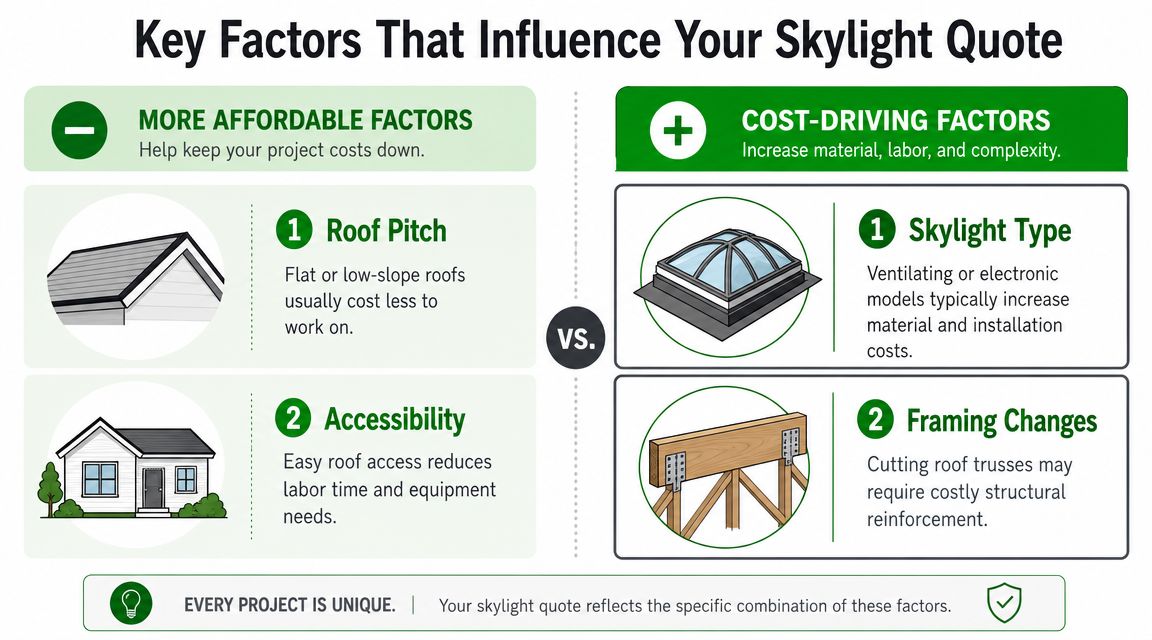
Broad benchmark guides put common installation ranges at about AUD $1,011 to $2,808 per skylight, while higher-end projects can rise to AUD $7,465 to $13,582 when the skylight is oversized, custom, or the roof conditions are more complex, including steep pitch situations (installed skylight cost benchmarks).
Roof pitch and roof type
A low-pitch roof is generally easier and safer to work on than a steep one. That affects setup time, safety equipment, labour hours, and sometimes even the installer pool willing to take the job.
Roof material matters too:
- Concrete or terracotta tile roofs can require careful tile removal and reinstatement.
- Metal roofs need precise cutting and flashing integration.
- Older roofs may reveal brittle materials, previous patchwork, or hidden water entry points once the work starts.
If the roof is difficult to walk on, awkward to reach, or already showing signs of wear, the quote usually reflects that.
Skylight type and feature level
Homeowners often compare the wrong things in this situation. A fixed skylight isn't priced like a venting skylight, and a manual opening unit isn't the same scope as an electric or solar-operated version.
The more moving parts involved, the more detail the installation needs. Once motors, controls, sensors, or powered opening systems enter the conversation, both product complexity and install complexity rise.
That doesn't mean those options are bad. It means they should be chosen because they solve a genuine problem, not because they sound premium on paper.
Size and structural changes
Bigger openings are rarely just “more glass”. They can mean more framing work, more weatherproofing detail, and more internal finishing. If the opening doesn't sit neatly between existing structural members, additional carpentry may be needed to create a compliant opening.
That's why a larger skylight can jump in cost faster than people expect. Custom sizes also tend to create more variables than standard units.
If a skylight needs structural alteration, the project stops being a simple fit-off and starts behaving more like a small renovation.
Access, maintenance, and practical ownership
Some quotes are higher because the installer is pricing not only the install, but also the risk and handling involved in working at height or over fragile roof sections. Tight side access, landscaping, and multi-storey elevations all affect labour.
There's also the ownership question after installation. A skylight that's hard to reach is harder to clean, inspect, and service. If your home design makes external glass access difficult, it's worth understanding how maintenance is handled. Guidance around safe access and professional window cleaning methods gives a useful sense of why difficult glazing locations often carry higher labour expectations.
If your main concern is summer heat build-up or stale roof-space air, a skylight may not be the smartest first step. In many homes, roof ventilation solutions address comfort more directly without adding another glazed roof penetration.
Exploring Alternatives for Light and Home Comfort
A lot of people ask for a skylight when what they really want is one of three things: more daylight, less heat, or a fresher-feeling home. Those are related goals, but they're not the same problem.
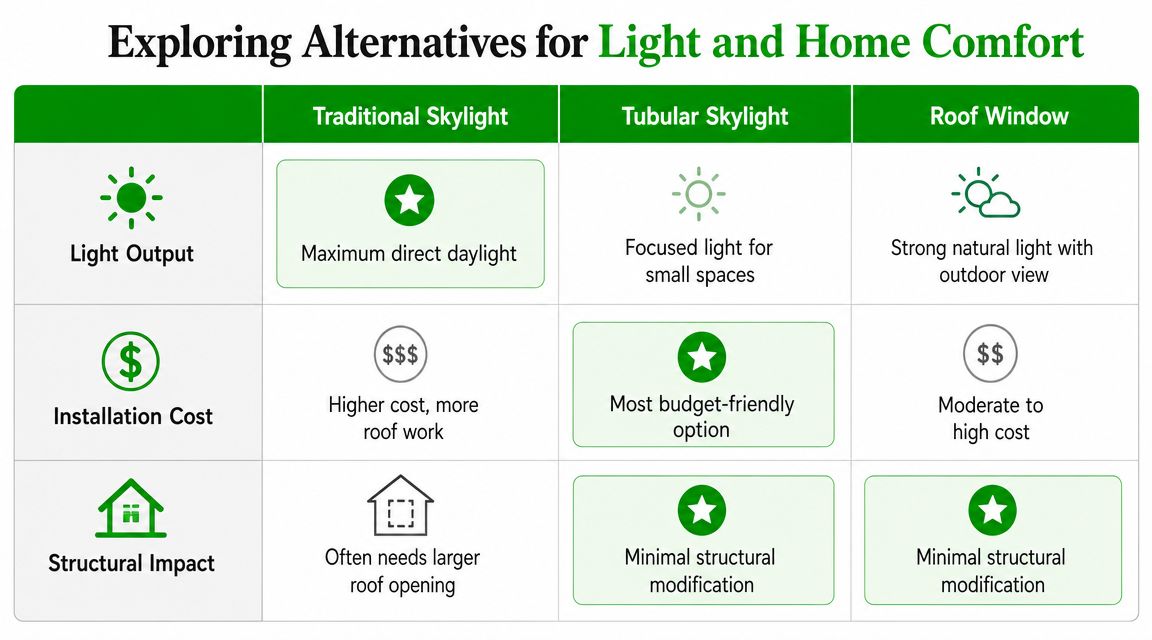
One of the most useful comparisons isn't skylight versus nothing. It's traditional skylight versus tubular skylight. Australian guidance from one provider says a traditional skylight can start at about $2,500, while a tubular skylight can start at about $800, making tubular systems the cheaper installed option for delivering daylight in many situations (traditional versus tubular skylight comparison).
Traditional skylight versus tubular skylight
A traditional skylight makes sense when the visual impact matters. It creates a direct connection to the sky, can make a room feel larger, and often suits open living spaces where daylight is part of the design goal.
A tubular skylight solves a different problem. It's often better for hallways, walk-in robes, laundries, and bathrooms where the homeowner wants daylight without major structural disruption. The installation is usually less invasive because the system doesn't require the same kind of large roof opening and ceiling reconstruction.
Here's the practical difference:
- Choose a traditional skylight when view, architectural effect, and broad daylight spread matter most.
- Choose a tubular skylight when you want daylight delivered efficiently into a compact space with less disruption.
- Avoid overbuilding a solution for a room that only needs functional light, not a major architectural statement.
When ventilation matters more than daylight
Some homeowners lean toward an opening skylight because they want hot air to escape. That can work in the right design. But it's not always the most direct or cost-effective way to improve comfort.
If the house is suffering from roof-space heat build-up, trapped hot air, or poor seasonal comfort, dedicated roof ventilation often addresses the root issue more directly than paying extra for a venting skylight. A venting skylight helps one opening. Ventilation strategies can improve how the whole roof space behaves.
That broader view matters if your energy goals include reducing cooling load and making the home feel less stuffy. It's the same reason many households look at connected upgrades such as heat pump hot water systems rather than treating every comfort problem as a standalone product decision.
Solution Comparison Light vs. Comfort
| Solution | Primary Goal | Typical Cost Level | Best For |
|---|---|---|---|
| Traditional skylight | Strong natural light and visual impact | Higher | Living areas, kitchens, design-led renovations |
| Tubular skylight | Efficient daylight with less structural work | Lower | Hallways, bathrooms, smaller internal spaces |
| Roof ventilation | Heat reduction and roof-space airflow | Varies by home and system | Homes with hot ceilings, stuffy rooms, summer comfort issues |
A homeowner asking for “more light” sometimes actually needs a daylight solution. A homeowner asking for “less heat” usually needs an airflow solution.
What works and what doesn't
What works is matching the product to the actual outcome you want.
What doesn't work is spending on a large skylight because the room feels unpleasant, only to discover the bigger issue was heat load from the roof space or poor overall energy performance. In that case, the cost of skylight installation can feel disappointing because the wrong problem was solved well.
Your Checklist for Getting an Accurate Quote
A homeowner rings three installers and asks the same question. “How much for a skylight?” The answers can vary wildly, not because one contractor is guessing, but because the job itself is still undefined.
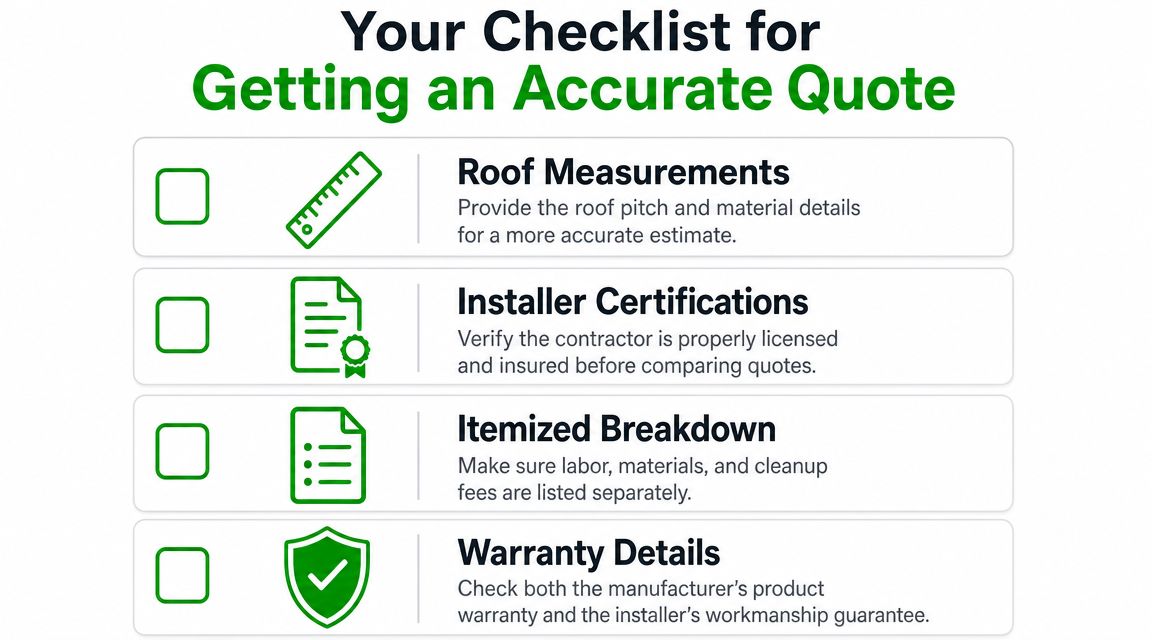
The quote gets sharper once the scope gets sharper. A skylight replacement, a new install through a tiled roof, and a leak repair around failed flashing are different jobs with different labour, risk, and finishing work. If you want a useful number, give the installer enough detail to price the job properly.
Start with the outcome you want
This is the part many people skip.
If the room is dark, say when it feels dark and how often you use it. If the room is hot, humid, or stale, say that clearly too. In plenty of NSW homes, the better solution is not a larger skylight but improved airflow through the roof space, especially where summer heat is building above the ceiling.
That distinction saves money. It also avoids paying for a daylight product when the actual issue is comfort.
Gather the site details before you call
Good installers ask these questions early because they affect access, labour time, and the chance of extra trade work.
Roof material
Tile, corrugated metal, and concealed-fix metal roofs all need different cutting and flashing methods.Roof pitch and storeys
Steep roofs, limited access, and two-storey homes usually take longer and may need extra safety setup.Ceiling type below
A flat ceiling often needs a shaft, plastering, and paint work. A raked or cathedral ceiling can be simpler, but not always.Room location and use
A hallway, bathroom, kitchen, and stairwell each call for a different approach to light, privacy, and ventilation.Photos of the inside and outside
Clear photos help an installer spot likely complications before anyone visits site.
If you want to understand the steps that affect labour and finish quality, read this guide to installing a skylight.
Ask for an itemised quote
A single lump sum makes comparison harder. Itemised pricing shows where the money is going and whether two quotes cover the same scope.
Ask for these items to be separated:
- Skylight unit
- Roof cutting and installation labour
- Flashing and weatherproofing
- Internal shaft framing
- Plastering and paint finish
- Electrical work, if the unit is powered
- Waste removal and clean-up
One quote may include internal finishing and another may stop at making the roof watertight. Those are not equal offers.
Ask what is excluded. That is where cost surprises usually sit.
Clarify who is responsible for what
Product warranty and installation warranty are often handled by different parties. Get that clear before work starts.
Ask these questions directly:
- Who handles leaks after installation?
- Is the flashing a manufacturer-approved system or a custom site detail?
- Who repairs internal cracking or movement around the shaft if it appears later?
- Who coordinates follow-up trades if plaster, paint, or electrical work is needed?
A well-prepared quote does more than give you a price. It shows whether the installer has assessed the roof, the ceiling, and the home's comfort problem with enough care to recommend the right solution.
Beyond Light The Impact on Energy Efficiency
A skylight changes more than the look of a room. It changes how the home handles heat, glare, and comfort. Done well, it can improve daylight and reduce reliance on artificial lighting during the day. Done poorly, it can add unwanted summer heat and make temperature control harder.
That's why the cost of skylight decisions shouldn't be separated from the home's overall energy behaviour. Glazing choice matters. Installation quality matters. Orientation matters. So does the question of whether the house really needs more daylight, more airflow, or a broader energy-efficiency upgrade.
For many NSW homes, the smartest outcome comes from looking at the roof as a whole system. Daylight is one piece. Ventilation is another. Solar generation, battery storage, hot water efficiency, and EV charging can all sit within the same long-term plan to reduce running costs and improve comfort. If your priority is lower household spend, it's worth stepping back and reviewing practical ways to reduce electricity bills before committing to any single upgrade in isolation.
The right answer isn't always the biggest skylight or the cheapest quote. It's the solution that fits the room, the roof, and the way the whole home performs.
If you're weighing up skylights, roof ventilation, solar, battery storage, or EV charging, Interactive Solar can help you look at the full energy picture instead of treating each upgrade as a separate decision. A practical assessment can save you from spending on the wrong fix first.
Make Interactive Solar a preferred source in Google
One click tells Google to surface our articles more often in Top Stories, AI Overviews and AI Mode.