
Commercial Solar Panels Cost: Your 2026 Australia Guide
You're probably here because the quotes don't line up.
One installer talks about panel brands. Another leads with a headline system size. A third promises fast payback, but the proposal barely mentions your switchboard, export limits, or what happens if your business doesn't use much power during the middle of the day. That's where most confusion around commercial solar panels cost starts.
For Australian businesses, the crucial question isn't “What do commercial solar panels cost?” It's “What will this system cost me to own, connect, operate, and turn into savings over time?” The cheapest quote often wins attention first, but not profit. A low number on page one can hide expensive compromises in design, electrical scope, inverter selection, or grid connection work.
Why Smart Businesses Look Beyond the Price Tag
If you've looked at commercial solar recently, you've probably noticed that panels themselves are no longer the whole story. That shift matters. Global benchmark data used in Australian market analysis show commercial PV system costs fell 77% between 2010 and 2024 according to photovoltaic pricing trend benchmarks. That long decline changed the economics of the industry.
It also changed where the risk sits.
Years ago, hardware cost dominated the conversation. Today, a lot of the difference between a strong project and a disappointing one sits in the parts of the quote many buyers skim past. Roof complexity. Switchboard upgrades. Metering changes. Compliance. Grid connection requirements. Export controls. Installer capability. Those items decide whether a system is smooth to deliver and profitable to run.
Cheap solar and profitable solar aren't the same thing
A low quote can still be the wrong investment if it ignores how your site works. A warehouse with steady daytime load can justify a very different design from an office that empties out early, or a factory with seasonal demand swings. Two businesses can have similar roof area and end up needing very different systems.
That's why “price per panel” isn't a useful buying metric for most commercial projects.
Practical rule: Judge a proposal by its design logic first, and its headline price second.
The better question is whether the installer has designed around your business. Have they checked your interval data or at least your billing pattern? Have they flagged site constraints early? Have they shown where the solar will be consumed, where it may be exported, and what could trigger extra electrical works?
Think like an asset owner
Commercial solar should be treated like a long-term operating asset, not a commodity purchase. The value comes from how reliably it offsets grid power, how well it integrates with your site, and how little rework it creates after installation.
A quote that looks higher at first can be the better financial decision if it includes the right inverter strategy, realistic connection planning, and enough electrical detail to avoid ugly surprises later. That's especially true on larger rooftops where one overlooked issue can hold up commissioning or force redesign.
Businesses that get the best outcome usually do one thing well. They stop shopping for the lowest sticker and start comparing total project quality.
The Key Components That Shape Your System's Cost
Most articles about commercial solar panels cost reduce everything to a simple installed rate. That misses what drives commercial project value. In Australia, site-specific requirements such as switchboard upgrades, interconnection, engineering, and compliance often matter more than the module price itself, as discussed in this overview of non-panel commercial solar cost drivers.
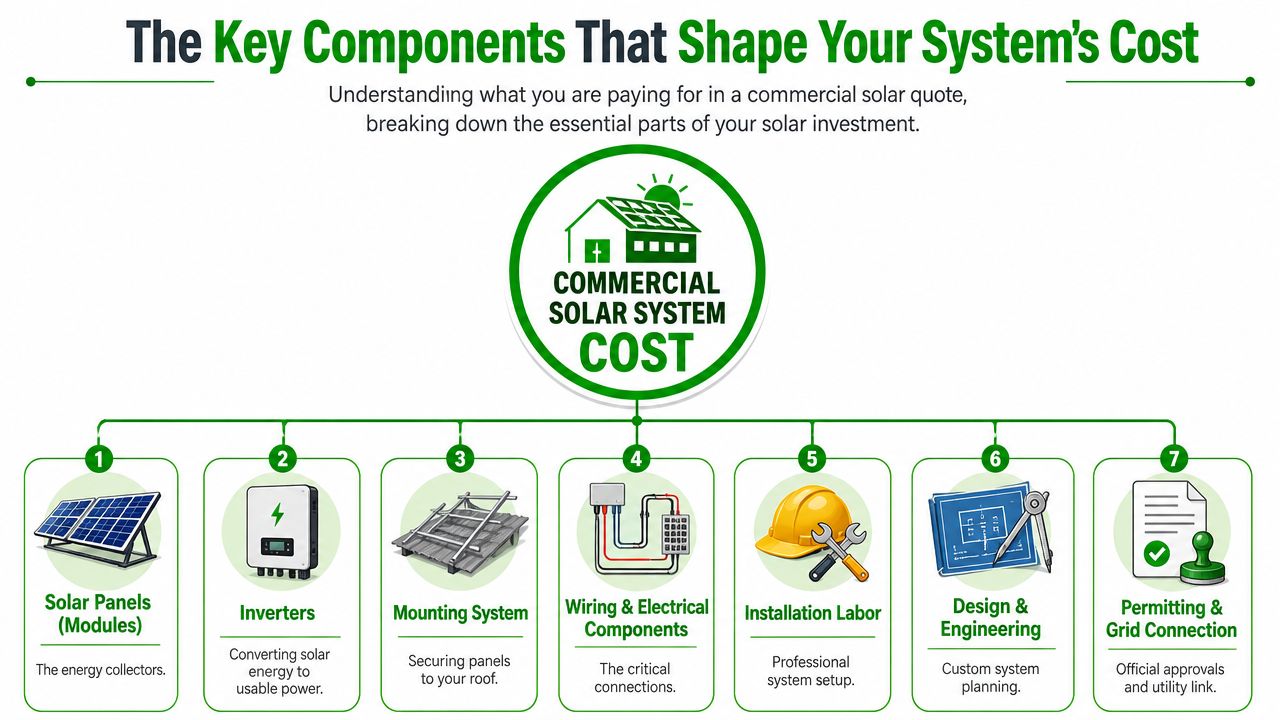
What you're actually paying for
A commercial quote usually includes far more than panels and labour. The core cost stack often looks like this:
- Solar modules. These generate the electricity, but they're only one part of the system. Panel efficiency, product warranty, degradation profile, and suitability for your roof layout all affect long-term value.
- Inverters. Many proposals diverge due to inverter choices. String inverter layouts, DC design, monitoring capability, and replacement planning all influence system performance and serviceability.
- Mounting system. Roof type changes everything here. Metal deck, clip-lock, tile, membrane, or custom framing each require different mounting methods and waterproofing detail.
- Electrical balance of system. Cabling, isolators, protection devices, combiner arrangements, meter changes, and switchboard integration all sit here. In this category, under-scoped proposals often unravel.
- Design and engineering. Good solar design isn't just about fitting more panels. It includes array layout, electrical architecture, structural review where needed, and compliance planning.
- Installation labour. Experienced crews move faster, make fewer mistakes, and usually leave a cleaner handover.
- Permitting and grid connection. Approval work isn't glamorous, but delays here can stall the whole project.
Where quote quality usually separates
Two quotes can look similar on capacity and equipment brand yet be very different in quality. One may include realistic assumptions for connection and switchboard work. The other may leave those as provisional or unstated.
Use this quick comparison when reviewing proposals:
| Quote item | Strong proposal | Risky proposal |
|---|---|---|
| Scope detail | Clearly lists inclusions and exclusions | Uses broad wording with little detail |
| Electrical works | Notes switchboard, metering, protection, shutdown needs | Treats electrical integration as minor |
| Layout logic | Explains orientation, shading, and inverter grouping | Shows a panel count but little rationale |
| Compliance path | Mentions approvals and connection process | Assumes approvals are straightforward |
| Aftercare | Includes monitoring and fault response plan | Focuses only on install day |
A commercial solar quote should read like a delivery plan, not just a shopping list.
The non-panel costs that deserve attention
The highest-value questions to ask are often the least glamorous:
- Switchboard condition. Is the existing board suitable, or does it need upgrade work before solar can be connected?
- Roof attachment method. What mounting system is being used, and is it appropriate for the roof material and age?
- Inverter placement. Where will inverters sit, and how will that affect cable runs, service access, and weather protection?
- Monitoring access. Will your team be able to see faults and production issues quickly?
- Future compatibility. If you later add batteries, EV charging, or more load, will the design support it?
If you're comparing module options, it also helps to understand how newer panel formats fit commercial use cases. This guide to bifacial solar panels in 2025 is useful background, especially if your project includes reflective surfaces, carparks, or ground-mount elements.
How Your Property's Unique Profile Affects the Investment
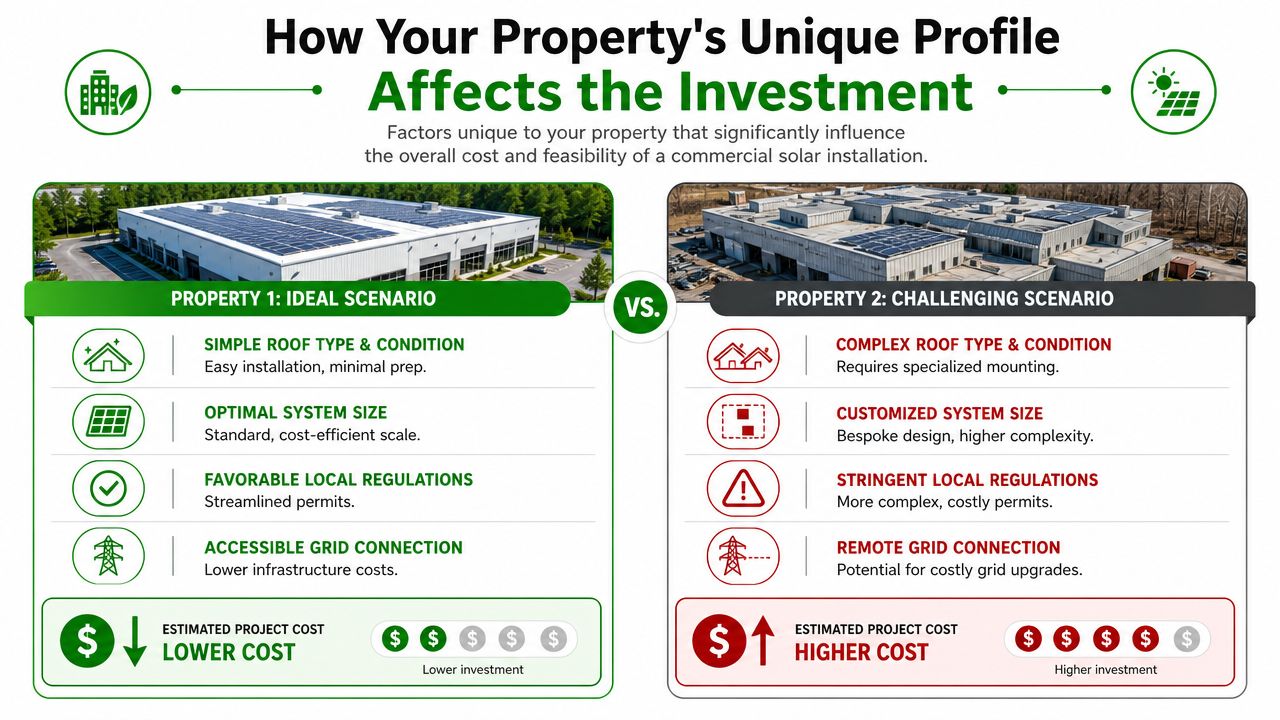
A commercial solar system is built around a site, not a brochure. The same equipment can be straightforward on one property and awkward on another. That's why any serious assessment starts with the building itself.
Roof shape, access, and condition
A large, open metal roof is usually easier to work with than a roof broken up by plant equipment, skylights, parapets, height changes, or restricted access paths. More complexity means more design time, more mounting detail, and usually more labour.
Roof condition matters just as much. If the roof is near the end of its service life, installing solar first can create avoidable future cost. Removing and reinstalling arrays later is rarely a smart surprise.
A proper site review should ask practical questions such as:
- Can the roof carry the proposed layout?
- Are there waterproofing or penetration concerns?
- Will maintenance walkways or safety access reduce usable area?
- Is shading present at certain times of day or year?
Connection conditions can reshape the project
Some sites look ideal from the street and still face connection issues once the electrical review starts. Export limits, switchboard layout, transformer capacity, and meter configuration can all affect what gets approved and what it costs to deliver.
That's one reason remote assumptions from satellite imagery aren't enough. A reputable installer should want to inspect the main board, sub-boards, cable paths, and roof access before locking in the final design.
If a provider is happy to finalise a commercial quote without properly reviewing your site, they may be pricing for speed, not accuracy.
Ground conditions can also matter on projects that include carpark structures, ground-mount sections, or civil works around the installation area. In those cases, engineering input around footing and soil performance becomes relevant. For businesses planning larger external structures, this resource on specialized ground improvement design gives useful context on why sub-surface conditions can influence buildability and long-term stability.
What a good site assessment looks like
You should expect more than a sales walkthrough. A worthwhile assessment usually includes:
- Energy review. How and when the site uses power.
- Physical inspection. Roof type, access, available area, obstacles, and safety requirements.
- Electrical inspection. Main switchboard, metering, spare capacity, and likely upgrade points.
- Connection strategy. Whether the project should aim for self-consumption, controlled export, staged rollout, or future battery integration.
The property itself often decides whether a quote is realistic. That's why comparing proposals without comparing assumptions is risky.
Sizing Your System for Maximum Financial Return
A bigger system often looks better on a proposal. More panels. More generation. Lower installed cost per watt at scale. But bigger isn't automatically better for your business.
For commercial PV, the key benchmark is the installed system cost, and benchmark work from NREL's 2023 Commercial PV ATB uses a fixed O&M assumption of US$18/kWDC-year in a commercial context, showing why larger systems can benefit from scale when fixed costs are spread across more capacity, according to the commercial PV benchmark framework. The catch is important. That advantage only holds when the extra kilowatts are useful to the site.
Useful kilowatts beat maximum kilowatts
If your business consumes most of its power during daylight hours, a larger array may perform well. If your site shuts down early, has low daytime demand, or already operates efficiently, an oversized system can push too much generation into export. That's where returns often soften.
The strongest commercial designs start with load profile, not roof area.
Look for an installer who wants to understand:
- When your site uses electricity
- Whether load is steady or peaky
- How weekdays differ from weekends
- Whether seasonal operations change demand
- If future electrification will increase daytime load
A warehouse with refrigeration, a workshop with daytime machinery, and a school with holiday shutdowns all need different sizing logic.
Oversizing can create diminishing returns
Many business owners assume that if some solar is good, more solar must be better. That only works when the site can absorb the production at good value. If the project ends up exporting heavily during low-value periods, the extra panels may add capacity without adding proportionate savings.
That's why careful design beats aggressive design.
The most profitable system is rarely the one that fills every available square metre. It's the one that matches generation to your tariff and your operations.
This matters even more if you're considering future batteries or EV charging. A battery can improve how much solar gets used on site. EV charging can create a new daytime load if vehicles are present when the sun is up. But those additions need to be planned, not assumed.
For businesses weighing system size options, this overview of commercial solar solutions is a useful reference point for how system design should align with operational demand rather than just roof capacity.
Leveraging Australian Incentives to Reduce Upfront Cost
Australian commercial solar economics are heavily influenced by the federal certificate framework. For many businesses, that incentive is the first thing that makes a project move from “interesting” to “financeable”.
The most important national pricing signal here is the STC reference price, which was A$38.00 per certificate for the fortnight ending 31 May 2026 according to NREL documentation referencing Australia's STC market. Because businesses are commonly quoted on an installed basis after certificates are deducted, that reference price directly affects the effective upfront capital cost seen in proposals.
How the certificate benefit usually appears in a quote
Most business owners don't need to master certificate trading mechanics. They do need to know how the benefit shows up in their paperwork.
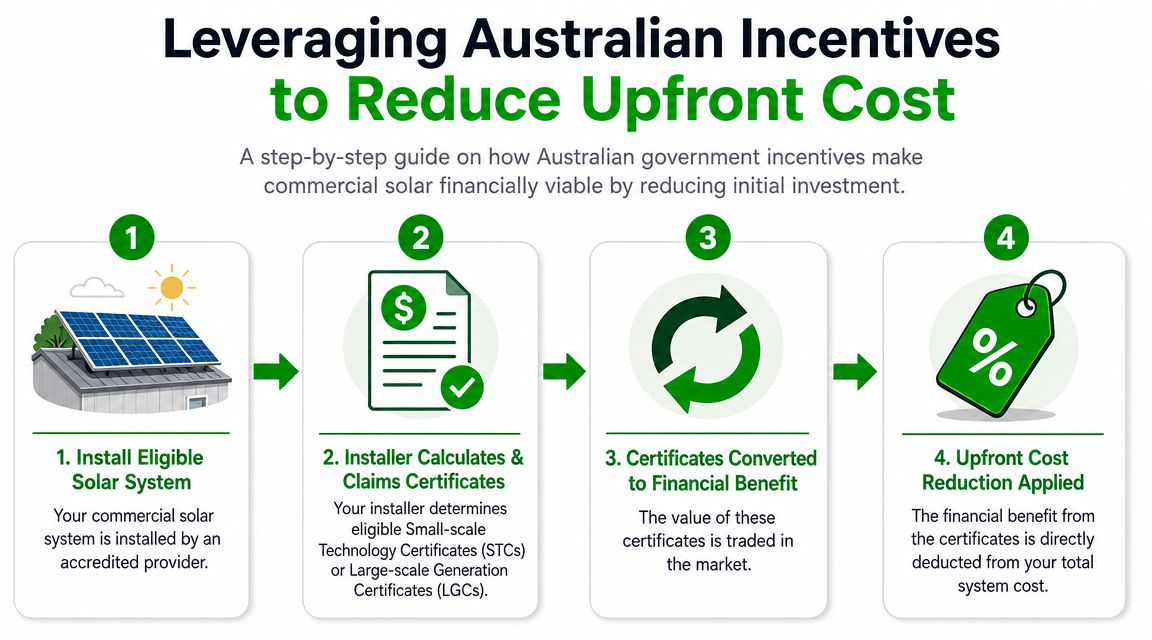
In practical terms, the process usually works like this:
- Your eligible system is designed and installed through an accredited pathway.
- The certificate entitlement is calculated based on the project rules that apply.
- That certificate value is converted into a financial benefit within the market structure.
- The installer reflects that benefit in the quoted project cost, reducing the amount you're comparing and funding upfront.
That's why one proposal may look materially different from another even before you get into equipment quality or electrical scope.
A short explainer can help if you want the broad picture first:
Incentives help, but structure still matters
Government incentives reduce upfront cost. They don't guarantee a good project. A poorly sized or poorly connected system can still underperform even with certificate support baked in.
Businesses should also consider how the purchase will sit inside a broader capital strategy. Some owners prefer a direct purchase. Others want to preserve cash and review finance or lease structures. Separately, tax treatment may also affect the attractiveness of the investment. For owners discussing the accounting side internally, this guide to understanding instant asset write-off benefits is a useful starting point to review with an accountant.
If you're in New South Wales, it's also worth checking current program context and installer guidance through resources on NSW solar rebates and government rebate pathways.
How to Calculate Solar ROI Beyond Simple Bill Savings
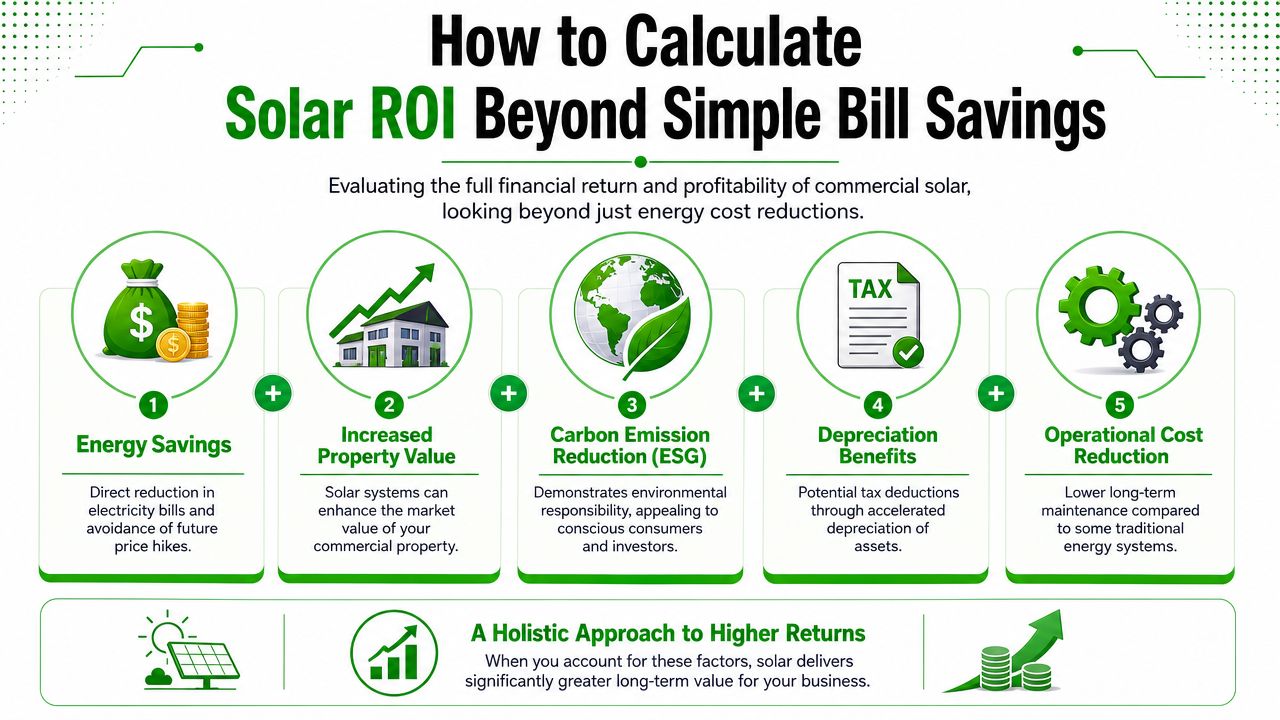
A lot of commercial solar proposals still lean on a basic story. Install system. Reduce bill. Wait for payback. That approach is too thin for most businesses.
Australian commercial customers deal with variable network charges, tariff complexity, and wholesale price volatility. Recent analysis highlighted in this discussion of the commercial solar tariff reality points to a more useful question in 2026: what is the least-cost configuration for the site's load and tariff, not just how much the panels cost.
Start with tariff fit, not generic savings
Two businesses with the same annual consumption can get very different financial outcomes from the same array size. The difference often comes down to tariff structure and usage timing.
A proper ROI review should look at:
- Self-consumption. How much solar your site uses directly during operating hours.
- Export exposure. How often the system sends excess power back to the grid, and during which periods.
- Demand behaviour. Whether solar meaningfully reduces the parts of the bill that hurt most.
- Operating pattern. If the site runs consistently, seasonally, or in short intensive windows.
- Control options. Whether batteries, export limiting, or load shifting would improve value.
If a proposal only shows annual generation and an estimated bill reduction, it's incomplete.
Simple payback can hide weak design
Simple payback is popular because it's easy to explain. But it can flatten out the details that matter. It doesn't always show whether savings are front-loaded into strong self-consumption or diluted by low-value exports. It may not reflect future operational changes either.
A more useful commercial question is this: how does the system behave on your actual site, under your actual tariff, during your actual business hours?
A system that offsets expensive daytime imports is usually worth more than a larger system that floods the grid when your building is barely using power.
That's why batteries deserve a place in the conversation, even when they're not installed on day one. In some cases, the best return doesn't come from adding more panels. It comes from making more of your solar generation usable through storage, controls, or shifting flexible loads into solar hours.
ROI is also an operations decision
Commercial solar affects more than the electricity line on your monthly bill. It can improve forecasting, reduce exposure to tariff changes, and support electrification plans such as EV charging or equipment upgrades. But those benefits only materialise when the design reflects how the site runs.
A sensible review process usually includes:
| ROI lens | What to test |
|---|---|
| Energy value | When solar generation overlaps with site demand |
| Tariff exposure | Which charges are being reduced, and which are not |
| Export outcome | Whether excess production earns acceptable value |
| Expansion path | If batteries or EV charging may improve returns later |
| Operational fit | Whether system performance aligns with trading hours and occupancy |
If your energy costs have been climbing and you're reviewing alternatives, this article on rising energy costs and available options is a useful companion to the ROI conversation.
Your Path to a High-Performing Commercial Solar System
A strong commercial solar outcome usually starts with a boring step that too many buyers skip. Proper assessment.
You want a provider who looks at the roof, the switchboard, the meter setup, the load profile, and the connection pathway before presenting the final answer. That process can feel slower than a quick online estimate, but it saves time where it counts. During engineering, approvals, and commissioning.
What to do before you sign
Use this shortlist when comparing proposals:
- Ask for load-based sizing logic. Don't accept a system size chosen only from roof area.
- Review exclusions carefully. If switchboard upgrades, metering changes, or grid works are vague, ask for clarity in writing.
- Check serviceability. Inverter placement, access paths, and monitoring matter after handover, not just on install day.
- Look at install capability. Commercial projects benefit from teams that can handle electrical detail in-house.
- Plan for future loads. If you may add batteries, EV charging, or new plant, ask whether the design leaves room for that.
What usually goes wrong
The most common project disappointments aren't caused by the sun or the panels. They come from under-scoped electrical work, weak site review, oversized systems, or poor installation standards.
That last point matters more than many owners realise. Product quality helps, but workmanship determines whether the system runs cleanly for years. This guide on why installation quality matters in advanced solar systems is worth reading before you compare final offers.
The right commercial solar investment isn't the one with the lowest sticker. It's the one that fits your site, your tariff, and your business operations well enough to keep delivering long after the sales process ends.
If you want a commercial solar assessment grounded in real site conditions, load profile, and long-term performance, Interactive Solar can help. Their team delivers turnkey solar, batteries, EV charging, and installation support for Australian homes and businesses, with in-house electricians and practical guidance from design through after-care.
Make Interactive Solar a preferred source in Google
One click tells Google to surface our articles more often in Top Stories, AI Overviews and AI Mode.