Solar Tube Skylights: A Bright Idea for Sydney Homes
If you're turning lights on in the middle of the day, your home is telling you something. In Sydney and across greater NSW, plenty of houses have dark hallways, internal bathrooms, walk-in robes and kitchens that never quite get enough natural light. That's frustrating on its own, but it also points to a bigger energy issue. Every daytime light switch you rely on adds to the bill you're already trying to control.
That's why solar tube skylights are worth looking at as more than a lighting upgrade. Used properly, they can trim daytime lighting demand, improve comfort, and make the rest of your home energy plan work harder. Lower consumption first. Then size solar PV and batteries around a more efficient home, instead of paying to cover waste.
A lot of homeowners start with panels, which makes sense. But in practice, the best results usually come from tackling the easy daytime loads as well. Daylighting, roof ventilation, solar PV and battery storage all work better when they're planned as one system rather than as separate purchases.
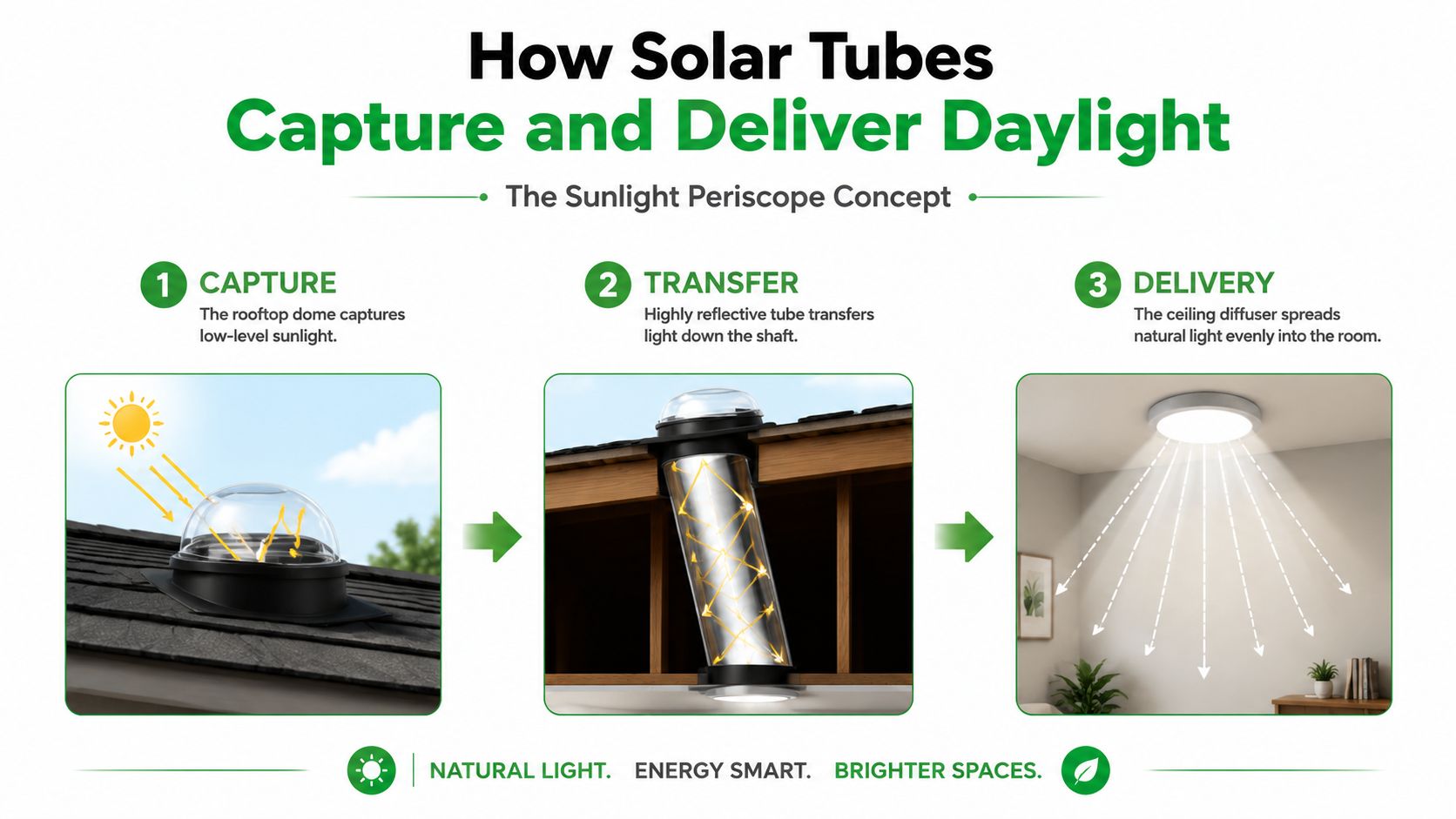
How Solar Tubes Capture and Deliver Daylight
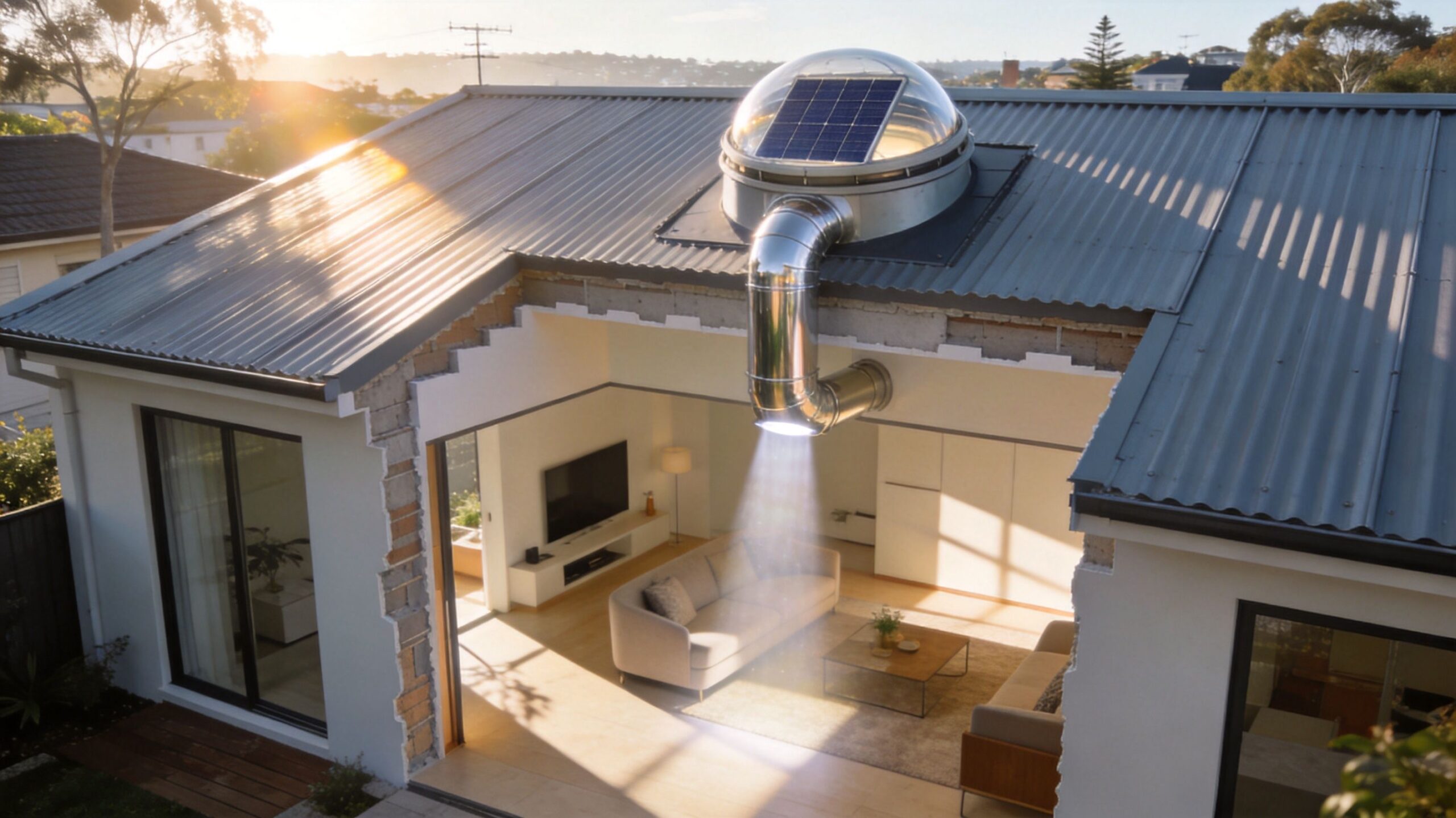
Think of a solar tube as a periscope for sunlight. It grabs daylight on the roof, sends it down a reflective pathway, and spreads it into the room below in a way that feels soft rather than harsh.
That simple idea is why solar tube skylights suit so many NSW homes. You get natural light where a window can't go and where a full skylight would be excessive, expensive or awkward to install.
The dome on the roof
The top section is the rooftop collector. Its job is to gather available daylight across the day, not just when the sun is directly overhead.
Modern systems use LightTracker Reflectors to capture low-angle sunlight and super-reflective tubing with 99.7% specular reflectance, which helps minimise light loss even over 6 to 12 metre runs common in Australian homes, according to Solatube technical specifications for the 14-inch 290 DS kit. That matters in real houses where the best ceiling position isn't always directly under the ideal roof spot.
The reflective tube in the roof space
The middle section does the hard work. This tube channels light through the ceiling cavity or roof space and keeps as much of it intact as possible.
In straightforward installs, the route is short and almost vertical. In trickier homes, the path might need to dodge framing, ducting or other services. Product quality and installation quality start to matter a lot more in these situations than brochures suggest. A high-performing tube can carry useful daylight deep into the home, but a poor route or sloppy fit-out can leave you with less light than expected.
A good installer treats the run like a light path, not just a hole through the roof.
Practical rule: The best roof location isn't always the best ceiling location. Good daylighting design balances both.
The diffuser in the ceiling
At the room end, the diffuser spreads the incoming light so it feels even and usable. You're not looking up at a sharp beam of sun. You're getting broad ambient light that makes a dark room feel naturally occupied.
That's one of the reasons solar tube skylights work so well in circulation spaces. Hallways, laundries and internal bathrooms don't usually need a sky view. They need reliable daytime light without glare.
A quick way to understand the three parts is this:
- Collector dome: Captures sunlight from above, including lower-angle daylight.
- Reflective tube: Transfers that light through the roof space with minimal loss.
- Ceiling diffuser: Delivers the light into the room in a softer, more even spread.
What works well is simple. Keep the light path sensible, use a quality product, and install it where the daylight will replace switched lighting for a good part of the day. What doesn't work is treating solar tubes like a decorative feature first and an energy tool second.
The Real Benefits for Your Home and Wallet
The appeal of solar tube skylights isn't just that they brighten a room. Their primary benefit is what that light replaces. In many homes, it replaces hours of artificial lighting use, improves how rooms feel during the day, and avoids the thermal penalty people often worry about with larger glazed roof openings.
Better daytime living
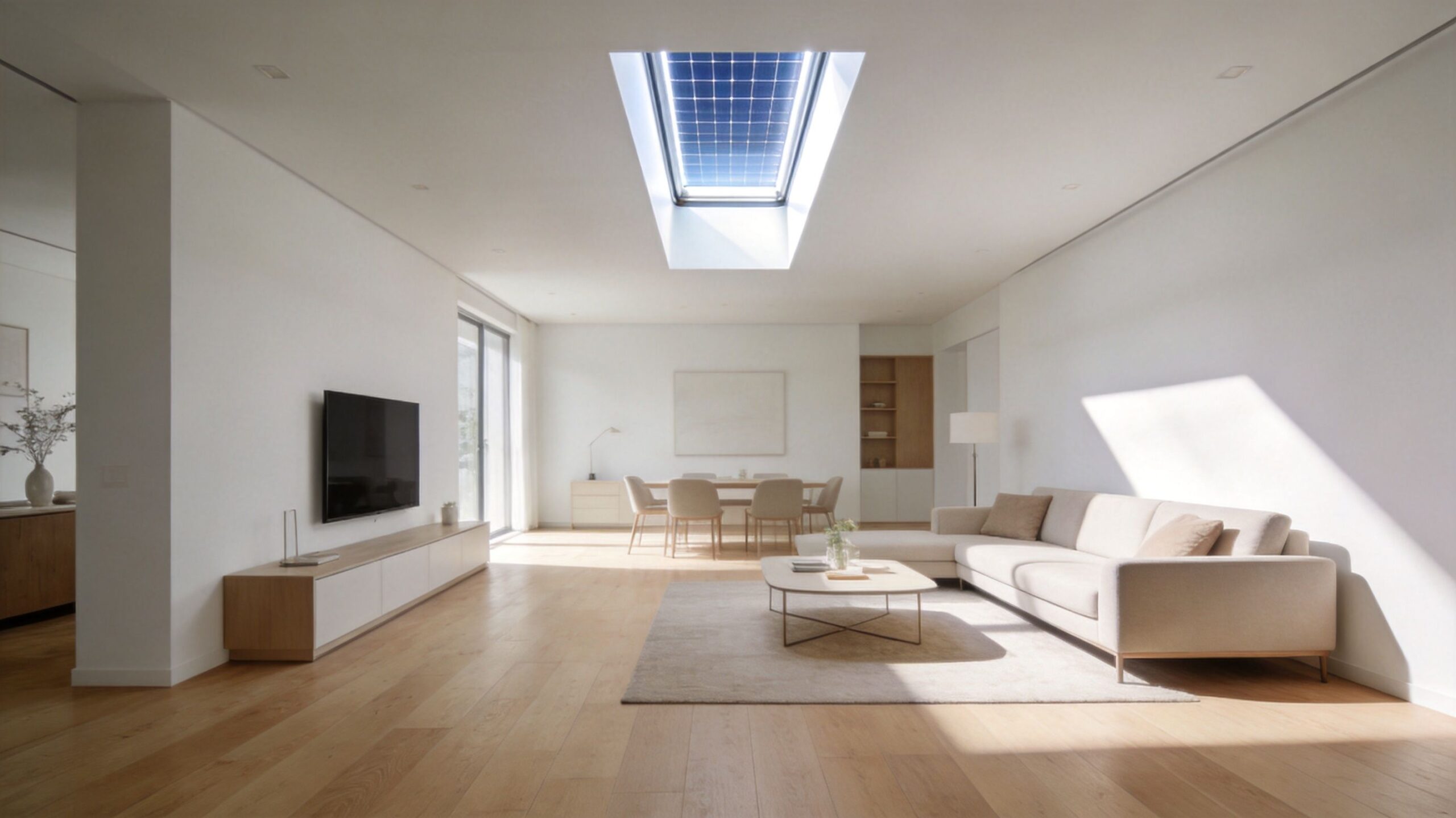
Dark interiors change how people use their homes. They make bathrooms feel closed in, hallways feel narrow, and kitchens feel flat even when the layout is good.
Natural light changes that immediately. Colours read better. Rooms feel cleaner. People use those spaces more comfortably without touching a switch. In practical terms, that matters because upgrades people notice are the ones they value and keep using properly.
Solar tube skylights are especially strong in rooms where you want daylight but don't need a view out. That's why they often outperform more complex alternatives in internal areas.
Lower lighting demand
These systems fit into a wider energy strategy. In NSW, solar tubes can contribute to 40 to 60% savings on electricity used for lighting and reduce artificial lighting needs by up to 70% during daylight hours, while also blocking 99% of harmful UV rays, according to tubular skylight market data covering NSW performance claims.
Those gains matter most when daylighting is paired with the rest of the home's energy plan. If you reduce daytime lighting demand first, your solar system can cover a larger share of what remains. If you're reviewing broader ways to reduce electricity use at home, daylighting belongs in that conversation alongside appliance timing, ventilation and solar self-consumption.
For a broader household view, DLG Electrical also shares practical tips to lower your monthly electricity bills that complement this kind of upgrade well.
More light without the usual heat penalty
Homeowners often assume any roof daylight product will add unwanted summer heat. That concern is reasonable. It's also where solar tubes usually compare well against larger glazed skylight openings.
Because the delivered light is controlled through the tube and diffuser system, the result is typically more measured than direct overhead glazing. You get usable daylight in the room without turning the ceiling into a solar hot spot. The UV blocking also helps protect finishes, flooring and furnishings from fading.
Good daylighting should lower your reliance on switched lighting without creating a new cooling problem.
The biggest financial mistake is looking at solar tube skylights as a stand-alone purchase. The better approach is to treat them as part of load reduction. Once daytime consumption drops, every solar export, every battery cycle and every self-consumed kilowatt-hour becomes more valuable.
Solar Tubes vs Traditional Skylights
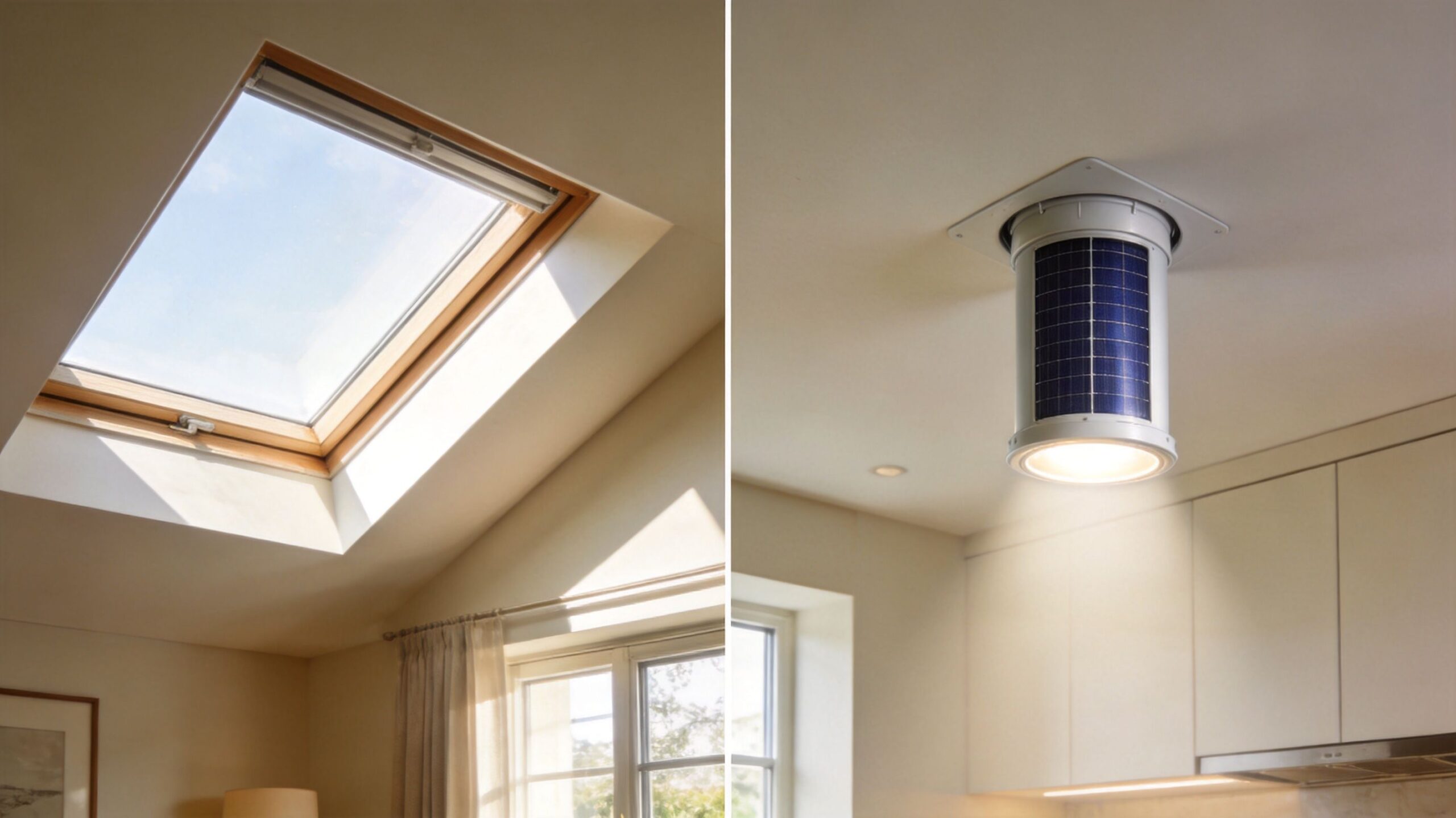
If you're choosing between solar tube skylights and traditional skylights, the right answer depends on what problem you're solving. If you want a view of the sky and a strong architectural statement, a traditional skylight may suit. If you want efficient daylight in a dark part of the home with less roof disruption, solar tubes usually make more sense.
The practical differences that matter
The biggest differences show up in installation, leak risk, heat management and where each product works best.
According to this comparison of skylights and solar tubes, traditional skylights can cost over $3,000, while solar tubes are often half the price to install, can be fitted in about 2 hours, carry less than 1% leak risk, and transmit 99% of visible light versus 36% for some skylights. Those are strong figures, but they only matter if the product suits the room.
Here's the simple comparison homeowners usually need:
| Decision point | Solar tube skylights | Traditional skylights |
|---|---|---|
| Best use | Internal rooms, hallways, bathrooms, robes | Larger living zones where a sky view matters |
| Roof impact | Smaller penetration | Larger opening |
| Light quality | Diffused and even | More direct, often more dramatic |
| Heat behaviour | Usually easier to manage | Can add more unwanted heat gain |
| Leak exposure | Lower when installed properly | Higher because the opening is larger |
| Placement flexibility | Easier to fit into awkward plans | More constrained by structure and design intent |
Where skylights still win
Traditional skylights aren't a bad option. They're just a different tool.
If you're renovating a main living area and want openness, visual drama and a connection to the outdoors, a skylight can do something a tube can't. Solar tube skylights don't create that architectural effect. They're functional first.
That's why I usually frame the choice this way:
- Choose a skylight when you want view, volume and design impact.
- Choose a solar tube when you want practical daylight, simpler installation and a lower-risk roof penetration.
- Choose carefully if the room already runs hot, because overhead glazing needs more thermal thought.
For homeowners also weighing workmanship quality across any roof penetration, this guide on why installation quality matters in advanced energy systems is worth reading.
A quick visual walk-through helps if you're comparing both options in a real roof context.
What tends to work best in Sydney homes
In established Sydney housing stock, solar tube skylights often win in the rooms people struggle with most. Internal corridors. Bathrooms in the middle of the floorplan. Laundry zones. Small kitchens with poor side-window access.
What doesn't work is using them where the actual brief is “I want a design feature”. They'll improve the room, but they won't replace the feeling of a large glazed roof opening. When the goal is lower daytime electricity use with minimal fuss, they're usually the more practical choice.
Ideal Locations and Common Limitations
The best solar tube installations solve a specific problem. They don't just add daylight somewhere random. They target rooms that use lights during the day and can't easily be improved with standard windows.
Where they usually perform best
The strongest locations are the ones with high daytime use and poor natural light.
- Internal hallways: These are often the easiest win because people pass through them all day and they rarely have windows.
- Bathrooms and ensuites: Privacy stays intact, but the room feels brighter and cleaner.
- Walk-in robes and laundries: These spaces benefit from even light more than from outside views.
- Kitchens in the centre of the home: A well-positioned tube can lift the working light in a dark kitchen zone.
The common thread is simple. If the room needs daytime illumination more than outlook, a solar tube is often a strong fit.
Where the design gets harder
Not every house offers an easy path from roof to ceiling. Two-storey homes can be more restrictive. Busy roof spaces can also complicate the run.
Existing solar PV is the limitation people ask about most. It's a valid concern, but it's not always a deal-breaker. With good planning, roof elements can often coexist. In homes where temperature build-up is also part of the problem, daylighting should be considered alongside roof ventilation options for NSW homes, because a brighter room that still traps heat won't feel properly solved.
The best location on paper can be the wrong location in the roof space. A site check matters more than a floorplan guess.
What doesn't work well
There are situations where solar tube skylights aren't the best answer.
- Rooms that need a view: If the homeowner wants openness and sky connection, a tube won't deliver that.
- Highly obstructed roof spaces: Heavy service congestion can make the route awkward or compromise output.
- Poorly chosen placements: Installing one off-centre in a large room and expecting it to replace the whole lighting design usually leads to disappointment.
The honest approach is to match the product to the job. Solar tube skylights are excellent at targeted daytime lighting. They are not a cure-all for every dark room in every house.
Installation Considerations for NSW Homes
NSW homes bring their own installation realities. Roof type, pitch, humidity, bushfire exposure and existing rooftop equipment all affect how well a solar tube performs over time. The product matters, but the install details matter just as much.
Roof material and pitch matter
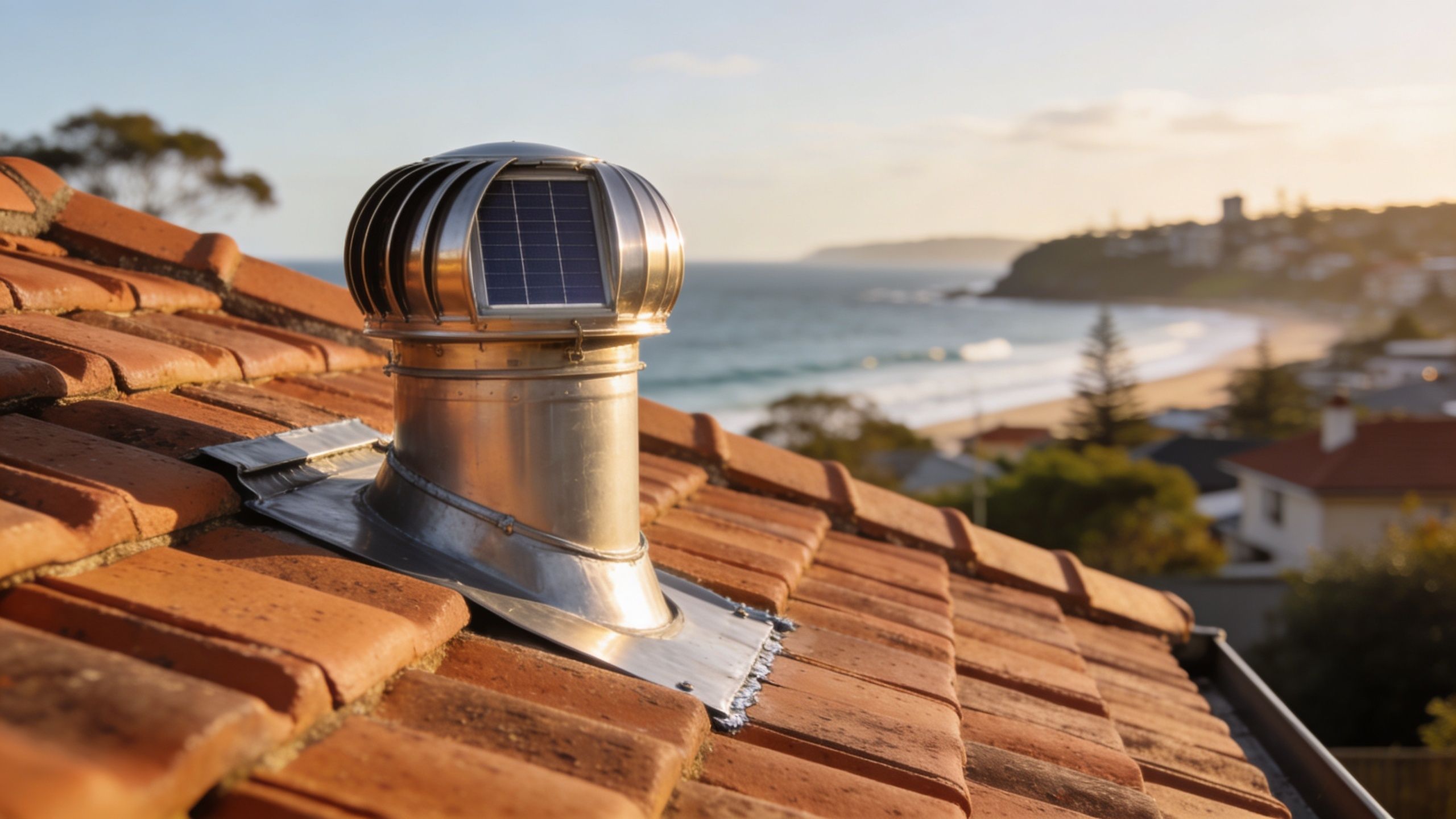
A lot of local homes use Colorbond metal or tile roofs, and many sit within the 30 to 45 degree roof pitch range common in Australia. In that context, proper installation is critical. Solar tubes are often preferred in bushfire-prone areas because of their minimal glazing risk, but they may require custom flashing to suit these roof conditions, as noted in this discussion of Australian roof conditions and solar tubes.
That's the sort of detail homeowners rarely see in product marketing. A tube that performs well on paper can still underperform if the flashing kit isn't right for the roof profile or pitch.
Humidity, sealing and long-term performance
Sydney's mix of heat, humidity and sudden weather shifts means sealing work has to be done properly. The weak point in any roof penetration is rarely the concept. It's the workmanship.
That includes:
- Correct flashing selection: Metal and tile roofs need different approaches.
- Thoughtful tube routing: The path should protect output, not just fit around obstacles.
- Clean sealing and ceiling finishing: A neat interior diffuser means little if the roof detail is poor.
If the house is already being upgraded for energy performance, this is also the stage to think about available NSW solar rebate pathways and support settings, especially when daylighting is being considered alongside larger solar works.
Why licensed installation matters
Roof penetrations aren't the place to chase shortcuts. On a practical level, you want a licensed team that understands roofing interfaces, weatherproofing and how daylighting interacts with other rooftop assets. Interactive Solar operates with fully licensed electricians under Licence #329360c, which is the level of compliance and accountability homeowners should expect from any contractor doing this kind of work.
A clean-looking diffuser inside the room tells you almost nothing about the quality of the roof work above it.
What works in NSW is a system matched to the roof, the pitch and the home's broader energy plan. What doesn't work is treating solar tube skylights like a generic off-the-shelf add-on with no local design thought.
Frequently Asked Questions
Do solar tube skylights still work on cloudy days
Yes, but expectations need to be realistic. They work best with available daylight, not just direct sun. On bright overcast days they can still make a dark hallway, bathroom or robe much more usable. On very gloomy days, you may still want artificial lighting for task-heavy activities.
The key point is that they reduce daytime reliance on switched lighting. They don't eliminate the need for electrical lights in all weather and at all times.
Do they need much maintenance
Not much, if they're installed properly and the roof detail is sound. In most homes, maintenance is mostly about occasional inspection rather than ongoing adjustment.
A sensible routine includes:
- Check the ceiling diffuser: Dust can dull the finish over time.
- Inspect after major roof work: Any trade working nearby should leave the unit and flashing undisturbed.
- Watch for moisture signs: Condensation stains or ceiling marks should be investigated early.
If there's a problem, it's usually installation-related rather than because the concept itself is high-maintenance.
Can a solar tube be added to a roof that already has solar panels
Often, yes. This comes up a lot because many Sydney homes already have PV or plan to add it.
Recent innovations allow 10 to 20 metre tube runs around existing solar PV arrays with less than 5% light loss, according to this article on long-run Solatube layouts. That doesn't mean every roof will suit it, but it does mean panel layouts are no longer the automatic blocker they once seemed to be.
In practice, the sequence matters. If you're planning both daylighting and solar PV, design them together. That avoids wasting prime roof real estate or forcing awkward compromises later.
Are they suitable for the low-pitch roofs common in some Sydney suburbs
They can be, but the product choice and roof detail matter. The same source notes that emerging hybrid models are being adapted for low-pitch roofs under 20 degrees, which is relevant for suburban homes that standard kits don't always suit.
That's why a generic online answer isn't enough. Low-pitch roofs need a proper assessment of water management, flashing and collector position. Some homes are straightforward. Others need a more customised approach.
Do they help with the bigger goal of lowering grid reliance
Yes, if you treat them as part of the full strategy. Solar tube skylights lower daytime lighting demand. That means your home needs less purchased energy for the same comfort and usability.
From there, the next steps are usually clearer:
- Reduce avoidable daytime loads such as switched lighting.
- Improve roof-space behaviour through ventilation if heat build-up is part of the issue.
- Add solar PV sized around actual consumption patterns.
- Consider battery storage if evening use and tariff structure justify it.
That order isn't mandatory for every household, but it's often the most efficient way to build toward lower bills and greater energy independence.
Are they better than a skylight in every situation
No. They're better in specific situations.
They're usually the better choice when you want efficient light delivery into an internal room with less roof disruption. They're not the better choice when your priority is a sky view, dramatic ceiling effect or a major architectural statement. A lot of disappointment comes from choosing the wrong tool, not from a bad product category.
What questions should I ask before installing one
Ask practical questions, not just product questions.
- Where will the tube start and where will it end
- What roof material and flashing method will be used
- Are there obstacles in the roof space
- Will future solar PV or ventilation works affect placement
- What happens if the chosen room still needs more light than expected
For broader homeowner queries around integrated energy upgrades, Interactive Solar also has a useful frequently asked questions resource.
What's the biggest mistake homeowners make
They assess solar tube skylights in isolation.
A dark room is rarely just a lighting issue. Sometimes it sits under a hot roof. Sometimes the home already has poor daytime energy habits. Sometimes rooftop space is being claimed by future solar, ventilation or EV-related upgrades. The most cost-effective result usually comes from planning all of that together instead of solving each item one at a time.
If you want honest advice on where solar tube skylights fit into your wider home energy plan, speak with Interactive Solar. They can help you look at daylighting, roof ventilation, solar PV and batteries as one coordinated strategy to cut electricity bills and reduce reliance on the grid.
Make Interactive Solar a preferred source in Google
One click tells Google to surface our articles more often in Top Stories, AI Overviews and AI Mode.