
Commercial Solar Installation Liverpool Experts
Last updated:
Your power bill lands. It’s higher again. You compare it against the same month last year, then against your production schedule, your warehouse hours, your HVAC load, your forklifts, your office air con, your refrigeration, or your machinery. Nothing feels unusual, yet the bill still bites.
That’s the point where many Liverpool business owners start looking at commercial solar installation Liverpool options seriously. Not because solar sounds good in theory, but because electricity has become an operational risk. If energy is one of the few major costs you can actively control, it makes sense to treat it that way.
For businesses in Liverpool NSW, solar isn’t just about lowering daytime electricity purchases. It’s about building more certainty into your cost base, improving site resilience, and making smarter use of a roof that currently does nothing for the business.
The Business Case for Solar in Liverpool NSW
It usually starts in a finance meeting. The business is still trading well, but energy is becoming harder to forecast. For a Liverpool warehouse, factory, school, medical site, or multi-tenant facility, that matters because power is tied directly to operating margin.
Commercial solar makes sense when it is assessed the same way you would assess any other capital works decision. What does it reduce, what does it protect, and how long does it take to pay back?
For many businesses in south-west Sydney, the strongest case is simple. A well-matched system can cut expensive daytime electricity purchases, improve cost certainty, and turn unused roof area into an asset that supports the site every working day. The Australian Government’s Solar Consumer Guide notes that commercial systems can reduce bills materially where daytime consumption lines up with solar generation, which is exactly the pattern we see on many Liverpool sites with regular weekday loads.
Why the numbers stack up differently for businesses
A commercial site uses power differently from a home. Loads often start early, stay consistent through business hours, and spike around HVAC, production equipment, refrigeration, server rooms, pumps, or charging. That load shape is what gives solar its financial value.
The best projects are not sold on panel count alone. They are built around three commercial realities:
- Tariff pressure during business hours: Solar offsets electricity when many sites are paying some of their highest usage charges.
- Predictable daytime demand: Businesses with stable daytime consumption usually self-consume more solar and export less at lower rates.
- Long asset life: A system that is designed properly can keep producing value long after the initial payback period.
That last point gets missed. A cheap proposal can look fine on paper and still underperform if the layout ignores shading, switchboard limits, roof access, or future maintenance.
Liverpool conditions matter
Liverpool is not a generic postcode. Local business stock includes older warehouses, newer distribution centres, mixed-use commercial buildings, food operators, schools, and medical facilities. Each has a different load profile, roof condition, and approval pathway.
That is why broad sales estimates are rarely enough. A good business case has to reflect how your site operates. If your plant runs hard from 7 am to 4 pm, solar behaves one way. If your site peaks late in the afternoon, the savings profile is different. If you lease the building, the conversation also has to cover tenancy term, landlord approvals, and who receives the long-term benefit.
Roof condition also affects the business case more than many owners expect. If major roofing works are likely within a few years, staging those decisions properly can save a lot of rework. For context on budgeting that side of the project, many owners first look at typical commercial roof inspection costs before committing to detailed design.
The value goes beyond bill savings
Lower energy bills are the obvious result. Better control over operating costs is often the bigger one.
When part of your electricity is produced on site, budgeting becomes less exposed to tariff changes. That matters for businesses quoting fixed-price contracts, managing tight margins, or planning headcount and equipment upgrades over the next few years. Solar also gives boards and owners a practical way to improve ESG performance without relying on offsets or vague claims.
In some cases, the strategic value is resilience. Solar on its own does not provide backup during a grid outage unless it is paired with the right battery and backup configuration, but it does reduce everyday reliance on grid supply and creates a platform for future battery integration if the economics improve.
If you are comparing solar against other ways to control costs, our guide on options for managing rising energy costs is a useful place to start.
What makes a project commercially sound
The strongest commercial solar projects in Liverpool tend to share the same foundations:
- Good load alignment: The site uses a large share of its electricity while the system is producing.
- Clear occupancy plans: Owner-occupiers and long-term tenants usually get the best return from the asset.
- Real design work before pricing: Roof constraints, switchboard capacity, export limits, and access requirements are checked early.
- A system sized for economics, not ego: Bigger is not always better if excess generation is exported at weak rates.
Projects disappoint for predictable reasons too. Oversized systems, rushed proposals, weak roof planning, and hardware chosen on price alone usually create problems later. I have seen businesses accept a low headline quote, then spend more fixing avoidable issues around cable routes, inverter locations, or roof penetrations after the install has started.
For Liverpool businesses, the business case for solar is not theoretical. It is a site-by-site decision about cost control, asset performance, and how much exposure you want to keep handing to the grid. Interactive Solar approaches that decision the way an operations team or finance lead would. Start with the numbers, test the constraints, and build a system that suits the site for the long term.
Assessing Your Site for Maximum Solar Success
A Liverpool business can have the right budget, the right motivation, and the right roof size, then still end up with a poor solar asset because the site was assessed too lightly at the start.
That early assessment sets the commercial outcome. It affects yield, install cost, service access, shutdown planning, and how much rework appears after the quote is accepted.
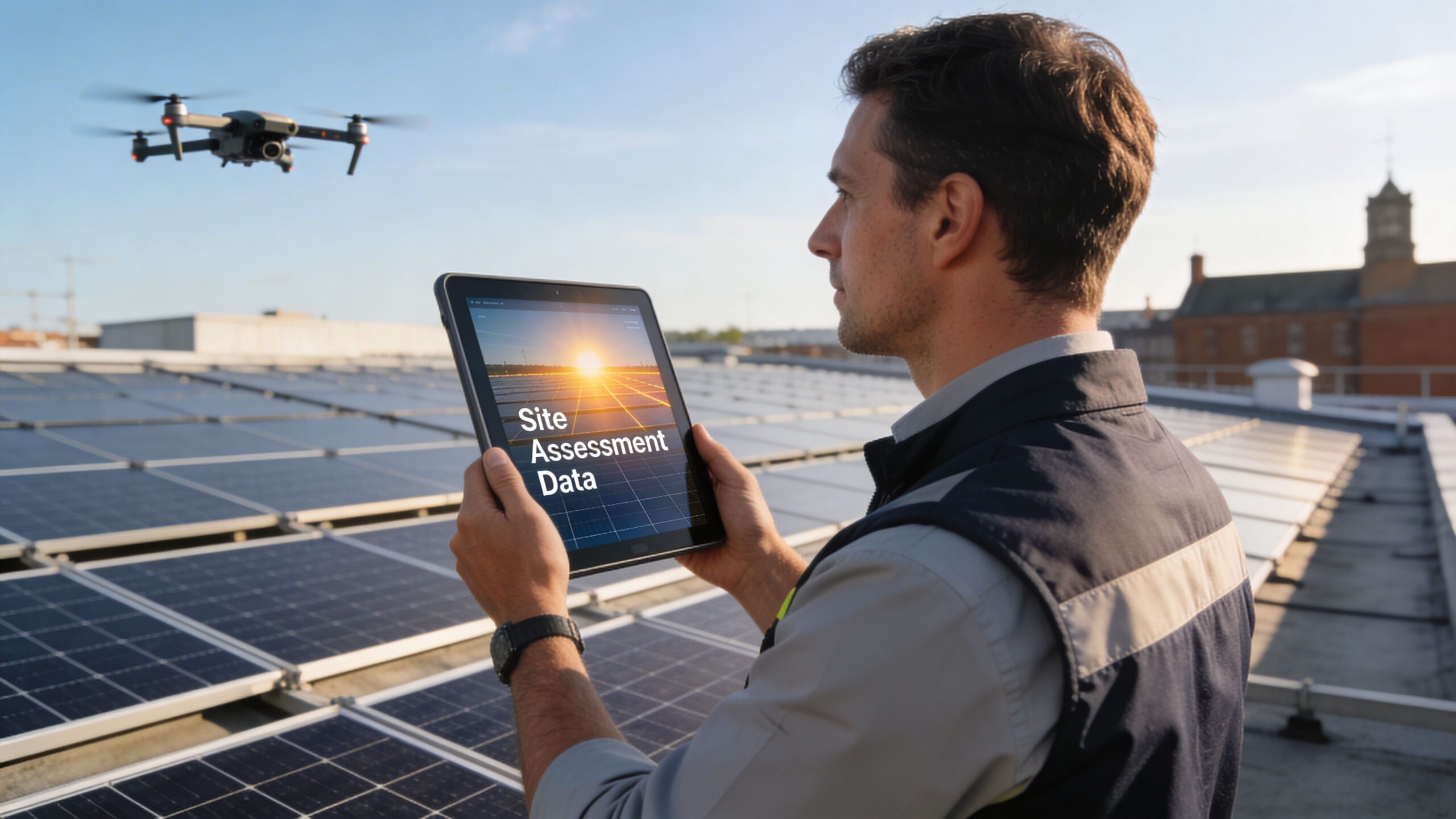
The roof tells you what’s possible
On commercial properties around Liverpool NSW, roof suitability usually decides the shape of the project before equipment selection even starts.
Usable roof area is always smaller than it looks from the ground. Access paths, skylights, plant platforms, vents, parapets, safety setbacks, and fire egress requirements all reduce the array footprint. On some warehouses, the difference is minor. On others, it changes system size enough to alter the payback.
Roof condition is a frequently underestimated aspect of a commercial solar project. If a roof is close to remediation, sheet replacement, or waterproofing work, installing solar first often creates two avoidable costs. Panels may need to come off for roof works later, and the business pays twice for access and labour.
Mounting method matters too. Klip-Lok, corrugated sheet, concrete, membrane, and tiled sections all need different fixing details. The wrong approach can create leaks, warranty disputes, or maintenance headaches that outlast the installation itself. If you need a general reference point before committing to inspections, this overview of commercial roof inspection costs is useful background reading.
Structure decides what can be installed safely
A roof that looks fine from the car park can fail the engineering check once load paths, purlin spacing, fixing zones, corrosion, and wind exposure are examined properly.
For commercial sites, the structural review usually answers four practical questions:
| Assessment area | Why it matters |
|---|---|
| Roof load capacity | Confirms the building can carry the array and mounting system |
| Fixing suitability | Shows how the system can be secured without compromising the roof |
| Wind exposure | Affects engineering, attachment density, and racking layout |
| Access pathways | Protects safe installation and future maintenance access |
I have seen projects in South West Sydney priced on aerial imagery alone, then revised after the engineer gets involved. That usually means delays, redesign, or a smaller system than the client expected.
Orientation, shade, and local conditions affect real yield
Panel count does not equal performance. Output depends on how the roof faces, where shade falls across the day, and how the array can be laid out without creating service or drainage problems.
For Liverpool NSW, the better reference point is local solar resource data from the Australian Government’s Bureau of Meteorology solar exposure tools. That gives a more relevant starting point than generic overseas yield figures. The actual production estimate still needs site-specific modelling, especially on commercial roofs with multiple roof planes, parapets, and rooftop plant.
The main checks are straightforward:
- Orientation: North-facing roof areas are often productive, but east-west layouts can suit businesses with broader daytime demand and limited roof depth.
- Tilt and spacing: These affect generation, drainage, ballast or fixing requirements, and whether one row shades the next.
- Shading: Trees, neighbouring buildings, lift overruns, signage, and HVAC equipment need to be mapped accurately.
- Soiling risk: Dust, leaf build-up, bird activity, and industrial residue can reduce output and increase cleaning requirements.
Monitoring should also be considered early, not as an afterthought. On larger systems, inverter remote monitoring for better solar efficiency helps identify string faults, partial shading losses, and underperformance before they turn into lost savings over several billing cycles.
The electrical side can cap the project
Some sites have plenty of roof space but limited electrical headroom.
A proper assessment checks the main switchboard condition, metering setup, cable routes, available space for protection equipment, and any network export restrictions likely to affect the final design. For owner-occupied warehouses, cold storage sites, workshops, and retail buildings in Liverpool, this step often changes the commercial recommendation. The best answer may be a self-consumption-focused system, an export-limited design, or a staged rollout that matches planned switchboard upgrades.
Good site assessment work answers a harder question than “How many panels fit on the roof?” It determines what the building can support safely, what the network will allow, and what system size will produce reliable savings without creating avoidable cost later.
Designing Your Custom Commercial Solar System
System design is the point where savings are either built in properly or lost on paper before installation starts. For a Liverpool business, that means matching the system to your trading profile, tariff structure, switchboard realities, and future plans, not chasing the biggest panel count.
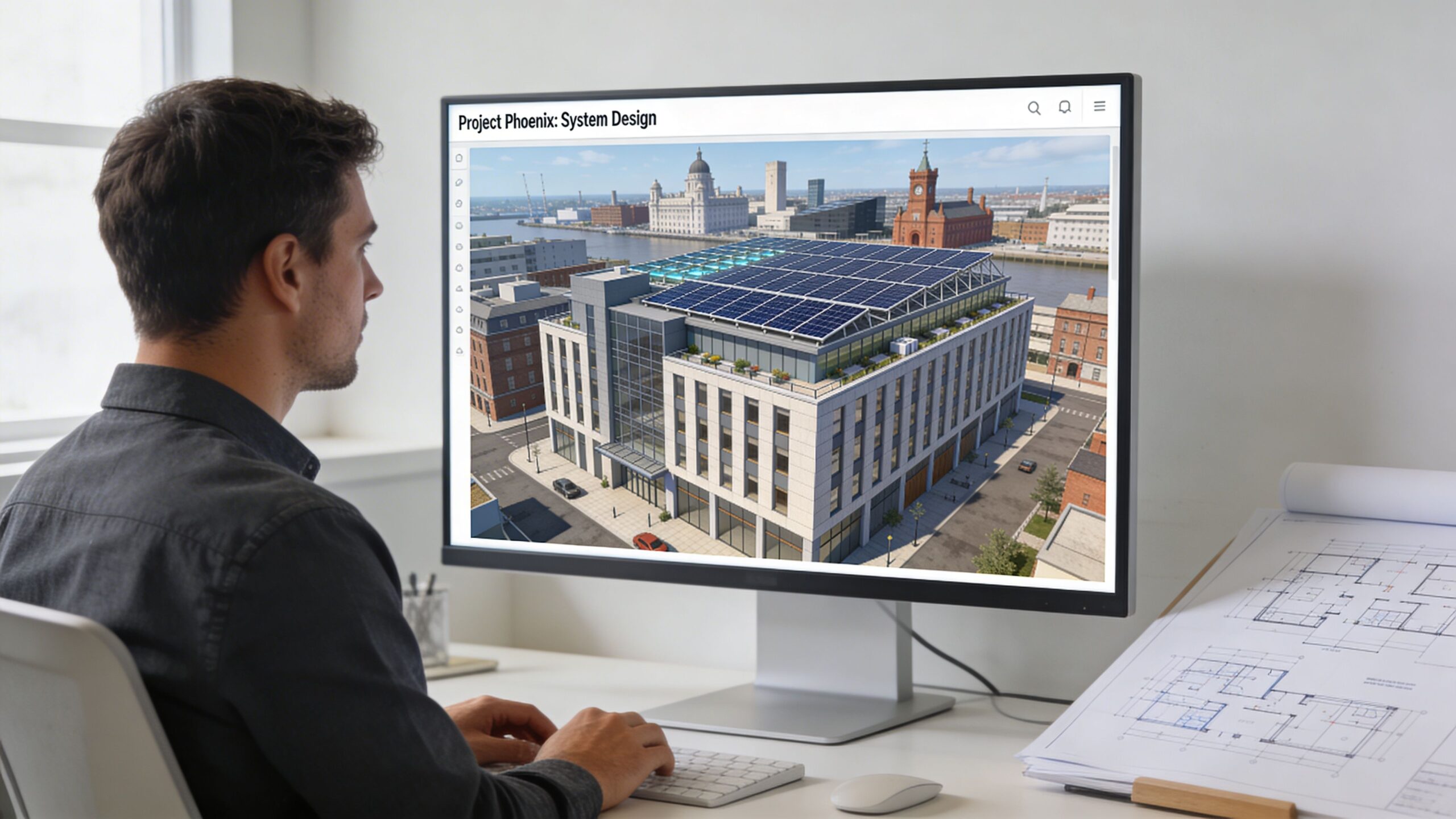
A good commercial design starts with one question. Where will the value come from on this site?
For some owner occupiers in Liverpool, the answer is strong daytime self-consumption. For others, it is demand reduction during working hours, better protection against future tariff pressure, or a staged system that fits planned operational growth. We design around those outcomes first, then choose the hardware.
Panel selection affects more than roof coverage
Panels generate the energy, but panel choice is rarely just a brand decision. Roof area, structural constraints, dust exposure, maintenance access, warranty terms, and expected operating temperature all affect which modules make sense.
On a warehouse or industrial roof, high-efficiency panels can help where usable space is tight because of walkways, setbacks, plant equipment, or exclusion zones. On a larger open roof, the better commercial decision may be a panel that gives dependable long-term yield and service support rather than the highest nameplate efficiency.
In practice, we weigh panel choice against four things:
- Available roof area
- Expected long-term output
- Mechanical suitability for the building
- How the modules pair with the inverter layout
That last point gets missed often. A strong module specification does not guarantee a strong result if the strings are poorly arranged or the operating characteristics do not suit the rest of the system.
Inverter design decides how the system behaves day to day
Inverters convert generation into usable power, but on a commercial site they also shape visibility, fault finding, expandability, and maintenance planning.
String inverter layouts suit many Liverpool commercial roofs because they are efficient, proven, and easier to scale across separate roof zones. Sites with mixed orientations, partial shading, or awkward roof geometry may justify module-level optimisation on selected sections. Larger simple arrays can also suit a more centralised approach, but service access and fault isolation need to be planned carefully from the start.
The trade-off is straightforward. Simpler designs are usually easier to maintain. More granular designs can recover performance on difficult roofs, but they add rooftop components and can increase service complexity over time.
The best commercial design is usually the one that delivers predictable output with the fewest avoidable complications.
Battery storage should be tested against your load profile, not added by default
Battery storage can improve self-consumption and reduce exposure to low export value, but only when the operating pattern supports it. A battery makes more sense on sites with late afternoon demand, evening operation, refrigeration loads, or resilience requirements for selected circuits.
Many Liverpool businesses are better served by making the initial solar system battery-ready rather than forcing storage into stage one. That can mean reserving wall space, selecting compatible inverter architecture, and allowing for future switchboard integration so the option stays open when economics improve or operating needs change.
For businesses comparing options across larger depots, factories, and logistics sites, our guide to industrial solar installation planning in Sydney shows how these design decisions scale on more complex commercial assets.
EV charging belongs in the design brief early
If fleet electrification is even a medium-term plan, it should be part of the solar design discussion now. Charger locations, board capacity, load management, solar production windows, and cable routes all affect project cost.
We see this regularly. A business installs solar, then adds EV chargers later without allowing for spare capacity or practical cable paths. The result is extra electrical work, higher upgrade costs, and a design that could have been cleaner if both pieces were planned together.
Common commercial EV charging use cases include:
- Fleet vehicles returning to base during business hours
- Staff charging in all-day parking areas
- Customer or visitor charging where dwell time is long enough to matter
When charging is aligned with midday generation, more solar stays on site and imported energy drops. That improves the business case.
Good design leaves room for the next decision
Commercial buildings change. Tenants change. Operating hours change. Vehicle fleets change. A solar system should handle that without expensive redesign work.
That is why we often recommend staged thinking at design time. The first stage might focus on the best self-consumption zones and straightforward electrical integration. Later stages can add more array capacity, battery storage, EV charging, or switchboard upgrades once the business case is clear.
Good design is disciplined. It respects how the site runs, what the network is likely to allow, and what will still make sense five years from now. That is how Liverpool businesses get a system that performs reliably and keeps delivering value after the installation crew has left.
The Installation and Permitting Roadmap
A Liverpool business can approve a solar project in one meeting, then lose weeks because the network application was incomplete, switchboard details were missing, or roof access was never properly locked in. The install crew is rarely the first constraint. Approvals, engineering, procurement, and site coordination usually set the pace.
That is the part experienced commercial clients watch closely.
Approvals often decide the real project timeline
For many Liverpool NSW sites, the critical path starts well before panels arrive. Commercial systems may need detailed engineering, distributor review, export assessment, and coordination with the existing electrical infrastructure on site. On larger or more complex sites, network approval can take longer than the physical rooftop works.
Ausgrid sets out the connection and commissioning requirements for embedded generation projects in its solar and embedded generation connection process. For business owners, the practical takeaway is simple. Contract signature does not equal install start.
This catches businesses out when they plan around a quiet trading period but leave no allowance for application review, technical queries, or changes requested after the first submission.
What a well-run commercial project usually involves
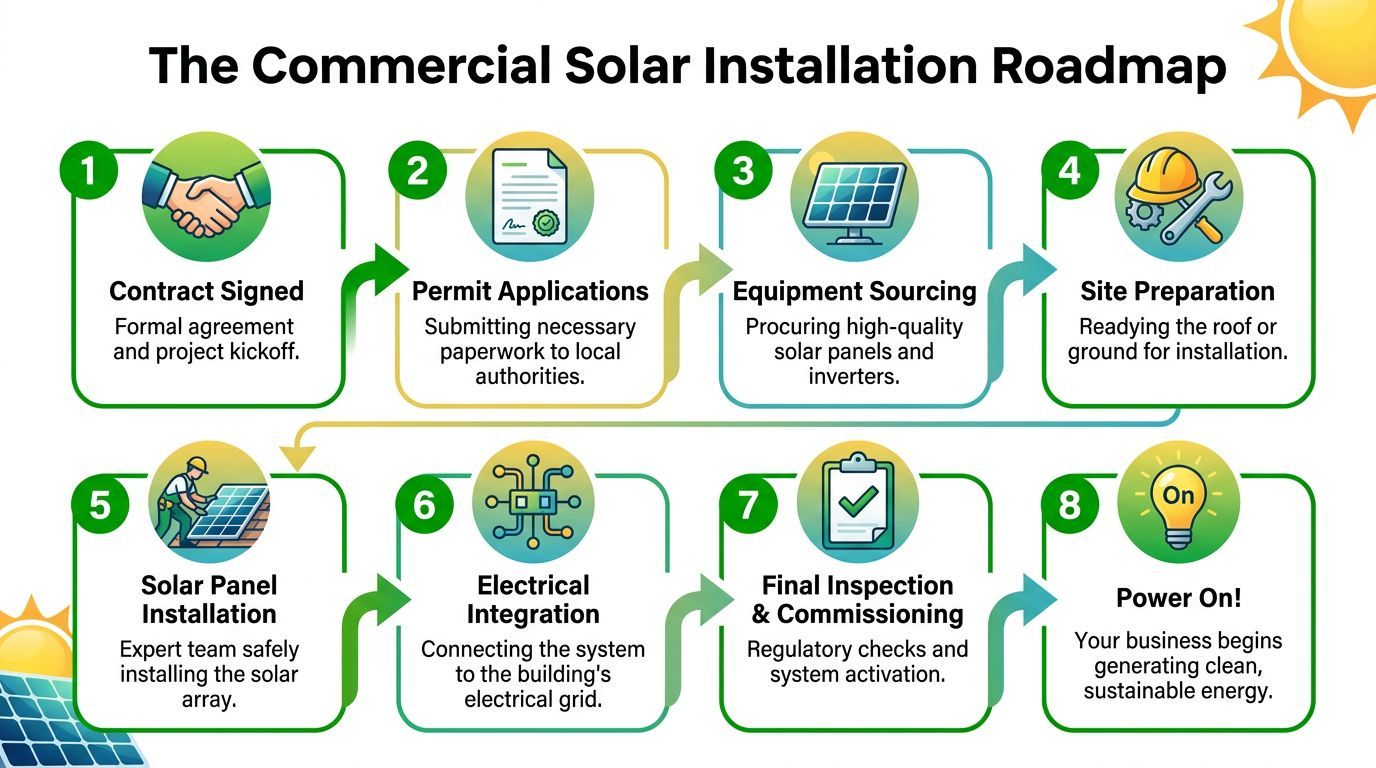
A disciplined rollout follows a clear order:
Contract and project kickoff
Scope, responsibilities, program constraints, and site contacts are confirmed.Detailed engineering
Final electrical and structural documents are prepared for the actual building, not a generic template.Network and authority applications
Connection paperwork, protection details, export settings, and supporting technical documents are submitted.Procurement and scheduling
Equipment is allocated, lead times are checked, and crane, scissor lift, or traffic access needs are booked if required.Site preparation
Safety controls, inductions, roof access, and staging areas are organised around day-to-day business operations.Mechanical installation
Mounting systems, modules, cable trays, and rooftop infrastructure are installed.Electrical integration
Inverters, isolators, protection equipment, metering interfaces, and switchboard works are completed.Commissioning and energisation
Testing, settings verification, labelling, and final closeout are completed before the system is placed into service.
Later in the process, it’s useful to see a live example of how an install comes together on site.
Where commercial jobs usually run into trouble
The pattern is predictable. Access is assumed rather than confirmed. Roof works clash with tenants or warehouse movements. A switchboard upgrade appears late. Network queries sit unanswered because the original documentation was thin.
None of those problems are unusual. They are project management problems, and they cost time.
At Interactive Solar, we plan around business continuity first. For a Liverpool warehouse, that may mean keeping loading zones clear and scheduling shutdowns outside dispatch hours. For an office or mixed-tenancy building, it may mean staging works to avoid interrupting tenants, alarms, lifts, or shared switchrooms. Good coordination protects the savings case because delays, return visits, and variation work eat into project value.
Installation quality shows up after handover
A commercial system can look fine on day one and still create years of avoidable service work if the install quality is poor. Cable support, weatherproofing, rooftop spacing, isolator placement, labelling, and switchboard workmanship all affect how safely and efficiently the system operates over time.
These are the quality markers I tell clients to ask about:
| Quality marker | Why it matters in practice |
|---|---|
| Neat cable routing | Reduces wear, UV exposure, and fault risk |
| Safe service access | Makes inspection and maintenance faster and safer |
| Proper rooftop spacing | Preserves drainage and technician movement |
| Clear labelling | Cuts fault-finding time and supports compliance |
| Commissioning records | Creates a baseline for future performance checks |
Cleaning access matters as well. If panels are boxed into awkward roof areas or service paths are ignored, even routine maintenance becomes harder and more expensive. That is one reason access planning should sit alongside design and installation quality, not be treated as an afterthought. Businesses reviewing long-term upkeep should also understand how commercial solar panel cleaning fits into ongoing performance and service planning.
For a closer look at the workmanship details that affect long-term reliability, see our guide to installation quality in advanced solar systems.
The strongest commercial solar projects in Liverpool are organised in the right order, documented properly, and installed with enough care that the system is still easy to service years later.
Understanding ROI and Financing Your Project
A Liverpool business can approve a solar project and still end up disappointed if the financial model is built on the wrong assumptions. I’ve seen proposals with attractive payback estimates that fell apart once export limits, tariff structure, and actual daytime load were tested against how the site really operated.
A sound ROI review starts with one question. How much grid electricity will your business avoid buying, and at what rate?
Start with the right financial questions
For Liverpool NSW sites, the return usually depends less on system size alone and more on operating pattern. A warehouse with steady weekday loads can justify a very different design from a hospitality venue with late trading, or a factory that ramps up and down across shifts.
The commercial questions that matter are practical:
- How much solar generation will be used on site during business hours?
- What tariff are you offsetting during those hours?
- How much energy will be pushed back to the grid, and what is that export worth under your network conditions?
- Does the business expect load growth, tenancy change, or equipment upgrades in the next few years?
- Would battery storage improve bill outcomes now, or should it stay as a future stage?
That last point matters. Batteries can help some businesses reduce peak demand exposure or hold more solar on site, but they do not improve every commercial project. In many cases, the strongest first move is getting the solar system size right and leaving battery readiness in the design.
How to read the core ROI metrics
A proposal is easier to judge when each metric is tied back to business decisions, not sales language.
Payback period
Payback shows how long it takes for bill savings and upfront incentives to recover the initial spend.
It is useful because it is simple. It is limited because it ignores what happens after payback, and it can hide weak assumptions on maintenance, degradation, or export value.
Internal Rate of Return
IRR helps compare solar against other uses of capital. For an owner-managed business, that might mean comparing the project with plant upgrades, fleet purchases, or debt reduction.
A good IRR does not automatically make a project suitable. It still needs to match your cash position and risk tolerance.
Levelised Cost of Energy
LCOE looks at the long-run cost of each unit of electricity the system produces over its service life. That is a better strategic measure for businesses planning to stay at the site for years.
The comparison is straightforward. If your system can produce power at a lower effective cost than the electricity you currently buy from the grid, the project starts to make commercial sense.
Good solar modelling should still make sense after conservative assumptions are applied. If the returns disappear as soon as export income is reduced or maintenance is added, the proposal needs another pass.
The variables that change the outcome
Two businesses on the same street in Liverpool can get very different returns from similar systems. The difference usually comes from energy behaviour, tariff setup, and operational constraints.
| ROI driver | What it affects in practice |
|---|---|
| Daytime self-consumption | Higher on-site use usually improves savings |
| Retail tariff and demand structure | Changes the value of each kWh the system offsets |
| Export approval conditions | Limits how much oversized generation is worth |
| Tenancy security | Affects how much time the business has to realise the return |
| Maintenance planning | Protects output and shortens fault response time |
Maintenance is often underestimated in financial modelling. Output losses from dirt build-up, undetected inverter faults, or poor access do not show up in the sales brochure, but they do show up on the power bill. That is why service planning should be built into the project from day one, including practical items such as commercial solar panel cleaning where site conditions call for it.
Funding paths that businesses commonly use
The best funding structure depends on how the business treats cash, debt, and asset ownership.
Some clients want a direct purchase because they intend to hold the property or operate from the site long term. That usually gives the strongest lifetime return. Others prefer asset finance because preserving working capital matters more than owning the system outright from day one. Lease and power purchase arrangements can also suit businesses that want predictable monthly costs or need to avoid a large upfront spend.
Each option has trade-offs:
- Direct purchase gives full control and strongest long-term value, but uses capital upfront.
- Asset finance spreads cost over time, but interest expense affects total return.
- Lease arrangements can smooth cash flow, but contract terms need careful review.
- Power purchase agreements reduce upfront cost, but the business does not capture the full upside of ownership.
Incentives also affect project economics at the start. For NSW businesses reviewing how certificates and rebate pathways may apply, our guide to NSW solar rebates and government rebate pathways gives the local context that should sit beside any formal commercial proposal.
The best finance decision is the one that supports operations while keeping the project commercially sound. A solar system should lower energy cost without putting pressure on the rest of the business.
Why Liverpool Businesses Choose Interactive Solar
Plenty of companies can sell a solar system. Fewer can stay accountable when the project gets technical, when the roof isn’t straightforward, or when a client needs support after the install crew has left.
That’s usually where local reputation starts to matter.
In Liverpool and the wider South West Sydney market, business owners tend to prefer partners they can reach. They want to know where the stock comes from, who’s turning up on site, who’s handling the electrical work, and who answers the phone if the system needs attention later.
Local presence changes the service experience
A business with a physical base nearby operates differently from a lead-generation brand that outsources everything.
Interactive Solar is based in Chipping Norton, NSW, with its own warehouse, office, and showroom. For commercial clients, that practical footprint matters. Equipment flow is easier to manage. Scheduling is tighter. If an issue needs a site response, there’s a real local team behind the promise.
That doesn’t guarantee every project will be simple. Commercial work never is. But it does change how problems get handled.
In-house teams create tighter quality control
A lot of frustration in commercial solar starts when the sales process and the delivery process belong to different businesses.
Interactive Solar uses in-house installation teams and fully licensed electricians. That creates a more direct line between design intent and on-site execution. The people scoping the work aren’t handing the client off to a rotating chain of subcontractors with different standards.
For a business owner, that usually means:
- Clearer accountability
- Better communication during delivery
- More consistent workmanship across the project
- Fewer surprises at commissioning
There’s also a longer-term benefit. When the same company owns the install quality, after-care tends to be faster and more practical.
Good after-sales support starts before installation. It starts with clear documentation, clean workmanship, and a team that knows the site.
Experience matters when the site isn’t textbook
Straightforward roofs are easy to quote. Mixed-use sites, awkward switchboards, operational access constraints, and staged growth plans are where experience shows.
Interactive Solar brings over 20 years of combined experience across solar, batteries, EV charging, and related energy solutions. That matters because many commercial sites don’t need a single product. They need a staged energy plan.
A warehouse might install solar now, prepare for battery integration later, and add workplace or fleet EV charging as vehicle adoption grows. A provider that understands those interactions can design with the next step in mind, rather than forcing expensive redesign later.
Responsiveness becomes part of the value
Commercial clients don’t judge service on marketing. They judge it when something needs attention.
Interactive Solar commits to swift troubleshooting within 48 hours as part of its after-care approach. That kind of responsiveness matters more to a business than generic promises about customer service, because downtime, uncertainty, and finger-pointing cost time.
There’s also a cultural difference with a family-owned company. The relationship tends to be more direct. You’re not just another postcode in a national pipeline.
If you’re comparing providers for commercial solar installation Liverpool NSW, ask the practical questions first. Who designs it? Who installs it? Who handles approvals? Who comes back if there’s an issue? Where are they based? Who owns the outcome?
Those answers usually tell you more than the sales brochure ever will.
If your Liverpool business is ready to turn roof space into a productive asset, speak with Interactive Solar. The team handles commercial solar, batteries, and EV charging with face-to-face advice, in-house installation, and local after-care from their Chipping Norton base. Book a consultation and get a proposal built around your site, your load, and your business goals.
Make Interactive Solar a preferred source in Google
One click tells Google to surface our articles more often in Top Stories, AI Overviews and AI Mode.