Solar Water Heater Panels Your Guide for Sydney Homes
Last updated:
If your power bill keeps climbing and you've already changed lights, watched standby loads, and shifted appliance use, hot water is often the next place to look. In many Sydney homes, it remains in the background, drawing energy every day whether anyone thinks about it or not.
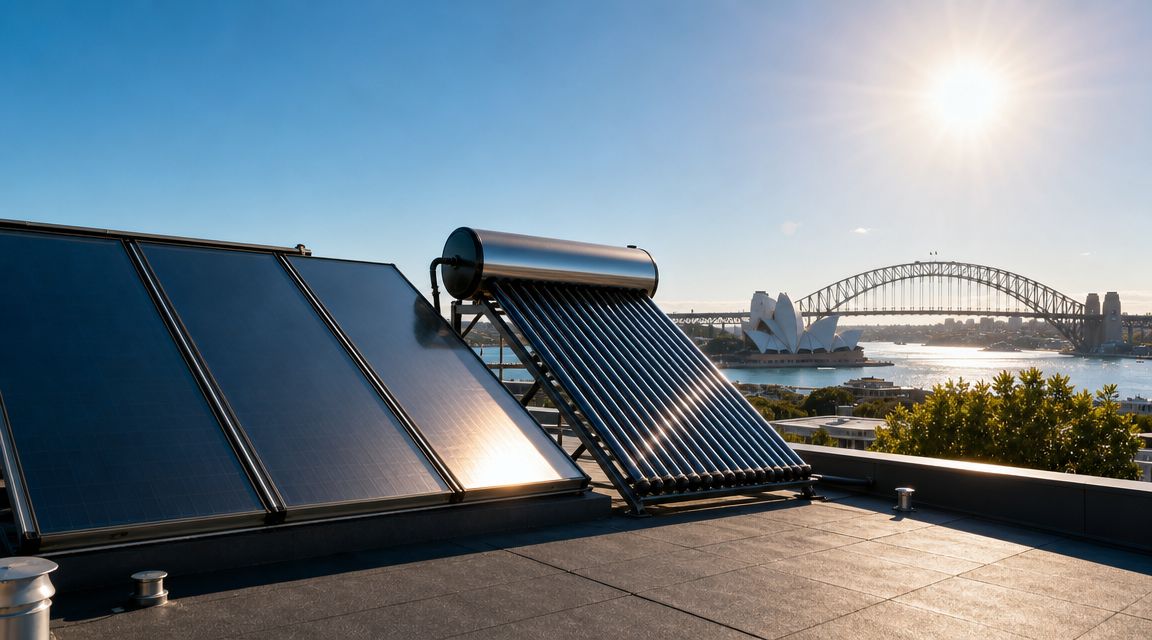
That's why solar water heater panels still deserve serious attention. They aren't a novelty product and they aren't a leftover from an earlier wave of green technology. They're a practical way to turn NSW sunshine into something every household uses daily. Hot showers, kitchen cleaning, laundry, and morning routines all depend on reliable hot water.
For homeowners who want lower bills, better energy resilience, and a system that keeps delivering over the long term, solar thermal can be a smart investment when it's matched properly to the home. The details matter. Roof direction matters. Tank placement matters. Plumbing design matters. And the installer matters more than is commonly understood.
Your First Step Towards Lower Energy Bills
A common trigger for exploring solar water heating comes after a shared experience. The bill arrives, you scan the total, and you know the house isn't using power carelessly enough to explain it. The hidden culprit is often your hot water system.
That's what makes solar water heater panels so compelling. They target one of the most consistent energy loads in the home. According to the U.S. Department of Energy, solar water heating systems can reduce water-heating bills by 50% to 80% on average through solar water heaters. For a homeowner, that's not a minor tweak. It's a direct hit on a core household expense.
Why hot water deserves attention
Lighting has become more efficient. Appliances have improved. Even air conditioning is often used more deliberately than it was years ago. Hot water is different because demand stays steady. People still shower before work, wash dishes after dinner, and run loads of washing through the week.
A well-designed solar hot water system works with that routine instead of against it. It captures heat during the day, stores it, and reduces how much backup heating your home needs from the grid or gas supply.
Practical rule: If you want to lower bills without changing your lifestyle much, start with the systems that run in the background every day.
If you're reviewing broader ways to cut household energy use, this guide on how to reduce electricity bills is a useful place to compare where hot water fits into the bigger picture.
Not new technology. Mature technology.
One reason solar thermal still makes sense is that it's established. It isn't an experimental category that needs ideal conditions to work at all. In practice, the value comes from pairing proven hardware with the right roof, the right storage, and the right controls.
Homeowners who already have rooftop energy systems should also think about upkeep across the whole roof space. Good cleaning and inspection habits help every solar asset perform properly, and these solar panel maintenance tips are a sensible reference if your home has, or will have, more than one solar technology working together.
How Solar Water Heating Works A Simple Guide
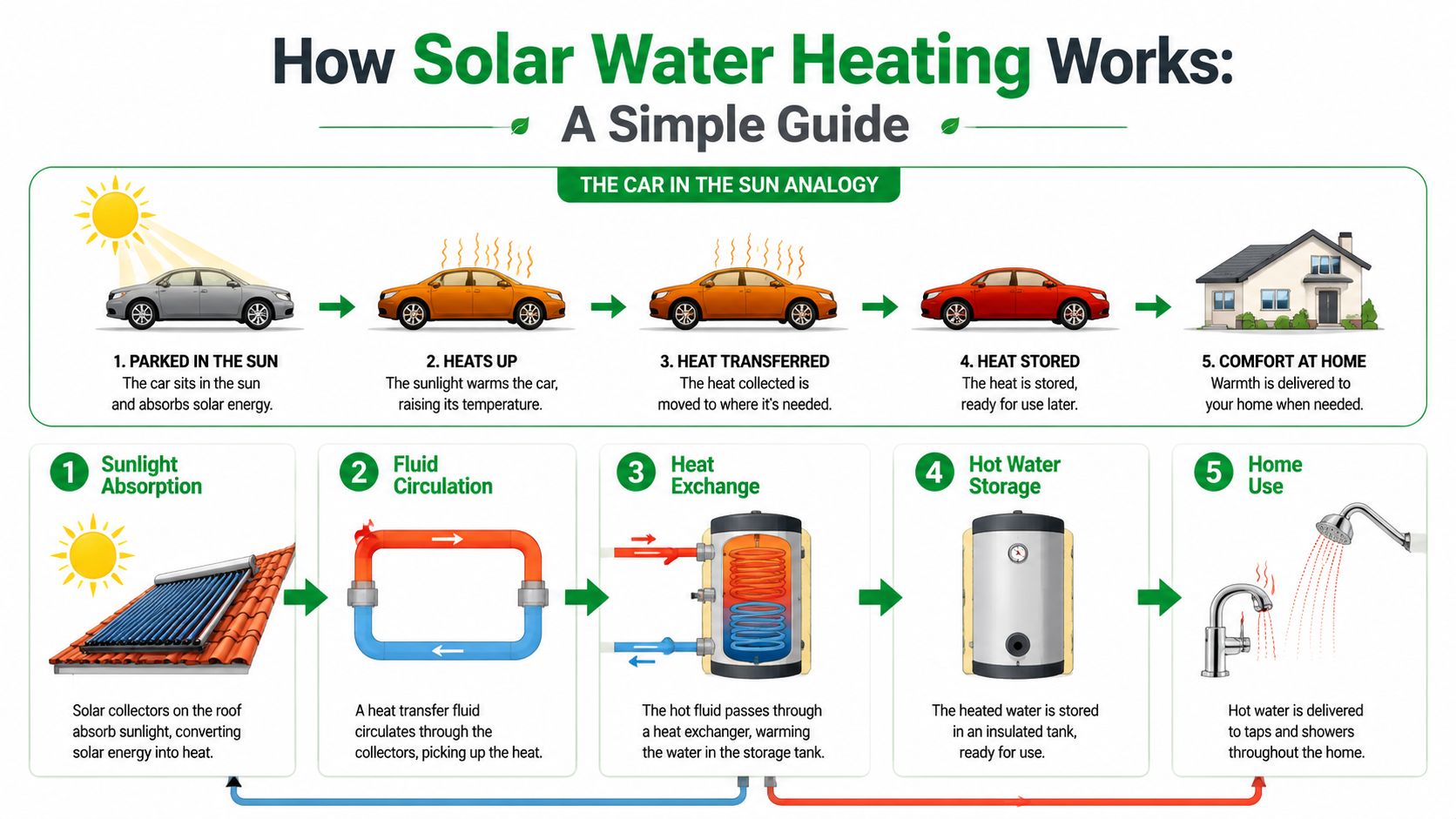
Leave a car in the sun with the windows up and you already understand the basic idea. Sunlight hits a surface, heat builds up, and that heat can be captured and used. Solar water heater panels do that in a controlled, much more useful way.
The three parts that matter
At a practical level, most systems come down to three jobs.
Collect heat
The roof collector absorbs solar energy. Depending on the system, that collector might be a flat-plate panel or a bank of evacuated tubes.Move heat
A fluid circulates through the collector loop and carries that heat away from the roof.Store usable hot water
The heat transfers into a storage tank, where water is kept ready for household use.
That's the core loop. Sun in, heat captured, hot water stored.
What happens inside the system
The easiest way to picture it is to follow the heat rather than the water first.
- On the roof, the collector gets hot in the sun.
- In the pipework, a transfer fluid picks up that heat.
- At the tank, a heat exchanger passes that warmth into stored household water.
- At the tap, you draw the hot water when you need it.
Here's a visual walkthrough of that process:
The backup booster is part of a good system
A proper solar hot water setup doesn't assume every day is cloudless. It includes a booster so the household still has reliable hot water during poor weather, heavy demand, or times when solar gain isn't enough.
That backup may be electric or gas depending on the design. The important point is this: the solar side does the heavy lifting when conditions allow, and the booster covers the gaps. That's how the system stays practical for real households instead of only looking good on paper.
A good solar hot water system doesn't chase perfection. It delivers strong solar contribution and smooth backup when the weather or usage pattern changes.
Common collector formats
The technology itself is well established. Practical system types used in the market include flat-plate, evacuated tube, integral collector-storage, and thermosiphon systems, with additional collector formats also used in broader solar thermal applications, as outlined by the U.S. Department of Energy and related technical guidance. That matters because homeowners aren't buying into an unproven category. They're choosing between mature designs with known strengths, limitations, and installation requirements.
Flat Plate vs Evacuated Tube Collectors
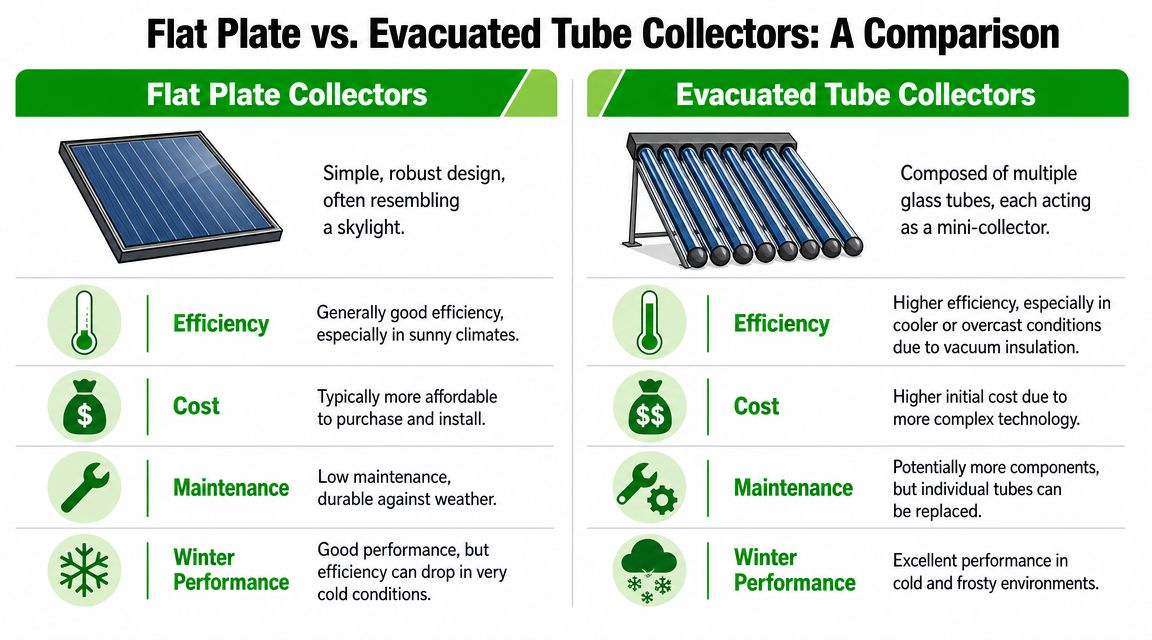
When homeowners compare solar water heater panels, this is usually the first real equipment choice they face. Both options do the same job. They collect solar heat for your hot water system. But they do it differently, and the right choice depends on roof conditions, climate exposure, serviceability, and how much complexity you want overhead.
How flat plate collectors are built
A flat plate collector looks more like a traditional panel. It has a dark absorber surface inside a framed, glazed box. Sunlight passes through the cover, the absorber heats up, and that heat transfers into the circulating fluid.
In Sydney and much of NSW, flat plates often suit homeowners who want a clean, low-profile look and a sturdy piece of hardware with fewer visually exposed parts.
How evacuated tube collectors are built
An evacuated tube collector uses multiple glass tubes. Each tube acts as a mini collector, and the vacuum around the absorber helps reduce heat loss. That insulation effect is the main reason these systems are often chosen where roof conditions or cooler periods make heat retention more important.
They tend to look more technical on the roof, which some homeowners like and some don't.
Comparing Solar Collector Types
| Feature | Flat Plate Collector | Evacuated Tube Collector |
|---|---|---|
| Collector form | One framed panel-style unit | Multiple individual glass tubes |
| Appearance on roof | Lower-profile, more uniform | More segmented, more visibly technical |
| Heat retention | Good in strong sun | Stronger heat retention in cooler or variable conditions |
| Service approach | Whole panel is the main unit | Individual tubes may be replaced if needed |
| Roof suitability | Often easier where appearance matters | Often useful where performance flexibility matters |
Pros and cons in real homes
Flat plates usually make sense when the roof has good solar access and the owner wants simpler-looking hardware. They're widely understood by installers and tend to be straightforward from a structural and plumbing layout perspective.
Evacuated tubes often appeal when the site has less-than-ideal conditions or the owner wants stronger performance during cooler weather and variable sunlight. The trade-off is that there are more individual components exposed on the roof, and the visual impact is different.
A practical way to compare them is this:
- Flat plate strengths: sturdy form, tidy roof presentation, proven design in sunny conditions
- Flat plate limitations: can give away performance when heat loss becomes a bigger issue
- Evacuated tube strengths: strong insulation characteristics, flexible performance in mixed conditions
- Evacuated tube limitations: more intricate roof hardware, appearance isn't for everyone
The better collector isn't the one with the most marketing around it. It's the one that suits the roof, the plumbing path, and the way the household actually uses hot water.
What works best in NSW
Across NSW, I'd never choose collector type on brochure language alone. A coastal home with good northern exposure and little shading may do very well with flat plate. A home with a trickier roof plane, winter shading, or tighter performance requirements may justify evacuated tubes.
The mistake is treating the collector choice as the whole decision. It isn't. Tank sizing, booster setup, pipe run lengths, mounting method, and future service access all affect whether the system feels like a smart investment after year one, year five, and beyond.
Sizing and Performance in Sydney and NSW
In Sydney, the best solar hot water system isn't the biggest one. It's the one sized to the household and fitted to the roof properly. Oversizing can add unnecessary complexity. Undersizing leaves the booster doing too much work.
That's why system design starts with usage. How many people live in the home, when they use hot water, whether demand spikes in the morning or evening, and whether the property is a freestanding house, duplex, strata townhouse, or small commercial site all shape the result.

Orientation and tilt matter more than brand hype
For year-round performance, collector position is critical. The Whole Building Design Guide notes that a tilt angle equal to local latitude gives near-maximum annual gains, and rotating the collector within 30° of true north preserves performance through its guidance on solar water heating orientation and tilt. In plain terms, north-facing roof planes in NSW are usually the first choice.
That doesn't mean every good system sits on a perfect roof. It means the design needs to account for what the roof gives you.
What installers look at on a real NSW roof
A proper site assessment should consider more than direction alone.
- Shading across the day: Trees, neighbouring homes, parapets, and upper storeys can all cut output.
- Usable roof area: The collector needs room, but so does safe access for future servicing.
- Mounting angle: A frame can help where the roof pitch isn't ideal, but it changes wind loading and roof presentation.
- Pipe route back to the tank: Long or awkward runs create heat loss and installation complications.
If rebates are part of your planning, it also helps to understand how NSW solar rebates and government incentives can affect the overall decision around solar technologies on the property.
Imperfect roofs can still work
Plenty of Sydney homes have east-west roof layouts, partial shading, limited plant area, or architectural features that make textbook placement impossible. That doesn't automatically rule out solar thermal.
What changes is the design approach. An experienced installer may compensate through collector selection, mounting method, tank placement, or by advising that another hot water technology is the better fit for that site.
A good designer doesn't force a solar thermal system onto the roof. They test whether the roof can support a system that will perform well over time.
That's the difference between buying hardware and getting a working energy asset.
Solar Thermal vs Solar PV and Heat Pumps
Homeowners aren't choosing in a vacuum anymore. When someone asks about solar water heater panels today, they're usually comparing three paths at once: solar thermal, solar PV paired with electric water heating, and heat pump hot water.
Each can be the right answer. Each can also be the wrong answer if it doesn't match the home.
Solar thermal's strongest case
Solar thermal is purpose-built for one job. It makes heat from sunlight and stores that value in hot water. If your household has steady hot water demand and a suitable roof, that direct approach can be very attractive.
The long-term appeal is simple. You're not asking the roof to produce electricity first and then convert that energy into heat later. You're collecting heat directly at the source.
Solar thermal often suits:
- Households with predictable daily hot water use
- Homes with strong roof orientation and low shading
- Owners who want a dedicated hot water solution rather than a general electricity system
- Properties where long-term reduction in hot water energy use is the main objective
Where solar PV takes the lead
Solar PV is broader. It can support hot water, but it also powers the rest of the home. That changes the calculation. A homeowner might prefer putting more roof space into PV because it improves whole-of-home energy flexibility, especially where daytime consumption, batteries, or EV charging are also part of the plan.
Using PV for hot water can work well when the home already has, or is planning, a strong solar electricity setup. It may also be attractive where roof layout favours PV placement more easily than solar thermal collectors and tank arrangement.
The trade-off is strategic. PV is a whole-house energy tool. Solar thermal is a dedicated hot water tool.
Heat pumps deserve serious consideration
A heat pump doesn't rely on roof collectors at all. It draws heat from ambient air and transfers that heat into stored water. For many NSW properties, that makes it a strong contender where roof space is poor, shaded, heavily occupied by PV, or architecturally difficult.
Heat pumps usually make sense for:
- homes with limited solar access on the roof
- owners who want easier placement at ground level
- households comparing hot water upgrades alongside broader electrification
- sites where roof penetrations or collector mounting would be awkward
If you're weighing that option seriously, it helps to look at current heat pump hot water considerations as part of the decision.
There isn't a universal winner
The most useful official guidance on this point is also the most honest. Savings from solar water heaters depend heavily on site, climate, and system design, and the choice against alternatives like heat pumps or PV-powered heaters is highly case-specific based on electricity prices, gas availability, and household load profiles, as outlined in guidance on siting a solar water heating system.
That lines up with what works in the field. In NSW, the best answer depends on what kind of house you have and how you live in it.
A practical way to decide
Ask these questions:
Is your roof suitable for solar thermal?
Good orientation, manageable shading, and sensible tank integration all matter.Do you want your rooftop solar to focus on electricity for the whole home instead?
If yes, PV may deserve priority roof space.Is the home moving toward full electrification?
If so, a heat pump may fit the broader strategy neatly.When does the household use hot water?
Usage pattern often decides whether a dedicated thermal system will shine.Will the system still make sense after future upgrades?
Think about batteries, EV charging, renovations, and roof work before locking in one path.
The strongest installers won't push one answer for every property. They'll compare all three objectively and tell you when solar water heater panels are the best fit, and when they aren't.
Installation, Maintenance, and System Longevity
A solar hot water system only performs as well as it's installed. That sounds obvious, but many homeowners often get caught at this very point. They focus on collector type and tank brand, then overlook the plumbing design, roof integration, pressure control, and service access that decide how the system behaves over the long run.
This is not a plug-and-play product. It's a roof-mounted thermal and plumbing system exposed to sun, weather, pressure changes, and repeated heating cycles.
What a durable system needs
EPA guidance used in solar hot water specifications sets a minimum design life of 20 years, and compliant systems require components such as an expansion tank and isolation valves to manage pressure and allow servicing through solar hot water system specifications.
Those details matter for a simple reason. When the solar loop heats up, fluid expands. If the system doesn't manage that pressure properly, components wear faster, relief valves can discharge unnecessarily, and leak risk goes up.
The installation details that separate good from bad
A quality installation should account for:
- Hydraulic protection: Expansion control, correct valves, and proper commissioning.
- Serviceability: Technicians need safe access to isolate, inspect, and maintain the system later.
- Roof integration: Mounting must suit the roof structure and weather exposure.
- Heat loss control: Pipe insulation and sensible routing help preserve what the collectors produce.
This is why licensed, experienced installation matters so much. Poor workmanship can turn a good product into an average system very quickly.
“The hardware can be excellent, but if the pipework is awkward, the roof layout is rushed, or key protection components are missing, the owner pays for it later.”
If you want a broader look at why workmanship affects performance over the life of an energy system, this piece on quality installations and long-term value makes the point well.
Low maintenance doesn't mean no maintenance
Solar water heating is generally low maintenance when it's installed properly, but low maintenance is not the same as maintenance-free.
Good ownership usually involves:
- Periodic visual checks: Look for shading changes, damaged insulation, or obvious leaks.
- Scheduled servicing: Pumps, valves, sensors, and controls should be checked by a qualified technician.
- Roof access planning: Any future roofing work should account for the existing solar equipment.
That last point gets missed often. If a roof needs major repair or replacement later, the solar equipment has to be managed properly. Homeowners dealing with that scenario may find this guide to replacing roof with existing solar panels useful as a general planning reference.
Long-term value comes from getting the boring parts right
The parts that protect your investment are rarely the ones in the brochure. They're the valves, pipe runs, mounting decisions, tank location, and commissioning checks that nobody notices on day one.
But those are exactly the details that preserve efficiency, reduce call-backs, and help the system deliver over the kind of lifespan a serious homeowner expects.
Choosing a Reputable Installer in NSW
By the time you're comparing quotes, the technology question is mostly solved. The bigger question is who's designing and installing the system. With solar water heater panels, that choice affects output, reliability, maintenance burden, and whether the system still makes sense years from now.

Ask better questions before you sign
Don't just ask what brand they sell. Ask how they design.
A worthwhile installer should be able to answer these clearly:
Who is doing the work on site?
You want to know whether the job is handled by the company's own team or passed through layers of subcontracting.How do they assess roof suitability?
They should talk about orientation, shading, structure, pipe routing, and service access. Not just panel count.What does the warranty cover?
Product warranties and installation warranties are different things.How will the system be serviced later?
If they can't explain isolation, access, and maintenance approach, that's a red flag.
Why installation quality affects ownership costs
The ongoing ownership side of solar hot water is generally modest. The U.S. Department of Energy notes that operational and maintenance costs are generally low, typically ranging from 0.5% to 2% of the initial system cost per year, which is why initial installation quality matters so much for long-term value. Since that source was already cited earlier in this article, the key takeaway here is straightforward: low running costs only stay low when the system is installed well from the start.
NSW-specific checks worth making
Consumer protection matters too. Homeowners should understand what standards, documentation, and conduct to expect from an energy company, especially when the system forms part of a broader household energy plan. A good starting point is understanding the New Energy Tech Consumer Code.
Use this quick shortlist when comparing installers:
- Licences and insurance: Confirm they're properly licensed for NSW work and fully insured.
- Local experience: NSW roofs, council conditions, and climate realities matter.
- Clear design rationale: They should explain why the chosen system suits your property.
- After-care support: Ask what happens if a fault appears after commissioning.
Bottom line: The right installer doesn't just supply panels and a tank. They leave you with a system that's safe, serviceable, and worth owning for the long haul.
A strong solar hot water system is part equipment, part design, and part workmanship. The first two are important. The third is what makes the first two pay off.
If you want personalized advice from a local team that understands NSW roofs, household energy use, and long-term system design, speak with Interactive Solar. As a family-owned Australian provider, they can help you assess whether solar water heater panels, heat pumps, solar PV, or a combined approach makes the most sense for your property.
Make Interactive Solar a preferred source in Google
One click tells Google to surface our articles more often in Top Stories, AI Overviews and AI Mode.