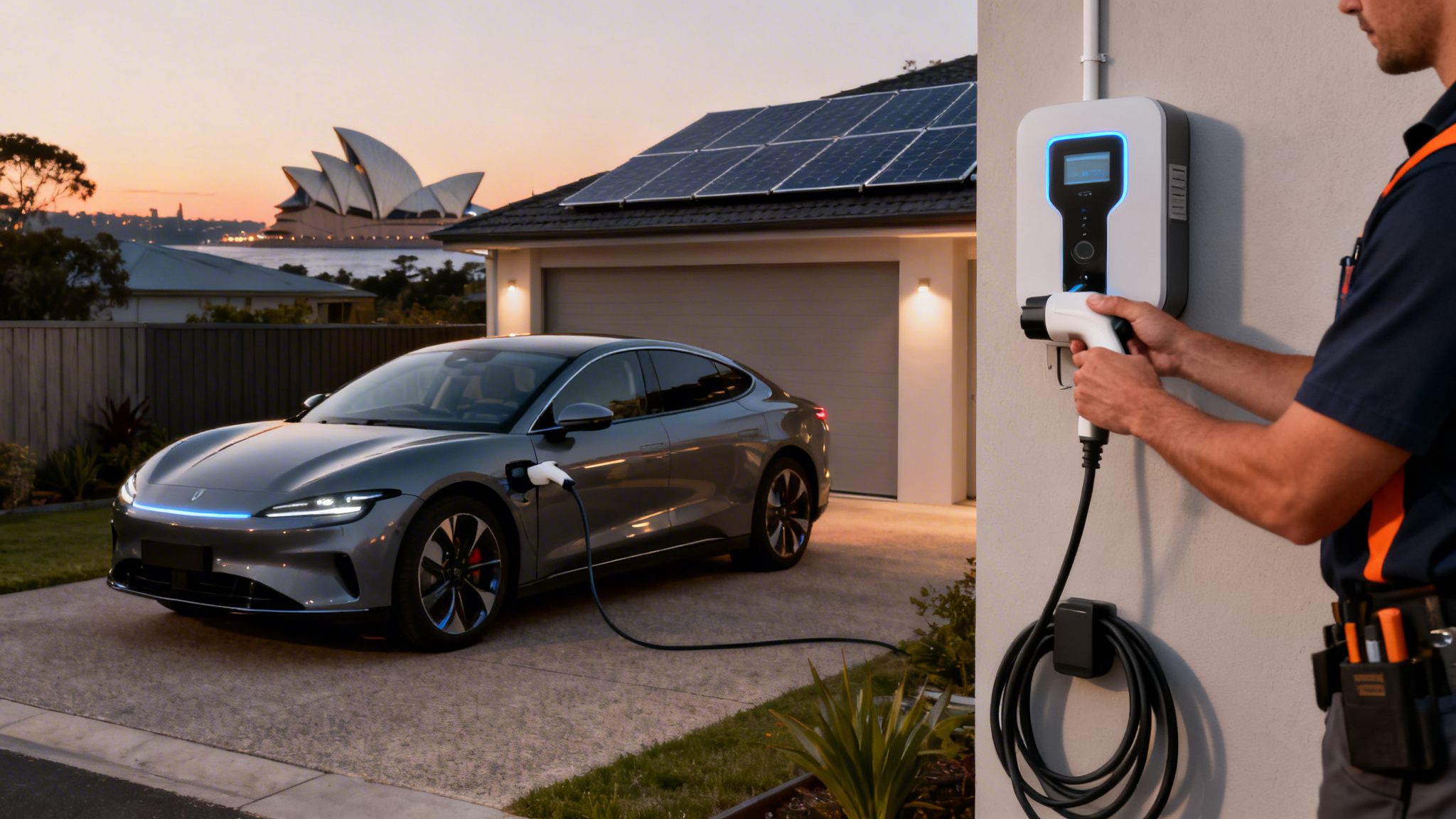
Expert EV Charging Installation Sydney Services for 2026
So, you’re ready to get an EV charger installed at your Sydney home or business. Smart move. While you can use a standard power point in a pinch, a professionally installed, dedicated charger is what truly turns your property into a proper refuelling station.
Think of it this way: a regular outlet trickle-charges your car, but a dedicated Level 2 charger gets the job done properly overnight. It’s the difference between waking up to a partially charged battery and knowing you have a full "tank" every single morning.
Getting it done right involves a bit more than just mounting a box on the wall, though. A professional EV charging installation in Sydney is a structured electrical project with three core stages: assessing your property, installing the hardware, and commissioning the system to make sure it’s safe and ready to go.
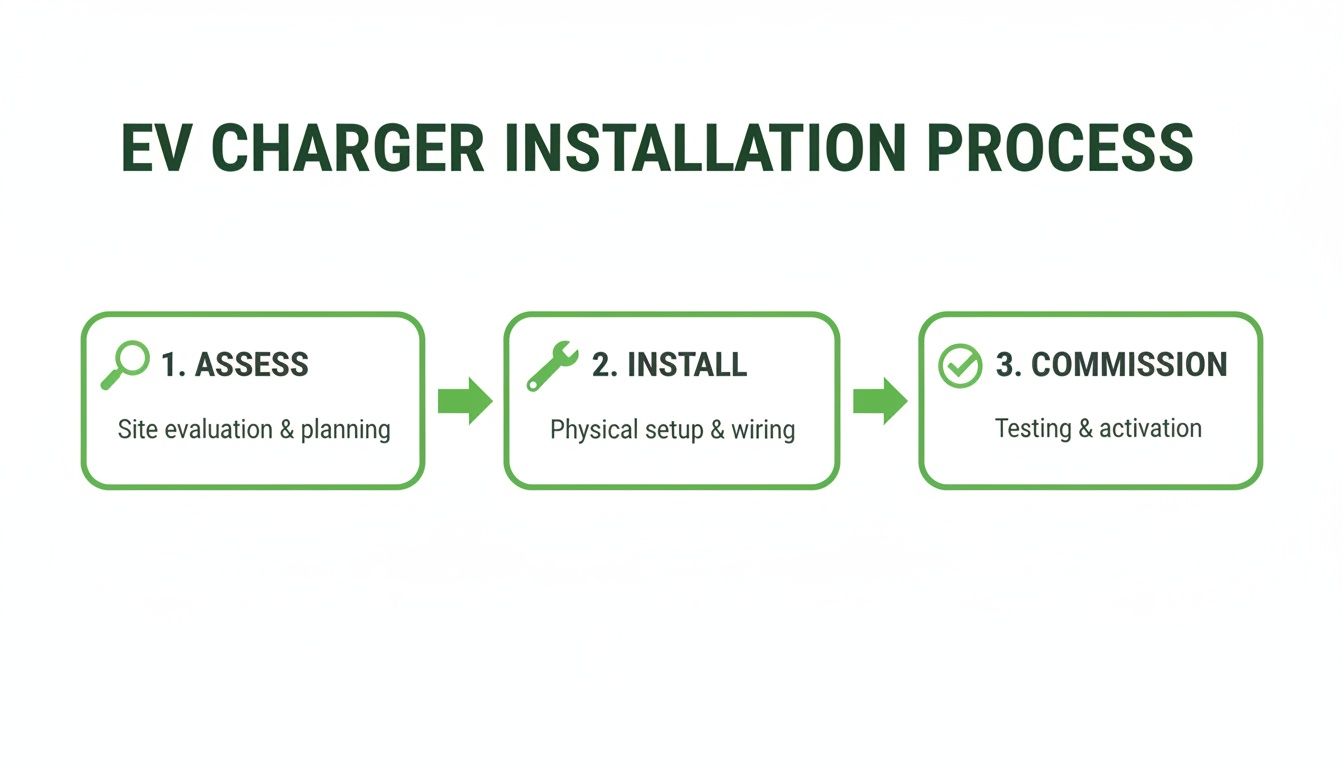
This simple flowchart shows the journey. It's not a single event but a clear, professional workflow from start to finish.
The Essential Stages of Installation
A proper installation is all about safety and performance, and the real work begins long before any tools come out.
It all starts with a detailed site assessment. A qualified electrician will come out to check your switchboard, wiring, and overall electrical capacity. This isn’t a step you can skip—it’s crucial for figuring out what your home can safely handle.
Next comes the physical installation. This is where the electrician runs a new, dedicated circuit from your switchboard to your chosen spot and securely mounts the charging unit.
Finally, there’s the commissioning phase, which is arguably the most important part.
Commissioning is where the installer thoroughly tests the entire system. They’ll check all the safety features, confirm everything is working as it should, and walk you through how to use your new charger. You should feel completely confident before they sign off on the job.
We've put together a quick table summarising these key stages. Think of it as a cheat sheet for your installation journey.
Key Stages of a Sydney EV Charger Installation
| Stage | What It Involves | Key Consideration |
|---|---|---|
| Site Assessment | An electrician inspects your switchboard, wiring, and property layout. | Is your current electrical system sufficient, or will it need an upgrade to handle the load? |
| Physical Installation | A dedicated circuit is run from the switchboard to the charger location, and the unit is mounted. | Where is the most practical location for the charger in your garage or carport for daily use? |
| Commissioning & Handover | The installer tests all functions, verifies safety mechanisms, and provides a full demonstration. | Does the charger work correctly, and do you understand how to operate it, including any smart features? |
Understanding this workflow demystifies the whole process and gives you a clear roadmap. Of course, a big part of this is choosing the right hardware in the first place, and you can learn more about the different types of EV chargers available to see what fits your needs.
Ultimately, a quality installation gives you the freedom to charge on your own terms—especially when you pair it with a solar system to take full control of your energy.
Choosing the Right EV Charger for Your Home
Picking the right EV charger for your Sydney home isn't as complicated as it might seem. You can technically just plug your car into a standard wall socket, but let's be honest, it's painfully slow. If you want real convenience, a professionally installed, dedicated EV charger is the only way to go.
For almost every homeowner in Sydney, the conversation begins and ends with a Level 2 charger. These are the go-to standard for residential installs, hitting that sweet spot between charging speed and what your home's electrical system can handle. You might have heard of DC fast chargers, but those are high-powered beasts you see at public stations, not something you'd put in your garage.
Matching Charger Power to Your Needs
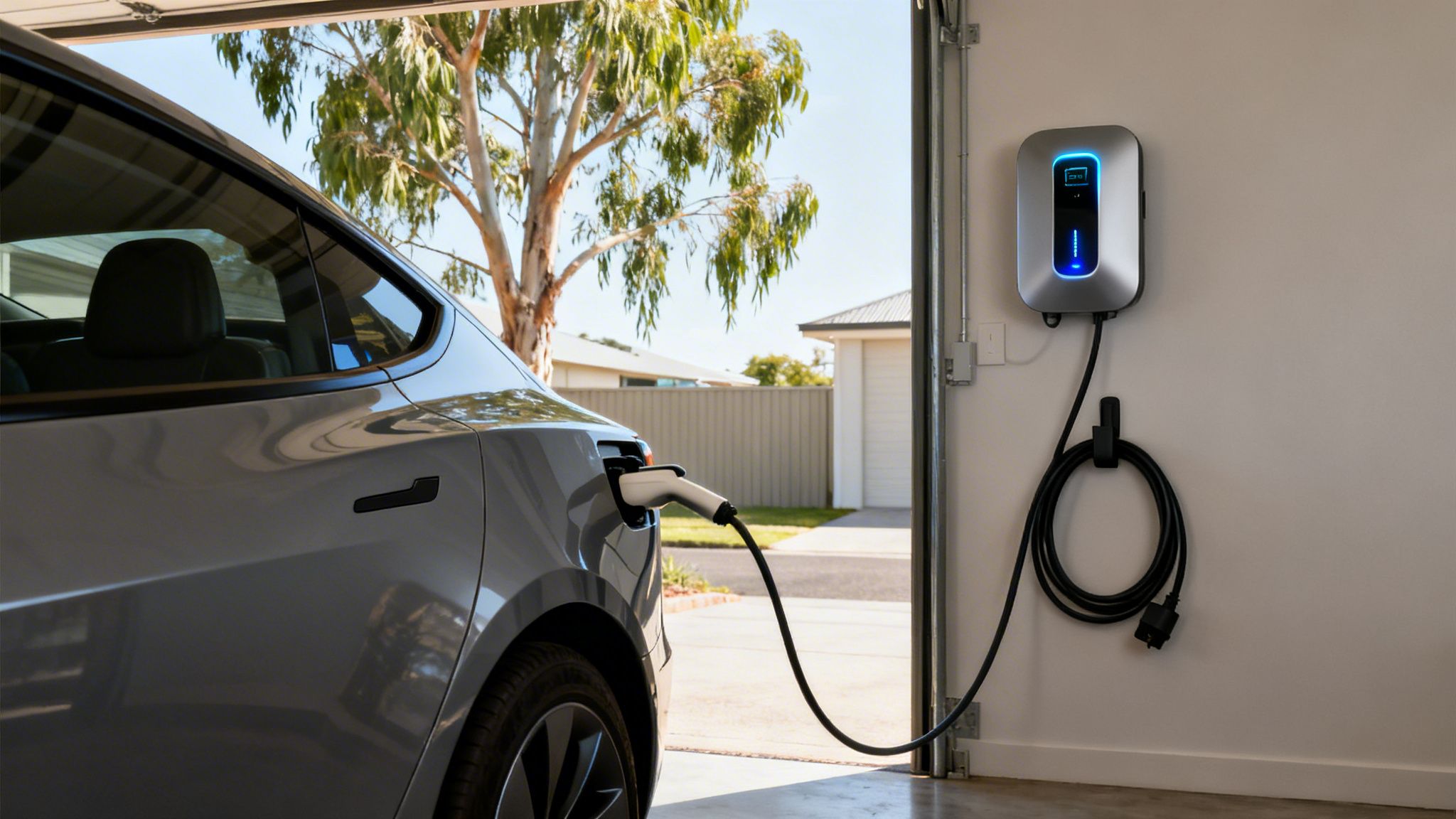
Level 2 chargers generally come in two main flavours: 7kW (single-phase) and 22kW (three-phase). Choosing between them comes down to a few practical things: your home's power supply, what your car can actually handle, and how much you drive each day.
A 7kW charger is, by far, the most common choice for residential EV charging installation in Sydney. It’s more than capable of giving most EVs a full charge overnight, adding about 40km of range every hour. For the average daily commute, this is plenty.
A 22kW charger, on the other hand, is a serious step up, delivering over 100km of range per hour. The catch? It requires a three-phase power supply. While this is becoming more common in new builds and is standard in commercial properties, many older Sydney homes don't have it.
Here’s a simple way to think about it:
- For the daily commuter: A 7kW charger is almost always the perfect match. It guarantees your car is topped up and ready every morning, often without needing switchboard upgrades.
- For high-mileage drivers or future-proofing: If you’re lucky enough to have a three-phase supply and an EV that can take the faster charge, a 22kW unit gives you incredible speed and sets you up for next-gen vehicles with bigger batteries.
The real aim is to get a system that fits your lifestyle. You don't need a sledgehammer to crack a nut. For most people, a 7kW charger is the right tool for the job, giving you a full battery every morning.
The Advantage of Smart Chargers
Beyond just the power rating, you’ve got a choice between a basic "dumb" charger and a "smart" one. A standard unit gets the job done, but a smart charger opens up a world of features that can seriously cut your running costs.
A smart charger connects to your Wi-Fi, giving you full control from a smartphone app. This is where the real magic happens.
- Scheduled Charging: You can set the charger to only run during off-peak electricity hours—usually late at night when power is cheapest.
- Solar Integration: This is the big one. Smart chargers can be configured to use only the excess solar power your rooftop panels are generating. You’re literally filling your car with free sunshine.
- Energy Monitoring: Get detailed reports on exactly how much electricity your car is using. This helps you track your habits and fine-tune your charging.
This level of control is a game-changer, especially in Sydney where power prices can sting. Pairing a smart charger with solar panels is the ultimate setup for energy independence. To get a better handle on the numbers, have a look at our detailed guide on electric vehicle charging station installation costs.
This technology is moving fast. The push for EV charging in Sydney is a great example of NSW's commitment, with the state targeting 30,000 chargers by 2026. This growth is aimed at making installations easier, particularly in apartment buildings. Choosing a future-proof smart charger today means you’re ready for whatever comes next.
Getting Your Wiring and Paperwork in Order for an EV Charger
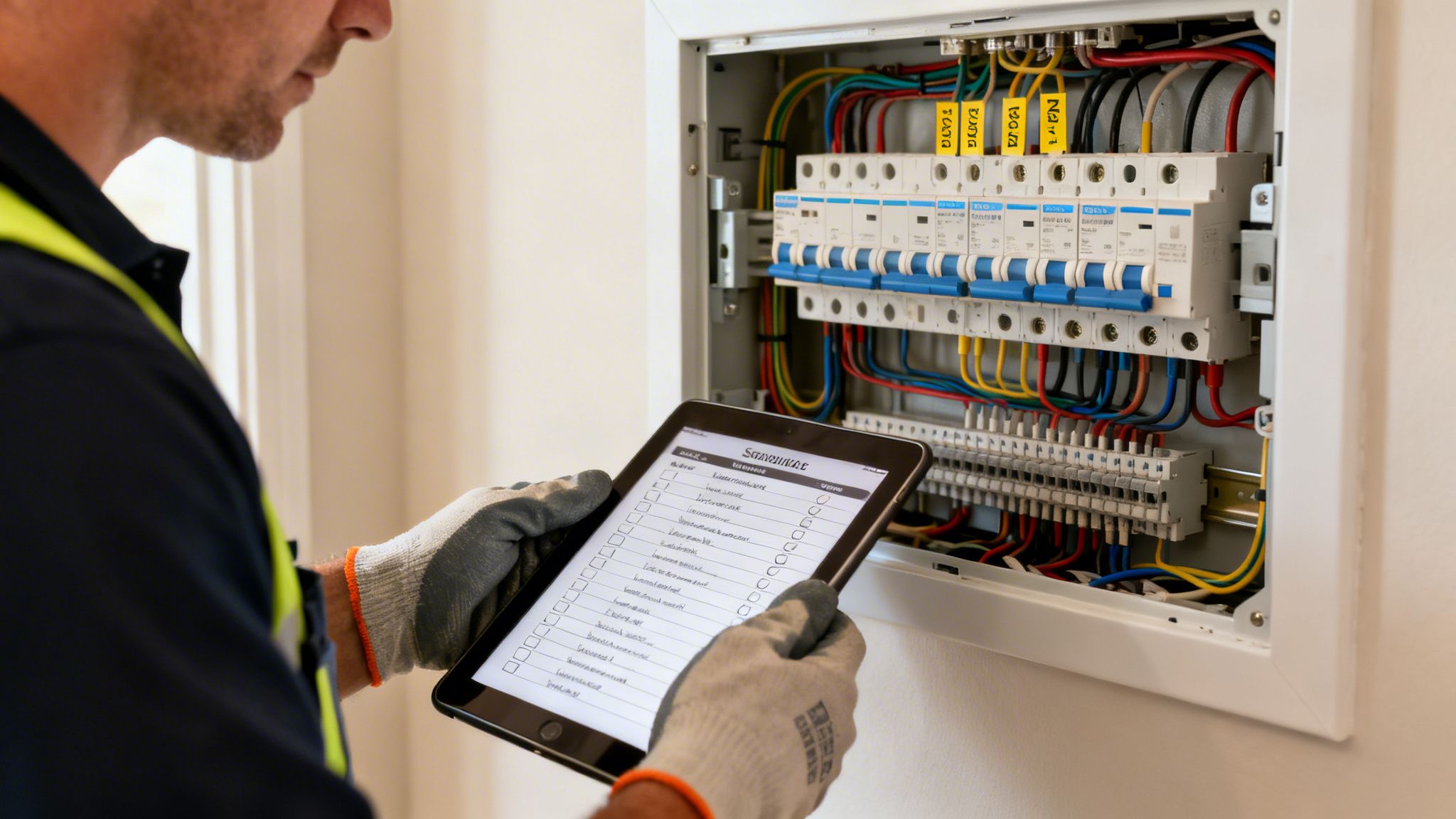
Putting in a new EV charger isn't like plugging in a new toaster. It’s a proper electrical project, and the first, most important step is getting a professional site assessment. This isn't just a box-ticking exercise; it's a crucial check to see what your home's electrical system can actually handle. You can't skip this.
A qualified electrician will take a hard look at your switchboard, your existing wiring, and how you’re connected to the grid. This is all about safety. The last thing you want is to overload your system, which can lead to frustrating power trips or, in the worst-case scenario, an electrical fire. The goal is to figure out if your current setup is up to the job or if it needs a bit of work first.
Will Your Switchboard Need an Upgrade?
Let's be honest, many older homes across Sydney weren't built with electric vehicles in mind. Their switchboards were designed for a much lighter load—a few lights, a fridge, a telly. A modern Level 2 EV charger can draw as much power as an electric oven, and that often pushes older systems past their limits.
During the site assessment, an installer is looking for a few tell-tale signs that an upgrade is on the cards.
- Old-School Fuse Boxes: If your home still has one of those ceramic fuse boxes with the fiddly wires, a switchboard upgrade is almost guaranteed. Modern circuit breakers are a must.
- No Room at the Inn: Your new charger needs its own dedicated circuit, complete with a circuit breaker and a safety switch (RCD). If your board is already choc-a-bloc, you’ll need to make space or get a larger one.
- Main Switch Is Undersized: The main switch is the gatekeeper for all power coming into your home. If its amperage rating is too low, it simply won't cope with the extra demand from an EV charger.
An upgrade isn't just about adding another slot. It's about making sure the entire system—from the power lines in the street right through to the charger itself—is safe, compliant, and ready to deliver consistent power without any drama.
Meeting NSW Regulations and Australian Standards
Any electrical work in Australia is tightly regulated, and EV chargers are no exception. Every single installation must comply with the Australian and New Zealand Wiring Rules (AS/NZS 3000). This is the big book of rules that covers everything from what size cable to use to where safety switches must be installed.
On top of that, licensed installers in Sydney have to follow specific NSW service and installation rules. These regulations ensure your connection to the grid is safe and won't cause problems for the wider network.
Using a qualified, licensed electrician is the only way to go. They’ll make sure your installation is fully compliant and provide a Certificate of Compliance for Electrical Work (CCEW) when the job is done. This document is your official proof that everything was done by the book.
It's also worth getting familiar with your rights as a consumer by understanding the New Energy Tech Consumer Code (NETCC).
Special Considerations for Strata Properties
Installing an EV charger in an apartment or townhouse complex used to be a massive headache. Thankfully, recent changes to NSW strata laws have made things a lot easier for residents.
The government is serious about this. In New South Wales, the goal is to install 30,000 EV chargers statewide by 2026. This push is backed by reforms designed to help Sydney's many apartment dwellers get charging sorted. With NSW already boasting 715 public charging stations, these changes are a huge step forward. You can see how the government is supporting the EV transition on localelectricianssydney.com.au.
While strata committees can no longer unreasonably refuse a request, they can set reasonable conditions. A good installer with strata experience can help you put together a solid proposal that answers the committee's key questions, such as:
- How will the electricity usage be billed fairly?
- Who is responsible for maintaining the charger?
- What is the total impact on the building's electrical load?
Pairing Your EV Charger with Solar and Battery Storage
Why pay energy retailers for electricity when you can make your own? For any Sydney homeowner, connecting a home EV charger to a solar panel and battery system is the ultimate step towards energy independence. It creates a powerful, self-sufficient ecosystem right on your property, turning sunshine into fuel for your car.
Imagine this: your rooftop solar panels spend the day soaking up the strong Sydney sun. That clean, free energy runs your home, and any extra power goes straight into charging your electric vehicle. You’re not just shrinking your carbon footprint; you’re literally driving on sunshine.
This setup is more than just a way to save on your power bill. It represents a fundamental shift in how you manage your home's energy, transforming your EV from just a car into a fully integrated part of your energy solution.
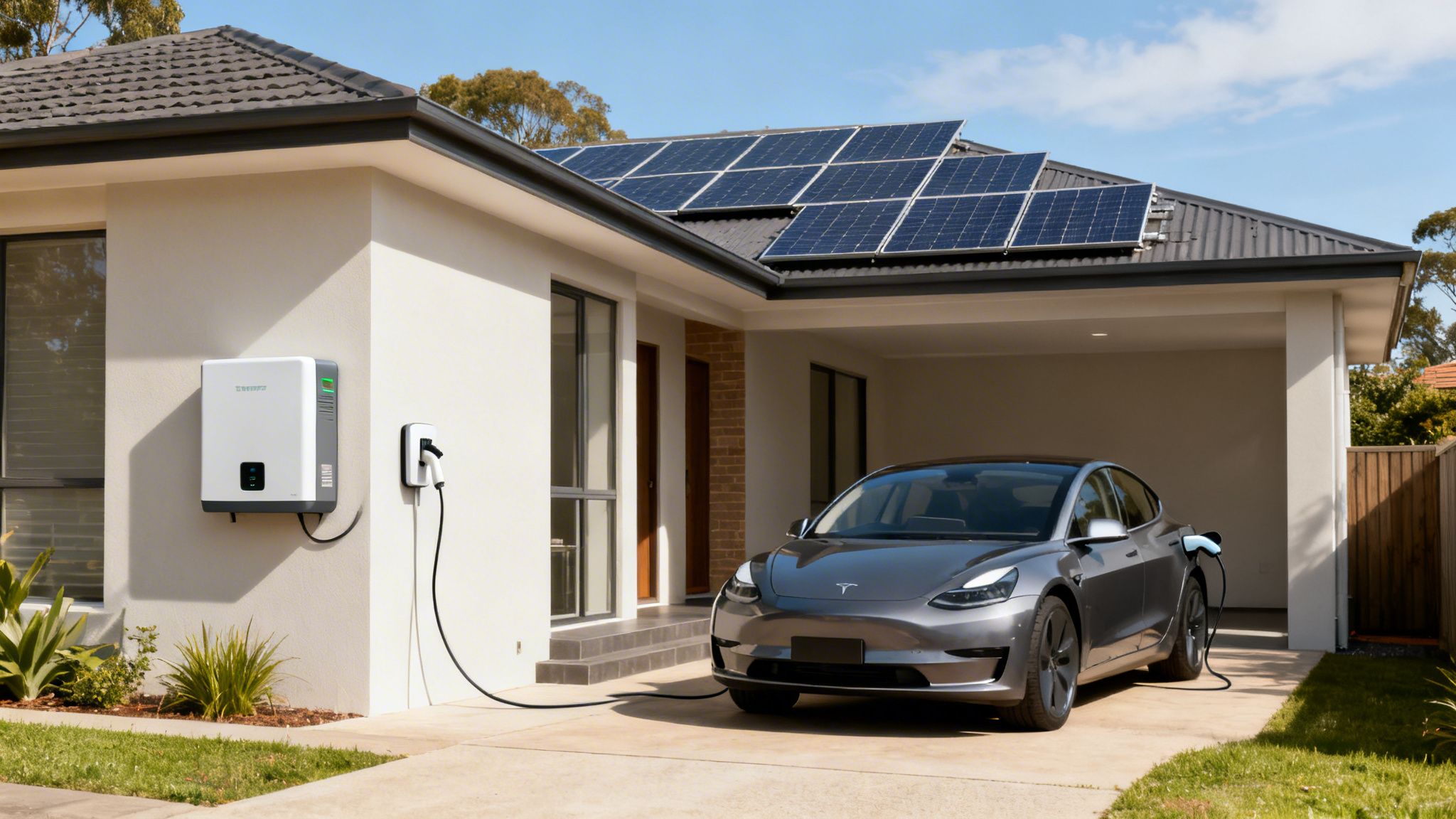
How It Works: The Smart Energy Flow
The real magic happens through intelligent energy management, all handled by your smart EV charger and solar inverter. This technology is the brain of your home energy system, constantly making decisions in real-time to make sure you use as much of your own solar power as possible.
During the day, when your panels are producing the most power, the system automatically prioritises running your home first. Once your household appliances have what they need, the smart tech looks at the next best use for that surplus energy. Is your EV plugged in? If so, the excess solar starts flowing directly into your car's battery.
This is a world away from just plugging in at night and pulling expensive, grid-generated power. It's an active, intelligent approach to using the energy you produce.
But what happens if your car is already full, or you're out for the day? That’s where a home battery changes the game.
The Role of Battery Storage
A solar battery, like a Tesla Powerwall, is the final piece of the puzzle for achieving true 24/7 energy freedom. Think of it as a reservoir for your valuable solar power.
Instead of exporting your excess solar energy back to the grid for a tiny feed-in tariff, you store it right there in your home battery. Then, when the sun goes down, you can use that stored energy to charge your EV overnight—still for free.
This combination of solar, a battery, and EV charging completely rewrites the economics of running a car and powering your home. To learn more about how these batteries work, have a look at our comprehensive guide to the Tesla Powerwall 3.
A well-designed system creates a clear priority for your free solar energy:
- Power Your Home: All active appliances and lights get covered first.
- Charge Your EV: Your car is the next priority, using surplus solar to top up.
- Fill Your Home Battery: Any remaining solar generation is stored for later.
- Export to the Grid: Only as a last resort is any leftover power sent back to the grid.
By following this logic, a properly configured system can help a typical Sydney household offset 70–100% of its reliance on the grid. We see this every day in the systems we design and install—it's not just a theoretical benefit.
A Real-World Sydney Example
Let's take a typical family living in a Sydney suburb. They’ve installed a 10kW solar system, a home battery, and a smart EV charger.
On a sunny Tuesday, their solar panels are generating power all day. The system effortlessly runs the home office, washing machine, and air conditioning. After the morning school run, the EV gets plugged in, and the excess solar is diverted to the car, giving it plenty of charge for the afternoon's activities.
By late afternoon, the car is topped up. The solar energy now automatically switches to filling the home battery. That evening, the family cooks dinner, watches TV, and charges their devices using the stored battery power. Later that night, the car can even draw more power from the battery if needed, ensuring it's ready for the next day's commute.
The result? They've barely touched the grid all day. This is the future-proofed reality that a combined solar, battery, and EV charging installation in Sydney delivers. It’s all about taking back control from rising energy costs and achieving a new level of self-sufficiency.
Finding a Professional EV Charger Installer
Let's be blunt: choosing the right installer is the single most important decision you'll make in this entire process. You can have the best charger on the market, but its safety, reliability, and long-term performance all come down to the skill of the team you hire.
This is more than just getting a box mounted on a wall. You're bringing an expert into your home or business, someone who should guide you from that first curious question right through to the final sign-off. A quality company will never rush you; the process should always kick off with a proper consultation and site assessment. It’s their chance to understand your property, and your chance to see if they really know their stuff.
What to Ask a Potential Installer
When you're vetting companies for an EV charging installation in Sydney, you need to go in armed with the right questions. The quality of their answers will reveal everything about their experience, legitimacy, and commitment to doing the job properly.
Don't be afraid to dig into the details. A true professional will welcome these questions and have confident, ready answers.
Here are the absolute non-negotiables to ask:
- Are you a licensed electrician and CEC accredited? Ask for their electrical licence number and actually check it. Clean Energy Council (CEC) accreditation is a huge plus, showing they're trained in renewable energy best practices—vital if you're thinking about solar integration.
- Do you use your own in-house installers? Companies that subcontract work often have less control over quality and timing. An in-house team means you know who is showing up, and they are accountable to the company you hired.
- Can you show me examples of similar jobs you’ve done in Sydney? A portfolio of local work is proof of real-world experience, not just textbook knowledge.
- What's your process for after-care and troubleshooting? Things can go wrong. You need to know what their promise is for support after they’ve been paid. A clear plan for responsive support is critical.
As a quick tip, have a look at their online presence. Something as simple as an effective website design for electricians can be a good first indicator of their professionalism and how much they care about the customer experience.
The Value of Local Presence and Transparent Guidance
There’s real value in choosing a local Sydney-based installer with a physical office and warehouse. It means they have a local reputation to protect and can provide much faster response times if you need support or a warranty claim.
A trustworthy installer also acts more like a consultant than a salesperson. They should be explaining why they’re recommending a particular charger or a switchboard upgrade, not just pushing the most expensive gear. This consultative approach is the hallmark of a company focused on building a long-term relationship, not just making a quick sale.
The right installer doesn't just hang equipment; they deliver a complete, managed solution. They should handle everything from the initial design and paperwork to the final commissioning and handover, giving you a completely seamless and stress-free experience.
The EV market is exploding. For Sydney homeowners and businesses, this rapid growth means it’s more important than ever to partner with a trusted local expert who can manage the entire process properly.
Final Commissioning and After-Care
The job isn't done when the charger is on the wall. The final and most critical phase is commissioning. Your installer must run a series of tests to verify every component is working correctly and, most importantly, safely.
This is also the handover point. They should walk you through exactly how to use your new charger, explaining any smart features or app integrations. You should feel totally comfortable with how it works before they pack up their tools.
A quality installation is always backed by a solid workmanship warranty and a clear path for troubleshooting. You must receive a formal Certificate of Compliance for Electrical Work (CCEW), which is your legal guarantee that the job meets all Australian Standards. Ultimately, as we cover in another article, it’s the fact that quality installations are so valuable that determines your system's real-world performance. It’s this long-term peace of mind that truly defines a professional installation.
Your EV Charger Installation Questions, Answered
Thinking about getting an EV charger installed at your Sydney home or business? It’s a smart move, but it’s normal to have a few questions. It’s new territory for most people.
We get asked about the nuts and bolts of installation all the time. Here are the straight-up answers to the questions we hear most often from Sydney residents.
How Long Does an Installation Actually Take?
This is usually the first thing people want to know. For a simple, straightforward job at a modern home, we can often have a standard EV charging installation in Sydney done and dusted in just a few hours—think half a day, max. This assumes your switchboard is up to spec and the charger is going somewhere easy to access.
But if the job is more involved, the timeline will stretch.
- Switchboard Upgrades: If your switchboard is an older model that can't handle the extra load, it needs to be upgraded first. That alone can take several hours before we even touch the charger wiring.
- Complex Cable Runs: Need to run a cable out to a detached garage? That means trenching. Trying to wire up a spot in a tricky apartment building car park? That's going to take more time than just mounting a charger on the wall next to the main board.
Any good installer will give you a firm time estimate after they've done a proper site check.
Do I Need Council Approval for a Home EV Charger?
For the vast majority of residential charger installations in Sydney, the answer is a clear no, you do not need council approval. It’s classified as exempt development, so long as a licensed electrician does the work and it meets all the relevant Australian Standards.
Things can get a bit more complicated for commercial sites, or if you live in a heritage-listed property. In those cases, you might have a few extra hoops to jump through.
For most homeowners, the takeaway is simple: the council isn't the hurdle. Your focus should be on electrical safety and compliance, which is your installer's job to get right.
If you live in a strata building, you won't need council approval either, but you will need a green light from your owners' corporation. The good news is that recent NSW laws stop them from unreasonably blocking your request.
How Do I Know If My House Can Handle an EV Charger?
You don't need to be an electrician to get an answer—that's what we're here for. A proper site assessment is a non-negotiable part of any professional installation. A licensed sparky will come out and inspect your home’s entire electrical setup.
They’ll be looking at a few key things:
- Your Main Switch Amperage: This tells them the maximum amount of power your entire home can pull from the grid at once.
- Your Switchboard's Condition: They’ll check for old-school fuse boxes, see if there's physical space for new circuits, and make sure you have modern safety switches (RCDs) installed.
- Your Existing Electrical Load: The electrician will account for your big-ticket items like air conditioners, pool pumps, and ovens to see if there's enough leftover capacity for the charger.
After this check, they can tell you for sure if your home is ready to go or if you'll need an upgrade first.
Can I Install an EV Charger Myself?
Under no circumstances. In Australia, it is illegal and incredibly dangerous for anyone but a licensed electrician to carry out this kind of work. An EV charger isn't just a big plug; it’s a high-powered appliance that puts a serious, continuous load on your home’s electrical system.
Trying to DIY this is a terrible idea with serious risks:
- Electrical fire from faulty wiring or an overloaded circuit.
- Electric shock, which can be fatal when dealing with high-voltage gear.
- Voiding your home insurance, as no insurer will cover damage from illegal electrical work.
- Frying your EV's expensive battery or onboard electronics with an improper connection.
Always, always use a qualified and licensed electrician. They must provide you with a Certificate of Compliance for Electrical Work (CCEW) when they're finished. That certificate is your proof that the installation is safe, compliant, and done to Australian Standards.
Ready to take the next step towards convenient, reliable home charging? The team at Interactive Solar has over 20 years of combined experience designing and installing EV charging solutions for Sydney homes and businesses. We manage the entire process, from a detailed site assessment to the final handover, ensuring your system is safe, compliant, and perfectly suited to your needs.
Find out how we can help by visiting us at https://interactivesolar.com.au.
Make Interactive Solar a preferred source in Google
One click tells Google to surface our articles more often in Top Stories, AI Overviews and AI Mode.