
10kW Solar Battery Price Australia: A 2026 Buyer’s Guide
Last updated:
You’ve probably done the same search most homeowners do. You type in 10kw solar battery price australia, get hit with a spread of prices, and end up more confused than when you started. One site talks about battery size, another talks about output, another gives a hardware-only number that clearly doesn’t include actual installation work.
That confusion is normal. Battery pricing looks messy because a battery quote isn’t just about one box on the wall. It reflects how much energy you want to store, how much power you want to deliver at once, what your current solar setup can support, whether your switchboard is ready, and whether you want blackout backup or better bill savings.
A homeowner trying to make a sensible decision doesn’t need hype. You need clarity. The useful question isn’t “what’s the cheapest 10kW battery?” It’s “what am I paying for, and will it do what I need?”
The '10kW' Misconception Power vs Capacity Explained
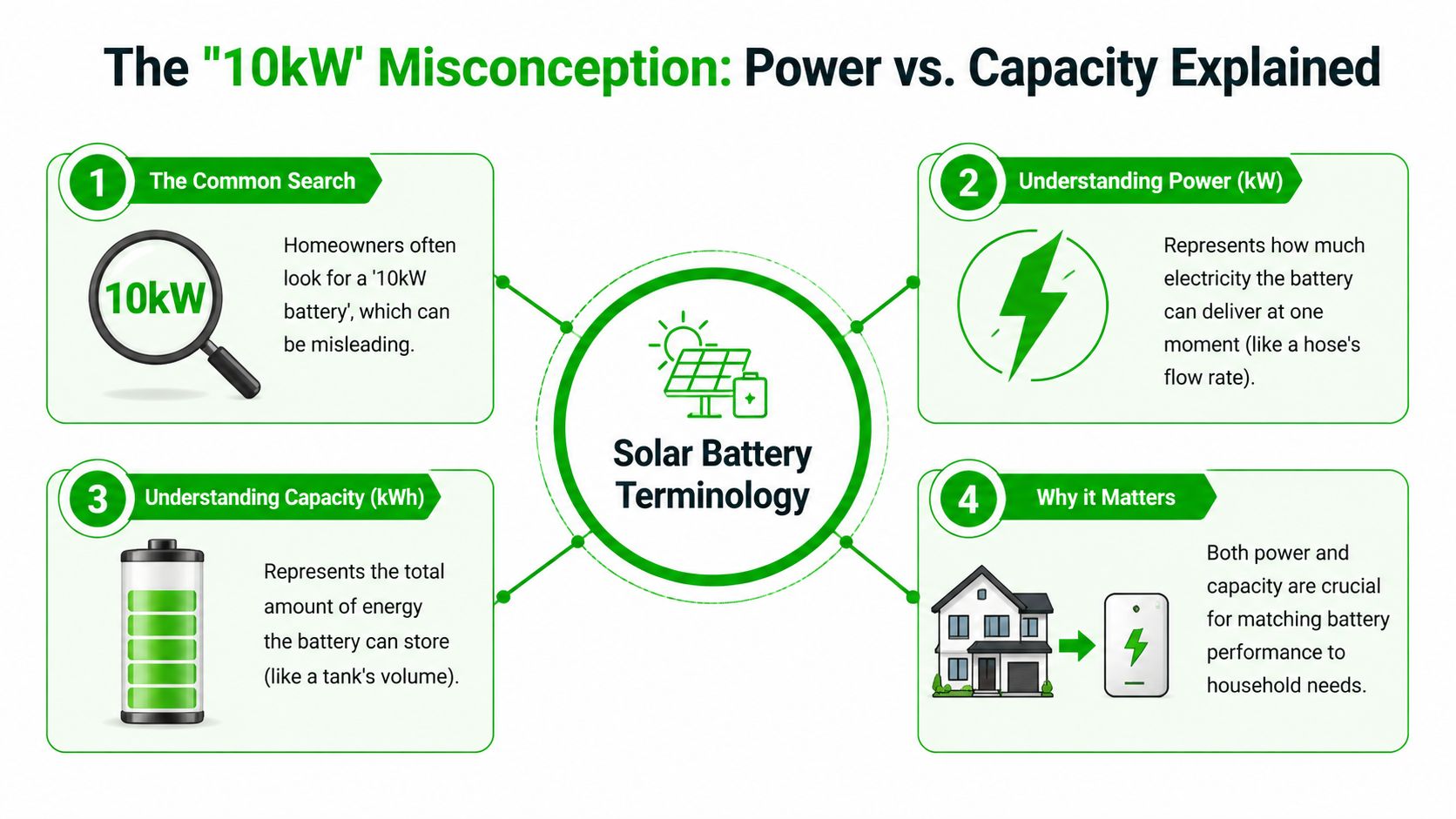
When searching for 10kw solar battery price australia, one is typically interested in a 10kWh battery, not a 10kW battery. That small difference matters a lot, because it changes what you’re comparing.
To understand it, consider water. kW is the size of the tap. It tells you how fast water can flow. kWh is the size of the bucket. It tells you how much water you can store. A battery needs both, but they answer different questions.
If you only focus on one number, you can end up with the wrong system. A battery might store enough energy for the evening, but not deliver enough power to handle several appliances at once. Or it might offer strong output, but not enough stored energy to last through the period you care about.
What kW actually means
Power rating in kW tells you how much electricity the battery can supply at one moment.
That matters when you run multiple loads together. Fridge, lights, television, Wi-Fi, maybe a kettle or microwave. The battery’s power rating affects whether those appliances can run comfortably at the same time, especially during a blackout if backup is enabled.
Here's a simple perspective:
- Higher kW output suits homes that want to run more appliances simultaneously
- Lower kW output can still work well if the goal is only evening load shifting
- Backup expectations often expose this issue fast, because many people assume a battery will power the whole house when it may only support selected circuits
A battery can be “big” in storage terms and still feel limited if its power delivery doesn’t match the way your household uses electricity.
What kWh actually means
Capacity in kWh tells you how much total energy the battery can hold.
This is usually the number homeowners mean when they say “10kW battery”. They’re really asking about a battery with roughly 10kWh of storage, because that’s the figure tied to how long stored solar can cover evening use.
If your goal is to store daytime solar and use it after sunset, capacity matters most. It affects how much solar you can keep instead of sending it to the grid, and how much of your night-time usage you can cover before importing power.
Here’s the quick distinction:
| Term | What it means | Homeowner question it answers |
|---|---|---|
| kW | Instant power output | “How many things can I run at once?” |
| kWh | Total stored energy | “How long will the battery last?” |
Why this confusion affects price comparisons
A lot of poor comparisons start right here. Homeowners line up products that all sound similar, then assume they’re direct alternatives. They often aren’t.
One battery may be better for blackout resilience. Another may be better for daily self-consumption. Another may suit future expansion. If you compare only the headline size, you miss the reason the prices differ.
That’s also why online price lists can be misleading. Some pages use “10kW” loosely because that’s how people search, but the actual product being discussed is a 10kWh storage battery. If you don’t separate those terms, quotes become hard to judge.
For a plain-English explanation of other common misunderstandings around home energy systems, this guide on debunking common solar myths and misconceptions about solar energy is worth reading.
What Really Determines Solar Battery Prices in Australia
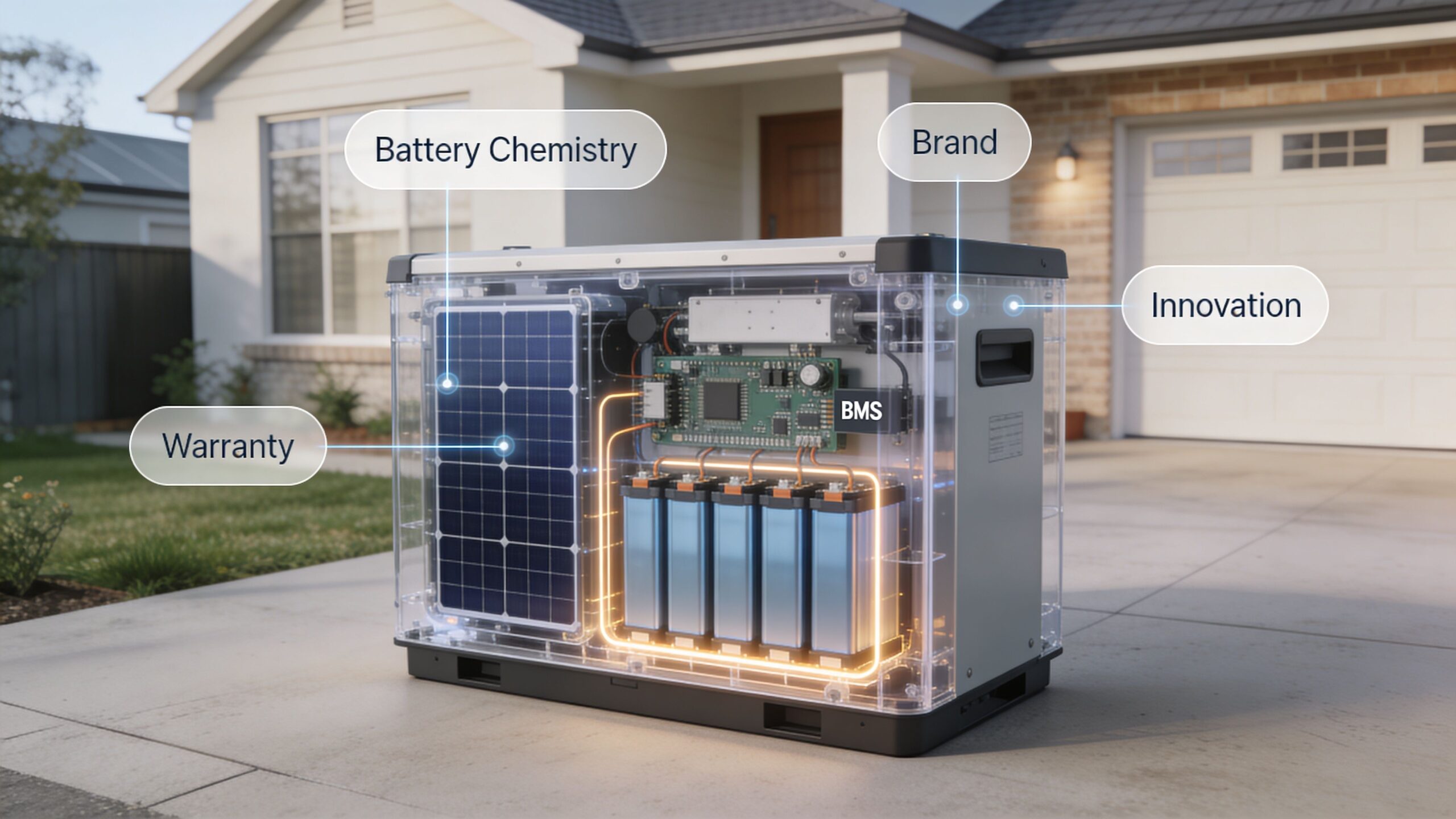
A homeowner can ask for a “10kW battery” and still receive quotes that differ by many thousands of dollars. That gap usually has a clear cause. The battery itself is only part of the answer. Price shifts with the brand, the battery chemistry, the usable energy available each day, the warranty terms, the inverter pairing, and how much electrical work the house needs before the system can be installed properly.
That is why online price charts only get you so far. They can give a rough market reference, but they cannot tell you what your home will require. A battery added to a newer, battery-ready solar system is a very different job from a battery being fitted to an older setup with a crowded switchboard, limited wall space, or no backup provision.
Brand matters because service and integration matter
Brand pricing is not just a badge premium. In the field, the better-known products often justify their higher price through cleaner software, stronger local support, clearer warranty processes, and broader compatibility with inverters, backup circuits, and energy management controls.
That does not make the premium option the right choice for every household.
A lower-cost battery can be the smarter buy if the home has simple evening usage, no blackout requirements, and an existing solar setup that matches the battery neatly. On the other hand, a cheap unit can cost more over time if it creates limits around backup performance, future expansion, replacement parts, or installer support.
For homeowners comparing model differences side by side, this battery comparison guide for Australian homes is a useful starting point.
Chemistry affects lifespan, safety, and long-term value
Most residential battery quotes in Australia are for lithium-based systems, but the chemistry inside those products still matters. The two names you will see most often are LFP and NMC.
The practical difference is straightforward:
- LFP is commonly selected for residential use because it suits frequent cycling and has a strong safety reputation
- NMC offers higher energy density and can make sense where compact size matters more
- The better option depends on the full system design, not the chemistry label alone
I would not choose a battery on chemistry in isolation. A good battery is the combination of chemistry, warranty terms, thermal management, inverter compatibility, and the quality of the installer standing behind it.
The Clean Energy Council’s consumer guidance on buying a home battery system is useful if you want an independent overview of the points that affect quality and suitability.
Usable capacity and warranty detail shape the real value
Brochure size can be misleading. What matters to your bill is how much stored energy you can use in normal operation, and how that performance holds up over time.
Two batteries in the same nominal size range can deliver different real-world value because of:
- Usable capacity, not just total stated capacity
- Depth of discharge settings and how the manufacturer protects battery life
- Cycle life and throughput limits written into the warranty
- Performance retention over time, especially after years of daily charging and discharging
Quotes can often appear similar yet differ significantly. One product may cost less upfront but allow less daily usable energy. Another may cost more while offering stronger backup capability or a warranty that is easier to claim against if something goes wrong.
A short explainer is useful here if you want to see how installers talk through these distinctions on site:
Installation complexity can move the price more than homeowners expect
Site conditions often decide whether a battery lands at the lower or upper end of the range. A straightforward install with good wall space, short cable runs, compliant clearances, and a modern switchboard is one thing. An older home that needs switchboard work, longer cabling, backup sub-circuit changes, or meter box upgrades is another.
This comes up regularly in older Australian homes where the battery itself is suitable, but the existing electrical infrastructure is not. In some cases, service upgrades are part of the conversation. If you want a plain-English example of how supply upgrades affect electrical project costs, Lighthouse Energy's 200 amp upgrades give a useful comparison point.
The main point is simple. Battery pricing is not mysterious once you separate the hardware price from the design and installation work around it. A serious quote should explain why the number is what it is, and which parts of that number are tied to your home rather than the battery brand alone.
Deconstructing the Quote A Complete Cost Breakdown
The biggest mistake homeowners make is treating the battery as if it’s the whole project. It isn’t. The battery unit is one part of a complete energy storage installation.
A proper quote should show you what’s included and what assumptions the installer has made about your site. If the document looks vague, or if it leans too heavily on a hardware-only price, you’re not comparing properly.
The battery unit is only one line item
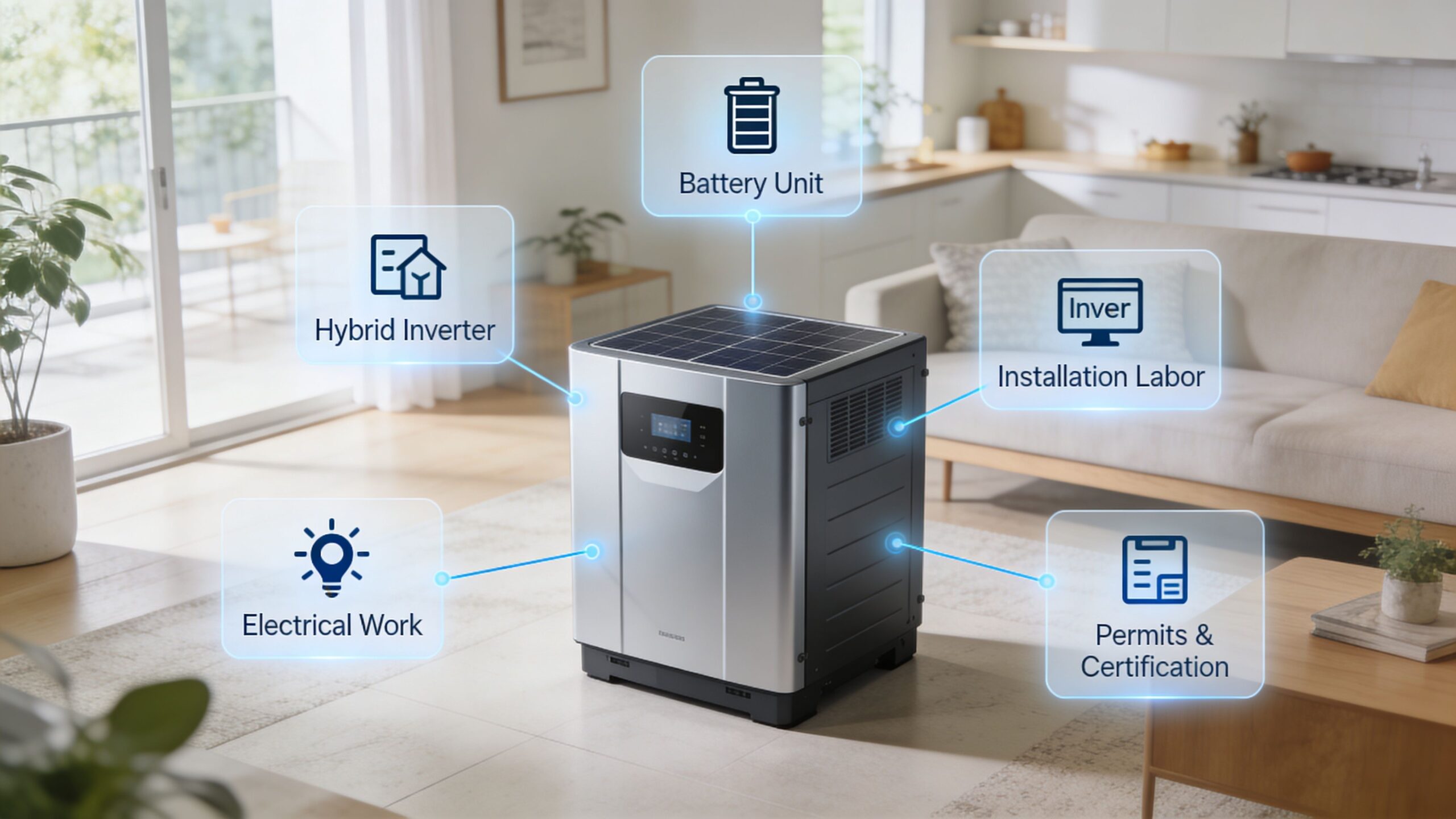
Most buyers start with the battery brand because that’s the visible part. Fair enough. But the battery can’t operate in isolation.
Depending on the existing solar system, the quote may also need to account for control hardware, inverter compatibility, protection equipment, mounting systems, isolators, cabling, commissioning, and monitoring setup. If an online number doesn’t discuss those items, it probably isn’t a turnkey price.
A complete quote should make clear whether it includes:
- Battery hardware and the exact model being proposed
- Inverter or integration equipment if the current setup isn’t battery-ready
- Monitoring and communications so the system can be configured and observed properly
- Safety gear and compliance items required for legal installation
Labour and electrical work often decide whether a quote is realistic
Very cheap quotes frequently unravel when considering installation. Battery installation isn’t just delivery and wall mounting. It involves licensed electrical work, testing, configuration, and compliance.
Homes with older switchboards can need extra work before a battery can be added safely. Backup circuits can add complexity too. If the quote includes blackout functionality, ask exactly what will be backed up. Some systems cover essential loads only. Others can support much more, but the design work and hardware scope change accordingly.
The right question isn’t “does it have backup?” It’s “which circuits stay on, and how is that being achieved?”
For homeowners trying to understand why electrical upgrades can materially affect a project, this plain-language overview of Lighthouse Energy's 200 amp upgrades is useful background on the sort of service capacity work that can influence larger energy upgrades.
What a professional quote should clarify
A useful battery quote answers practical questions before you have to ask them twice. It should tell you not just the product, but the installation intent.
Look for these points:
System compatibility
Is the battery being paired with your existing inverter, or is new equipment required?Backup scope
Are you getting no backup, essential-circuit backup, or broader home backup?Switchboard condition
Has the installer allowed for upgrades if the existing board isn’t suitable?Installation assumptions
Is the quoted battery location straightforward, compliant, and easy to access?After-care and fault response
If the monitoring drops out or the system faults, who handles it?
Cheap quotes usually hide one of three problems
Not every low quote is bad. Some are efficient. But the weak ones often share the same issues.
| Warning sign | What it usually means |
|---|---|
| No site inspection detail | The installer hasn’t priced your home properly |
| Vague wording around backup | You may be assuming more functionality than you’re getting |
| Little mention of electrical upgrades | Necessary compliance work may be excluded |
If you’re comparing well-known systems, it also helps to understand how one premium product is typically positioned in Australian homes. A detailed guide to Tesla Powerwall 3 gives a good reference point for what’s usually bundled, what’s optional, and what homeowners should ask about before signing.
Government Incentives and Rebates for NSW Homeowners
A homeowner in NSW might receive two battery quotes for the same house and see two very different totals. One shows the full installed price, then applies available support. The other leads with the reduced figure. That difference alone causes a lot of unnecessary confusion.
The practical question is simple. What amount are you funding, and what conditions sit behind it?
For NSW households, incentives can lower the upfront cost of battery storage. The exact benefit depends on the program, your system design, and whether the installer has presented the numbers clearly. That is why I always tell homeowners to read the quote from the bottom line back up. Start with the net cost, then check how the rebate or incentive has been applied, whether eligibility has been assumed, and whether any work has been left out.
What incentives change, and what they do not
Support programs can improve the affordability of a battery. They do not improve a poor battery choice.
A rebate helps with upfront cost. It does not fix undersized solar, weak evening usage, limited backup capability, or compatibility issues between the battery and the rest of the system. If the battery does not suit the house, a discount just makes the wrong system easier to buy.
That matters because homeowners often treat the rebate as proof the project makes sense. It is only one input. The better question is whether the battery will do useful work often enough to justify the spend after incentives are applied.
What to check on the quote
Before focusing on the rebate amount, check these points:
- Is the incentive already deducted? Some quotes show gross price first, others show net price first.
- Has eligibility been confirmed or assumed? That should be stated clearly.
- Are all installation costs included? A rebate can look generous until switchboard work or extra hardware appears later.
- Does the supported price still fit your budget? The reduced figure is the one that matters.
A good installer earns their keep. Clear quoting saves homeowners from comparing one net figure against another installer’s gross figure and assuming one system is cheaper when it is not.
NSW homeowners should treat the rebate as one part of the decision
The strongest battery decisions usually come from homes with clear reasons for adding storage. Bill reduction is one. Backup during outages is another. Future plans such as EV charging can also matter. Incentives improve the numbers, but they do not set those priorities for you.
For NSW-specific details, our guide to the NSW battery rebate launch and what homeowners need to know explains how local support works and what homeowners should confirm before signing.
A quote should make the incentive treatment plain in writing. If it does not, ask for the gross installed price, the rebate amount, the net installed price, and any exclusions. That usually clears up the confusion fast.
Is a 10kWh Battery System Worth It Payback and Financing
A Sydney homeowner with solar often reaches the same point. The panels are producing well through the middle of the day, the feed-in credit is modest, and the expensive power is the electricity bought back after sunset. That is the gap a battery is meant to address. The question is whether a 10kWh unit matches how the home uses energy.
For the right household, a 10kWh battery can make solid financial sense. For the wrong one, it becomes an expensive way to store energy you were never going to use.
The homes that usually see the strongest value have three things in common. They already export surplus solar during the day. They use a meaningful share of power in the evening. They want a practical outcome such as lower bills, backup capability, or less exposure to peak tariffs.
A weaker fit looks different. Some homes are empty through the evening, have limited excess solar to charge a battery, or are chasing storage mainly because it sounds like the next upgrade. In those cases, the battery may still be desirable, but the payback period is usually longer and the financial case is harder to justify.
What payback really depends on
Payback is not a fixed number you can lift from a website and apply to every house in Sydney. It depends on how often the battery cycles, how much grid electricity it replaces, what tariff you are on, and whether your solar system can regularly fill it.
In practical terms, a battery earns its keep when it stores low-value daytime surplus and offsets higher-cost evening imports. The bigger that price gap is, the more useful storage becomes. Time-of-use tariffs can strengthen the case. So can a household with consistent night-time demand from cooking, cooling, laundry, or home office use.
Battery performance on paper also needs context. A 10kWh battery does not deliver the same real-world value in every home. Usable capacity, discharge rate, backup setup, and inverter limits all affect how much of that stored energy you can use when it matters.
Where financing helps, and where it causes problems
Finance changes cash flow, not system value.
That distinction matters. I have seen finance used well by homeowners who had a clear use case and wanted to spread the cost while reducing large quarterly bills. I have also seen it used to make an unsuitable battery look acceptable because the monthly repayment sounded easier than the upfront price.
The better approach is simple. Work out whether the battery will do enough useful work in your home first. Then compare buying outright against finance. If repayments are close to, or higher than, the savings you are likely to achieve, the battery may still be worth it for backup or energy independence, but it is no longer a straightforward bill-saving decision.
A practical test before you say yes
A 10kWh battery is usually worth closer consideration if your home matches most of these points:
- Your solar system regularly exports excess energy during the day
- Your household uses plenty of electricity after sunset
- Your tariff makes evening grid power expensive relative to export credits
- You want backup power or lower reliance on the grid for a clear reason
- You are comparing the battery against other bill-reduction options, not treating it as automatic
If your main goal is lower bills, it also helps to compare storage with the other changes that may cut costs faster. Our guide on how to reduce electricity bills with the right mix of solar, usage changes, and tariff strategy is a useful starting point.
The best battery decisions come from matching the system to the household, not from chasing a headline payback period. A quote should show what the battery is expected to do in your home, how often it is likely to cycle, and what trade-offs come with the configuration. That is the point where the numbers start to mean something.
How to Get an Accurate Solar Battery Quote for Your Home
By the time most homeowners reach the quoting stage, they’ve already seen enough online pricing to know one thing. A generic number won’t tell them what their house needs.
A proper quote starts with your current energy use. Not a guess. Not a rough suburb average. Your actual bills, your daily pattern, your existing solar system, and any changes coming soon. If you’re planning to add an EV, change your hot water setup, or work from home more often, that needs to be part of the design conversation.
What a serious quoting process should include
A reliable battery quote usually involves a site assessment and a technical review, not just a phone estimate.
The installer should assess:
- Your power bills and usage pattern, especially evening demand
- Your current solar equipment and whether it’s battery-compatible
- Switchboard condition and cable pathways
- Battery location options for safety, compliance, and service access
- Your goals, whether that’s savings, backup, EV readiness, or a mix
If that process feels detailed, that’s a good sign. Battery systems are less forgiving than simple online shopping decisions. The right answer depends on how your house behaves.
What to ask before you accept any proposal
Some questions cut through sales talk fast.
Ask these directly:
- What exactly is included in the installed price?
- Does this system provide backup, and if so, to which circuits?
- Will my switchboard need upgrades?
- Is the quoted battery size based on my usage, or just a standard package?
- How will the system cope if I add more electrical demand later?
A good installer won’t dodge those questions. They’ll welcome them, because clear expectations prevent bad outcomes.
Why a face-to-face assessment still matters
Battery design is one of those jobs where details on site matter. Meter position, wall space, switchboard layout, cable runs, shade patterns, and future plans can all influence the final recommendation.
That’s why the quote process shouldn’t feel like a sales trap. It should feel like an engineering conversation. If the person quoting can explain not just the battery choice but the reasoning behind it, you’re usually in a much safer place.
Frequently Asked Questions About 10kWh Solar Batteries
Is 10kWh the same as 10kW
No. kWh is storage capacity. kW is power output. Capacity tells you how much energy the battery can hold. Power tells you how much it can deliver at once.
Will a 10kWh battery run my whole house
Sometimes for short periods, sometimes not at all, depending on the loads and system design. Many battery systems are set up to cover selected essential circuits rather than every appliance in the home.
Why are online prices so inconsistent
Because many online figures refer to different things. Some are battery-only prices. Some include installation. Some assume the home is battery-ready. Others don’t include electrical upgrades, backup hardware, or inverter changes.
Is a cheaper battery always worse
Not necessarily. Some lower-cost batteries are a good fit for straightforward homes. The problem starts when the lower price comes from missing scope, weaker integration, or a mismatch with the household’s needs.
Should I install a battery now or wait
That depends on your current solar setup, energy usage, and whether incentives improve the project enough to make sense now. Waiting can be sensible in some cases, but many households already have enough daytime export and evening demand to justify acting once the design is right.
What should I bring to a consultation
Bring recent electricity bills, details of your current solar system if you have one, and a clear idea of what you want. Lower bills, blackout backup, EV charging support, or more energy independence all point to slightly different system designs.
If you want a battery quote that reflects your actual home rather than a generic online estimate, Interactive Solar can help. Their team designs and installs turnkey solar, battery, and EV charging systems across NSW, with licensed in-house electricians and practical advice that starts with your usage, your switchboard, and your goals. A good battery decision starts with clarity. That’s what a proper consultation should give you.
Make Interactive Solar a preferred source in Google
One click tells Google to surface our articles more often in Top Stories, AI Overviews and AI Mode.