
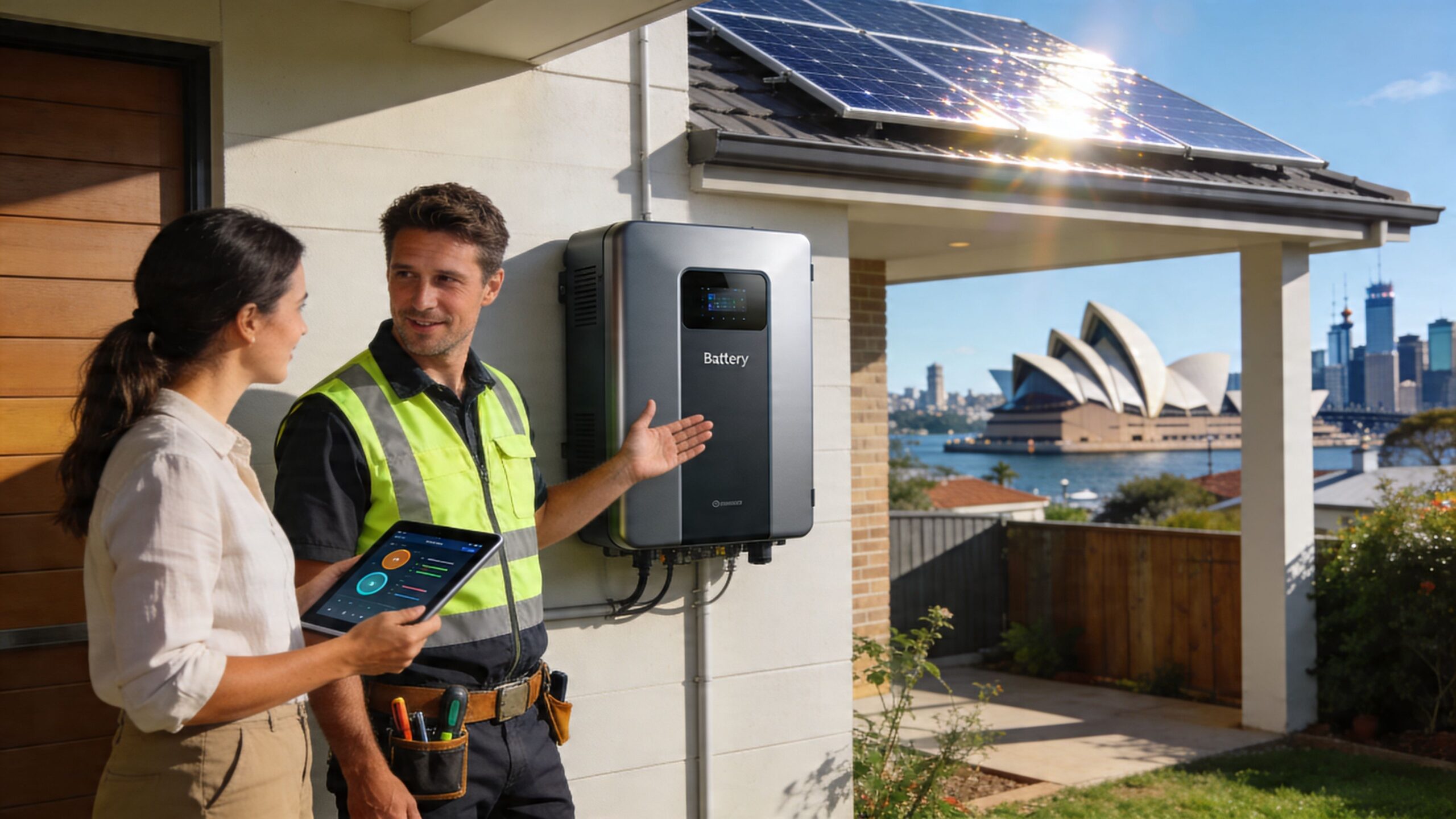
Home Battery Installation Sydney: Complete 2026 Guide
Last updated:
If you already have solar on the roof but your biggest power use happens after sunset, the frustration is familiar. Your panels work hard through the day, then the expensive part of your bill lands in the evening when the house is occupied, the air con is running, dinner is on, and the grid is doing the heavy lifting.
That’s where home battery installation sydney becomes more than a nice extra. For many households, it’s the missing piece between having solar and using more of your own power when you need it. In Sydney, that matters for two reasons. Bills still bite hardest outside solar production hours, and summer outages have made backup power a practical concern rather than a theoretical one.
From an installer’s point of view, the best battery projects start with the right expectations. A battery won’t fix a badly designed solar system. It won’t suit every house in the same way. And it definitely shouldn’t be sold as a generic add-on. But when the battery size, inverter setup, switchboard, and installation location all line up, it can make a home far less dependent on the grid and much easier to run.
Why Sydney Homeowners Are Embracing Battery Storage
A lot of Sydney homeowners come to batteries after the same realisation. Solar panels helped, but not enough. They’re exporting energy through the middle of the day, then buying it back in the evening when power is most valuable to the household.

That gap between daytime generation and night-time use is why battery demand has shifted from niche to mainstream. In the second half of 2025, New South Wales led the nation with 15,418 home battery installations by the end of August, driven by federal and state incentives, according to the Clean Energy Council’s battery surge update. That isn’t a fringe trend. It shows Sydney households are actively moving towards energy independence.
What’s driving the shift
The reasons are practical, not abstract:
- Evening bill pressure: Solar without storage often leaves a household exposed when the sun is down and usage is high.
- Blackout concerns: Backup power matters more in NSW summers, especially for homes that rely heavily on refrigeration, internet, lighting, or medical equipment.
- Better use of existing solar: A battery stores excess daytime generation instead of sending all of it away.
- Incentives: Rebates changed the conversation from “maybe later” to “let’s run the numbers now”.
Batteries make the most sense when they solve a problem you already feel. Evening usage, outage worries, or wasted solar exports are the usual ones.
Sydney’s housing mix also shapes demand. Freestanding homes in the west and south-west often have strong solar potential and enough wall or floor space for compliant battery placement. Closer to the city, tighter access and strata rules can complicate the job, but they don’t rule it out. They just make installer experience more important.
For households trying to make sense of rising energy costs, it helps to understand the broader pressure on retail power too. Interactive Solar explains that well in its guide to electricity prices and how to prepare.
Why batteries feel different from extra solar
Adding more panels can help if your daytime load is high. But if your household is empty for much of the day and busy at night, more generation alone often misses the point. Storage changes when your solar becomes useful.
That’s why batteries aren’t just being bought by early adopters now. More Sydney homeowners see them as the step that turns solar from partial relief into a more complete home energy system.
Planning Your System Sizing and Choosing the Right Battery
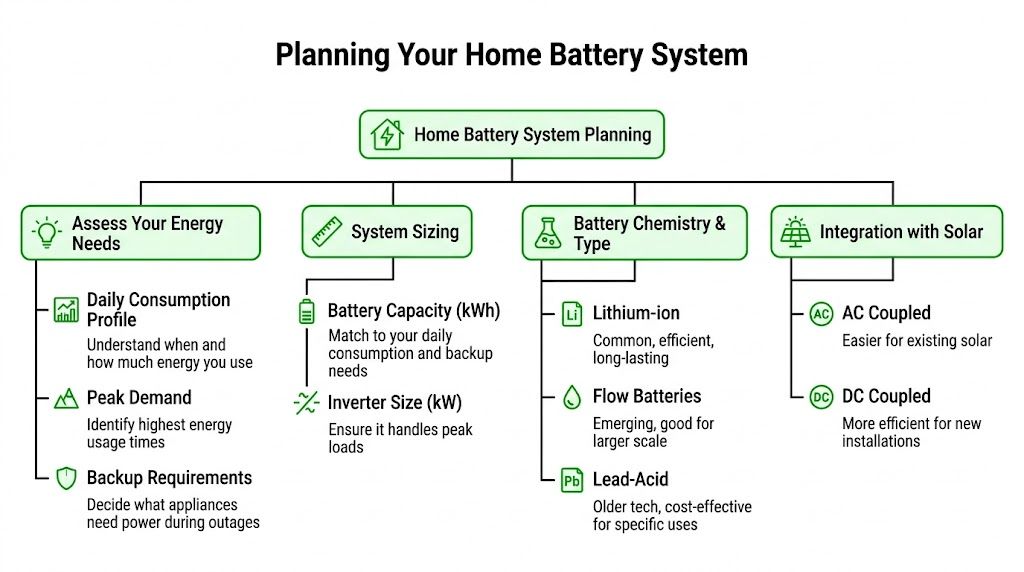
The biggest sizing mistake is simple. People shop for battery capacity before they’ve looked at how the home uses energy.
A battery should fit your load profile, solar production, and future plans. If it’s too small, it empties too early and doesn’t cover the evening properly. If it’s too large, you may pay for storage you rarely fill or use.
Start with your actual energy habits
The first question isn’t “Which brand?” It’s “When do we use power?”
Look at a typical weekday and weekend. Then look at the heavy loads. Air conditioning, pool equipment, ovens, electric hot water, and EV charging all change the battery conversation. A family that’s home from late afternoon onward behaves very differently from a household that’s empty until night.
The NSW battery guidance is especially useful here. It notes that an average Sydney home using 20-30kWh per day typically needs a 10-13kWh battery to offset 70-100% of grid use, and oversizing can create negative ROI. That trade-off is covered in the NSW energy advice on battery sizing and payback.
Practical rule: Size for the energy you can realistically store and use most days, not for the biggest possible battery your wall can hold.
The three inputs that matter most
A proper sizing discussion usually comes down to three things:
Your daily consumption pattern
Total daily use matters, but timing matters more. If most usage lands after sunset, storage becomes more valuable.Your existing solar system
A battery needs enough daytime surplus to charge properly. If the current solar array is small or heavily shaded, the battery may underperform unless the PV system is upgraded too.Your backup expectations
Some homeowners want lights, fridge, Wi-Fi and a few power points during outages. Others want broader coverage. Those are different designs with different switchboard implications.
Don’t confuse kWh with kW
This catches a lot of people out. Battery capacity is measured in kWh. That tells you how much energy the battery can store. Battery or inverter power output is measured in kW. That tells you how much it can deliver at one time.
A simple way to think about it is tank size versus tap size. A large tank with a small tap may run for a long time but struggle with high simultaneous loads. A smaller tank with a stronger tap may handle short bursts better but empty quickly.
That’s why battery selection is never just about the headline capacity.
AC coupled or DC coupled
This is one of the main design choices in home battery installation sydney, especially for retrofit jobs.
AC coupled for many retrofit homes
If you already have solar and don’t want to rebuild the whole system, an AC-coupled battery is often the practical path. It works alongside the existing solar setup and can be easier to integrate when the current inverter isn’t battery-ready.
In plain terms, AC coupling is often the cleaner retrofit option because it disturbs less of the original system.
DC coupled for new systems or battery-ready setups
A DC-coupled battery usually makes more sense when you’re installing solar and battery together, or when the existing inverter is already designed for battery integration. It can be more efficient in the right setup, but only if the hardware matches.
The right answer depends on what’s already on your wall. There isn’t a universally better option.
Battery chemistry and what homeowners should care about
Homeowners don’t need to become battery chemists, but they should understand the practical implications of battery type. In the field, the conversation usually centres on safety, thermal behaviour, usable capacity, warranty structure, and where the battery can be installed.
Questions worth asking include:
- How does this battery handle heat?
- Is it modular or fixed-capacity?
- Can it be expanded later?
- What inverter setup does it need?
- How is backup handled if the grid goes down?
For a useful product-level overview, Interactive Solar has a straightforward battery comparison guide for Sydney homeowners.
Plan for the house you’ll have, not just the house you have now
A battery sized only for today can become awkward if your household changes quickly. The common examples are adding an EV, switching from gas to electric appliances, or having teenagers at home more often.
That doesn’t mean everyone should oversize pre-emptively. It means your installer should ask sensible questions about what’s coming next. Good planning looks a year or two ahead without pushing unnecessary capacity now.
A well-sized system feels boring in the best way. It charges predictably, covers the right loads, and doesn’t leave you wondering why you paid for storage you rarely use.
Navigating Costs Savings and Sydney-Specific Rebates
The financial case for a battery isn’t just about the purchase decision. It’s about how the system behaves every day after installation. The households that get the best value usually do three things well. They charge the battery from solar consistently, they use stored power during higher-value periods, and they avoid buying a bigger system than their usage justifies.
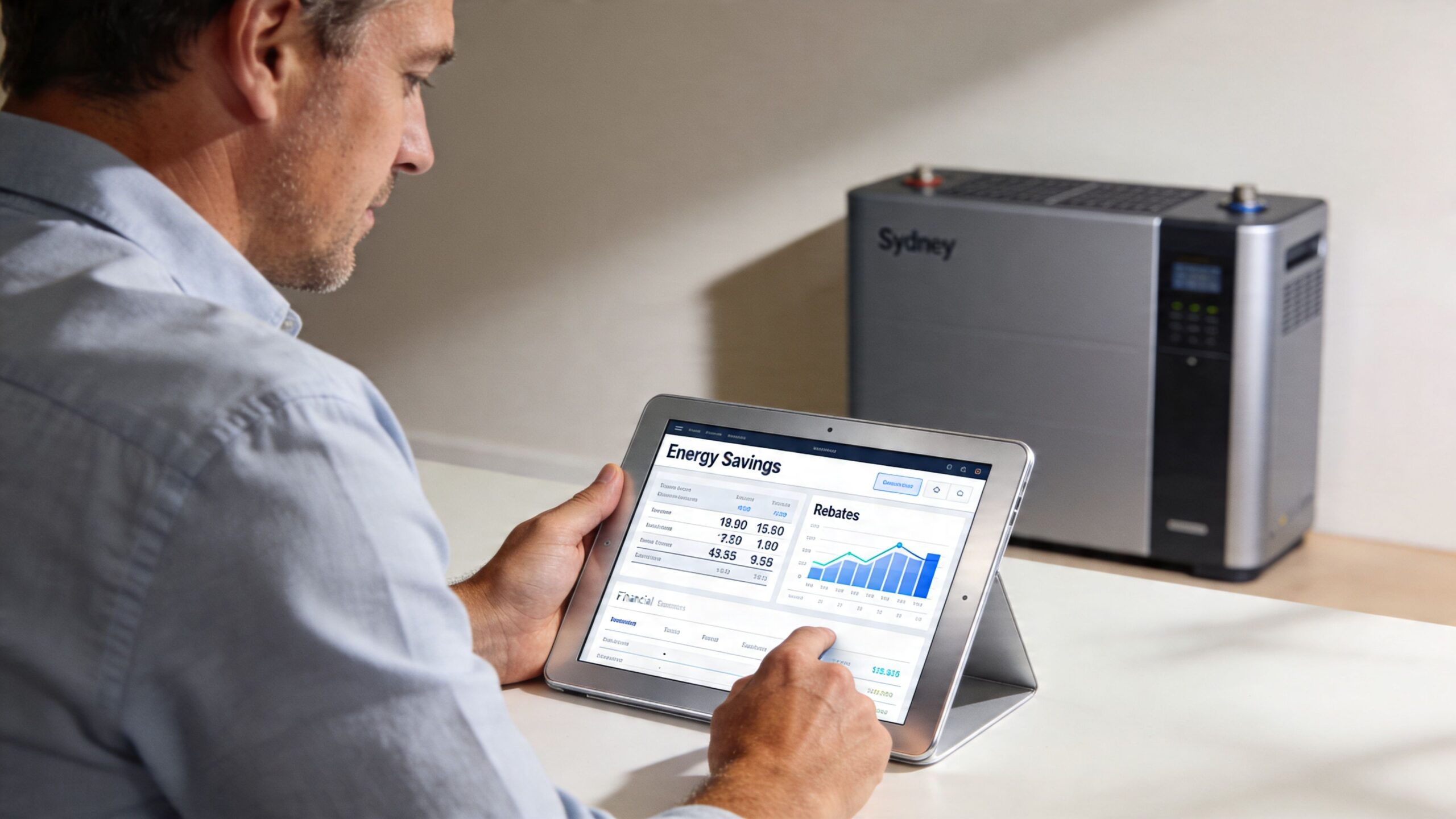
What changed after July 2025
The rebate environment shifted hard when the federal Cheaper Home Batteries Program started. According to SolarQuotes’ reporting, the program fueled explosive demand, with one Australian manufacturer scaling from 30 to over 600 monthly installs, and by February 2026 more than 236,000 subsidised installations had occurred nationwide. That summary is covered in this SolarQuotes analysis of 2025 battery installations.
For Sydney homeowners, the practical impact was simple. Upfront costs became easier to justify, which moved more households from “interested” to “ready to proceed”.
Where savings actually come from
A battery creates value in a few distinct ways.
- Self-consumption: You use more of your own solar instead of exporting it during the day and buying power back later.
- Evening load shifting: Stored solar can cover the period when households are active and grid reliance would otherwise spike.
- Backup value: Some households place real value on keeping selected circuits running during outages.
- VPP participation: Some systems can earn extra value if enrolled in a virtual power plant, though terms vary and shouldn’t be assumed to suit everyone.
The most consistent savings usually come from the first two. A battery that fills well and discharges into the evening is doing the core job.
The payback on paper can look fine, but actual value depends on charging behaviour, tariff structure, and whether the system is sized to the household instead of the sales target.
Rebates and incentives in NSW
Sydney households often need help sorting out which incentive applies, how it’s delivered, and whether it can be combined with other schemes. That confusion is normal. The rules are technical, and they can change.
The practical way to approach it is to ask your installer to explain:
| Incentive area | What to confirm | Why it matters |
|---|---|---|
| Federal support | Whether the battery and installer meet program requirements | Eligibility affects the upfront discount process |
| NSW support | Whether any state-based scheme or VPP-linked incentive applies to your site and battery size | It can materially change payback |
| Timing | When paperwork must be lodged and what approvals are needed first | Poor sequencing can delay the job or the incentive |
| System design | Whether the proposed configuration is compliant for the rebate pathway | Not every battery and inverter pairing is treated the same |
If you want a local summary of the state side, Interactive Solar has a useful explainer on the NSW battery rebate and what households need to know.
A short video can also help make sense of the moving parts before you commit:
The real trade-off in battery economics
The trap is assuming the largest rebate-adjusted system is automatically the smartest buy. It isn’t.
A well-performing battery project balances incentive access with usable daily cycling. If the battery spends too many days only partly charged or lightly used, the maths weakens. If it’s matched closely to the home’s load and solar surplus, the savings story is much cleaner.
That’s why good installers spend more time on interval usage, switchboard design, and future load planning than on glossy payback claims. The economics live in the design.
Your Home Battery Installation Process Explained
Battery installations look simple in photos. On-site, they’re a sequence of checks, approvals, electrical work, and commissioning steps that need to line up properly. The physical battery is only one part of the job.
For most Sydney homes, the process begins with a site visit. That visit should answer four questions. Where can the battery go safely, how will it connect to the current solar and inverter setup, what does the switchboard need, and what approvals are required before work starts.
Step one is the site inspection
In such situations, a competent installer earns their keep.
They’ll inspect roof orientation and shading if the solar system is part of the discussion, but for a battery retrofit the focus often shifts to the existing inverter, cable routes, available wall or floor space, ventilation, and switchboard condition. Garages are common locations because they’re often cool, dry, and accessible, but not every garage wall is automatically suitable.
If the home is older, the switchboard deserves special attention. Plenty of battery delays happen because a system was sold before anyone checked whether the board could support the new configuration.
Step two is matching the battery to the existing system
Many rushed sales processes fall apart because a battery has to work with the inverter architecture already in place, or the design needs to account for the upgrade path.
Some homes have a battery-ready hybrid inverter already. Others need an AC-coupled battery that can sit alongside the existing solar setup. In some jobs, the inverter mismatch is obvious immediately. In others, it only becomes clear once the installer reviews the model numbers, firmware compatibility, and backup requirements.
The Green Light Solar installation guide notes two important realities. Poor battery placement can reduce lifespan by 20-30% due to heat, and CEC-accredited installers achieve over 95% first-pass approval rates for grid connection, which helps avoid unnecessary delays.
If an installer talks about battery capacity but barely mentions inverter compatibility or switchboard condition, the design probably isn’t finished.
Step three is paperwork and distributor approvals
Sydney homeowners usually care about the end result, not the admin. That’s fair. But the paperwork is part of the installation, not an optional extra.
A proper installer handles network applications, grid connection documentation, compliance paperwork, and design sign-offs. In Sydney, that often means dealing with the local distributor requirements, including Ausgrid where relevant. The goal is to make sure the system can be connected, monitored, and signed off without surprises.
This stage also matters for incentive eligibility. If the paperwork path is wrong, the project can stall even when the hardware is sitting on-site ready to go.
What happens on installation day
For a battery-only job, installation commonly fits into a single workday. More complex projects, or jobs combined with solar, can run longer.
A typical day looks something like this:
Arrival and safety setup
The team isolates circuits as needed, protects the work area, and confirms the final battery location before drilling starts.Mounting and physical placement
The battery is wall-mounted or rack-mounted depending on the product and site conditions. Clearances and accessibility matter here.Electrical integration
The team wires the battery into the inverter and switchboard arrangement, installs isolation where required, and configures any backup circuit setup.Testing and commissioning
Voltage, communications, charging behaviour, and safety shutdown functions are checked before the system is energised.App setup and handover
The homeowner gets access to the monitoring platform and a walkthrough of the key screens.
Backup circuits and blackout expectations
Backup is one of the most misunderstood parts of home battery installation sydney. Homeowners often assume the whole house will stay live in a blackout. Sometimes it can. Often, selected loads are the more sensible design choice.
Fridges, lights, internet, and a few power circuits are common priorities. Large ducted air conditioning, ovens, or other high-demand loads may not be practical on the backup side unless the system is specifically designed for that role.
The right way to approach backup is to nominate what matters during an outage. That gives the installer something concrete to engineer around.
Where jobs go wrong
The most common installation problems aren’t dramatic. They’re predictable.
- Battery placed in a hot location: Heat shortens battery life and can create warranty and performance issues.
- Inverter mismatch discovered late: This leads to redesigns, extra hardware, or delays.
- Switchboard not assessed properly: Space, capacity, or compliance issues can stop the install from progressing smoothly.
- Cable routes ignored during quoting: Tight access, long runs, or awkward penetrations can affect labour and finish quality.
These are exactly the issues a thorough pre-install inspection is supposed to catch.
Handover shouldn’t be rushed
The last part of the job matters more than people think. Homeowners need to know how to read the app, what normal charging and discharging looks like, and how the system behaves during a blackout.
A good handover covers:
- Monitoring basics: Solar generation, battery charge level, home usage, and grid import/export
- Operating mode: Whether the battery prioritises self-consumption, backup reserve, or another setting
- Support path: Who to contact if the app drops out, the battery alerts, or the system behaves unexpectedly
A battery install is successful when the system performs well and the homeowner understands it well enough to spot when something changes.
How to Find and Vet a Licensed Sydney Installer
Battery hardware matters. The installer matters more.
In Sydney, the gap between a careful battery installation and a risky one usually shows up in the site audit, not the sales pitch. Any company can talk about premium products. The true test is whether they can explain where the battery can go, how it will connect, what approvals are needed, and what might complicate the job before you sign anything.
The compliance issue many homeowners miss
Battery location rules are stricter than a lot of homeowners expect. That’s not bureaucracy for its own sake. Placement affects safety, access, inspection outcomes, and warranty validity.
The SolarQuotes guidance on location compliance highlights that AS/NZS 5139 rules are critical and often misunderstood, and improper placement such as in wall cavities or near evacuation routes can void warranties and create safety hazards. That’s covered in their article on home battery installation locations and compliance.
Older Sydney homes make this especially relevant. Under-house spaces, narrow side passages, raised weatherboard floors, terraces with limited service areas, and apartment storage rooms all need site-specific judgement. There is no universal “just put it in the garage” answer because not every property has a compliant garage option.
A proper battery quote should be tied to a real site assessment. If the location discussion is vague, the project still has unanswered safety questions.
Questions worth asking before you choose anyone
Use the checklist below when comparing installers.
| Question Category | What to Ask | Why It Matters |
|---|---|---|
| Licensing | Are you using licensed electricians and who signs off the work? | Battery systems need compliant electrical installation and documentation |
| Accreditation | Is the design and installation handled by accredited personnel? | It affects compliance, approvals, and rebate pathways |
| Site audit | Will you inspect the actual battery location before final design approval? | Placement errors can create safety and warranty issues |
| Inverter compatibility | Have you checked the exact inverter model already installed at my home? | Many retrofit issues come from poor system matching |
| Switchboard review | Will you assess whether my switchboard needs upgrades? | Batteries often expose switchboard limitations |
| Approvals | Who handles distributor applications and grid connection paperwork? | Incomplete admin can delay energisation |
| Backup design | Which circuits will stay on in a blackout, and which won’t? | Backup expectations need to match the electrical design |
| Installation team | Do you use in-house installers or subcontractors? | It affects accountability and consistency |
| After-care | What happens if the system faults or the monitoring app stops reporting? | Post-install support is part of the product experience |
| Consumer protections | Are you operating in line with recognised consumer standards? | It helps you assess sales conduct and documentation quality |
One useful reference point is the consumer protection framework explained in Interactive Solar’s overview of the New Energy Tech Consumer Code.
Local installer or national sales brand
There’s a practical difference between buying from a local installer and buying from a national lead-generation machine that outsources the hard parts.
A local Sydney business is more likely to understand distributor expectations, local housing stock, access issues, and the practicalities of servicing the system after the install. A national sales operation may still deliver a good outcome, but the weak point is often accountability. If sales, design, install, and after-care all sit with different parties, homeowners can get bounced between departments when something doesn’t line up.
One example of a local provider in this market is Interactive Solar, which offers in-house installation teams and battery system design for Sydney homes. That kind of model can be worth considering when you want a clearer chain of responsibility.
Red flags that should slow you down
Be careful if you hear any of the following:
- “Any battery will work with your system.” Compatibility needs checking.
- “We’ll sort the location on the day.” Placement should be resolved before install day.
- “The whole house will back up automatically.” Maybe, maybe not. It depends on design.
- “Rebates apply the same way to every setup.” They don’t.
- “No need to inspect the switchboard yet.” There absolutely is.
A good installer doesn’t make the job sound effortless. They make it sound controlled.
Life With Your Battery Maximising Your Energy Independence
The first few weeks after installation are where the battery stops being a product and starts becoming part of the household. You stop thinking about it as equipment on a wall and start noticing what changes. Evening grid imports drop. Solar that used to leave the property now gets used later. During a blackout, a few key circuits stay alive and the house feels less exposed.
That is the benefit. Not novelty. Control.
What day-to-day use actually looks like
On a normal sunny day, the pattern is straightforward. The solar system covers live daytime loads first. Surplus generation charges the battery. Later, when the sun fades and the home is active, the battery discharges into those evening loads.
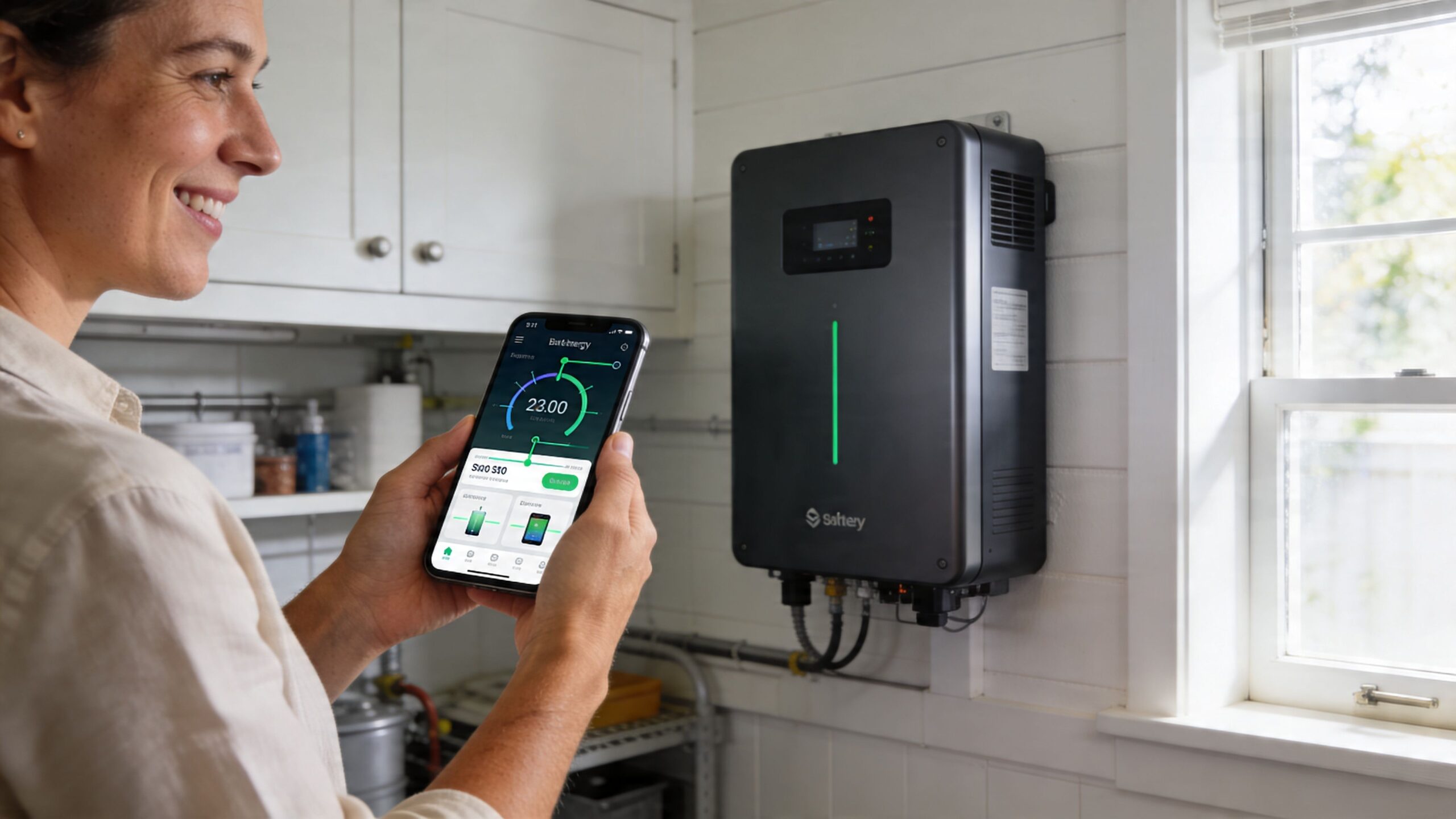
The monitoring app becomes useful very quickly. Most homeowners start by checking it out of curiosity. After that, they use it to understand patterns. You can see whether the battery is reaching full charge, whether evening consumption is draining it too quickly, and whether large appliances are chewing through stored power faster than expected.
That feedback changes behaviour. Some people shift dishwasher or pool pump timing. Others reserve more battery for blackout protection. Households with EVs often become more deliberate about when the car charges.
Getting more value from the system
The best battery owners aren’t obsessive. They’re observant.
A few habits make a noticeable difference:
- Check the app regularly at first: Learn what a normal day looks like in your house.
- Watch evening demand: If the battery empties early, identify what loads are driving it.
- Use major appliances strategically: Run flexible loads when solar is strong if that suits your setup.
- Review settings after seasonal changes: Summer cooling and winter heating can alter battery behaviour.
Most performance issues aren’t hardware failures. They’re settings, load changes, or expectations that were never aligned with how the household actually uses power.
Blackout protection in real terms
Backup power is reassuring, but it needs a realistic mindset. If your system is configured for essential circuits, then think in terms of resilience, not business-as-usual living.
During an outage, the backed-up circuits continue according to the battery’s available charge and output capability. That often means lights, refrigeration, internet, garage door access, and selected outlets. If the battery is partly discharged before the outage starts, available runtime will be lower. If the day is sunny and the system is configured appropriately, solar can help support the battery through the event.
The practical question is not “Can it run everything?” It’s “Can it keep the important parts of the home functioning?”
Virtual power plants and whether they suit you
A Virtual Power Plant, or VPP, allows eligible battery systems to participate in a broader energy network. In simple terms, the battery can sometimes be coordinated to support the grid, and the homeowner may receive value in return depending on the program terms.
For some households, a VPP is attractive. For others, control matters more than participation benefits. The decision usually comes down to how much flexibility the homeowner is comfortable giving up, what backup reserve they want maintained, and how transparent the program settings are.
Questions to ask before joining include:
- Who controls battery dispatch under the program?
- What reserve level can you keep for blackout protection?
- How easy is it to exit the program if it doesn’t suit you?
- How will participation appear in the monitoring app?
If you’re comparing battery products with blackout and app control in mind, this guide to Tesla Powerwall 3 in Australian homes is a useful product-specific reference.
Maintenance is light, but not zero
Modern batteries are low-maintenance compared with a lot of home equipment, but “set and forget” goes too far.
Homeowners should keep the installation area clear, avoid storing clutter around the battery, and pay attention to alerts from the app. If internet connectivity drops, monitoring may stop even if the battery still works. Firmware updates, system notifications, or unusual charging behaviour are worth checking rather than ignoring.
A tidy installation area also helps if service is ever needed. Technicians need safe access.
The long-term win
The strongest battery outcomes tend to feel calm rather than dramatic. The system does its job in the background. You rely less on imported power. You ride through short outages with less disruption. You understand your home’s energy use better than you did before.
That’s why home battery installation sydney has become a serious consideration for households that already have solar and want more from it. The battery doesn’t replace good energy habits or good system design. It rewards them.
If you want a battery system designed around your actual usage, roof setup, inverter compatibility, and backup priorities, speak with Interactive Solar. As a family-owned Sydney provider, they handle consultation, system design, installation, and after-care with licensed in-house teams, which makes the process far easier to manage from first site visit to final commissioning.
Make Interactive Solar a preferred source in Google
One click tells Google to surface our articles more often in Top Stories, AI Overviews and AI Mode.