
Solar Power for Home Cost: Investment & Payback 2026
Last updated:
If you're searching for solar power for home cost, most of the advice you'll find starts in the wrong place. It starts with a number.
That number is usually close to useless.
A solar system isn't a boxed appliance you pull off a shelf. It's a site-specific electrical system that has to suit your roof, your switchboard, your daytime usage, your night usage, and the way your household will live over the next several years. If someone gives you a neat headline price before asking about those things, they're giving you marketing, not guidance.
The better question isn't “What does solar cost?” It's “What makes one solar investment work well in my home while another disappoints?”
Why a Simple Price Tag Is Misleading
A solar quote without a home assessment is close to meaningless.
Online price guides can help you get your bearings, and a local explainer like how much do Brisbane solar panels cost? can be useful for understanding how installers talk about quotes in practice. But a headline figure still does not tell you whether the system suits your roof, matches your usage, or will hold its value over time.
I have seen cheaper quotes turn into expensive systems once the missing pieces show up. Extra switchboard work. Poor panel layout. An inverter that saves money on day one and limits battery options later. On paper, the system looked affordable. In practice, it was undersized, awkwardly installed, or built with short-term decisions that hurt long-term returns.
That is why two houses on the same street can get very different prices and both quotes can be reasonable. One home may have simple roof access and a modern switchboard. The other may need compliance upgrades, have morning shade, or need a different panel layout to avoid production losses.
What a sticker price leaves out
A low number often leaves out the parts that determine whether the system performs well for ten years or becomes a problem quote you regret accepting.
- Panel count without context can make a proposal look strong, even if orientation, tilt, and shading reduce output.
- A basic inverter choice can trim upfront cost while limiting monitoring, future expansion, or battery compatibility.
- Roof access and installation difficulty change labour time, mounting hardware, and cable runs.
- Switchboard and compliance work may be required before the system can be connected safely.
- Workmanship and after-sales support affect fault finding, maintenance, and how the system holds up in real conditions.
Installation quality matters as much as hardware selection. A guide on why installation quality shapes long-term solar value explains what to look for before you compare proposals.
Practical rule: Compare solar quotes the way you would compare building plans. Look at what is included, what has been assumed, and what could cost you later.
The better question to ask
Instead of asking for the lowest price, ask:
- What will this system offset in my home?
- What assumptions are being made about my daytime and evening usage?
- Which parts of this quote improve output, service life, and future flexibility?
- What has been excluded that could appear as a variation later?
That shift matters. It moves the conversation away from sticker price and toward investment quality.
The Building Blocks of Your Solar Power System
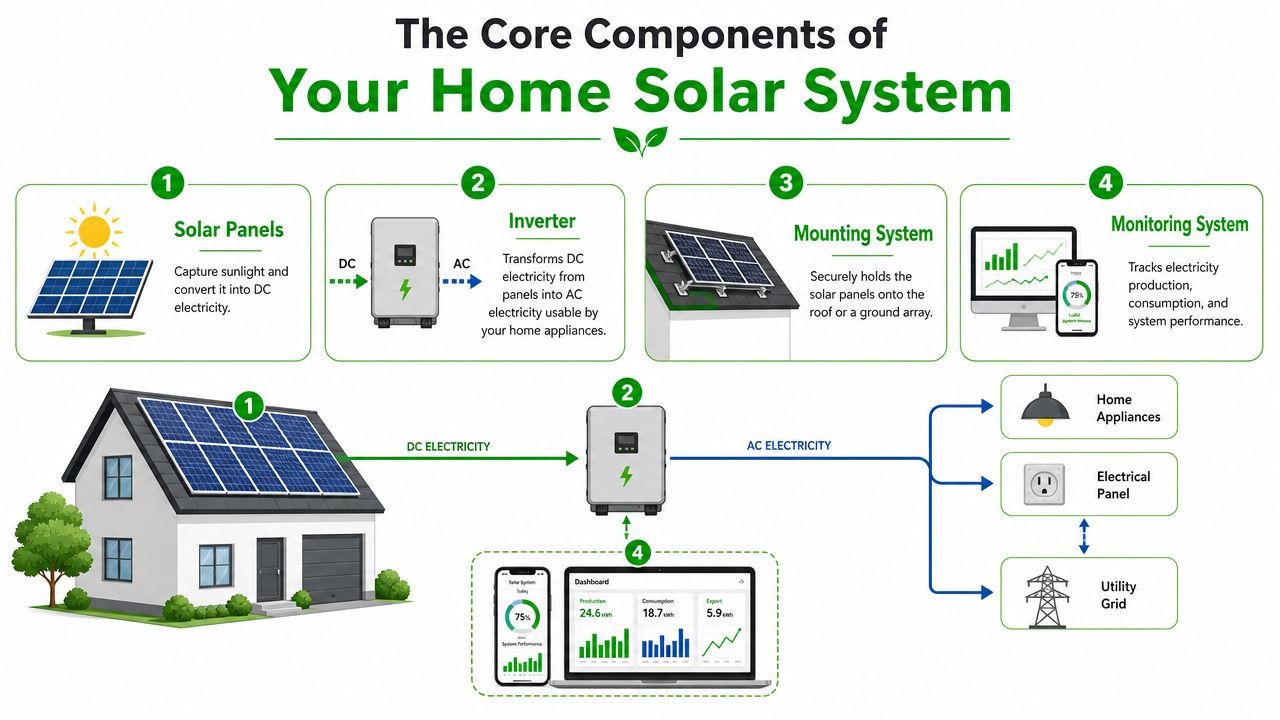
A home solar system is only as good as its weakest core component. Homeowners often focus on panel brand because that's the visible part on the roof, but the long-term result comes from how the whole system works together.
Solar panels
Panels are the generation engine. Their job sounds simple: capture sunlight and produce DC electricity. In practice, not all panels behave the same over years of weather exposure, heat, grime, and partial shading.
A lower-grade panel can still produce power. The problem is consistency over time. Frame quality, glass durability, cell design, and manufacturer support all influence whether that panel keeps delivering as expected or becomes the part of the system everyone regrets first.
If you want a deeper look at panel differences, this solar panel efficiency comparison is a useful starting point.
The inverter
If panels are the engine, the inverter is the control centre. It converts DC electricity into AC electricity your home can use, and it often handles monitoring, fault reporting, and future battery compatibility.
Many “cheap” systems lose value due to their inverter. The inverter affects:
- Energy conversion quality throughout the day
- Monitoring visibility when something underperforms
- Design flexibility on roofs with mixed angles or some shading
- Upgrade pathways if you later want battery storage
Some homes suit a straightforward string inverter. Others benefit from module-level control. The point isn't that one technology always wins. The point is that the inverter should match the roof and the household, not the sales brochure.
A strong panel paired with the wrong inverter is like fitting good tyres to a car with poor steering. You've paid for quality, but you won't feel the full benefit.
Mounting and monitoring
The mounting system doesn't get much attention because homeowners rarely see it once the job is done. Installers see it differently. Mounting determines how securely the array is fixed to the roof, how loads are handled, and how well the installation copes with years of weather.
Monitoring matters for a different reason. It tells you whether the system is doing what you were promised. Without good monitoring, underperformance can drag on unnoticed.
Here's the practical breakdown:
| Component | What homeowners often notice | What actually matters long term |
|---|---|---|
| Panels | Brand and appearance | Output stability, durability, support |
| Inverter | Whether it's included | Conversion quality, diagnostics, upgrade path |
| Mounting | Usually ignored | Roof safety, structural integrity, longevity |
| Monitoring | App features | Early fault detection and performance tracking |
A well-priced system uses balanced components. An overpriced system can hide behind branding. An underpriced system usually cuts corners somewhere you won't spot until later.
Why Your Home Is the Biggest Cost Variable
Two houses can want the same outcome and need very different systems to get there. That's why a proper solar quote looks more like a custom-made suit than an off-the-rack shirt.
The roof shape, roof material, usable panel area, orientation, shading, cable runs, and switchboard condition all change what's practical. None of that is visible in a quick online calculator.
Roofs don't behave the same
A simple, open roof gives an installer options. A chopped-up roof with multiple faces, vents, obstructions, and shade points forces design trade-offs.
Some homes allow a clean layout with strong solar access through the day. Others require more careful placement so the system avoids predictable losses. You can still install solar on many of those homes, but the design work matters more.
The roof itself also changes the job:
- Metal roofs can be more straightforward for certain mounting methods.
- Tile roofs often require more care during installation.
- Steeper pitches affect access, safety, and labour time.
- Older roofs may need attention before solar goes on top.
The electrical side matters just as much
A roof might be perfect and the electrical setup might still complicate the project. An ageing switchboard, limited space for new protection gear, or awkward cable paths can all affect the final scope.
This isn't padding. It's compliance and safety.
If an installer doesn't want to inspect the switchboard, they're not pricing the real job.
Good installers assess the whole path from roof to inverter to switchboard to meter connection. That's the difference between a quote that survives installation day and a quote that starts growing once work begins.
Why site visits matter
Homeowners sometimes worry that an in-person assessment is just a sales tactic. In practice, it's the part that protects you from a bad fit.
A proper visit should answer questions like these:
- How much roof space is usable?
- Will shade affect one part of the array more than another?
- Is the switchboard ready for solar?
- Does the design leave room for a battery or EV charger later?
- Will the system suit how the household uses power, not just how the roof looks?
That last point matters most. A home with excellent roof space can still get poor financial results if the system size and design don't match the occupants' habits.
This is why a single answer to “solar power for home cost” doesn't exist in any honest sense. The home itself is one of the biggest variables in the entire equation.
Future-Proofing with Batteries and EV Chargers
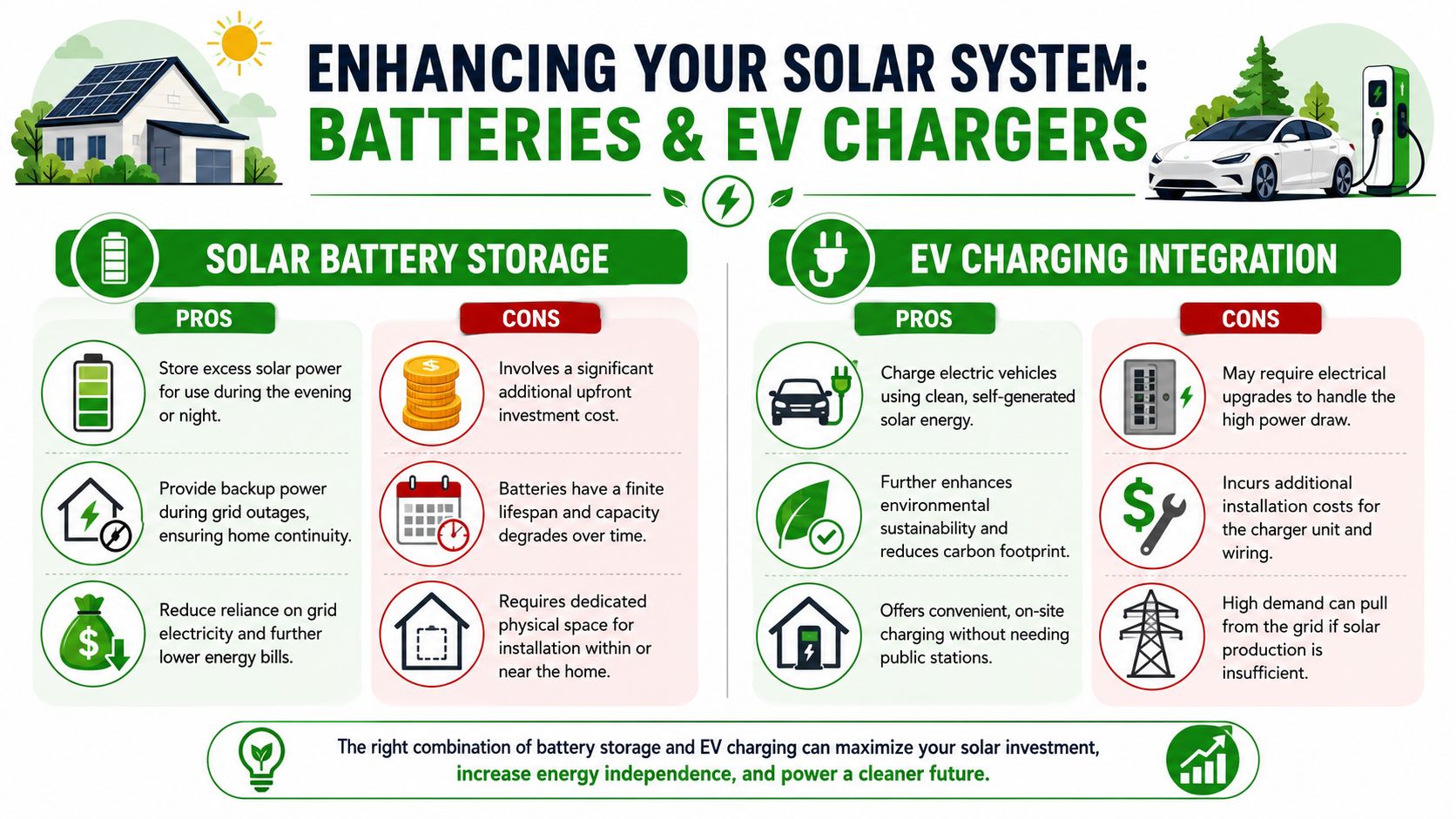
Solar panels lower daytime grid dependence. Batteries and EV charging push that benefit further by changing when and how you use the energy your roof produces.
For many households, that's where solar stops being a panel purchase and becomes a home energy system.
What a battery changes
Without a battery, excess daytime solar often leaves the house when no one is using it. With a battery, some of that energy can be stored for evening use. That can suit households whose demand rises after work, after school, or after sunset.
Batteries also appeal to homeowners who want backup capability during outages, depending on the system design.
The value isn't universal. A battery makes more sense for some usage patterns than others. But when it fits, it changes the economics and convenience of the whole setup. If you're weighing that option, this guide to home battery storage systems covers the practical considerations well.
EV charging on solar
An EV charger adds another layer. Instead of only offsetting household appliances, solar can also support vehicle charging at home.
That's attractive for a simple reason: transport becomes part of the solar equation. A roof that only feeds the house during the day can also help charge the car when production is high, if driving patterns allow it.
A few real trade-offs matter here:
- Electrical capacity may need checking before adding a charger.
- Charging times should align with solar production where possible.
- Future planning matters if the home may later add both an EV charger and battery.
Incentives can change the picture
Government support can make storage more accessible. In the ACT, the government's Next Gen Energy Storage program offered eligible households in the 2021–22 round up to $825 per kilowatt-hour of usable battery capacity, capped at $5,000 per battery, with zero-interest finance in some cases, according to this summary of the ACT battery support settings.
That example matters because it shows how targeted support can shift a battery from “maybe later” to “worth serious consideration” for the right household.
Batteries and EV chargers aren't extras for everyone. In the right home, they solve the exact usage mismatch that makes panel-only systems underperform financially.
How Government Rebates Reduce Your Upfront Cost
Most Australian homeowners hear the word “rebate” and picture money arriving later. That's not how the main national solar support mechanism usually feels in practice.
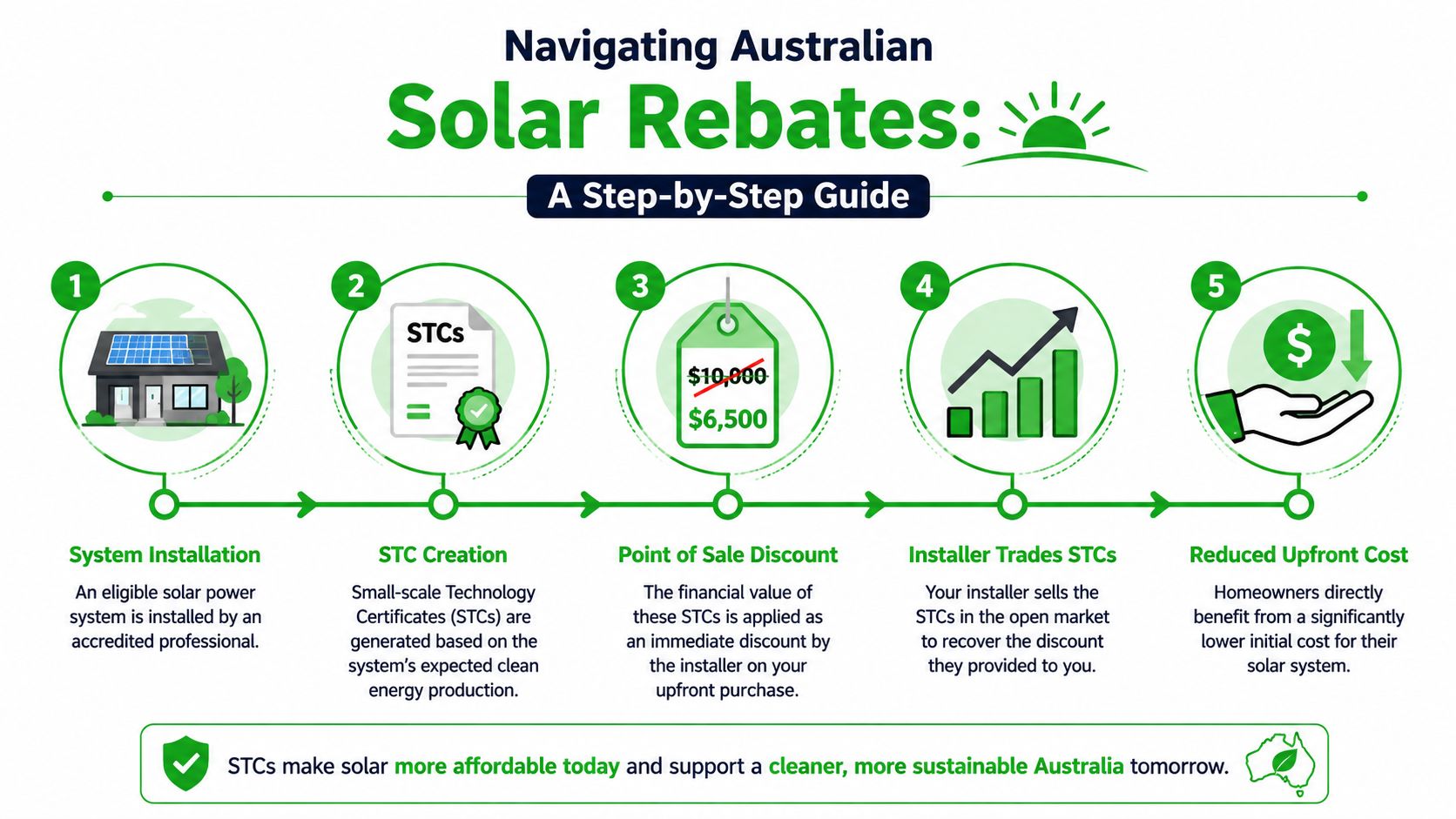
The key scheme is the Small-scale Renewable Energy Scheme, often shortened to SRES. Under that framework, eligible solar systems create small-scale technology certificates, or STCs, which are used to reduce the upfront purchase price.
How the discount works
The broad idea is straightforward:
- An eligible system is installed
- STCs are created based on expected generation
- The installer applies that value as an upfront discount
- The installer then trades those certificates in the market
Australian Government information notes that the SRES has been a major driver of lower home solar costs since it began on 1 January 2011, and that the incentive is linked to the electricity a system is expected to generate until 2030. It also notes that the number of certificates falls over time, steadily reducing the subsidy available to households as that end date approaches, as explained in this overview of Australian STCs and the SRES phase-down.
Why timing matters
This is one of the few parts of solar where waiting has a built-in downside. Because the certificate value declines as the scheme moves toward 2030, installing earlier captures more of that support than installing later.
That doesn't mean everyone should rush into a poor-quality system. It does mean delay has a real cost if you already know solar suits your home.
For households comparing broader electrification upgrades, it also helps to think beyond PV alone. Hot water can be a major part of electricity use, so a guide like best solar hot water systems in Australia can help round out the bigger efficiency picture.
What to ask your installer
Before you accept a quote, confirm:
- Whether the STC discount is already included
- What assumptions were used to calculate eligibility
- Whether the system design affects certificate creation
- How long the quote remains valid if market conditions change
For battery support in NSW, state-level settings can also matter. This overview of the NSW solar battery rebate landscape is useful if storage is part of your plan.
Calculating Your True Return on Investment
The quote total is the easy part. The key question is what that system will save, what it will still leave on the grid, and how long those results hold up in your house.
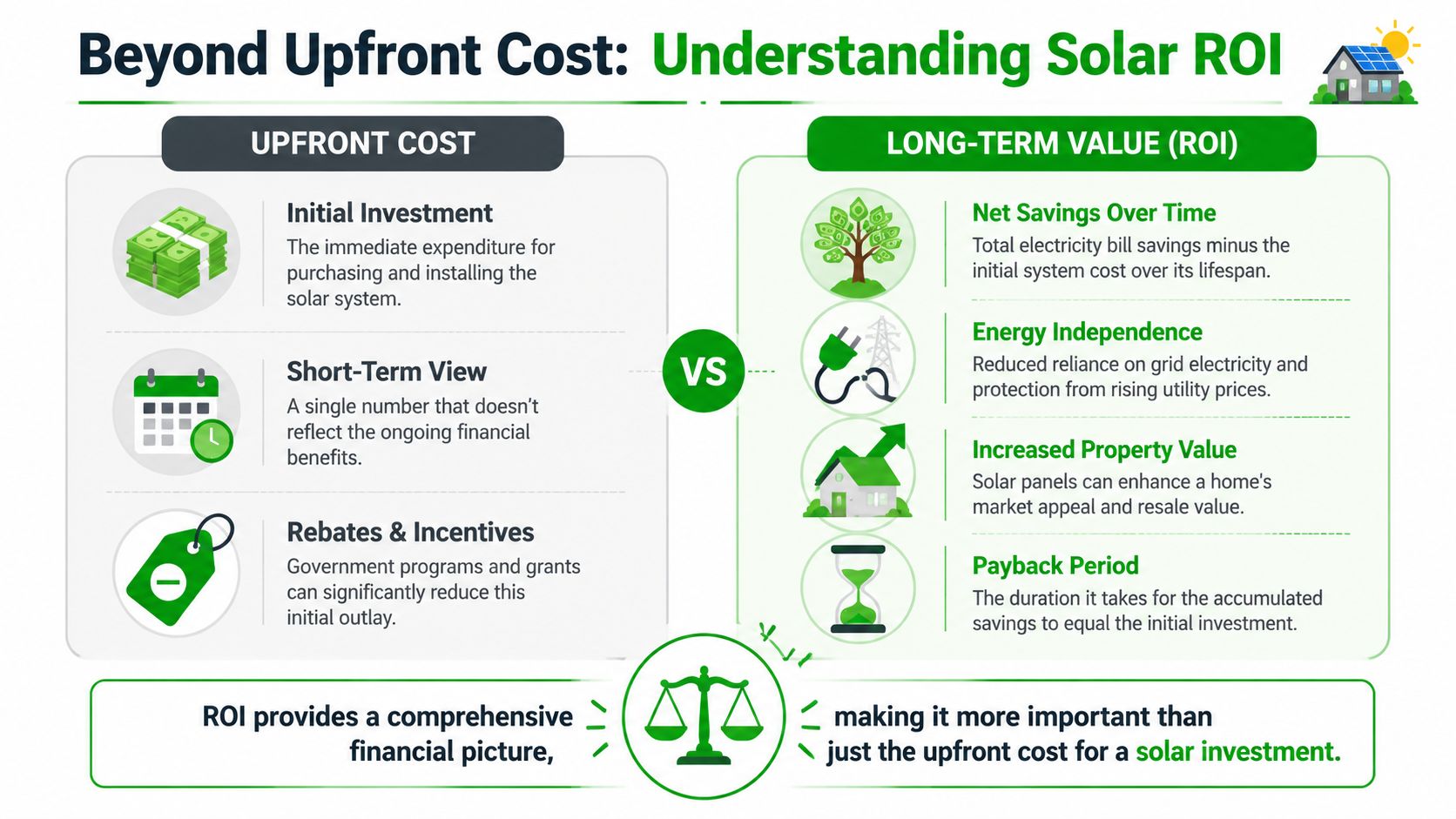
I've seen expensive systems produce mediocre returns, and modest systems perform very well. The difference usually comes down to self-consumption, tariff structure, roof suitability, and whether the design matches how the household uses power.
Family A and Family B
Take two common households.
Family A has someone working from home most days. The air conditioning, home office, washing, and kitchen use overlap with solar production. This household usually gets stronger value from a well-sized panel system because more of the generation is used on site when power rates are being avoided.
Family B leaves early, comes home late, cooks in the evening, runs the dishwasher at night, and has the highest demand after sunset. A panel-only system can still reduce bills, but the payback is often slower unless that household shifts some loads into the day or adds storage.
That difference matters more than a headline price.
Here's a simple way to look at the before-and-after pattern:
| Household pattern | Before solar | After well-matched solar setup |
|---|---|---|
| High daytime use | More grid kWh used during solar hours | Less daytime grid use |
| High evening use, no battery | Heavy late-day grid dependence | Daytime relief, evening grid use remains |
| High evening use with battery | Heavy late-day grid dependence | More stored solar used after sunset |
What to review on your bills
Start with the parts of the bill that directly affect savings, not just the amount due.
Check for:
- When power is being used, if your retailer or app shows interval data
- Seasonal peaks, especially cooling and heating loads
- Usage charges compared with supply charges
- Controlled loads or time-of-use tariffs
- Upcoming changes, such as an EV, battery, pool pump, or more days working from home
Those details shape return. A house with low daytime use and a weak feed-in tariff needs a different design conversation than a house that runs appliances through the middle of the day.
This video gives a useful visual explanation of how homeowners can think about solar savings in practical terms:
ROI starts with matching, not guessing
Good return comes from matching system output to expensive grid consumption. It does not come from chasing the biggest panel count a roof can hold.
A system that exports lots of cheap surplus power can look impressive in a proposal and still underperform financially. A smaller or differently oriented system can produce a better payback if it covers more of the loads you would otherwise buy from the grid at full retail rates.
The best solar system isn't the one that produces the most power on paper. It's the one that offsets the most expensive and most frequent grid usage in real life.
If you want to test your own assumptions before comparing quotes, a practical solar savings calculator helps you estimate how usage timing changes the result.
And once the system is on the roof, output preservation matters too. Dirt, leaf buildup, and shading can reduce the return you expected, which is why practical maintenance advice like Sparkle Tech on improving solar performance is worth factoring into the long-term value of the investment.
Your Next Steps to Unlocking Solar Savings
If you've read this far, you already know the main point. A generic online number won't tell you the actual solar power for home cost for your property, and it definitely won't tell you the likely return.
A proper decision starts with your bills, your roof, and your future plans.
Get your house data ready
Before speaking with an installer, gather:
- Recent electricity bills so your usage pattern is visible
- Notes on when people are usually home
- Any plans for an EV or battery
- Photos of the roof and switchboard, if available
- Questions about warranty, monitoring, and future expandability
That gives you a stronger starting point and makes it easier to spot the difference between a customized proposal and a recycled package.
Compare quality, not just the quote total
When you review proposals, don't just ask who's cheaper. Ask who has understood the house.
You should be looking for clear reasoning around design, not just a product list. You should also think about long-term maintenance and output preservation. For example, if tree growth, dust, or debris may become a problem at your property, practical advice like Sparkle Tech on improving solar performance can help you protect the value of the system after installation.
The homeowners who end up happiest with solar usually aren't the ones who chased the lowest number. They're the ones who bought a system that fit the house and the way they live.
Interactive Solar helps NSW homeowners turn that vague online “price” question into a proper plan. If you want a customized system design, honest guidance on panels, batteries or EV charging, and a face-to-face consultation built around your home and your bills, visit Interactive Solar.
Make Interactive Solar a preferred source in Google
One click tells Google to surface our articles more often in Top Stories, AI Overviews and AI Mode.