An Essential Guide: What Is Battery Management System
Last updated:
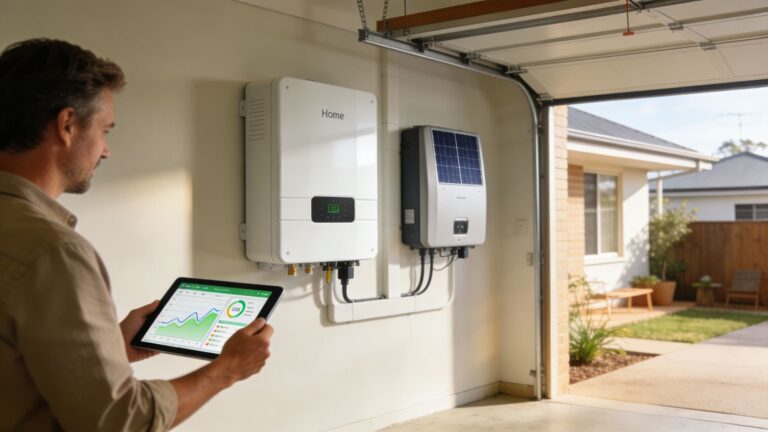
You can usually see the battery on the wall, the inverter nearby, and the app on your phone. What you can't see is the part making constant decisions in the background about safety, charging, temperature, and how hard that battery should work today.
That hidden layer matters more than is often recognised.
When someone asks what is battery management system, they're often expecting a short technical definition. Practically speaking, the better answer is simpler. It's the part that protects your battery investment from the sort of mistakes lithium batteries can't afford. It watches what each cell is doing, decides when charging or discharging needs to slow down or stop, and helps the battery deliver useful energy without being pushed into unsafe or damaging conditions.
If you own, or you're considering, a home battery, EV, e-bike, or scooter, this same principle applies. Good battery hardware helps, but control is what turns stored energy into something dependable. If you're comparing solar battery options, the BMS is one of the key reasons two systems that look similar on paper can behave very differently over time.
Your Battery's Unsung Hero The BMS
A lot of homeowners reach the battery-buying stage after doing the visible part of the research. They compare brands, storage size, backup features, and app interfaces. Then the installer mentions the BMS, and it sounds like a background detail.
It isn't.
A battery management system, or BMS, is the electronic control layer that monitors and regulates charge and discharge at the cell level. It typically measures voltage, current, and temperature, and it enforces protections such as overcharge, over-discharge, over-current, and short-circuit cutoff, according to Microchip's explanation of BMS fundamentals. In plain language, it's what keeps a lithium battery within safe operating limits and helps preserve battery health over time.
Why clients rarely notice it until it matters
If your battery behaves properly, the BMS stays invisible. It doesn't ask for attention. It does its job while you run the dishwasher off solar, charge the EV overnight, or keep reserve power available for later.
When it's poor quality, badly integrated, or poorly configured, the symptoms usually show up where homeowners feel them most:
- Safety concerns: Charging limits, temperature control, and fault handling aren't areas where you want guesswork.
- Reduced usable capacity: A battery can look fine on paper but feel disappointing in daily use if the control logic is conservative or uneven.
- Premature wear: Heat, repeated stress, and poorly managed charging can chip away at long-term value.
- Frustrating system behaviour: Unexpected cut-outs, odd app readings, or poor communication with other hardware usually point to control issues, not just battery chemistry.
A battery doesn't protect itself. The BMS does that job.
This matters outside home storage too. If you want practical advice for electric ride users, the same lesson shows up again and again. Charging habits, heat, and battery management all affect how well a pack lasts in everyday use.
The Core Role of a Battery Management System
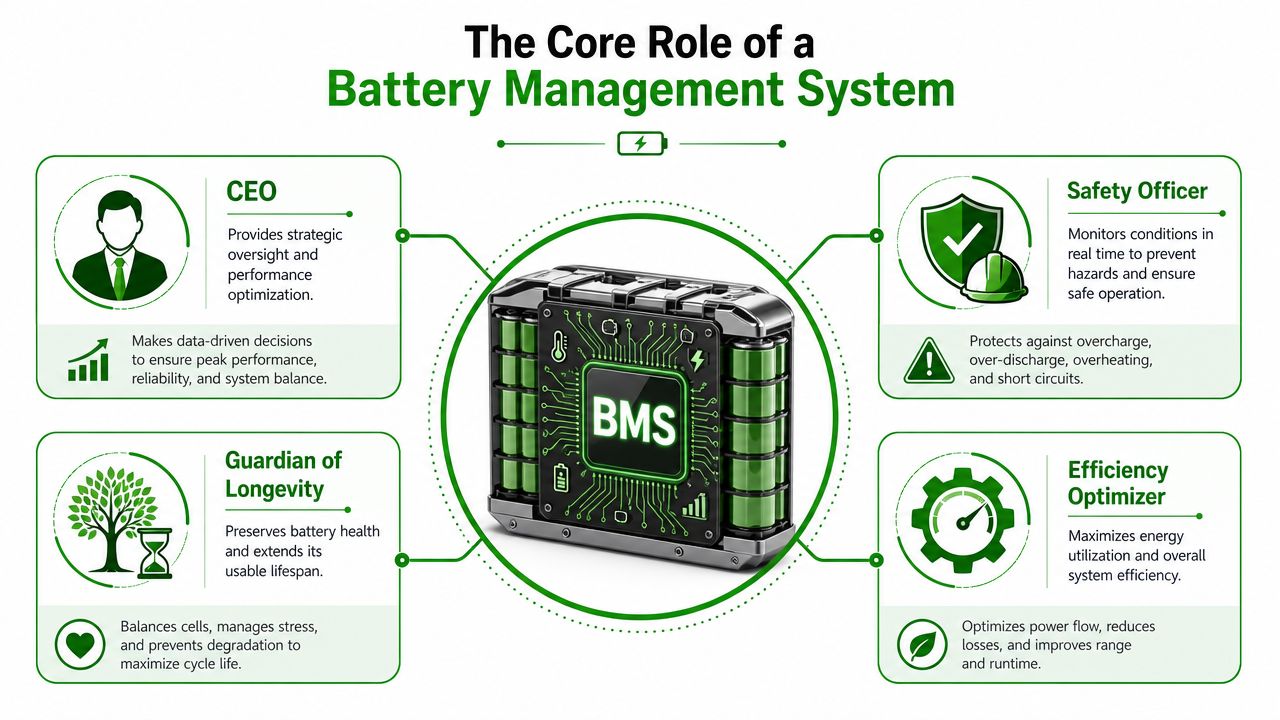
The easiest way to understand a BMS is to think of it as the battery pack's CEO and Safety Officer.
As the CEO, it's responsible for performance. It decides how the pack should operate within its limits, how charge and discharge should be managed, and how the battery should communicate with the rest of the system.
As the Safety Officer, it enforces hard rules. If voltage, current, or temperature moves outside acceptable boundaries, it acts. It doesn't just observe.
A battery pack is not one big battery
Many non-technical buyers often misunderstand this aspect. A home battery or EV battery isn't a single, uniform block. It's made from many cells working together. Those cells don't age in perfectly identical ways, and they don't always sit at exactly the same voltage or temperature.
The BMS exists because those differences matter.
If one part of the pack starts drifting outside the others, the whole system can suffer. The battery can only safely perform as well as its weakest or most stressed cells allow. That's why the BMS monitors the pack at cell level, not just as a single lump of stored energy.
What the BMS is trying to achieve
A good BMS has two jobs that never stop competing with each other:
| Goal | What it means in practice |
|---|---|
| Protect people and property | Prevent unsafe charging, overheating, short-circuit events, and operation outside safe limits |
| Protect the battery asset | Preserve state of health, maintain useful capacity, and avoid avoidable stress on the cells |
That balance is where quality shows. A crude system can be overprotective and leave performance on the table. A reckless one can chase output at the expense of long-term battery health.
Control, not just measurement
People sometimes assume a BMS is just a sensor package. It isn't. It's an active control layer.
MathWorks describes a BMS as the system that monitors cell voltage, current, temperature, state of charge, and state of health, while performing protection, cell balancing, thermal management, and communications in lithium-ion systems. It also notes that a BMS is central to preventing overcharging and overheating while extending battery life and cycle count, in its battery management system overview.
That's why battery discussions shouldn't stop at chemistry or brand name. The quality of the battery's control layer plays a direct role in how usable, stable, and durable that system feels in a home or business.
If you've looked into integrated battery products such as the Tesla Powerwall 3 guide, this is one reason the conversation always comes back to system design and control, not just headline storage specs.
Key Functions Your BMS Performs Every Day
The BMS operates discreetly, but it's active all day. Every charge session, every discharge event, every hot afternoon, every overnight top-up. It keeps checking, adjusting, and protecting.
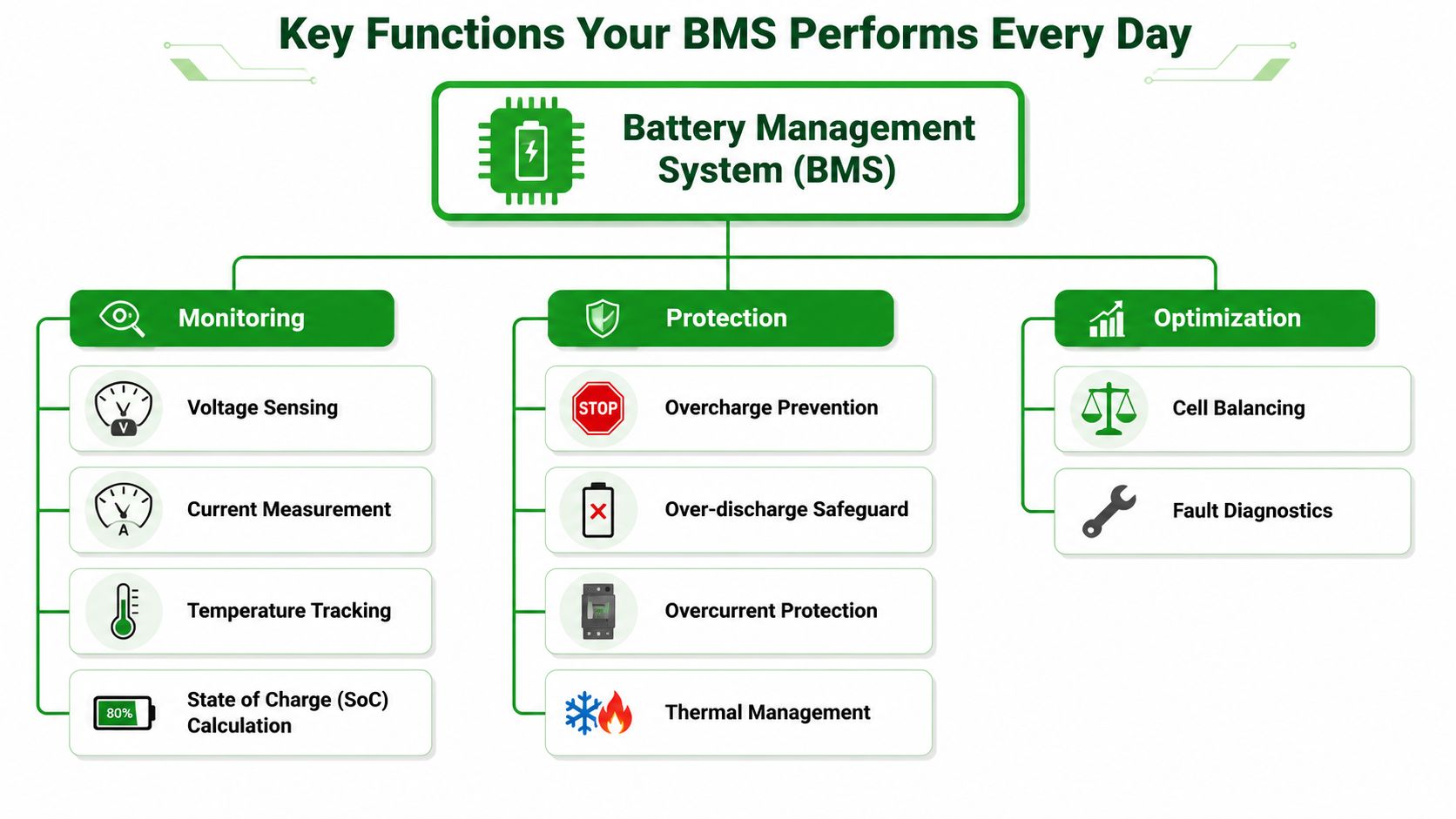
VDE's BMS fact sheet describes the BMS as the control layer that monitors cell voltage, current, temperature, state of charge, and state of health, while also performing protection, cell balancing, thermal management, and communications. It also makes a point installers know well. Cell balancing and dynamic power limiting are core functions, not optional extras, as outlined in VDE's battery management system fact sheet.
Protection comes first
The first daily job is straightforward. The BMS stops the battery from being charged or discharged in ways that can damage it or create a hazard.
That includes protection against:
- Overcharging: Preventing cells from being pushed beyond safe voltage
- Over-discharging: Stopping the battery from being emptied too far
- Over-current: Limiting current when demand or charging conditions become excessive
- Short-circuit conditions: Cutting off operation when a serious fault is detected
This is why a good battery system can feel conservative at times. If the BMS decides the pack needs to slow down or shut down, it's doing its job.
Monitoring is more than a battery percentage
A quality BMS tracks the important operating signs of the pack. That includes the obvious figures, such as voltage, current, and temperature, but it also calculates state of charge and state of health.
Those two get mixed up a lot.
- State of charge is the practical “fuel gauge”. It tells you how full the battery is right now.
- State of health is about condition over time. It reflects how the battery is ageing and how much useful capability it's retaining.
Modern BMS designs can also log operating information for diagnostics and fault analysis. That historical view helps technicians work out whether a battery issue is caused by heat, charging stress, imbalance, or external system problems.
A well-set-up system also shares these readings with the inverter, charger, or monitoring platform. If that communication is poor, the whole system becomes harder to trust. That's one reason inverter remote monitoring matters so much in solar and battery installations.
Here's a simple explainer worth watching if you want the visual version of how BMS logic fits together:
Cell balancing keeps the pack working as a team
Cell balancing is one of the least visible but most important BMS jobs.
Think of the battery pack as a relay team. If one runner is consistently weaker or more exhausted than the rest, the whole team slows down. The same thing happens inside a battery pack. One cell group drifting high or low can limit performance for everything.
Two balancing approaches are commonly discussed:
| Balancing type | What it does |
|---|---|
| Passive balancing | Bleeds excess energy from stronger cells, usually as heat |
| Active balancing | Moves energy in a more controlled way to help keep cells aligned |
Neither label automatically tells you the whole story. What matters is how well the balancing strategy suits the battery design and use case.
Practical rule: Ask how the battery keeps cell groups aligned over time, not just whether it has “a BMS”. Every serious lithium battery does. The difference is how well it manages imbalance in daily service.
Thermal management and communication
Heat is one of the quickest ways to stress a battery. A proper BMS doesn't just note temperature. It uses temperature information to influence charging, discharging, and protective actions.
It also acts as the interpreter between the battery and the rest of the system. The inverter needs to know what the battery can safely do. The charger needs limits. The app needs reliable data. If the BMS can't communicate clearly, the system won't behave cleanly.
Why a Quality BMS Matters for Solar and EVs in Australia
Australia is a demanding place for batteries. Roof spaces get hot. Garages get hot. Outdoor enclosures get hot. On top of that, many households are asking more from their battery than simple backup. They want solar self-consumption, smart charging, backup readiness, and in some cases future flexibility for EV charging.
That's exactly where BMS quality stops being a technical footnote and becomes part of the return on your investment.
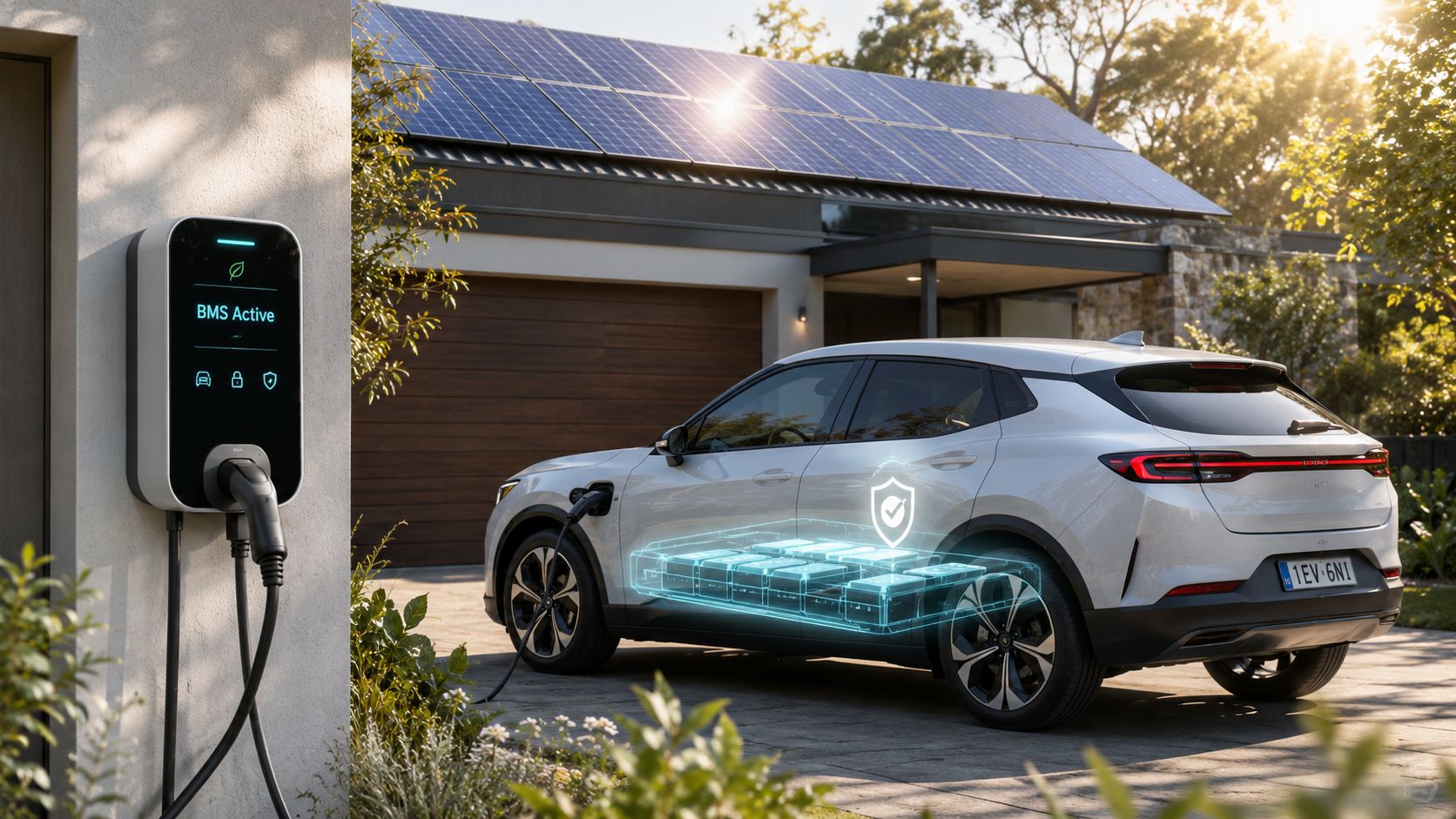
According to the market summary referenced by The Insight Partners, Australia's Cheaper Home Batteries Program is designed to make home batteries more affordable from 1 July 2025, and the same source notes there are over 4 million small-scale solar PV installations across Australia. It frames the BMS as the core technology that allows batteries to integrate safely with the grid and support high solar penetration in this environment, as described in this Australian battery deployment overview.
Heat changes the conversation
In mild conditions, a battery can look fine on a spec sheet and still perform acceptably. In hotter Australian conditions, poor thermal control shows up faster.
A quality BMS helps the system manage charging and discharge limits when temperatures rise. It can't erase the effects of bad installation location or extreme heat exposure, but it can stop the battery being driven harder than it should be under those conditions.
That's a major difference between a battery that ages gracefully and one that becomes disappointing earlier than expected.
Solar households need control, not just storage
For homes with rooftop solar, the battery only creates value when it charges and discharges in a smart, stable way. If control is sloppy, you can end up with lost solar capture, awkward charging windows, or a battery that isn't available when you expected it to be.
The BMS helps the system decide what the battery can safely accept and deliver at any given moment. That's especially important when the home's demand changes quickly, cloud cover moves through, or the system is coordinating with hybrid inverter logic.
A battery with poor control can still store energy. It just won't use that energy as cleanly or as reliably.
For EVs, the same logic applies. Drivers usually notice the BMS through charging behaviour, battery temperature response, and how believable the vehicle's range estimate feels in daily use.
If you're planning home charging or workplace charging, it also helps to understand the broader charger side of the equation. For larger sites, this overview of EV charging solutions for industrial facilities is useful because charger design and battery control need to work together, not in isolation. For household installs, the practical starting point is choosing the right EV charger installation near you with proper electrical design and sensible load management.
What to Ask Your Installer About the BMS
Most buyers won't compare BMS architecture line by line, and that's fine. You don't need to become a battery engineer. You do need to ask better questions.
The easiest way to spot the difference between a careful installer and a box-mover is this. A careful installer can explain how the battery is controlled, how it talks to the inverter or charger, and what limits are in place to protect the system in real Australian conditions.
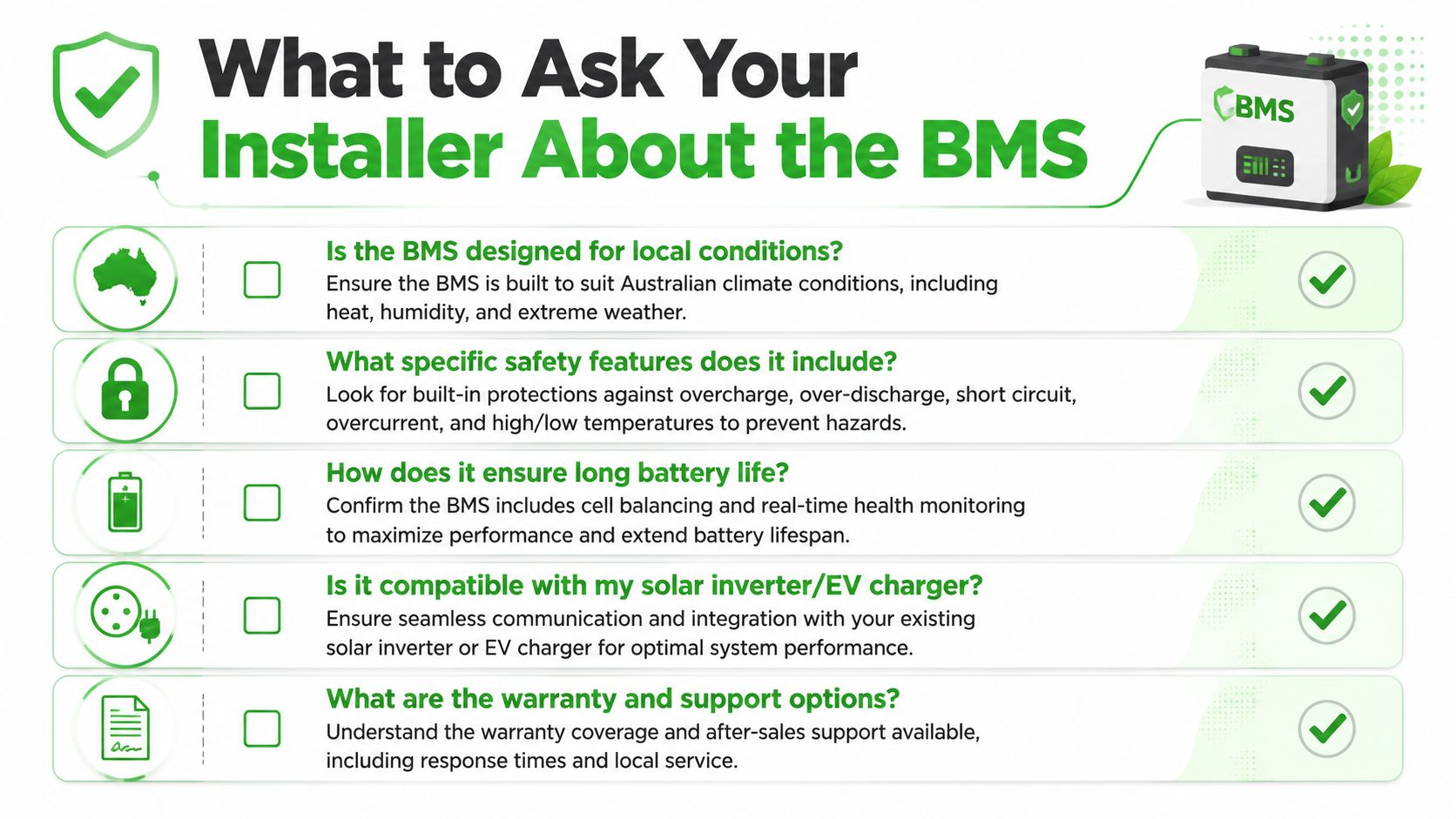
Questions worth asking before you sign
Use this checklist when you're reviewing quotes:
- What battery and BMS platform am I getting? Ask for the specific battery model, not just the brand family. Different products from the same manufacturer can behave differently.
- How does the battery communicate with the inverter or charger? Compatibility matters. A battery can be technically connected and still be poorly integrated.
- How does the system manage heat in the proposed installation location? Ask this if the battery is going in a garage, outside, or anywhere with harsh afternoon heat.
- What balancing strategy is used inside the battery? You don't need a lecture. You do want a clear answer that shows the installer understands the pack is made of multiple cells that must stay aligned.
- What happens during faults or abnormal conditions? The installer should be able to describe protective shutdown behaviour in simple language.
- What can I see in monitoring? Ask what battery information you'll be able to view as an owner.
Questions that reveal whether the design is thoughtful
Some answers sound polished but don't mean much. Better questions make vague sales talk harder.
| Ask this | Why it matters |
|---|---|
| Is the system designed for local conditions? | Heat, installation position, and ventilation affect battery performance |
| What safety protections are built into the battery control layer? | You want more than a generic “it's safe” answer |
| How will this battery behave during daily cycling? | Real value comes from repeated use, not brochure claims |
| Who supports fault diagnosis after installation? | Battery issues often need data interpretation, not just hardware replacement |
If an installer can't explain the BMS in plain English, there's a good chance they also won't explain system limitations until after install day.
Good installers welcome informed questions
A trustworthy installer won't get defensive when you ask about battery control, standards, or system behaviour. They should be comfortable explaining what the BMS does and where its responsibility ends.
Consumer protection matters here too. If you want to understand the standards expected in the industry, it's worth reading about the New Energy Tech Consumer Code, because sales promises and technical delivery need to line up.
Common BMS Questions for Australian Energy Users
Is the BMS the same as the battery warranty
No. The BMS helps protect the battery, but it isn't the warranty.
A good BMS can reduce stress on the cells, control charging and discharging, and support longer useful life. But it can't guarantee outcomes if the system is badly designed, badly installed, or used in harsh conditions the broader setup doesn't handle well.
Does the BMS provide backup power on its own
No. This is one of the most common points of confusion.
A BMS is a battery-control system. It does not, by itself, provide whole-home backup or manage solar export. MathWorks also notes that while BMS quality affects usable capacity and cycle life, it can't fix issues caused by an undersized or poorly configured system in its discussion of what a BMS does and doesn't do.
That means backup performance depends on the full system design, including battery, inverter, backup circuits, and installation settings.
Can a BMS fail
Yes, like any electronic control system, it can. When it does, the battery may show fault codes, refuse to charge or discharge normally, or behave in ways that don't match what the rest of the system is expecting.
That doesn't mean every battery fault is a BMS failure. Sometimes the issue is communication, configuration, temperature, or another part of the system. This is why support matters after installation, not just on sale day.
Does a better BMS mean the battery won't degrade
No. It means the battery is more likely to be managed properly.
All batteries age. Heat, charge rate, discharge rate, and cycling behaviour still matter. A quality BMS helps reduce avoidable stress and makes the most of the battery's usable life, but it doesn't change the fact that battery performance depends on chemistry, environment, and system design working together.
Is the BMS the inverter
No. They work together, but they are not the same thing.
The inverter manages power conversion and broader energy flow in the system. The BMS manages the battery pack itself. When those two layers communicate well, the result is smoother charging, safer operation, and better real-world performance.
If you're planning solar, battery storage, or EV charging and want advice that goes beyond brochure specs, Interactive Solar can help you choose a system that's designed properly from the battery control layer up.
Make Interactive Solar a preferred source in Google
One click tells Google to surface our articles more often in Top Stories, AI Overviews and AI Mode.