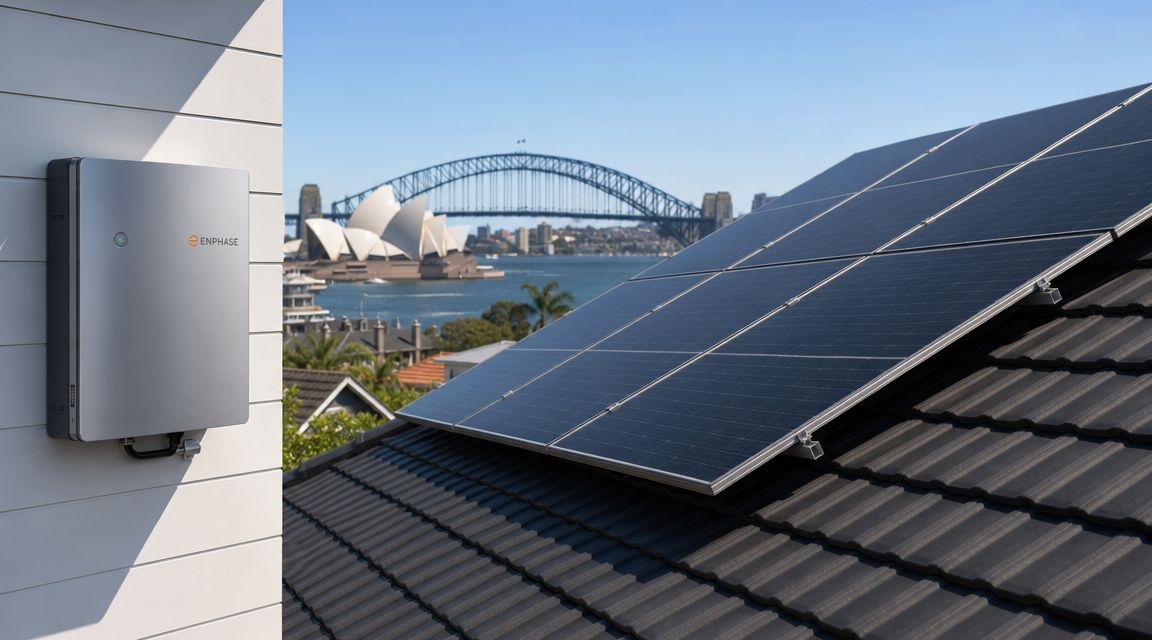
Solar Panel and Battery Cost in Sydney a 2026 Guide
You open your power bill in Sydney, look at the latest number, then search for solar panel and battery cost and get buried in calculators, price ranges, rebate headlines, and sales pages that all seem to say something different.
That confusion is normal. Most homeowners and small business owners aren't struggling because the idea of solar is hard to understand. They're struggling because the internet tends to reduce a long-term energy decision to a single upfront figure, when the answer depends on how your property uses power, when you use it, and what outcome you want.
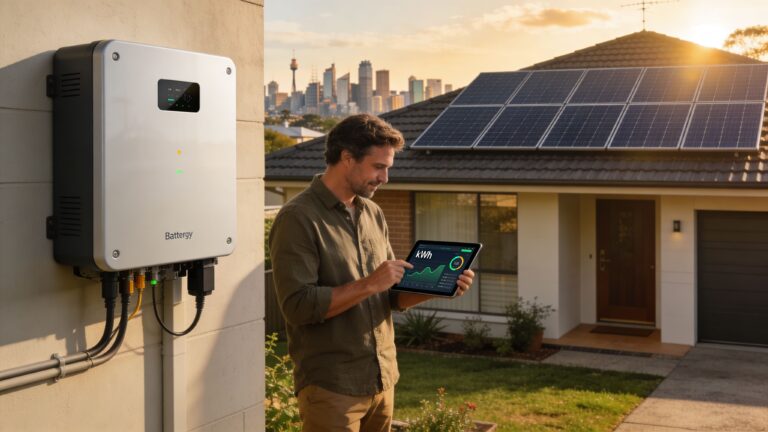
A cheap system that exports most of its generation at the wrong time can disappoint. A well-designed system can become a practical household asset that cuts grid reliance, supports evening usage, and leaves room for future upgrades like battery storage or EV charging.
Thinking About Solar and Battery Costs in Sydney
If you live in Sydney or broader NSW, you've probably already noticed the problem with generic online estimates. They might tell you what a “typical” system costs, but they don't tell you whether that system suits a terrace in the Inner West, a family home in the Hills District, or a small business with heavy daytime demand.
That's why the better question isn't just “what does solar and battery cost?” It's what drives the value of the system on my property.
For context, it can help to compare how the conversation differs by city and roof type. A resource like Cover Club's Melbourne solar panel guide is useful because it shows how local conditions shape the buying decision, rather than pretending one national price estimate fits everyone.
Why online figures often miss the mark
Most quick estimates leave out the things that change the actual outcome:
- Your load profile. A home that uses power heavily in the evening needs a different design from one with strong daytime occupancy.
- Your roof and switchboard. Shade, pitch, access, available roof space, and existing electrical infrastructure all affect what can be installed cleanly.
- Your goals. Bill reduction, blackout backup, EV charging readiness, and future expansion are not the same brief.
- Your tariff structure. In NSW, timing matters. The value of a kilowatt-hour changes depending on whether you use it, store it, or export it.
A lot of households start by chasing the smallest quote. Then they realise the system wasn't sized properly, the battery was added without a clear purpose, or the installation didn't account for future needs. A better starting point is understanding your options for rising energy costs and then working backwards from your usage.
Practical rule: If a quote focuses on hardware first and your energy habits second, it's usually the wrong way around.
The questions worth asking first
Before you compare brands or package names, ask:
- When do we use the most electricity?
- Are we trying to cut bills, gain backup, or both?
- Do we expect an EV charger, pool equipment, ducted air, or a renovation later?
- Will the proposed system still make sense in five to ten years?
Those questions lead to a much better buying decision than chasing an average price that may have little to do with your home.
Why You Should Look Beyond the Upfront Quote
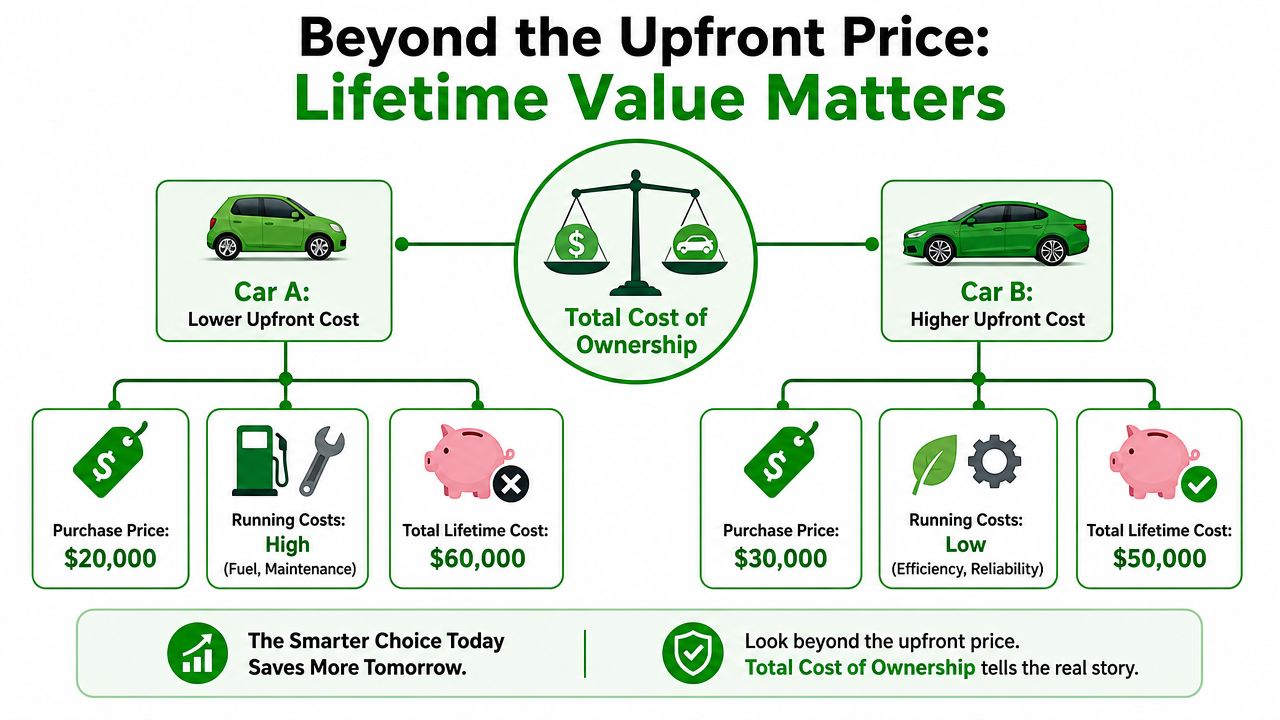
Buying a solar and battery system is a lot like buying a car. One option may look cheaper on day one, but if it uses more fuel, breaks down more often, and costs more to keep running, it wasn't the better buy.
The same logic applies here. The upfront quote matters, but it's only one part of the decision. What matters more is whether the system is designed to produce, store, and manage energy in a way that benefits your household or business over time.
Solar changed because the economics changed
Solar is no longer a fringe purchase. The reason is simple. Global solar PV installed costs fell by about 83% from 2010 to 2022, which is why solar moved from a niche option to a mainstream bill-reduction asset for Australian households (IRENA solar cost trends).
That long cost decline is why more homes can now justify a properly engineered system, not just a bare-minimum installation.
What the low quote often leaves out
A low quote can still be the right quote. But it often isn't.
Here's where problems usually show up:
- Undersized design. The system may be too small for daytime load, evening carryover, or future battery charging.
- Poor component matching. Panels, inverter, battery, and monitoring platform need to work together properly.
- Weak installation detail. Cable runs, isolator placement, switchboard work, and roof layout all affect reliability.
- No future pathway. Some systems are cheap because they're hard to expand later.
The best buyers treat solar like infrastructure, not a promotional bundle.
A good system should be boring in the best possible way. It should work every day, report clearly, and keep delivering value long after the sales process is forgotten.
Value comes from performance, not brochure promises
When a system is well planned, it can deliver several layers of value at once:
| What you're buying | Why it matters |
|---|---|
| Bill reduction | More of your own generation offsets purchased electricity |
| Energy independence | You rely less on the grid for routine usage |
| Flexibility | You can add battery storage or EV charging more sensibly later |
| Resilience | A battery-backed design can support essential loads during outages |
| Predictability | Quality equipment and workmanship reduce unpleasant surprises |
Installation quality sits right in the middle of all this. Strong products can still disappoint if the job is rushed or poorly integrated. That's why it's worth reviewing what separates quality solar installations from poor-value installs.
Key Factors That Influence System Investment
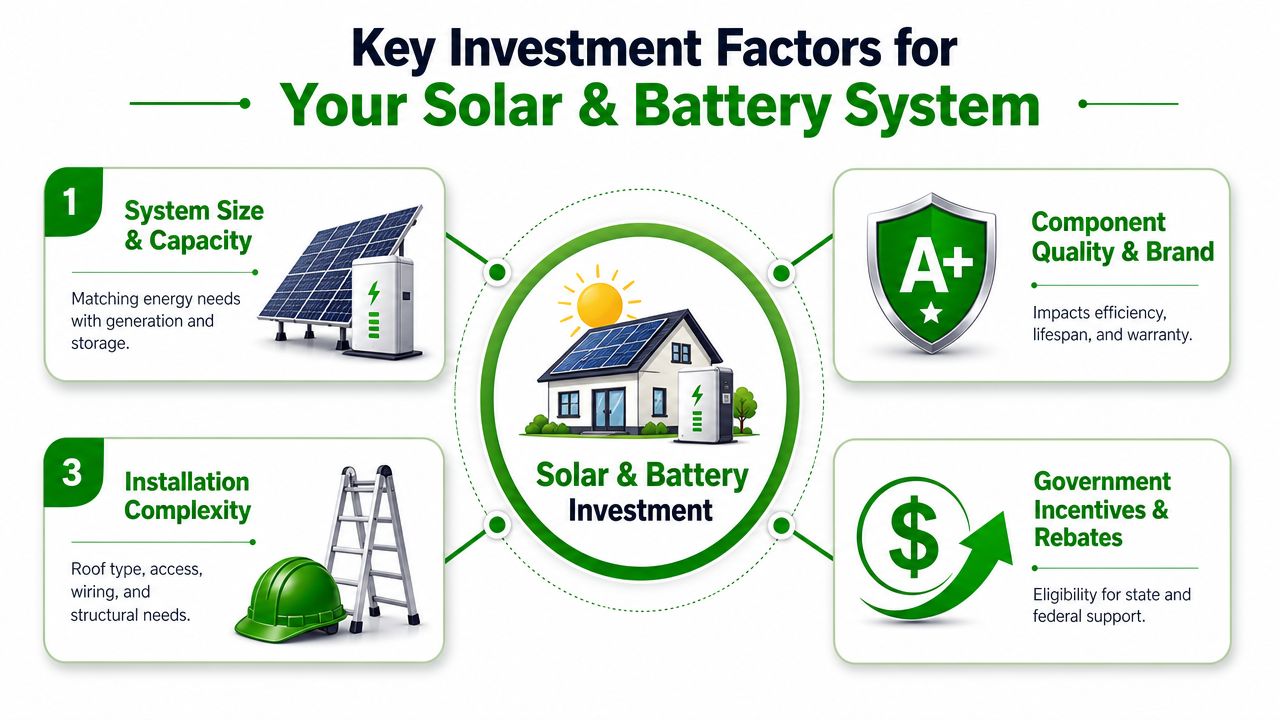
When people ask about solar panel and battery cost, they often assume the answer sits in the panel brand or battery label. In practice, the final investment is shaped by a mix of design choices, product choices, and site conditions.
The quote is not just about what gets bolted to the roof or mounted on the wall. It also reflects the engineering, labour, electrical integration, and compliance work needed to make the system perform properly over time.
System size changes more than output
For solar PV, turnkey installed price per watt matters more than panel module price alone, because soft costs such as design, engineering, permitting, labour, and grid connection make up a big part of the project. The benchmark structure provided in the supplied data puts residential PV at about US$2.86 to US$3.64 per watt, with larger systems tending toward the lower end because fixed costs are spread across more capacity (residential PV cost-per-watt benchmark).
That doesn't mean bigger is always better. It means a properly sized larger system can offer stronger value than a too-small system that looks cheaper upfront.
For NSW homes, this often shows up when people move from “just enough panels to offset part of the bill” to “enough solar to cover household demand and support battery charging.” For small businesses, it often means matching the array to operating hours rather than chasing a nominal package size.
Battery capacity has to match the job
Battery value depends on what you want the battery to do.
If the battery is there mainly for evening self-consumption, the right capacity may be very different from a battery chosen for backup power. Once backup becomes part of the brief, essential-load planning matters. Refrigeration, lights, internet, garage doors, medical loads, and selected circuits all need to be considered.
The supplied benchmark structure also shows why installed battery cost is better assessed as installed cost per usable kWh. Mainstream installed battery systems commonly land around US$700 to US$1,000 per usable kWh, while retrofit AC-coupled systems are higher at about US$1,000 to US$1,500 per kWh and new-solar DC-coupled systems are lower at roughly US$900 to US$1,300 per kWh because they can share power electronics with the PV array (battery installed cost per usable kWh breakdown).
Quality matters in ways buyers feel later
A system with strong panel, inverter, and battery components usually offers better monitoring, warranty support, and long-term consistency. That doesn't mean the most expensive brand always wins. It means the equipment should suit the use case and come from a supportable ecosystem.
Useful checks include:
- Panel performance stability. Not just headline wattage.
- Inverter capability. Especially for monitoring, export control, and future battery compatibility.
- Battery platform maturity. App quality, firmware support, integration, and backup features matter.
- Warranty clarity. A long warranty means little if the claim path is vague.
A lot of growing trades businesses are learning the same lesson about reputation and repeat work. Good systems are built on process, not shortcuts. That wider industry shift is visible in discussions around UK renewable energy business growth, where service quality and execution matter as much as product demand.
Installation complexity changes the real quote
Two homes with the same equipment list can still receive very different quotes.
Common site variables include:
| Site factor | Why it affects investment |
|---|---|
| Roof material and pitch | Changes mounting method, labour, and access requirements |
| Shade and layout | Affects panel placement and sometimes optimisation strategy |
| Switchboard condition | May require additional electrical work |
| Cable pathway length | Impacts labour and materials |
| Existing solar system | Can complicate retrofits and battery integration |
If you're comparing options, a good starting point is a detailed battery comparison guide that helps frame the technical differences buyers often miss.
Example System Designs for NSW Homes and Businesses
The easiest way to understand solar panel and battery cost is to stop thinking in package names and start thinking in property types. The right system for one home can be the wrong system for the house next door.

The Northern Beaches family planning for an EV
This household already runs air conditioning through summer, has kids at home in the afternoon, and knows an EV charger is likely in the near future. Their goal isn't just to shave the current bill. They want a system that still makes sense when charging demand rises.
A design like this usually leans toward a stronger solar array and a battery strategy that can support evening load shifting rather than a token storage add-on. Battery value rises for households that want resilience during outages or expect higher future energy needs from additions like EV charging (battery value for resilience and future EV demand).
In practical terms, that means asking:
- Will the inverter platform support later expansion cleanly?
- Is the battery sized for actual overnight usage or just brochure appeal?
- Can the EV charger be integrated into a broader energy management plan?
The Parramatta café owner with strong daytime demand
This business uses refrigeration, coffee equipment, lighting, and HVAC during trading hours. That load profile often suits solar well because generation lines up with demand.
For a site like this, the first priority is usually not battery storage. It's getting the solar design right so that daytime production offsets as much purchased electricity as possible during operating hours. If the café later wants to manage late-afternoon peaks or improve resilience for critical refrigeration, battery storage can be assessed with a clearer business case.
The best commercial designs usually start with load matching. If the business uses power while the sun is up, solar often does the heavy lifting before a battery ever enters the conversation.
The Western Sydney retirees with an existing solar system
This home already has solar, but the household now spends more time at home and wants better control over evening usage. They're also concerned about outages during hot weather events.
Battery retrofits require careful thought. Some existing systems work smoothly with new storage. Others need extra inverter hardware, switchboard work, or a redesign of backup circuits. That's why a battery that looks simple online can become more involved once the installer inspects the site.
For this kind of home, the right design questions are often:
- How much midday excess solar is available to store?
- Which loads need backup if the grid goes down?
- Is the current inverter compatible, or does the battery need an AC-coupled approach?
Households considering this kind of upgrade usually benefit from looking at how residential solar systems are designed around real household usage, not just catalogue features.
Calculating Your Return on Investment and Savings
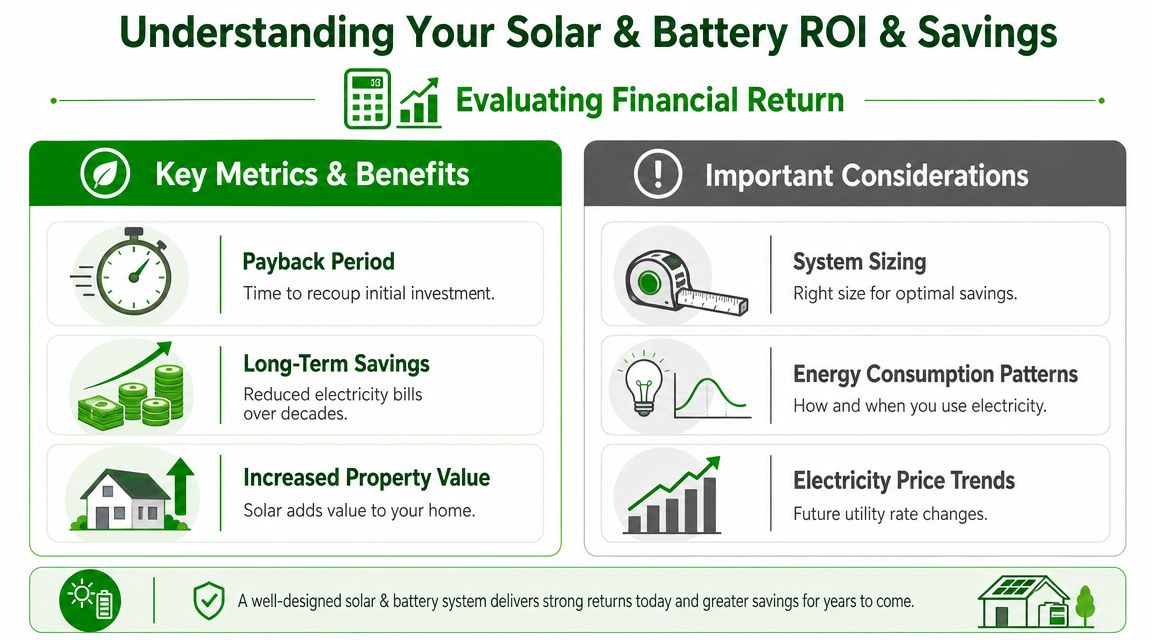
The financial side of solar becomes clearer once you stop thinking only about the upfront figure and start looking at how each kilowatt-hour is used.
In NSW, the difference between using your own solar, storing it, or exporting it can dramatically change the value you get from the system. That's why two homes with the same equipment can end up with very different outcomes.
A useful place to start is understanding basic bill terminology. If you want a quick refresher on what suppliers include on a statement, Matil's guide to define utility bill gives a plain-English overview.
Self-consumption usually matters more than export
For NSW homeowners, the supplied data makes the key point clearly. It's not just battery cost that matters. It's battery value. Retail electricity prices are typically much higher than feed-in tariffs, so storing midday solar for evening use can deliver more value than exporting it. The same source notes that upcoming federal battery support from 1 July 2025 is set to reduce upfront battery prices, with public reporting framing that discount as roughly 30% off battery costs (NSW battery value and federal support context).
That shifts how you should read a quote. Don't just ask what the battery costs. Ask what portion of your exported solar it can turn into avoided evening purchases from the grid.
Three terms every buyer should understand
| Term | What it means in plain English |
|---|---|
| Payback period | How long it takes for bill savings to recover the investment |
| Self-consumption | How much of your solar generation you use yourself |
| Time-of-use arbitrage | Using stored energy when grid power is most expensive |
If you're reviewing a proposal, ask the installer to show:
- Daytime solar usage rather than just annual generation
- Expected export levels after the system is installed
- Evening consumption profile, for battery value often appears then
- Tariff assumptions, especially if you're on a time-of-use plan
A short explainer can help if you want to see these ideas in action:
How to read a quote like a careful buyer
A sound proposal should answer these questions without hand-waving:
- How much of my current bill is driven by daytime versus evening use?
- How much solar will I likely consume directly?
- How much excess generation will be exported?
- If a battery is included, what problem is it solving?
- Does the battery improve economics, resilience, or both?
Buyer's check: If a quote talks constantly about system size but never models your usage pattern, it's incomplete.
For households trying to cut ongoing bills, it also helps to review practical ways of reducing electricity bills at home so the solar design aligns with actual energy habits.
Financing Incentives and Long-Term Warranties
A strong solar or battery decision isn't only about generation and storage. It's also about reducing risk.
That's where incentives and warranties work together. Incentives can lower the entry barrier. Warranties protect the investment after the installation is finished. If either piece is weak, the system becomes harder to judge properly.
Incentives should support the design, not drive it
In NSW, most homeowners already know that available support can influence the final quote. The trap is letting the rebate decide the system, instead of letting the property decide the system.
A sensible installer should explain what support applies, how it's handled in the proposal, and whether any projected battery incentive is current or future-dated. If a program is expected to begin later, it should be presented that way, not folded into today's economics as if it's already active.
The strongest use of incentives is simple. They help you buy the right system with less friction. They don't turn a poor design into a good investment.
Warranties tell you a lot about the installer
A warranty document matters. So does the company standing behind it.
Look closely at these points:
- Product warranty. Panels, inverters, and batteries all carry separate manufacturer terms.
- Workmanship warranty. This covers the installation itself, not just the hardware.
- Support pathway. You want a clear process if monitoring drops out, an inverter faults, or a battery needs inspection.
- Compatibility responsibility. If multiple brands are used, someone should own the integration outcome.
A battery system in particular deserves close scrutiny here. Storage adds software, controls, backup configuration, and more electrical complexity. The long-term value of the system depends on the hardware and on whether the installer built it properly in the first place.
Strong warranties don't remove all risk. They make sure the risk is manageable, visible, and backed by someone accountable.
Get a Clear Path to Energy Savings Today
The phrase solar panel and battery cost sounds like it should have a quick answer. In real homes and businesses, it doesn't.
The right answer depends on your roof, your switchboard, your daytime and evening usage, your tariff structure, and whether you want bill reduction, backup power, or future EV readiness. That's why broad averages often create more confusion than clarity.
The smartest approach is to treat the system like a long-term asset. Look at design quality. Look at how much solar you'll use. Look at whether a battery improves self-consumption, resilience, or both. And make sure the proposal fits the way your property runs now, not the way a generic calculator assumes it runs.
Cheap systems can still be expensive decisions if they're undersized, poorly integrated, or hard to expand later. A custom design usually gives you a clearer path to savings because it starts with how you live and use power.
If you want a result that pays its way, ask better questions, compare proposals carefully, and insist on a design that makes operational sense for your property.
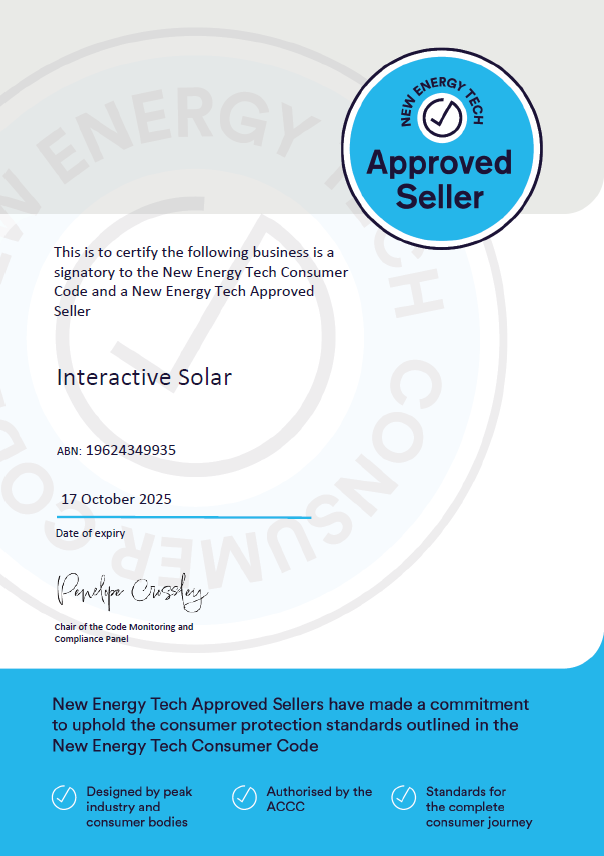
If you want that kind of practical guidance, Interactive Solar can help with a no-obligation assessment specific to your home or business in NSW. As a family-owned team with in-house installation capability, they can map your usage, explain the trade-offs clearly, and recommend a solar, battery, or EV charging setup that suits your long-term energy goals rather than just chasing the lowest quote.
Make Interactive Solar a preferred source in Google
One click tells Google to surface our articles more often in Top Stories, AI Overviews and AI Mode.