Unlock Savings with Commercial Solar Power Brisbane
Another power bill lands. It's higher than the last one, your daytime usage is doing most of the damage, and budgeting gets harder every quarter. That's the point where many Brisbane business owners stop treating electricity as a background overhead and start looking at it like any other controllable operating cost.
That's where commercial solar power Brisbane projects have changed. For most businesses, this isn't about putting panels on a roof because it feels environmentally responsible. It's about locking more of your energy use behind the meter, reducing exposure to retail electricity pricing, and making sure today's installation still works when batteries and EV chargers become part of the site.
Is Solar Power the Right Move for Your Brisbane Business
Brisbane sits in a strong position for commercial solar because the local solar resource is good and the market is mature. Queensland had more than 640,979 small-scale PV systems under 100 kW installed statewide as of August 2025, which is why solar no longer looks like an edge-case decision for business owners in this market. It looks like normal infrastructure planning, as noted in Queensland solar adoption data from SolarQuotes.
If you run a warehouse, office, medical site, workshop, retail tenancy, cold storage facility, or multi-use commercial property, the question usually isn't “should I get solar?” It's “will the system be sized around how my site uses power?” That distinction matters because a poor design can leave too much generation exported at low value, while a well-matched system can steadily cut what you buy from the grid during business hours.
The businesses that usually suit solar best
Some sites are naturally stronger candidates than others. The common pattern is simple.
- Daytime operations: Businesses that use most of their electricity while the sun is up usually get the cleanest value from solar.
- Consistent weekday load: HVAC, refrigeration, process equipment, lighting, and administration loads help absorb production on site.
- Usable roof area: Shade, rooftop clutter, access constraints, and structural limitations can affect what's practical.
- Stable occupancy plans: If you expect to stay in the premises long enough to benefit from the system, the business case is easier to support internally.
Commercial solar works best when the roof, the load profile, and the tariff all line up. If one of those is wrong, the numbers soften fast.
There's also a second layer that many owners miss. If your site depends on local visibility, clean presentation, and a modern customer experience, energy upgrades support that broader positioning. Businesses that are already investing in expert local search optimization often find that operational improvements and digital trust signals reinforce each other. Customers notice both.
If your bills have started forcing bigger decisions about margins, fit-out timing, or equipment upgrades, it's worth reviewing the broader set of options before you commit to any one path. A useful starting point is this guide on rising energy costs and business options.
Gaining Control Over Your Energy Costs and Operations
For a Brisbane business, solar's biggest benefit is usually control. Not total independence, and not zero bills. Control over how much daytime electricity you still need to buy, and better visibility over one of your least predictable overheads.
That matters because grid electricity doesn't just affect your monthly accounts. It affects operating decisions. When energy costs jump, businesses delay purchases, hold off on staffing, or avoid extending trading hours. Solar changes that conversation by turning part of your consumption into something you produce on site.
What improves when solar is done properly
The first gain is financial stability. A well-designed commercial system can reduce your exposure to purchased daytime energy, which gives you a more dependable baseline for forecasting.
The second gain is operational discipline. Once a site starts looking closely at interval data, load timing, and equipment scheduling, waste becomes easier to spot. Solar projects often force a business to understand its own energy use for the first time.
- Budget certainty: Solar won't remove every energy charge, but it can lower how much of your daytime demand is exposed to retail pricing.
- Better operational decisions: Once you know when your site uses power, you can time discretionary loads more intelligently.
- Stronger resilience planning: If batteries are added now or later, the site has a clearer path to backup support and better load management.
- Visible ESG action: Customers, staff, landlords, and procurement teams increasingly prefer businesses that can show practical action rather than vague sustainability claims.
Why batteries change the conversation
Panels alone address generation. Batteries add flexibility. They can help hold more solar on site, support after-hours use cases, and reduce the penalty of mismatched production and consumption.
That doesn't mean every Brisbane business should install batteries immediately. It means every serious commercial solar design should at least consider battery readiness from the start. Switchboard capacity, inverter pathway, metering setup, and plant room space all become expensive problems when they're left for later.
On-site generation is only half the strategy. The other half is deciding when to use it, when to store it, and which loads should get priority.
Businesses that want a practical framework for cutting bills before and after solar can also review these ways to reduce electricity bills. The strongest projects usually combine solar with tariff review, load management, and smarter equipment operation.
How to Size a Commercial Solar System in Brisbane
Most sizing mistakes come from one assumption. Bigger must be better.
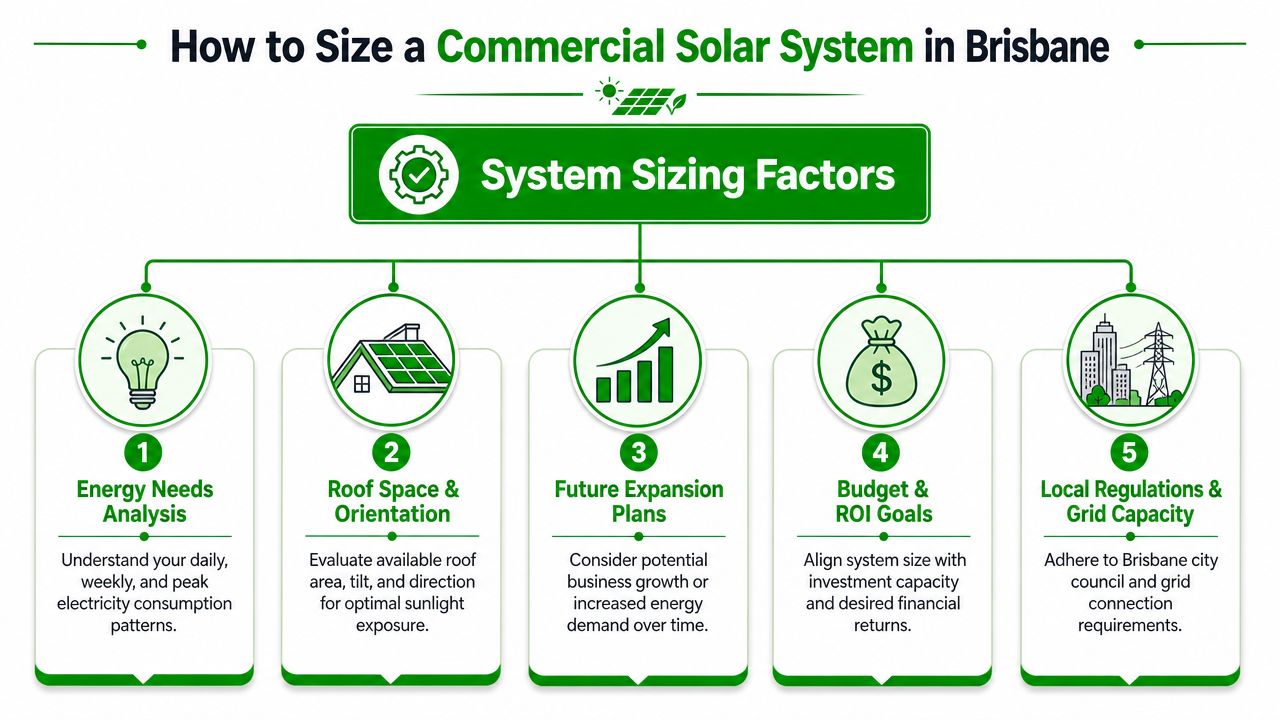
In Brisbane, that often isn't true. A larger system may produce more energy, but that doesn't automatically mean better returns. The system has to fit the site's actual load profile, export conditions, roof constraints, and future electrical plans.
Brisbane has an average solar irradiation of about 5.08 kWh/m²/day, and a well-sited 10 kW system can generate roughly 15,546 kWh annually, according to Brisbane solar resource data from SolarQuotes. That's strong output by Australian standards. It also means poor sizing decisions get magnified. If a business can't use much of that generation during the day, the extra output won't be worth what many owners expect.
Start with load, not roof area
A roof inspection matters, but it shouldn't be the first sizing input. The first input is energy data.
Look at when the site uses power across a normal week. Then compare that against likely solar production hours. If your highest consumption sits in daylight trading hours, solar has a strong foundation. If most use happens before sunrise, after sunset, or in short irregular spikes, the design needs more care.
A practical sizing review should consider:
- Your daytime base load: What level of demand is present even on quieter business days?
- Seasonal behaviour: HVAC-heavy sites can look very different in summer and winter.
- Weekend profile: Some businesses can use solar seven days a week. Others can't.
- Future electrification: Planned equipment changes, EV charging, or battery storage can justify leaving design headroom.
- Network and switchboard limits: These can cap what's practical even when roof space is available.
Self-consumption beats maximum export
One of the clearest design errors is sizing for roof capacity instead of value. Many owners still assume exporting surplus power will carry the project. In Brisbane commercial settings, that's rarely the best path.
A smaller or more carefully staged system often performs better commercially because it pushes more generation directly into live site loads. That's where avoided grid purchase usually delivers the strongest value. Export still has a role, but it shouldn't be the centre of the business case.
Design for the load you can reliably offset first. Treat exports as secondary value, not the main revenue stream.
Here's the mindset shift that helps most:
| Design approach | What it targets | What usually happens |
|---|---|---|
| Fill every available roof section | Maximum generation | Higher export risk if daytime demand is modest |
| Match the system to daytime demand | Maximum self-consumption | Better use of solar on site and cleaner economics |
| Plan for future battery or EV loads | Long-term flexibility | Fewer retrofit headaches later |
For businesses reviewing proposals from different installers, it helps to compare how each one treats load matching, inverter selection, and future expansion allowances. Even if you're based in Brisbane, this broader guide to commercial system installation thinking is useful because the core sizing logic is the same.
Calculating the Real Return on Investment for Your System
A Brisbane business can install a system that looks good on paper and still miss the target financially. The difference usually comes down to how the savings model was built.
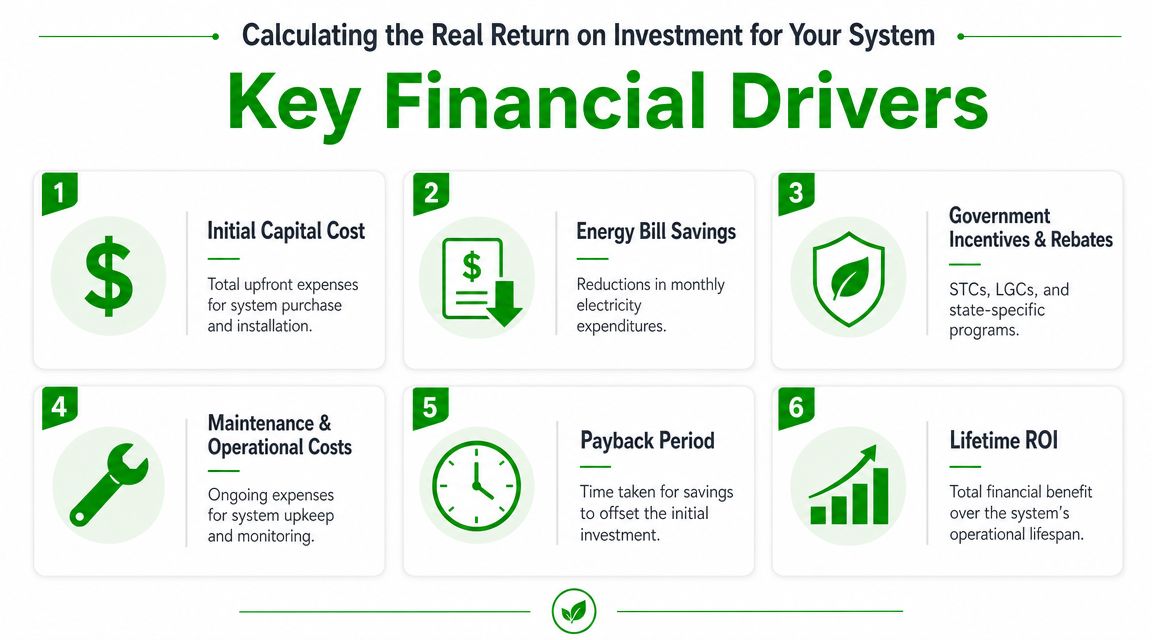
For commercial sites, return on investment is usually driven by avoided daytime grid purchases, tariff structure, and how the system fits the way the site operates. Export income can help, but it rarely carries the project on its own. A proper assessment also needs to account for what the site may add later, especially battery storage, EV charging, and other new electrical loads that can either improve solar utilisation or create new peaks if they are handled badly.
Taylor Energy gives a useful local reference point. A 50 kW system producing 76,650 kWh can deliver estimated annual savings of around $14,026, with most of that value coming from offsetting daytime electricity purchases rather than relying on exports, based on Brisbane commercial solar performance figures from Taylor Energy.
What drives the commercial return
A credible ROI model starts with interval data, tariff detail, and a realistic operating pattern. These factors usually matter most:
- Direct on-site use of solar generation: This is often the largest savings component for Brisbane businesses.
- Exported energy: Export still has value, but it is commonly lower than the value of avoided imports.
- System size relative to incentive thresholds: Incentives can shift project economics and should be tested properly.
- Tariff structure: Energy rates, demand charges, and time-of-use pricing can change the result materially.
- Operating profile: Sites with consistent weekday daytime consumption usually get cleaner, more reliable returns.
- Future electrical loads: Planned EV charging, added air conditioning, refrigeration upgrades, or electrified fleet use can improve solar use on site if they are designed into the model early.
Why the under 100 kW threshold matters
For many Brisbane SMEs, the sub-100 kW range deserves close attention because STCs can reduce upfront cost. Under the Small-scale Renewable Energy Scheme, eligible systems up to 100 kW can receive STCs, with the number of certificates depending on system size, installation date, and postcode, as outlined by Australia's Clean Energy Regulator guidance on small-scale technology certificates.
That threshold should inform the financial model, but it should not dictate the design by itself. I have seen sites stop below 100 kW to maximise the incentive, then run into avoidable problems a year later when extra EV chargers or new electric plant push daytime demand higher. I have also seen larger systems make sense immediately because the load profile supported them. The right answer depends on tariff exposure, demand shape, available roof area, switchboard constraints, and whether the business expects to electrify more of its operations.
A practical way to test proposal quality
Ask the installer to break the value into separate lines instead of presenting one headline payback figure.
A useful proposal should show:
| Question | Why it matters |
|---|---|
| How much generation is expected to be self-consumed? | This usually produces the strongest savings |
| How much energy is likely to be exported? | High export assumptions can hide oversizing risk |
| What tariff assumptions sit behind the savings estimate? | Poor tariff inputs can distort ROI |
| Is there a battery or EV charging pathway in the design? | Future upgrades affect both savings and retrofit cost |
| Has demand charging been considered? | Demand spikes can erode savings even when energy use falls |
One more check matters. Ask whether the proposal models future site electrification as a risk or as an opportunity. For many businesses, adding managed EV charging or a battery later can improve solar utilisation, reduce peak demand, and change the project economics in your favour. If the design leaves no room for that, the first-stage ROI may look acceptable while the long-term site plan becomes more expensive.
If you are comparing project timing, rising tariffs strengthen the case for offsetting grid purchases on site. This update on electricity price rises and how Brisbane businesses can prepare gives useful context. Solar return improves when the system is matched to real consumption and built with the next stage of the site in mind.
Future-Proofing Your Business with Batteries and EV Charging
The biggest mistake in commercial energy projects is treating solar as a stand-alone purchase.
For many Brisbane sites, panels should be the base layer of a broader electrical plan that includes battery storage, EV charging capacity, and room for future electrification. Even if you're not installing all of that on day one, the design should anticipate it.
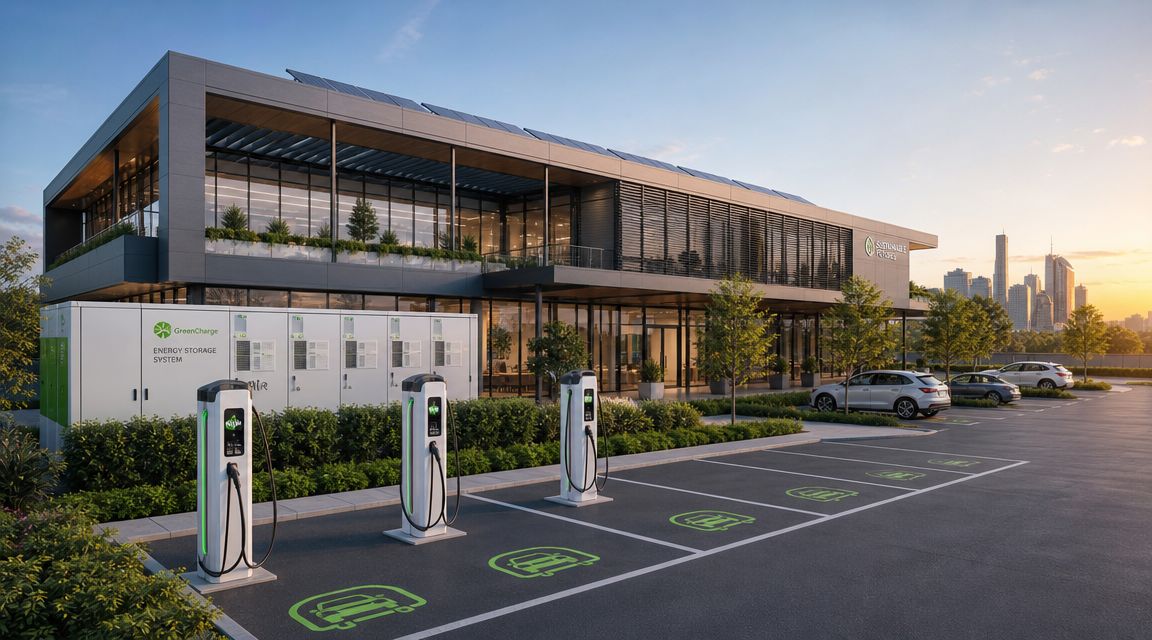
Australian workplaces are rapidly adding EV charging, and that creates a real design issue for commercial solar sites. If chargers are added later without proper planning, they can create new demand peaks that eat into solar savings. That's why managed charging and dynamic load balancing matter, as discussed in commercial solar and EV charging planning for Brisbane workplaces.
What battery-ready actually means
A battery-ready site is more than a verbal promise. It should show up in the design choices.
That can include inverter pathway, switchboard capacity, metering approach, cable routes, and physical space allocation. If any of those are ignored, adding storage later becomes more expensive and more disruptive than it needed to be.
Battery planning is especially relevant when a business has:
- Late afternoon or evening demand: Storage can help extend the value of daytime generation.
- Sensitive operations: Some sites want stronger continuity planning for critical loads.
- Demand exposure: Batteries can support smarter load shaping when the tariff structure penalises peaks.
- Expansion plans: Additional tenancy use, refrigeration, or electric plant can change the load profile quickly.
EV charging should be part of the original scope
A lot of commercial EV charger projects run into preventable problems. The charger itself is often the easy part. The difficult part is upstream capacity, load control, and making sure the site doesn't trade one energy cost problem for another.
If your business expects fleet vehicles, staff charging, customer charging, or destination charging, ask these questions early:
- Where will chargers physically go?
- Can the current electrical infrastructure support staged rollout?
- Will charging be scheduled, prioritised, or dynamically limited?
- Can solar generation be matched to charging windows?
- Will batteries be used later to support charging loads?
A sensible design doesn't assume all vehicles charge at once, and it doesn't assume every charger needs full output all day. Managed charging strategy matters as much as hardware selection.
Here's a useful explainer on the broader integration logic:
Build one energy platform, not three separate projects
Many sites waste money through a disjointed approach to energy infrastructure. Solar gets installed first. EV charging is added later by another contractor. A battery is considered after tariffs change or operational issues appear. Each stage then forces redesign work that could have been avoided.
One option in the market is commercial battery integration through Interactive Solar, alongside solar and EV charging. The important point isn't the brand. It's the delivery model. Businesses usually get a better long-term result when one design process considers generation, storage, charging, and switchboard impacts together.
Good commercial energy design leaves room for what your site will need next, not just what it needs this quarter.
Your Procurement and Installation Checklist for Brisbane
A Brisbane business signs off on a solar quote in June expecting panels on the roof a few weeks later. Then significant bottlenecks appear. Switchboard upgrades were not allowed for. The network application needs more detail. The owner now wants to add EV chargers within 12 months, but the original design left no room in the board or cable paths.
That is how straightforward solar jobs turn into expensive rework.
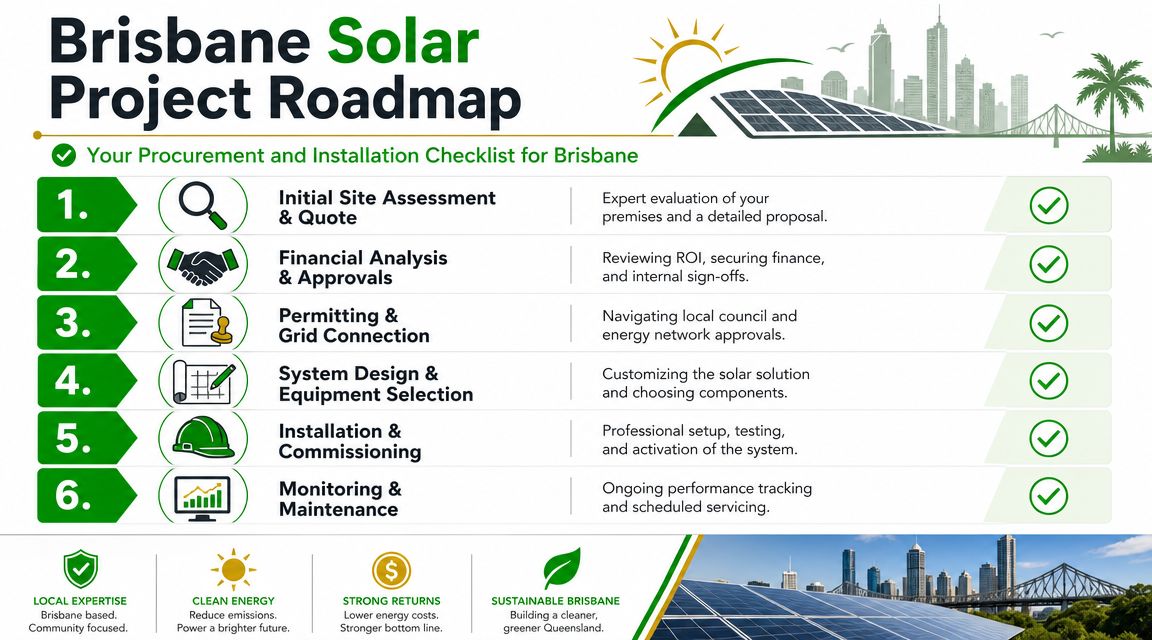
A good procurement process fixes this early. For commercial sites, the job is not just buying panels and inverters. It is confirming that the system can be installed safely, approved properly, and expanded later for batteries or managed EV charging without reopening major electrical works.
What to check before you sign
A useful proposal answers three commercial questions clearly. What is being built, what has been excluded, and what future site changes has the designer already allowed for?
Use this checklist when comparing quotes:
- Energy data review: The installer should ask for interval data, or enough billing history to separate daytime demand from after-hours usage.
- Roof and structure assessment: Shade, roof condition, access, penetrations, and mounting method affect yield, labour, and maintenance access.
- Electrical scope clarity: The quote should identify switchboard work, protection changes, metering, monitoring, shutdown procedures, and spare capacity for future batteries or EV chargers.
- Network application planning: Grid connection requirements should be checked before equipment is locked in, especially where export limits or protection settings may affect the design.
- Hardware transparency: The proposal should name the inverter platform, panel model, monitoring portal, warranties, and who is standing behind each component.
- Installation responsibility: Ask who is doing the install, who is commissioning it, and who carries fault responsibility after handover.
One more check matters. Ask whether the cable routes, board layout, and communications setup have been planned with battery integration or charger load management in mind. If the answer is vague, the site is probably being designed for today only.
Installation timing and disruption
Owners usually focus on the rooftop work because that is the visible part of the project. On most sites, the harder part is the pre-install coordination.
Physical installation for a commercial system can be relatively quick once approvals, materials, access equipment, and shutdown windows are lined up. The Clean Energy Council's guide to buying quality solar for business explains the procurement steps around system design, approvals, installation, and commissioning, which is a more useful planning frame than a simple “days on site” estimate: Clean Energy Council guide for businesses buying solar.
For Brisbane sites, program risk usually sits in four places. Network approval. Switchboard condition. Roof access and safety controls. Whether the business can tolerate an outage for tie-in works.
Ask for two separate timelines:
- Pre-install timeline: site inspection, engineering review, network approval, procurement, and scheduling
- On-site works timeline: delivery, installation, shutdowns, commissioning, and monitoring setup
That distinction matters for warehouses, schools, body corporates, and production sites where a one-day shutdown can cost more than the solar labour itself.
A cleaner procurement process
The strongest commercial jobs usually follow a clear sequence:
| Stage | What you should expect |
|---|---|
| Initial assessment | Review of bills, interval data, roof constraints, switchboard condition, and future plans for batteries or EV charging |
| Concept design | Proposed system size, single-line diagram, estimated production pattern, and preliminary integration allowances |
| Approval stage | Network application, engineering checks, and confirmation of any board upgrades or protection changes |
| Procurement | Equipment selection is locked only after approvals and electrical scope are clear |
| Installation | Coordinated site works, safety controls, and planned outages where required |
| Commissioning | Testing, monitoring setup, as-built documentation, and handover of operating instructions |
If an installer cannot explain that process in plain language, the business is probably carrying too much project risk.
Good procurement reduces surprises later. It also gives the site a cleaner path to add storage, demand control, and EV charging as those loads become commercially worthwhile.
Take Control of Your Energy Future with Interactive Solar
For Brisbane businesses, commercial solar is no longer just a panel purchase. It's an operating-cost decision, a site-planning decision, and increasingly an electrification decision.
The strongest projects share the same fundamentals. They're sized around real daytime demand. They don't rely on exports to make the numbers work. They leave room for batteries, EV charging, and future load growth. And they're procured with enough discipline that the final system performs the way it was sold.
That's why the right question isn't “how big a system can fit on the roof?” It's “what energy system should this site be building over the next several years?” For some businesses, that starts with solar only. For others, it means designing the solar project so batteries and managed EV charging can be added without reworking the whole electrical backbone.
If you want a sensible next step, start with your load profile, tariff structure, roof constraints, and future plans for vehicles or battery storage. A proper site assessment should translate those inputs into a system design that fits the business, not a generic sales template.
If you want a practical review of your site, book a no-obligation assessment with Interactive Solar. A useful first meeting should look at your daytime usage, roof suitability, switchboard capacity, and whether battery storage or EV charging should be planned now or staged later.
Make Interactive Solar a preferred source in Google
One click tells Google to surface our articles more often in Top Stories, AI Overviews and AI Mode.