Home Battery Storage System: Your 2026 NSW Guide
You've already done the hard part. You put solar on the roof, you watch it generate power through the middle of the day, and you expect your electricity bills to drop hard.
Then the evening arrives.
The air con comes on, someone starts cooking, lights are on in half the house, the hot water system kicks in, and the home starts buying power from the grid again. That's the point where many NSW homeowners realise their solar system is working, but their energy setup still isn't complete.
A home battery storage system solves that mismatch. It stores the solar you don't use during the day and shifts it into the hours when your household needs it most. For a lot of homes in Sydney and across NSW, that's the step that turns solar from a daytime generator into an all-day energy strategy.
The Missing Piece in Your Solar Setup
A common conversation goes like this. The household has solar. The monitoring app looks good in daylight. But the bill still has a sting in it because most of the expensive usage happens after work, not at lunchtime.
That frustration is reasonable. Solar-only systems often produce their best output when no one is home or when the house load is low. By the time the family gets back, solar generation has dropped and the home starts leaning on grid electricity again.
In Australia, that mismatch matters at scale. The Clean Energy Council reported that 110,883 rooftop solar systems were installed across Australia in 2024, adding 1.6 GW of new capacity, which keeps expanding the number of homes with surplus daytime solar that could be stored for evening use, especially in states such as NSW with higher evening peak tariffs, as noted in this Australian home battery market summary.
For a homeowner, the practical issue is simple. If you export cheap and buy back dear, the system isn't doing as much work for you as it could.
What that looks like in a real household
A typical pattern is easy to recognise:
- Midday surplus: Your panels are producing strongly, but the house doesn't need all of it.
- Low-value export: Excess solar heads out to the grid instead of staying on site.
- Evening import: The household then buys electricity back right when usage climbs.
- Bill frustration: You've invested in solar, but you still feel exposed.
That's why many households start looking at a battery as the logical next step, not a luxury add-on. It gives your solar somewhere to go.
Most solar owners don't have a generation problem. They have a timing problem.
A battery changes that timing. It keeps more of your own energy inside your home and gives you more control over when you use it. If you're weighing up that move, a good starting point is understanding how modern solar battery options for NSW homes are typically designed around self-consumption, backup needs, and future expansion.
How a Home Battery Storage System Works
The easiest way to think about a home battery storage system is as a rainwater tank for electricity. Your solar panels collect energy during the day the same way a roof collects rain. Instead of letting that extra energy flow away, the battery stores it until the house needs it.
That's the core idea. It isn't complicated once you picture the daily cycle.
The daytime cycle
During the day, your solar panels generate electricity. Your home uses that power first. If the house is only using part of what the system is producing, the extra energy can charge the battery.
Once the battery reaches its stored limit, any remaining surplus may still go to the grid, depending on how the system is configured and what your network allows. The battery doesn't replace solar. It works with it.
The evening cycle
When solar output drops, the battery can start supplying the house. Instead of buying power from the grid straight away, the system uses the energy you stored earlier.
That's called time-shifting. You're moving your daytime solar into the evening window when electricity is often more valuable to you.
A well-set-up system does this automatically. You don't need to manually switch it over every day.
What decides where the power goes
Three parts work together behind the scenes:
- Solar panels generate the electricity.
- An inverter manages conversion and directs energy where it needs to go.
- The battery and control system decide when to charge, hold, or discharge.
If your home is using power now, the system will prioritise that load. If there's spare solar, the battery charges. If solar isn't enough later on, the battery discharges before the home falls back to the grid, subject to the operating settings.
Practical rule: A battery doesn't create energy. It stores timing value.
Where homeowners get confused
A lot of people assume the battery will run the whole house all night no matter what. Sometimes it can support a large share of evening use. Sometimes it's better configured around essential circuits, peak periods, or backup loads.
That depends on system size, inverter limits, the way the switchboard is set up, and how much electricity the house uses at once. A battery might have enough stored energy, but if too many high-draw appliances start together, performance can still be limited by system design.
This is why comparing brand brochures alone usually isn't enough. You need to compare operating behaviour. A proper battery comparison guide for Australian homes helps you look beyond headline capacity and focus on how the system will behave on your property.
Unlock Energy Independence and Bill Control
Most NSW homeowners don't buy a battery because they love equipment. They buy one because they want more say over what happens to their electricity bill and what happens when the grid lets them down.
A battery helps in three places that matter day to day.
More of your solar stays in your home
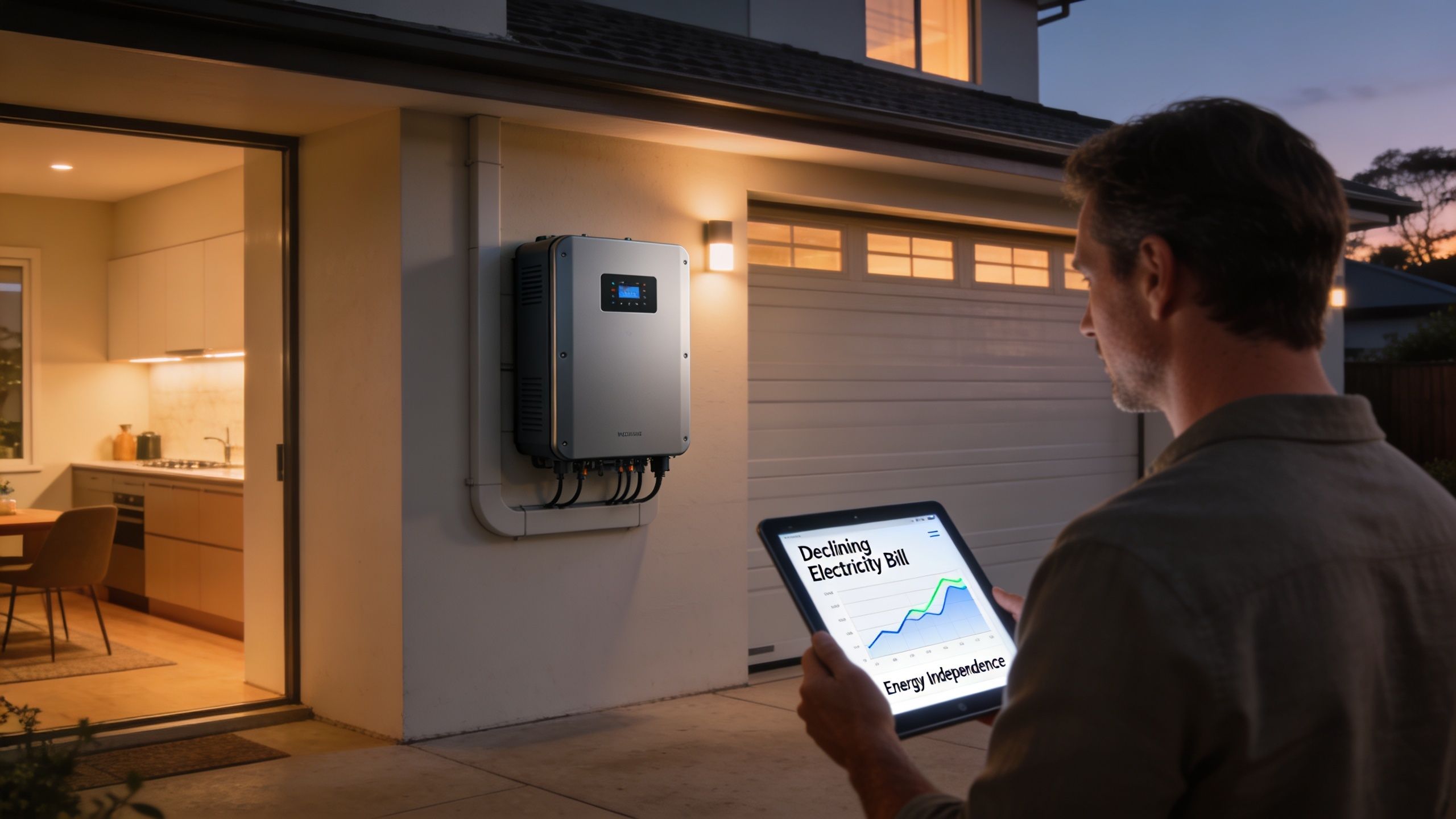
Without storage, a solar system often does its best work when household demand is low. With a battery, that spare production can be held back for later use instead of being exported immediately.
That changes the feeling of the system. The home starts using more of its own generation after sunset, when family life happens. For many households, that's the point where solar starts to feel complete rather than partial.
If your goal is to keep more of your energy on site and rely less on evening imports, these practical ways to reduce electricity bills at home usually start with load timing, tariff awareness, and battery-ready system design.
Backup matters when the grid doesn't cooperate
Not every battery setup delivers full-home backup, and good advice is important. Some systems are designed to support a dedicated essential-loads circuit. Others can back up more of the property, subject to inverter capacity and switchboard design.
That distinction matters in real life. During an outage, most households don't need every load running. They usually want lighting, refrigeration, internet, a few power points, and maybe selected comfort loads. The right battery setup should reflect that reality.
If backup is a priority, ask which circuits will actually stay on. Don't settle for a vague “yes, it has backup”.
Here's a quick visual overview of why storage changes the household energy picture:
Peak periods are where the battery earns its keep
In NSW, many homes are on tariffs where electricity costs more at certain times. That means the value of stored energy isn't only about using your own solar. It's also about when you avoid buying from the grid.
A battery can be set up to support the house through expensive periods, especially when evening loads climb. That's useful in homes where the air conditioner, cooktop, oven, lighting, and entertainment all come on within the same window.
Bill control is different from chasing a perfect payback story
Much marketing presents an overly simplistic view. A battery isn't magic, and not every home gets the same result. Homes with strong daytime surplus, heavy evening use, and concern about outages usually get more value than homes with low evening demand and generous export arrangements.
The practical benefit is control. More control over self-consumption. More control during outages. More control over when you draw from the grid.
Key Components and Technology Explained
When installers talk about battery quality, they're not just talking about brand names. They're looking at the chemistry inside the battery, the inverter that controls energy flow, and the protection systems that keep the whole setup stable and safe.
For a NSW homeowner, the hardware choices matter because the system will likely cycle often, live in a garage or on an external wall, and need to perform reliably through hot weather and daily use.
The battery chemistry
For home storage, LFP, or lithium iron phosphate, is widely preferred for residential use because of its long cycle life and stronger thermal stability. The battery's safety and reliability also depend heavily on the Battery Management System, which prevents overcharging, overheating, and cell degradation, as outlined in this guide to home energy storage safety standards.
That's why experienced installers pay close attention to more than capacity on a spec sheet. Chemistry and control systems have a direct effect on how the battery behaves over time.
Lead-acid still exists in some corners of the market, but it's generally not what most homeowners want for a modern daily-cycling setup. It's harder to make that option stack up when the goal is long-term residential performance.
The BMS is the quiet hero
The Battery Management System, or BMS, is the part many homeowners never see but absolutely need. It monitors cells, controls charging and discharging, and helps protect the battery from operating outside safe limits.
If the battery is the fuel tank, the BMS is the protection and control layer that stops small issues turning into serious ones. That matters in any climate, but it matters even more in Australian conditions where installation quality and thermal management are not negotiable.
A cheap battery with weak controls can become an expensive problem. Strong battery design starts with safe cell management, not glossy marketing.
For broader context on fire response and battery incidents, it can also help to understand the kinds of advanced fire suppression solutions for emergency responders used in high-risk environments. That isn't a substitute for correct residential product selection, but it reinforces why fire safety should never be treated as a minor detail.
The inverter choice shapes the system
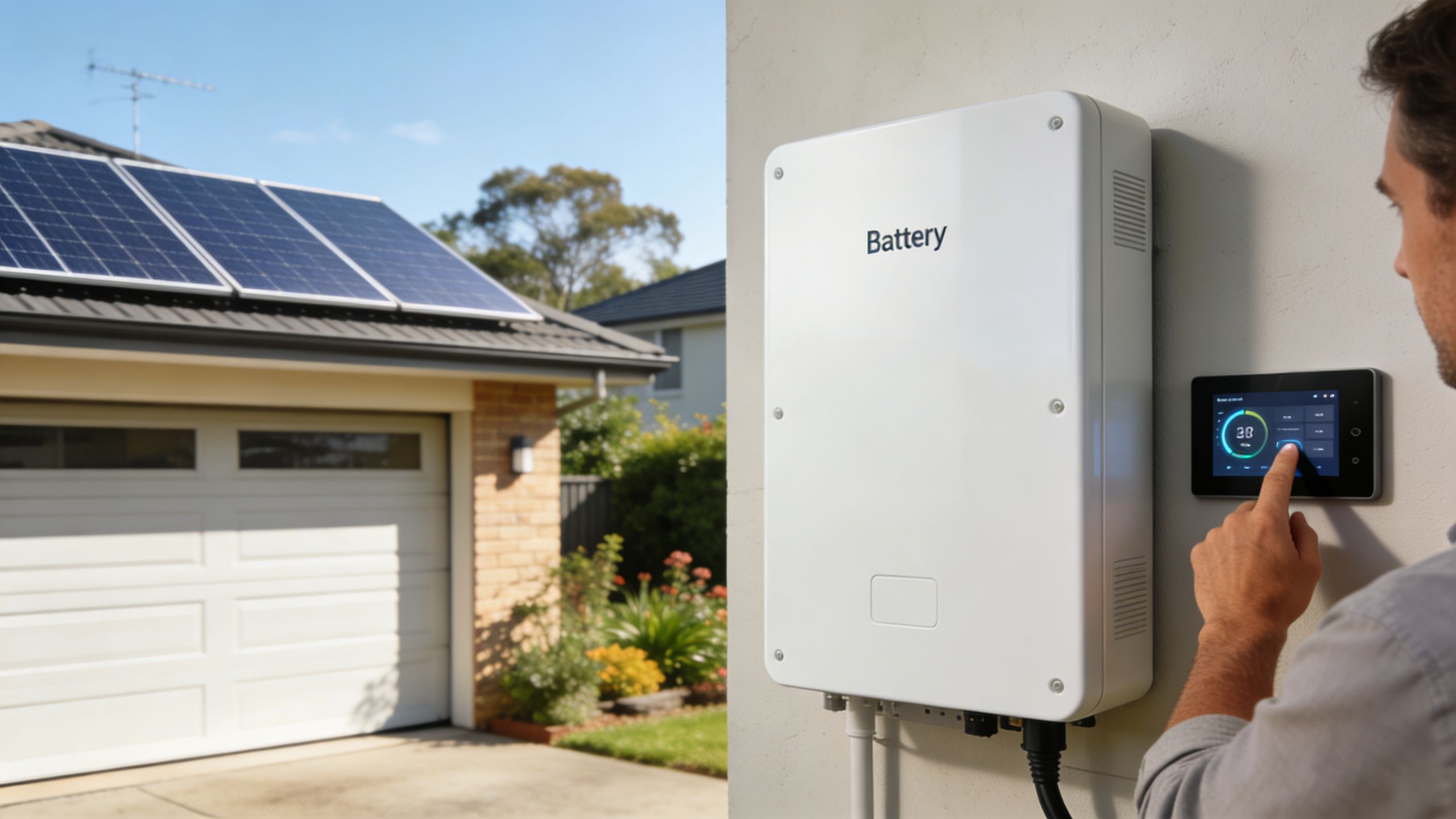
The inverter is the operating centre of the home battery storage system. It manages how solar, battery, home loads, and the grid interact.
In retrofit homes, installers often weigh up AC-coupled and hybrid pathways. In plain terms:
- AC-coupled setups often suit existing solar systems where the homeowner wants to add a battery without rebuilding the whole solar side.
- Hybrid inverters can be a strong fit for new solar-plus-battery systems or major upgrades where integrated control is the goal.
- Backup capability varies. It depends on the inverter, the battery, the switchboard layout, and whether essential circuits have been planned properly.
Product selection becomes a practical, rather than theoretical, matter. A popular example many homeowners ask about is the Powerwall category, and a detailed guide to Tesla Powerwall 3 and system planning is useful because it shows how battery, inverter behaviour, backup design, and whole-home expectations all intersect.
Sizing Your Battery System Correctly
Battery sizing is where good projects separate themselves from disappointing ones. Too small, and the battery empties before the evening is over. Too large, and you may end up with capacity your household rarely uses well.
The first thing to know is that kWh and kW are not the same thing.
kWh tells you how much energy the battery can store. kW tells you how much power it can deliver at once. A simple way to think about it is a water bottle and its opening. The bottle size is your energy capacity. The width of the opening is your power output.
A common benchmark for a residential battery is 5 kW / 12.5 kWh, which is enough for about 2.5 hours of discharge at full rated power, and that's exactly why homes with heavy evening appliance use need both the power and energy side sized properly, as shown in the NREL residential battery storage benchmark.
Why capacity alone can mislead
A homeowner might look at a battery's stored energy and assume it will comfortably run the house. But if the household turns on multiple loads at once, the power side becomes critical.
A battery can have enough stored energy to last through the evening and still struggle if the home tries to run air conditioning, cooking appliances, and refrigeration together while also supporting lights and general power. That's why experienced designers don't stop at “how many kWh do you want?”
They ask what's running, when it runs, and what needs to stay on during backup.
Start with your evening habits
The fastest way to size a battery properly is to review the period after solar production fades and before overnight demand drops off. In many homes, that's the stretch that matters most.
Look at the loads that tend to overlap:
- Cooling or heating: Air conditioning can dominate the early evening.
- Kitchen demand: Ovens, cooktops, kettles, and microwaves stack quickly.
- Base household loads: Fridge, lighting, internet, and standby power continue in the background.
- Lifestyle loads: Televisions, computers, pool equipment, and laundry can all push demand higher.
Here's a simple framework you can use to think through it.
Sample Evening Appliance Load Calculation
| Appliance | Typical Power (kW) | Hours of Use (Evening) | Energy Needed (kWh) |
|---|---|---|---|
| Fridge | 0.15 | 4 | 0.6 |
| Lighting circuit | 0.20 | 5 | 1.0 |
| Television and devices | 0.20 | 4 | 0.8 |
| Air conditioner | 2.50 | 3 | 7.5 |
| Oven or cooktop use | 2.00 | 1 | 2.0 |
| Dishwasher | 1.50 | 1.5 | 2.25 |
This table is illustrative rather than prescriptive. The important part is the method. Add up the loads that overlap and look at both the total energy and the highest simultaneous draw.
Don't size a battery around your quietest night. Size it around the nights that drive the bill and the nights when backup would matter.
What works and what doesn't
What works is designing around the home's actual behaviour. That includes tariff structure, solar production profile, backup priorities, and whether the house may later add an EV charger or other major electrical load.
What doesn't work is choosing the biggest battery you can fit on the wall and hoping it solves every problem. Oversizing without a reason rarely feels smart later. Undersizing to meet a headline budget usually creates disappointment faster than expected.
A strong sizing conversation should end with clear answers to these questions:
- Which loads matter most in the evening
- Which circuits need backup
- How much solar surplus is usually available to charge the battery
- Whether the system is being designed for self-consumption, backup, tariff optimisation, or a mix of all three
The Installation Process and Timeline
A battery installation feels much less complicated when you know what occurs. Most of the stress comes from uncertainty, not from the work itself.
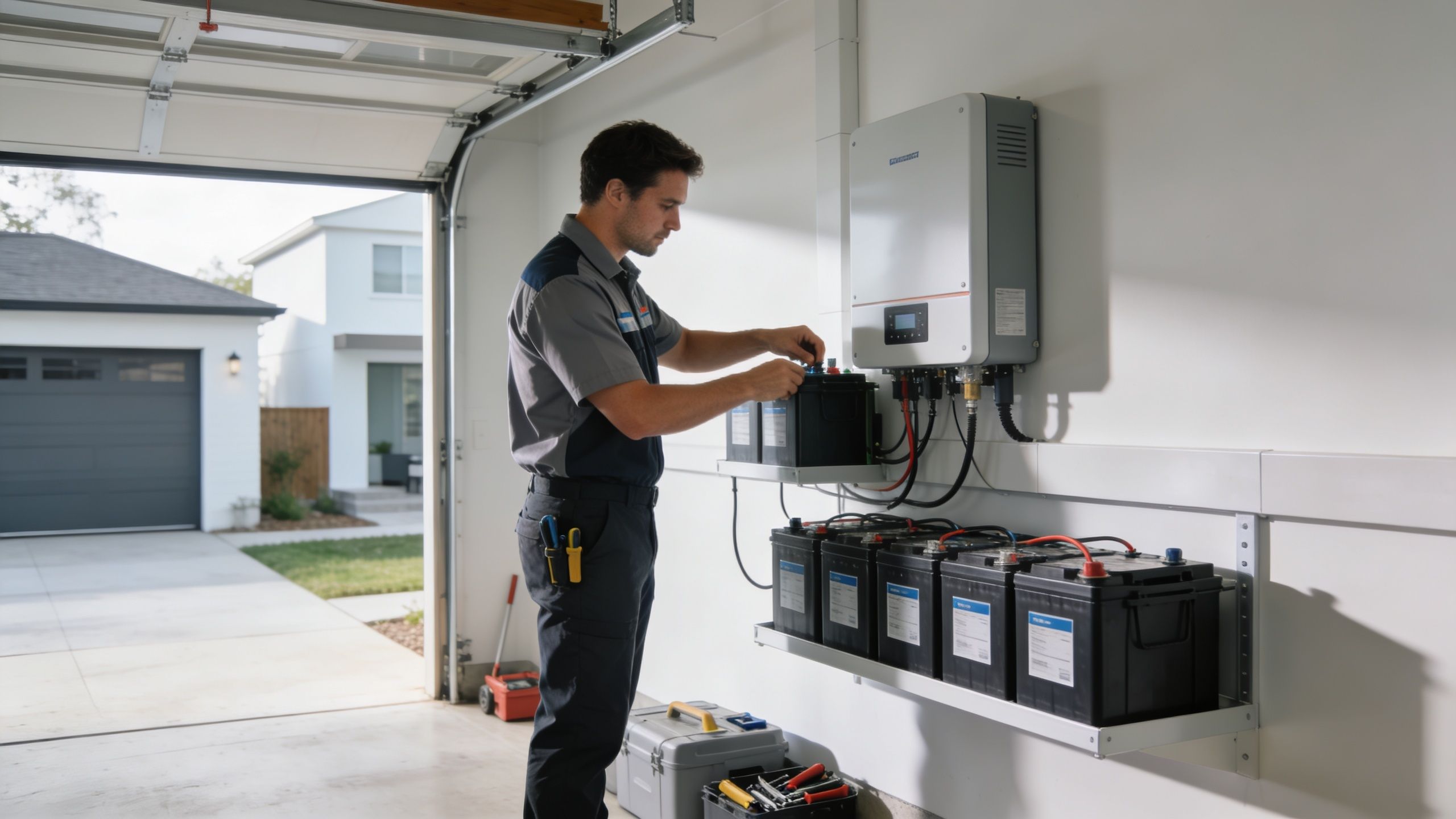
The process usually starts with a site assessment. The installer looks at your existing solar, switchboard, meter arrangement, available mounting space, and what you want the battery to do. Backup-only for essentials is one design brief. Whole-home ambition is another.
What happens before installation day
After the assessment, the system is designed around your property and usage pattern. That includes product selection, cable runs, protection equipment, placement, and any switchboard changes needed for safe integration.
Paperwork also has to be handled properly. Depending on the setup, that can include grid connection approvals and configuration requirements tied to your existing solar arrangement. A good installer manages this rather than leaving the homeowner to chase forms and guess what matters.
As battery adoption has accelerated, the market has matured significantly. The global collapse in lithium-ion costs has made residential systems more accessible, and homeowners now have a wider choice of reliable products and experienced installers, as discussed in this home battery storage system market overview.
What happens on the day
On installation day, licensed electricians typically handle the mounting, cabling, protection devices, inverter integration, communications setup, and commissioning. If backup is part of the design, the essential loads arrangement also needs to be wired and tested correctly.
The work itself can be tidy and straightforward when the planning has been done well. The rough jobs are usually the ones where no one properly reviewed the switchboard, wall space, or backup expectations at the start.
Why installation quality matters more than people think
A battery isn't just another appliance. It's becoming part of the home's electrical backbone. That means the neatness of the install, the logic of the circuit design, and the clarity of the commissioning all matter.
A well-installed system feels boring in the best possible way. It starts cleanly, monitors clearly, and behaves exactly as promised.
If you want a better sense of what separates a rushed job from a proper one, this article on why installation quality matters in advanced solar systems is worth reading. The same principle applies to batteries. Good design on paper still needs good hands on site.
Your Next Steps to Energy Independence
The question many homeowners ask first is, “What's the payback period?” It's understandable, but it's often the wrong place to start.
For NSW homes on time-of-use tariffs, the better question is which system design gives your household the most value. That depends on your tariff, your solar export limits, and how much you care about backup power, which is why a generic payback number can be misleading, as explained in this home energy storage guidance on value and design.
The better questions to ask
A more useful shortlist looks like this:
- How much of my evening usage could I shift onto stored solar
- Which circuits do I want available during an outage
- Will the battery integrate cleanly with my existing solar
- Am I designing only for today, or also for future loads like an EV charger
- Do I want the battery mainly for self-consumption, backup, tariff control, or a blend of all three
Those questions lead to a better outcome because they focus on system behaviour, not marketing shortcuts.
What about maintenance and warranties
Modern battery systems are generally low-maintenance from the homeowner's point of view, but “low-maintenance” doesn't mean “set and forget forever”. Monitoring matters. Firmware and communications matter. Installer support matters.
Warranties also need to be read properly. Homeowners should understand what's covered, what operating conditions apply, and how backup functionality is defined. Not all warranty language means the same thing in everyday use.
The right battery isn't the one with the most impressive brochure. It's the one that matches your home, your tariff, and the way your family actually uses power.
Why a personalised design matters
The best battery for one NSW home can be the wrong one for the house next door. Different load profiles, different switchboards, different export conditions, different priorities.
That's why the smartest next step isn't chasing a generic online answer. It's getting your home assessed properly. A good consultation should leave you with a clear view of what size makes sense, what backup would look like, how the system would operate through the day, and where the trade-offs sit.
If you want a customized plan rather than a guess, speak with Interactive Solar. Their team can assess your current solar setup, review your household usage, and design a home battery storage system that fits the way your NSW home operates.
Make Interactive Solar a preferred source in Google
One click tells Google to surface our articles more often in Top Stories, AI Overviews and AI Mode.