Feed-in Tariff NSW: A 2026 Homeowner’s Guide
Last updated:
You open your first bill after installing solar and scan straight to the credits line.
There it is: a small entry for exported energy. It’s usually labelled something like solar feed-in, and for a lot of NSW households that line creates the same reaction. Relief first, then confusion. The system’s on the roof, the sun’s been doing its job, so why isn’t that credit bigger?
That question matters because it gets to the heart of modern feed-in tariff nsw strategy. Years ago, high export payments were a major part of the solar story in New South Wales. Today, they’re not the main event. They’re a bonus. The main value comes from using your own solar power at the right time, storing excess generation in a battery, and charging major loads like an EV when your roof is producing.
If you’re a homeowner or business owner trying to cut bills for the long haul, that shift changes everything. A good system design no longer starts with “How much can I sell back?” It starts with “How much can I keep and use myself?”
Your First Solar Bill Credit Explained
That first bill credit is your introduction to how the grid and your solar system now interact.
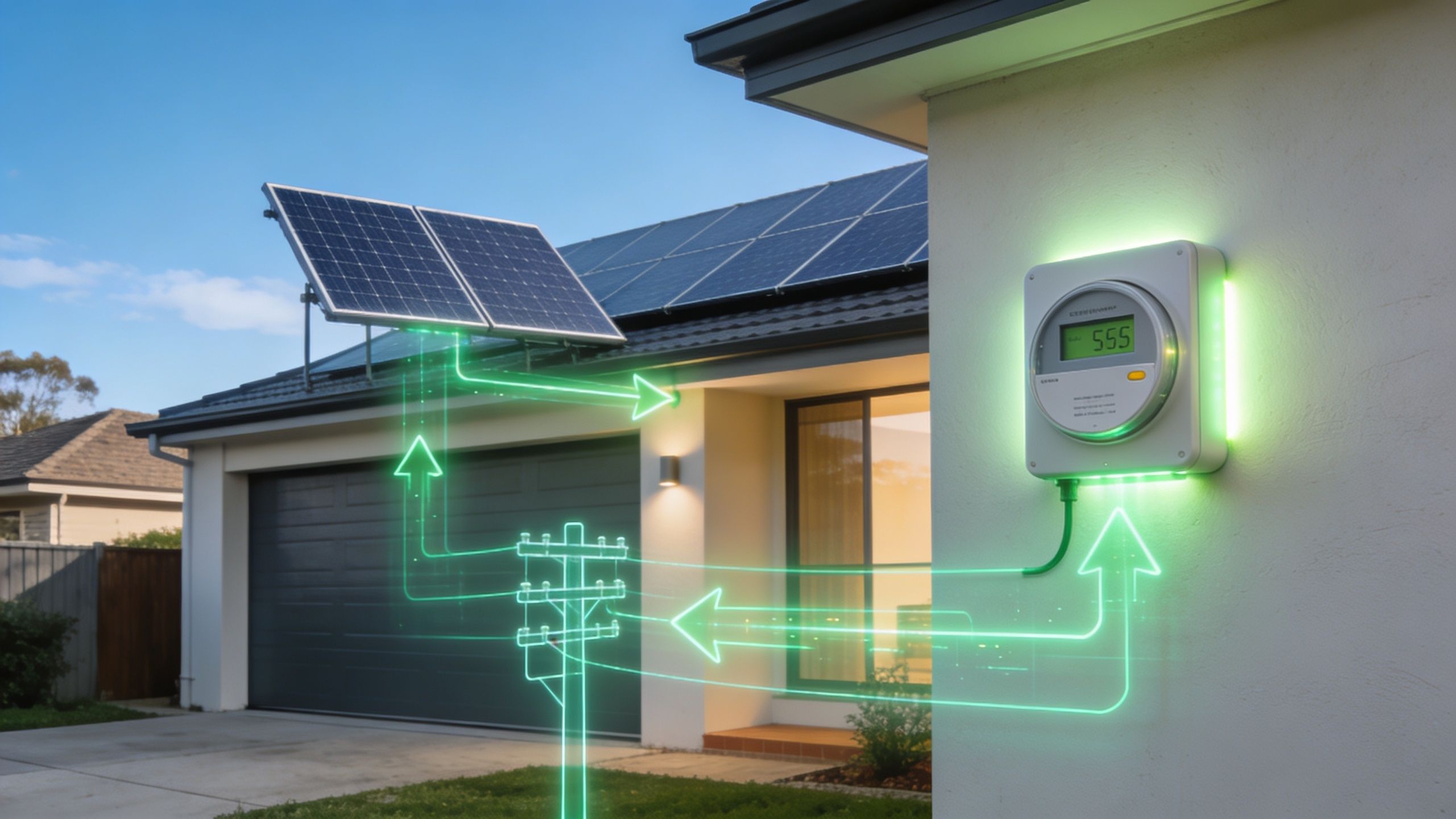
When your panels generate electricity, your home uses that power first. If the system is producing more than the house needs at that moment, the surplus flows out to the grid. Your retailer tracks that exported energy through your meter and applies a feed-in tariff, which is a credit on your bill for each unit exported.

What that bill line actually means
A lot of people assume the solar credit reflects everything their panels produced. It doesn’t.
It only covers the electricity you didn’t use on site. If your air conditioner, fridge, pool pump, office equipment, EV charger or hot water system used your solar power directly during the day, that value won’t show up as a feed-in credit. It shows up another way. This meant you bought less electricity from the grid.
That’s why a modest feed-in credit isn’t bad news by itself. In many cases, it means your home consumed a healthy chunk of what the system generated.
Why new solar owners often misread the result
The old mental model was simple: install solar, export lots of power, get paid well. That’s the outdated version.
The current one is different:
- Solar generation: What your panels produce
- Self-consumption: What your home uses immediately
- Grid export: Only the leftover amount
- Bill credit: The retailer’s payment for that leftover amount
Practical rule: The best solar kilowatt-hour is usually the one you use yourself, not the one you export.
If your daytime usage is low, you’ll naturally export more. That doesn’t automatically mean your system is performing better. It may just mean the home is empty during solar production hours.
The smarter way to read your bill
When I look at a customer’s bill after solar, I’m less interested in the export credit by itself than in the full picture:
- How much grid import dropped
- When the home still buys power
- Whether daytime appliances are using solar directly
- Whether a battery or EV charging schedule would capture more value
That’s where modern savings come from. Export credits matter, but they’re now a supporting player. If your goal is lower bills and more control, the bigger opportunity is shifting your habits and your hardware toward self-consumption. That’s the move that turns rooftop solar from a nice rebate on your bill into a system that changes how your property runs.
What Exactly Is a NSW Feed-in Tariff
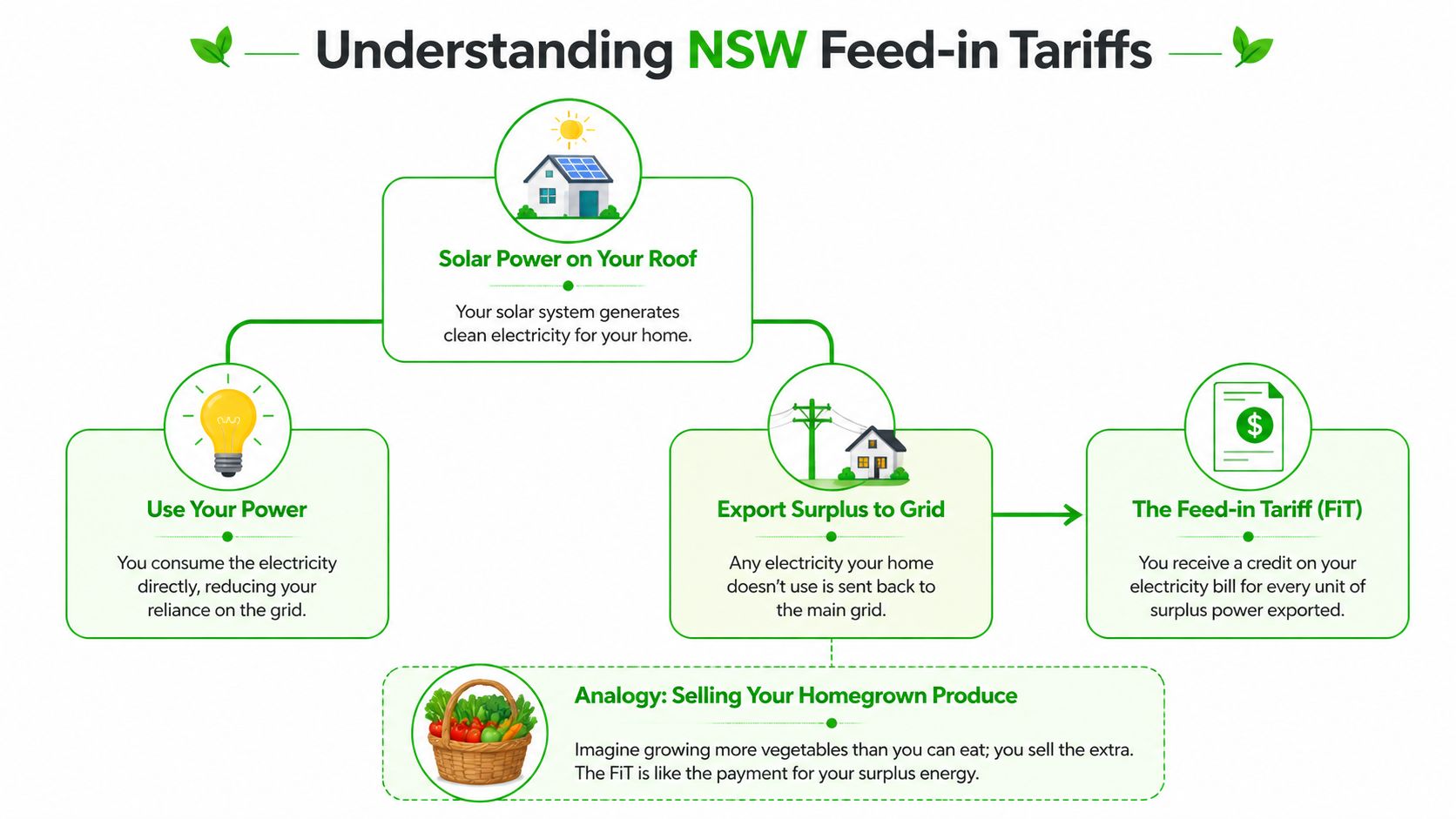
A NSW feed-in tariff is the credit your electricity retailer gives you for surplus solar electricity sent from your property back into the grid.
The simplest way to think about it is a home garden. You grow vegetables for your own household first. If you harvest more than you can use, you sell the extra to the local grocer. Your solar system works the same way. Your roof produces electricity for your property first. Only the surplus gets “sold” to the grid.
If you’re also weighing up broader incentives around solar ownership, this guide to NSW solar rebates and government rebates helps clarify where retailer credits fit compared with installation incentives.
The three energy buckets that matter
Most confusion disappears once you separate solar power into three buckets.
| Energy flow | What it means | Why it matters |
|---|---|---|
| Generated power | Total electricity your panels produce | This is the full output of the system |
| Used on site | Solar electricity consumed by your home or business in real time | This cuts how much power you buy from the grid |
| Exported surplus | Excess electricity sent back to the network | This is the only part that earns a feed-in tariff |
This distinction matters because people often compare their solar app to their bill and assume something is missing. Usually, nothing is missing. The app shows generation. The bill only pays export credits on the excess.
What measures imports and exports
A smart meter records electricity moving both ways.
It tracks power coming in from the grid when your property needs extra electricity, and it tracks power going out when your system is producing more than the site can use. Without that two-way metering, your retailer can’t calculate an export credit properly.
A feed-in tariff isn’t a payment for having solar. It’s a payment for the share of solar you don’t consume yourself.
Why the distinction changes system design
Practical solar advice separates from generic bill-comparison chatter.
If two homes have the same size solar array, they can get very different results from the same sun. A household that runs appliances, pool equipment, ducted air, or EV charging during the day will usually get stronger value from self-consumption. A household that’s empty all day may export more, but that doesn’t automatically translate into the best overall outcome.
For businesses, the pattern can be even more favourable. Offices, workshops, warehouses and retail spaces often use power while the system is generating, which means more solar gets consumed behind the meter instead of sold out cheaply.
What works and what doesn’t
Some habits improve the value of solar immediately:
- Running big loads in daylight: Dishwashers, pool pumps and EV charging can align with solar production.
- Using timers and smart controls: These shift demand into productive solar hours.
- Adding storage when export is consistently high: A battery can keep more of your generation on site.
What doesn’t work is treating the feed-in tariff as the main return lever. That approach ignores the bigger win, which is reducing purchased electricity. Once you understand that, your solar strategy becomes much clearer.
The Evolution of NSW Feed-in Tariffs From Bonus Scheme to Today
A homeowner in NSW gets a new solar quote and asks the same question I hear all the time: “What feed-in tariff will I get?” Usually, that question is shaped by an old story from a friend, parent or neighbour who installed solar years ago and was paid far more for exports than anyone is offered now.
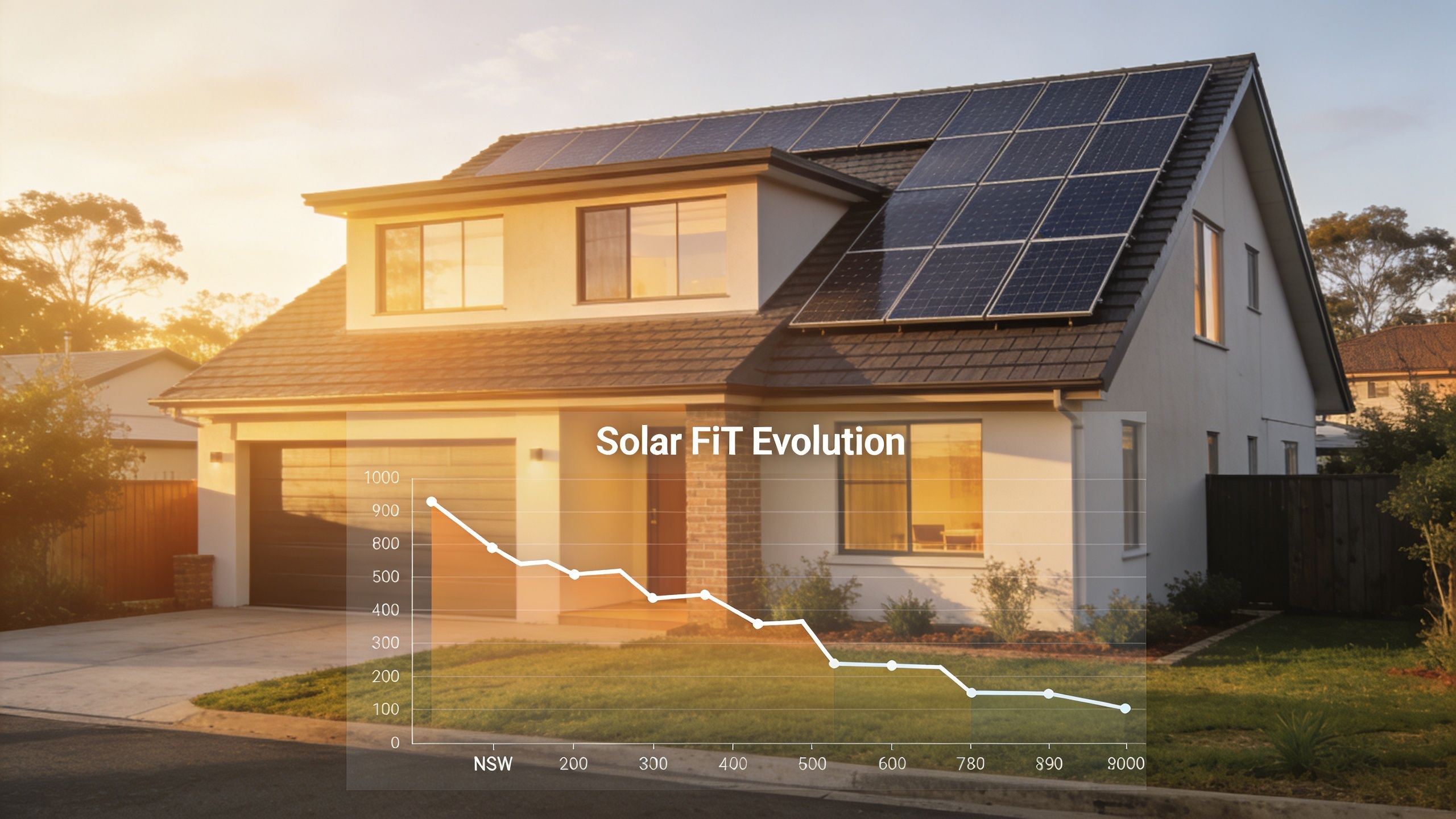
That story is real. It comes from the NSW Solar Bonus Scheme, an early policy that paid a premium rate for eligible exports and helped drive rapid solar uptake across the state. The scheme belonged to a very different stage of the market, when solar systems were expensive, adoption was lower, and governments were using strong incentives to get rooftop solar moving.
Why the bonus scheme made sense at the time
Back then, premium export payments were a market-building tool.
They gave early adopters a clear financial reason to install solar, and they gave the industry room to grow. Installers, retailers and manufacturers all benefited from that demand. So did households that got in early.
But that policy setting was never going to last. Once solar became mainstream and system prices came down, paying very high rates for exported power stopped matching the value of that electricity to the grid.
What changed after the scheme closed
The scheme closed to new entrants, transitional arrangements ran their course, and NSW shifted to the model we still have now. Retailers set the offers. Regulators provide benchmark guidance. The premium government-backed era ended. NSW Government information on the Solar Bonus Scheme and its closure makes that timeline clear: NSW Solar Bonus Scheme.
That change matters because it reset what solar should be expected to do. A modern system is not a licence to sell power at unusually high rates. It is a tool to avoid buying expensive grid electricity and to keep more control over your energy costs on site.
I’m candid with clients about this. Chasing a headline FiT can still make sense at the margins, especially if a site exports heavily and has limited daytime load. But the gains are usually smaller than people expect, and they can disappear quickly if the plan comes with higher import rates or restrictive conditions. A quick check of Connect VPP's FiT comparison can help show how varied these retailer offers are.
The real shift in solar economics
The old model rewarded exporting as much as possible.
The current model rewards using your own generation well. That is a better long-term position for most homes and many businesses in NSW. Daytime cooling, hot water control, pool filtration, workshop loads, refrigeration, EV charging and battery storage all improve the return from solar more reliably than hoping for premium export credits.
This is also why the debate around export charges gets more attention than it deserves. For most sites, the bigger financial decision is still how much solar can be used behind the meter. If you want a plain-English view on that issue, our article on the so-called sun tax and why the concern is often overstated sets it out clearly.
What current buyers should take from that history
The lesson is simple. Old bonus-scheme payments were designed to kickstart the market. Today’s systems need to be designed for self-consumption first, exports second.
That changes the conversation. Instead of asking only which retailer pays the highest feed-in tariff, ask better questions. How much daytime load can be shifted? Is a battery likely to improve evening coverage? Will an EV charger help soak up excess solar instead of sending it out cheaply? Those are the decisions that move a household or business closer to genuine energy independence.
Current Feed-in Tariff Rates in NSW for 2026
A homeowner in Sydney gets their first solar bill and sees a small credit for exported power. Then they look at the plan headline and wonder why the numbers do not feel as generous as the ad suggested.
That usually comes down to one point. There is no single NSW feed-in tariff set by government. Retailers set their own export rates, and IPART publishes a benchmark range as a reference point rather than a required payment. For 2025/26, that flat all-day benchmark sits at 4.8 to 7.3 c/kWh, based on SolarQuotes’ summary of the IPART guidance.
Use that range as a sense check, not as a promise. If a retailer advertises a rate well above the usual band, read the usage charges, export caps, plan conditions, and eligibility rules before signing anything. High FiTs can still be paired with expensive imports, and that is where the plan often gives back what the headline rate appears to offer.
The three structures you’ll actually see
Retailers in NSW usually package solar export rates in one of three ways.
| Tariff Structure | How It Works | Best For Households That… |
|---|---|---|
| Flat rate | One export rate applies across the day | Want predictability and have straightforward usage patterns |
| Tiered rate | A higher rate applies to an initial block of exports, then a lower rate applies after that | Export moderately and don’t usually push large excess volumes every day |
| Time-of-day rate | Export value changes depending on when electricity is sent to the grid | Can control timing, especially with a battery |
Flat rates are often the cleanest starting point
A flat feed-in tariff is easy to check against your bill and easy to compare.
For a solar-only home that exports whatever is left after daytime usage, a flat rate often avoids unnecessary complexity. You know what each exported unit is worth, and you are less likely to overestimate the value of a premium window that your system rarely hits.
Tiered rates reward small to moderate exports, not heavy spill
Tiered plans look attractive because the first block gets the premium rate.
In practice, the premium usually only applies to a limited amount of daily export, then the rest drops to a lower rate. Some plans also restrict eligibility by system size or inverter size. That can suit households with modest excess solar, but it is less appealing for larger systems that regularly send a lot back to the grid. If your roof produces far more than the site can use, the average export value can fall quickly once you move past that first tier.
Time-of-day tariffs suit controlled systems
Time-based export tariffs can work well if the property can choose when to export.
That usually means a battery, an EV charger with solar-aware controls, or a business load that can be scheduled with intent. Without that control, a time-of-day FiT often adds complexity without improving the result. Midday solar is abundant across NSW, so the key opportunity is not just finding a clever export tariff. It is deciding whether that excess energy should stay on site instead.
For households considering storage, the current NSW battery rebate changes and what they mean for solar owners are worth reviewing before choosing a retailer plan around export income alone.
Chasing the highest advertised FiT rarely beats using more of your own solar at home or at the business.
Compare rates, then compare strategy
I still recommend using a market-wide comparison tool as a first pass. Connect VPP's FiT comparison is useful for seeing how retailers structure their offers and where the obvious outliers sit.
Then go a step further and assess the whole setup:
- Whether the rate is flat, tiered or time-based
- Whether export caps apply
- Whether your system size affects eligibility
- Whether import charges wipe out the FiT advantage
- Whether a battery or EV charger would capture more value than extra exports
That last point matters more each year. A feed-in tariff still has value, but in NSW it is no longer the centre of the solar decision. The better question is how little power you need to buy back at retail rates.
The New Solar Math Shifting from Export to Self-Consumption
You open your bill after installing solar and see a feed-in credit. It feels like the system is paying you back. Then you look a little closer and notice the bigger number is still the power you bought from the grid after sunset.
That is where NSW solar economics have changed. Exporting still matters, but it is no longer the main event. The stronger result usually comes from using more of your solar on site and buying less electricity at retail rates.

Why using your own solar is worth more
Here’s the practical comparison.
Older NSW solar economics rewarded export much more heavily, which is why the Bonus Scheme shaped so many expectations. That period is gone. Current feed-in tariffs are modest by comparison, while the cost of importing electricity from the grid remains far higher than the credit you receive for exporting a surplus unit of solar.
For a homeowner or business owner, that changes the target. A kilowatt-hour used on site usually offsets an expensive purchase. A kilowatt-hour exported earns a much smaller credit.
That gap is the new solar math.
What self-consumption looks like in the real world
Self-consumption isn’t a buzzword. It’s a design and behaviour strategy.
It starts with one simple question. When your system is generating well, what in the property can use that energy before it leaves the site?
In practice, that often means:
- Daytime appliance scheduling: Running dishwashers, washing machines and pool pumps during solar hours
- Load shifting: Moving hot water heating or cooling loads into the middle of the day where possible
- Battery storage: Capturing excess daytime generation for use in the evening
- Smart EV charging: Telling the charger to draw from solar production instead of the grid
None of that is glamorous, but it works. I’ve seen plenty of systems with decent production and disappointing savings because the household kept its old usage pattern and treated export income as the plan.
On-site solar use cuts bills first. Export credit comes second.
Why batteries have become central
A battery gives surplus solar a second job.
Without storage, excess generation often leaves the property at the lowest-value part of the day, right when many other systems across NSW are doing the same thing. With storage, that same energy can cover the evening peak inside the home or business, when grid imports would otherwise be unavoidable.
That is why high feed-in tariff chasing has diminishing returns for many sites. Once exports become common and cheap, the smarter move is often to hold more of that energy back and use it later. For many households, especially those with strong evening demand, a battery improves the economics more reliably than a slightly better retailer export rate.
If you’re weighing that option up, our guide to the NSW battery rebate changes and what they mean for solar owners is a useful starting point.
EV chargers are part of the same strategy
An EV can be one of the best loads on the property because it is flexible and controllable.
If the car is home during the day, a smart charger can absorb surplus solar that would otherwise go out to the grid for a small credit. If daytime charging is not always possible, scheduled charging still helps line up vehicle use with your system output, tariff windows, and battery strategy.
A significant amount of value is often overlooked. Households spend good money on solar, then charge the car at night by habit, even though the setup could have been configured to use far more daytime generation.
A short demonstration helps illustrate the principle in action:
What works and what doesn’t
The patterns are clear once you look at load profile instead of just panel output.
What works:
- Battery plus solar for evening-heavy homes
- Smart EV charging for households with electric vehicles
- Timers, automations and energy apps
- System sizing based on load profile, not export assumptions
What doesn’t:
- Choosing a retailer on FiT headline alone
- Oversupplying the grid without a use plan
- Ignoring when the home uses power
- Treating storage as optional when exports are high and evening imports stay high
The best NSW solar systems now operate as managed energy systems. That is how a property moves closer to genuine energy independence, instead of relying on shrinking export value to carry the numbers.
Future-Proofing Your Solar Investment Beyond FiTs
If your solar plan depends on getting strong value for midday exports forever, it’s fragile.
The grid is changing, policy settings are changing, and the volume of rooftop solar in NSW keeps reshaping how daytime electricity is valued. That doesn’t make solar weaker as an investment. It means the strategy has to evolve with the market.
Why future export value may become harder to rely on
One of the clearest examples is the projected July 1, 2026 NSW three free hours initiative, which is described as likely covering 10am to 1pm and is intended to increase demand during peak sunlight hours and help absorb excess solar, according to Solar Calculator’s discussion of the policy and its likely effect on solar export economics.
That type of policy response tells you something important. NSW isn’t short of midday solar. The system increasingly needs smarter demand and smarter storage. When households across the state export at the same time, the market value of that power comes under pressure.
What that means for system owners
A solar-only property is more exposed to these shifts because it has fewer ways to respond.
If export conditions become less favourable, the owner still has a working solar system, but a larger share of value remains tied to retailer credits and market settings they can’t control. A property with a battery, flexible loads and good scheduling has more room to adapt. It can consume, store, defer or strategically release energy rather than sending excess power out as it’s generated.
That flexibility is the future-proofing benefit.
The less your savings depend on someone else’s export rate, the more stable your solar investment becomes.
Batteries turn uncertainty into control
Storage thus earns its place in the conversation.
A battery doesn’t just help reduce imports today. It gives your property an option set that a solar-only system doesn’t have. You can keep more midday production, cover the evening period, support backup capability on compatible systems, and respond better to changing tariff structures.
For homeowners considering a Tesla battery setup specifically, this guide to Tesla Powerwall 3 is useful for understanding how storage fits into a broader energy plan.
The broader self-consumption stack
Future-proofing isn’t only about adding a battery. It’s about building a system around controllable energy use.
A resilient setup often includes a mix of:
- Battery storage: Keeps excess production on site
- EV charging integration: Converts solar into transport energy
- Smart scheduling: Aligns appliances and heavy loads with generation
- Tariff awareness: Uses the right retailer plan for the property’s actual pattern
- System design with room to grow: Accounts for future EVs, added cooling loads or changed occupancy
The strategic shift NSW owners should make now
The homeowners who’ll be best placed over the next few years won’t be the ones chasing the highest advertised feed-in tariff.
They’ll be the ones who treat solar as the centre of a controlled energy ecosystem. Their roof generates. Their battery stores. Their charger and appliances absorb surplus intelligently. Their reliance on the grid falls not because export rates are generous, but because they need to buy less power in the first place.
That is a stronger position in any policy environment. It’s also the clearest path to long-term energy independence.
Your Next Steps to Maximising Solar Value in NSW
If you’ve made it this far, the main takeaway is simple. Feed-in tariff nsw decisions still matter, but they’re no longer the whole game. The strongest results come from matching your system, your usage and your controls so more of your solar stays useful on site.
A practical next step isn’t to obsess over a single retailer headline. It’s to get clear on how your property behaves and where you’re still buying expensive electricity when you shouldn’t need to.
A short checklist to work through
- Review your last few bills: Look for when you import most of your power, not just whether you receive a solar credit. If evening imports are still high, that usually points to a self-consumption gap.
- Check your daytime load: Pool pumps, ducted air, hot water, refrigeration and home office equipment all affect how much solar you use as it’s generated.
- Consider whether an EV changes the equation: An electric vehicle can become one of the best solar loads in the house if charging is managed properly.
- Assess battery suitability: Homes with strong daytime exports and consistent evening usage often have the clearest case for storage.
- Compare plans carefully: If you’re weighing retailer options, a breakdown like Origin Solar Boost vs VPP options can help you understand the trade-offs between a boosted export offer and a broader battery or VPP strategy.
- Reduce avoidable grid use first: Before changing hardware, tighten the basics. This guide on how to reduce electricity bills is a solid starting point.
What to avoid while you decide
Two mistakes show up again and again.
The first is choosing an energy plan purely because the feed-in tariff looks high, without checking the import rates and conditions. The second is installing solar and then doing nothing to change how the property uses electricity.
The households and businesses that get the best long-term value usually do the opposite. They align loads, monitor results, and upgrade in the order that makes sense for their lifestyle.
Start with your usage pattern. Then choose the solar, battery and charging strategy that fits it.
A good solar setup in NSW should do more than create a credit line on your bill. It should reduce dependence on the grid, give you more control over when you buy power, and make the home or business easier to run as energy prices and export conditions keep shifting.
If you want a system designed around real self-consumption instead of guesswork, Interactive Solar can help you map out the right mix of solar panels, battery storage and EV charging for your property. Their team works with NSW homeowners and businesses to design customized energy systems that cut grid reliance, improve day-to-day savings and support long-term energy independence.
Make Interactive Solar a preferred source in Google
One click tells Google to surface our articles more often in Top Stories, AI Overviews and AI Mode.