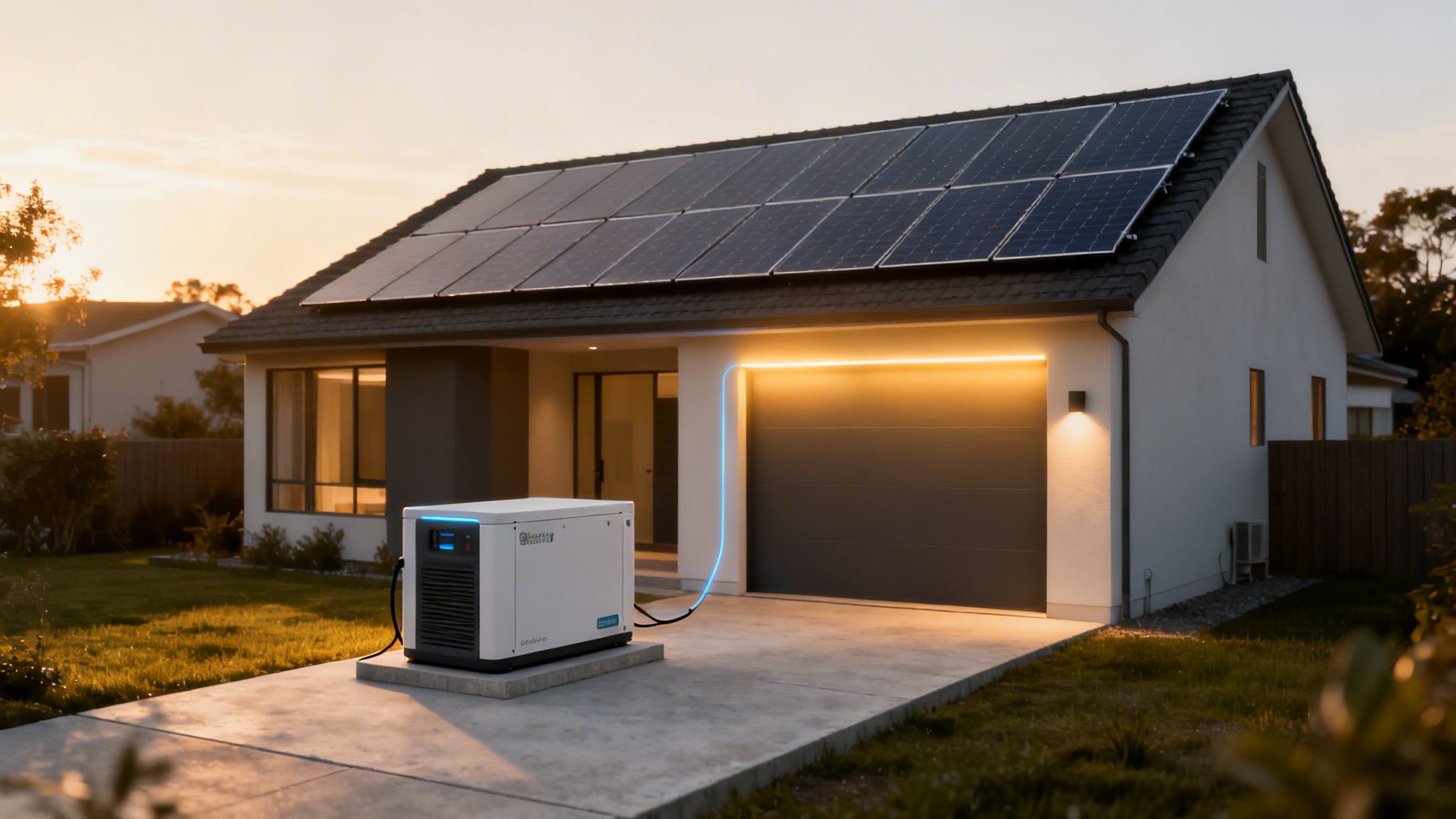
Finding the Best Home Solar Batteries for Your Needs
If you’re searching for the “best home solar batteries,” you’ll quickly find there’s no single winner. The truth is, the best battery is the one that fits your home’s energy habits and your financial goals like a glove. It’s never a one-size-fits-all solution.
What Makes a Solar Battery the Best for You

Think of it like buying a new car. A powerful ute isn’t automatically ‘better’ than a small, zippy hatchback; they’re just built for different jobs. The right choice comes down to your lifestyle and what you actually need it to do.
It’s exactly the same with a home solar battery. The perfect model for your neighbour might be all wrong for you, depending on why you’re getting one in the first place.
Defining Your Energy Goals
Before you even look at brands or models, you need to get clear on what you want your battery to achieve. This single decision will shape everything that follows, from the size and chemistry to the features you’ll need.
Are you hoping to:
- Slash your power bills? If so, your goal is to store the solar power you generate during the day and use it yourself during the expensive evening peak. We call this ‘self-consumption’.
- Secure blackout protection? Here, the priority is a battery that can kick in when the grid goes down, keeping essential appliances like your fridge, lights, and internet running.
- Achieve total energy independence? This is a bigger goal, usually requiring a more robust system with larger capacity to cut your reliance on the grid as much as possible.
A solar battery turns your panels from a part-time player that only works when the sun is out into a full-time power plant for your home. It captures all that free, clean energy and puts you in control of when and how you use it.
This is the key to unlocking the real value of your solar system. You move from just chipping away at your daytime power usage to managing your home’s entire energy cycle. You can dive deeper into the specifics in our comprehensive battery comparison guide.
The main job of a solar battery is to "time-shift" energy. It lets you bottle up the sunshine your panels produce all day and use that stored power later, making sure you get the full benefit of your system 24/7.
To help you find the right fit, we've put together a quick summary of the most important factors to consider.
Quick Guide to Choosing Your Ideal Solar Battery
This table breaks down the core elements you'll need to weigh up when making your decision.
| Key Factor | What It Means for You | Why It's Important |
|---|---|---|
| Battery Capacity (kWh) | How much energy the battery can store. Think of it as the size of your fuel tank. | Match this to your evening energy usage. Too small, and you'll run out of power; too big, and you've overspent. |
| Power Rating (kW) | How much electricity the battery can deliver at once. This determines how many appliances you can run simultaneously. | A low rating might only power your lights and fridge, while a high rating could run your air conditioner. |
| Round-Trip Efficiency | The percentage of stored energy you get back. A higher number means less energy is lost during charging and discharging. | A battery with 95% efficiency gives you back 9.5 kWh for every 10 kWh you put in. Higher is always better for your bottom line. |
| Depth of Discharge (DoD) | The percentage of the battery's total capacity that can be safely used. | A 10 kWh battery with a 90% DoD provides 9 kWh of usable energy. This directly impacts how much power you can actually use. |
| Warranty & Lifespan | Guarantees on performance, measured in years or cycles (one full charge and discharge). | Look for a warranty that covers at least 10 years and a high number of cycles, as this reflects the manufacturer's confidence in its longevity. |
Thinking through these points will put you in a much better position to evaluate different models and brands.
This guide will walk you through all these critical factors and more. We’ll explore battery chemistries, right-sizing your system, inverter compatibility, and the latest government rebates to help you make a smart, long-term investment in your home's energy future.
Decoding the Best Battery Technology for Your Home
When you start looking at home batteries, the technical jargon can feel overwhelming. But for your home, it really boils down to a choice between two main contenders. Getting your head around the difference is the first, most important step, because the chemistry inside your battery directly impacts its safety, lifespan, and the real-world value it delivers.
Think of it like choosing an engine for a car. One might be a high-revving V8 built for raw power and speed, while another is a diesel workhorse designed for reliability and long-haul endurance. Both will get you from A to B, but how they perform—and how long they last—is a completely different story.
LFP: The Marathon Runner
The first, and by far the most popular technology in modern home batteries, is Lithium Iron Phosphate, or LFP. This is your marathon runner. It’s not necessarily the fastest out of the blocks, but it’s built for incredible endurance, stability, and a long, reliable life.
For a battery that’s going to live in your home, the advantages of LFP are impossible to ignore:
- Superior Safety: LFP chemistry is fundamentally more stable and far less prone to overheating (a dangerous condition known as thermal runaway). This makes it the safest choice for installation inside your home or garage, giving you total peace of mind.
- Longer Lifespan: An LFP battery can handle thousands more charge and discharge cycles before its performance starts to fade. This means it simply lasts longer, delivering more years of energy storage and a much better return on your investment.
- Ethical and Sustainable: This chemistry avoids using cobalt, a mineral often tied to unethical mining and environmental issues. For homeowners who care about their environmental and social footprint, LFP is the clear winner.
It’s because of these massive benefits that LFP has become the gold standard for residential energy storage. It delivers the non-negotiable safety and endurance you need from an asset that’s at the core of your home.
NMC: The Sprinter
The other main player is Nickel Manganese Cobalt, or NMC. If LFP is the marathon runner, NMC is the sprinter. It’s incredibly powerful and energy-dense, which allows it to be packed into smaller and lighter units. You’ll often find this technology in electric vehicles, where squeezing maximum power into a tight space is the number one priority.
But that power comes with trade-offs in a home setting. NMC batteries typically have a shorter operational lifespan and a lower thermal stability threshold than their LFP counterparts. While they are made perfectly safe with sophisticated battery management systems, their core chemistry just doesn’t have the same inherent safety buffer as LFP. The popular Tesla Powerwall, for instance, has evolved its technology over the years—you can read our comprehensive guide to the Tesla Powerwall 3 to see how leading brands are adapting.
For a stationary home energy system, the extreme power density of an NMC battery is often less important than the long-term safety, reliability, and cycle life offered by LFP chemistry.
The rapid progress in battery technology, especially with LFP, has completely changed the financial equation for home storage. What was once a luxury is quickly becoming a financial necessity for Australian households hit with soaring energy costs. Home solar batteries have transformed the market, and here in Australia, payback periods are shrinking fast. In fact, some analysis shows that for a quality 10kWh system, the payback can now be much shorter than it was a decade ago, driven by these tech advances and skyrocketing peak electricity rates. You can read more about solar storage trends in Australia on solutions4solar.com.au.
Choosing the right battery chemistry is the foundational step in building a system that delivers both savings and security. For the vast majority of homeowners, the superior safety profile and extended lifespan of LFP make it the smartest and most reliable choice for powering their future.
Right-Sizing Your Battery For Maximum ROI
Choosing a solar battery isn't just about picking the best brand; it's about getting the size exactly right. This is where so many people go wrong. A battery that's too small or too large is a common and costly mistake that can completely wipe out your return on investment.
The key to unlocking real savings is ‘right-sizing’ the system to match how your home actually uses energy.
Think of it like a water tank for the electricity your solar panels generate. Your panels are the 'rain' that falls during the day. The goal is to have a tank that’s just big enough to catch all your excess solar 'rain' and hold enough 'water' to get your home through the night. A tank that’s too small will just overflow, wasting that free energy. But a tank that's too big will always be half-empty, meaning you’ve paid for capacity you’ll never even use.
This is where technical terms can get confusing, but understanding just a few key metrics will put you in the driver's seat when talking to an installer.
Power vs. Capacity: The Most Important Difference
The two most critical specs to get your head around are power (kW) and capacity (kWh). They sound almost the same, but they describe two totally different jobs. Getting this right is fundamental to finding the best home solar battery for your needs.
- Capacity (kWh): This is the total amount of energy your battery can store. Think of it as the size of the fuel tank in your car. A 10 kWh battery, for instance, can hold 10 kilowatt-hours of electricity.
- Power (kW): This is the rate at which the battery can deliver that electricity. Think of this as your car's horsepower. It dictates how many appliances you can run at the same time.
It's entirely possible for a battery to have a huge capacity (a big fuel tank) but a low power rating (a weak engine). This means it could run a few small lights for a very long time. On the flip side, a battery with a high power rating but tiny capacity could run your entire house… but only for a few minutes. Your goal is to find the perfect balance for your home.
Key Metrics For Battery Performance
Beyond just power and capacity, two other numbers directly impact how much energy you can actually use and how long your battery will last. Any quality installer will walk you through these.
The 'nameplate' capacity you see on a brochure isn't always what you get in reality. The usable energy is determined by the battery's Depth of Discharge—a critical factor in figuring out your system's real-world performance and payback period.
The two main performance indicators to look for are:
- Depth of Discharge (DoD): This is the percentage of a battery's total capacity that can be safely used without damaging its long-term health. For example, a 10 kWh battery with a 95% DoD gives you 9.5 kWh of usable energy. A higher DoD is always better.
- Round-Trip Efficiency: This measures how much energy you get back out compared to what you put in. Because of tiny losses during charging and discharging, no battery is 100% efficient. A modern LFP battery typically has a round-trip efficiency over 90%, meaning if you store 10 kWh from your panels, you’ll be able to use at least 9 kWh of it later.
The image below gives a great visual breakdown of the different strengths of LFP and NMC batteries, which we touched on earlier. It really helps to see why LFP is often the marathon runner perfectly suited for long-term home use.

This visual comparison drives home why LFP's endurance and safety profile make it the go-to choice for residential energy storage, where you need something you can rely on day in and day out for years.
The Role Of A Professional Energy Audit
So, how do you figure out the perfect size? You don’t have to guess. This is where a professional energy audit is absolutely essential. A qualified solar expert will dig into your electricity bills and usage data to see exactly how much power you use and, more importantly, when you use it. This data-first approach is the only way to design a system that truly fits your lifestyle.
A proper audit will account for your daily consumption, seasonal shifts in usage, and even your future plans, like getting an EV charger. By mapping out your home's unique energy heartbeat, we can recommend a battery with the ideal capacity and power rating to let you use as much of your own solar power as possible and slash your payback time.
Curious about your potential savings? You can get a quick snapshot by using our online solar savings calculator.
Understanding Costs, Payback Periods, and Rebates
Let’s get straight to the bottom line: what goes into the cost of a solar battery, and when does it start paying you back? While we don't list specific prices here—every home is different—it’s crucial to understand what goes into the total investment.
More importantly, we need to talk about the payback period. This is simply the time it takes for your battery to pay for itself through electricity savings.
Think of a solar battery as your own personal energy piggy bank. It stores the free, clean power your panels produce during the day. Then, when the sun goes down and grid electricity gets expensive, you use your own stored energy instead of buying it. This simple act of shifting your energy use is what drives your savings and makes the investment worthwhile.
How a Solar Battery Generates Savings
Your battery creates value in a few clever ways. Instead of exporting your excess solar power back to the grid for a tiny feed-in tariff, you store it for yourself. You’re essentially paying yourself first with free solar energy.
This strategy gets even more powerful if you’re on a time-of-use electricity tariff. Power can cost a whole lot more during the peak demand window, usually from 4 pm to 8 pm. Using your battery during these hours means you stop buying the most expensive grid power, which dramatically shortens your payback period.
A solar battery transforms your solar panels from a daytime asset into a 24/7 power solution. By storing your own solar generation, you drastically reduce how much expensive peak-rate electricity you need to buy from the grid, directly accelerating your payback period.
The financial case for batteries is getting stronger every year. In recent times, Australia's household battery demand has exploded, with tens of thousands of units being installed across the country.
According to the Clean Energy Council, solar panels by themselves can already significantly reduce your power bills. But add a subsidised battery to the mix, and those savings can increase substantially. Because of this, a typical 10kWh system now has a much shorter payback period than it did only a few years ago.
The Role of Government Rebates and Incentives
Government incentives play a huge role in making solar batteries more affordable and slashing those payback periods. These programs are designed to lower the upfront cost, making the switch to stored solar power a much easier financial decision.
Here are a few of the key programs available to homeowners:
- Small-scale Technology Certificates (STCs): This is a federal scheme that provides a point-of-sale discount on new solar systems. While it's mainly for the panels, it lowers the total cost when you install panels and a battery together.
- The Federal Cheaper Home Batteries Program: This national initiative is designed to provide direct financial support to households installing a new battery, making energy storage more affordable across the country.
- State-Based Rebates: Many states, including NSW, have their own specific programs to encourage battery uptake. These rebates can take a significant chunk out of your initial investment.
Getting a handle on these financial levers is the key to getting the fastest possible return on your investment. For the most current details on what's available in our area, have a look at our guide on what you need to know about the NSW battery rebate.
Of course, the financial side of things is just as important as the technology. For a different perspective on how costs are structured, you can explore the real solar battery backup cost for your Florida home, which details various pricing factors in a different market. While the specific rebates won't apply here, it's a helpful read for understanding the cost breakdown. By combining a right-sized system with all the available rebates, you make the move toward energy independence both smart and affordable.
Ensuring Seamless System Integration and Installation

A solar battery is so much more than just a box you plug into the wall. It’s a sophisticated piece of equipment that has to be woven perfectly into your home's entire electrical system. For it to deliver safe, reliable power, it needs to work in perfect sync with your solar panels and inverter.
Getting this integration right is every bit as important as the battery brand you choose. The solar inverter is the brain of the whole operation, directing where the energy goes. How your battery connects to this brain will define how efficient and flexible your system is. There are two main ways to wire everything up, and the right choice depends on your situation.
AC-Coupled vs DC-Coupled Systems
Getting your head around the difference between AC-coupled and DC-coupled systems will help you know what to expect, whether you're adding a battery to your existing panels or starting from scratch.
AC-Coupled Systems: This is the go-to for retrofits. If you’ve already got solar panels, your system is converting the DC power they generate into AC power for your home. An AC-coupled battery has its own inverter and gets added to your existing setup, working alongside the system you already have. It's a fantastic 'add-on' solution.
DC-Coupled Systems: This is the cleanest setup for a brand-new, all-in-one installation. Here, the DC power from the panels charges the battery directly, without needing to be converted to AC first. It’s a more efficient path with fewer energy losses because a single, smart hybrid inverter manages both the panels and the battery.
There’s no "better" option here; it's all about what's right for you. A good installer will look at what you have (or don’t have) and recommend the most efficient and cost-effective way forward.
The Critical Role of Professional Installation
It might be tempting to think about a DIY job to save a few dollars, but installing a home battery is strictly for the professionals. We’re talking about high-voltage systems. The risks of getting it wrong are huge, from poor performance and fire hazards to completely voiding your warranties.
A solar battery is not a plug-and-play device. Professional installation by a licensed and certified electrician is non-negotiable. It's the only way to guarantee your system is safe, compliant with Australian standards, and performs at its best for years to come.
A qualified installer does far more than just hang the battery on a wall. They're responsible for ensuring every wire is correct, the system is grounded properly, and all the components can talk to each other without a hitch. If you want to understand what separates a standard job from a truly great one, we break it down in our article on why quality installations are so valuable.
Comparing Warranties: A Key Step
Finally, let's talk about the warranty. This is your long-term peace of mind. When you're looking at different brands, don't just get fixated on the number of years. You need to dig into three key details to understand what that guarantee is really worth.
What to Look for in a Warranty:
- Length (Years): The industry benchmark is 10 years. Anything less should be a red flag.
- Cycle Life: This tells you how many full charge-and-discharge cycles the battery is warrantied for. A bigger number here points to a more durable product.
- End-of-Warranty Capacity: The fine print should guarantee the battery will still hold a certain percentage of its original capacity (e.g., 70% or more) by the time the warranty period is up.
A strong warranty that ticks all three of these boxes is a clear sign that the manufacturer stands behind its product. It’s what protects your investment and ensures you’ll get real value for years.
Your Decision Checklist for the Best Solar Battery
Alright, let's cut through the noise. Choosing a solar battery can feel like a huge task, but it really boils down to asking the right questions. This isn't about getting a sales pitch; it's about finding a solution that actually works for your home and your wallet.
Think of this checklist as your roadmap. Work through it before you even talk to an installer. Having clarity on what you want is the single most powerful tool you have. It ensures the conversation is about your needs, not just what's on special this month.
Step 1: Define Your Goals and Priorities
This is the big one. Your main reason for getting a battery will shape every other decision, from the size you need to the brand you choose.
- What's my primary goal? Am I trying to slash my power bills by using my own solar energy at night (self-consumption)? Or is my main worry keeping the lights on during a blackout? Be honest about this—it tells an installer what to prioritise.
- What are my backup needs? If the grid goes down, do I just need to keep the fridge, a few lights, and the internet running? Or am I expecting to power the air conditioner and other big-ticket items? This directly impacts the power rating (kW) your system needs.
- What does my future look like? Are you thinking about buying an electric vehicle in the next few years? Planning a home extension? A good system is designed for the life you'll be living, not just the one you have today.
A clear understanding of your 'why' is your most powerful tool. It transforms the conversation from a generic sales pitch into a collaborative design process focused on solving your energy challenges.
Step 2: Assess the Technical and Financial Details
Once you know your 'why', it's time to get into the nitty-gritty of the quote. Don't be shy about asking for details. A good installer will be happy to walk you through everything.
- Do I actually understand the warranty? Ask about the length (it must be at least 10 years), the guaranteed number of cycles, and the capacity it will have at the end of its life. A solid warranty is a manufacturer's vote of confidence in their own product.
- Did the installer get the size right? They should be able to show you the maths. A recommendation for capacity (kWh) should be based on your real energy usage data from your power bills, not just a gut feeling.
- Is the quote totally transparent? A professional proposal will itemise all the costs: the battery, the inverter, labour, and any other components. There shouldn't be any vague "sundries" or hidden fees waiting to bite you.
Step 3: Choose the Right Installation Partner
Here’s a truth many people overlook: the installer is just as important as the battery itself. A dodgy installation can undermine even the best equipment, creating safety risks and performance headaches.
Questions for Your Installer:
- Are you a fully licensed and insured electrician with Clean Energy Council (CEC) accreditation?
- How many of this specific battery brand have you installed? You want someone with hands-on experience, not someone learning on your job.
- What happens if something goes wrong? What does your after-sales support look like?
Using this checklist puts you in the driver's seat. You’ll be able to have a meaningful discussion, properly weigh your options, and make a decision you feel great about. When you're ready to move forward, you'll have the confidence that you're choosing a professionally designed system that's a perfect fit for you.
A Few Common Questions About Home Solar Batteries
To wrap things up, let's tackle some of the most common questions we hear from homeowners when they start looking into adding a battery to their solar setup.
Can I Add a Battery to My Existing Solar Panel System?
Yes, absolutely. This is called ‘retrofitting,’ and it’s something we do all the time for homeowners who already have solar panels humming away on their roof.
The most common way to do this is with an AC-coupled battery. Think of it as a smart device with its own built-in inverter, designed specifically to plug into your existing solar system without a major overhaul. A good installer can take one look at your current setup and recommend a battery that will play nicely with the gear you already own.
Will a Solar Battery Power My Whole House During a Blackout?
It can, but it all comes down to the battery's power rating (measured in kW) and how the system is wired up. Most standard battery installations are designed to keep the essentials running—things like your lights, the fridge, your internet modem, and a few key power points. This ensures you’re not left completely in the dark when the grid fails.
Powering your entire home, especially heavy-hitting appliances like air conditioners or electric ovens, is a different ball game. It requires a much beefier battery system and some specific wiring. It’s crucial to have this conversation with your installer so they can design a solution that actually meets your blackout expectations.
How Long Do Home Solar Batteries Last?
A modern home battery’s lifespan is typically covered by a manufacturer's warranty of around 10 years. The real measure of longevity, though, is its 'cycle life'—how many times it can be fully charged and discharged before its ability to hold a charge starts to fade.
Today's high-quality Lithium Iron Phosphate (LFP) batteries are the gold standard here, offering a very high cycle life. When you get a system from a reputable brand and have it installed professionally, you can expect it to be a reliable part of your home’s energy system for a decade or more.
Ready to take control of your energy bills? The team at Interactive Solar has over 20 years of combined experience designing and installing the perfect solar and battery solutions for homes across NSW. We handle everything from a free, no-obligation consultation to flawless installation and after-care. Talk to our solar experts today.
Make Interactive Solar a preferred source in Google
One click tells Google to surface our articles more often in Top Stories, AI Overviews and AI Mode.