
Solar Installation Warranty: Your Guide to Aussie Coverage
You're probably doing what most homeowners do. You've asked for a few solar quotes, lined them up side by side, and found that the system sizes, panel brands, battery options, and inverter specs are fairly easy to compare. Then you hit the warranty section, and it gets muddy fast.
One quote says 25 years. Another says 10 years. A third talks about panel performance, product cover, installer warranty, battery terms, labour, and service response in the same paragraph. If you're also looking at an EV charger or battery as part of the project, the paperwork gets even harder to read.
That confusion matters because a solar system isn't a box you buy and forget. It's a fixed electrical installation on your roof, tied into your switchboard, your home, and your long-term electricity savings. If something goes wrong, the important question isn't just “is there a warranty?” It's “who fixes what, who answers the phone, and what happens if the manufacturer and installer point at each other?”
Why Your Solar Warranty Is More Than Just a Number
You compare two solar quotes. One says 25 years in big type. The other says 10 years, but it also spells out who pays for fault-finding, who comes back to site, and how roof and wiring defects are handled. The safer quote is not always the one with the biggest number.
A solar warranty only makes sense once you separate manufacturer cover from installer cover. The manufacturer usually stands behind the panel, inverter, or battery itself. The installer's workmanship warranty covers how that equipment was mounted, wired, sealed, commissioned, and integrated with your home. Those are different promises, and homeowners get into trouble when a salesperson blurs them together.
In real jobs, plenty of faults sit in the gap between those two. A panel may be fine, but the isolator was installed poorly. The inverter may still be under manufacturer warranty, but the shutdown issue traces back to cable terminations or water entry at installation. That is why the quality of the install, and the installer's willingness to own defects, matters just as much as the hardware brand.
Australian Consumer Law helps close that gap. The ACCC's guidance on consumer guarantees, warranties, claims and returns makes the key point clear. Consumers can still have rights even when a written warranty is limited or has expired, and businesses cannot avoid those rights by pushing responsibility elsewhere. For solar, that matters. If the installer blames the manufacturer, or the manufacturer blames the install, ACL is often the framework that determines who still has to put things right.
That is also why a serious installer offers more than a headline term. They should be able to tell you, in writing, what their workmanship warranty covers, how service calls are handled, what exclusions apply, and whether labour, travel, and replacement coordination are included.
A useful checklist is simple:
- Ask for two separate answers: one for manufacturer warranties, one for workmanship warranty.
- Check the service process: who diagnoses the fault first, and who lodges claims with the manufacturer.
- Read the exclusions: roof leaks, third-party alterations, storm damage, and connectivity issues are common flashpoints.
- Ask about labour and attendance costs: some product warranties replace a part but not the time to remove and refit it.
- Check business stability: an installer promising 10 years of workmanship cover should have a clear aftercare process and a track record to match.
- Confirm ACL is acknowledged in the contract: the written warranty should not pretend it replaces your consumer rights.
That last point matters more than many homeowners realise. Written warranties are one layer of protection. Your statutory rights are another. The paperwork should work with both.
If you want a clearer sense of how installation standards affect long-term warranty outcomes, read why installation quality matters as much as system technology. The same logic shows up in other trades too. A home builders warranty program exists for the same basic reason. Long-term defects are easier to deal with when responsibility was defined properly from the start.
The practical rule is straightforward. Do not ask only, “How long is the warranty?” Ask, “Who owns the problem when the fault sits between the product and the installation?” That answer will tell you more than the big number on the front page.
The 6 Key Types of Solar Warranties Explained
A homeowner calls us two years after install. One side of the system has dropped off, the monitoring is throwing faults, and nobody is sure whether the problem sits in the panel, the inverter, or the way the array was wired. That is the moment the wording in the warranty starts to matter.
A solar system has several different warranty layers, and each one deals with a different kind of fault. The safest way to read them is by asking two questions. Who made the promise, and who pays to put things right if the fault sits between equipment and installation?
Australian Solar Warranty Comparison
| Warranty Type | What It Covers | Typical Duration (Australia) | Provided By |
|---|---|---|---|
| Product warranty for panels | Manufacturing defects in the solar panel itself | Commonly offered for a set period that varies by brand and model | Panel manufacturer |
| Performance warranty for panels | Minimum long-term power output under stated test conditions | Often runs much longer than the product warranty | Panel manufacturer |
| Inverter warranty | Failure of the inverter hardware | Varies widely between string inverters, hybrid inverters, and microinverters | Inverter manufacturer |
| Battery warranty | Battery hardware, retained capacity, and sometimes energy throughput limits | Brand-specific, with conditions that need careful reading | Battery manufacturer |
| Workmanship warranty | Installation quality, roof work, wiring, mounting, commissioning issues | Set by the installer and often the biggest point of difference between quotes | Solar installer |
| Australian Consumer Law rights | Statutory guarantees about acceptable quality and fit for purpose | Applies alongside written warranties | Australian law |
1. Product warranty for panels
This covers defects in the panel itself. If the laminate fails, the junction box has a manufacturing issue, or a panel develops a fault that traces back to the factory, this is the warranty that should respond.
It does not usually cover the labour to remove and refit the panel unless the installer or seller has agreed to handle that cost. That gap catches homeowners out.
2. Performance warranty for panels
This is the long-term output promise. It sets a minimum level of power production over time, usually with conditions around testing and degradation.
In practice, performance claims are less common than straightforward product defects. They can also be harder to prove because shading, dirt build-up, orientation, heat, and installation issues all affect output. A long performance term looks good on a quote, but it is not the same thing as a promise that your full system will perform exactly as expected on your roof.
3. Inverter warranty
The inverter works harder than any other component in a typical residential system, so its warranty deserves separate attention. If the inverter fails, the system can stop producing altogether or lose output across part of the array.
Terms differ a lot by brand and product type. Some manufacturers offer extensions. Some have better local support than others. If that brand is on your shortlist, review the SolarEdge inverter warranty and support options in the same practical way you would compare panel terms.
4. Battery warranty
Battery warranties are their own category. They often combine a product warranty with retained capacity terms, usage limits, and operating conditions.
Individuals should take their time to properly read the document. A battery warranty may refer to throughput, cycle limits, temperature limits, internet connectivity, approved installation methods, and software updates. If those conditions are not met, the claim can get messy quickly.
5. Workmanship warranty
This is the installer's promise. It covers faults caused by the way the system was designed, fitted, connected, sealed, or commissioned. Roof penetrations, cable routing, loose connections, poor mounting, water ingress, and labelling issues usually sit here.
For homeowners, this is often the warranty that matters most in the first few years. A manufacturer can replace a faulty part. The installer is the one who has to diagnose the problem on site, work out whether the fault belongs to the product or the install, and do the labour if the issue comes back to workmanship. If an installer offers a short workmanship period and leaves all claim handling to the homeowner, that is a real risk, not just a paperwork detail.
6. Australian Consumer Law rights
Australian Consumer Law sits over the top of the written warranty documents. It matters because real faults do not always fit neatly into one box.
If a product fails too early, if the system was not fit for the purpose you discussed, or if the installation was not carried out with due care and skill, your rights do not disappear because a brochure used a shorter warranty term. The ACCC guidance on consumer guarantees is worth reading for that reason.
From a practical point of view, ACL helps bridge the gap between the manufacturer's document and the installer's workmanship promise. It does not remove the need for a good installer, but it gives homeowners a stronger footing when responsibility starts getting passed around.
A good quote makes those lines of responsibility clear before the job starts. A weak one leaves you sorting it out after the fault shows up.
What Your Warranty Covers and More Importantly What It Excludes
The phrase “covered by warranty” is only useful when you know exactly what caused the fault.

A lot of disputes start because the homeowner sees one problem, but the installer and manufacturer see two different causes. A panel stops performing, moisture gets into a connector, or a section of the array underperforms. The symptom is obvious. The responsibility isn't.
What is usually covered
Most solar warranty documents divide faults into categories. In practical terms, the following are often where valid claims sit:
- Factory defects: Faults in the panel, inverter, battery, or other approved component itself.
- Workmanship faults: Problems created by how the system was installed, connected, labelled, or mounted.
- Performance shortfall within the warranty terms: Long-term output falling below the manufacturer's stated performance promise.
- Related labour under installer cover: Some installers include labour for warranty rectification, while others only point you to the equipment maker.
The detail that matters most is whether labour is included when the part itself is covered by someone else.
What is commonly excluded or disputed
The fine print often presents its challenges. You should expect close scrutiny when issues involve:
- Unauthorised changes: Extra work by another contractor, later rewiring, or unapproved modifications.
- Environmental damage: Some storm-related or external damage may fall outside standard solar warranty language and into your building or property insurance pathway.
- Poor maintenance records: If there's no paperwork, some claims become harder to prove.
- Borderline installation choices: A setup may be technically possible but still create arguments later if it sits outside a manufacturer's preferred method.
The grey area homeowners run into most
Many Australian homeowners don't know where the line sits when the installer's method differs from the manufacturer's preference. Australian Consumer Law provides statutory guarantees that can hold an installer responsible for ensuring a system is fit for purpose, even if a manufacturer denies a claim due to non-standard but acceptable installation practices (SolarQuotes discussion of flat panel warranty disputes).
That's a very important point.
If a manufacturer says, in effect, “our product wasn't installed in the way we prefer,” the conversation doesn't automatically end there. If the installer chose that method and sold the system as suitable for your home, Australian Consumer Law can help bridge the gap.
When an installer makes the design call, they don't get to disappear just because the manufacturer later becomes difficult.
A practical example
Say a roof layout leads to a shallow-angle array choice. The panel brand may tolerate that arrangement, but it may not be the manufacturer's ideal recommendation. Years later, if soiling, moisture behaviour, or drainage-related performance issues appear, the homeowner can get stuck in a loop.
The manufacturer may say the installation method contributed to the problem. The installer may say the panels should have handled it. That's where workmanship warranty wording and statutory protections matter far more than glossy brochure promises.
This same logic matters when you add storage. If you're also planning a battery, it helps to understand the service life and replacement context around that equipment too. A practical reference is this guide on how long solar batteries last, because batteries bring their own claim triggers and expectations.
Read exclusions with one question in mind
Don't ask, “what's the warranty period?” Ask, “under what circumstances can each party refuse responsibility?”
That one question will tell you more than a front-page badge ever will.
How to Make a Warranty Claim A Step-by-Step Process
Your inverter throws a fault on a hot Friday afternoon, the monitoring app shows a sharp drop in production, and nobody wants to take ownership. That is the point where a tidy paper trail matters more than the headline warranty term.
Start by working out what has actually failed
A good claim starts with diagnosis. Homeowners often jump straight to “the panels are faulty” or “the inverter is dead,” but the first job is to separate equipment failure from installation fault, settings issues, communications problems, or external damage.
Pull together the records that show what was installed, when it was commissioned, and what the system is doing now. The strongest claim file usually includes:
- Commissioning records: Signed handover, test results, and shutdown or startup notes.
- As-built diagrams: Useful if a technician needs to trace strings, isolators, cabling, or protection devices.
- Warranty documents: Product warranties and the installer's workmanship warranty.
- Monitoring screenshots: Fault codes, production drops, and alert history.
- Photos: Clear images of alarms, cracked components, corrosion, water ingress, roof damage, or impact damage.
- A timeline: The date the issue started, what you noticed, and who you have already contacted.
Keep all of it in one folder. Claims slow down when documents are scattered across old emails and screenshots.
Follow the claim path in the right order
Use a simple process and keep it disciplined.
- Confirm the symptom. Check the inverter screen, monitoring platform, battery app, or charger status before making assumptions.
- Record the exact fault. Write down error codes, warning messages, and the time they appeared.
- Contact the installer first. In many cases the installer should triage the issue, especially if the problem could involve workmanship, commissioning, roof penetrations, switchboard work, or product compatibility.
- Send the evidence early. Include photos, screenshots, serial numbers, invoice details, and your timeline in the first email.
- Ask who owns the next step. You need a named person, not a vague promise that “someone will look into it.”
- Request the outcome in writing. Ask whether the issue is being treated as a manufacturer claim, a workmanship claim, or both.
That last point matters. A panel maker may cover the product but not the labour to remove and reinstall it. An inverter manufacturer may approve a replacement unit while leaving site attendance and rewiring costs to the installer or homeowner. The workmanship warranty sits in that gap, and Australian Consumer Law can still matter if the system was sold and installed as fit for purpose.
If the problem points to the inverter, it helps to understand the practical options before approving any work. This guide to replacement solar inverter support gives a useful overview of what replacement usually involves.
Know when insurance also enters the picture
Some faults are not warranty matters at all. Storm damage, falling branches, impact damage, fire, flooding, or a roof issue caused by another trade can sit partly or fully with your insurer.
In those cases, the solar claim and the property claim often run side by side. The same habits still apply. Take photos early, keep a dated log, and confirm conversations by email. Homeowners dealing with roof or storm-related damage sometimes find it helpful to read about winning property insurance claims because the discipline is similar. Evidence first, timeline second, assumptions last.
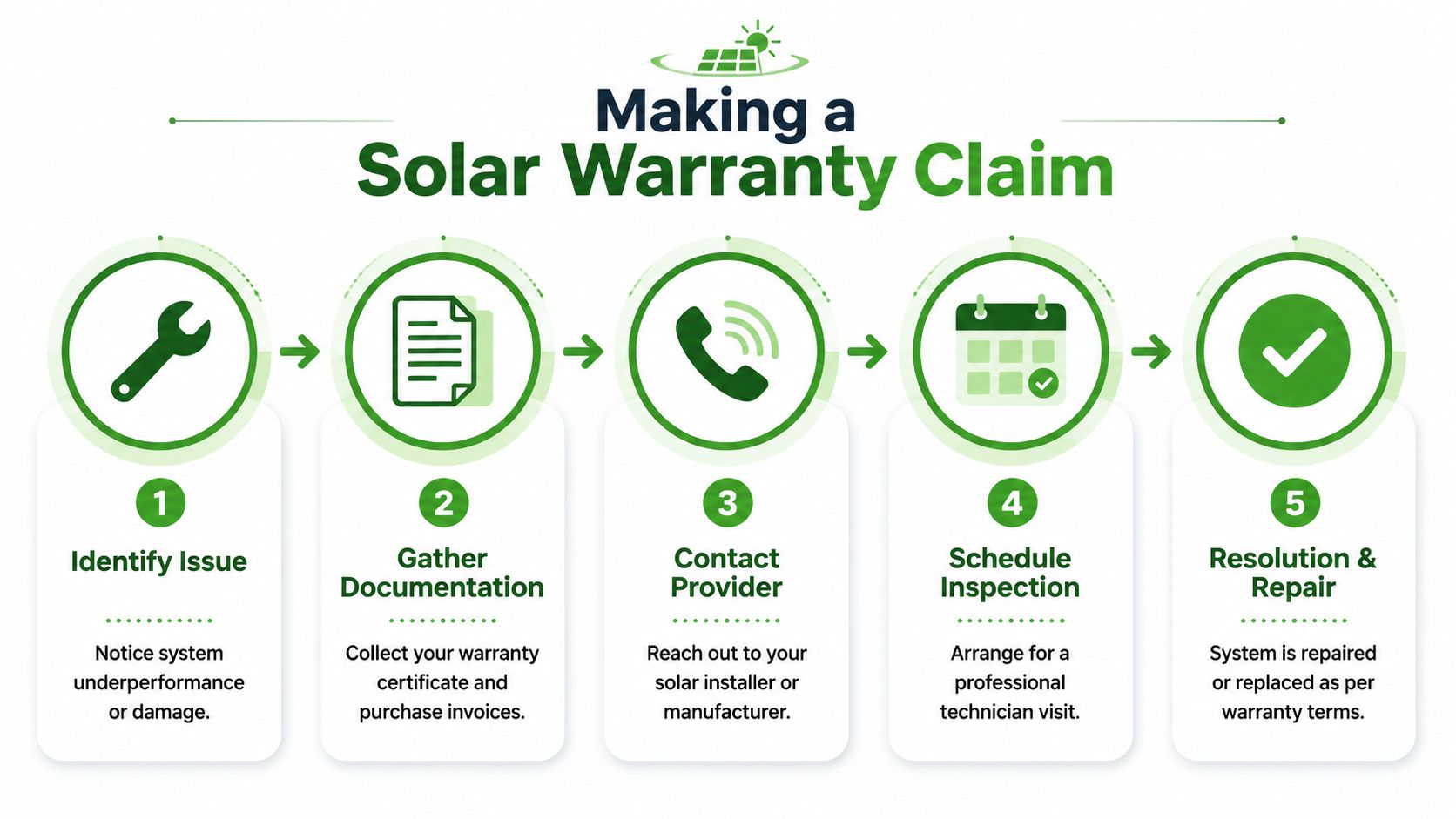
Here's a clear visual summary of the workflow:
What to insist on during the process
Keep every warranty conversation in writing after the first phone call. It prevents disputes about dates, promised actions, test results, and who accepted responsibility.
Also ask these three questions plainly:
- Is this a manufacturer issue, a workmanship issue, or both?
- Who is paying for labour, travel, and reinstallation if the product claim is approved?
- What happens if the manufacturer rejects the claim?
A reputable installer should answer those directly. If the replies stay vague, the problem is no longer just the hardware. It is the aftercare process behind it.
Questions to Ask Before You Sign Any Solar Contract
The best warranty negotiation happens before the deposit is paid.
A reputable installer won't get defensive when you ask hard questions. In fact, the way they answer tells you almost as much as the written contract does. Fast, clear answers usually mean the business has dealt with aftercare properly before. Evasive answers often mean the service side hasn't been thought through.
Ask questions that expose responsibility
Don't settle for “you're covered.” Ask these instead:
- Who is my first point of contact? If the inverter fails or the battery throws a fault, do you call the installer, the manufacturer, or a service agent?
- Who pays for labour on approved warranty work? This is one of the most overlooked questions in solar, battery, and EV charger contracts.
- What exactly counts as workmanship? Roof penetrations, isolator mounting, cable routing, labelling, switchboard work, communications setup, and commissioning should be discussed plainly.
- What happens if a manufacturer rejects the claim? You want to hear a process, not a shrug.
- Is the warranty transferable? If you sell the property, can the next owner rely on the same protections?
- Do you use your own install team or subcontractors? The answer affects accountability.
- What are your service response expectations? Not a vague promise. A practical service pathway.
Ask for proof, not reassurance
A polished quote can hide a weak delivery model. Before signing, look for the same due diligence you'd use with any licensed trade. If you want a broader framework for checking a contractor's standing, HomeProBadge contractor vetting is a sensible reference because it reinforces the basics homeowners often skip.
Then bring it back to solar-specific proof:
- Show me the workmanship warranty in writing
- Show me a sample handover pack
- Show me the commissioning and documentation process
- Show me who handles aftercare
If the installer can't produce those cleanly, the problem isn't paperwork. It's usually process.
Use battery and EV charger projects to test aftercare
Solar-only jobs are one thing. A home energy setup that includes a battery or EV charger is more complex and more service-sensitive. That's why I'd always ask who coordinates support across all installed equipment, not just the panels on the roof.
If you're comparing local providers, this is the point where you should also review their installation model and support structure, not just their advertised system list. A page like solar panel installers in Sydney is useful because it helps you gauge whether the business presents itself as a real installation partner or just a quote generator.
A good installer makes the claim path easy to explain before you buy. A poor one makes it sound simple only until you need help.
How Interactive Solar Delivers Peace of Mind
A warranty only works when the company behind it controls the installation quality and stays accessible after handover.

For homeowners who want one provider to manage solar panels, solar batteries, EV chargers, and aftercare together, Interactive Solar offers a model built around in-house installation teams, licensed electricians, and direct support rather than a sales-only handoff. The company also states a 48-hour response for troubleshooting, which gives customers a concrete expectation for the first service step.
Why that structure matters
The big practical advantage of an in-house team is accountability. When the designer, installer, and aftercare contact sit inside the same business, it's easier to trace decisions and fix mistakes. That's especially useful when a fault involves both hardware and installation choices.
A family-owned operator with its own warehouse, showroom, and local presence also gives the homeowner a more obvious place to return to if support is needed later. That doesn't replace the need to read the warranty documents carefully, but it does reduce the risk of ending up with a contract that nobody takes ownership of.
What homeowners should look for in any provider
Even if you're still comparing several installers, the benchmark should be clear:
- Direct service contact
- Licensed in-house or tightly controlled install crews
- A written workmanship warranty
- A documented handover pack
- A stated fault-response process
That combination is what turns a solar installation warranty from a marketing phrase into actual support.
Your Solar Warranty Verification Checklist
A warranty problem usually starts long before anything fails. It starts at quote stage, when the contract bundles manufacturer promises, installer promises, and service expectations into a few lines that look clearer than they really are.
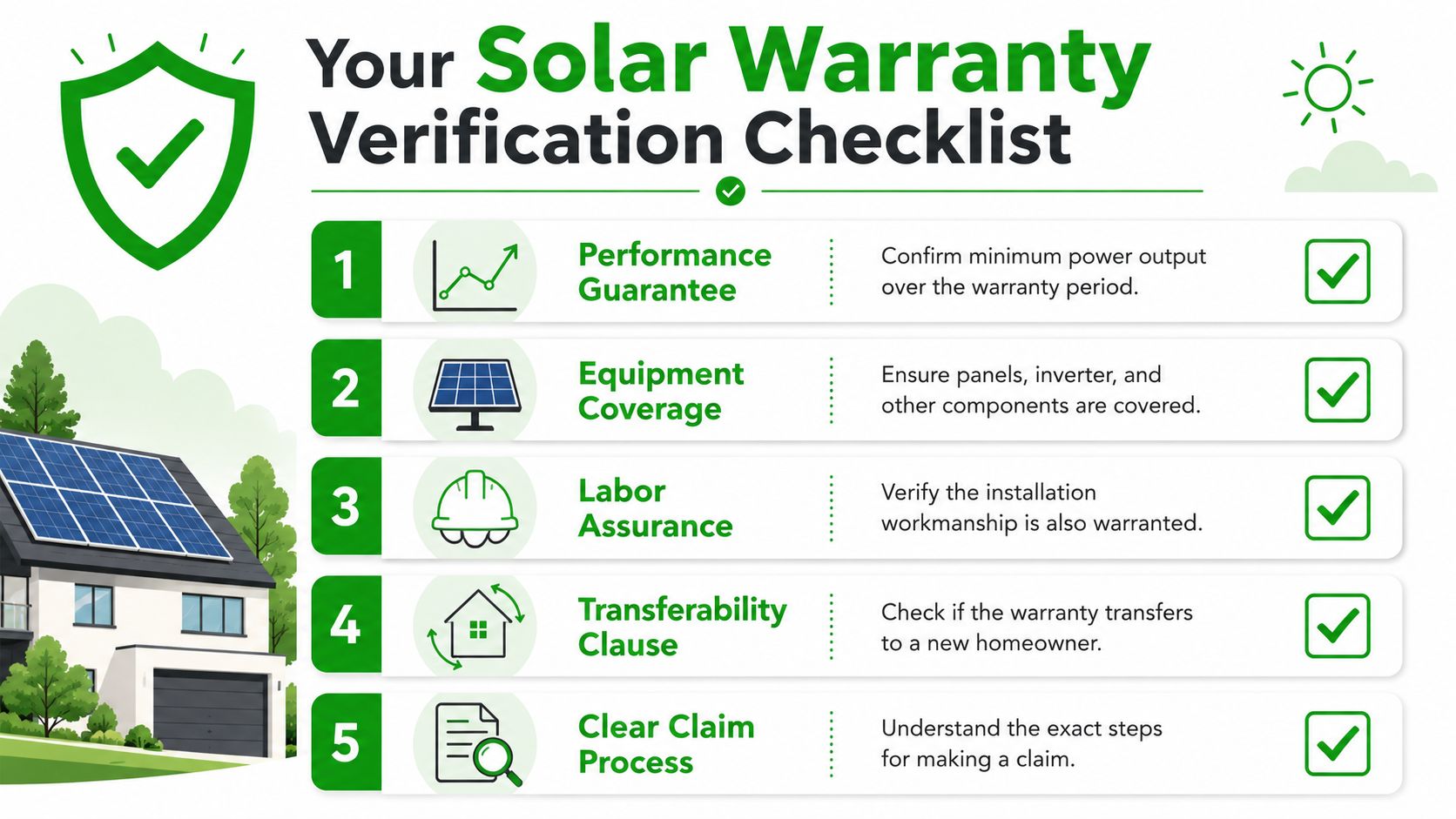
Use this checklist before you approve the install
- The workmanship warranty is written into the contract: Do not accept a vague promise that the installer will "look after you." The term should be stated clearly, along with what labour, roof penetrations, wiring, isolators, and commissioning work it covers.
- Manufacturer warranties are listed separately for each component: Panels, inverter, battery, monitoring hardware, and EV charger can all have different warranty periods and different claim paths.
- The contract explains who handles faults first: A good installer does not tell you to chase three manufacturers on your own. Ask who diagnoses the issue, who supplies replacement parts, and who pays for return visits if the fault turns out to be an install problem.
- Australian Consumer Law is not ignored: Even if a written warranty expires or a manufacturer pushes back, ACL can still apply. That matters if the system was not installed with due care and skill or does not perform as reasonably expected.
- Claim contact details are specific: You want a service email, phone number, and business address. A generic sales inbox is a warning sign.
- Handover documents are promised in writing: Ask for panel and inverter serial numbers, shutdown and startup instructions, a single-line diagram, commissioning records, and copies of the product warranties.
- Exclusions are easy to find: Look for clauses about storm damage, vermin, internet connectivity, third-party alterations, and access costs such as scaffolding or travel.
- Transferability is addressed: If you sell the home, check whether the equipment warranty and workmanship warranty transfer to the next owner, and whether any paperwork is required.
- Aftercare timeframes are stated: "Support available" means very little. A written response process is much more useful.
- The business behind the warranty is visible: Check the installer licence details, ABN, local trading history, and whether the company that sold the job is the same company responsible for service.
Final check before signing
Ask one plain question: if the inverter fails in year five, or a roof leak shows up after heavy rain, who owns the problem first?
That answer should be written down. In practice, the safest setup is simple. The manufacturer backs the product. The installer backs the installation. Australian Consumer Law helps fill the gap if either side tries to step away from a reasonable obligation.
If you want a clear explanation of how your solar, battery, or EV charger warranty would work in practice, speak with Interactive Solar and ask for the full workmanship, product, and aftercare pathway in writing before you sign.