
Boost ROI with Commercial Solar Installation Parramatta
If you're running a warehouse, office, clinic, showroom, or mixed-use site in Parramatta, you've probably had the same moment many business owners have. The bill arrives, usage looks familiar, yet the cost still jumps. You tighten operations, review lighting, remind staff about after-hours loads, and the electricity line still feels harder to control than it should.
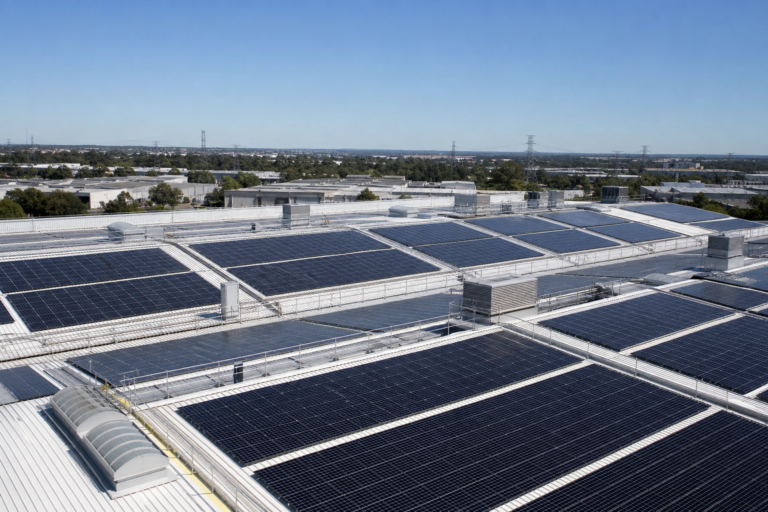
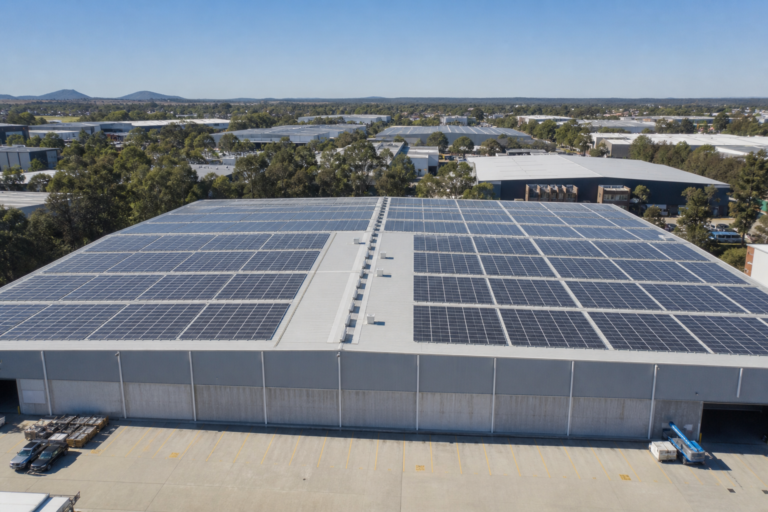
That’s usually the point where commercial solar stops being a “maybe later” idea and becomes an operational decision. In Parramatta, the businesses that benefit most are often not the giant industrial sites people picture, and not the small shops that fit a residential-style template. They sit in the middle. They have meaningful daytime demand, workable roof space, and enough complexity that a generic quote won’t do the job.
Is Your Parramatta Business Ready for Commercial Solar
The most common starting point isn’t a sustainability target. It’s frustration.
A business owner in Parramatta notices the site is busy during the day, the roof is doing nothing, and the electricity bill keeps pulling margin out of the business. For a warehouse, that might be roller doors, office air conditioning, lighting and equipment. For an office, it’s HVAC, computers, lifts, common area loads and rising daytime usage. For a medical or retail site, it’s refrigeration, fitout equipment, and a long trading day.

The businesses that hesitate are often the ones that should be looking hardest at commercial solar installation Parramatta. They’re too large for a simple residential-style approach, but not large enough to attract the sort of engineering attention enterprise projects receive. Smart Commercial Energy describes this as the “overlooked middle”, where projects are too large for residential installers yet too small for enterprise-scale resources, which creates challenges around financing, roof assessments, and utility demand charges for businesses in places like Parramatta (Smart Commercial Energy on the overlooked middle).
The signs your site is a good fit
A Parramatta business is usually ready for solar when a few practical conditions line up:
- Daytime consumption matters: Solar works best when your business uses a solid share of its power while the sun is up.
- The roof is usable: It doesn’t need to be perfect, but it does need enough clear area and a condition that justifies putting assets on it.
- You expect to stay put: The return improves when the same operator keeps the benefit over time.
- Energy costs are now a management issue: Once the bill starts affecting pricing, staffing decisions or operating confidence, the timing is right.
For businesses across Western Sydney, this is why a specific commercial process matters more than a quick online estimate. A site in Parramatta often needs the same kind of structured planning seen in broader commercial solar installation Western Sydney projects, but scaled to the realities of a small or medium enterprise.
Most poor solar outcomes don’t come from bad intent. They come from treating a commercial site like a bigger house.
The Financial Case for Solar in Your Parramatta Enterprise
A typical Parramatta business owner looks at solar after the second or third painful power bill, not after a sustainability seminar. That is usually the right trigger. For small and medium sites in this area, the financial case lives or dies on one question. Can the system offset expensive daytime consumption often enough to produce a return that holds up on paper and in practice?
For many offices, workshops, medical suites, and light warehouses in Parramatta, the answer is yes. These sites often operate through the middle of the day, pay commercial tariffs that are hard to ignore, and sit in the awkward middle market where systems need to be sized with more care than a standard residential job.
What the local numbers actually look like
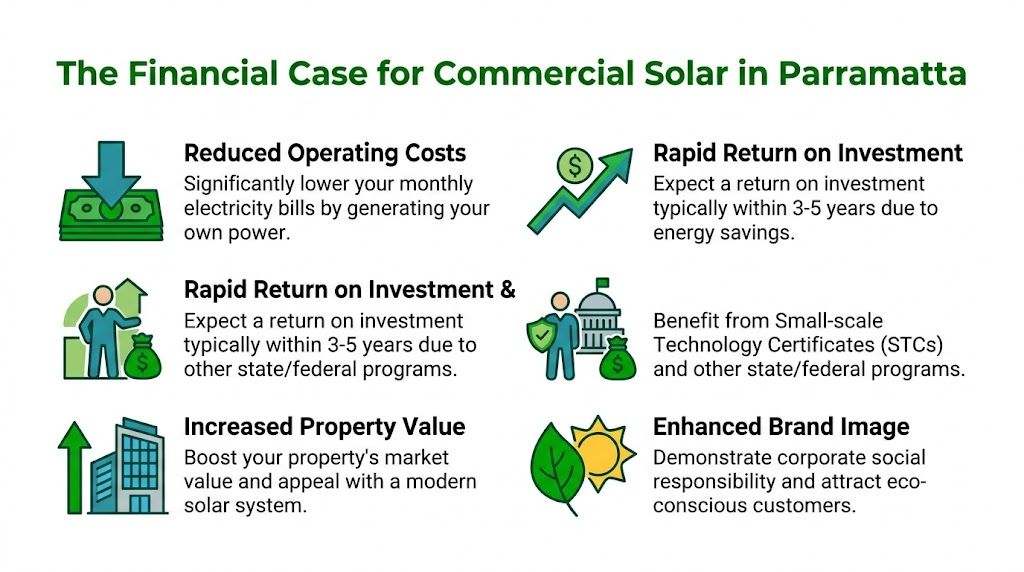
A Parramatta warehouse case gives a realistic benchmark for this size of project. A 50 kW system produced annual savings of $16,200, a 27% ROI, and a 3.6-year payback period, while showing how a suitable commercial site can reduce power costs by 40 to 60% (Parramatta warehouse ROI example).
That example matters because it sits in the range many local businesses are considering. It is not a house with a small inverter, and it is not a multi-megawatt industrial plant with a specialist energy team behind it. It is closer to the kind of office and warehouse stock found around Parramatta, Rydalmere, Silverwater, and the surrounding commercial pockets.
Where the return really comes from
The strongest solar projects in Parramatta are built around self-consumption. If your business is buying power from the grid at daytime commercial rates and using that energy as it is generated, the savings are usually straightforward to model.
Three factors drive the numbers.
First, system size has to match the load profile. A smaller system with high on-site use often performs better financially than a larger one that spills excess generation back to the grid at a modest feed-in rate.
Second, incentives need to be applied correctly from the start. STC treatment can shift the upfront cost enough to change the payback period, but only if the design assumptions are sound. Parramatta businesses comparing proposals should check current NSW solar rebates and government rebates for solar before signing off on the feasibility numbers.
Third, contract terms matter more than many owners expect. I have seen acceptable hardware underperform as an investment because the approval path, variation process, or delivery responsibilities were vague. Good construction contract management reduces that risk before it becomes a cost problem.
What changes in your cash flow
Solar does not remove your power bill. It changes the shape of it.
For a Parramatta SME, that usually means lower daytime import costs, better forecasting, and less exposure to tariff pressure during trading hours. If the business owns the property, the benefit compounds because the asset and the savings stay under the same control. If the site is leased, the project can still work well, but the lease term and landlord position need to support the payback period.
This is why I treat export income as secondary in this market segment. It helps, but it rarely carries the business case on its own. The better returns come from using your own generation on site, especially in businesses with regular weekday demand from HVAC, lighting, office equipment, refrigeration, or workshop loads.
What usually works, and what usually disappoints
| Situation | Usually works well | Usually underperforms |
|---|---|---|
| Daytime-heavy operation | Solar matched to weekday load | Oversized system designed around exports |
| Stable occupancy | Ownership or long-term finance | Short tenancy with no landlord alignment |
| Clear roof area | Site-specific design | Generic layout with little attention to usable roof zones |
| Measured energy review | Bill and interval data analysis | Sizing based on rough guesswork |
A practical test helps here. If a proposal spends more time talking about panel quantity than interval data, tariff structure, and daytime demand, it has not been built around your business.
The market is mature enough to benchmark properly
Commercial solar is no longer a fringe purchase in Australia. The Clean Energy Regulator recorded more than 4 million small-scale solar installations nationally by 30 June 2024, with installed capacity above 25 GW (Clean Energy Regulator small-scale solar data).
For a Parramatta business owner, the useful point is not popularity. It is market maturity. There is now enough project volume in the 30 to 100 kW range to compare assumptions, challenge optimistic savings claims, and separate a sound commercial investment from a system that only looks good in a sales proposal.
Your Commercial Solar Project Blueprint
A successful commercial solar installation Parramatta project is won long before the installers arrive on site. The outcome depends on assessment, sizing, and design. If any of those are rushed, the system may still be installed, but it won’t perform as well financially or operationally.
Start with the roof you actually have
The first conversation should be about the building, not the brochure.
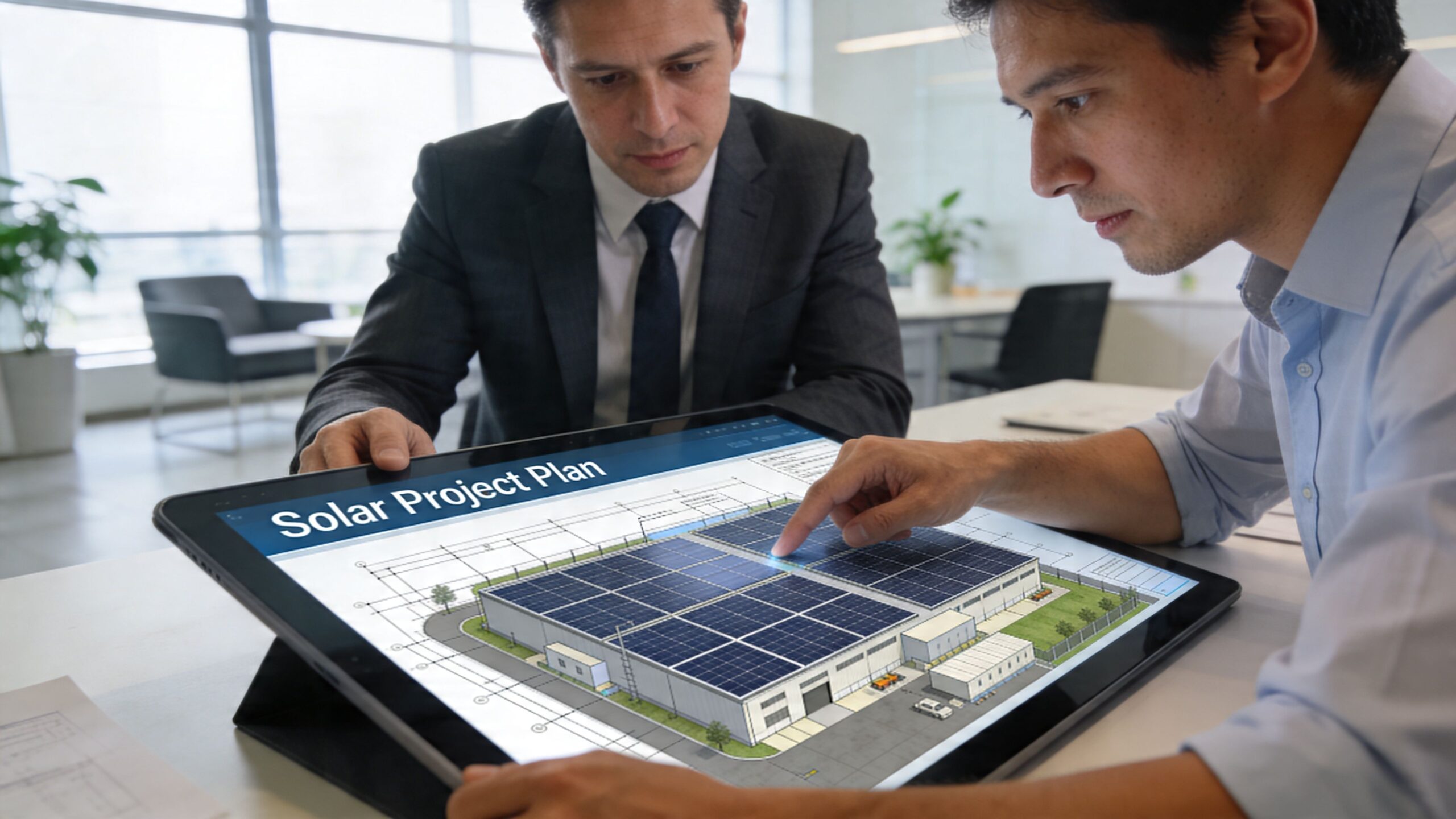
In Parramatta, many small and medium commercial sites have mixed roof conditions. Part of the roof may be excellent. Another section may be cluttered with plant, ageing penetrations, shading, or drainage constraints. A practical site review looks at usable roof area, structural suitability, access, switchboard position, and whether future maintenance crews can move safely around the array.
A best-practice engineering method for Parramatta commercial solar includes irradiance mapping for optimal layout, selecting 400 to 550W panels and 98% efficiency inverters, and applying a 0.77 derating factor so yield forecasts don’t overstate output by 23% (engineering methodology for Sydney commercial solar).
That derating point is important. A quote that ignores real-world losses can make a system look better on paper than it will ever be on the roof.
Sizing should follow your load profile
Many commercial projects often go off track here.
A warehouse with office space may have steady weekday demand and low weekend use. A gym may peak early and late. A clinic might run tightly through business hours. An office with future EV charging plans may need room for load growth. Good sizing starts with interval data, trading hours, equipment loads, and known changes ahead.
The goal isn’t maximum generation in theory. It’s useful generation when your business needs it.
Consider these common Parramatta scenarios:
- Warehouse and logistics sites: Often suit systems designed around weekday daytime operations and office support loads.
- Professional offices: Benefit when air conditioning and internal loads dominate business hours.
- Mixed-use commercial properties: Need closer attention because tenant patterns can differ across the same roof.
- Sites planning batteries or EV chargers: Should allow for future electrical integration from day one.
If your legal or facilities team handles build contracts internally, it helps to treat the solar package like any other building scope. A simple resource on construction contract management can help non-technical stakeholders organise approvals, scope control, contractor responsibilities, and sign-off points before procurement starts.
A solar quote should answer one question clearly: how does this system fit the way your site uses power from morning to close?
Design choices affect long-term performance
Once the load profile is clear, design becomes more than panel placement.
Panel layout should preserve service access, avoid obvious shading conflicts, and support maintenance over the life of the system. Inverter location matters too. It affects cable runs, heat exposure, serviceability and future expansion. On larger small-commercial sites, electrical capacity can also shape the design more than the roof itself.
The installation quality matters just as much as component selection. Businesses comparing contractors should look closely at workmanship standards, commissioning process, documentation, and who carries out the work. That’s where guidance on quality solar installations and why installation quality matters becomes relevant.
A few design trade-offs come up repeatedly:
| Design choice | Better outcome | Common mistake |
|---|---|---|
| Layout | Array designed around irradiance, access and roof obstacles | Forcing a neat-looking layout that sacrifices output or service access |
| Inverter selection | Commercial-grade unit matched to the site and expansion plans | Choosing solely on upfront quote appeal |
| Forecasting | Conservative modelling using realistic losses | Optimistic generation assumptions |
| Future-proofing | Allowing for batteries, EV charging or tenancy change | Designing a dead-end system with no room to evolve |
Here’s a useful visual overview of commercial solar planning and installation considerations:
The best blueprint is practical, not theoretical
A sound design respects the roof, the switchboard, access rules, operating hours, and business continuity.
Interactive Solar provides turnkey commercial systems with in-house installation teams, which is one model that suits businesses wanting design, installation and after-care handled through one provider. That structure is often useful for small and medium sites where coordination gaps can create delays or defects.
The winning blueprint is usually the one that looks slightly less exciting in a sales meeting and performs better over years of operation.
Navigating Permits and Local Requirements in Parramatta
For many Parramatta business owners, approvals feel harder than the solar decision itself. That’s understandable. Commercial projects sit in a more complex lane than residential jobs because council considerations, electrical compliance, landlord approvals, and distributor requirements can all overlap.
The easiest mistake is to treat permits as paperwork that happens after the quote is accepted. On commercial sites, approvals affect layout, programme, and even system size.
Council considerations before the install date
Whether a project needs council involvement depends on the building, the precinct, the visibility of the installation, and any planning controls affecting the site. A standard industrial or office roof may be straightforward. A building with heritage sensitivities, visible streetscape impact, unusual roof form, or strata-like governance can take more coordination.
In practice, the early questions are:
- Does the building owner approve the works?
- Will the installation alter the building externally in a way that needs planning review?
- Are there heritage or precinct controls affecting the property?
- Does roof access meet safety expectations for installation and future maintenance?
For larger or more complex sites, owners often review examples from broader industrial solar installation Sydney projects because those jobs tend to involve stricter site logistics and more formal approval pathways.
Grid connection is not a formality
The local network approval process matters because the system must be accepted for connection and export on the site’s existing electrical setup.
On commercial projects, this often means the installer or designer needs to confirm switchboard details, protection requirements, metering implications, and whether the proposed export arrangement is realistic for the property. Some sites are straightforward. Others need a more careful connection strategy, particularly where the electrical infrastructure is older or the business expects future battery integration.
A practical grid-approval checklist usually includes:
- Existing electrical capacity: Old boards or limited spare capacity can change the scope.
- Export expectations: Don’t assume the network will accept the export profile you’d prefer.
- Metering coordination: Changes may be needed before the system can be fully commissioned.
- Landlord and tenant sign-off: On leased sites, connection paperwork often needs both operational and legal approval.
Get approval questions moving early. Grid paperwork rarely improves by being left until materials are already ordered.
Local experience saves time
A contractor who understands Parramatta commercial sites will usually flag the approval pinch points before they become delays. That doesn’t just save time. It prevents redesign, re-documentation, and awkward conversations after internal budgets have been approved.
The cleanest projects are the ones where design, council considerations, landlord permissions and network application are all lined up before anyone books an installation crew.
Financing Your System and Maximising Incentives
A lot of Parramatta businesses get the technical side right and still stall at approval stage because the finance case is weak. On small to medium commercial jobs, the structure matters almost as much as the system size. A 30 kW office install and a 99 kW warehouse install can both stack up well, but they do not belong in the same funding conversation.
Most businesses I deal with are weighing three options. Buy the system outright, fund it through a business finance product such as a chattel mortgage, or use a PPA-style arrangement where a third party owns the asset and sells you the energy.
Ownership versus cash flow
Outright purchase usually produces the strongest long-term return because your business keeps the full value of the bill savings and the asset sits under your control from day one. It often suits owner-occupiers, businesses with healthy cash reserves, and companies planning to stay in the property for years.
Financed ownership works well where cash flow discipline matters more than minimising total project cost. The numbers can still be attractive, but only if the repayment profile matches the site’s actual savings pattern. For example, a Parramatta warehouse with steady weekday load will usually support finance more comfortably than an office that is half-empty on Fridays and quiet over holiday periods.
A PPA-style model can suit tenants, groups preserving capital for core operations, or businesses that want lower power costs without owning plant on the roof. The trade-off is contractual. You need to check price escalators, access rights, maintenance responsibility, lease alignment, and what happens if the site is sold or vacated early.
| Finance path | Best fit | Main trade-off |
|---|---|---|
| Outright purchase | Businesses wanting full control and long-term ownership | Highest upfront capital commitment |
| Financed ownership | Businesses protecting cash flow while building an asset | Repayment structure must be matched carefully |
| PPA-style arrangement | Businesses prioritising operational savings over asset ownership | Less control and more contract complexity |
Incentives need to be visible in the numbers
If incentives are not shown clearly in the proposal, it becomes harder for directors, finance teams, and landlords to approve the job with confidence.
For most Parramatta SME projects, the main value still comes from Small-scale Technology Certificates on eligible systems. On larger systems, the treatment is different and the quote needs to show exactly how that value has been applied. I prefer to see incentives listed as a separate line item rather than buried inside a headline system price. It makes comparisons cleaner and stops awkward disputes later.
Market maturity helps buyers, but it does not remove the need to check assumptions. A competitive solar market gives you more choice in equipment and funding structures. It also means quote quality varies a lot. Two proposals can show similar payback periods while using very different assumptions on tariff inflation, self-consumption, export revenue, and maintenance allowances.
Batteries should be priced at the same time, even if you wait
A battery is not automatic for every commercial site in Parramatta. Many offices still get better returns by sizing solar properly first. But if your business uses power into the evening, pays high demand charges, wants some backup capability, or expects EV charging to be added later, battery planning should happen during feasibility, not after the solar system is installed.
That does not always mean buying the battery now.
It means checking wall space, switchboard capacity, inverter compatibility, control strategy, and whether future battery funding could improve the business case. For businesses comparing timing, recent updates on the NSW battery rebate and what it means for system planning are worth reviewing before you lock in the final design.
What to ask before signing
The strongest finance discussions answer property, tax, and operations questions together.
Ask for clear written answers on:
- Who owns the system at each stage of the agreement
- How incentives have been calculated and applied
- What usage assumptions sit behind the savings forecast
- Whether repayments line up with expected seasonal savings
- What happens if the lease changes, the site is sold, or the business relocates
- Whether battery storage or EV charging can be added later without restructuring the whole deal
- Who carries maintenance, monitoring, and inverter replacement risk over the term
The best finance structure is the one that fits how your business uses electricity, how long you expect to stay at the site, and how your management team measures return on capital. On Parramatta SME sites, that practical fit usually matters more than chasing the cheapest headline price.
From Installation to Operation What to Expect
Once the contract is signed, the project stops being a concept and becomes a live workstream. That’s where expectations matter. A well-run commercial solar job should feel organised, not chaotic.
The process usually moves through procurement, scheduling, site preparation, installation, electrical works, commissioning and handover. What changes from site to site is the amount of coordination needed around access, roof safety, trading hours, and switchboard shutdown requirements.
Before the crew arrives
Most of the serious work happens before the first panel is lifted.
Materials are confirmed against the approved design. Delivery access is checked. Roof access and safety controls are finalised. If the business operates during installation, the sequencing should minimise disruption to staff, customers and tenants.
For owner-occupiers, this stage is often straightforward. On tenanted or multi-stakeholder sites, it’s where communication makes the difference between a smooth install and an avoidable argument.
What installation days usually involve
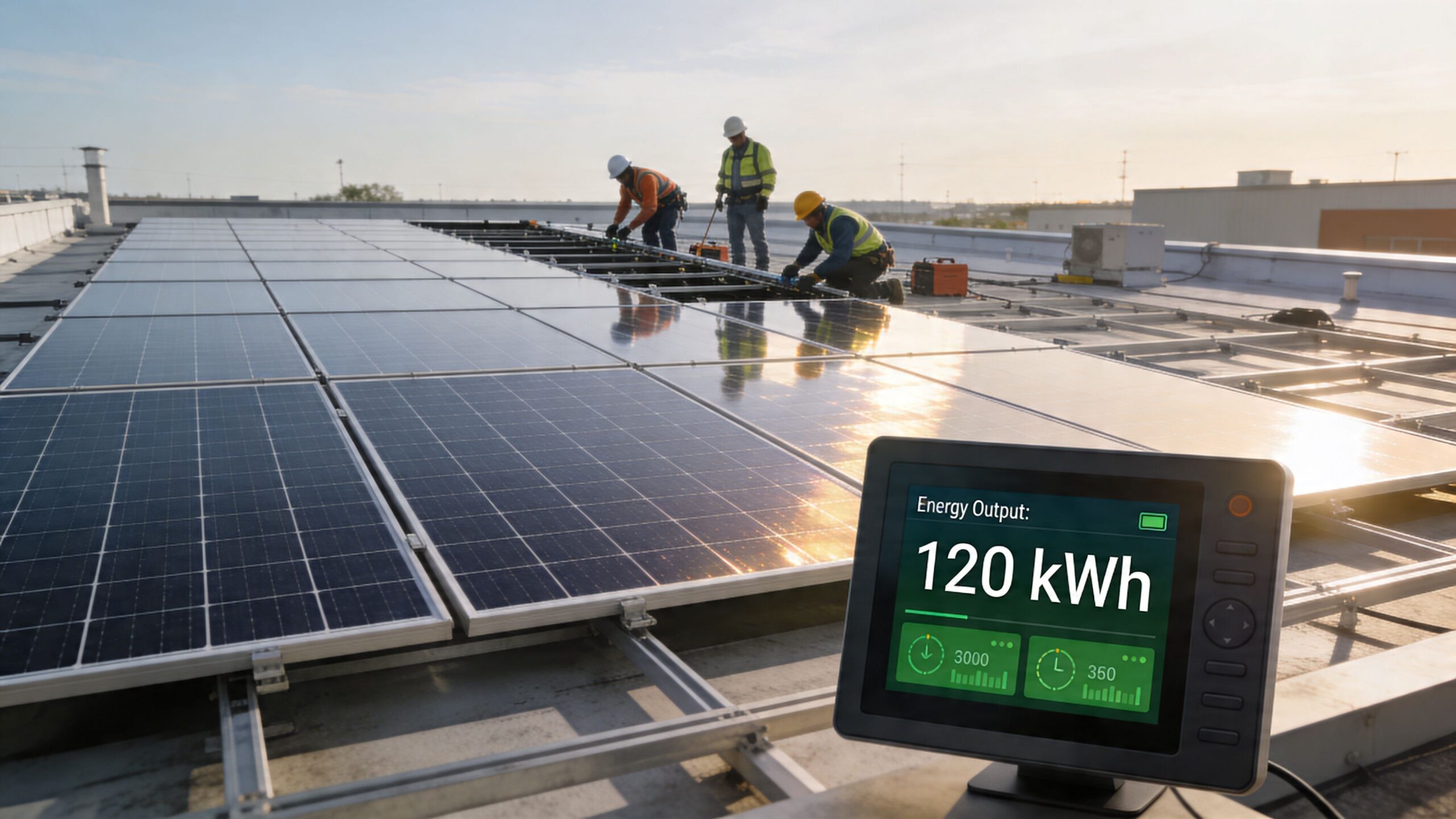
The visible phase includes panel mounting, DC cabling, inverter installation, electrical integration, labelling, and safety checks. On a commercial site, access planning matters as much as technical execution. Crews need room to work safely without interfering with deliveries, forklifts, staff parking, or customer movement.
The best commercial teams also protect the future maintenance path. A neat install isn’t enough. The array needs to remain serviceable for years.
During this phase, expect attention to:
- Roof safety and access control
- Weather and roof condition management
- Electrical shutdown coordination where required
- Separation between work zones and business operations
- As-built documentation for handover
Commissioning is where quality shows
Commissioning is not just “turning it on”. It’s the point where the installed system is tested, verified, and prepared for normal operation.
That includes confirming the system is performing as designed, the monitoring platform is working, safety and compliance checks are complete, and the client understands the basic operating logic. If something is unclear at handover, it tends to become a support issue later.
A commercial system should leave handover with three things in place: clear documentation, live monitoring, and a maintenance path the client actually understands.
What happens after energisation
Many business owners underestimate the difference between systems that perform well and systems that drift.
According to Energy Matters, successful commercial solar projects can see ROI in 3 to 6 years and achieve 82% energy cost reductions, but those outcomes depend on avoiding issues such as mismatched energy profiles. The same source notes that post-installation monitoring and maintenance are critical to keeping the system productive over its 20+ year lifespan (commercial solar performance and maintenance guidance).
That reflects what happens in practice. Monitoring catches faults, underperformance, inverter issues and unusual usage changes early. Maintenance keeps the asset working as intended. Neither should be treated as optional.
Batteries and ongoing operations
For some Parramatta businesses, the first phase is solar only. For others, battery planning should be built in from the start.
A battery can help where the business wants to store daytime generation for later use, reduce reliance on grid power during critical periods, or improve resilience during interruptions. It doesn’t automatically suit every site, but where continuity matters, it deserves a serious operational review rather than an afterthought.
A commercial solar system should be treated like productive infrastructure. Once it’s installed, the job isn’t finished. It has entered service.
Your Local Checklist for a Successful Installation
The businesses that get strong results from commercial solar installation Parramatta usually make a series of calm, disciplined decisions. They don’t chase the flashiest proposal. They clear the practical hurdles early and make sure the project fits the site.
Use this checklist before you approve a system.
Check the business case properly
- Review actual usage: Look at how the site consumes power during business hours, not just total spend.
- Test the occupancy horizon: Solar works best when the business or owner expects to benefit from the asset over time.
- Challenge the forecast: Ask whether output assumptions reflect roof constraints and real operating conditions.
Test the building, not just the quote
- Confirm roof suitability: A promising bill doesn’t fix a poor roof, difficult access, or unresolved structural concerns.
- Check electrical readiness: Board condition, spare capacity and site layout can shape the entire project.
- Keep future loads in view: If EV charging, refrigeration changes, tenancy shifts or batteries are likely, allow for them now.
Get approvals and safety lined up early
- Clarify landlord and stakeholder permissions: Delays often come from internal property approvals rather than solar hardware.
- Treat compliance as part of design: Council, network and access requirements influence what should be built.
- Review site safety holistically: Before works begin, broader operational safety matters too. A practical resource like this workplace fire safety checklist can help facilities teams review emergency readiness alongside electrical upgrades and rooftop works.
Choose the provider on process, not pitch
- Ask who installs the system: Subcontract-heavy delivery can work, but roles and accountability need to be clear.
- Inspect the handover standard: Monitoring, documentation and maintenance planning should be visible before signing.
- Look for commercial reasoning: A credible proposal explains load profile, layout logic, and approval pathway in plain language.
The right project should feel commercially sensible at every stage. The savings matter, but so do access plans, ownership structure, permit handling, and after-care. If any of those are vague, keep asking questions.
A good installer won’t try to push you past the detail. They’ll use the detail to make the project stronger.
If you're weighing up a commercial solar project in Parramatta and want a clear view of site suitability, approvals, system design, batteries, or EV charging integration, speak with Interactive Solar. A proper consultation should leave you with a realistic pathway, not just a sales estimate.
Make Interactive Solar a preferred source in Google
One click tells Google to surface our articles more often in Top Stories, AI Overviews and AI Mode.