Decoding Electric Car Charger Installation Cost in Sydney
So, you’re trying to pin down the electric car charger installation cost in Sydney. Let's get right to it. There's no single price tag, but the best way to think about it is as a complete project, not just a product you buy off the shelf.
Your Guide to Home EV Charger Installation Costs
Switching to an EV is a fantastic move for cheaper, cleaner driving. But that dream of waking up to a full battery every morning hinges on one thing: a professionally installed home charger. The total cost isn't just the box on the wall; it’s the combination of the charger itself and the skilled work required to bring it to life safely.
Just like any trade work at your house, the final bill depends entirely on the job's complexity. A straightforward install in a modern garage with a new switchboard is a world away from a tricky setup that needs major electrical upgrades.
What to Expect for Your Installation
To budget properly, you need to see this as a small-scale electrical project, not just an appliance purchase. The final invoice reflects the charger unit, yes, but more importantly, it covers the licensed electrician's expertise, all the necessary materials, and the compliance checks that ensure it works perfectly for years to come.
Several key things will shape your total cost:
- The Charger Hardware: The price of the unit itself varies a lot. It depends on the brand, power output (7kW vs. 22kW), and whether it has smart features like app control or solar integration. You can check out a range of quality EV chargers to get a feel for the options.
- Professional Labour: This is the electrician's time for the site check, the actual installation, and final testing. You can't cut corners here—their expertise is crucial for safety and meeting NSW standards.
- Electrical Upgrades: A lot of homes, especially older ones across NSW, will need a switchboard upgrade to handle the extra electrical load. This can be a major part of the budget.
- Installation Complexity: How far is your switchboard from your car park? Does the cable need to run through a trench? Are you in an apartment with strata rules? All these factors add to the labour and material costs.
Getting a detailed, itemised quote from a qualified installer is the only way to know for sure what the investment will look like for your specific property.
The installation work itself is often the biggest slice of the pie. It's the critical service that ensures your charger is safe, compliant with NSW rules, and ready to perform reliably, day in and day out.
This isn’t just our opinion; it’s a reality across Australia. The cost of labour and high-quality materials can make up a huge chunk of the total project. For anyone in NSW, this makes getting detailed, itemised quotes an absolute must.
In fact, professional installation work can sometimes account for a significant portion of the total project expense. By the time you finish this guide, you’ll have everything you need to budget for your home EV charger with total confidence.
Deconstructing the Costs: What Are You Actually Paying For?
Think about getting a new kitchen installed. You’re not just paying for the oven and benchtops; you’re paying for the cabinet maker's skill, the plumber's expertise, and the electrician's compliance checks to make sure it’s all safe and built to last. It’s the same story with an electric car charger installation cost. The final price on the quote is a sum of several essential parts, not just the charger you see on the wall.
To set a realistic budget, you need to know exactly what’s going into the job. Your total investment is split between two main things: the charger hardware itself, and the professional installation, which covers all the labour, materials, and crucial safety paperwork.
This breakdown shows how the total investment is divided.
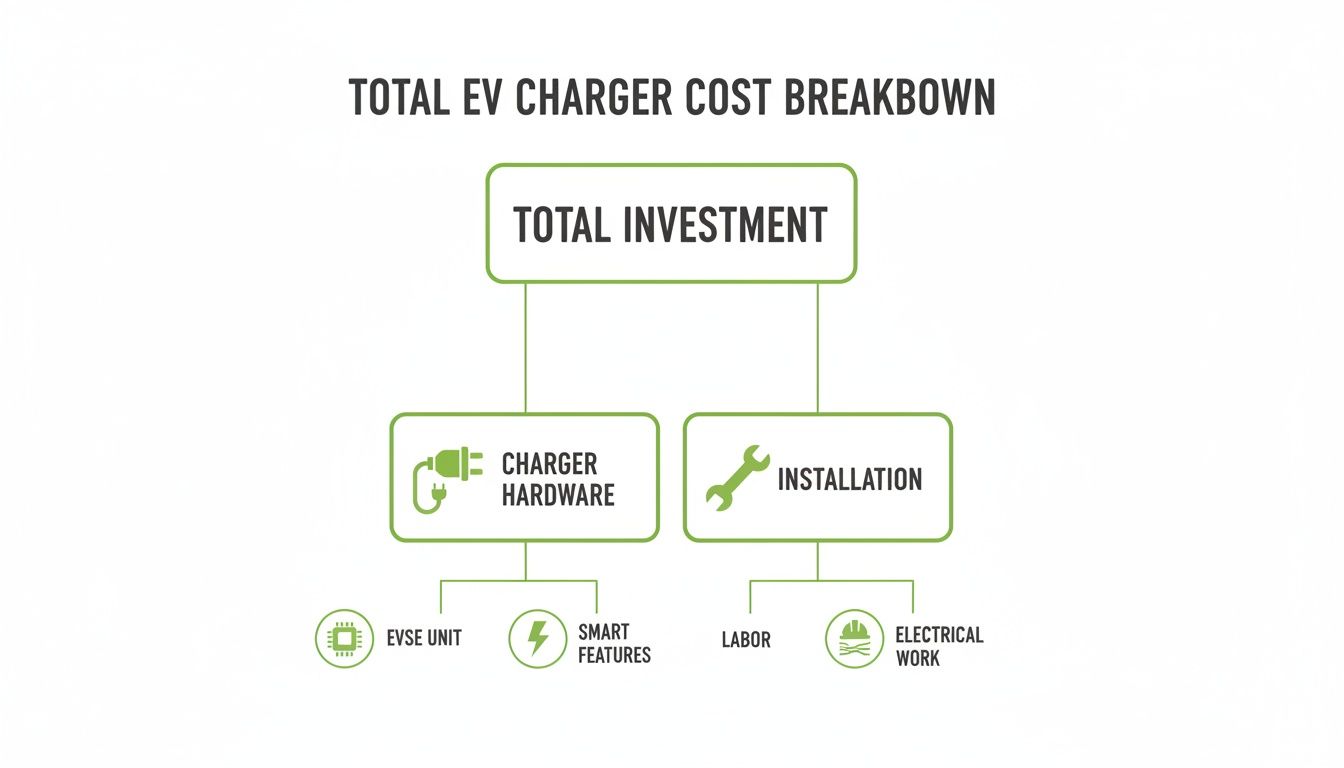
As you can see, a successful and safe installation hinges on both getting the right gear and hiring a skilled installer to connect it all properly. Let’s pull these two components apart.
The Charger Hardware
First up is the charging unit itself—the physical box your electrician will mount in your garage or on an outside wall. This isn't a "one size fits all" purchase. The hardware you pick directly impacts how you charge every day and makes up a big chunk of the project budget.
The main differences come down to a few key choices:
- Standard vs. Smart Chargers: A basic, or "dumb," charger does one job: it sends power to your car. A smart charger, on the other hand, connects to your home Wi-Fi. This lets you schedule charging for off-peak power rates, track your energy use on an app, and even link up with your solar panels.
- Power Output: Most home chargers are Level 2 AC units. The real choice is between a 7kW single-phase charger, which is perfect for most homes, or a more powerful 22kW three-phase unit. Which one you can get depends entirely on your home's power supply and how quickly you need to add range.
- Brand and Build Quality: It pays to go with a reputable brand. They tend to invest more in durable materials and weatherproofing (which is a must for outdoor units) and offer better warranties, giving you confidence the unit will last.
The Professional Installation Service
This is the most important part of the equation, and it’s where a good portion of your money goes. The service covers much more than just drilling a few holes and hanging the charger on the wall. A licensed electrician performs a whole series of critical tasks to ensure your system is safe, efficient, and meets all NSW electrical regulations.
This work really breaks down into skilled labour and the essential materials needed to get the job done right.
Skilled Labour
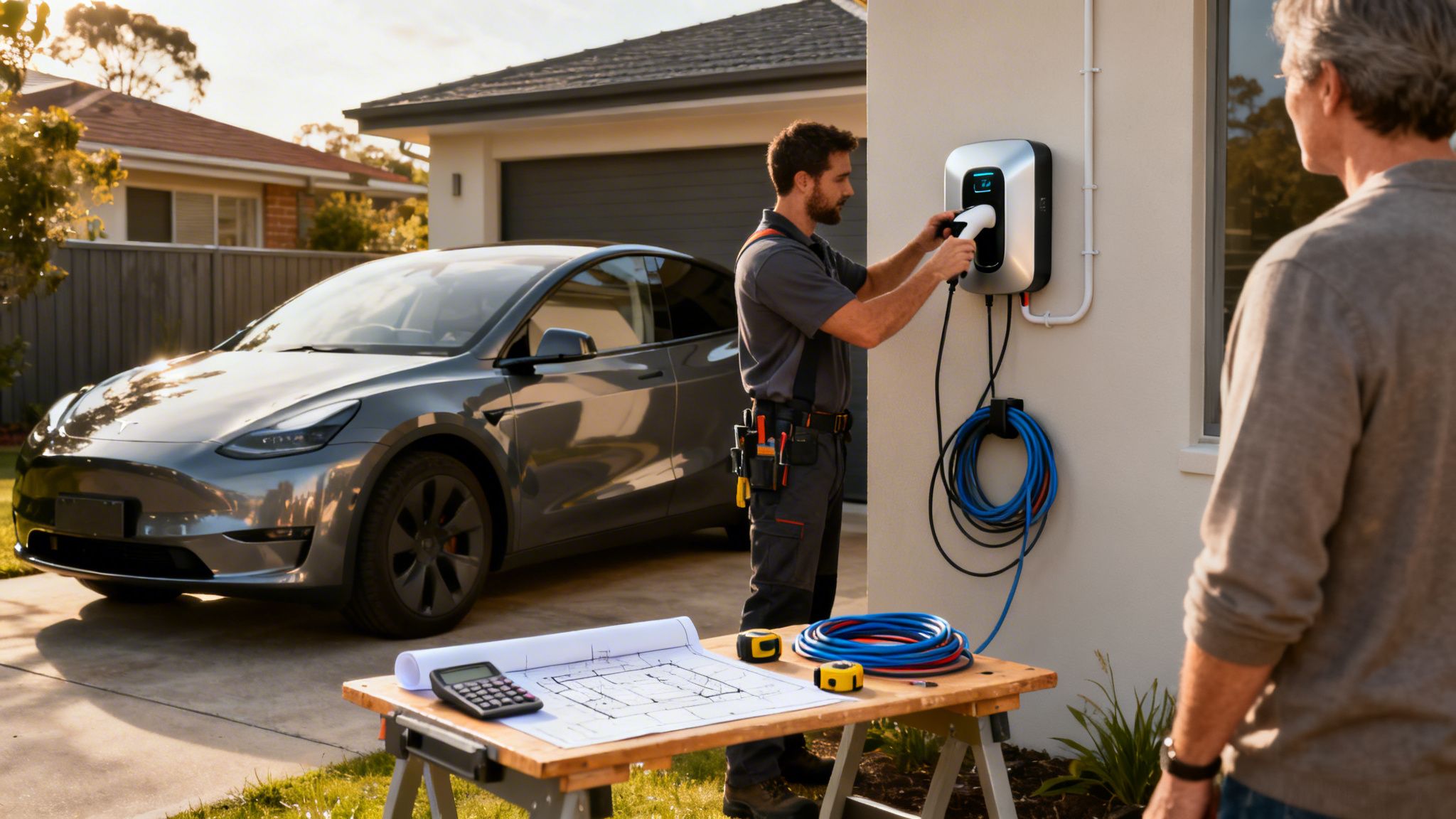
When you hire a qualified sparkie, you're paying for their expertise, time, and insurance. The hands-on work for a standard installation includes:
- Initial Site Assessment: An electrician comes out to inspect your switchboard, existing wiring, and where you want the charger to go. This is how they figure out the exact scope of the job.
- System Design: They'll map out the safest and most efficient path for the cable to run from your switchboard to the charger's location.
- Electrical Work: This is the core of the job. It involves installing a brand-new, dedicated circuit just for the charger, complete with its own safety switch (RCBO) to protect your home's wiring and your car.
- Installation and Commissioning: Finally, they’ll securely mount the unit, connect all the wiring, and run a series of tests to make sure everything is working correctly and safely.
Essential Materials and Compliance
On top of the charger itself, every installation requires a list of electrical components to connect it all safely. These aren’t optional extras; they are non-negotiable for a safe and compliant job.
Your final invoice will include the supply of high-quality cables, conduits to protect the wiring, circuit breakers, and other hardware necessary to meet strict Australian Electrical Standards.
A crucial piece of the puzzle is the Certificate of Compliance for Electrical Work (CCEW). In NSW, this is a legal document your electrician must issue when the job is done. It's your proof that the work is safe and up to code. Without this certificate, your installation isn't legally compliant, which can cause major headaches with your home insurance or car warranty. A pro will always provide one, no questions asked.
The complexity of these factors—from your home's power system to whether cabling needs to be run through trenches—is exactly why a professional on-site assessment is so vital. You can get a deeper understanding of how these variables affect the final price by looking at detailed cost guides. The cost to install an EV charger in Australia varies significantly based on whether a home has single-phase or three-phase power, with cable length and potential switchboard upgrades adding even more to the mix.
Charger Levels and How They Impact Your Budget
Choosing an EV charger is a bit like picking the right tool for the job. You wouldn't use a tack hammer to break up concrete, right? The charger's "level" is a direct measure of its power, speed, and, most importantly, its impact on the final electric car charger installation cost. Getting your head around these tiers is the first step to picking a setup that suits your daily drive and your wallet.
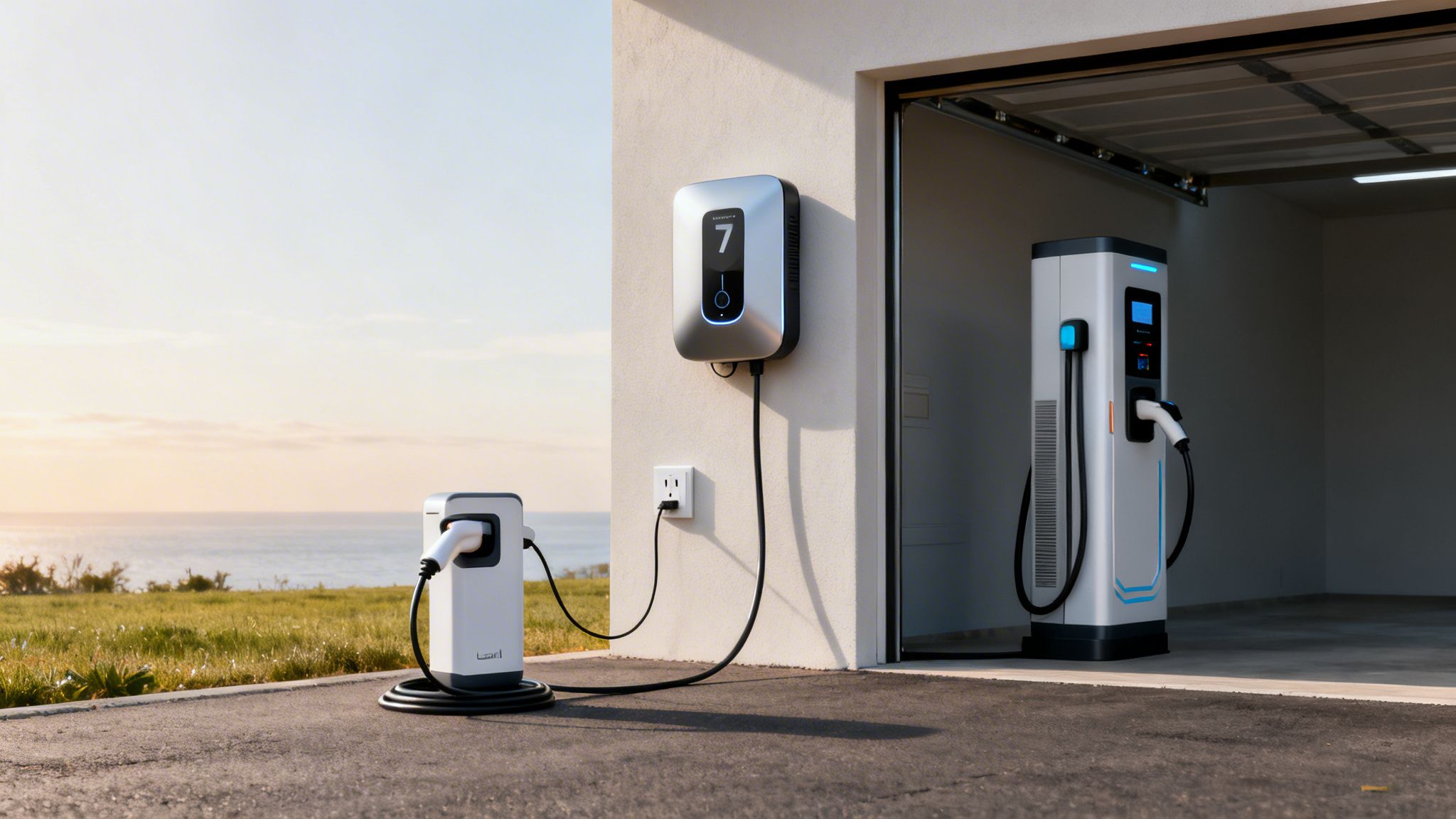
Think of it this way: your car probably came with a Level 1 charger. This is the one that plugs into a standard wall socket. It’s like trying to fill a swimming pool with a garden hose. It gets the job done eventually, but it's painfully slow. Fine for a small top-up in a pinch, but totally impractical if you need to add serious range every day.
This is why almost every home installation moves up to the next level.
Level 2 AC Chargers: The Home Sweet Spot
A Level 2 AC charger is the undisputed gold standard for home charging. Sticking with our pool analogy, this is like getting a dedicated, high-flow tap installed right beside it. It hits that perfect sweet spot between charging speed and installation cost, making it the go-to choice for homeowners in Sydney and across NSW.
These chargers need a dedicated 240V circuit, much like a big appliance like an oven or clothes dryer. A qualified electrician has to install it, but that professional job is what delivers a much faster, safer charge.
For homes, Level 2 chargers generally come in two flavours:
- 7kW Single-Phase Chargers: This is the crowd favourite for Australian homes. It's powerful enough to fully charge most EVs overnight and works with the standard single-phase power supply found in the vast majority of houses.
- 22kW Three-Phase Chargers: This is the beefier option, but it’s only for properties that already have a three-phase power supply. While the charging is significantly faster, the installation is more involved and usually only makes sense for homes with massive electrical needs or for drivers who truly need that rapid-fire speed.
For most people, a 7kW unit is more than enough for daily driving, adding around 40-50 kilometres of range for every hour it's plugged in. The right choice often depends on your home's unique wiring, and you can dive deeper into the options with our guide to find the best home EV charger for your specific situation.
Level 3 DC Chargers: The Commercial Powerhouses
So what about those lightning-fast chargers you see at public stations on the highway? Those are Level 3 DC fast chargers, and they are the petrol stations of the EV world. They can pump hundreds of kilometres of range into a battery in under an hour, but they operate on a completely different level.
These units are incredibly power-hungry, drawing between 400V to 1,000V, and require a direct, heavy-duty connection to the high-voltage grid. This makes them a purely commercial-grade solution and financially out of reach for a standard residential installation.
For a homeowner, the financial and logistical jump from a Level 2 to a Level 3 charger is massive. The sheer cost of the hardware and the required electrical infrastructure firmly plants DC fast chargers in the commercial sphere, cementing the Level 2 charger's place as the champion for home use.
The investment required for Level 3 chargers is not comparable to a residential project. For a homeowner in NSW, getting a complete, turnkey Level 2 charger installation is a manageable project. It's a significant upgrade over a standard power point but remains worlds away from the cost of its commercial-grade cousins.
This tiered system works well. It means public infrastructure can keep getting more powerful for long trips, while homeowners have an affordable and effective solution that perfectly handles the day-to-day grind.
Common Installation Scenarios and Potential Costs
So, you’ve asked a few electricians for a quote and received wildly different numbers. Why is the electric car charger installation cost so variable? It almost always comes down to the unique layout of your home.
Every property tells a different story. The distance from your switchboard to your car, the age of your electricals, and the path the cable needs to take are the biggest factors driving the final price. By understanding a few common scenarios, you’ll be able to spot which one matches your home and know exactly what to ask your installer. No more nasty surprises.
The Simple Garage Install
This is the best-case scenario. It’s the most straightforward and cost-effective job an electrician can do. In this situation, your switchboard is conveniently located inside or right next to your garage—exactly where you plan to park your EV.
This setup is ideal because it keeps the two biggest cost drivers—labour and materials—to a bare minimum.
- Short Cable Run: The electrician only needs to run a short length of specialised armoured cable from the switchboard to your new charger.
- Minimal Disruption: There’s no need to cut through walls or dig trenches. The cable can usually be mounted neatly along the surface of a garage wall.
- Modern Switchboard: This scenario assumes your switchboard is up-to-date and has enough space for the new dedicated circuit and safety switch your charger requires by law.
If this sounds like your place, you’re in luck. Your installation will almost certainly be on the lower end of the cost spectrum and be finished in just a few hours.
The Long-Distance Cable Run
Now, let's look at a different setup. Your switchboard is at the front of the house, but your carport is all the way out the back. This is what we call "The Long-Distance Cable Run," and it’s where things get more involved.
The main challenge here is the distance itself. To prevent "voltage drop" and ensure your charger gets the full power it needs to work properly, the electrician has to use a much longer and thicker-gauge cable. This immediately increases both the cost of materials and the labour hours needed to run that cable safely across your property.
Of course, there are plenty of variables that can influence your final installation cost. A professional assessment is the only way to know for sure, but here are some of the most common factors we see.
Factors That Influence Your Final Installation Cost
| Cost Factor | Potential Impact on Cost | What to Look For |
|---|---|---|
| Cable Length & Route | High | The further the charger is from the switchboard, the more expensive the cable and labour. A simple surface-mounted run is cheapest. |
| Switchboard Condition | High | An old, full, or non-compliant switchboard will require a costly but essential upgrade before a charger can be safely installed. |
| Groundworks (Trenching) | Medium to High | If the cable must be buried to cross a garden or driveway, trenching adds significant labour and cost. |
| Power Phase | Medium | Most homes have single-phase power (fine for 7kW chargers). Utilising three-phase for a 22kW charger is more complex. |
| Wall/Ceiling Penetrations | Low to Medium | Drilling through brick, concrete, or multiple walls takes more time and specialised tools than running cable through a simple cavity. |
| Strata/Apartment Rules | Variable | Strata approval can add administrative time and may have specific requirements (e.g., load management systems) that add to the cost. |
Understanding these variables helps you have a more informed conversation with your electrician and better interpret the quotes you receive.
The Dreaded Switchboard Upgrade
This is a plot twist we see all the time, especially in older Sydney homes. You’re all set to get your charger installed, but the electrician takes one look at your switchboard and delivers the bad news: it’s not up to the task. It’s crucial to understand this isn't an upsell; it's a critical safety issue.
An outdated switchboard is the number one reason for a higher-than-expected installation cost. It's an essential safety upgrade that protects your home, your car, and your family from electrical hazards.
Older electrical panels often lack the capacity to handle the continuous high draw of an EV charger. They might be missing modern safety switches (RCDs) or simply have no physical space for the new circuit your charger legally needs. A switchboard upgrade is a significant job, but it's a non-negotiable step for a safe, compliant installation.
Navigating Other Common Hurdles
Beyond those main scenarios, a few other factors can add layers of complexity. For instance, if you're thinking about how a charger fits into your home's total energy picture, our battery comparison guide is a great resource for seeing how energy storage can work with both solar and EV charging.
Other challenges that can pop up include:
- Trenching for Buried Cables: If your charger is going into a detached garage or an open carport, the cable will likely need to be buried in a trench. This is done for safety and aesthetics, but it adds significant labour costs.
- Strata Approvals: Living in an apartment, unit, or townhouse? You’ll have to navigate your strata's bylaws and get formal approval, which can add time and sometimes specific technical requirements to the project.
- Single-Phase vs. Three-Phase Power: The vast majority of Australian homes have single-phase power, which is perfect for a standard 7kW charger. If you’re lucky enough to have three-phase power and want a much faster 22kW charger, the installation is more complex and the cost will reflect that.
By figuring out which of these situations most closely matches yours, you’ll be in a much stronger position to discuss the electric car charger installation cost with a professional and understand exactly what your quote covers.
Future-Proof Your Investment with Smart Charging and Solar
Think of your new EV charger as more than just a plug on the wall. It’s the brains of your home’s energy future. Once you’ve sorted the basics of the installation, it’s time to think about long-term value and how to make that investment pay you back. This is where a charger stops being a simple appliance and becomes the key to genuine energy independence.
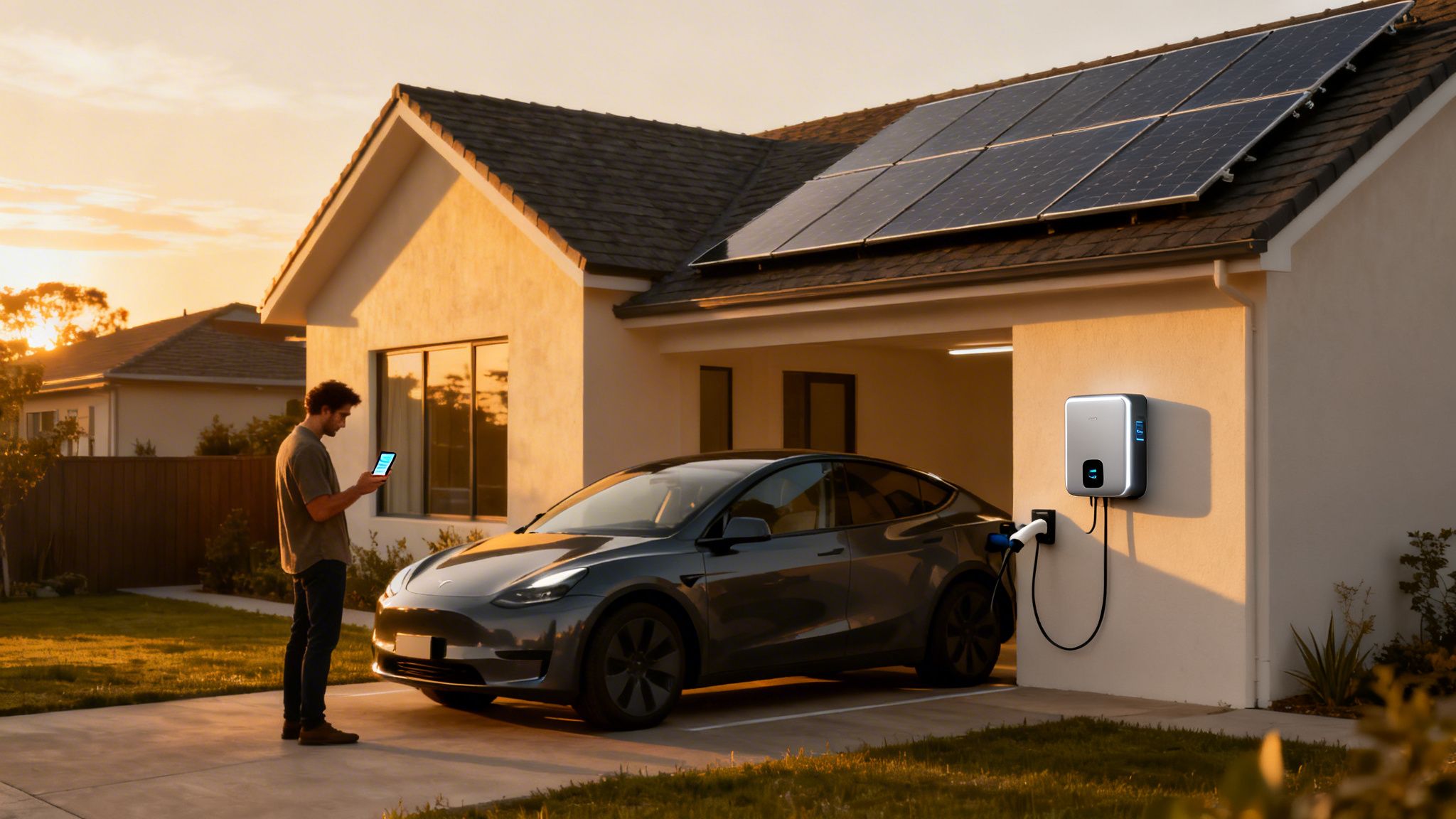
That leap forward starts by choosing a smart charger. Unlike a basic "dumb" unit that just dumps power into your car, a smart charger connects to your Wi-Fi. This simple connection opens up a whole world of control right from your smartphone. It’s the difference between a simple light switch and a fully automated smart lighting system.
Unlock Savings with Smart Charging
The most immediate win with a smart charger is scheduling. In NSW, electricity prices can swing wildly throughout the day, and the off-peak rates at night are significantly cheaper. A smart charger lets you program your EV to only drink electricity during these low-cost windows, automatically starting after you’ve gone to bed and finishing before the morning rush.
This one feature alone can slash your electricity bills over the life of the car. You wake up to a full battery every morning without ever paying those premium daytime rates.
Another brilliant feature is load management. A smart charger keeps an eye on your home's total electricity use in real-time. If it senses you’re about to push your system to its limit—maybe the air con, oven, and washing machine are all going at once—it will cleverly pause or slow down the car charging to prevent an overload. It’s a crucial safety net that keeps your home’s electrical system stable.
The Ultimate Synergy: Charging Your EV with Solar
Now, this is where the real magic happens. When you integrate your EV charger with a home solar and battery system, you create a powerful, self-sustaining energy loop. Instead of buying power from the grid to fill your car, you can charge it for free using clean energy generated right on your own roof.
Picture your solar panels as your own personal power station. During the day, they're busy making clean electricity.
- First, that energy powers your home's appliances.
- Next, any excess solar is sent straight to your EV’s battery via your smart charger.
- If there’s still more sun, the leftover power gets stored in a home battery to use at night.
This synergy is the absolute pinnacle of home energy management. You’re literally fuelling your car with sunshine, which drastically cuts your running costs and makes you almost completely independent from the grid on sunny days.
This integrated approach is at the heart of what we do at Interactive Solar. An EV charger isn't just a tacked-on accessory; it's a vital piece of a complete home energy solution. Paired with solar panels and a battery, it becomes part of a system that delivers energy security, massive long-term savings, and true freedom from unpredictable electricity prices.
For anyone looking to get the most out of this setup, it's worth understanding the tech that ties it all together. You can learn more about how a high-quality SolarEdge inverter masterfully directs the flow of energy between your panels, battery, and EV charger. By taking this holistic view, your electric car charger installation cost becomes an investment in a cheaper, cleaner, and more resilient energy future.
Why Your Choice of Installer Matters Most
When it comes to installing an EV charger, there’s one decision that outweighs all others. It’s not the brand of charger you pick—it’s the person you hire to install it. The electric car charger installation cost isn't just for the box on the wall; it’s for the expertise that ensures your home, your car, and your family are kept safe.
This is the critical choice that separates a flawless, compliant system from one that causes headaches down the road. It’s the difference between a cheap job and a professional installation that delivers genuine peace of mind.
The Dangers of a Sub-Par Installation
It can be tempting to go with a general electrician offering a bargain-basement price, but that approach comes with serious, tangible risks. An EV charger isn't just another appliance; it places a heavy, continuous load on your home’s electrical system.
Getting it wrong can lead to some genuinely dangerous outcomes.
- Fire Hazards: Incorrect wiring, loose connections, or using the wrong type of circuit breaker can cause components to overheat. Under the sustained load of an EV, this becomes a major fire risk.
- Voided Warranties: Both car and charger manufacturers will void their warranties if they discover the unit was installed improperly or by an unqualified person. That quick saving could cost you thousands.
- Non-Compliance: All electrical work in NSW must meet strict Australian Standards. A dodgy installation won’t just fail an inspection; it can create legal headaches and even put your home and contents insurance at risk.
An expert installer is your first line of defence against these problems. Their job is to make sure every single component is correctly rated, safely connected, and 100% compliant with state and national regulations.
What to Look for in a Quality Installer
To sidestep these issues, you need an installer who is a specialist in EV charging technology. A general electrician knows how to connect a circuit, but an EV expert understands the specific demands of these systems.
You want a team that isn’t just licensed but also accredited by the Clean Energy Council (CEC). CEC accreditation is the industry benchmark for professionals committed to high standards and ongoing training in modern energy tech.
Here’s a checklist of what you should be looking for:
- Full Licensing and Insurance: They must hold a current NSW electrical contractor licence and have comprehensive public liability insurance. No exceptions.
- Proven EV Experience: Ask to see examples of their work. A seasoned installer can talk you through different charger models, load management solutions, and how to tackle common installation hurdles.
- Deep Regulatory Knowledge: Your installer needs an expert-level grasp of NSW service rules and the Australian Electrical Standards (AS/NZS 3000).
- Solar Integration Skills: If you have solar (or plan to get it), you need a specialist who can design an integrated energy system, not just someone who bolts a charger to the wall. To learn more about this, you can read our article on why quality installations are essential for advanced solar systems.
Vetting your installer against these points is the single best thing you can do to ensure your home charging setup is safe, reliable, and built to perform for years to come.
A Few Common Questions About EV Charger Installations
As you start thinking about the budget for your electric car charger installation cost, a few questions almost always come up. Let's tackle some of the most common ones we hear from homeowners across Sydney.
Do I Need to Upgrade My Switchboard to Get an EV Charger?
Not always, but it’s a very common step, especially in older homes. To safely power a new EV charger, you need a modern switchboard that has safety switches (RCDs) and enough spare capacity. It's a non-negotiable for safety.
When a licensed electrician comes for a site visit, one of the first things they'll do is inspect your board. If it's an old fuse-style board, is already full, or doesn't meet the current Australian Standards for handling the continuous load an EV charger draws, an upgrade will be on the cards.
How Long Does a Standard Home EV Charger Installation Take?
A straightforward installation, where the charger is going in a garage close to the switchboard, can usually be done in 2 to 4 hours. It’s a pretty smooth process when everything is easily accessible.
However, the timeline can stretch out for more complex jobs. If the work involves running a lot of new cabling, digging trenches to bury wires across a property, or a full switchboard upgrade, it can easily take a full day or sometimes even longer. Your installer should give you a clear and realistic timeframe with your quote after they've had a proper look at your home.
Can I Just Install the Charger Myself and Save Some Money?
Absolutely not. In Australia, it is illegal for anyone other than a licensed electrician to perform fixed electrical wiring, and that includes installing a home EV charger.
Trying to DIY an installation isn't just against the law; it's incredibly dangerous. You're creating a serious risk of electric shock or fire. It will also instantly void your charger's warranty and could even invalidate your home and contents insurance policy. For safety, compliance, and your own peace of mind, this is one job you must leave to a qualified, licensed professional.
At Interactive Solar, our in-house, fully licensed electricians make sure every installation is safe, compliant, and works perfectly with your home's energy setup. If you're looking for a seamless installation from a trusted local team, get in touch today for a detailed chat. Learn more at interactivesolar.com.au.
Make Interactive Solar a preferred source in Google
One click tells Google to surface our articles more often in Top Stories, AI Overviews and AI Mode.