Finding the Best Home EV Charger in Australia for 2026
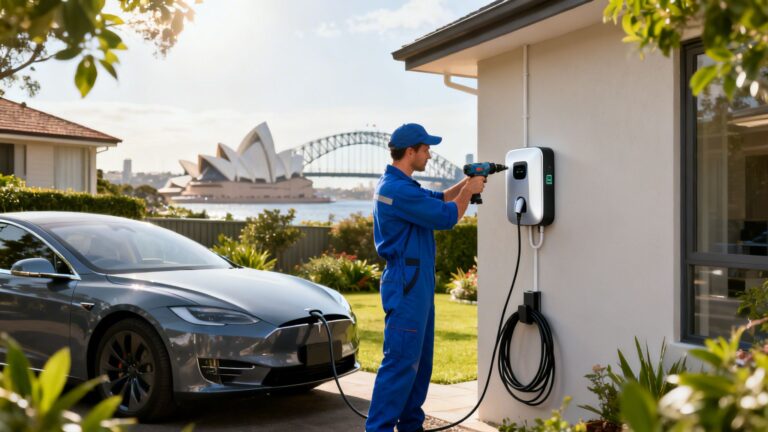
For most Australian EV owners, charging happens at home. The best home EV charger isn't a luxury accessory—it's the single most important upgrade you can make to unlock convenience, significant cost savings, and a level of energy freedom you simply can't get from the public grid.
Why a Dedicated Home Charger Is Your Most Critical EV Upgrade

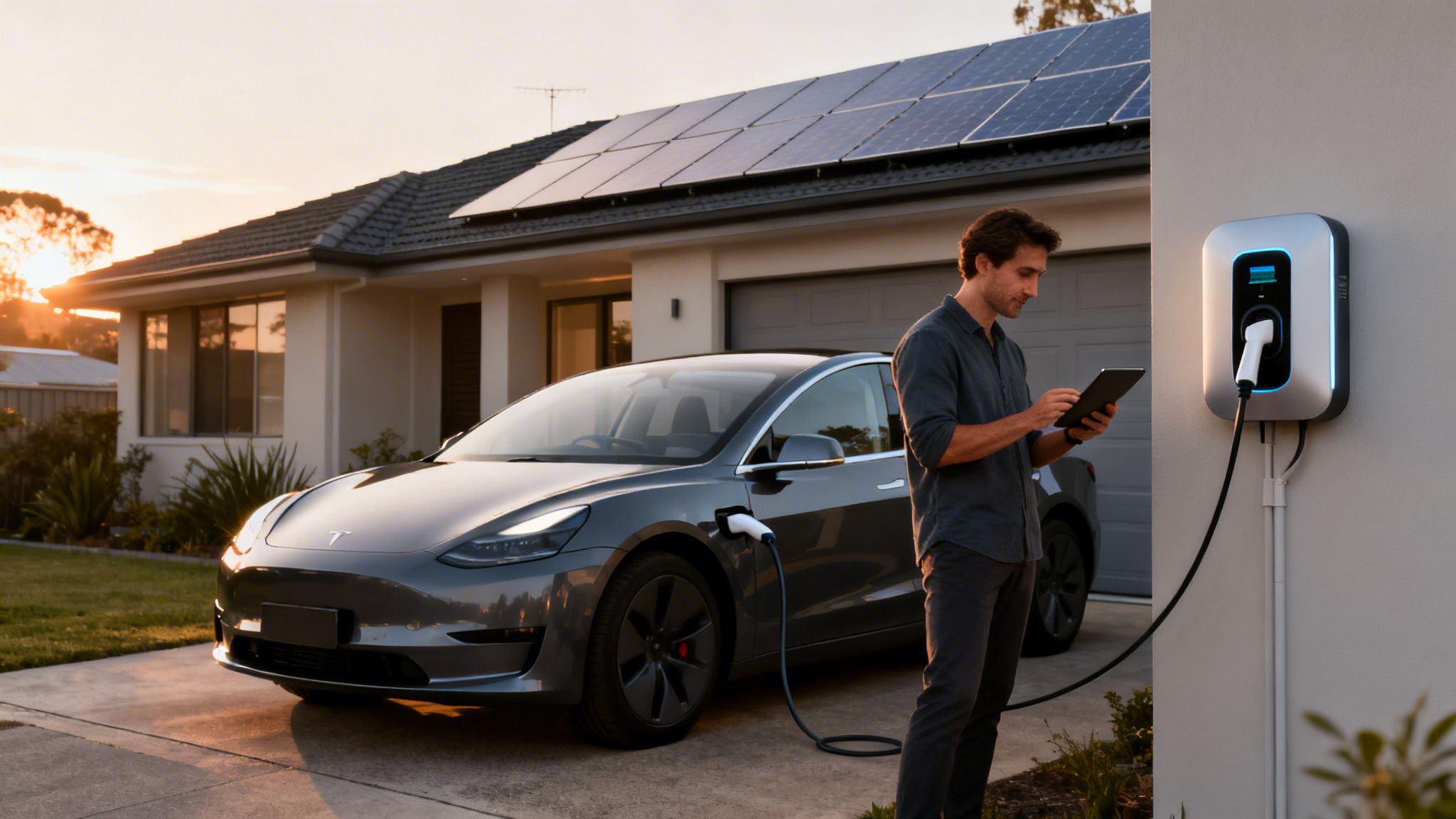
Waking up every morning to a fully charged car completely changes the EV ownership experience. You stop planning your day around a detour to a public charging station and instead start with a "full tank" from your own garage. This simple shift from reliance to self-sufficiency is the real power of having a dedicated charger at home.
Sure, your EV came with a standard portable cord for a regular wall socket. But for daily use, it's painfully slow. A trickle charge might take 24 hours or more for a full battery. A professionally installed Level 2 charger, on the other hand, is a game-changer, slashing that time and turning your home into a reliable, primary power source for your car.
The Real Cost of Public Charging
Relying on the public charging network isn't just inconvenient—it can get expensive. You're often paying premium rates, session fees, and even idle charges if you stay plugged in too long. These costs pile up, chipping away at one of the biggest financial perks of driving an EV in the first place.
A home charger puts you back in control. You can tap into off-peak electricity tariffs, which offer dramatically lower rates for charging overnight. By scheduling your charge times, you can cut your "refuelling" costs to a fraction of what you'd pay at a public station or even using your own standard daytime power.
Future-Proofing Your Home and Energy Use
Installing a dedicated EV charger is more than a convenience; it's a smart investment in your property. As Australia's EV market continues to boom, homes with built-in charging infrastructure are becoming far more attractive to potential buyers. It's a clear signal that a property is modern and ready for the future of transport. You can explore our full range of home EV chargers to see how seamlessly they integrate into a modern home.
A dedicated home EV charger is the key to unlocking the full economic and lifestyle benefits of electric vehicle ownership. It provides unmatched convenience, direct access to the cheapest electricity rates, and the foundation for a truly independent home energy system.
The market numbers show a clear trend. The Australian EV charging sector is forecast for explosive growth, expected to reach USD 813.66 million by 2030. For homeowners, this means getting ahead of the curve is crucial. Partnering with an experienced installer like Interactive Solar for a quality installation is the smartest way to tap into this trend, avoiding future grid strain and locking in energy savings, especially when paired with a solar system.
Here’s a quick breakdown of how home charging stacks up against relying on public networks.
| Feature | Dedicated Home Charging | Public Charging Network |
|---|---|---|
| Convenience | Always there, always ready. Charge overnight while you sleep. | Requires travel, planning, and potential waiting times. |
| Cost | Access to cheap off-peak tariffs and free solar energy. | Higher commercial rates, plus potential session or idle fees. |
| Reliability | Your personal station is always available and working. | Chargers can be occupied, out of service, or incompatible. |
| Speed | Level 2 charging is 3-7x faster than a standard wall outlet. | Varies from slow AC to super-fast DC charging. |
Understanding Charger Power Levels for Real-World Speed

When picking a home EV charger, the jargon around power and speed can feel overwhelming. But it all really boils down to one simple question: how fast do you actually need to charge your car at home? For almost every Australian homeowner, the answer points straight to a Level 2 AC charger.
Let’s quickly clear up the charger "Levels". A Level 1 charger is just the basic portable cord that plugs into a standard wall socket. It offers a slow trickle charge, adding maybe 10-20 kilometres of range per hour. While handy in a pinch, it’s not a practical daily solution.
Level 2 chargers, on the other hand, are the real deal for home use. They are professionally hardwired into your home’s electrical system and deliver much faster charging, making them the default choice for a hassle-free EV lifestyle.
Single-Phase vs Three-Phase Power: What's at Your Place?
The speed you get from a Level 2 charger comes down to your home’s electrical supply. Most properties have either single-phase or three-phase power. Think of it like water pipes: single-phase is one standard pipe, while three-phase is like having three pipes delivering power at once.
Single-Phase Power: The vast majority of Australian homes have a single-phase connection. Here, a 7kW charger is the standard and most powerful option you can install. It adds roughly 40-50 kilometres of range per hour, which is more than enough to give any EV a full charge overnight.
Three-Phase Power: Some larger or newer homes, particularly those with big workshops, might have a three-phase connection. This opens the door to more powerful chargers, like 11kW or even 22kW models. A 22kW charger can pump in over 120 kilometres of range per hour, but there's a catch. Your car’s onboard charger also has to be able to accept that much AC power, and many can’t.
For the vast majority of homeowners in Sydney and greater NSW, a 7kW single-phase Level 2 charger is the perfect balance of speed, performance, and practicality. It provides more than enough power for overnight charging without forcing expensive and often unnecessary electrical upgrades.
A professional site assessment is the only way to know for sure what your property can handle. An expert from Interactive Solar can inspect your switchboard and wiring to determine your home's capacity, ensuring the charger you choose is both safe and effective.
To put this in perspective, here’s a quick breakdown of what to expect from each power level.
Home EV Charger Power Levels and Charging Speeds
| Charger Level | Typical Power | Connection Type | Approx. Range Added Per Hour |
|---|---|---|---|
| Level 1 | 2.4kW | Standard 10A Wall Socket | 10-15 km |
| Level 2 | 7kW | Single-Phase Hardwired | 40-50 km |
| Level 2 | 11kW | Three-Phase Hardwired | 60-70 km |
| Level 2 | 22kW | Three-Phase Hardwired | 120+ km |
As you can see, the jump from a standard socket to a dedicated Level 2 unit is massive. It’s the difference between a top-up and a full charge.
Why Level 2 is the Home Charging Sweet Spot
Going for a dedicated Level 2 charger isn't just about speed—it’s about unlocking the full potential of your EV and your home energy system. This is especially true if you have solar panels. A Level 2 charger is powerful enough to make the most of your midday solar generation, a topic we dive into in our guide to designing a 10 kW solar system.
This upgrade is becoming essential in New South Wales, Australia's leader in EV uptake. As of mid-2025, NSW has 357 charging locations, far outpacing other states. With EV sales climbing 13.1% in 2025 alone, the convenience of a proper home charger is no longer a luxury but a core part of owning an electric vehicle. You can get more details on Australian electric vehicle market trends over at imarcgroup.com.
Ultimately, your home's electrical setup dictates what’s possible. Before you can choose the best charger, you need to have a clear picture of your property's power supply. This is the non-negotiable first step to guaranteeing your new system performs exactly as you expect from day one.
Comparing Smart Features: What You Actually Need
A modern EV charger isn’t just a fancy power point. It’s a smart device, and its intelligence is what separates a frustrating experience from a seamless one, saving you money and keeping your home’s electrical system safe.
But let’s be honest, the list of "smart features" can get long and confusing. You need to know which ones are genuine game-changers and which are just nice-to-have extras. The secret is connectivity. Once a charger is on your home Wi-Fi, it unlocks powerful tools you can control straight from your phone, making it an active part of your home's energy ecosystem.
App Scheduling and Remote Monitoring
The most fundamental smart feature, and one you'll use daily, is the ability to control and monitor charging from an app. This simple function has a massive impact on both convenience and your power bills.
- Remote Start and Stop: Left home and forgot to plug in? No problem. You can start a charging session from your desk at work. Need to stop it early? Just a tap on your phone.
- Real-Time Monitoring: You can see exactly what’s happening in your garage without leaving the couch. Check your charging speed, see how much power has been delivered, and know when your car will be ready to go.
Most importantly, this connectivity enables scheduled charging. This is your key to unlocking serious savings. By setting your charger to run only during off-peak hours—usually overnight when electricity rates are cheaper—you can slash your "refuelling" costs. For a deeper dive into the various charger technologies available, this comprehensive guide to EV charging types and smart technologies is a great resource.
Dynamic Load Balancing for Safety and Performance
If there's one feature that’s non-negotiable for home safety, it’s dynamic load balancing. Think of it as an expert traffic controller for your home’s electricity.
Imagine this scenario: you get home, plug in your EV, and start cooking dinner. The oven is on, the air conditioner kicks in, and suddenly your whole house goes dark. That’s your main circuit breaker tripping because the total demand was too high.
Dynamic load balancing prevents this entirely. It constantly monitors your home's total electricity use. If it senses you're getting close to the maximum limit, it automatically and temporarily slows down the EV charger until other power-hungry appliances switch off.
This is a brilliant feature. It ensures you can charge your EV as fast as your home can safely allow, without ever risking an overload. It offers complete peace of mind and, in many cases, saves you from needing a costly switchboard upgrade. For most Australian homes, this is a must-have.
Differentiating Essential and Optional Features
When you're comparing chargers, it helps to put features into two clear camps: what you absolutely need versus what’s cool but not critical.
Essential Smart Features (Must-Haves):
- Wi-Fi Connectivity: The foundation for all smart functionality. Don’t even consider a charger without it.
- App-Based Scheduling: This is your ticket to cheaper, off-peak electricity tariffs. It pays for itself.
- Remote Monitoring and Control: Offers genuine convenience and gives you valuable insight into your energy use.
- Dynamic Load Balancing: A critical safety feature that protects your home’s electrical system from overloads.
Advanced Smart Features (Nice-to-Haves):
- Solar Integration: This allows your charger to intelligently use your own self-generated solar power first. We'll dig into this powerful feature in the next section.
- Voice Control Integration: The ability to tell Alexa or Google Assistant to start or stop charging. A neat trick, but not essential.
- Power Sharing: Perfect for two-EV households, this lets two chargers on the same circuit share the available power intelligently.
- Usage Reporting and History: Provides detailed analytics on your energy consumption and costs over time, helping you fine-tune your charging habits.
Ultimately, the right mix of features comes down to your home and lifestyle. But the essentials—scheduling and load balancing—deliver such immediate, tangible benefits to your wallet and your home's safety that they should be at the top of your checklist.
Integrating Your Charger with a Solar and Battery System

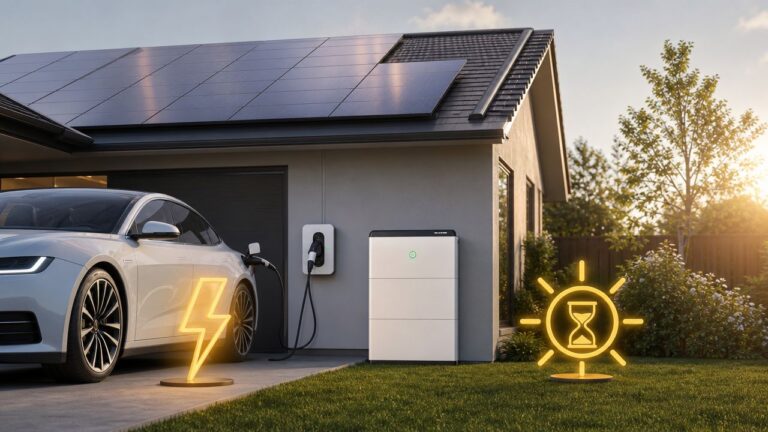
This is where your EV charger stops being just another appliance and becomes a core part of your home's energy strategy. Pairing it with a solar system is the ticket to real energy independence. You’re not just breaking up with petrol stations anymore; you’re starting to break up with the grid itself.
The concept is simple but powerful: you get to literally drive on sunshine. Your rooftop panels generate clean, free electricity all day, which a smart charger can direct straight into your car. It’s the ultimate way to power your vehicle, turning your daily commute into a zero-emission—and zero-cost—journey.
Of course, you need a smart EV charger to pull this off. The best models come with dedicated solar-aware modes that manage the whole process for you.
Understanding Solar-Aware Charging Modes
Chargers built for solar integration give you specific modes to play with, usually managed right from the charger’s app. These settings let you dictate exactly how your car uses the power you generate, making sure not a single kilowatt goes to waste.
Eco or Solar-Only Mode: In this mode, your EV will only charge when you have excess solar power. If clouds roll in and your generation dips, charging pauses. Once the sun comes back out, it picks up right where it left off. This guarantees your car is running on 100% free, clean energy.
Eco+ or Solar + Grid Mode: This is the practical, everyday hybrid mode. It prioritises your excess solar first but will pull a little power from the grid if needed to maintain a minimum charging speed. It’s a fantastic balance, ensuring your car still gets a decent top-up on overcast days while still maximising your self-generated power.
Choosing a charger with these smarts is a huge step, but it’s only half the story. The real game-changer is adding a home battery into the mix.
Adding a Home Battery: The Ultimate Energy Solution
A home battery elevates your entire system. During the day, your solar panels power your home and charge your EV. Any energy left over—which you’d normally sell to the grid for very little—gets stored in your battery instead.
This stored energy is your personal power reserve. You can use it to run your home during the expensive evening peak, but more importantly, you can use it to charge your EV overnight, long after the sun has set.
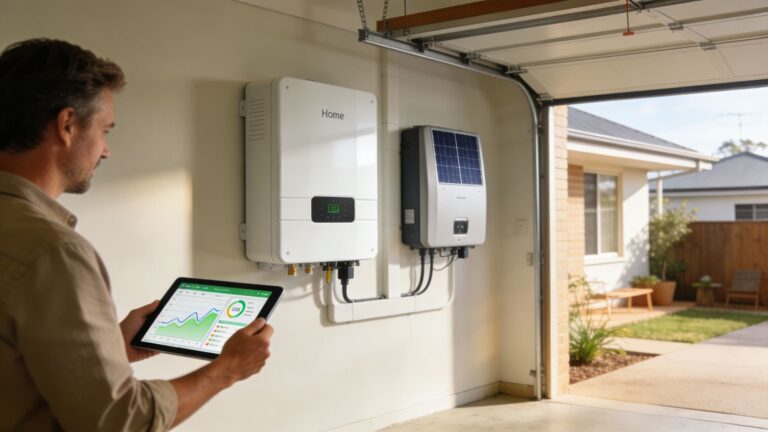
A solar, battery, and EV charger system creates a closed-loop energy ecosystem for your home. You generate your own power during the day, store it, and then use that stored energy to charge your car overnight. You’re achieving near-total self-sufficiency and resilience against blackouts.
There’s a reason over 80% of charging sessions happen at home, even as the public charging network grows at a predicted 23.1% annually in Australia. A professionally installed home setup from a specialist like Interactive Solar lets you offset 70-100% of your grid usage. When you add a home battery, you can charge your EV with stored solar power, making even off-peak grid rates look expensive. To see how this technology works in detail, check out our comprehensive guide to the Tesla Powerwall 3.
Designing an integrated system that works flawlessly takes real expertise. All the components—panels, inverter, battery, and charger—need to communicate to direct energy where it’s needed most. This is where bringing in a certified expert like Interactive Solar is non-negotiable. We make sure every piece of your system works in perfect harmony to maximise your savings and independence from day one. You can read more on the future of the Australian EV charging market from industry analysts like Grand View Research.
Navigating the Installation Process and Requirements
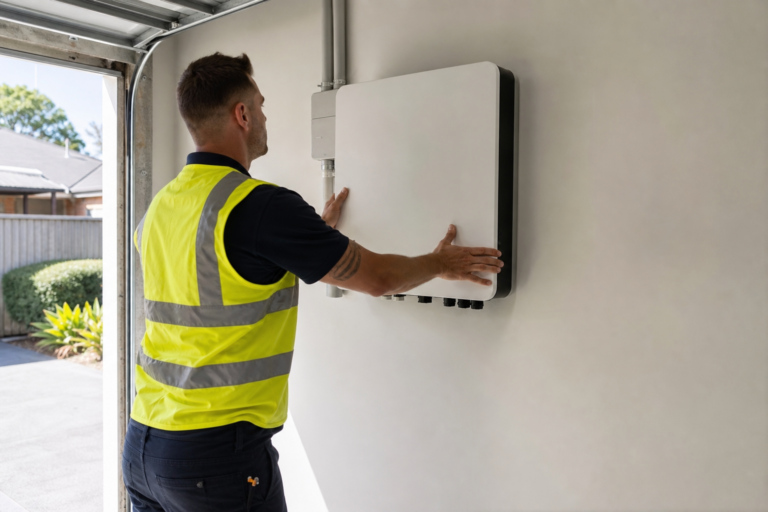
You’ve picked your EV charger. Great. But that’s only half the job. Getting it installed is just as critical, and this is one task that is absolutely not a DIY project. A certified installation is non-negotiable to keep your home safe, meet Australian Standards, and ensure your manufacturer's warranty isn't voided.
It’s not as simple as just mounting a box on the wall. A qualified installer needs to perform a detailed site assessment to get a clear picture of your property's electrical setup. This is the only way to make sure your new charger works properly without putting your home’s electrical system at risk.
The Initial Site Assessment and Switchboard Check
Before any cables are run, a licensed electrician needs to take a hard look at your home's electrical system, starting with the switchboard. This is the command centre for your home’s power, and it dictates whether you can even support a high-power device like an EV charger.
The electrician will be checking for a few key things:
- Switchboard Capacity: Is your main switch big enough to handle the extra load from an EV charger on top of all your usual household appliances?
- Safety Switches: Is your board fitted with modern RCDs (residual current devices) for circuit protection? This is a legal requirement.
- Physical Space: Is there actually enough room in the switchboard to add a new, dedicated circuit for the charger?
This check is vital. If your switchboard is a bit long in the tooth or already running at full tilt, it may need an upgrade. This is a common and necessary step in many older Australian homes.
Factors That Influence Installation Complexity
The physical journey from your switchboard to your garage plays a huge role in how complex the installation will be. A simple job might just involve running a cable neatly along a garage wall. A more involved one can be a whole different story.
Here are a few variables that can change the game:
- Location: Is your switchboard on the complete opposite side of the house from your garage? Running long sections of specialised, heavy-duty cable is a significant job.
- Trenching: If your charger is going into a detached carport, the electrician will probably need to dig a trench to run armoured cable safely underground. This is considered minor civil works.
- Wall Materials: It’s a lot more work to drill through double brick or solid concrete than it is to run a cable through a simple plasterboard wall.
The most important decision you'll make in this process is choosing your installer. They must be a Clean Energy Council (CEC) accredited and licensed electrician who is intimately familiar with Australian Standards, specifically AS/NZS 3000, the Wiring Rules.
This kind of expertise isn't just a "nice to have"—it's a must. It’s your guarantee that every single component, from the circuit breaker in your board to the charger on the wall, is installed correctly for safe, reliable performance for years to come. Using an expert for the job is paramount, a principle we cover in our article on why quality installations are so valuable.
In the end, a professional assessment takes all the guesswork out of the process. An expert from a reputable company like Interactive Solar can give you a clear, straightforward plan. They’ll outline exactly what’s needed to get your home ready for the future of driving, preventing nasty surprises and ensuring a smooth, safe, and efficient installation from day one.
Your Final Home EV Charger Decision Checklist
Choosing a home EV charger is about a lot more than just picking a brand off a shelf. It’s about getting the right technology to match your car, your home’s wiring, and how you actually live.
This final checklist pulls together all the key questions from this guide. Run through these points yourself before you pick up the phone. It’s the best way to walk into a conversation with an installer knowing exactly what you need and why.
Confirm Your Home and Driving Needs
First things first, let’s ground your choice in reality. Your home’s electrical setup and your daily driving habits are the two biggest factors that will narrow down your options from the start.
Electrical Capacity: Can your switchboard handle a new, dedicated circuit for an EV charger? You’ll need to know if you have single-phase or three-phase power, as this sets the ceiling for your maximum charging speed.
Daily Driving Distance: How many kilometres do you really drive each day? This will tell you how much of a top-up you need overnight. Most drivers find a 7kW charger is plenty.
Future Plans: Do you see a second EV in your future? What about a home battery? Thinking about this now can save you from having to upgrade your charger down the track.
Select Your Must-Have Features
Next, let's nail down the smart features that will actually make a difference to you. It's easy to get distracted by flashy tech, but the focus should be on practical functions that save you money or add real convenience.
The most important decision you'll make isn't about the charger itself, but about who installs it. A certified, experienced installer guarantees your system is safe, compliant with all Australian Standards, and will work reliably for years.
This decision tree gives you a clear look at how a professional installation should unfold.

As you can see, a quality installation always starts with a thorough site check and switchboard assessment. Once you have a handle on those things, you're ready to bring in a certified expert like Interactive Solar to get your project moving.
Common Questions About Home EV Charger Installation
Even when you think you’ve got it all figured out, a few last-minute questions always seem to pop up. It’s completely normal. Here are some of the most common queries we get from homeowners, with straight-to-the-point answers to help you lock in your decision.
How Much Faster Is a Dedicated Level 2 Charger?
The difference is night and day. Plugging into a standard wall socket (Level 1) is more of a trickle charge, adding maybe 10-15 km of range per hour. It’s slow going.
In contrast, a professionally installed 7kW Level 2 charger gives you a proper "refill," adding 40-50 km of range every hour. That’s more than enough to fully charge pretty much any EV overnight, ensuring you wake up to a full battery every single day.
Can Any EV Use Any Charger in Australia?
Yes, for the most part. Australia has thankfully standardised on the Type 2 (Mennekes) connector for all AC charging.
This means any modern EV you buy here will plug into any home charger with that same connector. It’s a universal standard that removes guesswork and ensures your setup will be compatible for years to come.
Do I Need Council Approval for a Home Charger Installation?
Probably not. In most areas of NSW, installing a standard home EV charger is classed as an "exempt development."
As long as the installation is handled by a licensed electrician and complies with Australian Standards (AS/NZS 3000), you typically won’t need to get council involved. Of course, a qualified installer will always double-check local rules to ensure everything is above board.
A home EV charger is increasingly seen as a valuable property upgrade. Much like a modern kitchen or solar panels, it signals that a home is future-ready, making it more appealing to a growing segment of tech-savvy buyers.
How Will a Home EV Charger Impact My Property's Value?
As electric vehicles become the norm, a pre-installed home charger gives your property a real edge on the market. It’s a feature that buyers are starting to look for, demonstrating that a home is equipped for modern energy demands.
Think of it as a smart investment. It’s not just about the convenience for you right now; it’s about boosting your home's long-term appeal and value.
These are the big questions, but they often lead to more specific ones about your own home. For a deeper dive, you can explore our frequently asked questions page for more detailed information.
Ready to take control of your energy and enjoy the convenience of charging your EV at home? The expert team at Interactive Solar designs and installs tailored solar and EV charging solutions across Sydney and NSW. Contact us today for a consultation and discover the perfect system for your home.
Make Interactive Solar a preferred source in Google
One click tells Google to surface our articles more often in Top Stories, AI Overviews and AI Mode.