Renewable Energy for Businesses: A Strategic Guide to Solar, Batteries & EV Chargers
For savvy business leaders in Australia, the energy conversation has changed for good. It's no longer about just paying a power bill—it’s about taking control of a critical operational cost. Adopting renewables isn't just an environmental statement; it's a core financial strategy for any competitive business.
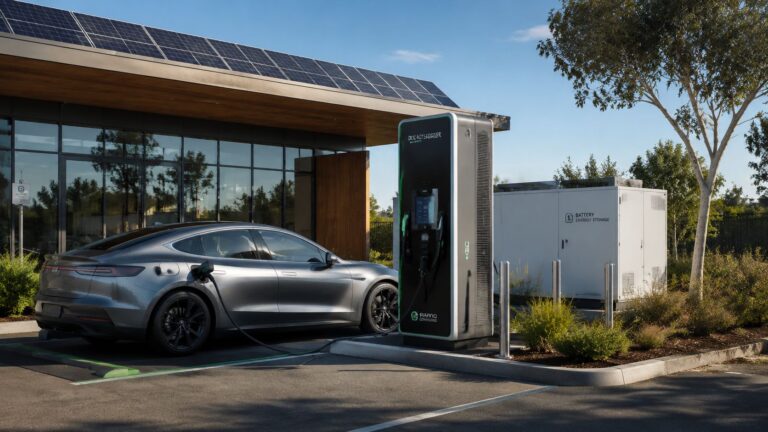
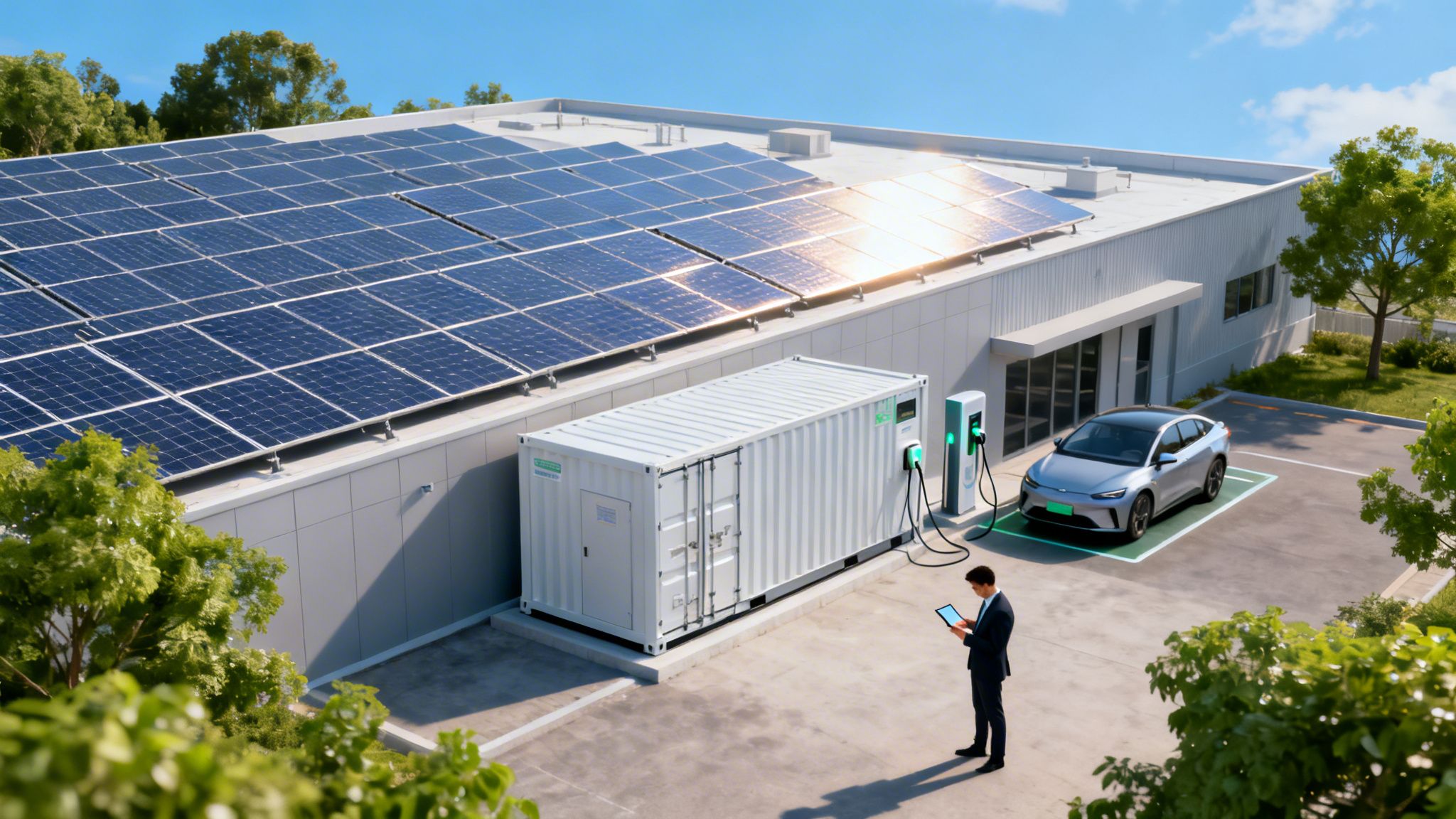
By investing in a complete energy solution—including commercial solar panels, battery storage, and EV chargers—you can lock in energy savings, guarantee operational continuity, and build a stronger, future-ready brand.
Why Smart Businesses Are Investing in Solar, Batteries & EV Chargers
The primary drivers are clear. Proactively managing your own power has shifted from a ‘nice-to-have’ to a business necessity. The goal is to build genuine financial resilience by generating, storing, and using your own clean energy.
This entire shift is about one thing: decoupling your business from the unpredictable and expensive grid. When you generate your own electricity with commercial solar, you create a permanent buffer against rising prices. When you add a battery, you can store that energy to use whenever you need it. And with EV chargers, you future-proof your fleet and property. You finally gain control over a huge overhead, turning a volatile expense into a predictable, manageable asset.
The core idea is simple but profound: Your business property can be transformed from a passive energy consumer into a self-sufficient energy hub. This isn't just an expense; it's a long-term investment in future-proofing your bottom line with solar panels, batteries, and EV chargers.
This simple process flow breaks down the strategic pillars of going renewable for your business.

It all starts with gaining control over your energy with an integrated system. This directly leads to savings, which then feeds back into strengthening your brand as a modern, sustainable enterprise.
Unlocking Strategic Gains with an Integrated Energy System
The real benefits of a commercial renewable energy system go far beyond just what you see on the meter. When you integrate solar panels with battery storage and EV chargers, you create a powerful ecosystem that delivers returns from multiple angles.
The table below outlines the immediate advantages of investing in on-site energy infrastructure.
| Benefit | How It Boosts Your Business |
|---|---|
| Energy Cost Control | Generate your own power with solar panels to drastically reduce or eliminate reliance on the grid, protecting your budget from price hikes. |
| Operational Continuity | Solar batteries keep essential systems running during grid outages, preventing costly downtime and revenue loss. |
| New Revenue Streams | Earn credits by selling excess solar energy back to the grid or monetise EV charging stations for public use. |
| Enhanced Brand Value | A visible commitment to sustainability attracts modern customers, investors, and top talent. |
| Future-Ready Infrastructure | EV chargers prepare you for the electric transport shift, serving a growing market of employees and customers. |
Each element works together to build a more robust, efficient, and profitable business, turning your property into a high-performing asset.
- Operational Continuity: A solar battery means your key operations stay online during a blackout. This prevents costly downtime and protects your revenue.
- Enhanced Brand Reputation: Showing a real commitment to sustainability with solar panels and EV chargers speaks volumes to customers, employees, and stakeholders.
- Future-Ready Infrastructure: Installing EV chargers gets your business ready for the electric transport revolution, helping you attract top talent and serve a growing customer base.
Beyond the immediate cost savings, understanding what green energy is and how it supports business decarbonization can further clarify the long-term strategic advantages.
If you’re looking to shield your operations from market volatility, you might find our guide useful on how to prepare when electricity prices to rise in Australia. The ultimate goal is a complete solution that tackles not just today’s costs but also unlocks tomorrow's opportunities.
Auditing Your Energy Profile for Maximum ROI
Jumping straight into renewables without a plan is like navigating without a map. Before you even think about installing solar panels, batteries, or chargers, you need to know exactly where your energy dollar is going. Shifting from guesswork to a data-driven strategy is the single most important move you can make to ensure your investment pays off—quickly and significantly.
It all starts with a deep dive into your operations.

Grab your electricity bills from the last 12 months. They're more than just a record of what you owe; they tell a story about when you use power, and that timing is everything.
Look for a line item called peak demand charges. These are extra fees your retailer hits you with for the highest amount of power you pull from the grid at any one time. For many businesses, these charges can make up a shocking 30% to 70% of the entire bill. This is the low-hanging fruit, and a well-designed solar and battery system is purpose-built to eliminate it.
Analysing Your Site for Solar and EV Charger Potential
Once you have a handle on your usage patterns, it's time to look at your physical property. A quick site assessment will tell you what’s feasible and how to get the most out of your assets for solar panels and EV chargers.
A preliminary roof evaluation is the perfect place to start for solar:
- Available Space: How much clear, unshaded roof do you actually have? Things like HVAC units, vents, and skylights will eat into the usable area for solar panels.
- Roof Orientation and Pitch: In Australia, a north-facing roof is the gold standard for all-day sun. But don't discount east and west-facing roofs—they’re fantastic for catching morning and afternoon sun, which often aligns perfectly with your business hours.
- Structural Health: Is your roof in good shape? While a professional installer will always do a full structural check, a quick visual inspection for obvious damage is a smart first move.
By identifying your peak demand periods and mapping them against your potential for solar generation, you start to build a powerful business case. You can see exactly how on-site generation can directly offset your most expensive grid consumption, leading to substantial savings.
This data-first approach takes the uncertainty out of the equation. You can model different scenarios and get a much clearer picture of your potential returns. For a quick estimate based on your location and general usage, our commercial solar savings calculator is a great starting point.
Building the Case for EV Charging
The audit doesn't stop at your roof. It should also cover your vehicle fleet, parking areas, and even your team's commuting habits. The shift to electric vehicles is gaining speed, and installing EV chargers now will give you a serious competitive edge.
Start by analysing your current fleet operations. Track the daily kilometres travelled and where vehicles are parked overnight. This data is crucial for figuring out the number and type of EV chargers you'll need to support a switch to an electric fleet, which can slash your fuel and maintenance costs.
Don’t forget about your employees and customers. A simple survey about their interest in EVs can justify installing chargers as a workplace perk or a customer amenity. It’s not just about hitting sustainability goals; it's a powerful tool for attracting and retaining top talent and forward-thinking clients. This information ensures your EV charging infrastructure is sized right and strategically placed.
Choosing the Right Technology for Your Operations
With your energy audit complete, you have the data. Now for the exciting part—choosing the hardware that turns those numbers into real-world savings and energy independence.
This is where your strategy takes physical form. It’s not just about bolting on some panels; it’s about engineering a powerful, interconnected system of solar panels, batteries, and EV chargers. Each piece of technology should serve a specific financial and operational goal for your business, working together to transform your property from a cost centre into a high-performing asset.
The three pillars of a modern business energy system are commercial solar, battery storage, and EV charging. When designed to work together, they do more than just lower your power bill—they give you control.
Powering Your Daytime Operations with Commercial Solar Panels
For most businesses, the biggest energy costs hit during daylight hours. This is exactly when a solar system is at peak production, creating a perfect match between your consumption and your generation.
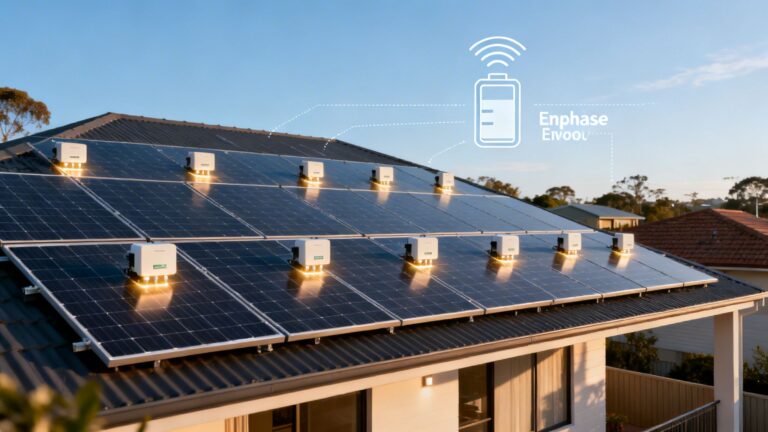
Commercial solar panels are engineered to directly offset this daytime energy use, generating clean power right on your rooftop that your operations consume in real-time.
Think of it as locking in your own electricity while grid prices keep climbing. The power your system generates is used first, before you pull a single kilowatt from the utility. This immediately slashes your grid reliance and shields your bottom line from volatile market rates. You can explore our tailored approach to commercial solar to see how a custom-designed system can fit your specific business.
Unlocking Energy Independence with Solar Batteries
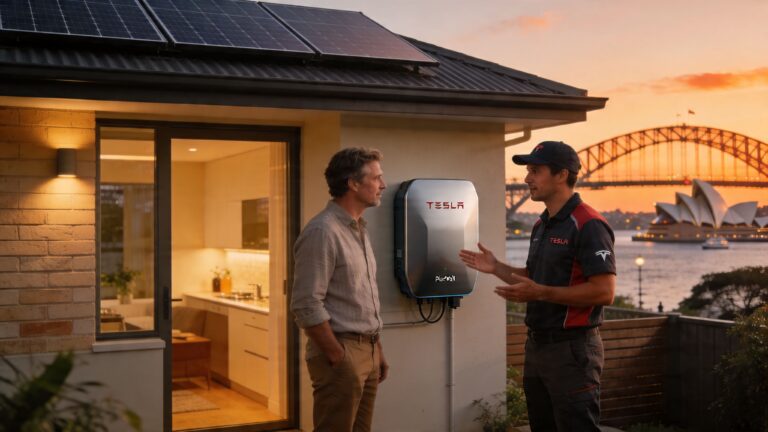
While solar panels are the workhorse for daytime savings, a solar battery is what gives you true energy control and operational resilience. Its main job is to store the excess solar power your panels generate during the day, instead of exporting it back to the grid for a tiny credit.
This stored energy then becomes your secret weapon against high electricity costs.
Real-World Scenario: Manufacturing Business
Imagine a manufacturing facility that runs machinery all day. Its solar panels cover most of the daytime load, but the business still gets hit with steep peak demand charges in the early evening as it finishes a production run.
- Without a Battery: Any surplus solar power is sent to the grid for a low feed-in tariff. Come 5 PM, the business is forced to buy expensive grid electricity to finish its work.
- With a Battery: That same surplus power is captured and stored. As the evening peak rates kick in, the business automatically switches to its own stored, free solar energy, completely sidestepping the highest charges on its bill.
Even better, a solar battery acts as an uninterruptible power supply (UPS). If a blackout hits, your essential equipment—from servers and security systems to critical machinery—stays online, preventing costly downtime and data loss.
Future-Proofing with EV Chargers
Electric Vehicle (EV) chargers are quickly moving from a novelty to a non-negotiable. Installing them is a strategic move that positions your business as a leader.
- Attract Talent and Customers: Offering EV charging is a huge perk for attracting and keeping forward-thinking employees. It also draws in the growing demographic of customers who drive EVs.
- Create a New Revenue Stream: Public-facing chargers can be monetised, turning your car park into a source of income.
- Increase Property Value: Commercial properties that are "EV-ready" are far more attractive to future tenants and buyers, making chargers a smart, future-focused investment.
When you integrate EV chargers with your solar and battery system, you can power vehicles with your own clean energy. This cuts operational costs for your fleet and provides a zero-carbon amenity for your staff and clients.
The growth in battery technology isn't just happening at a business level; it's a nationwide trend. Battery energy storage systems (BESS) are now seen as critical infrastructure for Australia's energy transition. This wider adoption reinforces the reliability and financial viability of the technology for individual businesses.
The scale of this shift is undeniable, with grid-scale storage capacity growing by 2,936 MW in a single year leading up to Q3 2025. Major commercial projects, like Victoria's 250-MW Gnarwarre BESS, have reached financial close, proving that battery technology has moved from experimental to proven, mainstream infrastructure.
For businesses in NSW, this massive grid-level investment means more stable supply chains, a bigger pool of experienced installers, and the confidence that you’re investing in a mature, bankable technology. You can read more about Australia’s record-setting solar and storage performance on pv-tech.org.
Finally, don't forget about efficiency upgrades like roof ventilation. These act as a force multiplier for your whole system. By keeping your building cooler, you reduce the strain on your air conditioning units. This means your solar and battery system doesn't have to work as hard, freeing up more stored energy for other critical uses and maximising your overall savings.
Financing Your Project and Navigating Incentives

You’ve done the hard work of auditing your energy use and picking the right technologies. Now for the crucial part: funding your new energy asset. Turning your rooftop into a power-generating hub is one of the smartest investments a business can make, and understanding the financial pathways is key to getting your project approved and installed.
While the initial investment for a full commercial solar, battery, and EV charging system can seem significant, a solid business case makes it entirely manageable. There are diverse funding options available to help you acquire these powerful assets.
Common Financing Pathways for Australian Businesses
For most businesses in Australia, it really boils down to two main paths: owning the system yourself with a loan or signing a Power Purchase Agreement (PPA). Each has its own pros and cons, and the right choice depends entirely on your company’s financial situation and long-term goals.
A Chattel Mortgage is a very popular and straightforward way to acquire your system. You simply take out a loan to buy the solar panels, battery, and chargers outright. They are your assets from day one, and so is every kilowatt of electricity they produce.
This path has some powerful benefits:
- Full Ownership: The system immediately becomes an asset on your balance sheet.
- Maximum Savings: You keep 100% of the financial upside from the energy you generate, plus all the government incentives.
- Tax Advantages: You can usually claim depreciation on the asset and write off the loan interest as a business expense.
The other route is a Power Purchase Agreement (PPA), which lets you tap into solar savings without the upfront capital hit. Under a PPA, a provider installs and maintains a system on your roof at no cost to you. In return, you agree to buy the power it generates at a fixed rate that’s cheaper than what you’re paying the grid.
A PPA is an excellent operational expense model. It provides immediate bill savings with zero capital outlay, making it a low-risk entry into renewable energy. However, with direct ownership, you capture the full long-term financial upside as you own a power-generating asset.
Maximising Government Incentives
This is where the business case for solar panels and batteries really gets supercharged. Government incentives are specifically designed to slash the upfront cost of your system and shorten your payback period. In Australia, the main program you’ll deal with is the Small-scale Renewable Energy Scheme.
For systems under 100kW, you’ll be eligible for Small-scale Technology Certificates (STCs). The number of STCs your system gets depends on its size and your location, and they have a market value. Your installer handles all the paperwork, creating and selling the certificates for you and applying the total value as a direct discount on your invoice. For bigger projects, you’ll be looking at Large-scale Generation Certificates (LGCs), which deliver similar financial benefits.
This federal support is a massive reason why commercial solar is such a no-brainer for businesses in NSW. If you want to get into the nitty-gritty, we've put together a full breakdown of the solar rebates available in NSW.
On top of that, the broader economic climate in Australia is pushing hard for renewables. Large-scale investment hit a massive AUD $9 billion in 2024 and is only gaining speed. This huge injection of capital, including a record AUD $5.8 billion in wind investment, is making the entire grid stronger and more reliable.
For you, this means your new commercial solar and battery system is plugging into a network that’s rapidly modernising, which only enhances the long-term value and stability of your investment.
Ensuring a Smooth Installation and Long-Term Success
You can have the best solar panels, batteries, and EV chargers in the world, but it’s the quality of the installation and upkeep that truly secures your return on investment. A top-tier system is a long-term business asset that needs professional execution from day one and ongoing care to deliver decades of value.
Choosing the right technology is only half the battle.
A proper installation process is all about precision and minimising disruption to your business. It should always start with rigorous site safety protocols and a project management plan that respects your daily operations. A professional partner will work with you to schedule the work thoughtfully, making sure your business can keep running smoothly while your new energy system is being brought online.
Executing a Best-in-Class Installation
The quality of an installation directly impacts the performance, safety, and longevity of your solar panels, batteries, and EV chargers. A professional provider will never cut corners.
Their team should be made up of in-house, certified electricians who follow strict Australian standards. This ensures every connection is secure and every component is configured for optimal performance from the get-go.
This commitment to quality is crucial. You can learn more about why the difference between a standard and a high-quality installation is so significant in our article on what makes a truly valuable solar system. Ultimately, a superior installation gives you peace of mind that your asset is built to last.
Maximising Your System’s Lifetime Value
Once your system is commissioned and running, the focus shifts to maximising its lifetime value and proving its ROI. This is where modern monitoring and a proactive maintenance plan become indispensable tools for any business serious about its energy independence.
Your renewable energy system is a power-generating asset. Just like any valuable asset, it needs to be monitored and maintained. Real-time data empowers you to track performance, verify savings, and proactively address any issues before they impact your bottom line.
Modern monitoring software gives you a live dashboard of your system's health. You can see precisely how much energy your solar panels are generating, how much power your battery is storing, and how much electricity your EV chargers are delivering. This data lets you track your savings against your initial projections, providing tangible proof of your return on investment.
A proactive operations and maintenance (O&M) plan is also essential. This doesn't have to be complicated, but it should include:
- Regular Panel Cleaning: Dust, pollen, and general grime can build up on your solar panels, reducing their efficiency. A simple cleaning schedule can easily restore their performance.
- System Health Checks: Annual inspections by a qualified technician can identify potential issues with wiring, inverters, or mounting hardware before they become bigger problems.
- Responsive Support: Partnering with a provider who offers prompt, expert support is critical. Knowing you have a team on call to troubleshoot any issues provides immense security.
This proactive approach is well-supported by Australia's mature solar industry. The sector recently surpassed 4 million rooftop solar installations across homes and businesses—a milestone that shows just how mainstream the technology has become. For businesses in Sydney and greater NSW, this scale means you benefit from a well-developed supply chain and a large pool of skilled professionals, ensuring access to quality installations and reliable long-term support. You can read the full report from the Clean Energy Council to discover more about this achievement and what it means for the industry.
Your Questions on Business Renewables Answered
When businesses start exploring a switch to renewable energy, we find the same practical questions come up time and time again. Before you can make a smart investment in solar, batteries, and EV charging, you need clear, straightforward answers.
Let's cut through the noise and tackle the most common queries we get from business owners about these powerful technologies.

How Much Roof Space Do I Need For Commercial Solar?
There's no magic formula here—the amount of roof space you need depends entirely on how much energy your business actually uses. You might see a general guide of 7-8 square metres per kilowatt (kW) of solar, but that’s just a starting point. A professional assessment is the only way to get a real answer.
A good provider will always start by analysing your power bills. This tells them what size solar system you’ll need to hit your financial targets, whether that's a 80% reduction in grid power or something else.
Only then will they get on the roof. A detailed site inspection confirms you have enough unshaded, structurally sound space to work with. The final design is never off-the-shelf; it’s a custom layout engineered to get the absolute most out of your specific roof.
Is a Commercial Solar Battery a Smart Investment?
For almost any business on a time-of-use electricity tariff, the answer is a resounding yes. A commercial battery is a financial game-changer, and its primary job is to enable "self-consumption."
Here’s how it works. Instead of exporting your surplus solar power back to the grid for a tiny feed-in tariff, you store it in your own battery. Later, you use that stored, free energy during peak morning and evening periods when grid power is most expensive. This one strategic move can slash your operating costs.
The other critical job a battery performs is acting as an uninterruptible power supply (UPS). When a blackout hits, it keeps your essential operations running without a flicker. The ROI is undeniable for any business where power continuity is non-negotiable.
This means a grid outage no longer brings your business to a grinding, costly halt. Your servers, security systems, and critical machinery stay online.
What Is Involved In Installing Commercial EV Chargers?
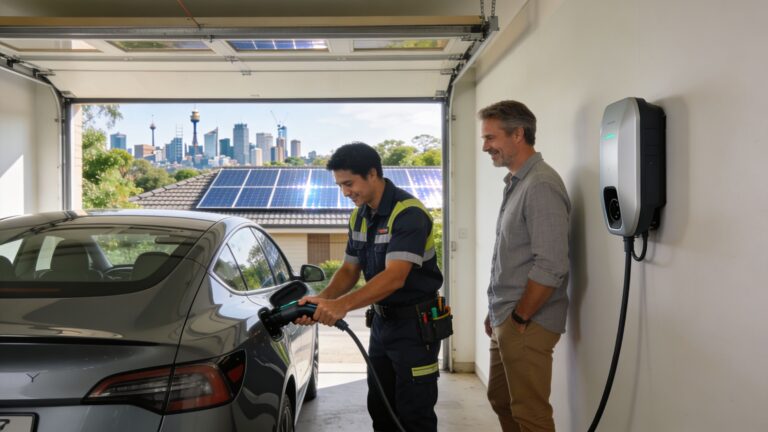
Getting commercial EV chargers installed is a very systematic, managed process from start to finish. It all kicks off with a needs analysis. How many chargers do you need? What charging speed makes sense? (Level 2 is the standard for workplace charging). And where’s the best spot to put them for easy access?
Next, a licensed electrician will perform an audit of your switchboard and electrical systems to ensure they can handle the extra load safely. Once that’s clear, the physical installation begins. This involves running dedicated circuits from the switchboard to each charging station and securely mounting the hardware.
The key to a safe, seamless result is working with a provider who manages the entire project in-house. This should always include:
- The initial site audit and load calculations.
- Hardware selection and procurement.
- Installation by certified electricians.
- Final commissioning, testing, and a proper handover.
This is the only way to guarantee your EV charging solution is effective, fully compliant, and safely integrated with your property's electrical system.
How Is the ROI on a Commercial Solar System Calculated?
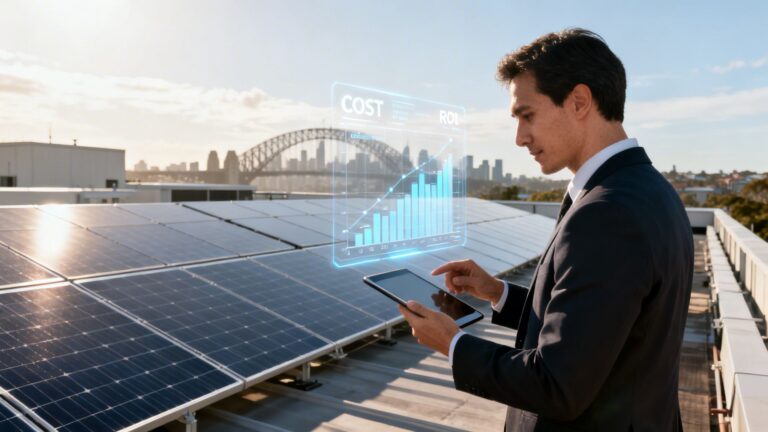
Calculating the return on investment for commercial solar is refreshingly straightforward. Your total investment is simply the final, post-rebate cost of the system. The "return" comes directly from what you save on your electricity bills.
Your installer will give you a detailed performance estimate, but modern monitoring software lets you see exactly what’s happening in real-time. You can track how much energy your solar panels are producing and how much your business is using, day by day.
From there, you can put a dollar value on the energy you’ve generated and see exactly what you would have paid the utility for that same power.
Divide your total investment by your annual savings, and you’ve got your payback period. For most quality commercial systems in Australia, that period is impressively short. After that, every kilowatt-hour the system produces is pure profit for your business.
Ready to get clear answers for your business? The team at Interactive Solar provides face-to-face consultations to design a renewable energy system that cuts your costs and secures your operations. Start your journey to energy independence with us today.
Make Interactive Solar a preferred source in Google
One click tells Google to surface our articles more often in Top Stories, AI Overviews and AI Mode.