A Guide to Commercial Solar Installation Costs for Australian Businesses
When you start looking into a commercial solar installation, it’s easy to get lost in the final price tag. The real metric you need to focus on is the value of the system and its long-term return on investment.
Think of it as the unit price for solar power. It’s the industry-standard way to cut through the noise and compare different proposals on a level playing field, no matter the overall system size.
What Really Determines Your Commercial Solar Costs
Investing in commercial solar is a lot like any other major business decision. You’re not just buying a product off the shelf; you’re acquiring a long-term asset designed to deliver financial returns and operational security. The upfront cost is only one piece of the puzzle.
The true value is shaped by your business's unique energy footprint, the scale of the system needed to match it, and the quality of the gear you choose. A professional solar consultation allows you to analyse quotes on an apples-to-apples basis, focusing on the generating capacity and long-term savings you get for your investment.
This hierarchy shows you exactly how all the factors stack up, starting with that foundational cost-per-watt.

As you can see, the final investment is a function of the system's size and quality. And that size is dictated entirely by your business type and how it uses energy.
Matching Solar System Size to Your Business Needs
The biggest driver of your total project investment is the size of the solar system, which we measure in kilowatts (kW). A small retail shop with predictable daytime energy needs will require a completely different setup from a large manufacturing plant running machinery 24/7.
The goal isn't just to cover your roof in panels. It’s about designing a system that’s precisely tailored to your consumption patterns. An undersized system won’t make a dent in your bills, while an oversized one is a poor use of capital. You can see how our experts dial this in by reading our guide on quality installations.
To give you a clearer picture, here’s a breakdown of how different system sizes typically align with various business profiles.
| System Size (kW) | Ideal Business Profile | Estimated Annual Energy Generation (kWh) | Key Strategic Benefit |
|---|---|---|---|
| 10kW – 30kW | Small businesses like cafes, professional offices, or small retail shops. | 13,000 – 39,000 kWh | Offsets core daytime electricity costs like lighting, A/C, and office equipment. |
| 30kW – 100kW | Medium enterprises such as small warehouses, gyms, or larger retail stores. | 39,000 – 130,000 kWh | Covers more significant loads from machinery, refrigeration, and extensive building services. |
| 100kW+ | Large-scale operations like factories, cold storage facilities, and data centres. | 130,000+ kWh | Makes a substantial impact on very high energy consumption, offering major operational savings. |
This table helps illustrate why a one-size-fits-all approach just doesn't work for commercial solar. A proper energy assessment is the only way to find the sweet spot for your business.
Financial Incentives for Your Business
While every project is unique, it helps to have a general idea of the financial landscape. A professional solar consultant can provide a detailed proposal based on your specific energy needs and site requirements.
It’s also crucial to remember that government incentives can dramatically reduce the net cost of your system.
The Australian tax system's instant asset write-off is a game-changer here. It allows eligible businesses to immediately deduct the full cost of the solar system, which improves cash flow and seriously speeds up your return on investment.
When you start to see commercial solar as a strategic asset rather than an expense, you can better appreciate how the upfront investment translates into decades of energy savings and a more resilient business. The right system isn’t a purchase; it’s a powerful investment in your financial future.
What’s Really Driving the Cost of Your Solar Investment?
So, you’ve got a few quotes for what looks like the same 30kW commercial solar system, but the prices are all over the place. It’s a common scenario, and it happens because no two solar systems are ever truly the same. The final cost is a blend of hardware quality, the complexity of the install, and the unique quirks of your own building.
Think of it like buying a commercial vehicle. A basic ute for light deliveries has a very different price tag and purpose than a custom-fitted, heavy-duty truck. They might have similar engine sizes, but their components, build quality, and what they’re designed to do create a huge gap in cost and capability. It's the exact same principle with commercial solar.

This is precisely why a generic online solar calculator often misses the mark. It simply can’t see the variables that make your business unique. A proper, tailored consultation is the only way to design a high-performance system that delivers real, lasting value—not just a cheap upfront price.
The Quality of Your Solar Gear
The brands you choose for your solar panels and inverters are massive cost drivers. It's always tempting to go for the cheapest option on the table, but that’s a classic short-term saving that can turn into a long-term headache.
- Solar Panels: Premium, Tier 1 panels are more efficient, meaning they squeeze more power out of the same roof space. They also come with stronger warranties and degrade far more slowly, ensuring your system is still a workhorse in 25+ years.
- Inverters: The inverter is the brain of the whole operation. It’s what turns the DC power from the panels into the AC power your business actually uses. A high-quality inverter is more reliable, more efficient, and often includes advanced monitoring to keep an eye on performance.
Opting for lower-tier equipment might shave a bit off the initial investment, but it almost always means lower energy generation, more maintenance callouts, and a shorter system lifespan. In the end, it just eats away at your return on investment.
Your Building’s Unique Footprint
No two commercial buildings are identical, and those differences directly impact the complexity and cost of an installation. Your property’s physical layout dictates the labour, materials, and engineering needed to get the job done right.
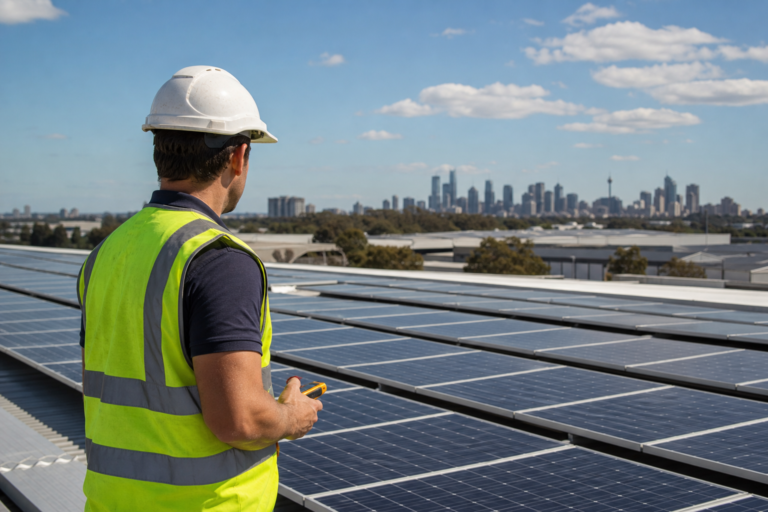
A simple, flat metal roof, for instance, is fairly straightforward to work on. But a sloped, tiled roof covered in obstacles like vents, skylights, and air conditioning units? That requires a lot more planning, specialised mounting gear, and labour.
The state of your existing electrical infrastructure is another huge factor. An older switchboard might need to be upgraded to safely handle the new power coming from the solar system, adding to the project's scope and budget.
Installation Complexity and Labour
The final piece of the cost puzzle is the installation itself. The labour needed to install a commercial solar system correctly and safely is a major part of the budget, and it reflects the installer’s expertise and their commitment to quality workmanship.
Here are a few key things that influence labour costs:
- Roof Type and Access: As we touched on, tricky roofs take more time and skill. Just getting safely onto the roof can also add to the labour hours.
- System Size: It’s simple maths—bigger systems need more people and more time for mounting, wiring, and commissioning.
- Electrical Work: The distance from the solar panels on the roof to your main switchboard determines how much cabling is needed and how complex that connection will be.
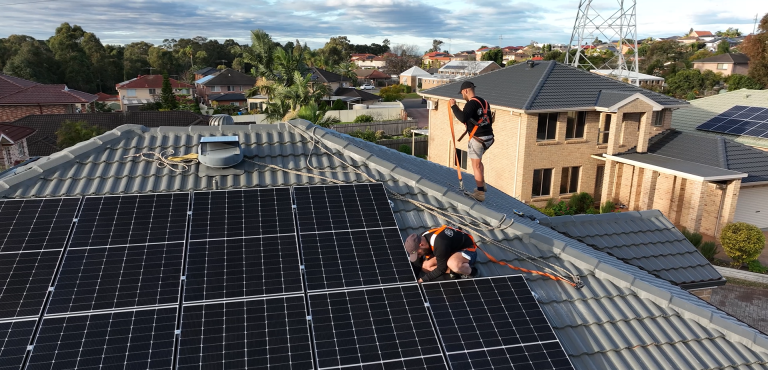
- Compliance and Safety: A professional installer doesn’t cut corners. They follow strict safety standards, using harnesses, scaffolding, and other measures to protect their team and your property.
Cutting corners on the installation is the quickest way to end up with an underperforming or, worse, an unsafe system. An experienced, in-house team ensures the job is done properly the first time.
To get a better sense of what goes into a great system, you can learn more about our approach to commercial solar and see how we design every project around our clients' specific goals.
Unlocking the True ROI of Your Solar System
It’s easy to get hung up on the upfront price of a commercial solar system. But focusing only on the initial spend misses the bigger picture entirely. A solar installation is one of the few business assets that doesn’t just sit on the books—it actively pays for itself and then keeps generating returns for decades.

The moment your system is switched on, it starts working for you. A powerful combination of government incentives, massive energy savings, and even bonus credits come together to build an undeniable financial case for your NSW business.
How Government Incentives Slash Your Upfront Cost
One of the best financial perks comes right at the start, thanks to Australia's Small-scale Technology Certificates (STCs). The easiest way to think of STCs is as a massive, point-of-sale discount on your system.
This isn't a tax rebate you have to claim months later. Instead, the value is deducted directly from your invoice by your installer, right then and there.
For any commercial system up to 100kW, these certificates are created based on the system's size and your location. Your installer, like Interactive Solar, handles all the admin of creating and selling them for you, passing the full value on as an upfront cost reduction. This immediately brings down your net investment and gets you on the fast track to a shorter payback period.
This incentive is the foundation of the business case for solar. It’s designed to make the initial commercial solar installation costs much more manageable and kick-start your journey to energy independence.
The Power of Self-Consumption
The real engine driving your solar ROI is self-consumption. It’s a simple concept: you use the solar power you generate in real-time to run your business. Every kilowatt-hour (kWh) your panels produce and you use is a kWh you don't have to buy from the grid at its ever-climbing retail price.
Think of it like pre-paying for a huge chunk of your electricity for the next 25+ years at a fixed, rock-bottom rate. Once the system is paid off, that power is basically free. This gives you two massive advantages:
- Cost Certainty: You lock in your energy costs, making your business far more resilient against volatile grid electricity prices. Budgeting becomes a whole lot easier when one of your biggest operational expenses is under your control.
- Significant Savings: By directly offsetting your daytime energy use—often when power is most expensive—you can slash or even wipe out your consumption charges from your energy retailer.
For businesses in NSW, where grid prices can be particularly high, maximising self-consumption is the quickest path to a strong return. We analyse your energy bills to design a system that perfectly matches your daytime electricity needs, making sure nearly every electron generated is working for your bottom line.
You can start getting a feel for your potential savings with our simple solar savings calculator.
Unlocking Extra Value with Feed-in Tariffs
So, what happens if your system produces more power than your business is using at that moment? That extra energy isn't wasted. It’s automatically sent back to the grid, and your electricity retailer pays you for it through a feed-in tariff (FiT).
While FiT rates are usually lower than what you pay for power, they act as a valuable bonus revenue stream. This income helps chip away at any remaining electricity bill, often covering those fixed daily supply charges or any small amount of grid power you still use. It's an extra layer of financial upside that boosts your overall ROI.
Recent data shows just how powerful this all is. An analysis by the Australian Energy Council found that by the first quarter of 2024, larger commercial solar systems in key markets like Sydney had brought effective energy costs down to between 8.12-9.01 c/kWh.
To put that in perspective, this is a world away from the industrial averages of 10.72 c/kWh back in 2014-15. This data proves that a well-designed solar installation isn’t an expense—it's a powerful financial tool for any forward-thinking NSW business. You can dive into the details in the full Australian Energy Council solar report.
Smart Ways to Finance Your Commercial Solar Project
Worried about the huge capital outlay for a commercial solar project? You don't have to be. The idea that you need a mountain of cash sitting in the bank is one of the biggest myths holding businesses back.
In reality, there are several flexible ways to fund a high-performance solar system, making it accessible for almost any business, no matter your cash flow situation.
Choosing the right structure means you can start slashing your energy costs from the very first month. The goal is to find an option that fits your financial strategy, turning your solar system into a cash-flow-positive asset right from the get-go. Your energy savings effectively cover the financing payments, making the whole investment feel seamless.
Outright Purchase (CAPEX)
The most direct route is an outright purchase, known as a Capital Expenditure or CAPEX investment. You simply pay for the entire system upfront using your company's funds.
While this needs the most initial capital, it also delivers the highest long-term returns. Why? Because you won't have any ongoing finance costs or interest payments chipping away at your savings. For businesses with healthy cash reserves, this is often the smartest path.
You own the asset from day one and can claim all the financial perks directly, like depreciation and government incentives. It’s the fastest way to pure profit from the energy your roof generates.
Chattel Mortgage or Equipment Loan
A chattel mortgage is easily one of Australia's most popular financing options for commercial solar. It’s simple to wrap your head around because it works just like a loan for any other critical business asset, whether that's a new company ute or specialised machinery.
Here’s the simple breakdown:
- Ownership: Your business owns the solar system from the moment it's installed.
- Loan: A lender fronts the cash to cover the installation, and you make regular payments over a fixed term.
- Security: The solar system itself acts as the security (the "chattel") for the loan.
The real beauty of a chattel mortgage is that you still own the asset. This means your business can typically claim depreciation and the GST component of the purchase on your next BAS, giving your cash flow a significant boost.
This structure lets you tap into solar savings immediately without having to drain your working capital.
Solar Leases and Power Purchase Agreements (PPAs)
If keeping your capital untouched is the number one priority, a solar lease or a Power Purchase Agreement (PPA) is an excellent way to go. These are your "$0 upfront" solutions. A third party installs, owns, and maintains the solar system on your roof, and you just reap the benefits.
With a solar lease, you pay a fixed monthly fee to "rent" the system. This fee is almost always set lower than your current electricity bill, guaranteeing you save money from day one.
A PPA works a little differently. Instead of paying to rent the gear, you agree to buy the solar power it generates at a cheap, pre-agreed rate per kilowatt-hour (kWh). That rate is locked in for the long haul, protecting your business from future grid price hikes.
Both are hassle-free ways to go solar. You get to sidestep the commercial solar installation costs and forget about maintenance, all while enjoying a healthier bottom line. It's a powerful strategy for any business wanting to cut costs without a capital investment.
Plus, with various state-based programs on offer, it’s worth learning how NSW government rebates for solar can work alongside your chosen financing path.
Future-Proofing Your Investment with Batteries and EV Charging
A smart energy strategy does more than just chip away at today's power bills; it sets your business up for the future. While installing solar panels is a fantastic first move, pairing them with commercial batteries and electric vehicle (EV) charging is what truly transforms your site into a modern energy asset.
This isn't just about bolting on more equipment. It's a fundamental shift in how your business controls its energy, building in resilience and opening up new ways to operate that can give you a real competitive advantage.
Turning Your System into a Private Energy Reserve
Think of a commercial solar battery as your business's own private energy vault. During the day, your panels are busy generating clean, cheap electricity. Instead of exporting all the excess power back to the grid for a pittance, a battery lets you capture and store it for when you really need it.
For any NSW business with operations that run into the evening or overnight, this is an absolute game-changer.
- Beat Peak Tariffs: Why pay top dollar for grid power in the late afternoon? Use your own stored solar energy to run your operations during the most expensive time-of-use periods.
- Overnight Operations: Power your security systems, essential equipment, and lighting through the night using the clean energy you generated for free hours earlier.
- Energy Security: When a blackout hits, a battery can provide backup power to keep your critical systems online, preventing costly downtime and disruption.
Storing your own solar power gives you the ultimate control. You get to decide when to use it, which maximises your savings and shields your business from the grid’s unpredictable price hikes.
For businesses serious about achieving genuine energy independence, looking into commercial solar batteries is a non-negotiable part of the design process. It’s the difference between just trimming your bill and taking full command of your energy destiny.
Powering the Future with EV Charging
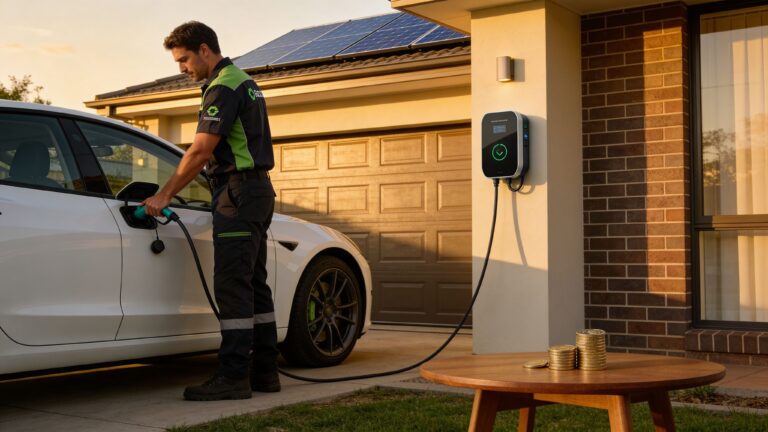
The EV revolution isn't coming; it's already here in Australia. This shift presents a massive opportunity for businesses that are ready to adapt. Your commercial solar system is the perfect power source for on-site EV chargers, positioning your company as both a leader in sustainability and a genuinely modern workplace.
Adding EV charging isn't just a feel-good measure; it delivers real, tangible benefits to your business, your people, and your customers.
- Employee & Visitor Perk: Offering EV charging is quickly becoming a high-value amenity that helps you attract and keep great staff and makes your site more welcoming to eco-conscious clients.
- Fleet Electrification: If your business runs a fleet of vehicles, fuelling them with your own solar power will slash your operational costs and cut your reliance on petrol.
- New Revenue Stream: You can set up publicly accessible chargers to generate income, effectively turning a few parking spots into a new profit centre for the business.
Installing EV charging infrastructure is more than a green tick-box exercise; it’s a strategic business decision that aligns you with the future of transport. It sends a powerful message about your commitment to sustainability that resonates with today’s customers and stakeholders. If you're keen to explore this further, a great place to start is this guide on Commercial EV Charging Solutions.
By combining solar with EV charging, you're not just shrinking your carbon footprint—you're building a smarter, more profitable, and more resilient business.
Your Checklist for a Truly Accurate Solar Quote

To get a solar proposal that’s actually worth the paper it’s printed on, you need to move past ballpark figures. Vague quotes built on guesswork are a sure-fire way to end up with a system that disappoints. A genuine expert doesn’t guess; they analyse.
When you walk into a solar consultation with the right information in hand, the entire dynamic changes. It stops being a sales pitch and becomes a proper design session, with you in the driver's seat. This preparation turns a vague number into a bankable plan for your business's energy future.
Gather Your Essential Energy Data
The bedrock of any high-performance solar system is a rock-solid understanding of how your business uses power. Without this, any installer is just flying blind. Before you meet with anyone, pull these documents together.
12 Months of Electricity Bills: This is the absolute minimum. A full year of bills shows your seasonal energy swings, demand charges, and how your time-of-use tariff works. An installer uses this to map out exactly when and how much power you're drawing from the grid.
Half-Hourly Interval Data: If you can get this from your energy retailer, you've struck gold. This gives a minute-by-minute, 30-minute breakdown of your power usage, allowing for incredibly precise system sizing and savings forecasts.
Future Operational Plans: Are you planning to add a new production line, install EV chargers, or extend your operating hours? Any big change that will affect your future power consumption needs to be baked into the design from day one.
This data isn't just "nice to have"—it's non-negotiable for a quote you can trust. It’s what allows a good installer to size a system that maximises how much solar you use yourself, delivering the strongest possible return on your investment.
Handing over this data lets your solar partner design a system that guarantees performance. It’s the difference between a system that looks good on paper and one that actually delivers savings to your bottom line for the next 25+ years.
Prepare Your Property and Business Details
Beyond just your power bills, the specifics of your site and business operations are critical to the final design and cost. Any decent installer will do a full site inspection, but having this info ready makes your first meeting far more productive.
Be ready to talk about:
Roof Information: What’s the age, material (like metal, tile, or membrane), and general condition of your roof? Also, make a note of where big things like HVAC units, vents, and skylights are, as they’ll impact where panels can go.
Electrical Infrastructure: You’ll need to know where your main switchboard and any sub-boards are located. Understanding your building’s electrical setup is vital for ensuring the solar system can be connected safely and legally.
Business Operating Hours: Be crystal clear about when your business is running. This helps figure out if your peak power usage lines up with peak solar production—a key factor in calculating your savings.
Financial Goals: Be upfront about what you want to achieve. Are you chasing the fastest possible payback? The biggest long-term savings? Or are you aiming for specific sustainability targets?
Coming prepared with this checklist lets you have a serious, productive conversation. It helps you quickly spot the installers offering cookie-cutter solutions and find a true expert committed to designing a system built for your business.
Common Questions About Commercial Solar
As you start looking into a commercial solar setup, it's completely normal for a few key questions to pop up. We hear them all the time from Sydney business owners.
Here are some clear, straight-to-the-point answers to help you move forward with confidence.
What Is a Realistic Payback Period for a Commercial Solar System?
This is the big one, and the answer is surprisingly fast. Most NSW businesses see a full return on their investment within 3 to 6 years.
This quick payback is driven by a powerful combination of massive drops in your electricity bills and the government incentives currently available. Once your system is paid off, every kilowatt of energy it generates is almost pure profit, carving out what was once a major operational cost for decades to come.
Of course, a proper, data-driven proposal will give you a precise payback calculation tailored specifically to your business's energy use and financials.
Is a Solar Battery Necessary for My Business?
Not always, but it's becoming an incredibly powerful upgrade for almost any commercial operation. If your business runs almost entirely during daylight hours, you’ll use most of your solar power as it's generated, making a battery less critical from day one.
However, a battery is a game-changer in a few key scenarios:
- You Have Significant Overnight Loads: Think refrigeration, security systems, or any essential equipment that runs after the sun goes down. A battery lets you power them with stored solar energy instead of paying for expensive grid power.
- Energy Security is Critical: For any business where a blackout, even a short one, causes major headaches and financial loss, a battery provides essential backup to keep your critical operations online.
- You Want to Maximise Savings: A battery gives you ultimate control. You can store your own cheap solar power and use it during the evening peak tariff periods, effectively telling your energy retailer you don't need their expensive power anymore.
A great strategy is to install a 'battery-ready' solar system. This gives you the flexibility to easily add energy storage down the track as your needs change or battery tech becomes even more attractive, future-proofing your initial investment.
How Will the Installation Process Affect My Operations?
Minimising disruption is the number one priority for any professional solar installer worth their salt. The good news is that almost all the work happens out of the way on your rooftop and around your main switchboard.
We work closely with your team to lock in a schedule that works for you. Any brief shutdown needed for the final grid connection is always planned for a time that causes the least possible impact—think after hours or on a weekend.
Our goal is simple: keep your business running smoothly from start to finish.
Ready to take control of your energy costs and future-proof your business? The expert team at Interactive Solar is here to provide a detailed, data-driven proposal showing exactly what solar can do for you. Visit https://interactivesolar.com.au to book your obligation-free consultation today.
Make Interactive Solar a preferred source in Google
One click tells Google to surface our articles more often in Top Stories, AI Overviews and AI Mode.