
Residential Homes

Storage & Industrial
Residential Sheds & Garages

Schools & Universities
Commercial Buildings

Warehouses

Fights mould and condensation build-up in your roof cavity. The Solarark roof ventilator reduces the chances of mould spores in the roof space that can harm the health of your roof and the quality of air in your home.
Being totally solar-powered, the MaxBreeze roof ventilator has a $0 operating cost of the life of the product.
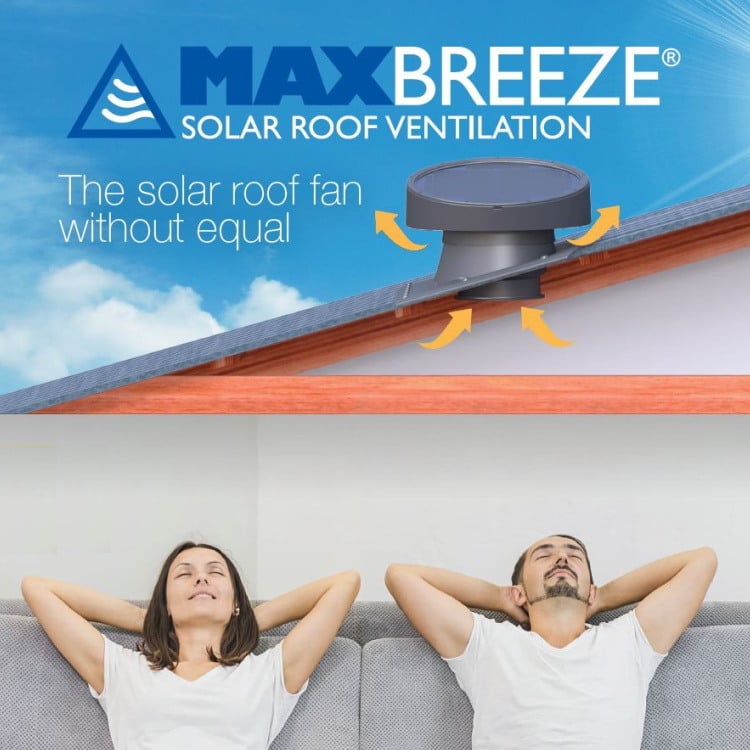
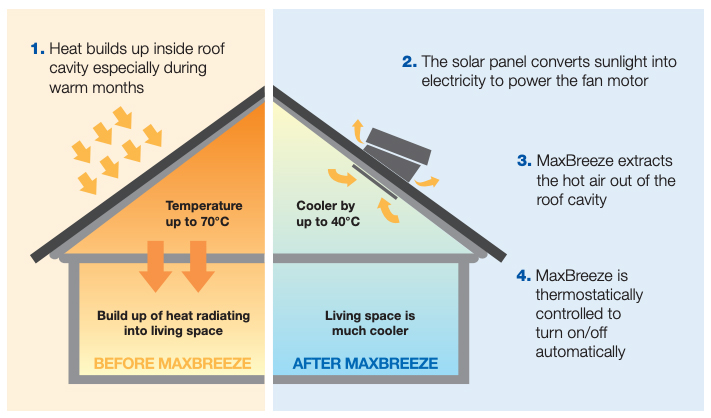
Your roof cavity is the hottest part of the house. On a summer day the space above your ceiling can reach around 70 degrees, and that heat sits there radiating down into the rooms below long after the sun has gone off the roof. Your air conditioner then spends the evening fighting a ceiling that is essentially a giant radiator. The MaxBreeze attacks the problem at the source. A dedicated solar panel, adjustable so it can be angled to face north for maximum sun, converts daylight straight into electricity and drives a brushless DC motor mounted in the roof. That fan pulls the superheated air out of the cavity and pushes it outside, drawing cooler air in through the eaves to replace it. Because it is actively powered rather than relying on a passing breeze, it moves serious volume: up to 2,200 cubic metres of air an hour on the larger models, which the brochure puts at more than twenty times what a whirly-bird shifts. The result is a cooler ceiling, a cooler living space, and an air conditioner that has far less work to do. It also pulls moisture out, which matters in winter for condensation, mould and timber rot.
The intelligence is in the thermostat. Every model has one, and it switches the fan on and off automatically based on the temperature in the cavity, so there is nothing for the homeowner to operate. On a stifling still day with no wind at all, exactly when a whirly-bird is sitting motionless and useless, the MaxBreeze is running at full noise and clearing the heat. On a cold winter day the thermostat keeps it switched off, so the warm air stays trapped in the cavity and helps insulate the home, whereas a wind driven whirly-bird spins away in the winter gales stripping out that warmth and pushing your heating bill up. Where the models differ is what happens after sunset. The entry level MB-25S20W is daytime only. The Standard MB-40S40W adds a mains power option via a supplied plug, and the Zephyr MB-40Z80W runs a second 40W panel with a built in 9.6ah lithium battery that charges through the day and keeps the fan running through the night, purging the heat the roof soaked up during the day so the house starts the next morning cooler. Running cost across the range is zero, since it powers itself off its own panel and simply pays back through lower cooling bills.

Make Interactive Solar a preferred source in Google
One click tells Google to surface our articles more often in Top Stories, AI Overviews and AI Mode.