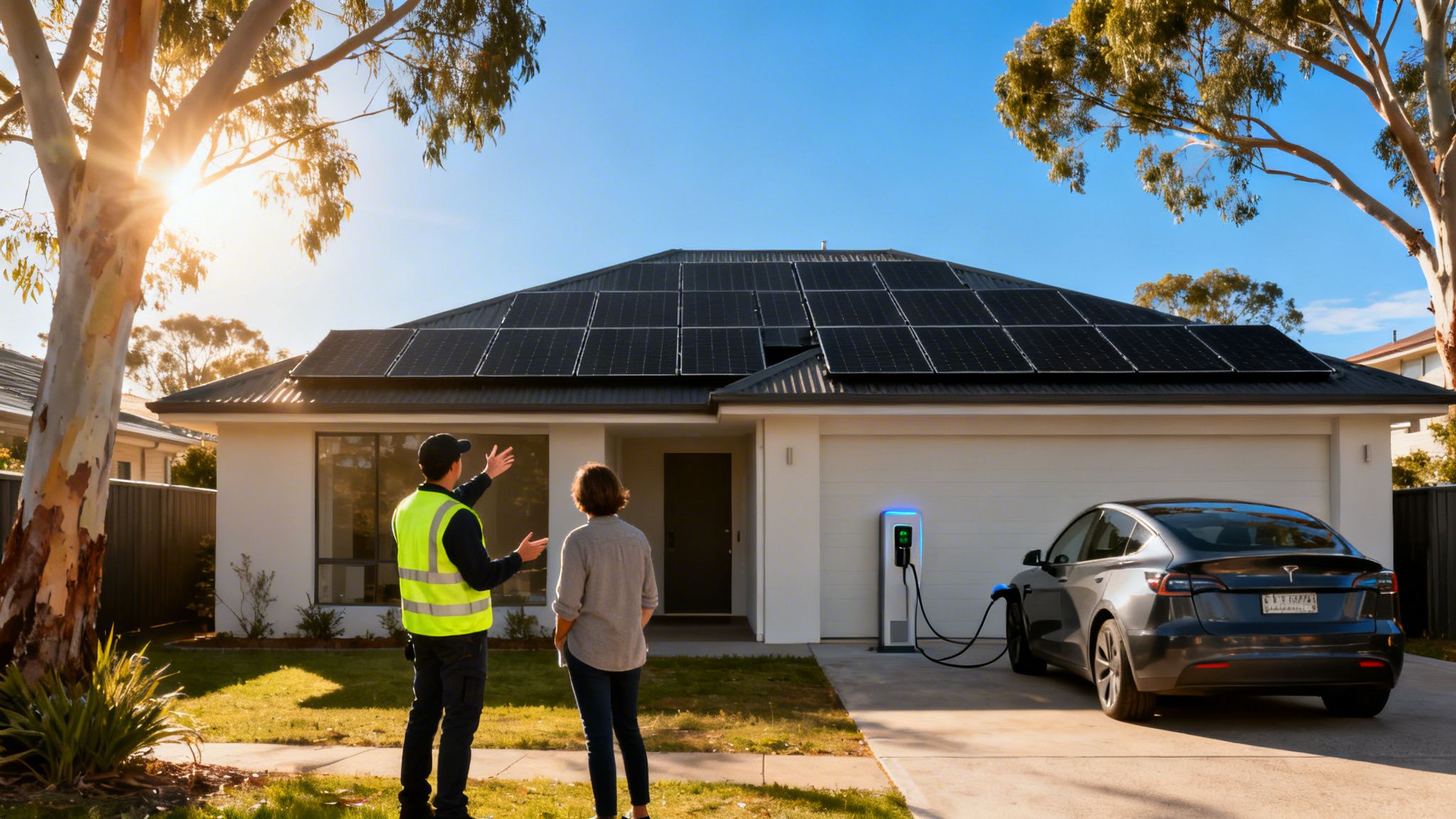
Unlock Savings with Solar Panel Installation Western Sydney
Thinking about getting solar panels for your home in Western Sydney? You’re not alone. Drive through any suburb from Penrith to Parramatta, and you’ll see thousands of your neighbours have already made the switch. They’re tapping into our abundant sunshine to slash their power bills and gain some real energy independence.
Why Western Sydney Is Going Solar
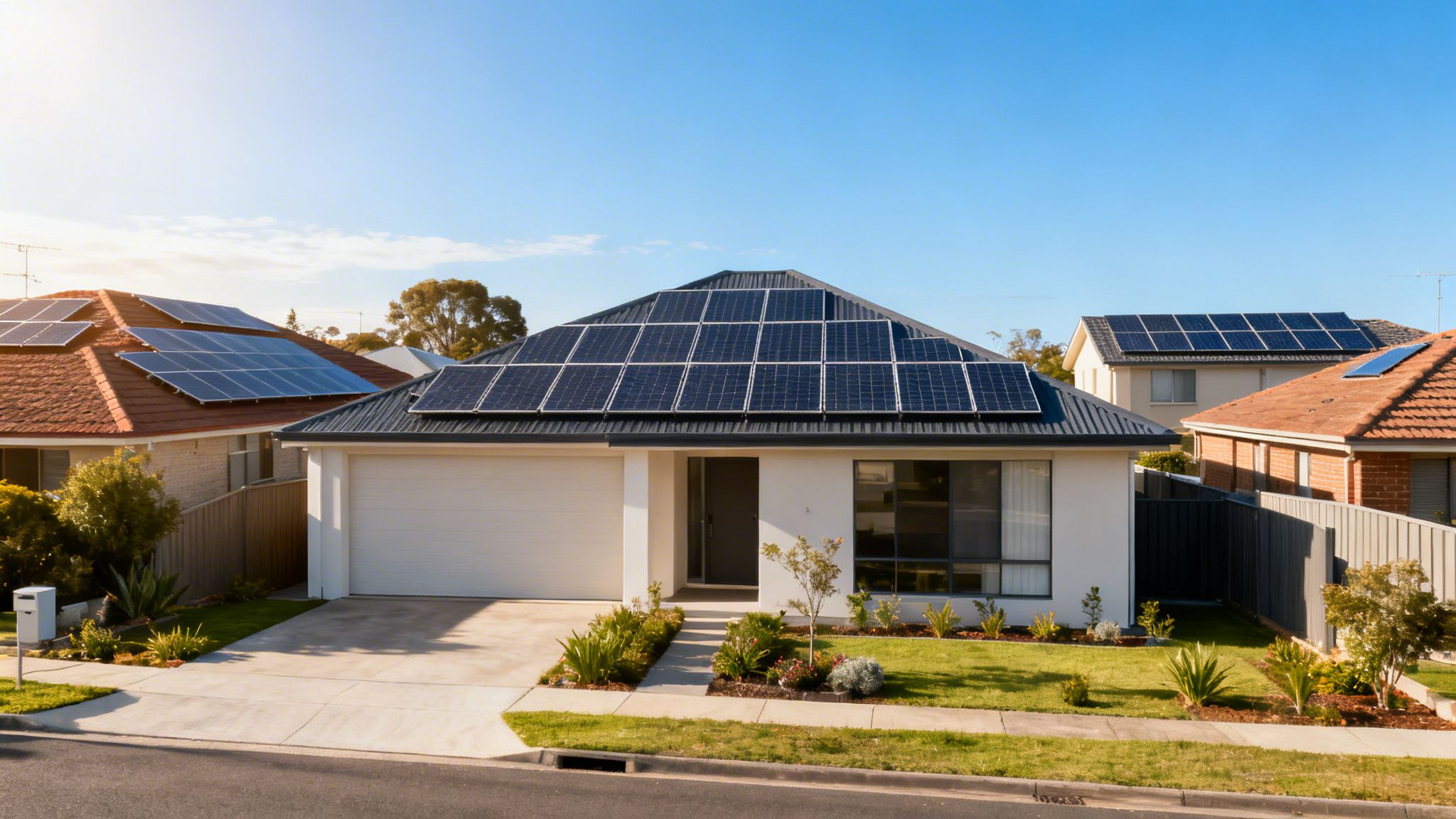
The move to solar across Western Sydney isn’t just a passing trend. It’s a smart, practical response to electricity costs that just keep climbing and a growing desire to take back control of the household budget. Local homeowners and small business owners are quickly figuring out that a quality solar installation isn't an expense—it’s one of the best investments you can make in your property.
And the numbers back it up. Our region has become a powerhouse for renewable energy, with Western Sydney homes and businesses accounting for a massive 25% of all small-scale solar systems in New South Wales. That adds up to roughly 65,000 rooftop systems pumping out nearly 300 megawatts (MW) of clean, local power.
A Quick Overview of Solar Benefits in Western Sydney
To see why so many locals are making the switch, here's a quick summary of what you can expect.
| Benefit | Typical Outcome for a Western Sydney Property |
|---|---|
| Lower Power Bills | Drastically reduce, or even eliminate, your quarterly electricity bills. |
| Energy Independence | Generate your own power, reducing reliance on an unpredictable grid. |
| Future-Proofing | Protect your budget from future electricity price rises with your own power source. |
| Increased Property Value | A modern solar system with battery and EV charging is a major selling point. |
| Environmental Impact | Lower your household's carbon footprint by using clean, renewable energy. |
These benefits come together to provide real financial relief and peace of mind, which is why solar has become such a popular choice across the region.
Your Roadmap to Energy Freedom
We've put this guide together to be your straightforward, no-nonsense roadmap. It’s here to walk you through the entire process, from the first chat with an installer to the moment you flick the switch and start generating your own clean power in 2026. Think of it as your plan for breaking free from the grid and shielding your finances from those wild price swings.
The first step is getting your head around how a solar power system works. At its heart, it’s about converting free sunlight into usable electricity for your home, which means you buy far less from your energy retailer.
A solar installation is so much more than just panels on a roof. It's a complete energy solution. The inverter acts as the system's brain, and you can add solar batteries or EV chargers to build a truly self-sufficient home energy hub.
As we go through this guide, we'll break down exactly how you can:
- Take a huge bite out of your electricity bills.
- Future-proof your home against rising energy prices—something we cover in our guide on how to prepare for electricity price rises.
- Find a trusted local expert to design and install the perfect system for you.
By the time you’re done reading, you'll have the confidence and knowledge to make a smart decision and finally take back control of your power costs.
Is Your Property a Good Fit for Solar?
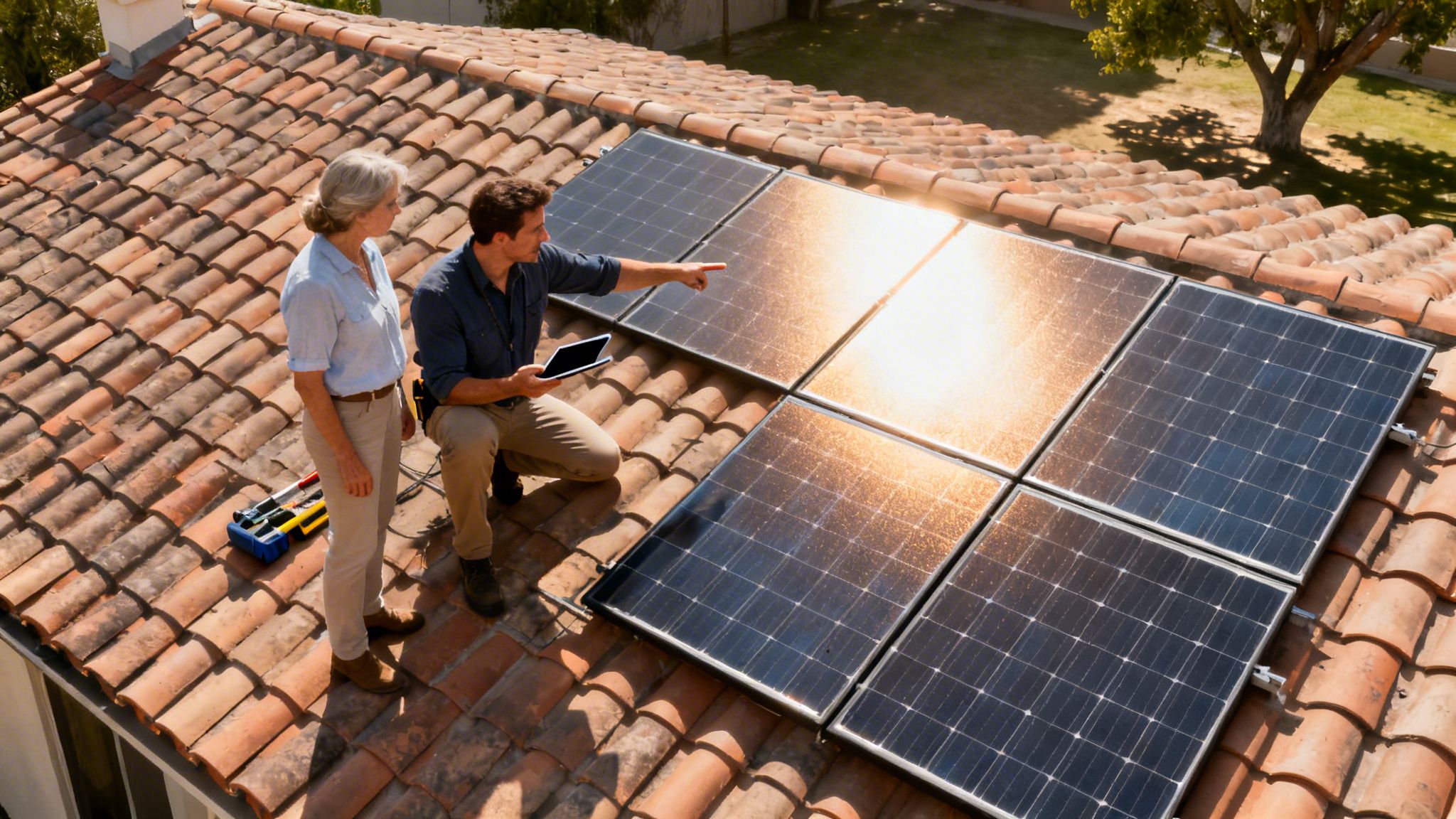
Before we even talk about brands or system sizes, there’s a more fundamental question: is your place actually suited for solar? Think of your roof like a patch of land for a garden—for anything to grow, you need plenty of sun and the right conditions. Any professional solar panel installation in Western Sydney will kick off with a detailed site assessment, but you can get a head start by doing a quick evaluation yourself.
Knowing what an installer is looking for makes you a smarter buyer. You’ll be able to ask better questions and properly understand the recommendations they give you. Let's walk through the main things that determine your property's solar potential.
Your Roof’s Direction and Angle
In Australia, a north-facing roof is the gold standard. It soaks up the most sun as it tracks across the northern sky all day long, which means you get the highest possible energy generation.
But don’t stress if your roof doesn’t face due north. Plenty of homes across Western Sydney have fantastic results with panels on other sections of their roof.
- East-Facing Panels: These are great for catching the strong morning sun. If your household is a whirlwind of activity in the mornings—showers, breakfast, getting ready for work and school—this setup helps offset that early peak usage.
- West-Facing Panels: Perfect for capturing the hot afternoon sun. West-facing panels keep generating power later in the day, which is ideal if your peak energy use hits when everyone gets home and the air con goes on.
- East-West Split: This is a really popular and effective layout. By splitting panels across both your east and west roof faces, you get a much broader and more consistent stream of power all day, rather than one big spike around noon.
The pitch, or angle, of your roof also matters. Most Aussie roofs have a decent pitch for solar, but a good installer will make sure the panels are tilted to the optimal angle for your exact location.
Checking for Shade and Obstructions
Shade is the number one enemy of solar panels. A small shadow from a branch or chimney falling on just one panel can drag down the performance of the whole system. You need to become a bit of a "shade detective."
Take a look at your roof at different times of the day and think about the different seasons. What could cast a shadow on it? The usual suspects in Western Sydney suburbs are:
- Big Trees: Those beautiful, established gum trees in your yard or your neighbour’s can cast surprisingly long shadows, especially in the morning and late afternoon.
- Neighbouring Buildings: A new two-storey house going up next door can suddenly block the sun you’ve always had.
- Your Own House: Don't forget about obstructions on your own roof, like chimneys, satellite dishes, or even a second-storey wall shadowing a lower roof area.
A professional installer doesn't just guess. We use specialised software to map the sun’s path over your roof for an entire year. This "solar path analysis" pinpoints exactly where and when shadows will fall, so we can design a panel layout that avoids them and gets you the most energy possible.
Your Roof’s Material and Condition
Finally, the roof itself is a huge factor. The good news is that most common roof types in Western Sydney, like terracotta tiles and Colorbond steel, are perfect for solar. Installers use specific mounting systems designed for each roof type to ensure everything is secure and completely watertight.
The condition of the roof is just as important. If your roof is old, has cracked tiles, or is in poor shape, it absolutely must be repaired before any panels go on. A professional will also check the underlying structure to make sure it can handle the weight of the panels for the next 25+ years.
A healthy roof also contributes to your home's overall efficiency. You can find out more about how proper roof ventilation complements a solar system and helps keep your home cooler in our detailed guide.
Designing a Solar System That Fits Your Needs
Once we know your property is a good fit for solar, the real work begins: designing a system that’s built for your specific lifestyle. When it comes to solar panels in Western Sydney, there’s no such thing as ‘one-size-fits-all’. A custom design is the only way you’ll get the performance and savings you’re looking for.
Think of it this way: you wouldn’t pack the same lunch for a day in the office as you would for a long hike. Your solar system works the same way. It needs to be sized to generate enough power for your home's unique energy appetite, cutting down what you have to buy from the grid.
To get this spot-on, the first thing any good solar installer will ask for is your electricity bill. It’s not about being nosy—it’s about understanding your home’s energy pulse.
Analysing Your Energy Consumption
Your power bill is a goldmine of data. The most important number on there is your average daily energy consumption, measured in kilowatt-hours (kWh). This tells us exactly how much power your household chews through on a typical day.
A skilled designer will dig into your bills to spot the patterns:
- Daily Usage (kWh): How much energy do you actually use each day? This is the starting line for sizing your system.
- Peak Usage Times: When are you using the most power? Is it that chaotic morning rush, or is it the afternoon when the air con kicks in and dinner is on the go?
- Seasonal Variations: Your usage will naturally climb in summer (thanks to air conditioning) and winter (for heating). A smart design has to account for these peaks to make sure you have power when you need it most.
Your electricity bill is a roadmap to your energy profile. By understanding your daily kWh consumption and when you use it, we can design a system that works for you, not just a system that sits on your roof. The goal is to generate power when you need it most.
This detailed analysis is what separates a quality solar installer from a company just trying to move boxes. It’s about creating a solution tailored to your home and family, not just selling you a generic package.
Choosing the Right Components
Once we have a clear picture of your energy needs, we can start picking the hardware. A solar system isn't just a bunch of panels; it’s a power plant in miniature, and every part has to work together seamlessly.
- High-Efficiency Solar Panels: These are the workhorses, turning sunlight into DC electricity. We only use panels with top-tier efficiency ratings and proven durability that can handle the harsh Western Sydney sun for decades.
- The Inverter: This is the brain of the whole operation. It converts the DC power from your panels into the 240V AC power your appliances run on. A quality inverter is also your window into the system, giving you all the monitoring data you need.
- Durable Mounting Hardware: This is the unsung hero. The mounting system is what physically secures your panels to the roof, keeping everything watertight and locked down against strong winds. Using the right hardware for your roof type isn't just important—it's non-negotiable.
The massive growth of solar in our area shows just how effective a well-designed system can be. Across New South Wales, there are now 1,137,478 operational systems, meaning a staggering 33.81% of households have gone solar.
Western Sydney is a huge part of this story. Postcodes like 2765 have seen 1,823 installations, making it one of Australia’s solar hotspots. This success is built on systems averaging 6.43 kW, which are expertly designed to maximise self-consumption and send surplus power back to the grid—proving what’s possible with the right design.
Future-Proofing Your Solar System
A truly great solar design doesn't just cover your needs today—it looks ahead to what you’ll need tomorrow. We call this future-proofing. Life changes, and your energy needs will almost certainly grow over the 10 to 25-year lifespan of your system.
We always ask about your future plans to make sure your investment is ready for what's next.
- Are you thinking of starting a family, or will your kids be teenagers soon?
- Are you working from home more often?
- Is an electric vehicle (EV) on your radar for the next few years?
- Could a new pool or a ducted air conditioning system be in your future?
If you answered yes to any of these, your power consumption is going to go up. A future-proofed design might mean installing a slightly larger inverter now, making it simple and affordable to add more panels down the track. By planning ahead, you ensure your solar system grows right alongside you.
To get a clearer picture of what a custom-sized system could do for your bills, you can use our calculator to estimate your solar savings.
Go Beyond Panels: Batteries and EV Chargers for True Energy Independence
Getting solar panels on your roof in Western Sydney is a brilliant first move to cut down your power bills. But it's really just the start. To get the absolute most out of your system, two key upgrades can turn your home into a self-sufficient energy powerhouse: a solar battery and an electric vehicle (EV) charger.
Think of it like building a complete home energy ecosystem. The panels are your power plant. The battery and EV charger are how you use that free, clean energy whenever you want—not just when the sun’s out.
Your Energy Savings Account: The Solar Battery
Picture this: it's a brilliant sunny day, and your panels are cranking out a massive amount of power. But you're at work, the kids are at school, and the house is empty. Without a battery, all that extra energy you’re not using gets sold back to the grid. It’s better than nothing, but it’s not nearly as valuable as using that power yourself.
This is where a solar battery completely changes the game.
Think of a solar battery as your personal energy savings account. All day, you make ‘deposits’ of free solar power. At night, when your panels are off, you simply ‘withdraw’ that energy to run your lights, TV, and air con instead of buying it from the grid at sky-high peak rates.
This simple shift delivers two huge advantages:
- Maximise Your Own Solar: Using your own stored power at night means you buy far, far less from your energy retailer. This is how you really squeeze every drop of value out of your solar system and slash your bills.
- Get Blackout Protection: A properly set up solar battery offers vital backup power. When the grid goes down in your street, your essentials—like the fridge, lights, and internet—can keep running without a hitch.
By storing your own solar, you build a powerful defence against unpredictable electricity prices and an unreliable grid. You become far more self-reliant, running your home on clean energy you made yourself. If you're weighing up your options, our detailed solar battery comparison guide breaks down the best models available.
Fuelling Your Future with an EV Charger
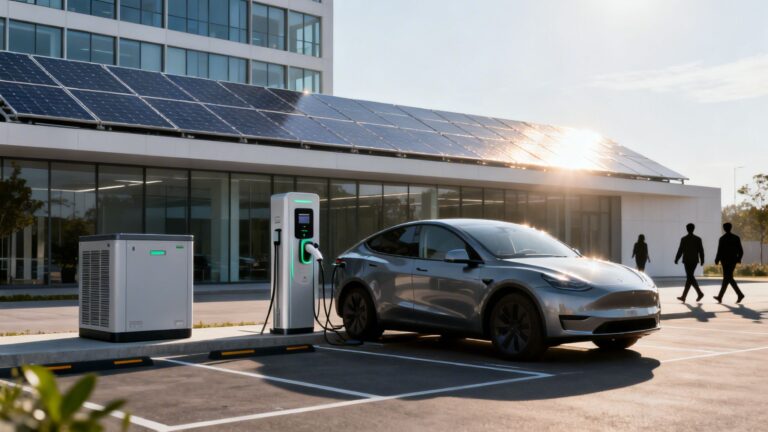
The other game-changing upgrade is an integrated EV charger. Electric vehicles are no longer a novelty; they’re rapidly becoming the norm. And being able to charge your car at home with your own solar power is the ultimate move for your wallet and the planet.
Imagine never visiting a petrol station again. By wiring a dedicated EV charger into your solar setup, you can literally fuel your car with sunshine.
This is way smarter than just plugging your car into a standard wall socket. A proper solar EV charger talks to your inverter, making sure it pulls as much free solar power as possible to charge your vehicle.
This means you can:
- Charge for Free: Instead of exporting your excess solar for a tiny credit, you can send it straight into your car’s battery.
- Charge Faster and Safer: A dedicated charger is much quicker and safer than a regular power point, which wasn't designed for that kind of heavy, continuous load.
- Future-Proof Your Home: Don't have an EV yet? No problem. Getting the wiring done during your solar install is a clever and cost-effective move. It makes your home "EV-ready," which is a massive selling point for future buyers.
Adding an EV charger to your solar panel installation in Western Sydney completes your personal energy ecosystem. You're not just powering your home anymore; you're powering your transport, too. This single strategy insulates you from both rising electricity bills and volatile fuel prices, delivering genuine energy independence for years to come.
The Solar Installation Process from Start to Finish
So, you’ve signed on the dotted line and your custom solar design is locked in. It’s a great feeling, but it’s often followed by a big question: "What happens now?"
The good news is that the journey from paperwork to powering your home is a well-oiled machine. We handle everything, but it helps to know what’s going on behind the scenes and what to expect on the big day. Let's walk through it.
This diagram shows how all the pieces of a modern home energy system fit together.
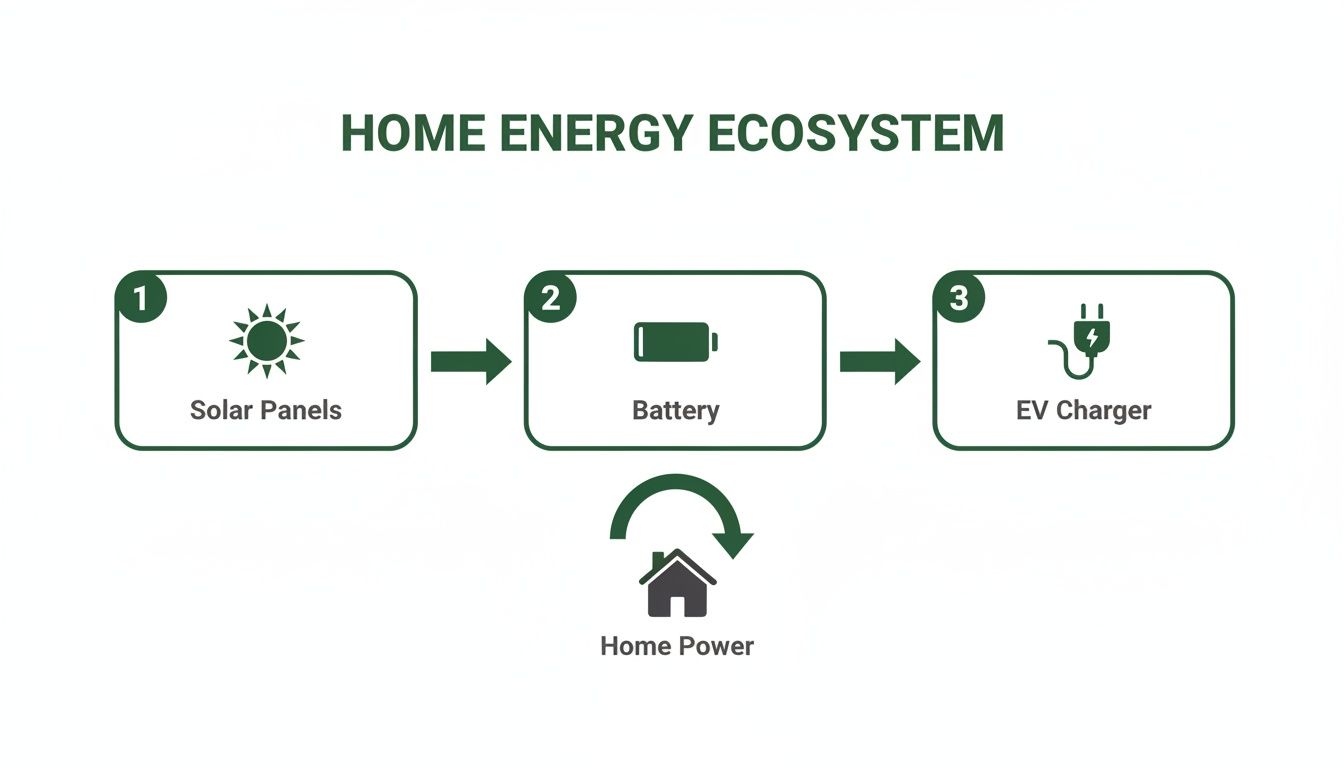
The panels create the power, which you can use straight away. Any excess can be stored in a battery for nighttime use or sent to your EV charger, creating your own little power station at home.
Before the Big Day
Before our team even thinks about stepping onto your roof, there's a flurry of activity behind the scenes. We're busy sorting out all the red tape to make sure your installation is 100% compliant and ready to roll.
Here’s what we’re taking care of:
- Grid Connection Approval: We handle all the applications with your electricity network provider (that’s usually Endeavour Energy for most of Western Sydney) to get the official green light to connect your system to the grid.
- Permit and Compliance Checks: We make sure the design and plan tick all the boxes with local council rules and Australian Standards.
- Sourcing Your Gear: Your panels, inverter, and mounting gear are all ordered and set aside specifically for your job at our Chipping Norton warehouse. No last-minute scrambles.
It's no surprise that solar is booming out west. As of October 2024, Western Sydney suburbs were seeing over 71 small-scale systems installed every month, adding 1,895 kW of clean energy capacity. That’s pushing household solar penetration towards the 30% mark. This reflects the statewide trend, where NSW hit a record of 377,458 installations in 2021 and kept the momentum going with 333,865 in 2023. These figures from Energy Matters show the incredible solar adoption trends across our state.
Your Installation Day
When installation day arrives, our in-house team of licensed electricians and CEC-accredited installers will show up, ready to go. For a typical home in Western Sydney, a solar panel installation takes just one to two days.
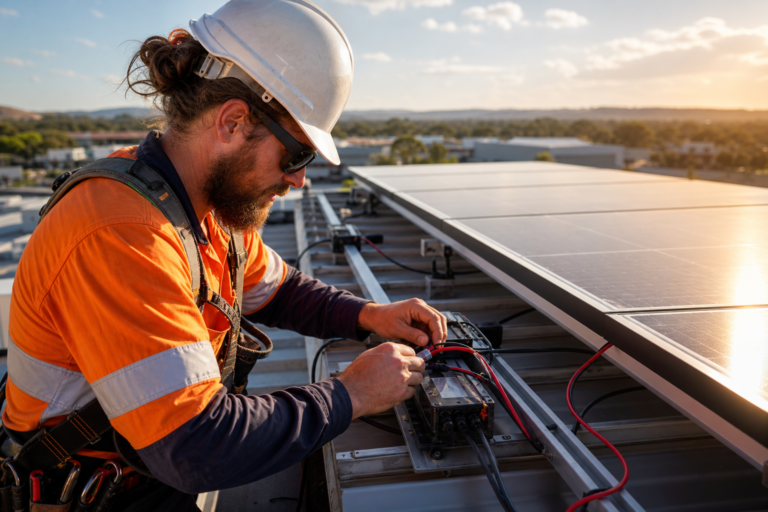
Safety isn’t just a buzzword for us; it’s everything. Our crew follows strict safety protocols, using harnesses and proper edge protection. We treat your property with the same care we’d treat our own.
Here’s a quick rundown of how the day usually unfolds:
- Mounting the Rails: First, the team installs the mounting system. This isn't just a rack; it's an engineered framework that's securely anchored to your roof rafters to create a rock-solid, weatherproof base for the panels.
- Securing the Panels: Next, the solar panels are carefully lifted onto the roof and fixed to the rails. Every panel is clamped down tight to handle anything the Aussie weather throws at it.
- Wiring and Inverter: Our sparkies then run the DC cabling from the panels down to your new inverter, which is usually installed neatly in the garage or on a shaded wall outside. From there, they wire the inverter into your home's main switchboard.
After the Installation
With all the hardware in place, the last few steps are about getting you officially connected and switched on.
We'll schedule the final grid connection and meter upgrade with your electricity provider. Once your new smart meter is in, we can officially commission the system.
Our team will then walk you through a complete handover. We’ll show you how to read your inverter, get your monitoring app set up on your phone, and understand the data so you can see exactly how much power you’re making in real-time. This final stage is just as critical as the physical install, because a system you don't understand is a system you can't get the most out of. It’s why we believe quality solar installations are so valuable from start to finish.
How to Choose a Trusted Western Sydney Solar Installer
Picking the right installer for your solar panel installation in Western Sydney is, without a doubt, the most important decision you'll make. Get this right, and your system will hum along happily for decades. Get it wrong, and you could be facing endless headaches and savings that never quite materialise.
It goes way beyond just grabbing the cheapest quote.
Think of it like hiring a builder to construct your home. You wouldn't just award the job to the lowest bidder. You'd check their track record, their qualifications, and what other locals have to say about them. Your solar installer is building your home’s power plant, and they deserve exactly the same level of scrutiny.
The Non-Negotiable Licences and Accreditations
Before you even glance at a quote, there are a couple of must-have credentials you need to verify. These aren't optional extras; they're your proof that an installer is qualified, insured, and committed to doing the job properly.
- NSW Electrical Contractor Licence: This one is mandatory. Any company touching the wiring in your home must hold a current licence. You can (and should) check this in a few seconds on the Service NSW website.
- Clean Energy Council (CEC) Accreditation: This is the gold standard for Australian solar. It shows the installer and their designers meet the highest industry benchmarks for safety and quality. Crucially, only systems installed by CEC-accredited professionals are eligible for government rebates (STCs).
If a company gets cagey or can't show you these two documents straight away, just cross them off your list. It's a massive red flag.
The True Local Advantage
Watch out for the big national "solar companies" you see online. Many are just marketing machines that farm out jobs to whichever subcontracting crew bids the lowest. A genuinely local installer with a physical office and warehouse right here in Sydney gives you a level of security they just can't match.
A local base, like our own in Chipping Norton, means we use our own in-house teams of electricians—not a rotating cast of random sparkies. It shows we’re invested in the Western Sydney community, we manage our own stock to avoid delays, and we’ll actually be here to help you years down the track.
Ask a potential installer: "Can I drop by your office or warehouse?" A real local business will have no problem with that. If they hesitate or give you a PO Box, you know they're not what they seem.
Decoding Warranties and Sifting Through Reviews
It’s easy to get confused by warranties, but there are two you need to know about. The manufacturer's warranty covers the physical gear—your panels and inverter. The workmanship warranty is the installer's promise, covering the quality of the installation itself. This is about the cabling, the mounting, and all the electrical work.
A good installer will stand by their team's work with a solid workmanship warranty of at least five years.
When you're reading reviews, look for the story behind the stars. A couple of grumpy reviews are normal for any business, but a pattern of complaints about poor communication, messy jobs, or underperforming systems is a serious warning. You want to see detailed, positive reviews that mention staff by name and talk about how smooth the process was. That tells you a lot more than a simple five-star rating ever could.
Your Top Questions About Solar in Western Sydney, Answered
Thinking about solar is a big step, and it's natural to have a lot of questions. We get it. To give you clarity and confidence, here are the answers to the most common queries we hear from homeowners across Western Sydney.
How Much Can I Realistically Save on My Bills?
This is the big one, isn't it? A professionally designed solar system can significantly reduce your reliance on grid electricity. With power prices constantly on the move, that means taking back control of your budget and locking in serious savings, year after year.
Your final savings figure comes down to a few things: your family’s power usage habits, the size of your system, and how much of that beautiful solar energy you can use directly during the day. For the biggest impact, adding a solar battery lets you use your own solar power at night, drastically cutting what you buy from the grid.
What Happens on Cloudy Days or During a Blackout?
It’s a common myth that solar panels are useless on overcast days. The truth is, they’re surprisingly good at generating power even with cloud cover—just not as much as they would on a clear, sunny afternoon. They don't need intense, direct sun to do their job.
A standard grid-connected system is designed to automatically shut down during a blackout. This is a critical safety feature to protect line workers making repairs. However, if you add a solar battery to your setup, you can store your excess energy and use it to keep your essentials running during an outage. That’s priceless energy independence right when you need it most.
How Long Does a Solar Panel Installation Take?
The on-site work is much faster than most people expect. For a typical family home, our crew can usually have the panels mounted and the inverter wired up in just one to two days.
The whole journey—from signing the dotted line to flicking the switch—generally takes a few weeks. That timeline accounts for all the crucial background work your installer handles for you, like:
- Sorting out the network paperwork with your electricity provider.
- Securing all the necessary local approvals.
- Coordinating the final grid connection and smart meter installation.
Are Government Rebates Still Available?
Absolutely. The main incentive available is the federal Small-scale Renewable Energy Scheme (SRES). This scheme provides a generous upfront discount on the total cost of your system.
It works through Small-scale Technology Certificates (STCs), but you don’t need to get bogged down in the details. A quality installer will take care of all the paperwork and apply the full discount directly to your quote, making the process completely seamless for you.
Ready to take control of your power bills with a trusted local expert? The team at Interactive Solar is here to design a custom solar solution that fits your home and budget. Get your free, no-obligation quote today!
Make Interactive Solar a preferred source in Google
One click tells Google to surface our articles more often in Top Stories, AI Overviews and AI Mode.