A Homeowner’s Guide to Solar Micro Inverters in NSW
Picture your solar panels as a team of individual workers. With older solar technology, if one worker slows down—maybe they're in the shade or just having an off day—the entire team is forced to slow down with them.
But what if each worker could operate at their peak performance, no matter what? That’s the core advantage of solar micro inverters. They’re the secret to unlocking the full potential of your rooftop solar, especially when it comes to boosting your energy independence and powering your solar batteries and EV chargers.
The Secret to Smarter Solar Power for Your Home

A solar power system is a significant investment, and getting the most out of it means understanding what makes it tick. While the panels on your roof get all the glory, the inverter is the real brains of the operation. It’s the component that converts the raw DC electricity from your panels into the usable AC electricity that powers your home, charges a battery, or tops up your EV.
The traditional setup relies on a single, central "string" inverter. All your panels are wired together in a series, creating a single chain. The problem with this design is that it creates a single point of failure.
Think of it like a set of old-school Christmas lights. If one bulb gets dim or goes out completely, the entire string of lights is affected. With a string inverter, one underperforming panel can bottleneck the output of your whole system.
This is exactly where solar micro inverters make all the difference, creating a more powerful and resilient energy solution for your home.
A Modern Approach for Maximum Performance
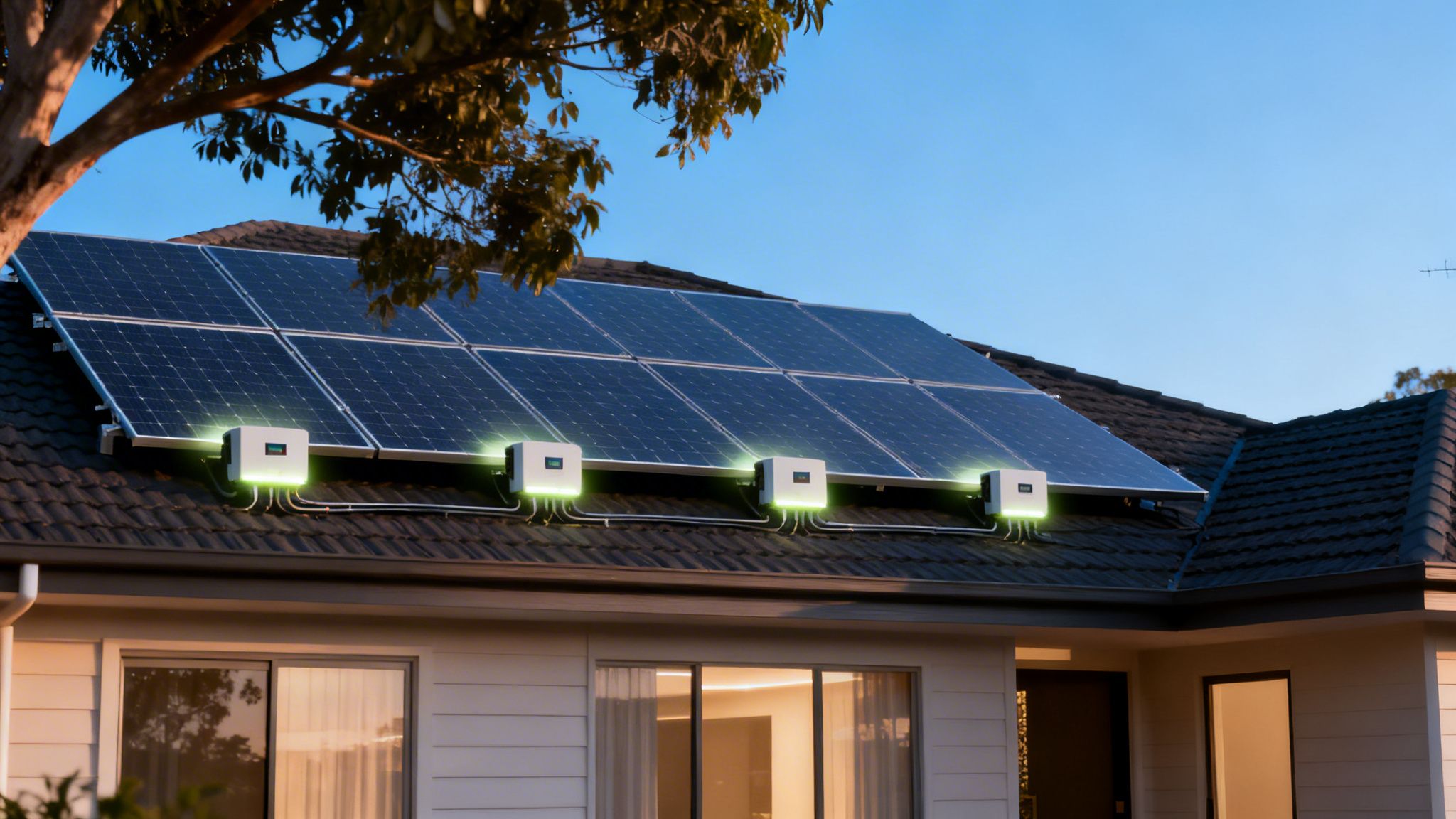
Instead of one big inverter trying to manage everything, a micro inverter system attaches a small, dedicated inverter to the back of every single panel. It’s a simple concept, but it has a huge impact on your system’s overall performance and intelligence.
Each panel essentially becomes its own miniature power plant, operating completely independently from the others. This builds a far more resilient and productive system, which is essential for powering solar batteries and EV chargers effectively. The benefits of this design are immediately clear:
- Maximised Energy Harvest: Every panel operates at its absolute peak. A bit of shade, some morning dew, or a few stray leaves on one panel won’t drag down the performance of its neighbours.
- Enhanced Rooftop Safety: Micro inverters convert DC to AC right at the panel, meaning the high-voltage DC electricity common in string systems isn't running across your roof. This makes the system inherently safer for maintenance workers and emergency responders.
- Detailed Performance Tracking: Because each panel is monitored individually, you can open an app and see exactly how each one is performing. This gives you incredible insight into your investment and makes it easy to spot any issues.
This technology is a particularly smart choice for NSW homeowners looking to get every last drop of value from their solar panels, batteries, and EV chargers. With electricity costs always on the move, maximising your own energy production is key. For those curious about how this fits into bigger energy networks, you can learn more by reading our deep dive into Virtual Power Plants in Australia. By making sure every panel is pulling its weight, you build a stronger foundation for a truly energy-independent home.
How Microinverters Maximise Your Energy Harvest
Every solar system has one crucial job: turning the raw DC power from your panels into the AC electricity that runs your home, charges your solar battery, and powers your EV. That’s the work of an inverter. But not all inverters do this job the same way.
Traditional systems use a single, central "string" inverter. Think of it as one big brain trying to manage all the panels at once. Microinverters, on the other hand, take a smarter approach. A small, dedicated inverter is installed on the back of every single panel, giving each one its own brain. This simple shift has a massive impact on the power your system produces.
Beating the Shade Problem
Picture a typical home in NSW. You’ve probably got a chimney casting a shadow in the morning, a large gum tree shading a corner of your roof in the afternoon, or even just patchy cloud cover. With a traditional string inverter, if just one panel's output drops from shade, it drags down the performance of the entire string it's connected to.
Microinverters solve this problem completely. Because each panel operates as its own independent power plant, one shaded panel has zero effect on its neighbours.
A string system with one shaded panel is like a set of old Christmas lights—when one bulb goes out, the whole string goes dim. With microinverters, every panel shines as brightly as it can, all the time.
This means the rest of your system keeps pumping out power at its absolute peak, capturing every bit of available sunlight throughout the day to power your home and charge your batteries.
Unlocking Peak Performance with MPPT
This individual optimisation is powered by a technology called Maximum Power Point Tracking (MPPT). All inverters use MPPT to squeeze the most energy out of your panels by finding the perfect balance of voltage and current. The difference is that microinverters apply this process to each panel individually.
This panel-level MPPT is constantly at work, making hundreds of tiny adjustments every second to adapt to real-world conditions. This gives you:
- Better Low-Light Performance: Microinverters get to work earlier in the morning and keep producing power later in the afternoon, when the sun is low and string systems often shut down.
- Adapting to Debris and Soiling: A few leaves or some bird droppings on one panel? No problem. Its microinverter will simply adjust to get the most power from the clean sections, while the other panels continue at 100%.
- Managing Panel Differences: No two panels are perfectly identical. Microinverters let each panel perform at its own unique maximum capacity, instead of being limited by the weakest one.
While the technology does the heavy lifting, you can get even more from your system by understanding how to increase solar panel efficiency through simple maintenance. Combining smart tech with good habits is the key to a massive energy yield.
This boost isn't just a minor tweak. Research shows microinverters can increase your energy harvest by up to 25% in partially shaded conditions. For homeowners who want to power their EV or charge a solar battery, that extra energy is crucial. Over the 25-year life of your system, that extra power translates directly into greater savings and energy independence.
Micro Inverters vs String Inverters vs Power Optimisers
Picking the right inverter technology for your solar setup is one of the most important decisions you'll make. It directly affects how much power you generate for your home, solar battery, and EV charger. The three main players on the field are solar micro inverters, traditional string inverters, and power optimisers.
Each one works differently, and the best choice really comes down to your roof, your budget, and what you want your system to do in the long run.
A traditional string inverter has been the standard for years. It works by connecting all your solar panels in a series—think of it like old-school Christmas lights. All the panels are linked together in a "string" and managed as a single unit by one central inverter box on the wall.
While this approach can be cost-effective upfront, it has one major flaw. If even one panel’s performance drops because of a bit of shade, a stray leaf, or a dirty spot, the output of the entire string is dragged down to match that single weakest panel.
Solar micro inverters flip this entire concept on its head. Instead of one big brain, each panel gets its own small, dedicated inverter installed right underneath it on the roof. This tiny powerhouse converts the DC power from the panel into usable AC power on the spot. Each panel becomes an independent power plant, completely unaffected by what its neighbours are doing.
The Hybrid Option: Power Optimisers
So where do power optimisers fit in? They're a kind of middle-ground solution. Like micro inverters, a small device is attached to each solar panel. However, these devices don't convert the power to AC. They just "condition" the DC power and perform individual power tracking (MPPT) before sending it all down to a central string inverter to do the final conversion.
This hybrid setup gets you some of the key benefits of micro inverters, like overcoming shading problems. But you're still left with a central string inverter, which means you still have a single point of failure. If that one box on the wall goes down, your whole system goes down with it.
The infographic below shows what makes micro inverters so effective at squeezing every last drop of energy from your panels.

By handling these jobs right at the source, micro inverters make sure every panel is pulling its own weight, all the time.
A Head-to-Head Comparison
To help you see the differences clearly, let's put these three technologies side-by-side. The right choice often depends on the specific challenges of your roof and your long-term energy goals, especially if you plan to add a solar battery or EV charger.
The core difference comes down to intelligence. A string system has one brain for the whole team, while a micro inverter system gives every player its own dedicated coach, ensuring peak performance at all times.
Here’s a breakdown of how they stack up.
Inverter Technology Comparison
| Feature | Solar Micro Inverters | String Inverters | Power Optimisers |
|---|---|---|---|
| Shade Performance | Excellent. Each panel operates independently, so shade on one has no impact on others. | Poor. One shaded panel can significantly reduce the output of the entire string. | Good. Optimisers mitigate most shading losses but still rely on a central inverter. |
| Panel-Level Monitoring | Yes. You can monitor the performance of every single panel through an app. | No. Only system-level or string-level performance data is available. | Yes. Provides detailed monitoring for each panel, similar to micro inverters. |
| System Scalability | Excellent. Very easy to add more panels one at a time as your needs grow. | Difficult. Expansion often requires a new, larger inverter and careful panel matching. | Moderate. Easier to expand than a string system but still limited by the central inverter's capacity. |
| Safety (Rapid Shutdown) | Excellent. High-voltage DC is converted to safer AC at the panel, with built-in rapid shutdown. | Basic. Requires additional components to achieve rapid shutdown at the panel level. | Good. Offers panel-level shutdown but high-voltage DC still runs to the central inverter. |
| Long-Term Value | High. Superior energy yield, longer warranties (25 years), and system resilience provide excellent lifetime value. | Standard. Lower initial cost but can result in lower lifetime energy production and shorter warranties. | Medium. A middle ground on cost, offering better performance than string inverters but with more components. |
For homeowners in NSW who want total control and visibility, that panel-level monitoring is a real game-changer. You can spot issues with a single panel instantly, instead of wondering why your whole system is underperforming. We dive deeper into this in our guide on enhancing solar efficiency with inverter remote monitoring.
So, what's the final verdict? While a string inverter can be a fine choice for a simple, unshaded roof, solar micro inverters offer far better performance, safety, and future-proofing.
Their ability to maximise your energy harvest—especially on complex roofs or those with passing shade—makes them the premium choice for anyone serious about long-term value and energy independence. This is particularly true if you're thinking about adding a solar battery or an EV charger down the track.
Future-Proofing Your Home's Energy Needs
Choosing a solar system is a big decision—one that should serve your family for decades, not just a few years. Your life isn't static. You might buy an electric vehicle, add a granny flat, or simply decide you want more independence from the grid. This is where solar microinverters shine, creating an intelligent and flexible foundation that grows with you.
Unlike older string inverter technology that can lock you into a fixed system size, a microinverter setup is built for change. As your energy demands evolve, expanding your solar array is refreshingly straightforward.
Think of it like a set of Lego blocks. With a traditional string inverter, adding more blocks is a major hassle, often forcing you to replace the entire foundation. A microinverter system lets you click new blocks into place one by one, whenever you need them, without tearing down what’s already there.
This modular design means you can start with a system that fits your budget today, knowing you can seamlessly add more panels down the track to power your home, solar battery, and EV.
Effortless System Expansion and Integration
One of the biggest headaches with a traditional string inverter is its fixed capacity. If you install a 5kW inverter, you’re stuck at around 5kW of panel capacity. What happens when you get an EV and your power bill shoots up? You’d probably have to rip out your central inverter and replace it entirely—a costly and frustrating exercise.
Solar microinverters make this problem disappear. Because each panel has its own dedicated inverter, you can add new panels to your roof whenever you’re ready, one at a time if you like. Your system scales with your life.
This makes integrating new energy tech incredibly simple:
- Preparing for an EV: Adding an electric vehicle charger will noticeably increase your home's power consumption. A microinverter system lets you easily pop a few extra panels on the roof to cover that new demand.
- Adding Battery Storage: Microinverters are perfect for creating an efficient AC-coupled system, which is the ideal setup for modern home batteries like the Tesla Powerwall. You can find out more in our Comprehensive Guide to Tesla Powerwall 3.
- Adapting to Lifestyle Changes: Whether you build a home office, install a pool pump, or welcome new family members, your energy needs will shift. Microinverters ensure your solar system can adapt without a complete and costly overhaul.
Total Control with Panel-Level Monitoring
Beyond just producing more power, microinverters give you incredible insight into how your investment is actually performing. A string inverter only shows you the total output of the entire system. If there’s an issue, it’s like trying to find a faulty light bulb in a string of Christmas lights—you have no idea where the problem is.
Microinverters deliver panel-level monitoring. Through a simple app on your phone, you get a bird's-eye view of the real-time and historical performance of every single panel. This puts you in complete control.
- Confirm Peak Performance: Instantly check that every panel is generating the power it’s supposed to. No guesswork.
- Pinpoint Issues Immediately: If a panel is underperforming because of a bit of debris, shade, or a technical fault, you'll know exactly which one needs a look.
- Maximise Your Savings: By tracking your energy production day by day, you can ensure you’re always getting the absolute most from your solar investment.
This level of transparency is why so many homeowners are making the switch. As Australia's solar power market is forecasted to surge to USD 33.9 billion by 2034, homeowners are getting smarter. Across greater NSW, many of the over 1 million rooftop solar systems are being upgraded to microinverters to achieve a 10-15% higher yield and get the superior monitoring they offer. You can read more about the projected growth of the Australian solar market.
Evaluating the Cost and Lifetime Value
When looking at solar for your home, it’s easy to get fixated on the upfront price. Solar microinverters do often have a different initial price point than traditional string systems, but a proper evaluation goes beyond that. The real story is in the long-term return and the lifetime value of your investment in solar panels, batteries, and EV chargers.
The key is to see the cost of microinverters as an investment in superior performance. That higher energy yield they produce, especially on rooftops with patchy shade, translates directly into bigger savings on your bills, month after month. This boost in production often leads to a faster return on investment (ROI), making them a financially smarter choice over the system's 25-year lifespan.
Understanding the Investment
The initial cost of a solar system is just one piece of the financial puzzle. To get the full picture, you have to look at the total energy it will produce and the savings it will generate over a couple of decades. This is where microinverters really make a compelling case for their value.
Several factors contribute to the better long-term value of solar microinverters:
- Greater Energy Harvest: By optimising each panel on its own, microinverters make sure you’re squeezing every last drop of power out of your system, all day, every day. This is a game-changer for the many NSW homes with partial shading from trees, chimneys, or the neighbour’s new extension.
- Longer Warranties: Microinverters typically come with a 25-year warranty, which matches the lifespan of your solar panels. Compare that to many string inverters, which often only offer 10-15 year warranties. That means you could be facing a costly replacement halfway through your system’s life.
- System Resilience: With no single point of failure, a microinverter system is simply more reliable. If one unit has a problem, the rest of your panels keep producing power. This protects your savings from being wiped out by unexpected downtime.
A solar system with microinverters is an asset designed to deliver consistent, high-level performance for over two decades. The upfront cost difference reflects an investment in technology built for longevity, greater energy production, and total peace of mind.
Calculating Your Return
For homeowners in NSW, the financial benefits are very real. The Asia-Pacific region, including Australia, is seeing massive growth in the uptake of solar microinverters. They deliver exceptional long-term value with peak efficiency ratings over 99% and those solid 25-year warranties.
In Australia, where up to 70% of urban rooftops deal with some shading, microinverters are vital for preventing energy losses that can hit 40% in string systems. You can read more about these trends in the full solar microinverter and power optimizer market forecast on altenergymag.com.
When you're trying to weigh up the long-term value, using a solar return on investment calculator can give you valuable insights into your potential savings. On top of that, government incentives like the Small-scale Renewable Energy Scheme (SRES) can significantly cut down the initial expense of your whole solar installation, making premium tech like microinverters much more accessible.
Getting your system sized correctly for your energy needs is critical to maximising those savings. Working with a professional installer ensures the system is perfectly tailored to your home’s layout and how you use power. To get a quick estimate of what you could save, give our online solar savings calculator a try to see how a new system might slash your bills.
Choosing a Reputable Solar Installer in NSW

Let's be blunt: even the world’s best solar gear is only as good as the team that installs it. You can invest in top-tier solar panels, batteries, EV chargers, and microinverters, but a sloppy installation can undo all that potential, turning your smart investment into a source of endless headaches.
Getting the installation right is the final, crucial piece of the puzzle. It’s what transforms panels on a roof into decades of clean energy and real savings. That’s why your choice of installer in NSW shouldn’t come down to the cheapest quote. A shoddy job can lead to poor performance, scary safety hazards, and a nightmare of warranty claims.
Your Checklist for Vetting Installers
When you start comparing installers, you need to look for a few non-negotiables. These are the markers that separate the true professionals from the rest. Think of it as a checklist for finding a partner you can actually trust.
A massive giveaway is whether they use their own in-house installation teams or just farm the work out to random subcontractors. In-house teams mean consistency, proper training, and direct accountability. If something goes wrong, you know exactly who to call.
Here’s what to verify before you sign anything:
- Clean Energy Council (CEC) Accreditation: This is the bare minimum. Make sure both the company and the actual electrician on your roof are CEC-accredited. It’s your proof they’re trained to meet Australia’s high standards.
- A Proven Track Record: How long have they been around? Ask to see a portfolio of their work and hunt down genuine customer reviews on independent sites. A good reputation for service and reliability is earned, not bought.
- Local NSW Presence: A company with a real, physical office, showroom, and warehouse is a sign of stability. They understand the local grid rules and will actually be around to provide support when you need them down the track.
Choosing a solar installer isn't a one-off transaction; it's the start of a long-term relationship. This is the team you'll rely on for the entire 25-year life of your system, whether for questions, troubleshooting, or future upgrades.
The Value of Workmanship and After-Care
A quality installation is so much more than just slapping panels on your roof. It’s about craftsmanship—the meticulous attention to detail that protects your home and ensures every component works perfectly together. To see what a truly professional job looks like, you can dive into the details of what makes a quality solar installation truly valuable.
Don’t be afraid to ask potential installers hard questions about their service policies. What happens if something goes wrong? A dependable partner offers solid post-installation support, with clear communication and fast troubleshooting. By putting in the effort to find a qualified and experienced installer now, you’re locking in decades of energy savings and complete peace of mind.
Your Top Questions About Solar Microinverters Answered
Investing in your home's energy future with solar panels, batteries, and EV chargers brings up a lot of questions. That’s a good thing. To help you get clear, straightforward answers, we’ve put together a list of the most common queries NSW homeowners have about solar microinverters.
This isn't about technical jargon; it's about how this technology fits your home, your budget, and your long-term energy goals.
Are Solar Microinverters Worth It in NSW?
For a lot of homes in NSW, the answer is a firm yes. While the upfront cost for microinverters can be different from a basic string system, you have to look at the long-term value they deliver. Most suburban rooftops aren't perfect—they have to deal with shade from trees, chimneys, or a neighbour's second-storey extension.
In these everyday situations, microinverters really shine. They stop one shaded panel from dragging down the performance of the entire system. That means more energy production over the system’s 25-year lifespan, which, combined with longer warranties and better safety, often leads to a much healthier return through bigger savings on your electricity bills. This is essential for effectively charging a solar battery or powering an EV.
Can I Add More Solar Panels Later?
Absolutely. This is one of the biggest real-world advantages of a microinverter system. Your life changes, and your energy needs often change with it. Maybe you'll buy an electric vehicle, put in a pool, or add a home office, and suddenly you need more power.
Because each solar panel and its microinverter work as an independent power-generating unit, expanding your array is incredibly straightforward. You can add one, two, or ten more panels whenever you’re ready, without the headache of finding matching panels or upgrading your central inverter.
This modular design makes a microinverter system a genuinely future-proof investment. It grows with your family and lifestyle, so you're never locked into a system that’s become too small for your needs.
Do Solar Microinverters Work with Batteries?
Yes, and they work exceptionally well together. A microinverter setup provides a highly efficient and stable foundation for a complete home battery system.
By squeezing every last drop of power from each individual panel, a microinverter system maximises the total amount of energy your roof generates all day long. This means you have more surplus solar power to send to your battery for storage. You can then use that stored energy at night or have it ready as a backup during a blackout, pushing you further towards energy independence and away from relying on the grid.
Ready to see how a high-performance solar system with solar panels, batteries, and microinverters can slash your power bills? The team at Interactive Solar provides expert advice and quality installations tailored to your home's needs. Get your free, no-obligation quote today.