How Solar Batteries Work for Australian Homes
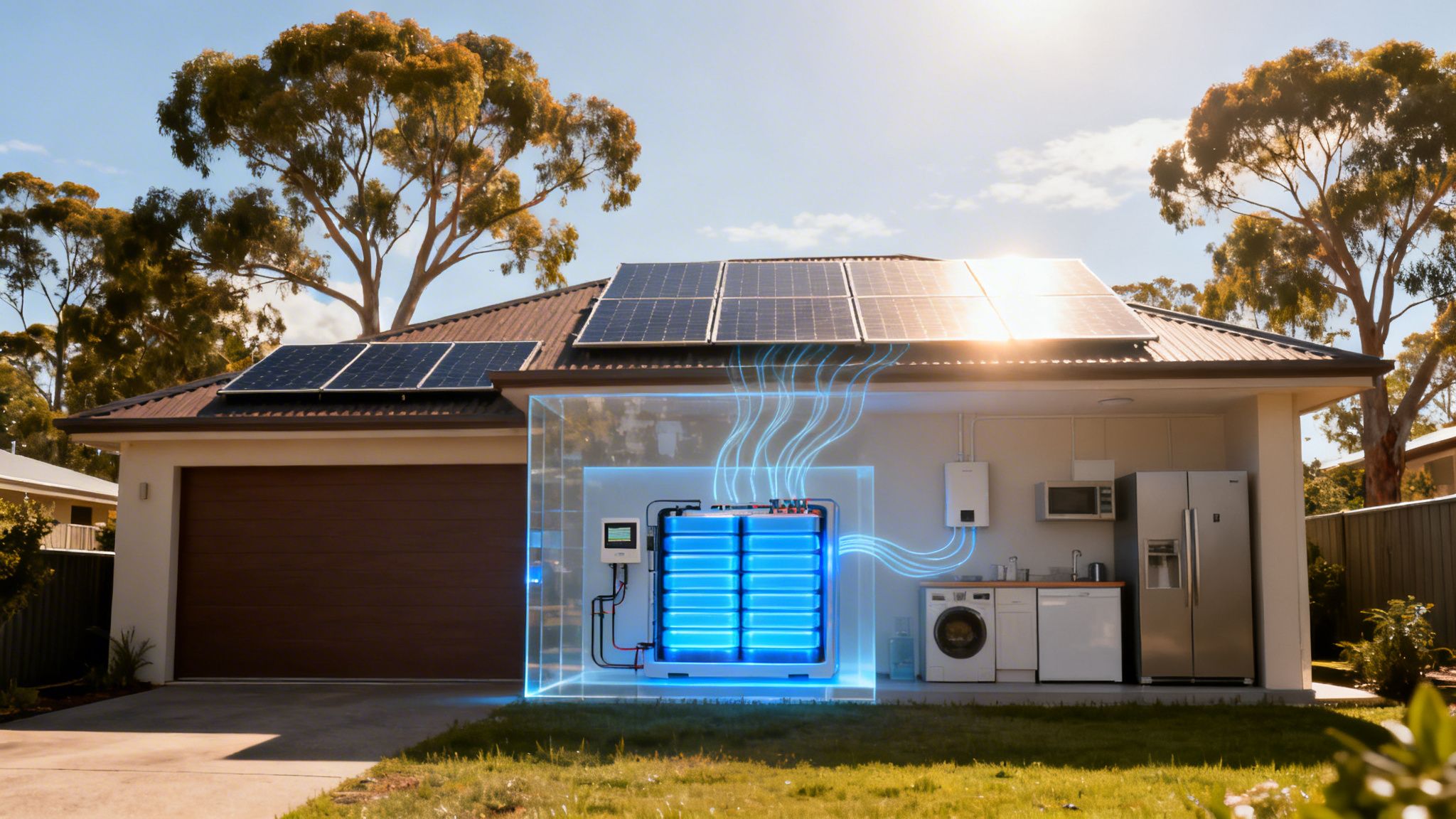
At its core, a solar battery is your personal energy bank. It catches and holds onto all the extra, unused solar power your panels crank out during the day, so you can draw on it at night or when the grid goes down. This simple idea is completely changing the energy game, putting the power—literally—back into the hands of homeowners across Australia.
The Secret to 24/7 Solar Power
Imagine powering your home with the sun, long after it’s dipped below the horizon. For a lot of Aussie homeowners, this isn't just a nice idea; it's the answer to sky-high electricity bills and an unreliable grid. Solar panels are a brilliant first step, but they only work when the sun's out. Without a way to store that power, you're right back to buying it from the grid every single evening.
This is exactly why getting your head around how solar batteries work is so important. A battery isn't just another piece of kit—it’s the missing piece of the puzzle for true energy independence. It completes your solar setup, turning that on-again, off-again daytime power into a dependable, round-the-clock source of energy for your home.

Unlocking Your Energy Freedom
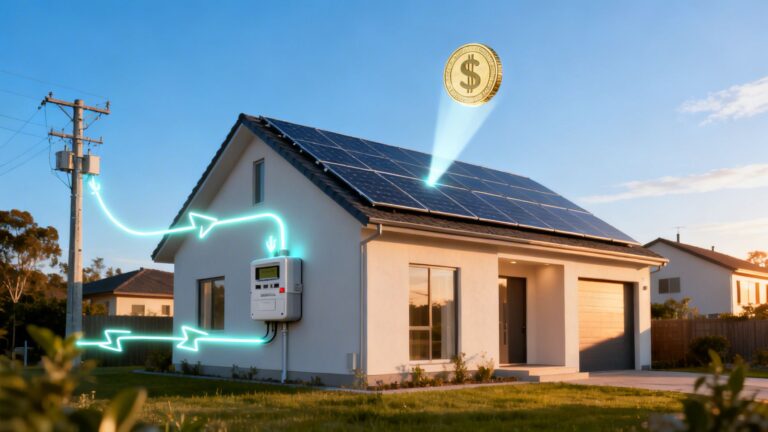
Think of it like this: the power your panels generate during the day is like water filling up a tank. If you don't use it right away, the tank overflows. That overflow is your excess energy, and it gets sent back to the grid, often for a minimal feed-in tariff. Then, come nightfall when your panels are asleep, you have to buy that same power back from your retailer—usually at a much higher rate. It’s a frustrating cycle.
A solar battery is your own private energy tank. Instead of letting all that valuable solar power "overflow" to the grid, your battery grabs it and saves it for when you actually need it.
A solar battery fundamentally changes your relationship with energy. You store your own clean power during the day and use it when it matters most—at night or during a blackout. This slashes your grid reliance and puts you back in control of your power bills.
With that stored energy, you can:
- Power your home at night with the free, clean electricity you made hours earlier.
- Keep the lights on during a blackout, running your essential appliances without a flicker.
- Get the most out of your solar investment by drastically cutting how much expensive power you need to buy from the grid.
This powerful shift is reshaping home energy right across NSW and the rest of Australia. You're no longer just an energy consumer; you become your own mini power station with the ability to produce, store, and manage your electricity. Some homeowners are even joining programs that help stabilise the grid, which you can read all about in our guide to Virtual Power Plants in Australia.
What's Inside a Solar Battery

To really get how a solar battery works, you need to peek under the bonnet. While it might look like a single sleek box on your wall, it’s actually a team of highly specialised components working together.
Think of it less as a simple battery and more as a sophisticated ecosystem. Each part has a critical job, from physically holding the energy to managing its flow and making it usable for your home. Let's break down the three key players inside.
The Battery Cells: The Energy Reservoir
At the very heart of the system, you’ll find the battery cells. These are the fundamental building blocks that actually store electricity. If the whole unit is an energy tank, the cells are the individual containers inside, holding the power your panels generated during the day.
These individual cells are bundled into larger blocks called modules. Several modules are then combined to form the complete battery bank, giving you the capacity needed to run your home through the night. The chemistry of these cells—most often lithium-ion—is what really dictates the battery's performance, safety, and lifespan. This modular design allows for scalable systems, like those in our guide to the Tesla Powerwall 3, where capacity can be matched to a home’s specific needs.
The Battery Management System: The Intelligent Brain
Perhaps the most critical component you’ll never see is the Battery Management System (BMS). This is the onboard computer, the "brain" of the whole operation. It’s constantly monitoring and managing every aspect of the battery to make sure it runs safely and lasts as long as possible.
The BMS is responsible for a few crucial jobs:
- Preventing Overcharging: It stops energy flowing in once the cells are full, which protects them from damage.
- Preventing Over-discharging: It ensures the battery doesn't drain too low, which can seriously shorten its life.
- Balancing Cells: It makes sure all the individual cells charge and discharge evenly, maximising the battery's overall health and available capacity.
- Monitoring Temperature: It keeps the battery within its ideal temperature range to prevent overheating and ensure peak performance.
A high-quality BMS is what separates a reliable, long-lasting battery from a dud. It’s the silent guardian optimising performance day in and day out, ensuring you get the most out of your investment for years to come.
The Inverter: The Universal Translator
The final piece of the puzzle is the inverter. Your solar panels generate Direct Current (DC) electricity, and your battery stores it as DC. The problem? Every appliance in your home, from your telly to the toaster, runs on Alternating Current (AC).
The inverter’s job is to act as a universal translator. It converts the stored DC power from your battery into usable AC power for your home. This conversion process is what makes all that stored solar energy useful. Some modern batteries have an inverter built right in, while others rely on a separate, external one. The efficiency of this component is vital—it determines how much of your stored energy actually makes it to your appliances.
This combination of cells, smarts from the BMS, and power conversion from the inverter is what makes the whole system click. The demand for these systems has exploded, with Aussie households installing an incredible number of units in recent years. It just goes to show how effective these systems are at helping homeowners and businesses slash their power bills.
Understanding Battery Performance Metrics
To really get your head around how a solar battery works, you need to look beyond its physical size and dive into the numbers that define its real-world performance. It’s a bit like buying a car—knowing the engine size doesn’t tell you a thing about its fuel economy or reliability. A battery's kilowatt-hour (kWh) rating is just one piece of the puzzle.
Getting the right system comes down to understanding the metrics that dictate how well it stores and releases your precious solar energy. These figures are what determine your battery's lifespan, its day-to-day usefulness, and ultimately, your return on investment.
State of Charge (SoC)
The easiest metric to grasp is the State of Charge (SoC). Think of it exactly like the battery percentage icon on your phone. It’s a simple, real-time percentage that tells you how much juice is currently in your battery.
A reading of 100% SoC means your battery is completely full, probably after a solid day of sunshine. If you see 20% SoC, it's nearly empty and has done its job powering your home through the evening. This number is your go-to for monitoring your system’s daily rhythm and figuring out your energy habits.
Depth of Discharge (DoD)
While SoC tells you what’s in the tank, Depth of Discharge (DoD) tells you how much of that tank you can actually use without damaging the battery. It might seem odd, but you never want to completely drain a battery to 0%.
For instance, a battery with a 90% DoD means you can safely use 90% of its total stored energy. The other 10% is kept in reserve by the Battery Management System (BMS) to protect the cells and make the battery last as long as possible.
A higher Depth of Discharge is a hallmark of a quality battery. It means you get to use more of the energy you paid to store, directly translating into greater energy independence and better value.
A battery with a low DoD, say 60%, means a huge 40% chunk of its capacity is off-limits. This is exactly why a high DoD is one of the most critical performance numbers to look for.
Round-Trip Efficiency
Every time you charge and then discharge a battery, a small amount of energy gets lost along the way, mostly as heat. Round-Trip Efficiency measures how much of the energy you put into the battery you can actually get back out, and it's shown as a percentage.
A modern lithium-ion battery usually has a round-trip efficiency of around 90-95%. This means for every 10 kWh of solar power you push into your battery, you'll get between 9 and 9.5 kWh of usable electricity back. Higher efficiency simply means less wasted energy and more value from your system.
Comparing Battery Chemistries
A battery's internal chemistry is the bedrock of its performance. It influences everything from lifespan and safety to its DoD and efficiency. For Aussie homes, the choice really boils down to two main players: modern Lithium-ion and the older Lead-acid technologies.
To help you see the bigger picture, our comprehensive solar battery comparison guide goes much deeper into the specific models available on the market.
For now, the table below gives you a clear snapshot of why one chemistry has become the go-to standard for home energy storage.
Comparing Solar Battery Chemistries: Lithium-ion vs Lead-acid
| Feature | Lithium-ion (LFP) | Lead-acid |
|---|---|---|
| Typical Lifespan | 10-15+ years (thousands of cycles) | 3-7 years (hundreds of cycles) |
| Depth of Discharge (DoD) | 90-100% (more usable energy) | 50-60% (much less usable energy) |
| Round-Trip Efficiency | Over 90% (very little wasted energy) | Around 80% (more energy lost) |
| Maintenance | Virtually none (managed by the BMS) | Requires regular maintenance |
| Safety | Very high, especially LFP variants | Lower, with risks of gas venting |
For Australian homes, Lithium Iron Phosphate (LFP), a type of lithium-ion battery, has emerged as the undisputed winner. Its superior safety profile, impressive lifespan, and high DoD make it the smartest and most reliable choice for a modern solar system. It’s all about making sure you get the most out of every single sunbeam.
How a Battery Integrates with Your Solar System
A solar battery is a lot more than just a box that holds power. It’s a clever piece of tech that has to talk to your solar panels and your home’s electrical system. Getting your head around how this all connects is the key to understanding how you’ll actually use your stored solar energy from day to day.
The way it’s all wired up determines how efficient and flexible your system is, while the operating mode you choose dictates how your battery prioritises that precious stored energy.
There are two main ways a battery connects to your setup: AC-coupling and DC-coupling. Each has its pros and cons, and the best choice often comes down to whether you’re adding a battery to an existing solar system or installing a brand-new, all-in-one package.
AC-Coupling and DC-Coupling Explained
Think of AC-coupling like adding a new smart appliance to your home. In an AC-coupled system, the battery comes with its own dedicated inverter. Your solar panels feed DC power to their own solar inverter, which converts it to AC for your home to use. Any leftover AC power then gets sent over to the battery's inverter, converted back to DC, and stored.
This method is perfect for retrofitting a battery to a solar system you already have. It works alongside your current setup without needing to rip out and replace your existing solar inverter.
On the other hand, DC-coupling connects the battery directly to the solar panels on the DC side, before the power gets converted to AC. This is all managed by a single, specialised "hybrid" inverter that handles both the panels and the battery. Solar power flows as DC electricity to this hybrid inverter, which then smartly decides whether to send it to the battery for storage (still as DC) or convert it to AC for your home to use immediately.
DC-coupling is generally more efficient because the electricity is only converted once when it’s time to power your home. Fewer conversions mean less energy is lost along the way, making it a go-to choice for new, combined solar and battery installations.
This diagram shows the simple flow of how your battery charges, powers your home, and holds onto that energy.

The main takeaway here is that modern batteries are incredibly efficient. You can be confident that the vast majority of the solar energy you store will be there for you when you need it.
Your Battery's Operating Modes
Once your system is up and running, your solar battery will operate in one of two main modes, which you can usually switch between using a smartphone app. These modes tell your system how to use its stored energy to meet your goals, whether that's maximum savings or total peace of mind.
- Self-Consumption Mode: This is the default setting for most Aussie homes. The battery’s number one job is to power your home with stored solar energy whenever the sun isn’t shining, especially during those expensive evening peak hours. This cuts down how much electricity you have to buy from the grid, directly slashing your power bills.
- Backup Mode: In this mode, the battery keeps a portion of its charge aside purely for blackouts. For instance, you could set it to always keep 30% in reserve. The remaining 70% is used for your daily self-consumption, but you’ll always have that protected buffer ready to go, keeping your essential appliances running if the grid fails.
For homeowners in NSW facing rising energy costs, solar batteries work by capturing this excess solar energy to be used later. For many Sydney families, like those we at Interactive Solar help, pairing a standard 6.6kW solar system with a properly sized battery can offset 70-100% of their grid usage. It’s a powerful strategy for cutting bills, especially with more electricity price rises on the horizon.
You can usually fine-tune these settings from an app, which gives you complete control over your energy. For a deeper dive into this, check out our guide on enhancing solar efficiency with inverter remote monitoring.
Sizing Your Battery for Maximum ROI
Getting your battery size right is probably the single most important decision you'll make to maximise its return on investment. There's a common myth that bigger is always better when it comes to batteries. The reality is, "right-sizing" is the smarter approach—it's all about finding that perfect sweet spot between your energy needs, your solar system's output, and your budget.
This is where we move from the theory of how batteries work into putting them to use in the real world. If you invest in an oversized battery, you've paid for capacity you'll never actually use, which just pushes out your payback period. But go too small, and your battery will run out of juice early in the evening, forcing you straight back onto expensive grid power. That pretty much defeats the whole point.
Analysing Your Energy Consumption
The first step is getting a clear picture of your home’s unique energy habits, especially how much electricity you use overnight. This is the exact amount of power your battery will need to cover.
A good installer will look at your smart meter data or your power bills to figure out your household’s "base load" and evening peak usage.
For instance, if your home consistently draws 12 kWh of power between sunset and sunrise, a battery with around 12-14 kWh of usable capacity is an excellent starting point. This gives you enough stored energy to get through the night without having to buy power from the grid.
Right-sizing isn't about buying the biggest battery on the market; it’s about installing the correct one. A system tailored to your specific evening energy use delivers the fastest payback and the best long-term savings. It's a precise calculation, not just a guess.
To size your battery effectively, you first need to know your overall energy needs and how a system like a 5kW solar system could cover your daytime use. Getting this foundation right ensures your panels and battery work together perfectly.
Matching Your Battery to Your Solar System
Your battery doesn't work in a vacuum—it's one part of a bigger system. The amount of excess solar energy your panels generate during the day is what determines how much charge your battery gets. A huge battery paired with a small solar array is a bad match; it will likely struggle to ever get fully charged, especially on cloudy days or in winter.
Your installer will run a simple calculation to make sure everything is in balance:
- Calculate average daily solar generation: How much power do your panels typically produce in a day?
- Subtract your daytime energy consumption: How much of that solar power is used by your home appliances while the sun is up?
- The remainder is your 'charge potential': This is the leftover energy available to fill up your battery.
Your battery’s capacity should be lined up with this charge potential. There's no point having a 15 kWh battery if you only ever have 8 kWh of spare solar to send its way.
Future-Proofing Your Investment
A great solar and battery system should be built to last you a decade or more, not just for today. When you're deciding on size, it's crucial to think about what your future energy needs might look like. Are you planning any big changes that will ramp up your electricity consumption?
Think about these common scenarios:
- Buying an Electric Vehicle (EV): Charging an EV at home overnight will dramatically increase your power demand. Factoring this in from the start means you can install a battery that's ready to handle that extra load.
- Adding a swimming pool: Pool pumps are notoriously energy-hungry and can add a serious load to your nightly power usage.
- Family changes: Are the kids getting older and using more devices? Or are they about to move out, which would lower your consumption?
Talk these future plans over with your solar consultant. It ensures you end up with a system that can grow with you, rather than one you'll outgrow in a few years.
If you want to get a clearer picture of what you could save, try our interactive solar savings calculator for a more detailed look at the long-term benefits.
Your Solar Battery Questions Answered
Jumping into the world of solar batteries is a big step, and it's completely normal to have a few questions. As you think about this upgrade for your home, you need clear, straightforward answers to feel good about your decision. We’ve pulled together the most common questions we get from homeowners across NSW to help demystify the details.
Think of this as the final piece of the puzzle. Our goal is to give you the confidence that comes from genuine understanding, so you can make the right choice for your home's energy future.
How Long Do Solar Batteries Last?
A modern lithium-ion solar battery is built for the long haul. You can realistically expect 10 to 15 years of solid performance out of a quality unit, and most top-tier models come with a 10-year warranty as standard. These batteries are engineered to handle thousands of charge and discharge cycles.
Over its lifespan, a battery will see a bit of gradual degradation, which just means its maximum storage capacity will slowly reduce. But it will still be working hard, delivering big savings and energy security well beyond its warranty period.
The best part? They are almost entirely maintenance-free. The built-in Battery Management System (BMS) does all the heavy lifting, smartly optimising the battery's health and performance. A quality installation from a certified team ensures it’s set up perfectly from day one.
Can a Solar Battery Power My Whole House During a Blackout?
Yes, it certainly can. But whether it does comes down to three things: the battery's size (its kWh capacity), how much charge it has when the grid goes down, and which circuits in your home are wired for backup.
When we design your system, we'll help you choose between two main strategies:
- Full Home Backup: This is the all-in-one solution. We connect the battery to your entire switchboard, so you can run everything pretty much as normal. This setup needs a larger, more powerful battery, especially if you want to run power-hungry appliances like your air conditioner or oven.
- Essential Loads Backup: This is a really popular and practical option. We isolate and connect only your critical circuits—things like your lights, fridge, internet modem, and a few key power points. This lets a standard-sized battery keep your essentials running for much longer during an extended outage.
The right path depends entirely on what you value most: total convenience or prolonged security for the absolute necessities.
Choosing between full and essential load backup is a crucial part of the design process. It allows you to tailor the system to your specific needs, balancing convenience, blackout duration, and your overall budget to create the perfect solution.
Is a Solar Battery a Good Investment?
For most Aussie households, especially in places with high electricity rates like NSW, a solar battery has tipped over into being a very smart financial move. The value isn't just in the immediate bill savings; it's about locking in long-term control and predictability over your energy costs, which only seem to go one way—up.
The maths is pretty simple. Instead of sending your excess solar power back to the grid for a tiny feed-in tariff, you store it. Then, at night, you use that stored energy instead of buying expensive power from your retailer. This "self-consumption" is what creates massive savings and fast-tracks your return on investment.
Better yet, a battery acts as a shield against future electricity price hikes. Every time the grid prices go up, the value of your stored solar energy increases right alongside it, making it an incredibly savvy investment in your home's resilience and financial future.
Do I Need a Battery If I Already Have Solar Panels?
While solar panels are brilliant at slashing your daytime power bills, they don't store energy. As soon as the sun goes down, your home is back to pulling expensive power from the grid. And all that excess solar you generated during the day? It was sent back to your retailer for a minimal return.
Adding a battery to your existing solar system is how you break this cycle. It lets you capture and hold onto all that "free" energy your panels produced, so you can use it whenever you need it—day or night.
It’s the final step towards true energy independence. A battery closes the loop on your solar investment, making sure you wring every last drop of value out of every kilowatt-hour your panels generate.
Ready to take control of your energy bills and secure your home's power supply? The team at Interactive Solar has over 20 years of combined experience designing and installing tailored solar and battery solutions for homes across NSW. We manage the entire process in-house, from the initial consultation to the final installation, ensuring a seamless experience and a system built to last. Explore your options and get a personalised quote by visiting us at https://interactivesolar.com.au.