Your Guide to Home EV Charger Installation in NSW
Relying on public chargers in NSW can feel like a lottery. A professional home EV charger installation isn't just a convenience; it's the single best upgrade you can make to your EV ownership experience. It takes the stress out of the equation, ensuring you always wake up to a fully charged car and finally putting range anxiety to bed.
Why a Home Charger Is a Non-Negotiable for NSW EV Drivers
Making the switch to an electric vehicle is a great move, but many new owners hit a frustrating roadblock almost immediately: the public charging network. While handy for the occasional long trip, trying to depend on public stations for your daily charge is often a recipe for disappointment. Finding a working, available charger when you actually need one is never a guarantee.
A dedicated home EV charger changes everything.
Suddenly, you're in control. Instead of planning your day around a trip to a charging station, you just plug in when you get home. It’s that simple. This is the real-world convenience that makes a home unit a must-have for any serious EV driver.
The Public Infrastructure Gap Is Only Getting Wider
EV demand is surging across Australia, and it's shining a bright light on a huge infrastructure problem. Projections show we’ll have over 410,000 electric vehicles on our roads by early 2026, and the public charging network is already struggling to keep up.
This is especially true in NSW. The number of fast-charging locations just can't match the speed at which people are buying EVs. This growing scarcity is exactly why a home charger has shifted from a "nice-to-have" to a necessity for reliable daily driving.
This gap is a major hurdle for people thinking about making the switch. In fact, surveys consistently show that over 50% of non-EV drivers point to charging access as the biggest thing holding them back. A personal charging station in your own garage completely removes that worry.
Installing a charger at home means you get to bypass the queues, the broken stations, and the uncertainty of public networks. You’re essentially creating your own private, reliable fuel station, ready to go whenever you are.
Unlocking Serious Savings and Ultimate Convenience
The benefits go way beyond just avoiding queues. A home charger lets you tap into off-peak electricity tariffs, so you can charge your car overnight when rates are at their absolute lowest. This one simple habit can save you a small fortune over the long run compared to the premium prices you pay at public fast chargers.
But the real magic happens when you pair your home charger with a solar panel system.
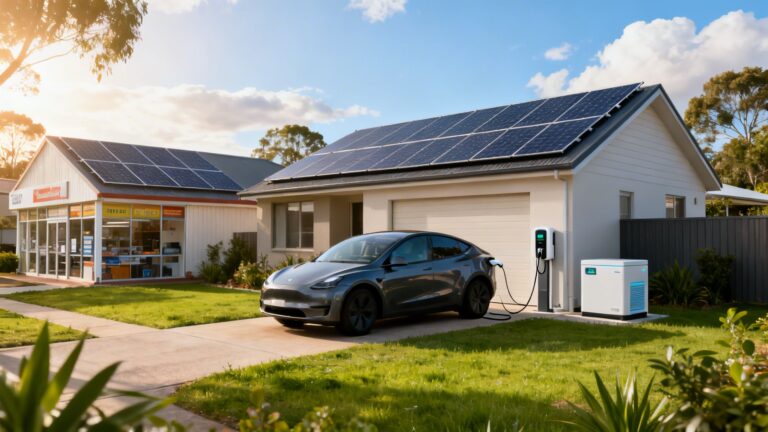
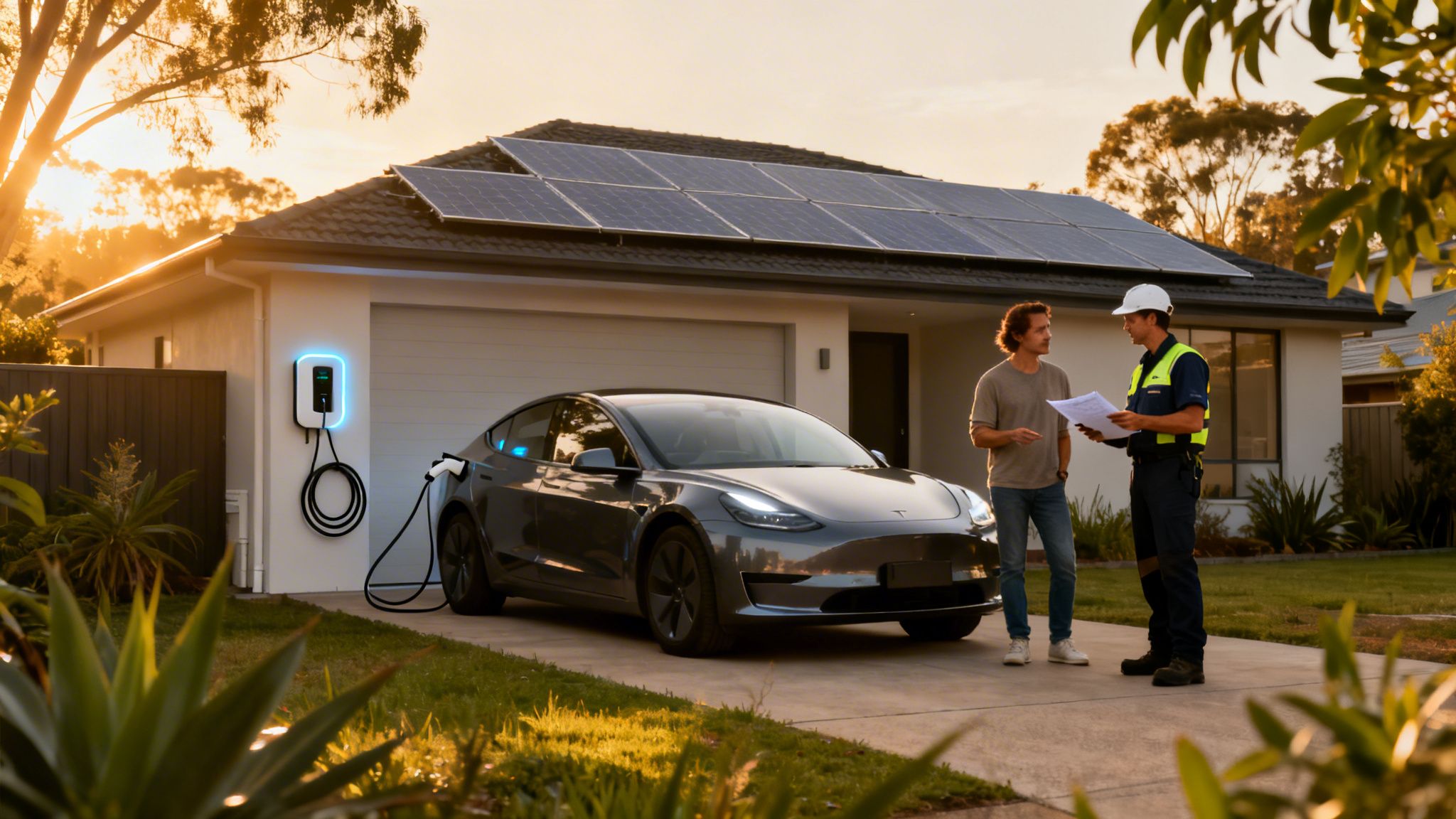
This is the ultimate setup. You can power your car with clean, free energy generated right from your own roof. Your daily commute effectively becomes free. By choosing the right gear, you can genuinely run your EV on sunshine. You can learn more about how to find the best home EV charger for your needs in our detailed guide.
Your Installation Journey From Start to Finish
So you've decided to get a home EV charger. Great! But what does a professional home EV charger installation actually look like? When you work with experienced specialists, it’s a surprisingly straightforward process. We see it as a partnership, making sure you feel confident and informed from our first chat right through to the final handover.
Let's cut through the technical jargon and walk you through what you should expect. This simple diagram perfectly captures the journey from the daily stress of hunting for a public charger to the effortless routine of having your own unit at home.
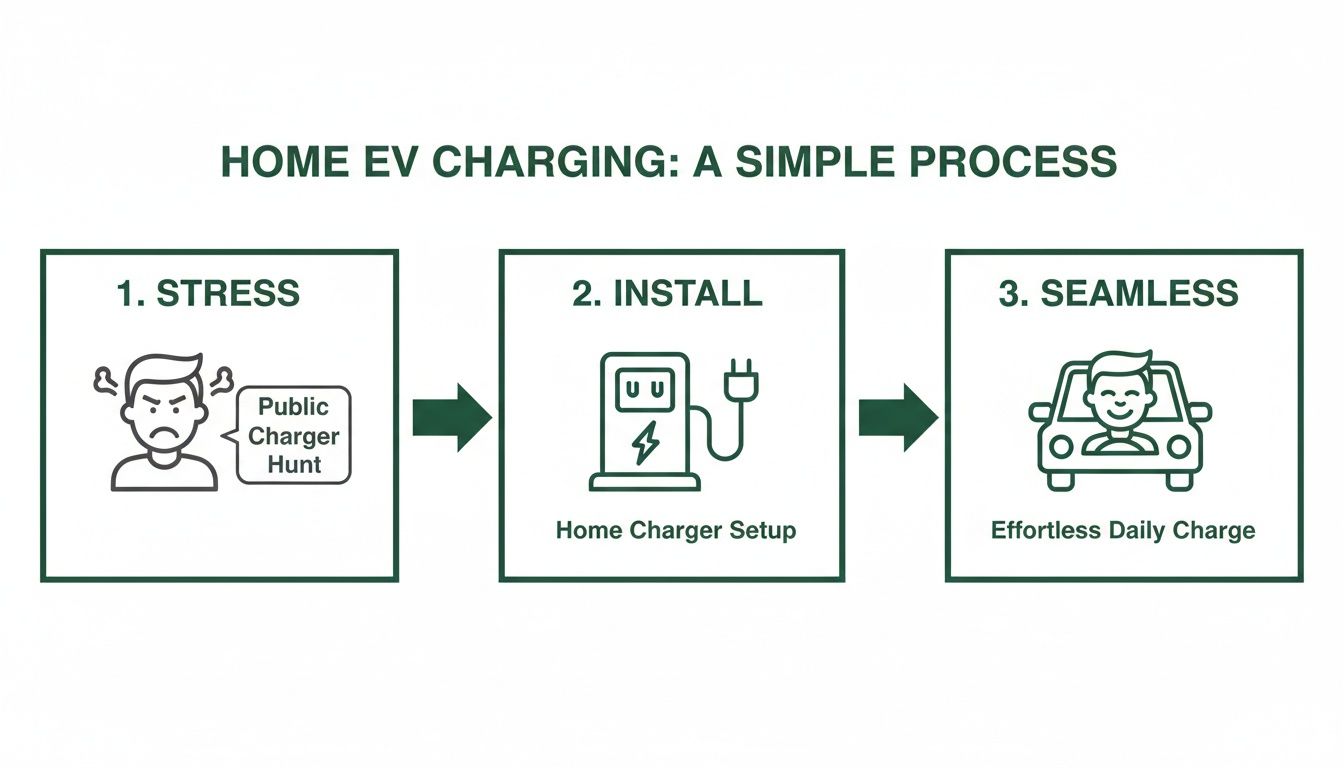
It really is that simple. The goal is to transform the frustrating search for a public charger into reliable, no-fuss charging in your own garage or carport.
Starting With a Professional Site Assessment
Everything begins with a thorough site assessment. This isn’t just a quick glance; it's a critical first step where a licensed electrician gets to know your home’s electrical DNA to guarantee a safe and efficient setup.
An expert will zone in on a few key areas:
- Switchboard Capacity: They’ll run a load calculation to see if your current switchboard can handle the extra demand. Older homes across NSW often have switchboards that are already running close to their maximum capacity.
- Existing Wiring: The condition and size of your home's wiring are checked to ensure it’s up to current Australian safety standards. No corners can be cut here.
- Potential Cable Routes: The electrician will map out the most practical and cost-effective path to run a dedicated cable from your switchboard to your chosen charger location.
Think of this assessment as the planning phase. It’s all about identifying any potential roadblocks—like a necessary switchboard upgrade or a tricky cable run—right from the get-go.
Choosing the Right Charger for Your Lifestyle
With the technical check done, it's time for the fun part: picking the perfect charger. They aren't all the same, and the best choice comes down to your car, your driving habits, and even your future plans.
Modern home chargers are almost always Level 2 units. These are a massive step up from the basic Level 1 cord that came with your car, typically adding 40-60 kilometres of range per hour. That speed makes overnight charging easy and completely reliable.
Your choice of charger is a long-term investment in your home’s energy infrastructure. It’s worth thinking about not just the car you have today, but the one you might have in five years.
Before you get into specific brands, you’ll want to compare the different types of chargers available.
Choosing Your Home EV Charger
This table breaks down the most common options to help you find the best fit for your home and vehicle.
| Charger Type | Charging Speed (kW) | Best For | Key Considerations |
|---|---|---|---|
| Level 1 (Portable) | 1.8 – 2.4 kW | Emergency top-ups or when no other option is available. | Very slow; can take over 24 hours for a full charge. Uses a standard wall socket. |
| Level 2 (Tethered) | 7 – 22 kW | Homeowners wanting maximum convenience with a single EV. | Cable is permanently attached. Can look messy if not managed. Not ideal for multiple EV types. |
| Level 2 (Untethered) | 7 – 22 kW | Future-proofing, homes with multiple EVs, or those wanting a cleaner look. | Requires you to use your own cable. More flexible for visitors or future vehicles. |
| Level 2 (Smart) | 7 – 22 kW | Anyone looking to save money and integrate with solar or off-peak tariffs. | Connects to Wi-Fi for scheduling, monitoring, and solar integration. |
One of the first practical decisions you'll make is between a tethered or untethered model.
- Tethered Chargers: These come with the charging cable permanently attached. They offer pure convenience—just grab the handle and plug in. They're perfect if you have one EV and just want simplicity.
- Untethered Chargers: These have a universal socket, giving you a clean look and the freedom to use different cables. This is a brilliant option for future-proofing or if you have multiple EVs with different plug types (like a Type 1 and Type 2).
Beyond the cable, you absolutely want to consider "smart" features. Smart chargers connect to your Wi-Fi, letting you schedule charging sessions to hit those cheap, off-peak electricity rates or to sync up with your solar panel output. This is where you unlock serious long-term savings.
The Electrical Work and Compliance
Once the site is assessed and your charger is chosen, the real work begins. This is a job that must be performed by a licensed electrician to meet strict Australian standards.
A critical part of the job is adding appropriate circuit breakers to your switchboard. This dedicated circuit is non-negotiable; it isolates the charger from the rest of your home’s wiring, protecting both your car and your property.
The electrician will mount the charger, run the new shielded cabling from the switchboard, and install all necessary safety gear, including a residual current device (RCD) for protection against electric shock. Everything is then tested meticulously to confirm it's all working correctly and, most importantly, safely.
Upon completion, you’ll receive a vital document: a Certificate of Compliance for Electrical Work (CCEW). This certificate is your official proof that the installation was done by a licensed professional and follows all NSW safety regulations. Keep it safe—it's essential for your home insurance and any warranty claims. This final sign-off marks the end of your installation and the beginning of effortless home charging.
Understanding the Costs and Timelines in NSW
So, what's involved, and how long will it take? It’s the first question every homeowner asks, and the honest answer is: it depends. There’s no single price tag because every home is unique.
Think of it less as a simple purchase and more as a permanent upgrade to your property. The real value isn't just in the charger itself, but in the convenience, fuel savings, and energy independence you gain for years to come.
Key Factors That Influence Installation Scope
A customised quote from a licensed electrician is the only way to get a firm idea of the investment. A straightforward job is one thing, but a few common complexities can quickly change the scope of the work.
Here’s what a qualified installer will be looking at:
- Charger Model and Features: The hardware is a big part of the project. A basic Level 2 charger will have a different price point than a 'smart' unit packed with Wi-Fi connectivity and advanced solar integration features.
- Your Switchboard's Condition: This is a big one, especially in older NSW homes. If your switchboard is already at full capacity, it won’t have the space or power rating for a new dedicated circuit. A switchboard upgrade then becomes a non-negotiable safety requirement.
- Cable Run Distance: How far is it from your switchboard to your preferred charger location? A simple run through a garage wall is far less complex than trenching a cable to a detached carport on the other side of your property.
- Site Complexity: Is the cable path straightforward, or does it involve drilling through double-brick walls, running conduits underground, or navigating other structural hurdles? These things add labour time and material costs.
While every installation is unique, understanding these factors helps set clear expectations. For a detailed breakdown of what can influence the final cost, you can explore this helpful EV charger installation cost guide.
Reducing Your Upfront Investment with Rebates
The good news for NSW residents is that you don’t have to cover the entire cost on your own. The state government often offers incentives to make switching to an EV more affordable, and these can significantly cut down your initial outlay for the charger and installation.
Government incentives are a powerful tool for homeowners. They're designed to speed up the transition to cleaner transport by making the initial investment far more manageable.
These programs can and do change, so it's crucial to check what’s currently on offer. Our team keeps a close eye on these rebates and can walk you through the application to make sure you get every dollar you’re entitled to. For more info, have a look at our comprehensive guide on solar rebates in NSW, as many of these energy-related incentives often overlap.
What to Expect for Your Installation Timeline
Beyond the cost, knowing the timeline helps you plan. The actual hands-on installation is surprisingly fast, but the entire process from your first call to your first charge follows a clear path.
Here’s how it typically unfolds:
- Initial Consultation & Quote (1-3 Days): We start with a chat about your needs, followed by a proper site assessment. This is how we provide an accurate, fixed-price quote with no surprises.
- Acceptance & Scheduling (1-2 Days): Once you give the green light on the quote, we book the job in for a day and time that works for you.
- Installation Day (3-6 Hours): For a standard installation, our licensed electrician is usually in and out on the same day. Most jobs are done in just a few hours.
- Commissioning & Handover (30 Minutes): After the tools are packed away, we test the system, commission it, and give you a full rundown on how to use your new charger.
From the day you first reach out to having a fully working charger ready to go, the whole process usually takes about one to two weeks. This gives us enough time for proper planning and scheduling without cutting corners. If your job is more complex and involves major electrical work, it might take a bit longer, but we'll always keep you in the loop.
Powering Your EV with Solar and Battery Storage
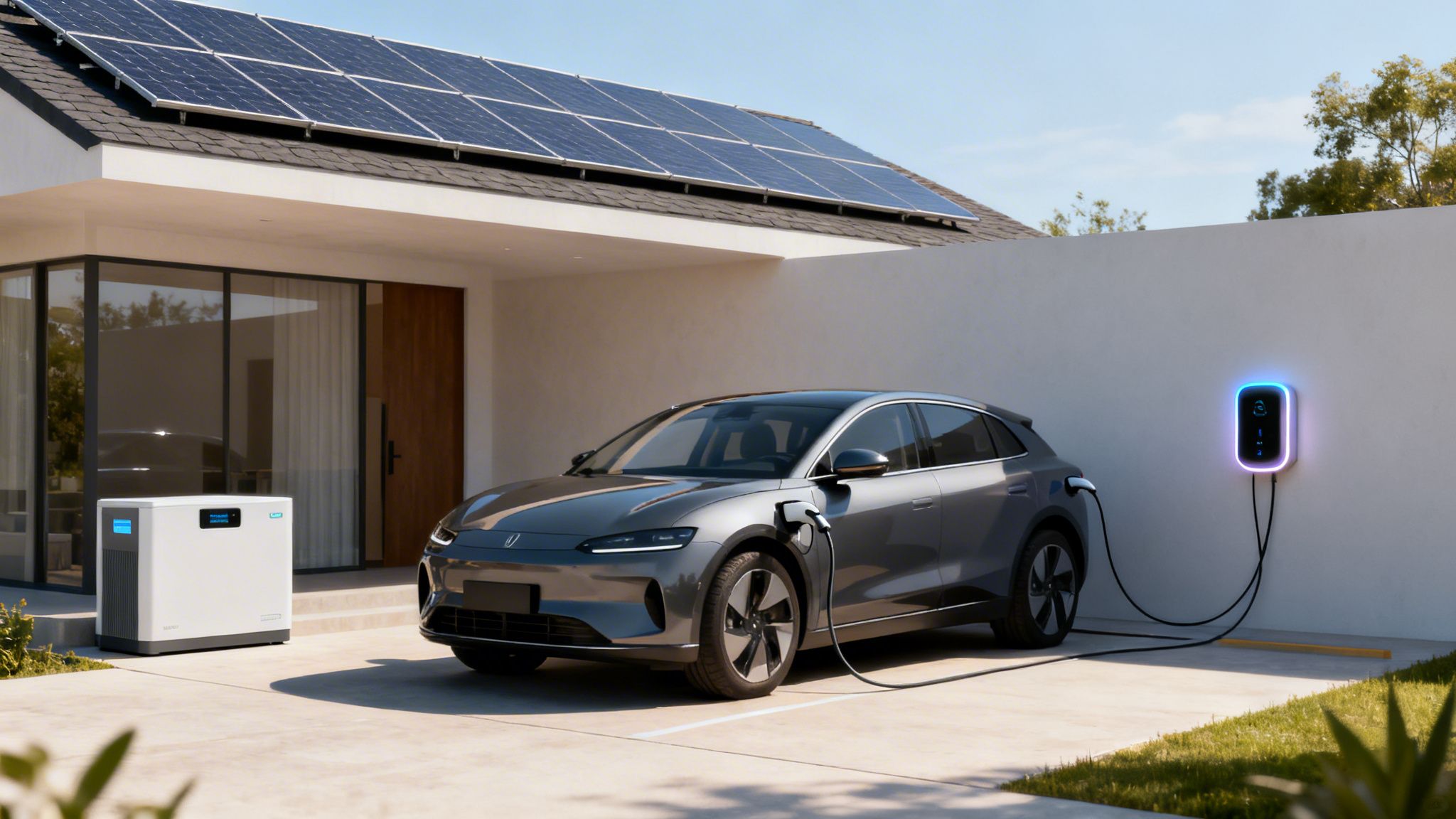
A home EV charger installation is a fantastic upgrade on its own. But the real magic happens when you connect it to your home's solar and battery setup. This is where your EV stops being just a car and becomes a key part of your home energy ecosystem. It’s how you can genuinely drive on sunshine, achieve real energy independence, and shield yourself from skyrocketing electricity prices.
Driving on Sunshine with Solar Integration
Pairing your EV charger with rooftop solar is a game-changer. It means you can literally power your car with clean, free energy you’ve generated yourself. Your daily commute suddenly becomes a zero-cost, zero-emissions trip.
It's a beautifully simple process. During the day, your solar panels are hard at work powering your home. Instead of sending all that excess energy back to the grid for a pittance, you can divert it straight into your car’s battery.
The key to making this work is a smart charger. Think of it as the brains of the whole operation. It talks directly to your solar inverter to figure out exactly how much spare power is available at any given moment.
How Smart "Solar Aware" Charging Works
A smart charger with a 'solar-aware' or 'eco' mode is designed to hunt for free solar power. It constantly watches what your panels are producing and what your house is using, then adjusts your EV’s charging speed in real-time.
This ensures you’re always using your own solar energy first, before ever needing to pull expensive power from the grid.
- On a bright, sunny day, your panels are cranking out power. The charger sees this surplus and ramps up to charge your EV at full speed.
- When clouds roll in, solar output drops. The charger detects this instantly and slows down or even pauses the charging session to avoid drawing from the grid.
- If you switch on the air con, the charger knows the house needs that power first. It will automatically reduce the power going to the car to compensate.
By timing your charging to match your solar generation, you’re not just saving a few bucks. You’re maximising the return on your entire solar investment and slashing your household’s carbon footprint. It’s the only way to be certain you’re fuelling your car with 100% renewable energy.
Adding a Solar Battery for 24/7 Energy Freedom
Charging directly from solar is brilliant, but what happens when you need to charge overnight? Or on a miserable, rainy day? This is where a home battery completely changes the game. It’s the final piece of the energy independence puzzle.
A solar battery’s job is to capture and store all the excess energy your panels generate during the day. Instead of exporting that valuable power, you save it for when you really need it.
That stored energy can then power your home in the evening and—most importantly—charge your EV overnight. You can come home from work, plug in, and wake up to a full battery, all without buying a single kilowatt-hour from your retailer. A battery makes your solar investment far more flexible and valuable. If you're curious about what's out there, this solar battery comparison guide is a great place to start exploring your options.
When you combine solar panels, a home battery, and a smart EV charger, you create a powerful, self-sufficient energy loop. You generate your own clean power, store it, and use it when you want. This gives you complete control and future-proofs your home against an unpredictable energy market. For any homeowner serious about long-term savings and sustainability, this integrated system is the ultimate goal.
How to Find a Qualified Installer in NSW
Picking the right electrician for your home EV charger installation is easily the most important decision you'll make in this whole process. This isn't just another electrical job. It requires a specific set of skills in EV charging systems, understanding load management, and navigating local compliance. Getting this right from the start means your system will be safe, efficient, and reliable for years to come.
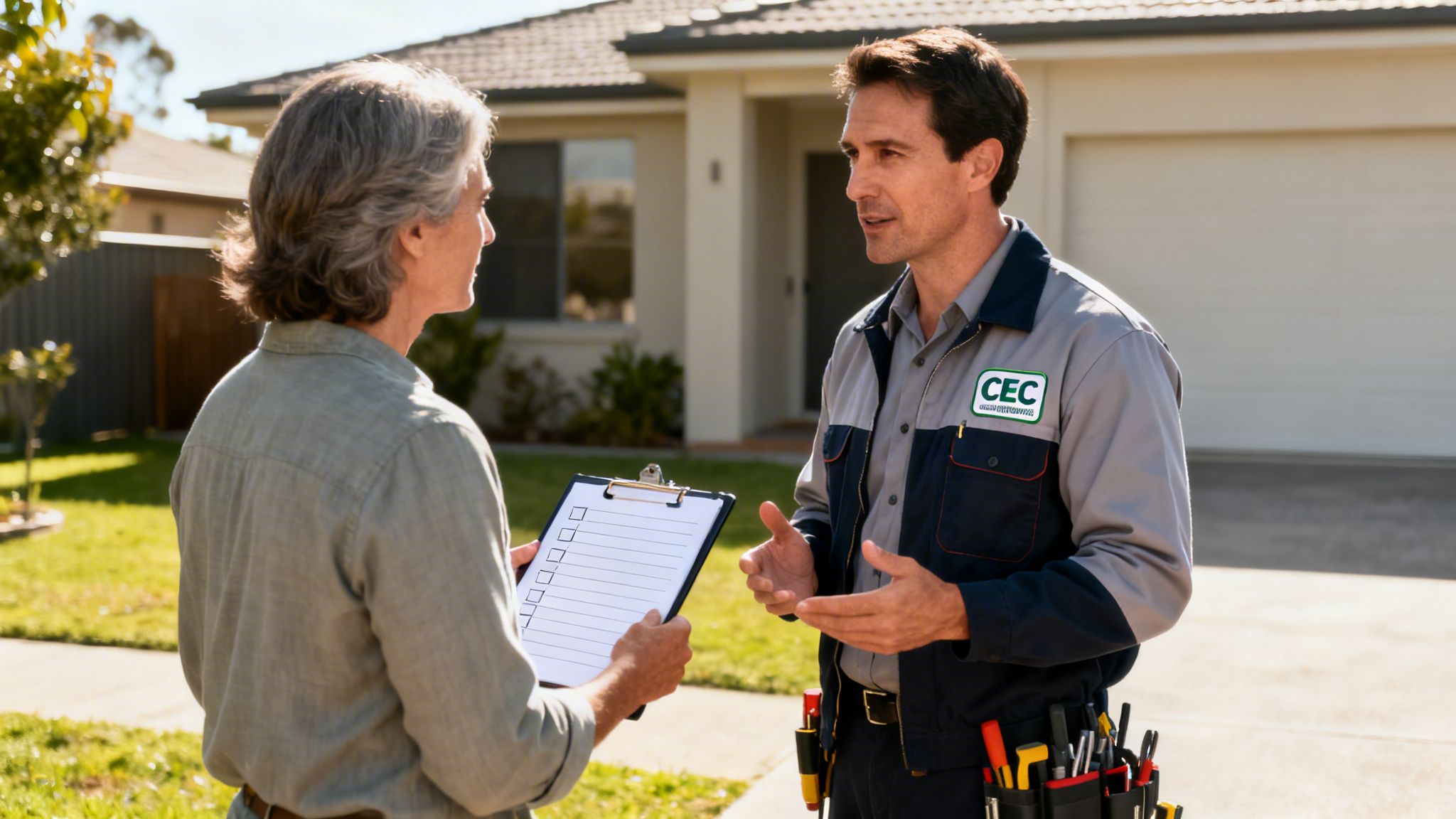
This is why you have to look beyond a standard electrical licence. For any renewable energy or EV charger project in Australia, the gold standard is Clean Energy Council (CEC) accreditation. This is your proof that an installer has gone through specialised training and is committed to the industry’s highest standards.
For context, our in-house teams at Interactive Solar aren’t just fully licensed electricians (Licence #329360c)—they are also CEC accredited. This dual qualification should be your benchmark for quality and safety.
Essential Questions to Ask Potential Installers
Once you have a shortlist of accredited electricians, it’s time to dig a little deeper. The way they answer these questions will tell you everything you need to know about their experience and professionalism. Don’t be shy about asking direct questions—a confident, experienced installer will have no problem answering them.
Here’s what you need to find out:
- How many EV charger installations have you actually completed? Experience matters. An installer who has fitted hundreds of chargers has seen it all, from tricky cable runs to complex switchboard upgrades.
- Which EV charger brands do you prefer to install, and why? A good installer will have a list of brands they trust based on real-world reliability, features, and after-sales support. Their reasoning will reveal a lot about their product knowledge.
- Do you use your own electricians or do you subcontract the work? Companies with in-house teams generally have far better quality control and accountability. It means the person who quotes your job is part of the same team that will install it.
- What is your workmanship warranty? The charger itself has a manufacturer's warranty, but you need a separate one covering the installation quality. This protects you if something goes wrong with the physical wiring or mounting down the track.
A reputable installer will always stand behind their work with a clear workmanship warranty. This is your assurance that they are confident in the quality of their installation and will be there to support you long after the job is done.
Verifying Credentials and Compliance
Asking the right questions is one thing, but you absolutely have to see the proof. A legitimate installer will happily provide all their documentation and be completely transparent about their process.
This stuff is non-negotiable. Before you sign any contract, use the checklist below to make sure you can verify every single point. A good installer is an advocate for consumer protection. You can get more familiar with your rights by reading our guide explaining the New Energy Tech Consumer Code (NETCC).
Here's a simple checklist to help you cover all your bases before hiring an electrician for your EV charger installation.
Installer Hiring Checklist
| Verification Point | Why It's Important | What to Ask For |
|---|---|---|
| Electrical Licence | This is the legal minimum for any electrical work in NSW. It ensures they are a qualified electrician. | Ask for their NSW electrical contractor licence number and verify it online. |
| CEC Accreditation | This shows they have specialised training in renewable energy and EV charging systems, meeting higher industry standards. | Ask for their CEC accreditation details and look them up on the CEC website. |
| Public Liability Insurance | This protects you and your-property from accidental damage during the installation. | Request a copy of their Certificate of Currency for public liability insurance. |
| Workmanship Warranty | This covers the quality of the installation labour itself, separate from the charger's product warranty. | Ask for a written statement detailing the length and terms of their workmanship warranty. |
Taking a few minutes to confirm these details upfront will save you from major headaches later on.
The Critical Documentation You Must Receive
When the installation is done and your charger is on the wall, the job isn’t finished until you have the right paperwork in your hands. This is your official record that the work was done safely and to Australian Standards.
You must be given the following:
- Certificate of Compliance for Electrical Work (CCEW): This is the single most important document you’ll receive. Issued by the licensed electrician, it’s your legal guarantee that the installation complies with all NSW safety regulations.
- A Detailed Tax Invoice: Your invoice should clearly break down all the costs—the charger hardware, labour, and any other materials or services like switchboard upgrades.
- Warranty Information: You need written details for both the manufacturer's warranty on the charger and the installer's own workmanship warranty. Keep these in a safe place.
- User Manuals and a Clear Handover: The installer should walk you through how to use your new charger, explain any smart features, and leave you with all the necessary manuals.
A professional company like Interactive Solar handles this entire process for you seamlessly. Our commitment to using our own licensed and CEC-accredited teams means every installation we do meets the highest benchmark for safety, transparency, and reliability. That end-to-end control is how we guarantee peace of mind for every single homeowner.
Your Top Questions About Home EV Charger Installation
Jumping into a home EV charger installation brings up a lot of questions. That’s perfectly normal. It’s a pretty big upgrade to your home’s energy setup, and you want to be sure you have all the facts before diving in. We get asked these things all the time by homeowners across NSW, so we’ve put them all in one place to help clear things up.
This isn't just about picking a piece of hardware; it's about making a smart, future-proof investment for your home. Finding a good, experienced professional is the most important part of getting this right. This guide to selecting the right EV charger installer is a great resource for figuring out what to look for.
Do I Need to Upgrade My Switchboard for an EV Charger?
Not always, but it’s a very common step, especially in older homes around NSW. Think of it this way: a Level 2 charger is a major new appliance, and a lot of existing switchboards are already running close to their limit.
When a licensed electrician comes out for a site assessment, they'll do a critical load calculation. This is where they figure out if your current system can safely take on the extra demand from the charger. If it can't, then a switchboard upgrade is essential for safety. It stops your main breaker from tripping all the time and ensures your charger works reliably when you need it.
Can I Install an EV Charger in an Apartment Building?
Yes, absolutely. It just takes a bit more coordination and paperwork. The first and most critical step is getting formal approval from your owners' corporation or strata committee before any work starts.
You'll need to give them a detailed proposal that maps everything out. This should include:
- The exact charger model and where you plan to put it.
- An assessment of the impact on the building's overall electrical load.
- A clear plan for how your electricity use will be measured and billed back to you.
Working with an installer who has experience with strata jobs is a huge advantage here. They know how to put together a professional, comprehensive proposal that’s more likely to get a quick green light.
Getting approval for a strata installation is about demonstrating that the work will be done safely, professionally, and with no negative impact on other residents. A clear proposal is your best tool for success.
How Long Does a Typical Home Installation Take?
The hands-on installation work is actually quite fast. For a standard, straightforward job, the electrician is often in and out in just 3-5 hours on the day.
But the whole process—from that first call and site visit to the final checks and handover—usually takes about 1-2 weeks. This buffer gives everyone enough time for proper quoting, scheduling, and any site prep, making sure the whole experience is smooth and hassle-free.
What Is the Difference Between a Tethered and Untethered Charger?
This one really boils down to convenience versus flexibility.
A tethered charger has the charging cable permanently attached to the unit. It’s incredibly convenient; you just park, grab the handle, and plug in. If you have one primary EV and want maximum simplicity, this is the way to go.
An untethered charger, on the other hand, is just a socket on the wall. This gives you a cleaner look and the flexibility to use different types of cables or longer ones if you need to. It's a great option if you want to future-proof your setup or occasionally have friends with different EVs over. We also answer many other questions in our general frequently asked questions section.
Ready to take control of your EV charging? At Interactive Solar, our in-house, CEC-accredited electricians provide expert home EV charger installations across NSW, fully integrated with your solar and battery systems for maximum savings. Get in touch today to start your journey towards effortless home energy. Visit us at https://interactivesolar.com.au.