Commercial Solar Panels Sydney: A 2026 Business Guide
Most Sydney operations managers do not need another lecture about sustainability. They need a way to stop electricity costs from chewing into margin, month after month, while keeping the site running smoothly.
That pressure is real across warehouses, schools, retail centres, workshops, offices, and mixed-use buildings. The bill lands. Usage patterns are hard to shift. Daytime demand is high because that is when the business is operating. Grid pricing stays outside your control.
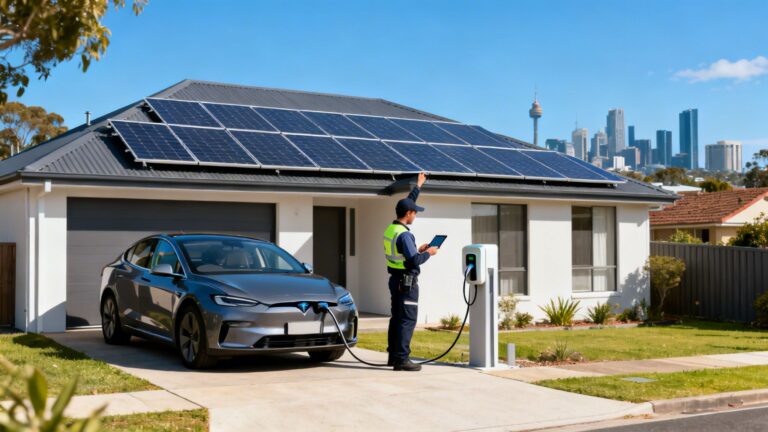
That is why commercial solar panels sydney is no longer a side project for “later”. It is an operational decision. A well-designed system can reduce exposure to peak pricing, improve budgeting certainty, support future battery or EV charger integration, and make the building work harder for the business.
Is Your Energy Bill Holding Your Sydney Business Back
A familiar pattern plays out in Sydney. A business finishes a solid quarter on sales, then the electricity bill arrives and takes a chunk out of the result. Nothing dramatic happened on site. Staff numbers stayed stable. Trading hours were normal. Yet power costs still moved against the business.
For operations teams, that is the frustrating part. Electricity is essential, but the price of it is not something you can negotiate away through better rostering alone. You still need lighting, HVAC, refrigeration, machinery, lifts, data rooms, chargers, and general daytime load.
Commercial solar changes that conversation. Instead of treating power as a fixed external problem, you turn part of your roof into an asset that produces electricity while the site is open and consuming it.
NSW is already deep into rooftop solar adoption. As of the end of 2023, NSW had 947,357 small generation units installed, making it the second-largest state for solar adoption after Queensland, according to the SunWiz PV market report. That matters because it tells you this is not an experimental move. It is established infrastructure.
What businesses usually realise first
The first shift is financial, but the second is operational. Once a site starts self-generating, the business has more control over:
- Daytime consumption: Solar output aligns naturally with many commercial loads.
- Budgeting confidence: Less dependence on volatile grid costs means easier forecasting.
- Resilience planning: A solar-ready site is in a better position to add storage or EV charging later.
- Decision speed: Management stops delaying upgrades because of power-cost uncertainty.
A lot of businesses start with bill shock, then realise the bigger advantage is control. That is the point where solar stops being a “green initiative” and becomes part of operating strategy.
Practical takeaway: If your business uses most of its electricity during the day, your roof is not just shelter. It is underused energy infrastructure.
If reducing power costs is on your agenda, it helps to start with the basics of how to reduce electricity bills before sizing a system. The strongest projects usually begin with a clear view of when the site uses power, not just how much it uses overall.
The Unmistakable ROI of Commercial Solar Power
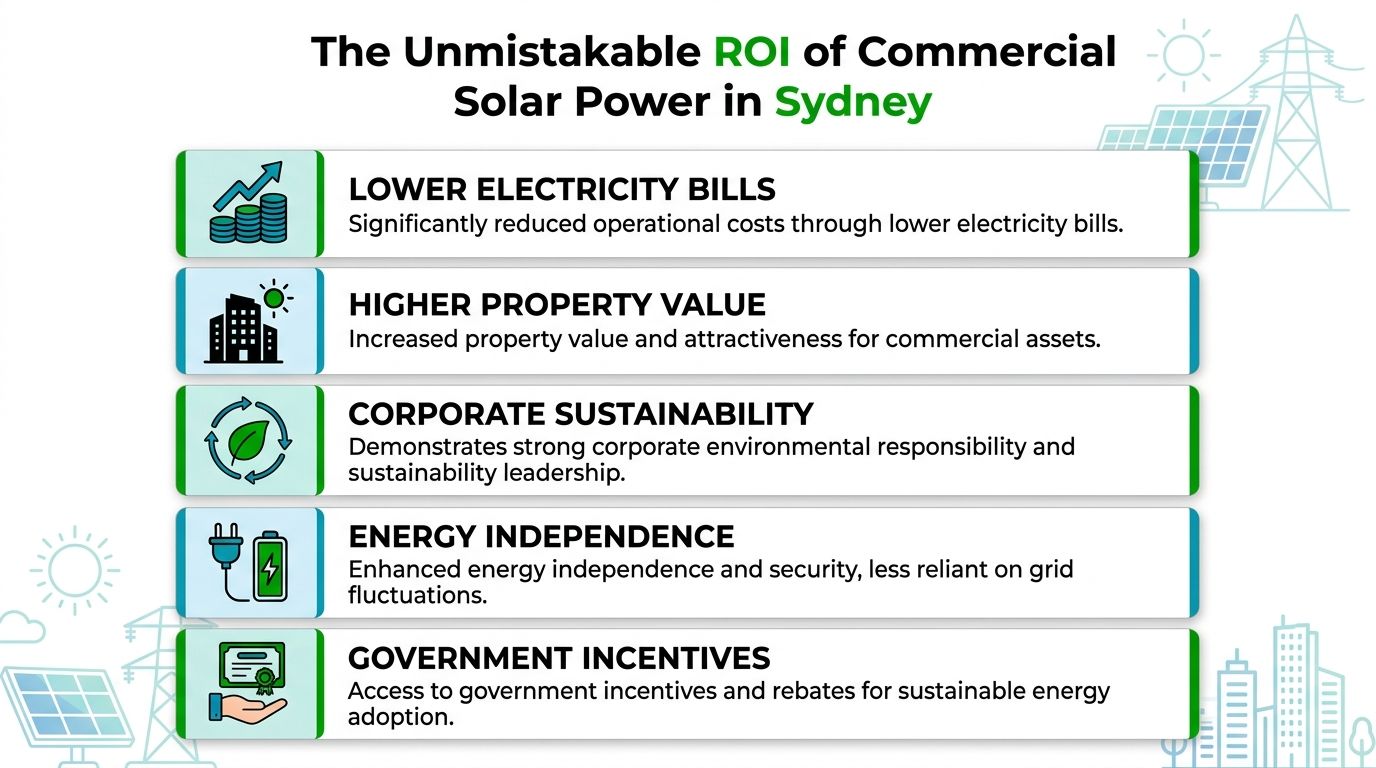
A Sydney operations manager sees the pattern quickly. Power costs climb, summer cooling load stretches through the afternoon, and every tariff increase eats into margin. A well-designed commercial solar system changes that equation by shifting part of your supply onto the roof you already own.
The return is strongest when the system matches how the site operates. Warehouses, factories, schools, offices, and retail sites with steady daytime demand can use a large share of their own generation on site, which is where the economics improve. In Sydney, that also creates an operational edge. North-facing arrays maximise annual yield, while east-west layouts can better cover the longer business day and help reduce exposure during higher-priced afternoon periods.
Industry guidance from the Clean Energy Council’s business case resources for commercial solar notes that commercial payback periods are commonly driven by daytime self-consumption, tariff structure, and system design rather than panel price alone. That is the point many finance teams care about. The project performs well when the site uses the energy as it is produced.
Why finance teams approve these projects
Finance approval usually comes down to three practical outcomes:
- The system offsets expensive daytime grid electricity.
- It produces for decades with predictable maintenance requirements.
- It reduces the business’s exposure to future energy price increases.
That third point matters in Sydney. Solar savings are not limited to today’s tariff. On-site generation gives the business more control over a cost line that has been difficult to forecast for years. For multi-site operators, that stability can improve budgeting across the portfolio, not just at one address.
There is also a competitive advantage here. A business with lower and more predictable energy costs has more room to protect margin, price confidently, or reinvest in equipment, staff, and site upgrades. For manufacturers and cold-storage operators, that can be the difference between absorbing volatility and passing it on to customers.
ROI is broader than the power bill
The strongest projects improve site performance, not just monthly accounts.
- Operational resilience: Lower grid dependence reduces exposure to tariff shocks and creates a practical foundation for batteries later.
- Better use of the roof asset: The building contributes to production instead of sitting idle above a high-load facility.
- Stronger property position: Lower operating costs can support lease retention, long-term occupancy, and asset appeal.
- Procurement and tender support: Many Sydney businesses now face supplier questionnaires around emissions and energy action. Solar provides a measurable response.
On Sydney sites near the coast, durability affects return as much as yield. Salt-laden air can shorten the life of poor mounting hardware and lower-grade components. Choosing corrosion-suitable materials costs more upfront, but it protects output and avoids remedial work that can drag down project economics later.
Key point: The best return usually comes from the system size and layout that fit the site’s load profile, tariff, and operating hours, not from chasing the largest array the roof can hold.
If you want an early estimate before detailed design, this commercial solar savings calculator for Sydney businesses is a practical starting point. It helps frame the decision around self-consumption, tariff offset, and expected payback.
What weak ROI usually looks like
Poor returns usually come from avoidable design and procurement mistakes:
- Oversized systems that send too much power to export instead of offsetting on-site consumption
- Low-grade hardware that increases fault risk and maintenance costs
- Generic array layouts that ignore when the business uses electricity
- Installations that miss local conditions such as shading, roof access constraints, or coastal corrosion exposure
I treat commercial solar as operating infrastructure. If it is sized around the load, configured for Sydney conditions, and installed to a high standard, it does more than cut bills. It gives the business tighter cost control, better resilience, and a stronger position in a market where energy reliability and margin protection matter.
Designing Your Ideal Commercial Solar System for Sydney
Commercial solar design in Sydney is not a copy-and-paste exercise. The right system for a warehouse in the west is not automatically the right system for a school near the coast or a retail site surrounded by taller buildings.
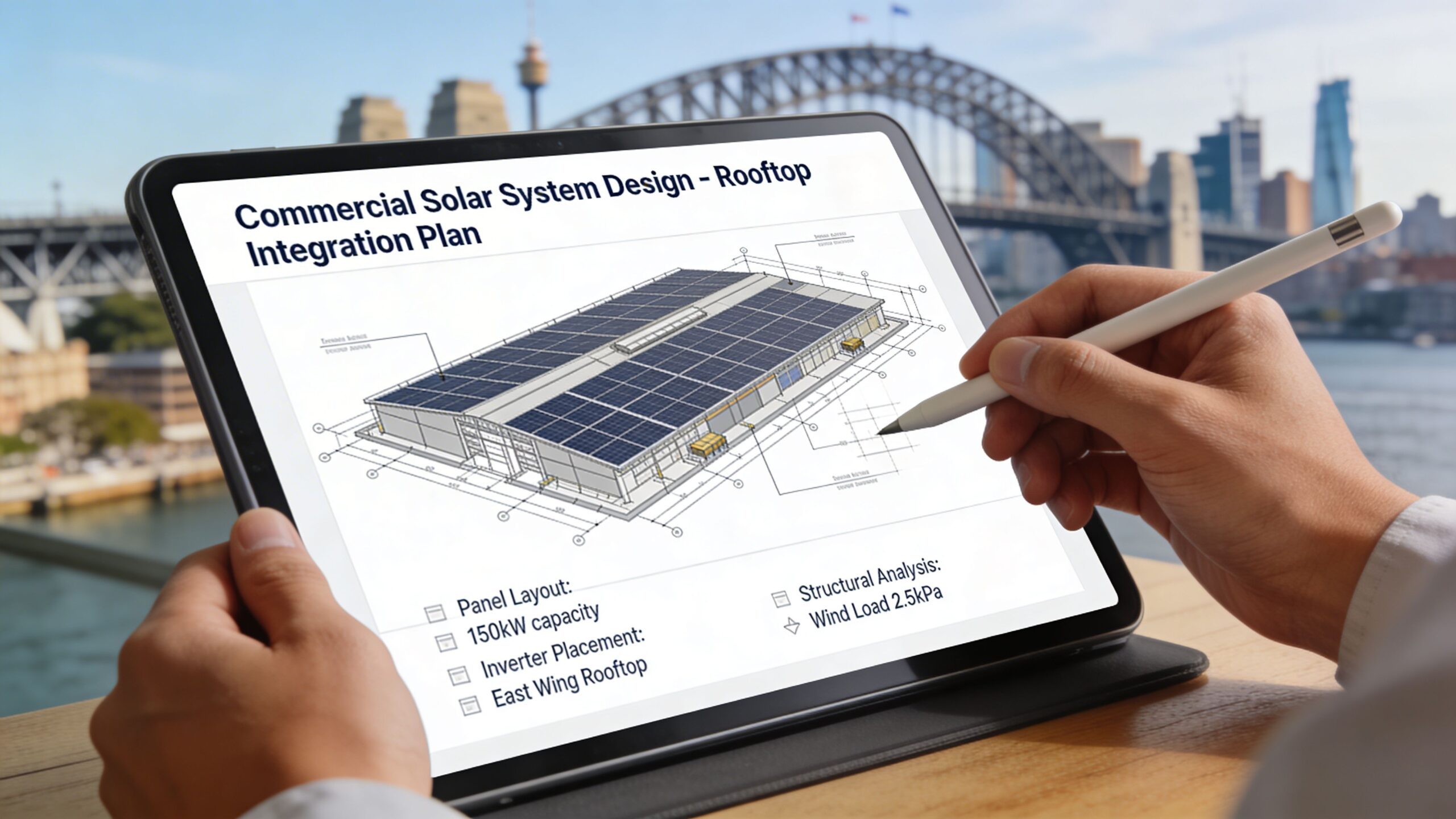
Hardware choice, orientation, roof layout, access requirements, temperature performance, corrosion resistance, and future expansion all matter. Good design protects output. Bad design creates underperformance that stays with the site for years.
Start with commercial-grade panel selection
Commercial rooftops usually benefit from 72-cell panels rather than residential-style formats. The reason is simple. They deliver stronger energy density and make better use of available roof area.
Based on Australian panel sizing benchmarks, commercial installations in Sydney predominantly use 72-cell panels measuring about 2m x 1m and delivering 400-600W per panel. The same source notes that half-cut cell and multi-busbar technology can push efficiency into the 20-22% range, which is useful on space-constrained urban roofs.
That does not mean every “high-watt” panel is suitable. Module selection still needs to match the building, mounting method, wind conditions, and maintenance access.
A useful technical reference for newer module formats is this overview of top bifacial solar panels to watch in 2025. It is relevant if your site has reflective roofing or layout conditions that may suit bifacial performance, though bifacial is not automatically the right answer for every commercial roof.
Sydney conditions punish generic specs
Sydney is not mild from a solar engineering point of view. Coastal air, summer heat, roof movement, and wind loading all test the system over time.
For optimal performance and longevity in Sydney’s coastal environment, commercial solar panels require certification to IEC 61701 for salt mist corrosion and a maximum power temperature coefficient of -0.45%/°C, according to Sydney Water’s solar PV specification.
Those are not box-ticking details. They affect long-term yield and maintenance risk.
What that means on real sites
- Coastal and harbour-adjacent buildings: Salt exposure increases the need for corrosion-resistant modules and hardware.
- Hot roofs in summer: Lower temperature sensitivity helps preserve output when module temperatures rise.
- Large open roofs: Wind certification and mounting quality matter as much as panel choice.
- Maintenance access: Tight layouts can save space on paper but create service problems later.
Sydney Water’s specification also sets out practical design requirements around access clearances and structural readiness. Commercial owners should pay attention to that because maintainability is part of system performance.
Engineering tip: If an installer cannot explain why a module’s corrosion rating and temperature coefficient matter on your specific site, they are probably selling a panel, not designing a system.
North is not always the most valuable direction
A common mistake in commercial solar panels sydney projects is rigidly chasing north-facing output without checking the site’s actual usage pattern.
North-facing arrays usually maximise annual production. But business value depends on when the electricity is generated, not only how much is generated over a full year.
The Solar Analytics orientation guidance notes that west-facing panels reduce total energy by only about 15% compared with north-facing arrays, while shifting production later into the afternoon. That can suit Sydney businesses with stronger afternoon demand. The same source states that NSW peak prices can reach $0.3648/kWh, which is why time-of-generation matters for many commercial sites.
Better design follows load, not folklore
A better commercial layout might be:
- West-facing: Useful for afternoon-heavy sites such as retail, hospitality, and some office loads.
- East-facing: Better where demand starts hard in the morning.
- East-west-north mix: Often the best operational compromise across longer trading days.
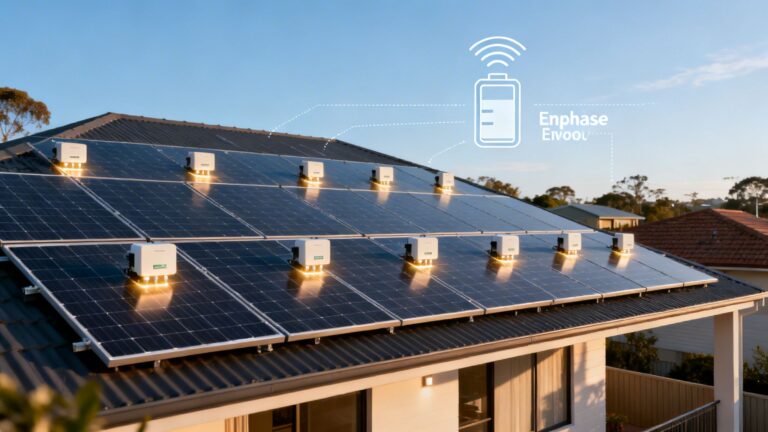
- Battery-ready configuration: Worth planning early even if storage comes later.
The right answer comes from interval data, roof geometry, and tariff structure. Not from generic advice that every array should face north because that is what people say residential systems should do.
One provider operating in this space, Interactive Solar, offers turnkey commercial solar systems for Sydney businesses with in-house delivery and custom system design. For buyers, that kind of model is useful when one team can review load profile, roof constraints, approvals, and future battery or EV charger integration together rather than treating them as separate jobs.
Navigating NSW Government Incentives and Approvals
The paperwork side of commercial solar puts many projects on hold longer than it should. Business owners usually understand the value of lower energy costs. What slows them down is uncertainty about certificates, approvals, network requirements, and who is responsible for each step.
The good news is that the framework is well established. The key is handling it methodically.
What support is already built into commercial solar
For Sydney businesses, two of the most relevant mechanisms are Small-scale Technology Certificates (STCs) and Large-scale Generation Certificates (LGCs). These help offset installation costs, depending on system size and project structure.
The Sydney commercial solar reference linked earlier notes that government incentives including STCs and LGCs are factored into commercial pricing, alongside available tax benefits and financing pathways. That means the market already prices these schemes into many proposals, but you still need to understand which applies to your project and how it is being treated.
A practical starting point is this guide to solar rebates NSW goverment rebates for solar. It helps clarify the language around rebate-style support and where businesses should look first.
The approval path most businesses go through
The process usually involves several moving parts rather than one single approval.
Site assessment
The installer reviews roof condition, switchboard capacity, load profile, and physical constraints.Network connection application
The local network needs to review how the system will connect, especially if export is proposed.Design and compliance documentation
This includes electrical design, component selection, and relevant standards.Council or landlord checks where required
Some sites need landlord approval, strata sign-off, or planning review depending on the building type.Certificate handling and commissioning paperwork
The project team finalises the documents needed for incentives and system energisation.
Where projects usually get delayed
The technical installation is often the easy part. Delays usually come from incomplete information at the start.
Common examples include:
- Landlord approvals not requested early enough
- Old switchboards that need upgrade work before solar can be connected
- Export assumptions that do not match network limits
- Roof access issues discovered after design has already progressed
Practical advice: Ask early who is handling each approval, what documents are needed from your side, and whether the design assumes export or mainly self-consumption.
A turnkey provider earns its keep here by managing the handoffs cleanly. The less fragmented the process, the lower the chance of redesign, delay, or compliance surprises.
Your Turnkey Commercial Solar Installation Journey
A Sydney installation should fit around trading hours, deliveries, tenants, and safety controls. If crews turn up with a generic plan and start improvising, the job gets slower, riskier, and more disruptive than it needs to be.
The job starts with how your site operates
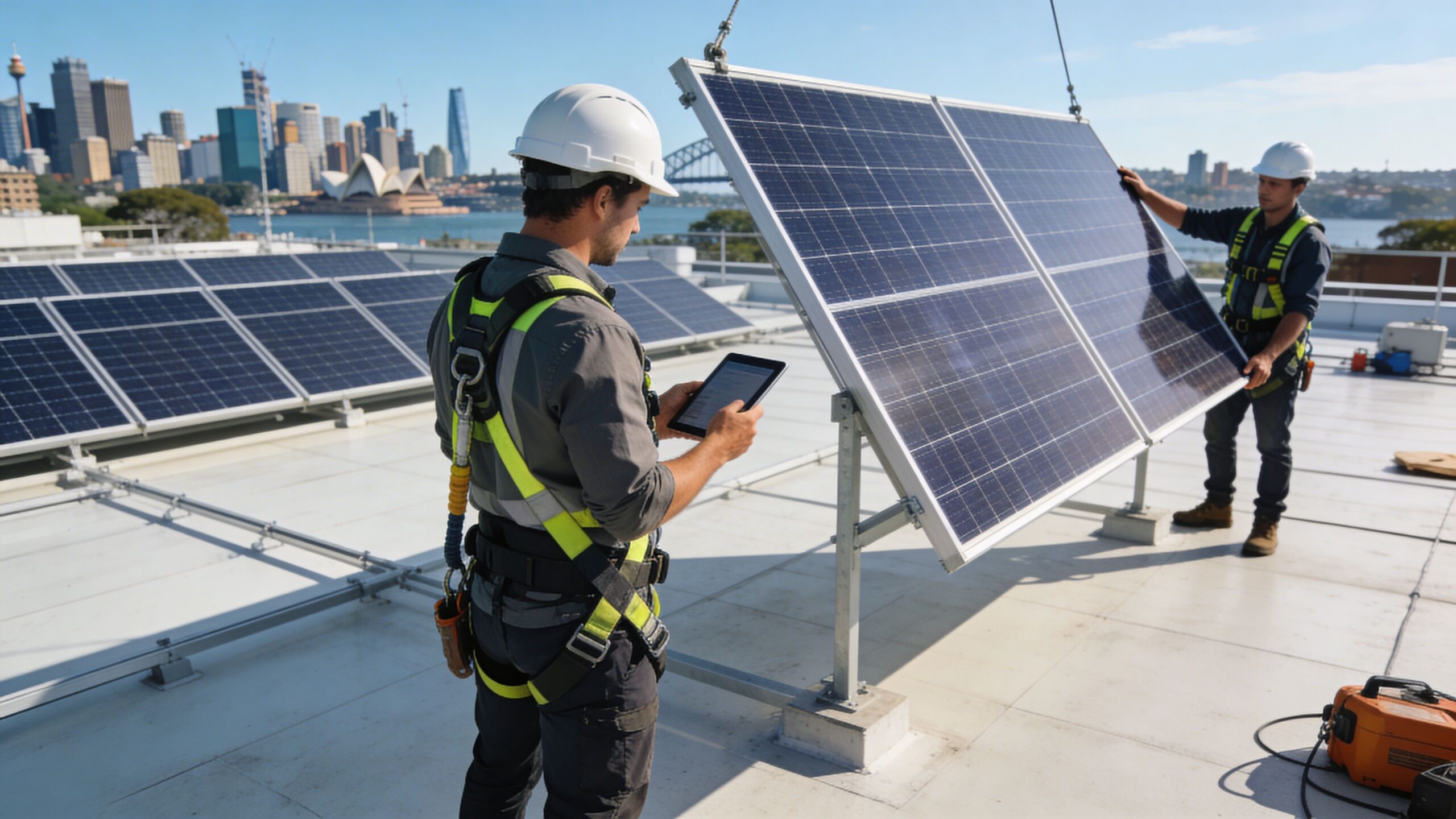
By the time installation begins, the important decisions should already be made. Crews need a clear plan for roof access, delivery routes, exclusion zones, shutdown windows, and how the system will tie into the site without interrupting core operations.
On Sydney sites, that planning often decides whether the project feels controlled or chaotic. Warehouses need loading bays kept clear. Schools and strata buildings need tighter access management. Coastal sites need extra attention to mounting hardware, cable protection, and panel selection because salt exposure shortens the life of poorly specified components.
The better projects also plan for business resilience, not just panel placement. That can mean orienting arrays to support expensive late afternoon demand, staging switchboard works outside production hours, or setting up monitoring so facilities teams can spot faults before they affect output.
What a well-run install looks like on site
The installation itself should be predictable.
A capable team coordinates permits, inductions, deliveries, crane access where needed, roof works, inverter placement, switchboard integration, testing, and final energisation without leaving your operations manager to chase every trade. That matters on active commercial sites, where one missed handoff can hold up electricians, roofing crews, tenants, or network inspections.
The details of workmanship matter here. Cable routes need to stay neat and protected. Weatherproofing needs to suit Sydney storms and heat. Mounting systems need to match the roof type and site conditions, especially close to the coast. This article on quality installations you can have the most advanced solar system installed but if the installation quality is subpar is it valuable is worth reading because poor install quality usually shows up later as water ingress, nuisance faults, or avoidable maintenance callouts.
Handover should leave your team in control
Commissioning is not the finish line if your staff do not know what has been installed or how to read system performance.
A proper handover includes as-built documentation, shutdown procedures where relevant, monitoring access, warranty records, and one service contact for faults or future changes. Operations teams should also know what level of solar generation to expect across the day, when export may be constrained, and what warning signs justify a service call.
If the project is being funded rather than purchased outright, it also helps to align handover documents with the lender or broker from day one. Clear asset records and commissioning paperwork make life easier for teams using equipment financing.
This walkthrough gives a useful visual sense of what a live solar project looks like in practice:
What works best: one project lead, a site-specific programme, and an installer that treats solar as operating infrastructure, not just another roof job.
Smart Financing Options for Your Solar Investment
A Sydney business can approve the technical side of a solar project, see the savings stack up, and still delay the job because the funding model does not fit the way the business runs. That is usually the primary issue. The wrong finance structure can strain cash flow, complicate tax treatment, or limit flexibility if the site changes hands or operating hours shift.
Good finance should match the asset life, the savings profile, and the level of control the business wants over the system.
The common paths businesses consider
A chattel mortgage usually suits businesses that want to own the system from day one and keep the long-term upside. In practice, rates, loan terms, and deposit requirements vary by lender, asset quality, and business profile, so the decision should be tested against expected bill reduction, depreciation treatment, and how quickly the site will use the solar energy it generates. For many Sydney operators, that matters because a well-shaped system can do more than cut costs. It can reduce exposure to expensive daytime grid power and give the business more control during peak pricing periods.
An operating lease or rent-to-own arrangement can make more sense if capital needs to stay available for stock, equipment, or expansion. Monthly payments are easier for some businesses to absorb than a large upfront spend, especially across multi-site operations where management wants predictable outgoings rather than immediate ownership.
A power purchase agreement, or PPA, is often the lowest-friction option for businesses that want solar performance without owning the hardware. The provider usually funds, owns, and maintains the system, and the customer buys the solar electricity under contract. That can work well for sites with strong daytime demand, but the contract needs close review. Escalation clauses, buyout options, roof access rights, and end-of-term responsibilities all affect whether the deal still looks good five or ten years in.
If you are comparing broader funding structures before deciding, this plain-English guide to equipment financing is useful because it explains how businesses often fund revenue-supporting assets without tying up all available capital.
Commercial Solar Financing Options Compared
| Financing Option | Upfront Cost | Asset Ownership | Key Tax Benefit |
|---|---|---|---|
| Chattel mortgage | Higher than lease-style options | Business owns the system from the start | May support depreciation claims and deductible repayments |
| Operating lease or rent-to-own | Lower initial capital pressure | Ownership depends on lease structure | Often useful where repayment treatment matters to cash flow planning |
| Power purchase agreement | Commonly structured to reduce upfront burden | Third party usually owns the system | Tax position depends on contract and energy purchase arrangement |
What to choose in practice
The right option depends on the operating goal.
- Choose ownership-focused finance if the site is stable, daytime consumption is strong, and the business wants the full asset value over the system life.
- Choose lease-style finance if preserving working capital matters more than immediate ownership, or if the business is balancing several capital projects at once.
- Choose a PPA if the priority is simplicity, limited internal management, and low upfront commitment.
I usually advise clients to test finance against real operating conditions, not just headline repayment numbers. A warehouse in Western Sydney with long daytime loads will judge value differently from an office near the coast with a shorter load window, stricter roof access rules, and higher corrosion risk. Financing should support a solid business case and a system that improves resilience, cost control, and competitiveness in the Sydney market.
Ensuring Decades of Performance and Reliability
Commercial solar is a long-life asset. That only helps if the system keeps performing across heat, UV exposure, weather, dirt buildup, and routine electrical ageing.
Here, cheap purchasing decisions usually come undone. A panel that looks acceptable on a quote sheet can become expensive if it degrades early, fails in harsh conditions, or creates service issues that interrupt output.
Sydney’s UV load is not a minor detail
An April 2026 UNSW Sydney study reveals that UV degradation can slash the lifespan of lower-quality commercial solar panels by up to 10 years in high-UV regions like Sydney, according to this Sydney commercial solar article discussing the UNSW finding.
That should change how buyers think about “equivalent” panels. They are not equivalent if one handles Sydney conditions for the full service life and another does not.
Premium commercial-grade PV modules, proper mounting, disciplined cable management, and careful installation detail are part of the same reliability decision. You do not protect long-term ROI by focusing only on inverter size and upfront quote value.
What a sensible maintenance approach includes
Maintenance does not need to be complicated, but it does need to be intentional.
A good post-installation plan usually includes:
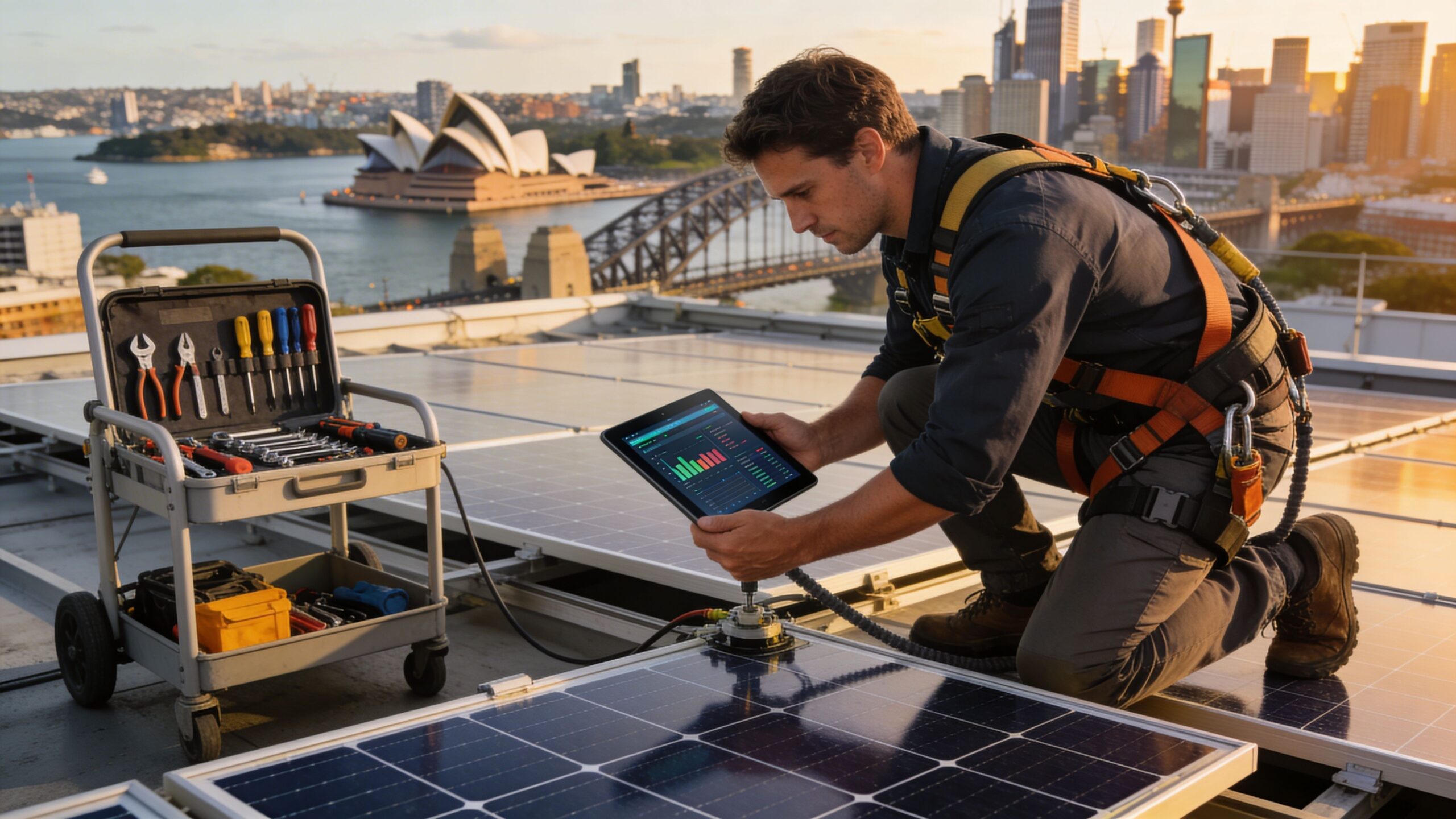
- Monitoring: Watch for unexpected drops in output, inverter faults, or string-level issues.
- Visual inspections: Check for debris, damage, loose hardware, and signs of water ingress risk.
- Cleaning where needed: Dust, salt film, bird activity, and industrial grime can all affect yield.
- Electrical review: Confirm isolators, cabling, and protection devices remain in sound condition.
For a practical non-manufacturer checklist, this guide on how to maintain solar panels for peak performance is a useful reference for understanding the basics of cleaning and visual upkeep.
Reliability rule: The cheapest system on installation day is often the most expensive system over its full life.
Warranties matter, but so does response
A warranty document is only part of the picture. Commercial owners should also ask who monitors the system, who responds when output drops, and how faults are diagnosed.
The strongest long-term outcomes usually come from three things working together:
- Good hardware selection
- Good installation quality
- Good after-care discipline
If one of those is weak, the system may still operate, but it is less likely to deliver the smooth, low-drama performance commercial clients want.
Common Questions About Commercial Solar in Sydney
Can a strata or multi-tenant commercial property install solar
Yes, but approval pathways are more involved. The key questions are who controls the roof, who pays for the system, who benefits from the generated electricity, and how ongoing maintenance is handled. In strata settings, agreement on roof rights and meter arrangements should happen before design is finalised.
Will solar affect my roof warranty
It can if the installation method is poor or if roof penetrations are handled badly. That is why roof type, mounting method, and weatherproofing details should be reviewed early. On many sites, the bigger risk is not solar itself. It is careless installation.
Can we add a battery later
In many cases, yes. But it is smarter to plan for that possibility during the initial design. Battery-ready thinking can affect inverter strategy, switchboard allowances, and how the system is configured for future load shifting or backup goals.
Can we add EV chargers later
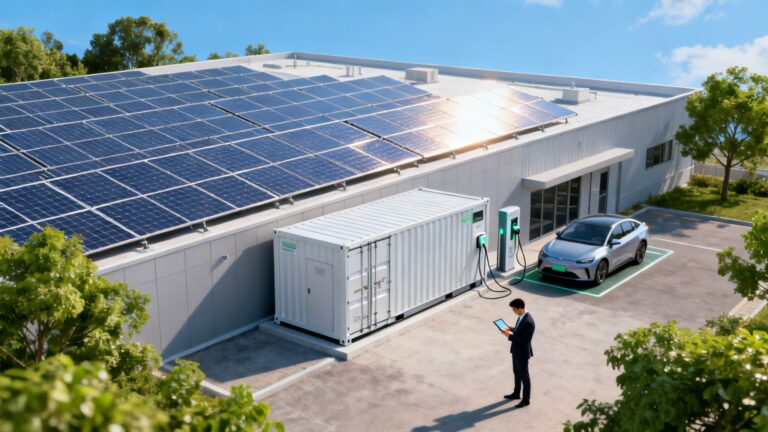
Usually yes, and commercial sites should think about this now even if chargers are not part of stage one. Fleet charging, staff charging, and destination charging can all increase daytime electricity demand. Solar can work well with that because it generates during business hours.
What if our business moves premises
That depends on ownership structure, lease terms, and whether the system is considered part of the property improvement. Some businesses treat solar as a long-term site upgrade. Others choose finance structures that offer more flexibility. This should be discussed before contract stage, not after installation.
What if the roof is not perfectly north-facing
That is not automatically a problem. For many businesses, east or west orientation can be commercially sensible if it aligns better with the site’s real usage pattern. The best layout is the one that supports business demand, tariff structure, and roof practicality.
Will the grid still matter after installation
Yes. Most commercial systems remain grid-connected. Solar reduces purchased electricity, but it does not remove the need for proper network connection, compliant switchboard integration, and ongoing coordination with your retailer or distributor where required.
How much disruption should we expect during installation
A well-managed project should keep disruption contained. Most operational issues are solved through planning, access coordination, and scheduling electrical works carefully. If the installer cannot explain the staging clearly, expect avoidable friction during the job.
If your business wants more control over power costs, better daytime energy resilience, and a commercial system designed around how the site operates, speak with Interactive Solar. They provide turnkey solar, battery, and EV charging solutions in NSW, with in-house installation teams and practical support from design through after-care.