
Unlock Savings with Commercial Solar Installation Sydney
Your power bill lands. It is higher again. You check operating costs, look at trading conditions, and realise energy is now one of the few overheads that can swing without warning.
That is why commercial solar installation sydney has moved from a nice-to-have upgrade to a serious business decision. For many Sydney businesses, the question is no longer whether solar works. It is whether the system is designed properly, approved properly, and built to support the next stage of the business, not just this quarter’s bill.
A commercial solar project should do more than put panels on a roof. It should align with your load profile, your roof conditions, your compliance obligations, and your future plans for battery storage and EV charging. When those pieces line up, solar becomes part of your operating strategy.
Why Sydney Businesses Are Switching to Solar Power
The pressure is familiar. Daytime usage is high, network charges keep biting, and budgeting energy costs feels harder than it should. A lot of Sydney owners start looking at solar after a run of elevated bills, but the reason they move ahead is broader than bill reduction alone.
Commercial solar gives a business a way to produce part of its own power on-site. That matters when electricity pricing is difficult to predict and operating margins are under pressure. It also gives management a clearer line of sight on future energy planning.
Why the shift feels urgent now
Owners are not just reacting to one expensive quarter. They are trying to build resilience into the business. Solar helps when your site uses the most electricity during daylight hours, which is common in warehouses, offices, workshops, retail, hospitality, and mixed-use commercial premises.
Some businesses also recognise that energy strategy now touches more than one area:
- Cash flow planning: predictable daytime generation can soften exposure to retail electricity volatility
- Asset improvement: a solar-ready site is often a better-prepared site for batteries and EV charging later
- Operational continuity: a properly engineered system supports long-term energy management rather than short-term patchwork fixes
If you are reviewing your options because electricity costs are becoming harder to absorb, this guide on electricity prices rising and how to prepare is a useful starting point.
A good commercial solar decision starts with load profile, roof condition, and future expansion plans. It should never start with panel count alone.
What owners often get wrong
The common mistake is treating solar like a commodity purchase. It is not. Two buildings with similar roof area can produce very different outcomes because of orientation, shading, switchboard constraints, access requirements, and daytime demand patterns.
The businesses that get strong long-term value approach solar as infrastructure. They ask better questions. How much daytime load can the site absorb? Is the roof structurally suitable? Will the system still make sense if EV charging is added later? That is the mindset that produces durable ROI.
The Strategic Business Case for Commercial Solar
Commercial solar works best when you assess it like any other capital decision. Look at risk reduction, cost control, and operating flexibility. Bill savings matter, but they are only one part of the case.
In Australia, commercial solar installations saw unprecedented growth in 2024, in the 15-30kW and 1-5MW segments, as businesses moved to reduce operating costs against rising electricity prices, according to the SunWiz 2025 market report. That shift tells you something important. Commercial buyers are not treating solar as a fringe sustainability play. They are using it as an operating asset.
Financial control matters more than headline savings
Most Sydney businesses are exposed to daytime electricity costs. That makes on-site generation valuable because it targets the period when many commercial sites are consuming power.
Think of solar as a form of energy price hedging. It does not remove every electricity cost, and it does not eliminate the need for a sensible retail contract. What it does is reduce the share of your demand that must be purchased from the grid during productive hours.
That can improve decision-making in practical ways:
- Budgeting becomes easier: a portion of your daytime energy is generated on-site rather than bought at whatever the market hands you
- Margin pressure is reduced: if energy is a meaningful operating expense, lower grid reliance can help protect profitability
- Long-term planning improves: businesses can tie solar, batteries, and equipment upgrades into one staged roadmap
A calculator is not a substitute for engineering, but it is a useful first filter. If you want a rough sense of project viability, this commercial solar savings calculator helps frame the opportunity.
On-site generation changes how the site behaves
There is also an operational benefit that many owners notice only after the system goes live. The site becomes more manageable from an energy perspective. Once management can see production and consumption patterns clearly, other improvements become easier to justify.
A business might discover that refrigeration, HVAC, workshop loads, or charging loads line up well with solar generation. In that case, the value of solar is not just lower bills. It is a site that runs more intelligently.
I rarely advise clients to focus on maximum panel density alone. If the design ignores load timing, export constraints, or future battery integration, the business can end up with a system that looks large on paper but performs below its commercial potential.
Brand and procurement value are now part of the equation
For customer-facing businesses, a visible investment in clean energy can strengthen credibility. For B2B operators, it can support procurement conversations, landlord discussions, and internal ESG goals. That does not mean a solar system should be justified by optics. It means the reputational value can sit alongside the financial case.
Consider this framework:
| Business objective | How solar supports it |
|---|---|
| Cost control | Reduces grid dependence during productive daylight hours |
| Operational resilience | Adds on-site generation to the site’s energy mix |
| Future readiness | Creates a platform for batteries and EV charging |
| Market positioning | Signals a practical commitment to lower-emission operations |
The strongest business case comes from combining all four. When owners treat solar as an isolated purchase, they often undersell its value. When they treat it as part of business infrastructure, the logic becomes much stronger.
Designing Your Optimal Commercial Solar System
A commercial solar system should fit the building and the business. That sounds obvious, but poor outcomes often start with a generic design, a rushed site review, or a system sized around available roof area instead of actual site behaviour.
In Sydney, suboptimal roof orientation can reduce energy yield by 15-25%, while a well-designed system can produce payback periods of 4-7 years through electricity bill reductions. The same source notes that designing for battery integration and higher loads can maximise self-consumption to 70% and cut peak demand charges by 30% under Ausgrid tariffs. Those design factors are outlined by Energy Action’s commercial solar guidance.
Start with the roof, not the brochure
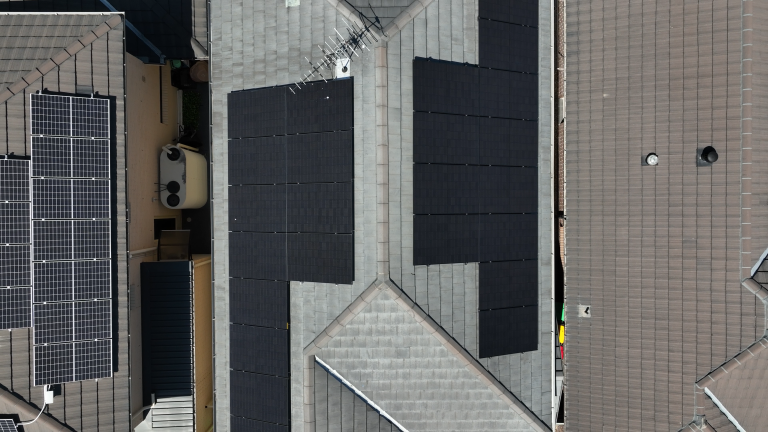
The roof tells you what is possible. Orientation, tilt, shading, structural condition, access, and obstructions all shape the result.
North-facing roof areas at moderate tilt are the strongest performers in Sydney. That does not mean east-west layouts are always wrong. In some commercial settings, an east-west arrangement can still be commercially sensible because it spreads generation more evenly across the day. But if a provider ignores the production trade-off, the proposal is incomplete.
A proper site assessment should review:
- Orientation and tilt: these influence how much usable generation the site can produce
- Shading sources: plant equipment, parapets, neighbouring structures, and vegetation all matter
- Usable roof zones: walkways, setbacks, and service access can limit array layout
- Electrical infrastructure: switchboards, metering, and inverter placement affect buildability
- Future additions: battery storage and EV charging should be considered before final design
Size the system to the load profile
Matching the system to the load profile makes commercial design more strategic than residential design. A business does not need the biggest system the roof can hold. It needs the system that best matches its daytime consumption, export conditions, and growth plans.
I tell owners to think of system sizing like tailoring a suit. Extra fabric does not make it a better fit. A well-sized system is built around how the site uses energy.
That means looking closely at:
| Design question | Why it matters |
|---|---|
| When does the site use the most power | Solar has more value when production aligns with daytime demand |
| How much power can be self-consumed | Higher self-consumption generally improves project economics |
| Are exports constrained | Network limits can change the right system size |
| Will loads increase later | EV chargers, extra machinery, or tenancy changes can affect design choices |
Choose components that suit commercial use
Panels get most of the attention, but inverters, monitoring, mounting systems, and switchgear decisions often separate a durable system from a troublesome one.
Inverter selection is especially important if the business may later add batteries or expand capacity. A design that allows sensible DC to AC loading and future integration can save major rework later. Monitoring also matters. If a system underperforms and nobody sees it quickly, avoidable losses creep in.
Remote oversight is one reason worth discussing early. Ongoing visibility into generation and system status helps operators spot faults, drops in output, and unusual patterns before they become expensive habits. This guide on inverter remote monitoring for stronger solar efficiency gives a practical overview.
The best-performing systems are rarely the cheapest on day one. They are the ones designed around the site’s load, roof constraints, and future electrical needs.
Future-proofing is not an optional extra
A lot of Sydney businesses are planning for electrification even if they are not ready to act immediately. They may add EV chargers for fleet vehicles, battery storage for demand management, or upgraded air conditioning and equipment later.
If the original solar design ignores those possibilities, the business can end up paying twice. Conduit runs, switchboard allowances, inverter strategy, and roof layout should all be reviewed with future expansion in mind.
What works is a staged design. Build the solar system that suits the current load, but leave a sensible path for storage and charging. What does not work is locking the site into a design that looks tidy on installation day and awkward two years later.
Navigating NSW Compliance and Solar Incentives
Compliance is where commercial projects either stay orderly or become expensive. Most owners do not want to become experts in standards, access rules, grid approvals, or paperwork. They want the project handled correctly the first time.
That is reasonable, because commercial solar in Sydney sits inside a real compliance framework. Roof access, structural considerations, fall protection, array setbacks, and grid connection all affect what can be installed and how.
Essential Requirements on a Commercial Roof
For commercial solar installations in Sydney, compliance with AS1657 and AS1891 for roof access and fall protection is mandatory, and proper panel positioning to avoid shading helps prevent output losses that can reach 20-30% annually, according to Sydney Water’s technical specification for solar PV works on relevant sites and structures: D0001431 specification for solar PV.
That matters for two reasons. First, safety. Second, system performance. A layout that ignores clearances, maintenance access, and shading risk can create a project that is harder to maintain and less productive over time.
Key compliance issues often include:
- Roof access and fall protection: safe access hardware and compliant work zones
- Array spacing and setbacks: clearances around roof edges and service areas
- Structural suitability: confirmation that the building can support the proposed mounting system
- DNSP approvals: permission for the system to connect and export under local network conditions
Incentives still matter, but they are not the whole decision
Businesses often ask about rebates first. Incentives can help project economics, but they should never be the only reason to proceed. A poor design with an incentive attached is still a poor design.
In practice, owners should think about incentives as one part of the commercial assessment. The stronger question is whether the site has the right fundamentals: suitable load profile, suitable roof, sensible approval pathway, and a design that can produce durable savings.
For a general overview of current pathways and support mechanisms, this page on NSW solar rebates and government rebates for solar is a practical reference point.
Good installers reduce compliance friction
The paperwork is not glamorous, but it is where many projects lose momentum. Grid application details, equipment documentation, single-line diagrams, roof access requirements, and as-built handover documents all need to line up.
This area benefits from using a licensed team. Interactive Solar operates with fully licensed electricians, including Licence #329360c, and manages commercial energy projects that extend beyond panel installation into batteries and EV charging. That matters because the compliance work should support the full site strategy, not just the first installation phase.
If a proposal talks only about output and savings, and says little about access, structural review, and approvals, it is incomplete.
The Turnkey Commercial Installation Process
Most business owners are less worried about whether solar works than whether installation will disrupt operations. That concern is fair. A commercial site already has deliveries, staff movement, customers, WHS procedures, and tenancy considerations to manage.
The project runs better when every stage is defined early and carried through by one accountable team.
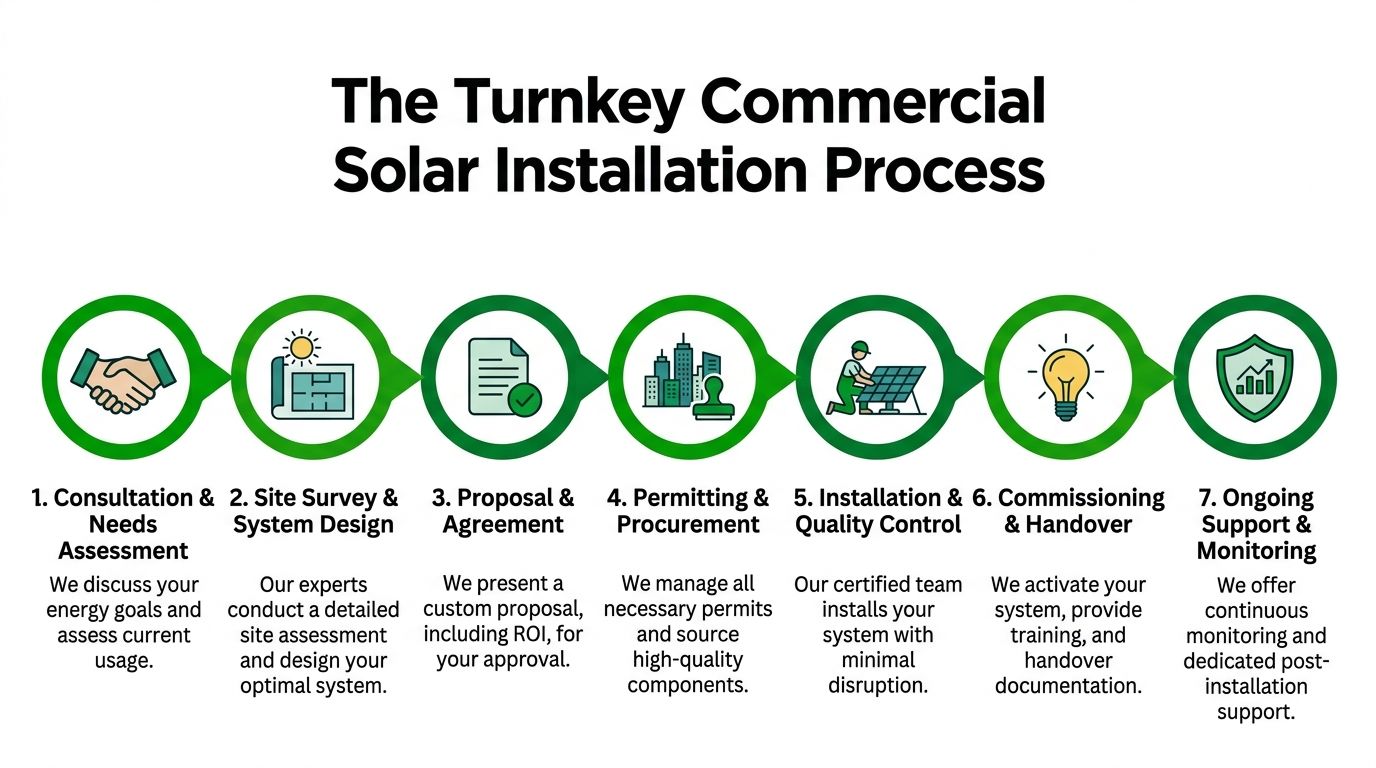
Consultation and site audit
The first step is not product selection. It is understanding how the site operates.
That includes reviewing interval data where available, walking the roof, checking switchboards, identifying plant and access constraints, and clarifying whether the business expects load growth. A warehouse with steady daytime use needs a different strategy from an office with weekend shutdowns or a retail site with late trading peaks.
Questions worth resolving early include:
- What does the site consume during daylight hours
- Is export important or is self-consumption the main goal
- Will the business add batteries, EV chargers, or major equipment later
Design and proposal
Once the audit is complete, the design phase turns site conditions into a workable system layout. During this phase, roof zones are mapped, inverter strategy is selected, and electrical integration is planned.
A strong proposal should be specific, not glossy. It should describe the array layout, major equipment, approvals pathway, assumptions behind projected performance, and the operational logic behind the sizing.
Approvals and procurement
This stage is where a lot of hidden work happens. Grid connection applications, technical documentation, scheduling, and procurement all need to be lined up before installation begins.
For the client, this should feel orderly. The business should know what approvals are pending, what documents are required, and when installation activities will affect the site.
A practical project manager coordinates:
| Stage | What needs to happen |
|---|---|
| Network approval | System application and technical review |
| Safety planning | Access method, WHS requirements, roof controls |
| Procurement | Panels, inverters, mounting, switchgear, protection gear |
| Scheduling | Installation dates aligned with business operations |
Installation and quality control
On installation days, the main goal is progress without unnecessary disruption. Roof works, inverter placement, cable routing, and switchboard integration should be sequenced so the business can keep functioning where possible.
Commercial installation is not just labour. It is coordination. Teams need to work around deliveries, staff parking, customer entry points, tenancy boundaries, and restricted areas. Good installers plan this before they arrive.
The cleanest commercial installs are the ones that look uneventful from the client’s side. That usually means the planning was done properly.
Commissioning and handover
Commissioning is where the system is tested, energised, and verified. Handover should include documentation, shutdown procedures, monitoring access, and a clear explanation of what normal performance looks like.
The job is not complete when the panels are fixed down. It is complete when the client knows how the system operates, who to call if something changes, and how ongoing support will work.
That turnkey structure matters because solar is now tied to broader energy planning. Once the base system is commissioned cleanly, the site is in a far better position to add storage, EV charging, or other electrical upgrades without redoing avoidable work.
Future-Proofing With Batteries and EV Chargers
Many Sydney businesses no longer see solar as a standalone product. They see it as the first layer of a broader site energy system. That shift is important because the value of solar improves when generation, storage, and charging are planned together.
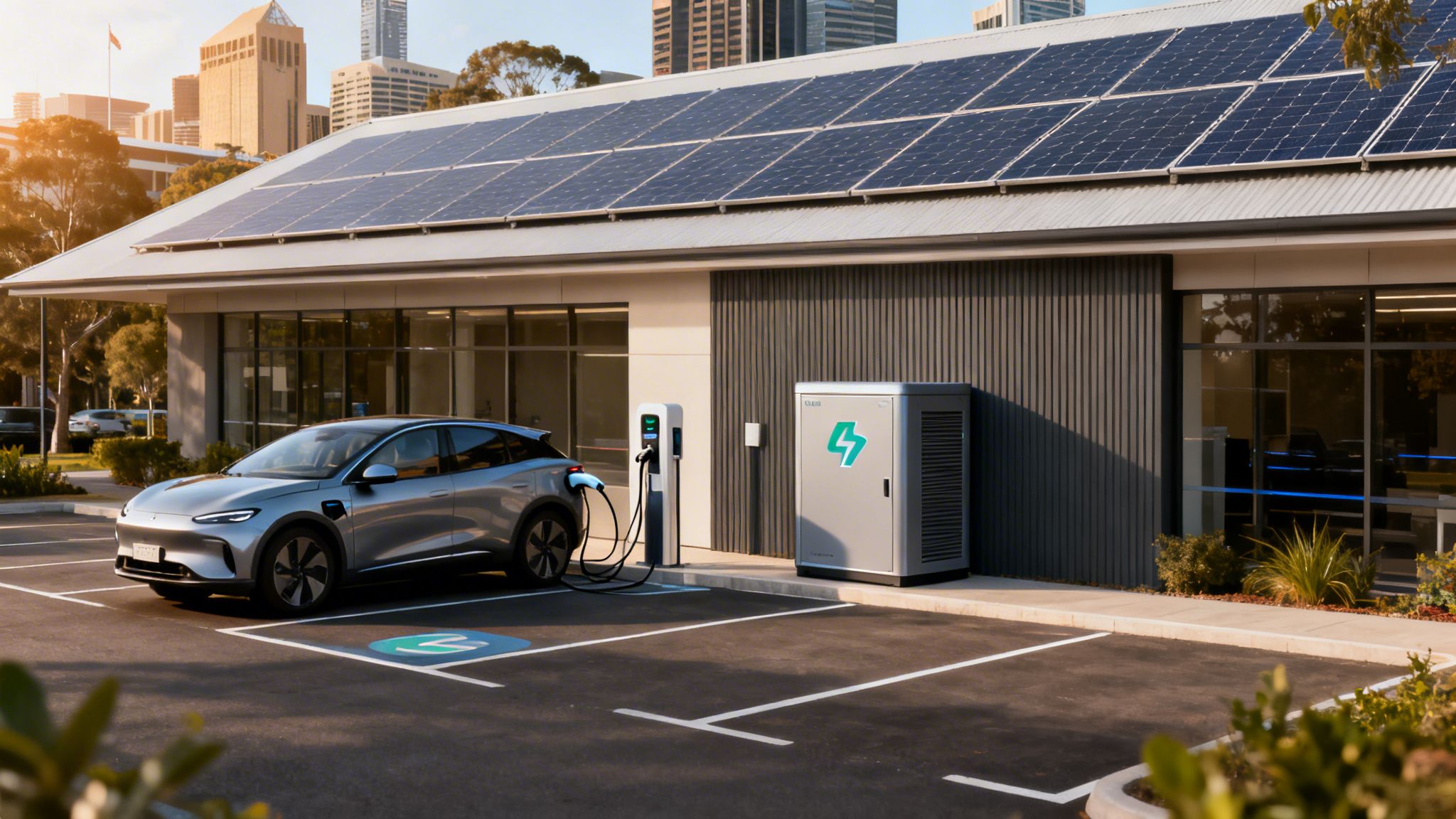
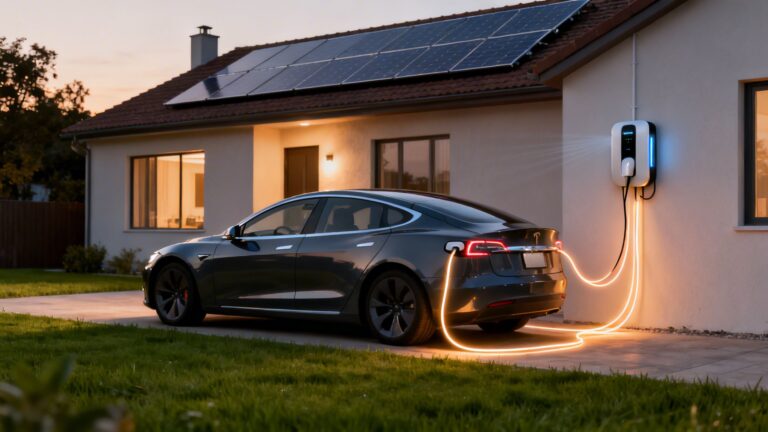
In NSW commercial fleets, EV adoption surged 45% year-over-year, and a correctly sized solar array can offset up to 80% of EV charging costs while helping businesses avoid high peak demand charges, according to this commercial solar and EV charging overview from Inspire Energy.
Why batteries change the commercial equation
A battery does not replace solar. It changes when solar value can be used.
For many businesses, that means holding surplus daytime energy for later use, reducing exposure to demand peaks, and creating more control over when electricity is drawn from the grid. Batteries can also support critical loads in some system configurations, which matters for sites where outages or instability create operational headaches.
Battery integration tends to make sense when the site has one or more of these characteristics:
- Strong daytime solar production with evening usage
- Demand charges that punish short spikes
- Critical equipment that benefits from stored energy support
- Plans to electrify vehicles or add new electrical loads
Why EV charging should be planned from day one
A lot of businesses wait until fleet electrification is imminent before thinking about chargers. That costs more and creates avoidable redesign.
If EV chargers are even a medium-term possibility, they should be considered during the original solar design. Charger location, cable pathways, switchboard capacity, load management, and battery compatibility all affect cost and flexibility later.
This is especially relevant for:
| Business type | Why integrated planning helps |
|---|---|
| Fleet operators | Charging can be aligned with solar generation windows |
| Offices | Staff charging may increase daytime site demand |
| Retail and hospitality | Customer charging can become an amenity and a load challenge |
| Industrial sites | Vehicle and equipment electrification may reshape the site’s load profile |
The ecosystem approach works better than bolt-ons
What works is an integrated plan. Solar supports daytime loads. Batteries improve self-consumption and demand management. EV chargers become part of controlled site energy use rather than an unmanaged add-on.
What does not work is treating each item as a separate purchase handled at different times with no common design logic. That often leads to constrained switchboards, awkward charger placement, avoidable civil work, and lower financial performance.
If your business is already thinking about vehicle charging, destination charging, or fleet readiness, this page on commercial and workplace EV chargers is worth reviewing before finalising solar design.
The cheapest time to prepare for batteries and EV charging is usually during the original solar design, even if those components are installed later.
Real-World ROI and Mitigating Project Risks
ROI in commercial solar is not just about generation. It is about how much of that generation the site can use effectively, how well the system is engineered, and whether hidden risks were dealt with before installation started.
A warehouse with broad daytime loads will present a cleaner business case than a site that closes through the day and relies heavily on export. A retail site with refrigeration or HVAC running through business hours can also stack up well. The shape of usage matters as much as system size.
What supports strong ROI
Projects tend to perform better when the business gets four basics right:
- Load matching: the site uses a meaningful share of solar power as it is generated
- Design discipline: orientation, shading, inverter strategy, and monitoring are handled properly
- Operational planning: future storage or charging needs are allowed for early
- Maintenance visibility: cleaning and inspections are not ignored after handover
On that last point, many owners overlook how much simple upkeep affects long-term output. If dust, grime, bird activity, or roof debris builds up, generation can slip. This practical guide on how to improve solar panel efficiency is useful for understanding the maintenance side of performance.
The risk many proposals gloss over
There is one issue serious commercial buyers should raise early. Structural integrity.
According to this overview of Sydney commercial solar risks from Sharpe IT, panel detachment from inadequate retrofits accounted for 22% of NSW commercial claims in 2025, and updated wind load compliance under AS/NZS 1170.2:2021 is critical to avoid liability and insurance problems.
That is not a minor technical footnote. It affects roof safety, insurer response, and the durability of the asset.
What reduces the downside
The practical answer is straightforward:
- Commission independent structural review where needed
- Confirm mounting design against current wind load requirements
- Avoid rushed retrofits on older or marginal roof structures
- Document compliance and keep handover records organised
A proposal that seems cheaper because it skips engineering checks can become expensive quickly. In commercial solar installation sydney, the better investment is often the one that removes future claims risk, not the one that cuts the install scope.
FAQs and Your Next Steps with Interactive Solar
Most businesses ask the same few questions before moving ahead. The answers are less complicated than people expect.
How much roof space do we need
There is no one-size answer. Usable roof space depends on setbacks, walkways, plant equipment, shading, access rules, and structural suitability. The right question is not how big the roof is. It is how much compliant, productive roof area is available.
Does solar still work on cloudy days
Yes. Output drops when conditions are poor, but the system still generates electricity. Commercial design should account for real operating conditions across the year rather than assuming perfect sunshine every day.
How much maintenance does a commercial system need
Less than many owners expect, but not zero. Commercial systems benefit from routine inspection, output monitoring, and cleaning when environmental conditions justify it. Roof access and maintenance clearances matter because serviceability affects long-term performance.
Should we install batteries and EV chargers now or later
That depends on your current load profile, capital plan, and fleet timeline. In many cases, the smartest move is to design for batteries and EV charging now, then stage those additions later. That protects the site from expensive redesign and keeps options open.
What should happen next
If you are seriously considering commercial solar installation sydney, the next step is a proper site assessment. Not a generic quote. Not a rough estimate based on roof size alone.
A useful commercial review should answer:
| Question | Why it matters |
|---|---|
| Is the roof suitable and compliant | It affects safety, approvals, and system longevity |
| What size system matches current daytime demand | It shapes self-consumption and project value |
| Are batteries or EV chargers likely later | It changes how the system should be designed today |
| What approvals and constraints apply | It affects timing, export capability, and design scope |
For Sydney businesses, the strongest outcomes come from teams that understand the full energy picture, not just panel installation. That includes system design, electrical integration, approvals, commissioning, and after-care. It also helps when the installer has in-house licensed teams and direct operational control rather than handing key parts to disconnected subcontractors.
Interactive Solar is a family-owned Australian provider with over 20 years of combined experience, in-house installation teams, and licensed electricians. That makes the process more straightforward for businesses that want one accountable partner across solar, battery storage, and EV charging.
If your business is ready to reduce grid dependence and plan its energy infrastructure properly, speak with Interactive Solar for a no-obligation consultation. A detailed site review will show what your roof can support, how the system should be sized, and whether battery storage or EV charging should be built into the roadmap from the start.