
Business Solar Installation Sydney: Boost Profit 2026
The businesses asking about business solar installation sydney usually arrive at the same point first. The power bill is climbing, the lease or property costs are not getting easier, and someone in the business has realised the roof is sitting there doing nothing.
That moment matters. Commercial solar is not just a hardware purchase. In Sydney, it is a project that touches your energy profile, your roof structure, your grid connection, your future plant and equipment, and often your ability to add batteries or EV chargers later without redoing work.
The good projects start with realism. Not every roof is straightforward. Not every tariff rewards export. Not every business should chase the biggest array that fits. The strongest outcomes come from getting the design, approvals, installation method, and long-term energy plan aligned from the start.
Why Commercial Solar is a Strategic Move for Sydney Businesses
A Sydney business does not need another expense. It needs more control.
That is why commercial solar has shifted from a “nice to have” sustainability measure to a practical operating decision. It gives businesses a way to produce a portion of their own daytime energy on site, reduce exposure to retail electricity pricing, and make the premises more useful over the long term.
New South Wales leads Australia in cumulative rooftop solar capacity with 7.5GW installed as of the end of H1 2025, which shows just how established the market has become for business users as well as households (PV Tech reporting CEC data). In plain terms, Sydney businesses are not looking at an untested technology. They are entering a mature market where installers, suppliers, finance providers, and network operators already work with commercial solar every day.
Solar changes the conversation from cost to control
Most business owners first focus on bill reduction. That makes sense, but it is only part of the value.
A commercial system can also help a site become less dependent on the grid during business hours. That matters for warehouses, offices, retail, hospitality venues, and mixed-use properties where daytime energy use is consistent and predictable.
It also changes internal planning. Once a business can forecast a meaningful share of daytime electricity from its own roof, decisions around refrigeration, HVAC scheduling, plant operation, and future charging infrastructure become easier to model.
A good commercial solar project should improve the way a site operates, not just reduce one line item on the P&L.
The strategic benefits most owners notice after installation
Some benefits show up immediately on the electricity account. Others become obvious later.
- Better energy visibility. The business starts paying attention to daytime load, peaks, and avoidable waste.
- Stronger sustainability proof. Customers, tenants, staff, and procurement teams increasingly look for visible action, not vague statements.
- A more capable building. A site with solar is better positioned for battery storage, electric fleet charging, and broader electrification.
- Less reactionary decision-making. Businesses with on-site generation are not as exposed when tariffs change or usage patterns shift.
For many owners, the upgrade that matters is not the panel on the roof. It is the fact that the building becomes an active energy asset.
Sydney rewards practical planning
Sydney has solid commercial solar potential, but the projects that perform best are matched to site conditions and business behaviour. A café with strong daytime refrigeration demand needs a different design approach from a warehouse with forklifts, office loads, and future EV charging plans.
That is why the right starting point is not “How many panels fit?” It is “How does this site use power, and what should this building be capable of in two to five years?”
If rising energy costs are already forcing decisions around margins or capital expenditure, this overview of rising costs of energy and your options is a useful place to frame the bigger decision.
Sizing Your System and Projecting Your Return on Investment
The most common sizing mistake is simple. People start with the roof.
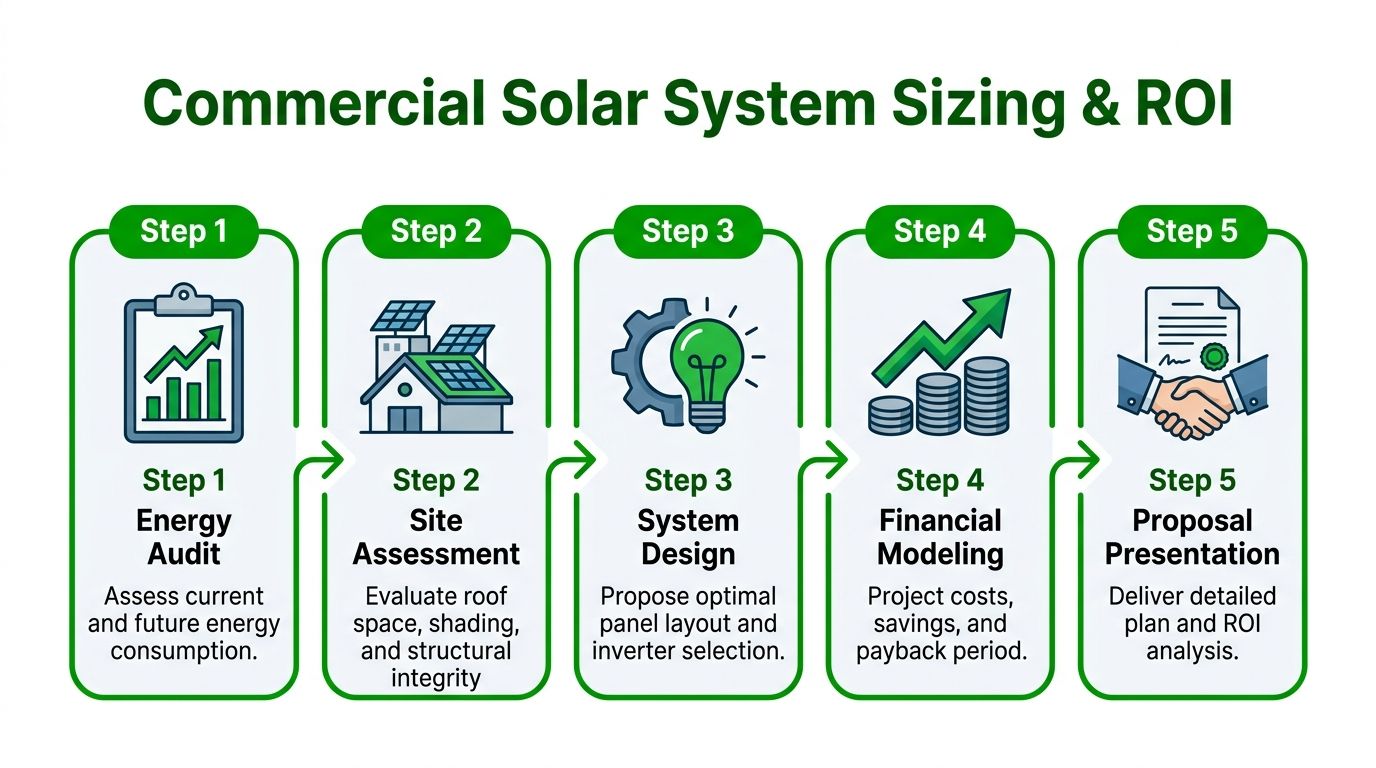
Roof area matters, but it is not the first number that should drive the design. The first job is to understand how the business uses electricity across the day, across the week, and across the year.
A commercial solar system should be sized like a water tank matched to actual usage. If the tank is too small, you still buy water constantly. If it is too large for your site conditions and discharge rules, part of that capacity becomes less useful than it looks on paper.
What a proper sizing exercise looks at
A serious proposal starts with energy data, not panel brochures.
At minimum, an installer should review a full year of electricity bills and interval data if it is available. That reveals how much electricity the site consumes, when it consumes it, and whether the daytime load is strong enough to absorb solar generation on site.
The core questions are usually these:
How much energy does the site use overall
Total usage matters, but it does not tell the whole story.When does the site use it
Daytime-heavy sites often suit solar better than sites that peak after sunset.Are there demand spikes
Some businesses have short, intense peaks from compressors, cool rooms, machinery, or HVAC.Will the site change soon
A new tenancy mix, production line, cold storage upgrade, or EV fleet can make today’s usage profile outdated.What can the roof realistically support
Roof geometry, access, shading, structural constraints, and switchboard location all affect final design.
Bigger is not always better
Undersizing leaves savings on the table. Oversizing can create a different problem if the business cannot use the generation effectively on site or if grid export becomes constrained.
That tension is why commercial solar should be modelled around self-consumption first and export second. The strongest projects usually line up solar production with the site’s core daytime demand, then assess whether additional capacity still makes sense under local network conditions and tariff settings.
A business with stable daytime operations may justify a larger system than a site that sits lightly loaded for most of the day. Two buildings with the same roof area can need completely different system sizes.
Understanding return without getting lost in jargon
Owners usually want one thing answered first. “When does this start paying for itself?”
That is a valid question, but the answer should include more than a rough payback estimate. A proper commercial proposal should also consider how the system behaves under your operating pattern and whether the funding method supports cashflow rather than straining it.
Only 25% of NSW commercial installs under 100kW achieve cashflow positivity within 12 months, often due to undersizing, according to the referenced NSW commercial solar analysis at Probec. That point matters because many underperforming systems are not “bad” systems. They are designed too cautiously, or modelled without enough attention to usage timing and finance structure.
Three financial concepts worth understanding
Payback period
This is the straightforward one. It measures how long savings take to recover the project cost.
Useful, yes. Complete, no. It does not capture the timing of savings, financing structure, or what happens if your site grows.
IRR
Internal Rate of Return gives a broader view of how the investment performs over time. It is useful when comparing solar against other capital uses, especially if you are weighing it against plant upgrades or operational expansion.
Not every owner needs to get deep into finance terminology, but the installer should be able to explain it clearly if it appears in the proposal.
Cashflow-positive design
Many businesses should focus on this. The goal is to structure the system and its financing so that the regular repayment is lower than the energy savings it creates. Done properly, the project supports cashflow rather than tying it up.
The right question is not only “What is the payback?” It is also “Will this improve monthly cashflow from the start?”
Where incentives fit
For eligible systems, STCs under the Small-scale Renewable Energy Scheme reduce the effective upfront cost. In practice, that can materially improve project viability for some commercial sizes. What matters is that the incentive is folded into a realistic model rather than used to make an average design look exceptional.
A useful next step is to run your own baseline using this solar savings calculator, then compare that starting point with a proposal based on your bills, your roof, and your operating hours.
Questions to ask before approving a design
| Question | Why it matters |
|---|---|
| How much of the solar output will I use on site? | Self-consumption usually drives value. |
| What assumptions are being made about export? | Export rules can limit the benefit of oversizing. |
| Has future load growth been considered? | Batteries, EV chargers, or new equipment can change the right system size. |
| Is the proposal based on my interval data or just annual usage? | Better data usually means a better-fit system. |
| What happens if my tenancy or operating hours change? | The design should still make sense if the business evolves. |
A good installer will enjoy those questions. A weak one will try to skip past them.
Navigating NSW Permits and Ausgrid Grid Connection
A lot of Sydney solar delays happen before anyone lifts a panel onto the roof.
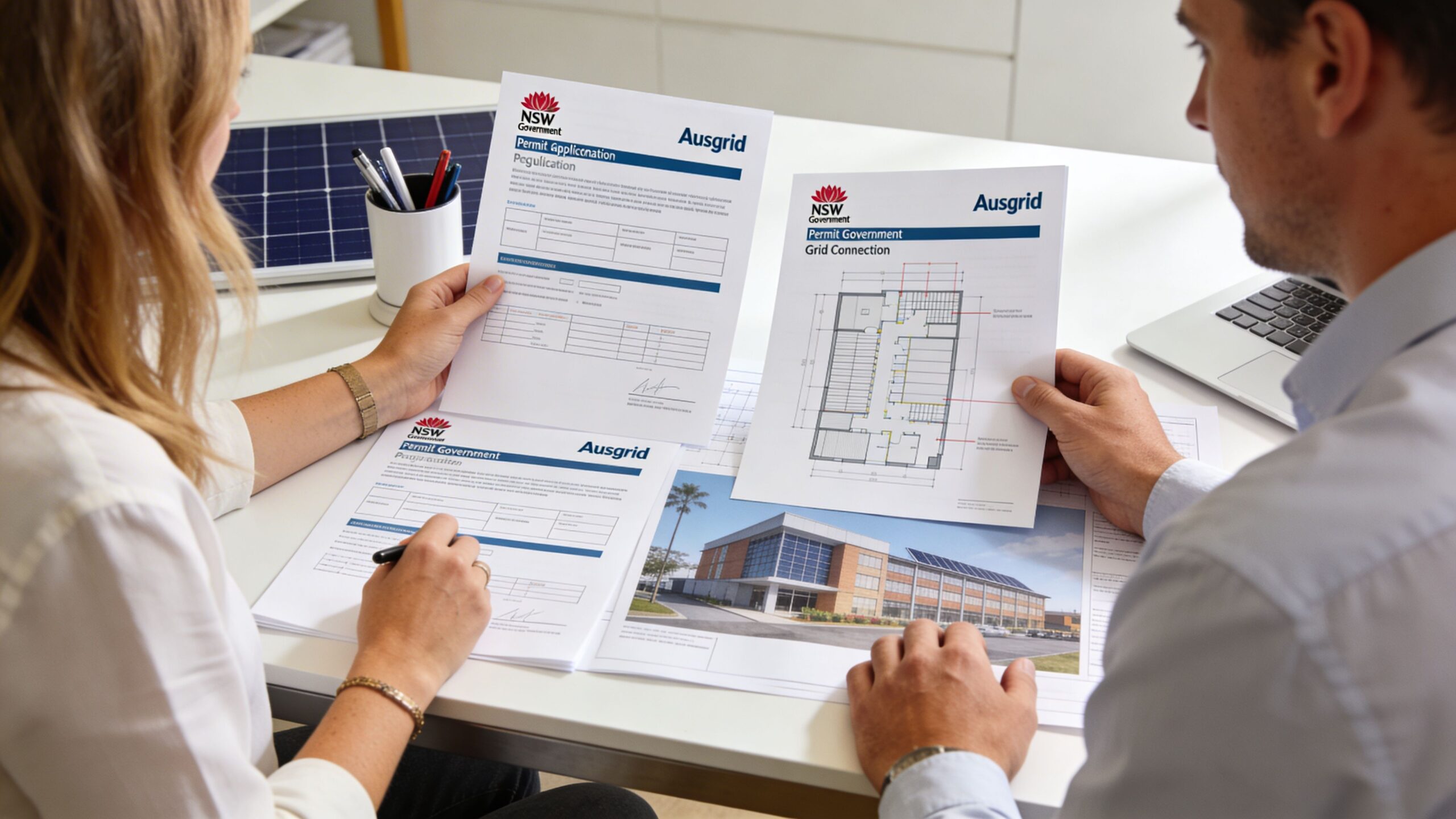
On commercial sites, the paperwork and technical approvals are not admin afterthoughts. They determine whether the design can proceed as drawn, whether export will be allowed, and whether switchboard or protection changes need to be built into the scope.
Why the DNSP matters
For most Sydney businesses, the key network stakeholder is the DNSP, usually Ausgrid depending on the site. The DNSP is not the retailer that sends your electricity bill. It is the network operator responsible for the local infrastructure that your building connects to.
That distinction matters because the network has to assess whether your proposed solar system can export safely without creating local power quality or capacity problems.
For commercial solar installations in Sydney exceeding 30kW, formal approval from the local DNSP is required, and export limiting is often mandated because reverse power flow can exceed local substation ratings (RK Solar project detail).
What export limiting means
Business owners often hear “export limit” and assume the system has been compromised. Not necessarily.
Export limiting means the system is configured so that it does not send more than an approved amount back into the grid at any given time. The goal is to protect local network equipment and voltage stability.
If the network can only accept limited export from your site, the design has to shift focus toward:
- Higher self-consumption during operating hours
- Smarter sizing rather than maximising panel count
- Battery readiness if storing excess energy later may improve value
- Load shifting, where practical, so more solar gets used on site
This is one of the biggest trade-offs in business solar installation sydney. A roof may physically hold a large system, but the network may not allow unrestricted export from that location.
Written DNSP approval should be treated as a project milestone, not a formality.
Permits, design sign-off, and building compliance
Grid approval is only part of the compliance pathway. Depending on the building, project teams may also need to address structural certification, fire access, heritage concerns, strata or landlord consent, and council-related requirements.
On many Sydney commercial properties, especially mixed-use or altered older buildings, the quality of the documentation is what keeps a project moving. Electrical single-line diagrams, roof layout drawings, mounting details, and structural notes all need to line up.
For practitioners and owners who want a clearer picture of the design compliance side, this guide to design certifications as per DBP Act 2020 is useful background reading. It helps explain why certification and design accountability matter before installation starts.
What usually causes delays
Not every delay comes from the network. In practice, these issues often slow projects down:
- Incomplete site information. Missing switchboard details or outdated plans force redesigns.
- Unclear ownership. Tenanted buildings can stall when landlord and tenant responsibilities are not settled early.
- Late structural review. If roof concerns appear after approvals are lodged, the programme can unwind quickly.
- Assumed export capacity. A proposal based on optimistic export assumptions can need revision after DNSP review.
A simple approval checklist for owners
Before approving a commercial solar contract, ask for confirmation of these items:
DNSP pathway identified
The installer should know who the network operator is and what application process applies.Export assumptions documented
If the financial model depends on export, that assumption should be stated clearly.Roof and switchboard information captured
Drawings and photos should support the proposed design.Compliance responsibility assigned
Someone should clearly own engineering, certification, and approval submissions.
The businesses that avoid stress are usually the ones that treat approvals as part of design, not as paperwork to tidy up later.
The Commercial Solar Installation Process Step by Step
Once design, approvals, and procurement are locked in, the project shifts from planning to delivery. This is the stage where a good commercial installer protects your business from disruption while still keeping quality high.
Step one is the site audit, not the install
Commercial jobs are won or lost before the first panel reaches the roof.
A proper pre-start audit usually covers roof condition, mounting zones, switchboards, cable pathways, access equipment, shutdown requirements, and structural review. On Sydney sites with older warehouses, mixed roof additions, plant platforms, or membrane roofs, that audit often changes the layout, inverter locations, or staging plan.
That is normal.
The point is to solve those issues before crews arrive, not after racking is on the roof and the programme starts slipping.
Non-standard roofs need a different mindset
A lot of Sydney commercial buildings were not built with solar in mind. We regularly see box gutters cutting through array areas, asbestos-related constraints around older structures, services added over time, roof sheets with limited remaining life, and parapets that create wind-loading complications.
Those roofs can still take solar, but the design and build method need to suit the building. On some sites, that means a ballast system. On others, penetrative fixing into verified structural members is the better option. The right answer depends on wind region, roof warranty conditions, drainage, waterproofing details, and how much future maintenance access the building needs.
Trying to force a standard layout onto an irregular roof usually creates problems later. The better approach is to set the array around the building’s real constraints and protect the roof asset at the same time.
The physical build usually follows this sequence
Roof preparation and set-out
Crews establish access, confirm exclusion zones, inspect the final roof condition, and mark array positions. If roof repairs are still outstanding, installation should pause until they are completed. Building over a known defect only makes the eventual repair more expensive.
Mounting and racking
Workmanship starts to show at this stage. The racking has to line up with the structural design, sit correctly on the roof system, and leave clear paths around services, gutters, and maintenance areas. On large commercial roofs, small errors in set-out can multiply fast across the array.
Panel installation
Modules are installed once the mounting system is checked and signed off internally. Cable management should already be part of the plan at this point. Loose DC cabling, poor clipping, and messy routing are common signs of rushed work and create service issues later.
Inverters and electrical works
This stage covers inverter installation, DC and AC cabling, isolators, protection devices, communications, and tie-in to the existing electrical infrastructure. On operating sites, this is also where project management matters most. Shutdown windows need to be agreed in advance, especially where the switchboard feeds refrigeration, production equipment, or tenant loads.
Testing and commissioning
Before the system is energised, the installer should complete testing, verification, labelling, monitoring setup, and commissioning records. Any export control settings, meter changes, or network-related commissioning requirements also need to be closed out here so the system operates as approved.
The cleanest commercial installs are usually the ones that looked slower at the start. Time spent on surveys, sequencing, and coordination removes rework later.
Roof access and maintenance space are part of the build quality
A high-yield design is not always the best commercial design.
If every spare square metre is filled with panels, access for gutter cleaning, roof inspections, air-conditioning service, and fault finding can become awkward or unsafe. That matters on Sydney sites where plant contractors, landlords, and facilities teams all need roof access after the solar crew has left.
Owners should ask a simple question. Will the roof still function as a roof once the array is installed?
Project management is what protects your operations
The installation programme should fit the site, not the other way around.
For occupied commercial buildings, that usually means:
- Staging works by roof area so operations can continue below
- Booking shutdowns early with facilities, tenants, or production managers
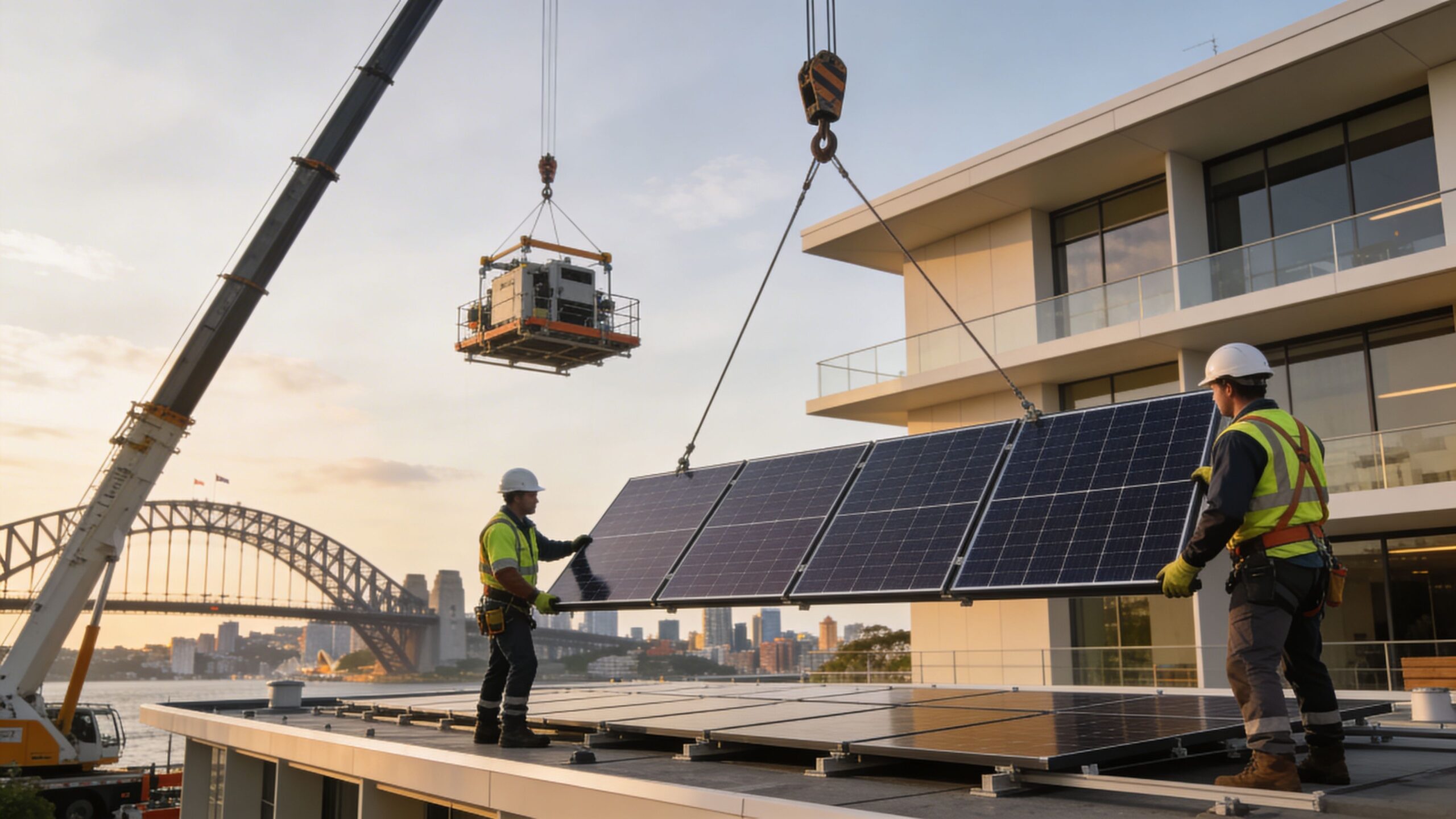
- Coordinating crane lifts and deliveries around busy site access periods
- Separating work zones from staff and visitors with clear site controls
- Assigning one project contact who can make decisions quickly
Quality control is part of this as well. For example, Interactive Solar’s installation quality approach for commercial projects shows the kind of QA process, supervision, and workmanship standards owners should ask about when comparing providers.
A short video can also help visualise how rooftop commercial work comes together on site.
Handover should leave no loose ends
Handover is part of the installation scope.
The owner, facilities manager, or site contact should receive as-built documentation, shutdown and isolation guidance, warranties, monitoring access, equipment schedules, and a clear service contact for faults or performance issues. On grid-connected commercial systems in Sydney, handover should also confirm that the installed configuration matches the approved design, including any export limits or control settings.
If those details are vague, the project is not finished properly.
Future-Proofing Your Investment with Batteries and EV Chargers
A commercial solar array on its own can do a lot. A well-planned energy system does more.
The biggest missed opportunity on many projects is treating solar as a one-off roof exercise instead of the foundation for a broader energy strategy. For many Sydney sites, the smarter move is to design the solar system so batteries and EV charging can be integrated cleanly when the timing suits the business.
Batteries make daytime generation more useful
Solar generation is strongest in the middle of the day. Many businesses also use a lot of energy then, which is ideal.
But some sites still generate surplus energy at times when on-site demand dips. A battery gives that excess energy another job. Instead of exporting all of it, the site can store part of it and use it later when demand remains high but the sun has dropped away.
That can help with:
- Evening shoulder and peak usage
- Operational resilience during outages
- Reducing dependence on imported grid power later in the day
- Making better use of a solar array on sites with export constraints
A battery is not right for every business from day one. It is right for more businesses when the original solar design leaves room for it, electrically and physically.
EV charging changes how the site uses power
Workplace charging is moving from novelty to planning item.
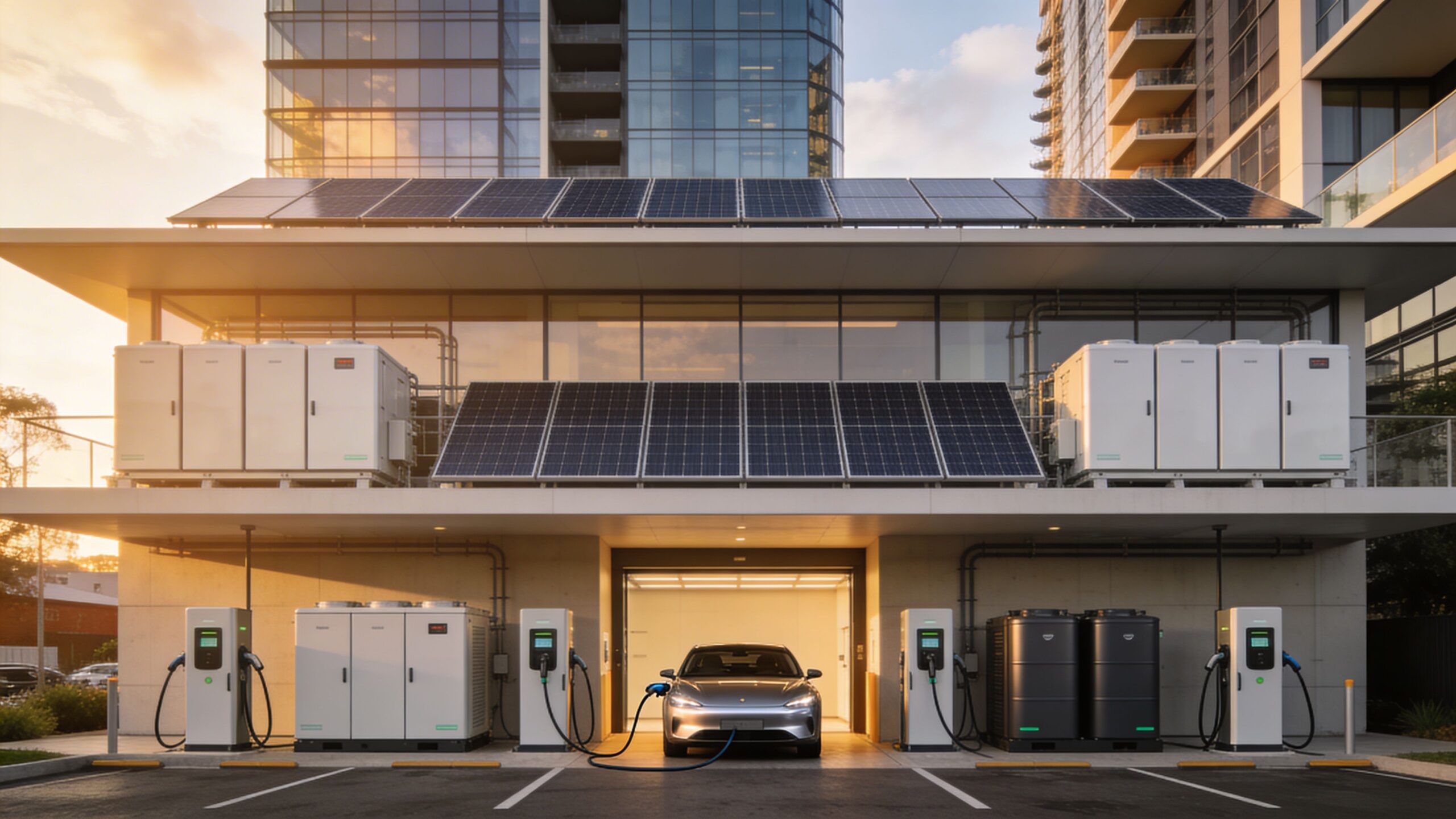
For some businesses, that means supporting staff vehicles. For others, it means preparing for delivery vans, serviceutes, pool cars, or customer charging. Once EV charging enters the picture, the value of daytime solar becomes even more obvious because the business can align charging with on-site generation rather than buying all that energy from the grid.
The key is to think through charger locations, cable routes, switchboard capacity, and charging management before resurfacing car parks or locking in a final electrical layout.
Future-proofing starts on the roof
Battery-ready and EV-ready does not only mean leaving switchboard space. It also starts with how the array is laid out.
Sydney Water’s technical specification requires 600mm maintenance access every four rows of panels and 500mm perimeter clearance to support performance and longevity (Sydney Water specification for solar PV). Those clearances are not just box-ticking. They make the roof workable for future inspection, service visits, cleaning, and later integration work.
If the original install uses every spare patch of roof with no thought for access, adding equipment later becomes harder than it needs to be.
A future-ready solar job leaves the building easier to work on, not more cramped.
A practical way to think about system expansion
Not every business should install solar, battery storage, and EV charging all at once. Many should at least design for that pathway.
A practical sequence often looks like this:
| Stage | What to decide early |
|---|---|
| Solar PV | Roof layout, inverter strategy, switchboard integration |
| Battery readiness | Space allocation, cable pathways, control philosophy |
| EV charging readiness | Charger locations, load management, parking layout |
| Full energy strategy | How solar, storage, and charging will interact operationally |
That approach avoids expensive rework. It also helps owners make phased decisions without trapping the site in a dead-end design.
If you are comparing storage pathways, this battery comparison guide is a practical starting point for understanding the options.
How to Choose the Right Commercial Solar Partner in Sydney
A Sydney business can receive three commercial solar proposals for the same site and end up with three very different projects. One allows for Ausgrid export limits, roof access, shutdown planning, and later battery integration. Another prices the roof as if it were a simple rectangle and leaves the hard parts for after the contract is signed.
That difference usually comes down to the installer, not the panel label.
A capable commercial solar partner checks the site properly, tests the design against the building you have, handles approvals in the right order, and stays responsible after commissioning. That is what keeps a project on programme and stops avoidable redesign, delay, and finger-pointing.
Start with Sydney experience that matches your building type
Local experience matters, but it needs to be specific. A contractor who mainly installs on clean metal roofs in new industrial estates may not be the right fit for an older warehouse with patch repairs, restricted access, and a landlord approval process. A retail site under Ausgrid can raise different issues again, especially where export, metering, and trading hours affect the installation plan.
Ask what kinds of Sydney commercial sites they work on every month. Ask which DNSP areas they regularly submit into. Ask how they deal with roofs that are not straightforward.
Those answers tell you more than a polished proposal PDF.
Ask who owns each part of the job
Commercial solar projects often go wrong at the handover points between sales, design, install crews, and service teams. Clear responsibility matters.
Ask directly:
- Who completes the site inspection
- Who prepares the final design
- Who manages grid application and approvals
- Who installs the system
- Who attends site if there is a fault after handover
Subcontracting is common in this market. It is not automatically a problem. The issue is whether the company selling the project still controls quality, documentation, and defect response when the site gets difficult.
If the chain of responsibility is blurry before you sign, it usually gets worse once works begin.
Test how they handle real constraints
Any provider can make a standard roof look easy. Sydney commercial projects get separated by how well the installer deals with awkward conditions early.
Look for practical judgement in four areas.
Roof complexity
Membrane roofs, asbestos history, congested plant areas, odd fall directions, and limited anchor points all affect design and cost. The right contractor should explain how they will protect the roof, maintain service access, and keep the layout workable for future maintenance.
Grid and export limits
A good partner should be comfortable discussing zero-export options, export-limited settings, inverter strategy, and whether the site load profile still supports the project if full export is not approved. In parts of Sydney, that conversation is not optional.
Site operations
Install planning has to fit your business. That can mean staging works around deliveries, quiet periods, tenants, school hours, food production rules, or shutdown windows. Good planning reduces disruption. Poor planning shifts cost back onto your operations team.
Expansion pathways
If you may add batteries or EV chargers later, the installer should allow for switchboard capacity, communications, equipment space, and control strategy now. A design that ignores those future loads can make the next stage slower and more expensive.
Good commercial solar partners explain the trade-offs early, then price and design the project around them.
Read the warranty and service model closely
Panel and inverter warranties matter, but they are only part of the risk picture. For a business owner, the practical question is simpler. If something stops working, who is responsible for fixing it and how quickly do they act?
A solid handover should include:
- Product warranty documents
- Written workmanship coverage
- Monitoring setup and login access
- A named support contact or service process
- Clear fault response steps
This is also a good point to check whether the business follows the standards set out in the New Energy Tech Consumer Code. A company that takes compliance and customer obligations seriously is usually easier to deal with if the project becomes more involved than expected.
Organisation shows up on site
Commercial solar is a coordination exercise as much as an electrical one. Site visits, inductions, deliveries, crane timing, crew allocation, and defect attendance all need structure.
For businesses with multiple sites, or for facilities teams that need predictable attendance, a review of effective mapping software is relevant because service coverage and scheduling discipline often separate reliable providers from disorganised ones.
That may sound secondary until you need a technician on site quickly and find out the installer has no clear field process.
Use a shortlist test before you sign
Before appointing anyone, ask each bidder the same five questions:
- What is the main technical or approval risk on my site?
- What export assumption have you used in your design and savings estimate?
- Who signs off the structural and electrical design?
- How will you stage the works to limit disruption to my business?
- If I add a battery or EV charging later, what have you allowed for now?
Strong contractors answer plainly. Weak ones drift back to generic sales language or avoid the risk question altogether.
The right partner for business solar installation sydney is usually the one that makes the difficult parts clear before the contract is signed. That is the installer most likely to deliver a system that performs, passes inspection cleanly, and remains workable as your site changes.
If you want a practical assessment of your site, Interactive Solar handles commercial solar, batteries, EV charging, and installation management from consultation through after-care. A useful first step is to review your recent bills, roof access, and future load plans with a project team that can tell you what will work, what will not, and what needs to be resolved before you commit.