Bidirectional EV Charger: Power Your Car and Home Securely
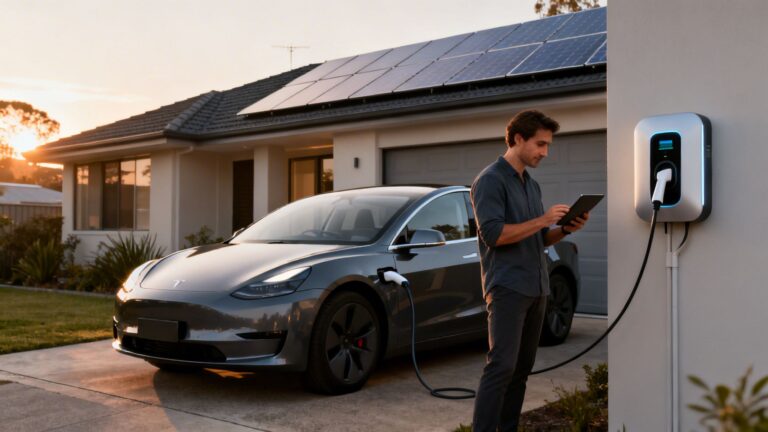
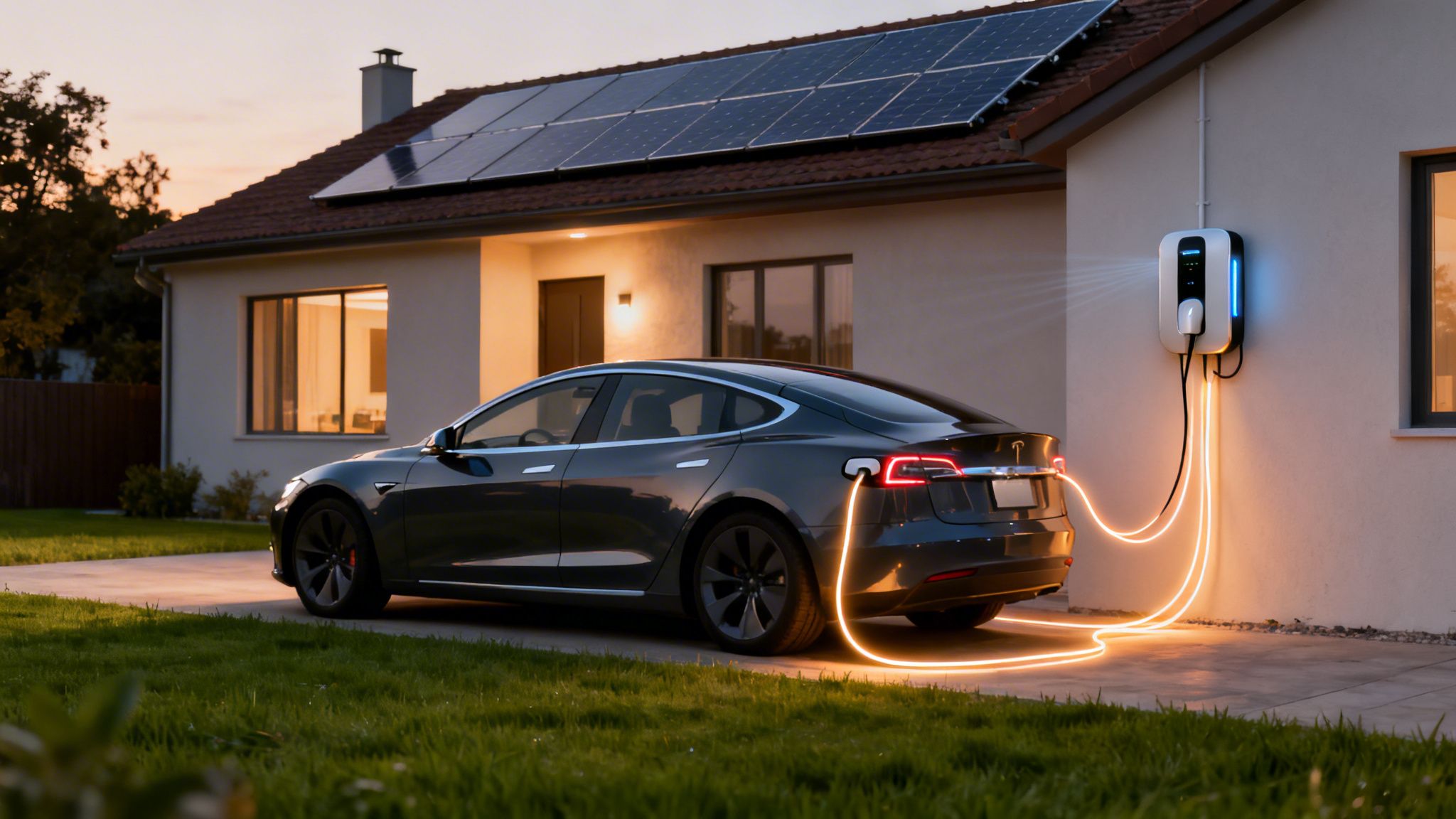
A bidirectional EV charger is a game-changer, turning your car from just a vehicle into a two-way energy hub. A standard charger works like a one-way street, sending power only to your car. This advanced technology flips the script, allowing energy to flow both into your car's battery and back out again.
Suddenly, you have the power to run your home, or even sell electricity back to the grid, all from your driveway.
Unlocking a Two-Way Energy Street
Think about your normal EV charger. It’s a simple, one-way system. Power flows from the grid or your solar panels, and its journey ends when your car's battery is full. It gets the job done, but that’s where the story ends.
A bidirectional EV charger completely transforms this into a dynamic, two-way superhighway. Your car can draw power to charge up, and when needed, it can send that stored power right back to where it’s needed most—your home or the wider grid.
This simple shift means your EV is no longer just a way to get from A to B. It becomes a valuable energy asset, a "battery on wheels" that integrates directly with your home.
This diagram shows just how elegantly the energy flows in a bidirectional setup.
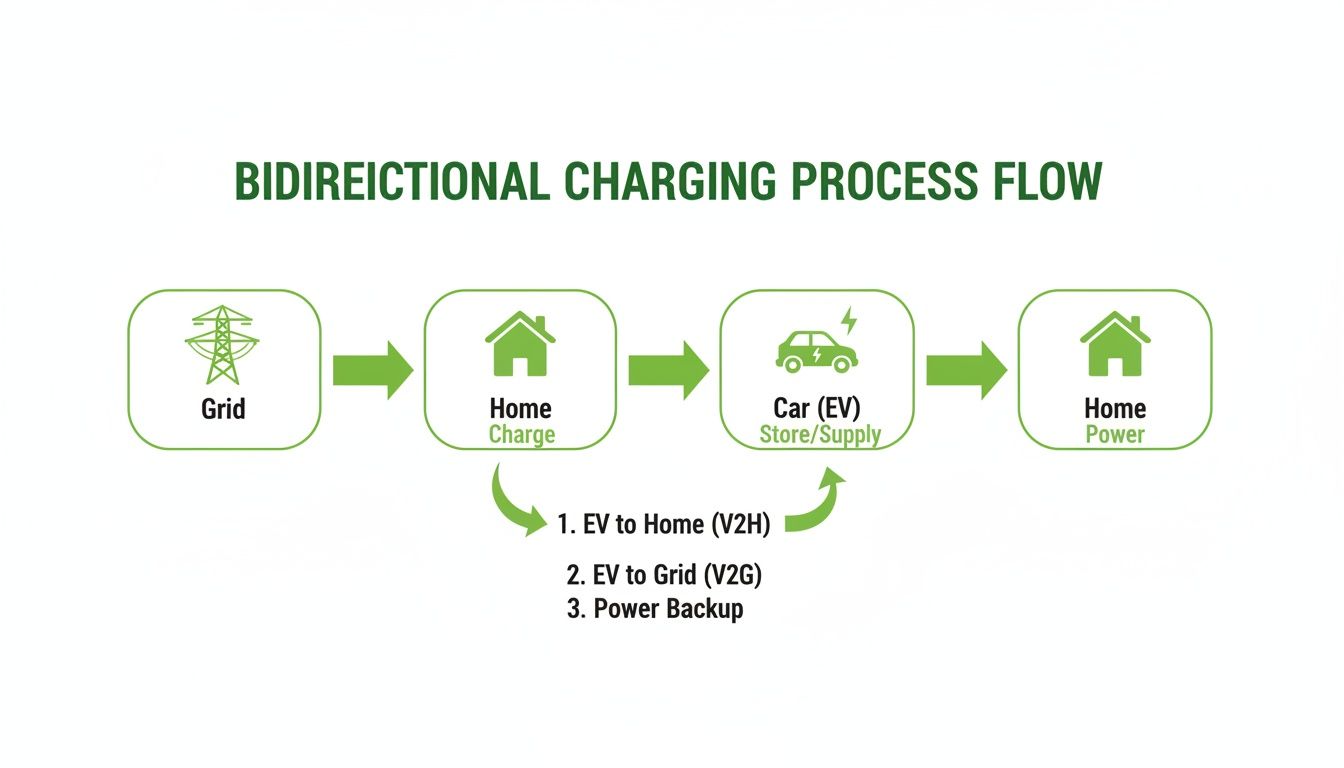
As you can see, your car becomes a central piece of your home energy strategy, creating a smart, circular flow instead of a dead end.
To help you see the difference clearly, here’s a quick breakdown of how a standard charger stacks up against a bidirectional one.
Unidirectional vs Bidirectional Charging at a Glance
This table breaks down the fundamental differences between standard and bidirectional EV charging to help you quickly understand the added value.
| Feature | Standard (Unidirectional) Charger | Bidirectional EV Charger |
|---|---|---|
| Energy Flow | One-way: Grid/Solar to EV | Two-way: Grid/Solar to EV, and EV to Home/Grid |
| Primary Use | Charging your electric vehicle | Charging your EV, home backup power, grid support |
| Grid Interaction | Consumes power only | Consumes and provides power |
| Home Integration | Powers the car only | Can power the entire home (V2H) |
| Financial Benefit | Enables charging on low off-peak tariffs | Enables V2H and V2G, allowing you to avoid peak tariffs and potentially earn credits |
| Emergency Power | None | Acts as a powerful backup generator during blackouts |
The key takeaway is that bidirectional charging unlocks the stored value in your EV's battery, giving you far more control and flexibility.
Key Concepts: Vehicle-to-Home and Vehicle-to-Grid
This technology really shines through two core functions: Vehicle-to-Home (V2H) and Vehicle-to-Grid (V2G). Understanding these is key to grasping the true potential sitting in your garage.
Vehicle-to-Home (V2H): This is where your EV steps in as a backup generator for your home. During a blackout, your car’s battery can keep your lights, fridge, and other essentials running, offering incredible peace of mind. But it’s not just for emergencies. V2H lets you use stored off-peak or solar electricity to power your home during expensive peak hours, directly slashing your energy bills.
Vehicle-to-Grid (V2G): This takes things a step further. With V2G, you have the potential to send excess energy from your EV back to the wider electricity grid. Energy retailers are developing programs that reward you for this service, creating a new income stream while also helping to stabilise the grid for the whole community.
By transforming your car into an active part of the energy network, you move from being a passive consumer to an active participant. You gain more control over your energy costs and contribute to a more resilient and flexible power grid.
Consider this: the average electric car battery holds around 60 kilowatt-hours (kWh) of electricity. For an average Australian home, that's often enough power for two to three days.
That massive storage capacity—which you already own—is just sitting there. With the right charging technology, your car stops being a parked vehicle and becomes a core part of your plan for energy independence and serious financial returns.
For years, the idea of using your electric car to power your home felt like something out of a sci-fi movie. Well, that future has officially landed in Australia. The conversation around the bidirectional EV charger has finally shifted from "what if" to "what's next," all thanks to a landmark certification.
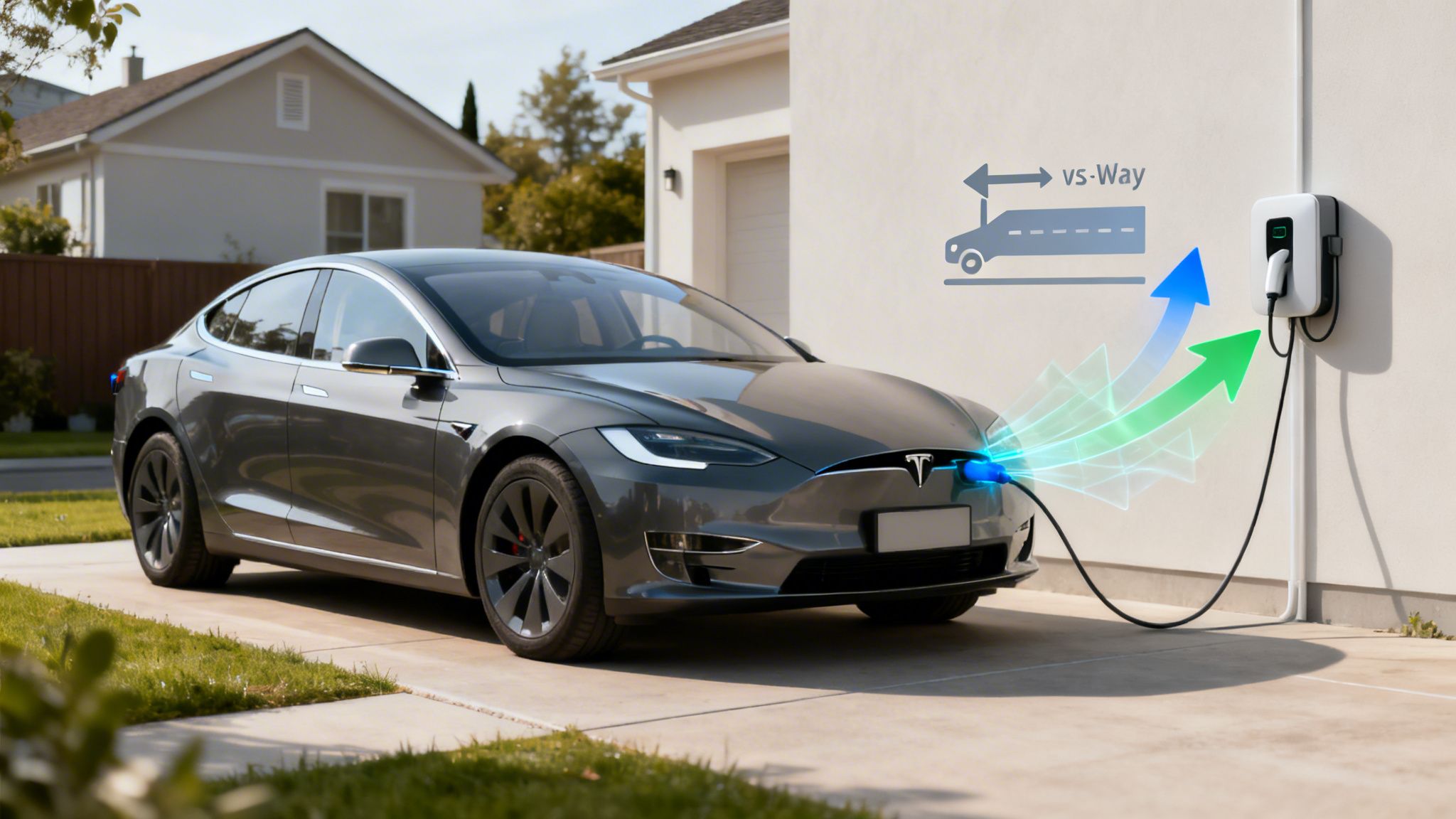
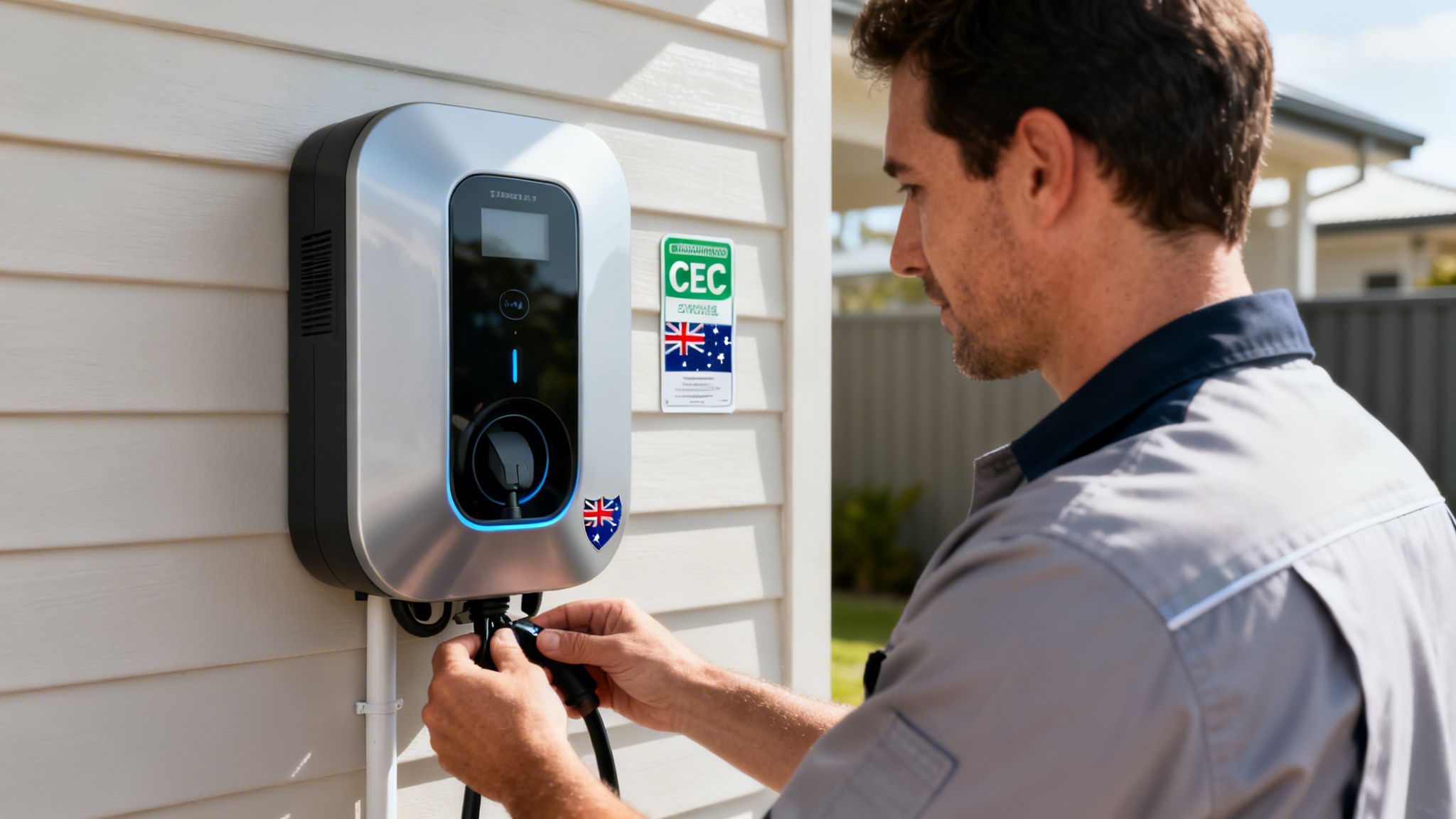
The breakthrough came in late 2025. V2Grid Australia successfully secured Clean Energy Council (CEC) certification for their Numbat bidirectional EV charger—the very first of its kind approved for Australian homes. This wall-mounted, 7 kW single-phase charger turns your EV into a mobile power station for your house.
For homeowners in Sydney and businesses across NSW, this is a game-changer. You can now use your EV's battery to store free solar power generated during the day and use it to run your property at night. We're talking about potentially offsetting 70-100% of your reliance on the grid. You can read the full story on this pioneering Aussie tech over at The Driven.
What CEC Certification Means for You
Getting that Clean Energy Council (CEC) certification isn't just about a sticker on a box. It's your guarantee of safety, quality, and reliability. For a complex piece of kit like a bidirectional charger, this approval is non-negotiable.
It confirms the product has been put through its paces, meeting Australia's tough electrical standards. This is crucial, as it ensures the charger can safely talk to your home's wiring and the wider grid without causing blackouts or, worse, safety risks.
Choosing a CEC-certified product means you're investing in tech that's not only powerful but also proven safe and compliant for your home. That peace of mind is invaluable when you're integrating advanced energy systems.
For you, the homeowner, this certification simplifies everything. The technology is officially market-ready, and it can be legally and safely installed by a qualified professional. It's the confidence you need to know your system will perform exactly as promised, seamlessly managing the two-way energy flow between your car, your home, and your solar panels.
Compatible Vehicles and Technical Details
With the regulatory path cleared, the next big question is: which cars actually work with this? Initially, compatibility in Australia centres on EVs that use the CHAdeMO charging standard.
Luckily, this includes a couple of the most popular and proven EVs on our roads:
- Nissan Leaf: A true pioneer in the EV world, the Leaf has had V2G capabilities overseas for ages and is now finally ready for action here.
- Mitsubishi Outlander PHEV: As one of Australia's favourite plug-in hybrids, the Outlander's battery can now be put to work powering your home, adding a whole new layer of utility.
While the first certified chargers are CHAdeMO-only, the industry is moving fast. We're expecting to see widespread support for the CCS2 standard for bidirectional charging soon, which will open the doors for a much longer list of new vehicles.
The V2Grid Numbat itself is a sleek, wall-mounted unit designed for a typical home. Its 7 kW output is a perfect match for a single-phase property, delivering enough juice to run most of your household appliances during peak times or a blackout.
Partnering with a Certified Installer
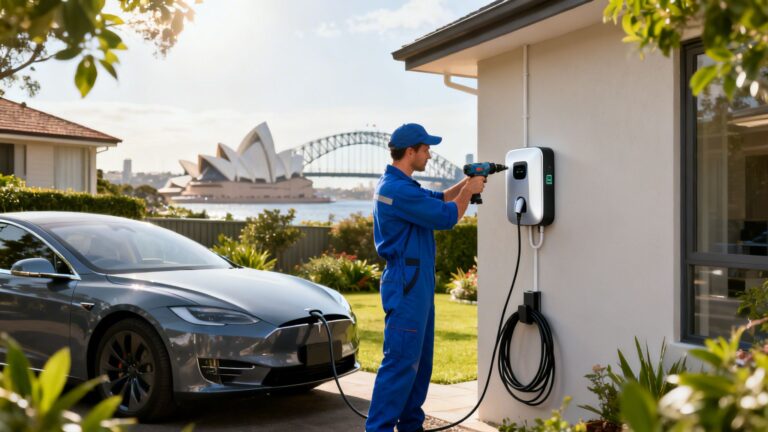
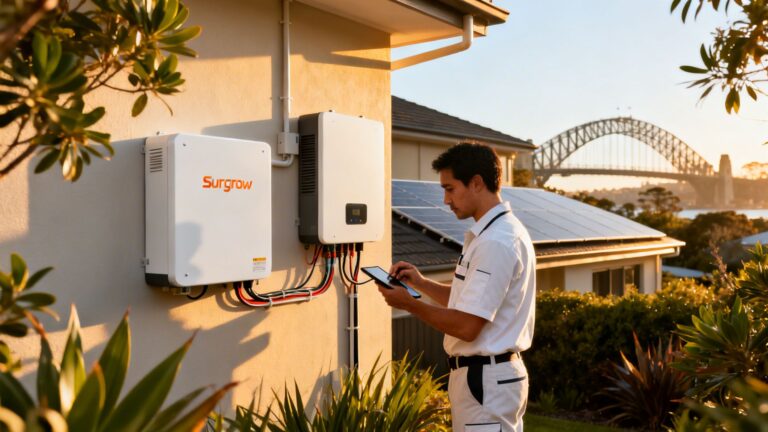
The final—and arguably most critical—piece of the puzzle is the installation. A sophisticated device like a bidirectional EV charger demands an expert touch. This isn't a simple plug-and-play appliance; it's a core component of your home's electrical system. It needs to be integrated flawlessly with your switchboard, your solar inverter, and the grid.
This is exactly where a trusted, certified installer like Interactive Solar becomes essential. Our in-house team of CEC-accredited electricians has the specific training and hands-on experience needed to install these advanced systems to the highest Australian standards. We make sure every connection is safe, every setting is optimised for your home, and your entire system works in perfect harmony.
Choosing an experienced installer is the only way to guarantee your investment is not only compliant but also fine-tuned to deliver maximum performance and savings. It’s the key to unlocking a true Vehicle-to-Home (V2H) solution and taking complete control of your energy future.
How to Maximise Your Solar Investment
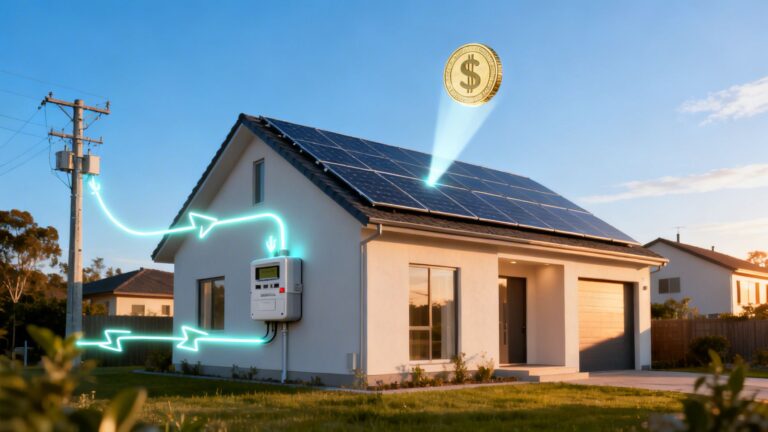
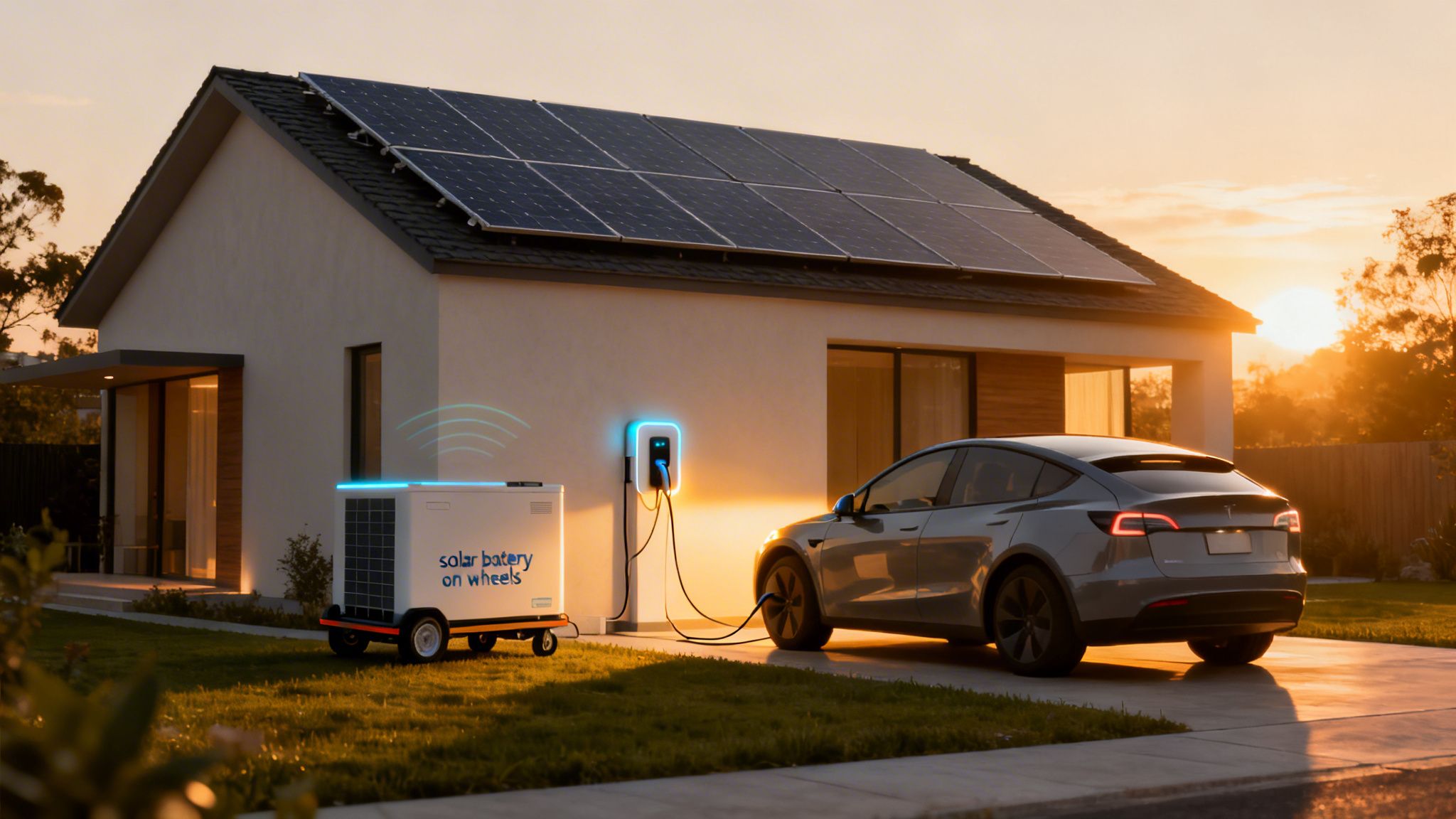
Pairing rooftop solar with an electric vehicle is a smart move, but adding a bidirectional EV charger to the mix is where the real magic happens. It turns your car from just a mode of transport into a powerful ‘solar battery on wheels,’ completely changing your home’s energy game. Think of the charger as the missing link, creating a two-way energy highway between your panels, your car, and your home.
This setup lets you squeeze every last drop of value from the solar energy you generate. Instead of exporting your excess power back to the grid for a pittance, you can store it directly in your EV’s massive battery for free. You’re essentially creating your own private energy reservoir.
A Day in the Life with Bidirectional Power
Let's walk through a typical day to see how this actually works.
During the day, while the sun is blazing, your solar panels are hard at work. They power your home, and any surplus energy flows straight into your parked EV, topping up its battery. We call this ‘solar sponging,’ and it makes sure not a single ray of sunlight goes to waste.
Then, as evening hits, the sun goes down and your solar panels stop producing. This is right when grid electricity prices usually spike. Instead of buying expensive power from your utility, your bidirectional EV charger kicks in. It reverses the flow, pulling that stored solar energy from your car to power your home.
You can run your lights, cook dinner, and watch TV—all using the free solar energy you captured just hours earlier.
Achieving True Energy Independence
This daily cycle of generating, storing, and discharging your own solar power is the key to a new level of energy independence. For many of our clients at Interactive Solar, this is the ultimate prize. You slash your reliance on the grid and protect your household from ever-rising electricity costs.
A bidirectional charger unlocks the full potential of your solar and EV, letting you control where your energy goes and when you use it. You shift from being a passive energy consumer to an active energy manager, giving you real power over your bills and your carbon footprint.
By running your own energy loop, you can dramatically lower, or in some cases, completely wipe out your electricity bills. It's a powerful way to future-proof your home against market volatility and build a more resilient, self-sufficient lifestyle.
Rethinking the Need for a Stationary Battery
One of the most compelling parts of this system is how it changes the conversation around home batteries. Your EV already has a massive battery, often holding 60 kWh or more—that’s easily enough to power an average home for two or three days. A bidirectional system lets you finally tap into this asset.
For many homeowners, this means a bidirectional EV charger can reduce or even get rid of the need for a separate, stationary home battery. This brings a few huge advantages:
- A Streamlined System: You have one piece of tech doing two jobs—charging your car and storing energy for your home. It just simplifies your whole setup.
- Efficient Use of Assets: You’re getting the most value out of something you already own (your car) instead of buying more hardware.
- A Smarter Financial Path: By using your EV's battery, you can reach your energy storage goals without the added investment of a separate solar battery.
This approach offers a more direct and efficient path to energy freedom. When you combine your solar panels with an intelligent bidirectional EV charger, you create a seamless ecosystem that puts you in complete control, turning your solar investment into a truly dynamic and powerful home energy solution.
Real-World Benefits for Your Home and Business
So, beyond all the technical jargon, what does a bidirectional EV charger actually do for you? It’s simple: it puts you back in the driver's seat when it comes to your energy. For both homes and businesses, this technology turns your electric vehicle from something that just gets you from A to B into a serious financial asset.
The biggest win is financial. By letting energy flow both ways, a bidirectional system completely changes your relationship with the electricity grid. You’re no longer just a passive customer—you become an active player, deciding when to buy power and when to use your own.
Slash Your Home Electricity Bills
For homeowners, the most immediate change you’ll see is a big drop in your power bills. When a team like Interactive Solar integrates a bidirectional system properly, you get the power to dodge those expensive peak electricity tariffs.
Here’s how it works. Your EV soaks up free solar energy during the day or charges on cheap off-peak rates overnight. Then, when the evening peak hits and grid prices shoot up, your bidirectional EV charger flips the script. It starts drawing power from your car’s battery to run your home, so you don’t have to buy a single kilowatt from the grid when it’s most expensive.
By intelligently managing the energy stored in your car, you can almost entirely avoid using the grid during peak hours. This one strategy can slash your power bills, turning your EV into a central part of your household’s savings plan.
This is more than just clipping a few dollars off your bill; it’s a total strategic shift. You’re using an asset you already own—your car—to fight back against soaring energy prices. It’s a powerful financial shield for your family.
Your Ultimate Backup Power Source
Power outages are a massive pain, disrupting everything from your work-from-home setup to your family's dinner plans. A bidirectional charger gives you incredible peace of mind by turning your EV into a huge, silent backup generator.
The average electric car battery stores around 60 kWh of energy. For most Australian homes, that’s easily enough to keep everything running for two to three days.
When the grid fails, your system can automatically switch over to your car’s battery. That means:
- Your lights stay on: No more hunting for candles in the dark.
- The fridge and freezer keep running: You won’t be throwing out hundreds of dollars worth of spoiled food.
- Essential devices stay powered up: You can keep your phones charged and the Wi-Fi on.
This gives you a level of energy security and resilience that’s powered by the car sitting right in your driveway.
A Powerful Asset for Your Business
For business owners in NSW, the financial case gets even stronger. A fleet of EVs with bidirectional chargers isn’t just for transport; it’s a dynamic energy asset that can seriously boost your bottom line.
The main strategy here is peak shaving. Instead of drawing expensive electricity from the grid during periods of high demand, you can use your fleet’s stored battery power to run your operations. This directly cuts your operating costs and can make a huge dent in your monthly energy bills.
Looking ahead, as the energy market matures, Vehicle-to-Grid (V2G) capabilities will unlock brand-new revenue streams. Businesses will be able to sell their excess energy back to the grid during peak events, earning credits or even direct payments from energy providers. At Interactive Solar, we design and engineer custom systems that position your business to capture these future opportunities, helping you hit your financial and sustainability targets.
Navigating Australian Installation and Regulatory Standards
Putting new technology like a bidirectional EV charger into your home means you need a partner who knows what they’re doing. The world of installation and regulations can feel like a maze, but with the right guide, it’s actually a pretty clear path. Getting your head around these standards is the key to making sure your system is safe, compliant, and works just like it should.
At its heart, a bidirectional system isn't just another appliance. It’s a sophisticated piece of kit that connects to your home’s switchboard and the wider grid. This is a lot more involved than plugging in a new TV. It has to follow strict Australian rules for safety and performance.
That’s why picking a highly qualified and certified installer isn’t just a good idea—it's absolutely essential for the safety of your home and the long-term health of your investment.
The Importance of AS/NZS 4777.2 Compliance
One of the most important rules in this space is AS/NZS 4777.2. Think of it as the rulebook for any device that sends power back to the grid, like a solar inverter or a bidirectional charger. It’s there to make sure everything is done safely, without causing issues for the network or putting utility workers at risk.
Just recently, in August 2024, Standards Australia updated this rule to specifically include bidirectional systems. This update gives everyone a clear blueprint for how these chargers need to behave, including how they react to signals from the grid and, crucially, how they shut down safely during a blackout.
An installer’s deep knowledge of AS/NZS 4777.2 is your guarantee that the system is compliant and safe. At Interactive Solar, our licensed electricians live and breathe these regulations, so you can be confident your installation meets every single requirement from day one.
This focus on compliance means your system will get the green light from network operators, your warranties will be solid, and most importantly, your family and property will be protected. It’s simply non-negotiable for any professional installation.
A National Vision for Bidirectional Charging
When you invest in a bidirectional EV charger, you’re not just going it alone. You’re tapping into a national strategy. The Australian government sees this technology as a vital part of our clean energy future, and they’ve laid it all out in the National Roadmap for Bidirectional EV Charging.
This roadmap, backed by the Australian Renewable Energy Agency (ARENA), sets a course for widespread adoption by 2030. The projections are huge, with up to 2.6 million residential V2G setups expected by 2040.
This kind of growth is just like what we saw with rooftop solar, which tells us that bidirectional chargers are on track to become a standard feature in Australian homes. By helping to stabilise the grid while cutting household energy bills, this tech is right at the centre of a more affordable and sustainable energy system for everyone.
Why Your Installer Must Be CEC-Accredited
With clear standards in place, the final piece of the puzzle is picking the right team for the job. In Australia, the gold standard for any renewable energy installer is Clean Energy Council (CEC) accreditation. This isn't just a fancy badge; it’s proof that your installer has the specific training and expertise needed for this kind of technology.
Choosing a CEC-accredited installer like Interactive Solar is your best form of protection. It guarantees that:
- The team is professionally trained and held to high national standards.
- The installation will be safe and fully compliant with all Australian regulations.
- You will be eligible for any government rebates or incentives that are available.
- Your product warranties will be fully honoured by the manufacturer.
At Interactive Solar, we never use subcontractors. Our own in-house, CEC-accredited electricians handle every single project from start to finish. This gives us complete control over quality and safety, ensuring you get a seamless and reliable installation. It's our commitment to being your expert energy advisor, every step of the way.
Choosing the Right Partner for Your Energy Future
Getting the right technology is only half the battle. When you decide to install a bidirectional EV charger, you’re not just adding another appliance—you’re placing a powerful energy hub at the very heart of your home or business.
The success of that investment comes down to one thing: the quality of the team you hire to design and install it. This isn't a standard electrical job. It's about seamlessly integrating your EV charger with solar panels and battery storage so they all work in perfect harmony. Choosing an experienced, trustworthy partner is the single most important decision you'll make.
At Interactive Solar, we live and breathe this stuff. This is what we do.
The Interactive Solar Difference
We’re a proud, family-owned Australian business, not some faceless national chain. With over 20 years of combined experience, our reputation is built on doing the job right the first time and giving honest, practical advice. We’re based in NSW, so we understand the local regulations and challenges because we live and work here too.
Here’s a key part of our promise: we never use subcontractors. Ever. The people who show up at your door are our own in-house team of Clean Energy Council (CEC) accredited electricians. This gives us total control over the quality and safety of your project, ensuring every last detail meets our tough standards and all Australian regulations.
Choosing Interactive Solar means you're choosing a single, accountable team dedicated to your project's success. From the first phone call to the final sign-off, you’re working with us directly.
Want to see the gear for yourself? Come and visit our physical showroom in Chipping Norton. You can get hands-on with the technology and have a real conversation with the experts who will be handling your project. That transparency is central to who we are. It’s your proof that you’re dealing with a genuine local business that’s invested in our community.
Your Complete Turnkey Service
We believe switching to smarter energy should be a smooth, stress-free process. That’s why we’ve built our service to handle everything from start to finish. We take care of all the details so you don't have to.
Your journey with us follows a clear and supportive path:
- No-Obligation Consultation: It all starts with a chat. We’ll take the time to understand your energy goals, look at your usage patterns, and answer every question you have.
- Custom System Design: This isn't a one-size-fits-all solution. We engineer a system specifically for your property, showing you exactly how a bidirectional EV charger and solar can work together to meet your needs.
- Certified Installation: Our in-house, CEC-accredited team gets to work, carrying out the installation with precision and care. We handle all compliance and safety checks.
- Dedicated After-Care: Our job isn’t done when the power is on. We provide ongoing support and fast troubleshooting to make sure your system keeps performing at its best for years to come.
Take the first step towards true energy independence with a partner you can actually trust. Let’s talk about how a custom-engineered energy system from Interactive Solar can secure your energy future.
Your Questions, Answered
As we’ve walked through the potential of bidirectional charging, you’ve probably got a few questions bubbling up. That’s a good thing. It means you’re thinking about how this technology fits into your world.
Here are some of the most common queries we get from homeowners, with straight-up answers to help clear the air.
Can My EV Do This? Which Cars Are Compatible?
Right now, not every electric car can send power back to your home. The ability to charge in two directions requires specific hardware and software built into the vehicle from the factory.
In Australia, the first cars to get the green light are those with a CHAdeMO charging port. Think of models like the Nissan Leaf and the Mitsubishi Outlander PHEV. But the industry is moving at lightning speed. We’re expecting more cars using the much more common CCS2 plug to get this capability very soon.
An expert at Interactive Solar can give you the latest rundown on which models are ready to go.
Will This Void My Car's Battery Warranty?
This is a big one, and you’re right to ask. Car manufacturers are still figuring out their official stances. Some have already confirmed that using their vehicles for Vehicle-to-Home (V2H) and Vehicle-to-Grid (V2G) is perfectly fine and won't affect the warranty. Others are still working on their policies.
The good news is that Australia's National Roadmap for bidirectional charging is pushing to get these policies standardised, which will give everyone a lot more clarity.
Before you jump in, it’s essential to check the warranty for your specific make and model. Our team at Interactive Solar keeps a close watch on these updates and can give you the most current advice during a consultation.
If I Have This, Do I Still Need a Home Battery?
For most people, the answer is a simple no. A bidirectional EV charger effectively turns your car into a massive battery on wheels. With a capacity of 60 kWh or more, your EV can store far more solar power than a typical home battery, giving you plenty of juice to run your home and providing reliable backup during a blackout.
There are, however, some edge cases. If your household uses an exceptionally large amount of energy, or if you need uninterrupted power even when the car is out for the day, a hybrid setup could be perfect. Combining a smaller stationary battery with your bidirectional charger gives you the best of both worlds.
Interactive Solar can look at your home’s unique energy habits to figure out the most practical and cost-effective system for your lifestyle.
Ready to turn your EV into a power source for your home? The team at Interactive Solar can design a custom solar and bidirectional charging solution engineered to slash your electricity bills and provide energy security. Start your journey toward energy independence today.